Getting the transcript
Reading the captions from YouTube. A video nobody has opened here before takes 10 to 30 seconds; this page fills in on its own.
Reading the captions from YouTube. A video nobody has opened here before takes 10 to 30 seconds; this page fills in on its own.
Education Reformers Academy · @EducationReformersAcadem-qs7wg
Words
17,330
Runtime
1:25:34
Speaking pace
203wpm
Reading time
72min
203 words per minute, above the 201 75th percentile of 349 measured videos. That distribution comes from the 349-video hook study.
Opening (first 30 seconds)
All right. Happy Thursday. It is Thursday, right? I think I think it is. Right. All right. I'm getting some nods. That's uh that's helpful. Thank you. Uh I've been traveling a little bit, which is why I haven't seen you guys in a while. And it's one of those where you like travel on a Sunday and you're like, "Was that Monday?" No, that was Sunday. So, you're actually behind a day. And then I traveled again this week. Anyway, you don't need to know any of this. Um hope you guys are well and um really looking forward to talking
102 words, the words spoken in the first 30 seconds at 203 words per minute.
Free, no signup. See how the first 30 seconds hold attention, with rewrites.
Sentence shape
| Measure | This transcript |
|---|---|
| Sentences | 1,087 |
| Average words per sentence | 15.9 |
| Longest sentence | 165 words |
| Questions asked | 154 |
What this transcript is
Every word below is the caption track YouTube publishes for this video, pulled from the video itself and reproduced unchanged. It is not Prepublish's writing, not a summary, and not a re-transcription: it is the video's own published captions. English captions, generated automatically by YouTube, in the video’s original language. Source: the video on YouTube. A channel that would rather this page did not exist can ask for its removal through the contact page, and it is removed.
All right. Happy Thursday. It is Thursday, right? I think I think it is. Right. All right. I'm getting some nods. That's uh that's helpful. Thank you. Uh I've been traveling a little bit, which is why I haven't seen you guys in a while. And it's one of those where you like travel on a Sunday and you're like, "Was that Monday?" No, that was Sunday. So, you're actually behind a day. And then I traveled again this week.
Anyway, you don't need to know any of this. Um hope you guys are well and um really looking forward to talking with you a little bit tonight about governance models. So we try to put this session towards the beginning um of the cohort mostly because it's helpful. We find we did you know the session with Andy a couple weeks ago about sort of the purposes of public education like what are we even trying to do? And so tonight we're going to dive into all right what is this system that we have like where did this system come from? who at which level does what thing, why does it work like this?
Why how did this end up being the system that we now use to try and educate all of these kids? So, what I'm going to do is a combination of sort of you getting some thoughts from you guys as we go, talking a little bit about the different levels um that work in public education. We'll back up and do a little bit of history and then I'm want to get your sense as folks who are working in this space kind of who are the power players in your states because obviously that's going to vary dramatically from place to place, from town to town, from district to district, from state to state over who are the folks that are really the ones that you need to be thinking about if you're trying to trying to move a reform agenda in your state.
So, we'll spend a little time towards the end like all right, who are the players? Who are the ones that are the ones you need to keep an eye on? who are maybe the ones that maybe once upon a time were powerful but are not as powerful and influential as they used to be. Uh and hopefully you walk out towards the end here with a sense of like all right if I'm going to move some reforms in my state I got to think about these guys and these ones but I don't have to worry about these ones over here quite as much.
So that's what we're going to do. So I'm going to share my slides if I am capable of pulling this off. Um and we're going to just kind of walk through and and talk about some of this. And if you've got questions, I've got multiple screens open here, so I may not see you right away, but um let me know, you know, throw up your hand and I'll see if I can get a hold of you. Also, please use the chat um so that we have some uh some conversation going there as well.
And I will try and keep an eye on you and the boxes and the chat and the PowerPoint slides and my phone and every other thing that I need to sort of manage this. It's a lot for an old guy like me who's not good at this. All right, so let me dive right in. I'm going to start with this first question. Actually, why don't we use the chat for this first one? So, I'm going to give you a a question to think about here as we dig into like, okay, who are the people in this space that make things happen and make decisions in public education?
I want you to start with this question and I'm going to have you put a couple of ideas in the chat here around this question of let me open this. you have got in your state, let's just say for the sake of argument, uh a school in your state that has been in the bottom 10% for five straight years in terms of academic performance. Okay? So, you're doing you're we'll talk about state accountability in a couple sessions from now.
We'll talk about how that works. You've got a chronically underperforming school in your state. Whose problem is this to solve? Who is responsible for doing something about that? So, let's see what you guys and if somebody wants to jump off mute and pop and and share what they're saying, would love to hear that. I'm seeing state board. I'm seeing district. I'm seeing department of ed. The district, I'm seeing district and state. >> I'm seeing board and district superintendent.
All stakeholders. That's a lot of people. District, but department of ed and legislators. District starts with district goes to state. District superintendent. district networks of folks, principal, district, state. Okay, we got a lot of districts. All right, so that's good. So, let me let me throw some complications in here. We assume that the district has been doing what they've been trying to do. They've been trying to get this done.
Let's assume that they want to be a better school, that they want to improve. They don't seem to be doing it. Five straight years we've given the district something to do. What's going on? Like, is that okay? or whose responsibility at does that responsibility shift at some point to somebody else or and again this is going to vary from one state to the next about what authorities you guys may have but I want you sort of thinking about like okay does that shift over time or does that responsibility shift over time and for those of you who I think sort of are making my point a little bit for me who had multiple people responsibles right you've got districts you got principles you got the state maybe you got the district Maybe you got school boards, you got state boards.
Um, sometimes it's a, you know, I see Indiana, if it's Indianapolis, right? You've got authorizers, you got this Indiana has got this new Indianapolis has this new thing that controls buildings and buses and there's a whole new entity there. So, there's a lot of these complicated things. What I want to spend some time on is like how does this system work and like what are these pieces and how in the world do we get here?
So, let's start a little bit with this first piece, which is let's talk about the four levels and how we got here. Okay? And again, throw a a question or a comment in the chat as we go and I'll I'll keep an eye on it and I promise I won't talk at you this entire time, but we are going to cover a lot of ground. All right? So, let's start with the feds and we'll go down through all of the levels. So, um the feds, as you know, as as we'll talk about a little later, were a little late to the game in terms of public education. really didn't have much of a federal presence really until the 50s and 60s and really in a in a much bigger way in the 70s with the passage of a lot of those sort of civil rights laws and things like that, special ed, and then of course under NCLB taking a much more aggressive role.
But the federal level sort of sits at the top of this and those of you who are in these departments know you've got all of these title programs. You've got IDA. It's a pile of money and resources go through these programs. You've got accountability. You've got civil rights. They do a lot of research pieces. So those of you who are at these state agencies have interact with these federal levels. You know that there's a pipeline of data and information and mostly money that goes back and forth.
Well, mostly from the dis from the feds down to the state through all of these programs. And the players there as you can see in that sort of center column, the secretary of congress, these federal offices like the office of civil rights. This is shifting as you guys know because we have an administration now that is has run on this idea of returning authority back to the states and so they are they can't they don't have statuto authority to dismantle the department.
So they're using these kind of like intergovernmental agreements to move responsibilities to different agencies and it's a little bit of a mess. Um but until there's statutory change you're still going to have these programs in place. All the title programs are statutory the department is statutory. So unless Congress passes a bill present signs, that's all going to remain. So it'll obviously we'll see what happens at the end of this administration.
You get a change in authority. Something will, you know, may switch back and the department may be back the way it was before. Who knows? So the key takeaways though for this is a couple of things that I want you to think about. One is what I just mentioned, which is that last bullet in the blue on the right. The change in Washington kind of derails the agenda, right? So you've got waiverss. You've got people in this office or this office that you're working with that may shift.
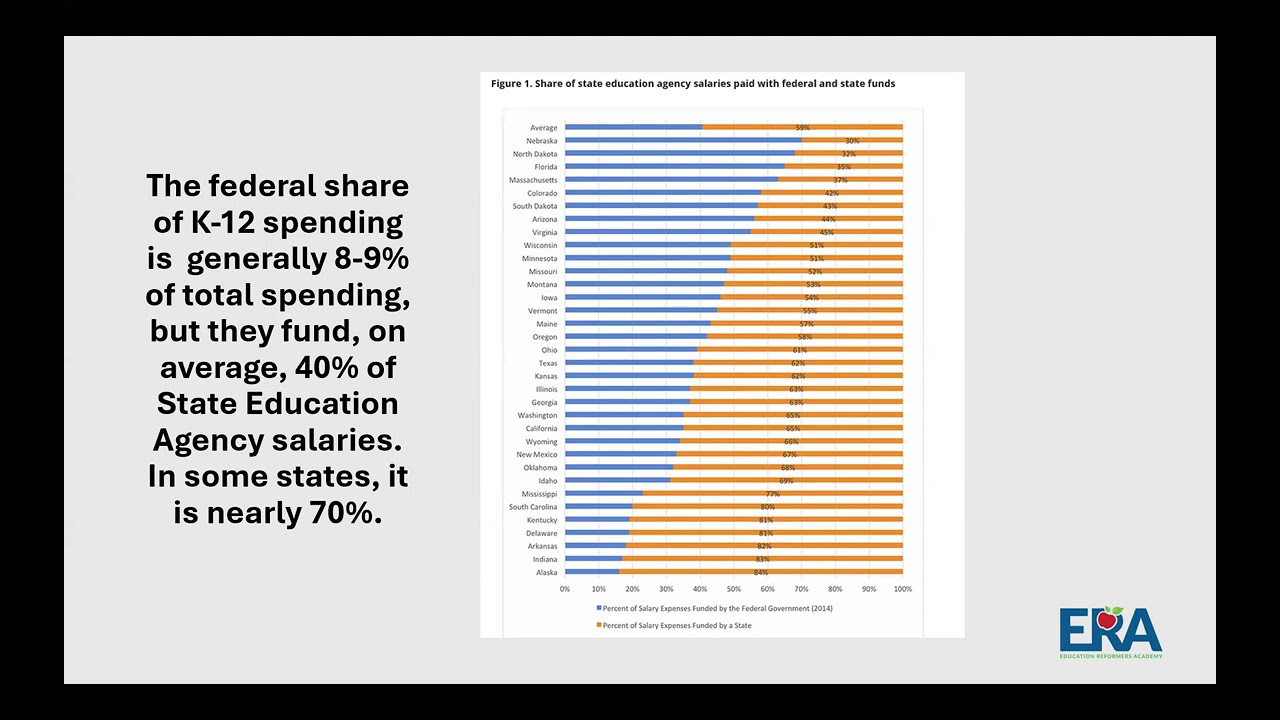
Waivers may be revoked. Reporting requirements may change. The requirements of a grant may change. Sorry. SCA stands for state uh education agency. So that's the state agency. Yep. So um which is that second bullet, right? So what's weird about the department the US department about the federal role is the feds are contributing 8 n% of total K12 funding right so they don't they're not bringing a lot of money to I mean it's a lot of money in dollar terms but in percentage terms it's not a lot but let me show you this real quick the federal share is this 8 n% but they fund on average 40% of state education agency salaries.
All right? So, they don't have a huge footprint in terms of their federal in terms of the way federal funding directs things. But when you go inside a state education agency, you will see that they are funding a lot of positions in that agency. And in some agencies, more than half, like a majority, right? You've got some states where seven out of 10 people who work in that state education agency are actually there being federally funded to run federal programs.
So what this allows the feds to do is sort of deputize the state education agencies, right? They're trying to run these programs from Washington. That's hard to do. They can't just send checks out. So they have to have some kind of way to make sure that the money is being used the way it's supposed to be used. So the way they do that is they pay for state departments to hire people who sit in special ed offices and sit in title program offices and run McKini Vento and run all of these different federal programs and do all the reporting data collection and feed that back to the feds.
So again this is going to vary from one state um from one state to another. Some of these state agencies are huge, some of the very tiny. This is to the question this is not a complete sample. This was a study that was done, I want to say AI might have done this a few years ago. I'll I'll find the citation for you guys. Uh, and the way they did it is by surveying the seas and getting the seas, the state folks to tell what percentage of your staff. when the new administration came in, we have friends in the administration, we know people in the administration in DC and when they were asking like what would be helpful in terms of data for research and things like that as we think about the federal footprint, I suggested you know it would be nice if you could tell us what you know how many people you are funding in each state agency.
So we would have you know the federal dollars going to it agency. The US Department of Education told me that that cannot be done, that they don't know how many positions they are funding in your agencies. And part of that's because they're all over the place and people are doing different things and nobody's coordinating that. But the main takeaway from this is that you um you may be working with or dealing with an agency where a lot of those people don't work for the state, they work for the feds.
And it's not as though you can come in and just grab those people and reassign them. Right? So even if you've got a hundred people in your department, if half of them are fedally funded, you can't take 20 of them and go put them on reading or something, right? So they are assigned to do what the federal law requires them to do, which is mostly data collection and make sureing making sure that money is being used properly and that you know the school nutrition kitchens are up to standard and these kinds of things. lots of regulatory stuff and it reinforces a kind of regulatory mindset from the feds.
Um, so the federal program I mean the federal model is shifting or the federal role I should say is shifting. I think we'll talk later about the degree to which you guys even interact with the feds or you're anticipating interacting with the feds. Some of you may come to us at some point and say, "Hey, I'm interested in maybe going to work for the department." I'm probably not the person to ask about that because I will probably try to dissuade you from going to work at the US Department and instead doing your good work at the state level where I think the real impact is.
I'm editorializing a little bit. That's not a reformers academy position necessarily, but it's it is a little tough to see from the federal level how they can make real reform happen since they really don't have a lot of tools to do that, right? So, they can regulate how the money they are sending you is spent. they can, you know, they have like civil rights laws and things like that that they can enforce, but their ability at the federal level to get people in schools to do something is pretty slim.
It's pretty slim. So, um, but anyway, you should be thinking about it because it's a pile of money and it's a constantly shifting thing in DC. So, let's shift along to the state and we'll we'll stop in a little bit. I want to get your sense of like who you think which of these levels you you tend to spend the most time on. I don't think it's any secret to any of you guys that those of us here at Reformer Academy are all state level people.
I was a state chief. I was a state legislator. The guys, you know, most everybody on the staff has worked at the state level at one time or another. We are here doing this because we think that states uh are the place where a lot of this happens. A lot of the sort of reform movement happens. Um but for some of you this may be new too and you may be at a district level or you may be outside state government or outside government at all.
Uh and you may have to be thinking about all right what exactly is the state role? So, as I said, a lot of the state roles is determined by the feds because they give money that the states then need to spend in compliance with federal law. But for the most part, you see these key powers on that left hand side of that slide, right? You've got you set standards, you do teachers lensure, you've got all the school funding models, which we'll talk about in a little bit.
We're going to talk about teaching down the road. We're going to talk standards assessment down the road. Um, school approval, charter authorization. Um, in a lot of your states, collective bargaining is a big piece of this. Um, graduation requirements. These are mostly set in state statute, right? Or in state regulation someplace. The feds don't actually lean into much or any of that stuff really. That's really a state level prerogative for the most part.
And of course, the key actors are, as you might imagine, the governors, state legislators, commissioners, or the superintendent of ed, state education agency staff. There's interest groups, and we'll talk about those in a little bit at the state level. Okay? Those of you who have spent time in an education committee room uh know who the people are who are sitting in that room every day, teachers unions and superintendent associations and those kind of folks.
So there special interest groups at that state level. Um but that in my mind that's where most of the kind of reform energy tends to be. Not always, but it tends to be there. Um but again, even here there's relatively there's some limits there, right? Um legislation takes time. It's hard to do. Um, some states, you know, most of your states are probably buried in legislation, right? You pass a lot of bills, a lot of legislation.
We'll talk a little bit about the statute books later, and we'll do a session about that. But you, you know, getting things done statutoily at a state level. It's not as hard as the feds, but it's pretty hard still, right? Even in even in states where you have um you know unanimous government control where you have one party that controls all the branches in the governor's mansion. Sometimes it's not as easy as you might think to get things passed that you might want to pass in education.
Look at how long it took Texas for example uh to get a lot of the school um school choice pieces that they wanted to pass pass even with control by the same party. Um a couple of other notes on the right hand side there. These interest groups have been there for a long time. um they are there because they maintain a lot of these relationships. If you're a legislator or you're someone from outside trying to influence that system, you are up against a kind of entrenched bureaucracy that can be there.
They have these relationships that can make it hard for you. And at the end of the day, I think it's fair to say that the lever even that you have at the state level to get people in classrooms to do things are relatively slight. So the story I tell people is when I was a when I was the commissioner, I have about I live about a little less than an hour from the state capital here in Augusta and I would have these, you know, the drive home was always a good sort of processing time to kind of like, all right, did we get anything accomplished today?
And what do we do? What do I have to do tomorrow? That kind of thing. So the drive home was was helpful. But there I I remember finding myself thinking there were days where you certainly left the state capital and you drove home and you're like and I my girls were in elementary school at the time when I was at the department and I I distinctly remember thinking to myself like did we do anything at the state level that's actually going to change the experience that these kids have of school, right?
Like what's going to change? The same teachers are going to be there. They're going to have the same curriculum. Like are we really So it can be frustrating, right? because you're you're a ways from the classroom. Even at a even in a state education agency, the classrooms are far away and the tools that a state has money and curriculum setting and so forth, you know, they're relatively limited. What is really interesting is what is happening in place in in you know areas like reading reform where you are starting to see and we'll talk about this when we talk about HQIM here in a couple weeks.
You're starting to see even red states giving more and more authority to state education agencies to sort of dictate curriculum and instructional materials and those kinds of things to districts. That never ever happened in the time where I I nobody would have tolerated the state department of education saying this is the reading curriculum you should use. These are the instructional materials you should use. No one would have tolerated that for a second.
So that's a big change. So, we'll talk later about where the states may be going, but the states seem to be having in in these states that are moving, it's because the state is taking a little more of an ambitious role than they typically have had. And we'll talk about the history of that in a little bit. The one other thing I want to pop on here about this model, and again, throw something in the chat or throw up a hand if if um if you've got a question here.
The other thing that's makes this complicated from a policy point of view, especially nationally, is that the states are all governed differently, right? So there's different governance models here. So here in Maine, the governor is elected and the governor appoints the commissioner of education. That's a pretty standard model, but it's not the most popular model. I think by numbers, the most popular model is actually the state board.
Either the governor appoints a state board who appoints the commissioner. There are states where there the state board is separately elected. So you as voters vote for the state board who in turn hires the commissioner who runs the department and the governor is kind of out on the side. So there's these changing models. This is from education commission of the states. It's pro I I put the note down here. So 2017 probably not totally up to date.
There have been some shifts. So Indiana for instance used to have an elected chief and now have as has an appointed chief. And that's been the trend in recent years um that we were moving away from elected chiefs. Remember the commissioner of education is an elected position. You run for statewide office in I don't know eight or nine states probably at this point uh sort of South Carolina. I mean there's a bunch. So there are some places where it's a it's a statewide elected office.
That's not the most popular model out there, but it is a model. So it's complicated, right? So there's different streams there. And of course, who the players are and who has their hands on the lever in those states is going to vary a lot depending on which structure you are sitting under in your state, right? Does your commissioner work for the board? Do they work for the governor? Is it some combination? There are states where the state boards are some of whom are gubernatorily appointed and some are elected.
It's a mix. I think Ohio works like that. So, there's just really convoluted systems for how we put the sort of government pieces into place at the state level. So, that's something to if you're working in a state or if you move to a new state, you're going to have to dig into, okay, like who who works for who here, who appoints who, how do people get these offices, um, and so forth. When I was at CCSO, we used to get questions about which model works best.
I don't know that there is one. Um, there's certainly times where elected chiefs who are in a different party than the elected governor, that typically doesn't work very well. There's sort of a standoff there. Um, board appointed chiefs tend to be a little more insulated from the politics and so they tend to stay in office longer just because the board typically is on their own like five-year terms or something. So, they can sort of insulate the chief.
So, in states like Massachusetts, this chief state school officer tends to stay a long time because the board's appointed. So, there's different there's different pros and cons to each of these models. All right. So, that's the state level. Let's talk about the districts because when we when I asked you at the top like who's responsible for this, you said most of you said districts. district's got to do something. All right, so here's where the rubber is starting to hit the road, right?
So you got the feds, you got the state, each of them are dictating things that they want the districts to do. This is typically, and again, this is going to vary a little bit, but this is typically where sort of staff is hired. This is where the curriculum decisions are made. This is where the funding levels are established, right? It's your district here in Maine, right? we have a local, you know, city council and but it's the school board that fig that gets the budget approved and the town just writes a check with some reluctance typically to the school board like they the school board is uh the one that sets the budget.
So, and then sort of HR policy, these kinds of things, hiring practices, labor union contracts, these things tend to be negotiated at the district level. So, this is where you're starting to get into staffing. And again, we'll do a session on staff. We'll talk about some of these things and how districts can be a little more thoughtful about that and and how they use their money. So, when we talk to Margarite Rosa next week, we'll talk about how districts think about how they use their money because they tend to be the spenders.
In most states, the sort of general purpose funding that you said in Maine, we have a general purpose aid for education GPA and we send it out to the schools and they just sort of spend it. And I remember telling the legislature who thought that they the districts had to spend it the way the legislature wanted them to spend it that unless the legislature created statuto language to say that the districts were just going to get a big check from the state and spend it however they thought they should spend it.
So that's where a lot of those really important decisions are made. Right? So um the notes on the right hand side here implementation to discretionary practice. Right? So you can try and get a lot of stuff done at the federal and state level, but ultimately the district and superintendence is where a lot of this starts to be like, all right, are we hiring people? Are we doing curriculum the way we want to do the curriculum?
Are we organizing kids and schools in the right way? Do we have grade level structures or are we doing local part like what are we doing to make this work? And those people at that level when we talk about who's who has authority and who are the ones that you need to listen to, district leaders are very very influential. They are not in state capitals. Typically, their associations usually are. But if you're elected, if you're a state legislator, you listen to the superintendent.
Your local superintendents have a lot of sway with their with with the state legislators. And so they can be people that you have to be careful of because uh they will they can slowly quietly sort of undermine your work. Right? So the last point there you are dramatically outnumbered. Look at this map. 13 I think the number I got was 13,300 school districts. Okay. So just think about that for a minute. 13,000 districts in the country.
There is some in I there is some coding for the colors. I don't remember what it is. Might be students in poverty. I don't remember where I pulled this map from. Uh but that's it was the best map I could find of the number of districts. And some of you guys in some of your states are dealing with a hideous number of districts. Hundreds and hundreds of school districts making these decisions. We're in Maine. Here in Maine, we've got 160,000 kids total and maybe 120 districts, something like that.
Some of you guys have got hundreds and hundreds and hundreds of districts. And so it's really hard if you're at a state level to get all of those districts to do something. Uh it's really tough. So you and you know, one of the third rails of politics is district consolidation. We'll talk about this over the course of this of this program. As you guys know, we've got declining student populations. We've got fiscal pressures.
Can we maintain 13,300 school districts across this country with declining numbers of kids and all the other complications that are coming with that? It's a hard question, right? So, um it's really something you got to sort of think through, but the districts tend to be where really what you're trying to do has to kind of get done, right? It has to be where the curriculum gets adopted and the other things need to happen that you're trying to achieve as a as a reformer.
All right, let's finish up with the school level. We sometimes don't think as much about this as we should because the district tends to be like it's the taxing authority. It's the legal authority. It tends to make those curriculum legal decisions and building decisions, busing decisions. They tend to make those decisions at that level. But at the end of the day, and Richard Elmore and others have talked about this, the only le level where actual learning happens is inside these school buildings, right?
That's where the teachers are. That's where the curriculum is. That's where the kids are, right? That's where all the content and all the technology and all of those things, the culture, how kids are organized for learning, the kind of support services or lack thereof the kids have, that's all coming inside that school level, right? And as we've discussed a little bit, it's really hard to get that to change, right? Because at the end of the day, and those of you who are classroom teachers know this, at the end of the day, the kids get off the bus and they go into your room and you close the door and you do your thing, right?
And everybody outside that door can say all they want about what they would like you to do, but their ability to get you as a teacher to do something other than what you are otherwise inclined to do is pretty slight. I mean, if you're a terrible teacher and you're, you know, I mean, there's obviously steps to remove you hopefully in your states really sort of obviously terrible teachers, but in terms of how you teach and what you teach and the way you teach it and how you interact with kids and how kids are grouped together for learning, like that all gets decided really inside that school building.
And it's even tough for superintendents sometimes to figure out how to make that happen. So, the challenge that you face with this really crazy four-level system is most of what you guys are trying to do as reformers is change what's going on in that room because that's where the learning happens. And yet, as we've seen, you're insulated by these various levers, layers. And there's places that can kind of pick these off all the way along. whatever you're trying to do can get watered down a little bit at this level and then it gets watered down a little bit at this level and then there's a little bit here and this memo doesn't get put out exactly right and this disappears over here and this priority is dep prioritized in favor of something else like there's just a lot of places along the way before you get to that classroom level where these things can get sort of watered down and it and it makes you real tough okay so all right let me stop because I've been talking at you for a little while I'd like to get a little discussion here around this question.
That was a very quick overview of these four levels. Would love to get your sense. You can use the chat or or please jump off mute and and and jump out. Um and let's hear what you have to say about like where do you think the reform is the hardest in your experience in the work that you guys are doing? What is where's been like wow we really can't make a lot of headway here. What what's been your experience? Put something in the chat or somebody jump in and let me know what you let me know what you think.
Yeah, Stephen, go ahead. >> I'll jump in. Steve, it made me think the other day we were I would say Texas is model the model one of the governance structure. I'll talk about the state level. I work in the state legislature on the education committee. >> And uh a newly elected state board of education member >> um asked for my time in my office the other day and he said, "You know, I can understand what a win looks like for your team and for your boss, for your party. um maybe a bill passed, a budget, right, or you know, whatever.
But what does a win look like for me? You know, he's one of nine or 10 Republicans on the state board of education, taken over for um honestly someone who's defied the governor in the past. Um and it made me think, you know, obviously the textbook answer is like you're making curriculum that is sound and high quality and you're ensuring standards are great, but I think he was trying to hit at a deeper point. And I think that's why my answer would be the state level because at least in Texas there's so many different um perspectives and you know all of them have great merit and value at most times and I think he was really trying to find a way he could make an impact that would actually last beyond him.
So made me think about question too. >> Yeah. I mean it's it's it's the same point I made about sort of the drive home discussion, right? like are we you know I I would come home I'd go to one of the things the kids are doing at school and you'd be like it doesn't seem any different in here than it was cuz I taught in this district right so I I went from literally well not exactly I had a little bit of a convoluted route but anyway from the classroom to the state right so I was back in the same classrooms that I had been teaching in years earlier and it was hard to point to things that had changed um and it's not for lack of trying most of you guys are buried in legislation, right?
You're just bills and bills and bills and bills and the statute books continue to grow. I don't share with you my prop here just so you guys get a sense of this because it leads into the sort of next discussion. So, I found this online. I like to carry this around. This is one of my props that I carry when I do presentations. I know it's hard for you to read. It says laws of Maine relating to public schools 1895. So, this is a photocopy of an old legal book from 1895 that talks about the school laws of Maine.
And as you might imagine, it talks about school districts and this and that and all the things you're supposed to do. I should send you, you can find a PDF online. It's it's really actually fascinating to read. The laws of public school for Maine in 1895. This is 33 pages. Okay. So, in 1895, 33 pages of state law dictated what we did in schools. This is Maine's education statute as of 2020. Okay. So, in this amount of time, we've added just about a century, we've added this many pages of statute.
And folks like, you know, the legislature you work with, like they're they're trying to think like what if I write something different in here, if the words in here are more words or different words, something else will happen in schools if we do that right. Like it's a hard case to make sometimes because you look at this and it's, you know, people put a lot of effort into building these statutes and a lot of them have a lot of merit and and do good things, but it's tough.
It is tough to make things happen at the state level. Again, even in in states where you have a trifecta control of of both houses in the governor's mansion. Anybody have a differing opinion? Where is change the hardest to make of those four levels in your experience, guys? Hey, this is Bo. I'm in South Carolina and I'll just tell you, I don't I don't know if change is the right word I'm thinking of, but I'll tell you there are there are multiple disperate >> entities doing what we want to do.
And it's really hard to collaborate and channel that communication from the state level all the way down to our schools. So I that's the biggest challenge I'm finding. >> Yep. Yep. Well, and something that's a important point there that I sort of I skipped over on the state level which I should circle back to which is I was on a call earlier today. we were talking and we're going to do a session and a lot of you guys are working in this this space of like career pathways and post-secondary transitions and these kinds of things.
So, we're only we've only been talking about the state education agency, but remember there's labor departments, there's workforce development, there's higher education, there's lots of other folks. So, the challenge if you're at the state level is it's it's hard to move this way, right, up and down from the from the districts or from the state down to the districts and schools. It's harder in some ways to go sideways and go and and coordinate higher education, the community college system, career and technical education, you know, all of the sort of like the chamber of commerce folks and all the workforce development people, the labor department with all of their data.
Like trying to do coordination laterally across state government and then have that have an impact vertically down to the classroom. It's super super hard. Um, and it's something that states have poured a ton of resources into trying to build. Some of you have been in this business long may if you've been as in this business as long as I have may remember it was a big push in the I want to say this was in the 90s might have been in the early 2000s of like P16 councils and these kinds of things, right, that were meant to sort of align do this kind of alignment bow that you're talking about like trying to get these pieces align.
It's just hard because of course everybody in there has a different thing they're trying to achieve and so getting them to even agree on a common vision for what we want to do is is tough to do. um you I think you're starting to see a lot of states lean into and a lot of your states may be too be happy to talk about this sometime these like profile of a graduate or something like that where they they are trying to bring like all right let's sit down with higher ed let's sit down with labor let's sit down with the workforce development guys and let's figure out like all right what do these kids need to know and be able to do and let's you know we did that in the standards movement in the 90s like what do kids need to know but we didn't actually do the that furthest part is like what what are we trying to produce here at the end of the day a kid who knows and can do But and that I think there's states that have had quite a lot of success sort of pulling people together around that common vision.
Now executing that vision is is a different matter. We'll talk about implementation as we go. All right. Anybody else? One more. Anybody else got a change easy at that school inside that bu that school building where you're at? Those of you who are >> I'll jump in Steve. >> Yeah, please. >> Harper. Um so to me reform and please correct me anyone in the team when I when I think about the word reform um improving an existing system like by fixing the flaws and changing the procedure.
So as an as an um exclassroom teacher to superintendent roles overseeing schools that was our daily job because we had our ultimate goal and if you don't constantly ask yourself as a team >> with the stakeholders the flaws and the procedure >> to change the environment change um how we learn and how we teach then the school will never improve from where they are to where they're going. >> So for that reason, that's a leadership perspective >> and and it's not that difficult.
It doesn't require um an approval. It requires an approval census with your your leadership team. >> Yeah. Right. >> But the state level like Stephen mentioned, it is difficult because in Arkansas for instance, we have a legislation session coming up and we're working on AL uh portfolios. So if we don't do something this upcoming year then we'll have to wait two years or if we do something and if it's not done correctly then we have to leave.
So that level of change is quite difficult as far as my experience. >> Yep. Well there's there's no question and I I'll I'll send this to you guys when I get done with I may have mentioned to you I'm working on a project for Hoover where I did get to talk to a bunch of district superintendents over the summer. We were talking about how to lead change in in big districts and what they're up against to do that. And we talked a little bit about like all those things coming down from on high from the feds and from the state that they have to manage.
But they did talk about the leadership challenge of how do you lead systemic change over time which takes a lot of time and a lot of effort, a lot of people skills and a lot of planning and a lot of while you're also managing the day-to-day like inside a school district. You know any large organization has complications. I mean any big corporation or big organization is hard to change things but schools with this very diffuse sort of governance model are really hard right and parents kind of cycle through and they're there and then they're gone because their kids are wrapped.
So now you got a constant churn of parents coming through who may have different you've got political things that go through. You've got new board members that come in like it's a constantly kind of churning um morass that you get stuck in. But there's there's real leadership challenges there for sure. And of course we know one of the consequences of that is superintendent tenure is tends to be very short, right? Superintendent don't last on the job uh in a lot of instances.
And that obviously makes it hard for continuity sake. All right. Um so let me keep going here a little I'm going to back up and do a little history lesson with you because I want to talk about kind of the emergence of this system. Like this system didn't arrive, you know, uh, fully formed like this. Nobody sat down at any state government and wrote all of this in one sitting, right? These things emerged over time. And this is the graphic that I like to use to show that.
Some of you may know what this is. Um my uh US history teacher when I was in high school was an archaeologist by training and which was great. He had done a lot of work in sort of colonial era New England. So as you might imagine again on on the theme of getting teachers to maybe cover all the things they're supposed to cover because he was a colonial historic and archaeologist. You can probably imagine that we spent, I would say, 60% of our US history class on the colonial era.
We got done with the colonial era, probably Christmas, maybe. And then he decided, all right, I'm really interested in the 20th century, so we skipped the 19th century. We essentially went from the Constitution to the First World War and kind of just went through that middle part. not like anything important happened in the 19th century or anything like but that but he was an archaeologist and so I think about this because his whole thing was hey you know it's it's about time travel and when you dig down in the ground as an archaeologist you it's time travel and you're going back in time and he had artifacts it was great it was great when you're a kid to do that it fired me up for history too but what I'm showing here is that these things are not the purposes of of design like this didn't result from design this system that we've just been talking about it sort of emerged over time it evolved over time.
So, let me take a few minutes to sort of walk through um how we got to where we got from these early days from my paper over here from 1895 to to now. So, bear with me as I go through a little bit of history. So, I want to start in the sort of early early public schools, right? So, we're talking about pre-Ivil War like colonial era and the early parts of the 19th century. The country was almost entirely rural as you see here. 80% of Americans lived in a rural one room school houses.
Education was a little bit of an afterthought. There wasn't much of a system to it at all. People kind of teachers traveled from town to town. Nobody had any teacher training. Like it was there was high turnover. you know, teachers, if you read some of the old stuff about the early days of of public education in the United States, you know, one of the one of the things that they sort of look for in teachers like could you thrash the children if you needed to if they needed thrashing or were they going to thrash you like having being able to maintain yourself safely and and manage discipline in these schools was something in these in these sort of wild times in early early parts of the country's history.
Um, attendance was voluntary. you know, kids were working around these sort of farm schedules. Kids might come and you never see them again. You know, it was it was all over the map. Um, and again, I live in New England. You could still see the little one room old one room schoolhouse museums and things around like that. Very, very primitive stuff. Um, and so as we moved into the middle part of the 19th century, there was a start of a movement like we're going to have to do better than this. like this is not going to work if we're going to be a civilization that accomplishes things here in the United States.
Like we got to have something better. So if you and I would encourage you to do some reading about this because it is kind of fascinating the early history of the what was called the common school movement which was the first the beginning of this system where you know it was after the civil war you had reconstruction you had growing immigration you had growing urbanization things were changing and there was a sense that like we got to move to something better than this and if we're going to be a world power we're going to have to we're going to have to get serious about education.
So this movement sort of began like midcentury where people started to do some more research and they looked at European models and they kind of leaned into this idea of standardization which of course was a big thing like this industrial model right and what is interesting about this is you know we will talk sometimes in education nowadays about the factory model and it's industrial and it's a factory model and it's oneizefits-all and it's kids are widgets and this kind of thing and that's True, but if you were somebody living in the 1800s, the mid 1800s, industrial and factory model was like a miracle.
Like that was modernity, right? Because factories were this new technology. They could do these amazing things. They could produce these fantastic products at almost no cost. And it this sort of rational model just seized control of everybody. Uh the factory model did become a sort of model for this like let's be thoughtful about this. let's organize in some way. And so you started to get standardization of these practices, right?
You started to get age- based grade levels. We're not going to have one room school houses with kids of all different grade levels. We're going to put all the first graders here and all the second graders there and we're going to figure that out and we're going to actually bring some kind of sense of of order to this system. And we're going to start training teachers and we're going to send teachers to teachers colleges.
And many of you have got you know at the University of Ma Farmington here was the teachers college for the state for years and years and years and years. who's a specialized school to send this staff to. We're going to focus on books. We're going to focus on HQIM, right? HQIM from the 1860s, right? Uh we're going to extend school years. We're going to we're going to make these free um for kids. So, we're going to get kids in eventually.
Eventually, they'll move to mandating that kids come, but that will take some time to get there. But this model, if you study the history of it, really sort of swept the country in those early days. And what's amazing is the sort of conception of school really started to pop up all over the place in lots of similar ways. And so schools started to look like each other for the first time really because they were sort of structured in that same way because we're trying to solve this problem of how do we get away from these one room schoolh houses into something that is more rational and is responsive to the challenges that we are facing.
Again, you're coming out of the civil war. You've got westward expansion. You've got massive immigration. You've got these cities exploding. Remember guys, in 1850, Chicago, Illinois had 30,000 people in it. By 1880, it had 500,000 people in it. Okay? So, in 30 years, it went from 30,000 to 500,000 people. And it was and and by the late end of the century, it was like the second biggest city in America. So that kind of explosive growth really drove these early thinkers to like, okay, we got to do something because you can't have classrooms with hundreds and hundreds of kids in them.
So it really sort of forced this new thinking. The reason I go into this is because this is where we start to see the first pieces of what I would say are the base special interests in education. You're seeing my chart over there on the right hand side. Over the course of my discussion here, we're going to fill that chart in as we go because this is where all these people came from. So right, so in the common schools you get the very first school districts.
So now you have school boards. Didn't have school boards before. Now we have school boards we deal with. You had the first state boards of education, right? So the state starts to have a little bit of a tiny tiny tiny sliver of a role of some kind. Mostly it was research uh and sort of counting noses. There wasn't much more to it in the early days even at the state level and certainly not at the federal level. Um you started to have these professional organizations, right?
The first teacher trainings and curriculum work and high quality instructional material work of that era came from the National Education Association which was not a union in those days. It was like a professional association more like like a medical association or something like that. It was a professional group that meant to raise these standards. And you even had in 1867 this federal office of education. I like this stat. $13,000 budget in 1867 and six people at the department.
So, I think if uh the president and the secretary get their way, that's I maybe that's what their goal is to get down to six people and $13,000 of budget at the US department. Don't think they'll get there, but that's where we started from. So, what's important here is you start to see these pieces start to click into place, right? First school boards, schools of education, state boards, these professionals or the the feds start to have a role.
And what we'll see as we go on is none of these pieces come off the board, right? We still have all of these. Like they didn't go away. They're still here, but we've got more that we're going to add to the list. But this is where the very sort of elemental pieces of this public school architecture began in that early era as we're trying to figure out how do we create a professional modern education system for a modern country.
And these were some of the elements that slid into place uh with that. So school boards for instance you know had separate taxing authority because it was felt that the city fathers didn't pay attention. So you needed dedicated school boards that were focused only on schools and you didn't want you know that to get mixed in with the city council and so you created these separate boards focused exclusively on education.
That's why we have school boards separate than your municipal governments or your city governments in most places although that's changed in some places. All right. So that's the basics where we start and again these are very small pieces in the early days but it grows pretty exponentially around the turn of the century and that is because of the progressive movement. I would encourage you guys to spend some time reading about the progressive movement because we are very much living with its um its its sort of legacy today. not exactly progressives in the sense that we think about progressives today, but not that uncommon.
As these systems came online, these folks at the ed schools and these folks working in these systems started to think through like we've got to come up with a better system than what we have. And so, the progressive era really did launch a lot of the things that we now think about as sort of core elements of public education. And I this little chart that I made shows you the difference between sort of the traditional approach and this progressive era approach.
Right? So in the traditional approach you had sort of you know proven practices local community needs. It's you're going to be reading classical texts. You're going to have you know it's going to be very teacherdirected you know old school classroom you know lots of order discipline. Uh local school boards in charge. um very if you think about sort of that early kind of classical model, you know, we're going to build a school, we're going to fit the child to the school.
That's how that works. So, you're going to that's kind of the old school system. The progressives pushed against all of that. They said, "We need experts to run things." Like, you can't have lay leadership of schools. You need experts to run things. You need professional managers. You need, you know, you need professionals writing textbooks. you need these kinds of things, right? And we need to make the school about the student.
So, we're not going to fit the school that kid to the school. We're going to fit the school to the child. And we're going to move into more child- centered, child focused things. We're going to have more professionals. We're going to have more academics writing these things. We're going to have these ed schools that where we're writing all the new curriculum and pedigogy and all these kinds of things. And there was also an aspect of it that was focused on sort of real world skills where there was a push back.
And again, you guys know we're still living with a lot of this tension here. There was a lot of push back like, why are we reading Shakespeare in school? Why why would we need to read Shakespeare? We need to teach these kids how to work in factories. We got all these factories all over the place. Who's going to work in the factories? Right? So, um, so these tensions are still with us. And what's fascinating as I look at this now and you think about like one of the one of the exploding movements in in education now is classical schools, right?
Classical charter schools. and you're seeing this return to like, oh, let's go back to do the great books, like these massive comprehensive schools. Like, we can't do those. That's not working for anybody, right? Um, so you had a bunch of these pieces start to come in. On the question of specific group, I don't think it's a specific group necessarily. There was a progressive movement more broadly, the progressive sort of political movement.
Um, and that's where you started to see like labor laws and you started to see lots of like clean government things like um getting rid of Tamonn Hall politics and um you know professional civil service and being a professionalism to government these these kinds of things. So yep Teddy Roosevelt was one of those guys. So you know this was a broader movement about government is complicated, society is complicated and we need people who are trained in those complications to run these things.
You can't have civil government just handling all of this. You need professionals to do this. Let the professionals do it. So that was the kind of sensibility that came out of this which is why you saw some of the transitions in the years that followed. So again let's go back to this for a second. What did you start to see here? You started to see, for instance, especially in these big cities, you had all of these immigrants pouring into the country.
Schools started to take on other other sort of um roles like public health roles, right? It was here that schools started to have immunization clinics. They started to do wraparound services, what we would call wraparound services, health, nutrition, school lunches. Like these things started because we're like, "Okay, we have these kids. We have these kids in this physical location. Why can't we do these other things?
Let's do these other things that need doing. These kids come from families that that don't speak English, that don't know the society. Like, let's get them the care they need. Let's figure out how to bring them along. Let's get them into a program that's going to make them successful and let's go. Right? And that's going to require professional administration of schools, curriculariation, these kinds of things. Right?
You're going to This is where you start to see tracking. Okay? So, this kid's going to go here, this kid's going to go here, and we're going to build scientific curriculum to follow them. This is when you started to see the expansion of schools beyond elementary school into high school and later comprehensive high schools and career technical pieces and voke schools and all of this other kind of stuff. So all of this developed as a very sort of scientific approach.
Not everybody's going to be a genius. Not everybody's going to go have a high-flying job. Somebody's got to work in the factories. So let's train kids to work in factories. Let's give them very basic things to do. We'll make sure they're ready to go. We'll slot them into those factories or wherever they need to go. So it was a it was a really the beginning of a lot of those elements that we see. The last one I want to hit on for a second too is that intelligence testing developed.
So around World War I, if you do the history of that, some of the early like IQ tests and things like that were developed and tested on soldiers for World War I by the military trying to figure out like how do we figure out where to put these guys? Like what do we have them to do? We have a huge army. We got to where do we put them? So they started messing around with testing as a way to like, okay, this kid will be good at this and this will be good at this and this will help us do this.
Those tests, as you might imagine, rapidly made their way into education. And that's when you started to see like the SAT tests and these kinds of things. And of course, they were used, as you might imagine, for nefarious purposes, which is we're going to start to give these kids tests and we're going to start tracking them from elementary school. Some that some of them are never going to make it out of elementary school because the testing tells us they don't need to move beyond that.
So we'll just keep them there and the testing will sort and these kids will go to a voke school and learn how to turn a wrench and these kids will do this and these kids will go off to law school and right so you use testing to kind of determine this and so the testing companies became these vendors and providers became part of the part of the ecosystem of public education. So again, look at my list on the right. Public health officials, we're going to see them come back, right, in COVID.
School and district administrators become increasingly influential. Business groups start to get in involved because business is very interested in developing u a workforce. And so they get very involved. That's when you see vocational education start to take off. Sort of the early parts of the 20th century, these IQ tests are developed. So you have this kind of new model rolling along where we're starting to professionalize this whole system.
Here's a stat that I'll show you that reinforces this. This is the number of school districts in the country, right? This is an effect. This is particularly, you see this drop post war, right, after World War II when you started to see like the school consolidation movement and the baby boom and there was this focus on we're going to consolidate schools, we got to consolidate districts. But you start to see this number of districts and of course, as you might imagine, because the number of kids is going up, as the number of districts going down, the district size goes up, right?
So you have this big what you start to see these big big big big big big big big districts start to develop and big school systems and big districts and these kinds of things and they of course need professional management. So the number of people in superintendencies and in building administration and all that kind of stuff starts to climb because we're creating much more to our earlier conversation complex organizations and we need to build systems to respond to that.
So these things are starting to grow. All right, let's keep going. I got a couple more. Now let's move into post-war, right? So you have more people at the table. So 1954, Brown versus Board of Education. Now you have civil rights movement. The civil rights groups are becoming organized. The civil rights groups are saying like you cannot have separate but equal school facilities. Brown versus Board of Education, obviously a monumental pro most important court case in the history of public education throws, you know, throws that out the window.
And it means that now you're going to have a sort of constant presence from civil rights groups. And the long shadow of Brown goes late, not just in in the civil rights movement of the 50s and 60s, but later into the 70s. And it begins to, you know, it informs later movements around native kids and around special education and title n and you know, things for women. So that movement and the civil rights groups take a really big role as we come out of World War II and into the 50s and 60s.
Then of course this Sputnik happens in 1957. And for those of you who are not historians of Sputnik, Sputnik was the Russian rocket that was launched, the first artificial satellite. And the nation, the United States had a collective meltdown because of Sputnik because the Russians had beat us into space and now they were going to drop bombs on us from space. And one of the effects of that, that was a one of the things that launched an increased federal role.
So all of a sudden people are like, I think the feds are going to have to lean in here. And they did with something called the National Defense Education Act, which came out in the late 50s. Really small initially, really small, just like better science education. And it was funding for this and that. pretty small program initially, but eventually it would lead to the Elementary and Secondary Education Act in 1965, which remains the core federal education statute to this day and ushered in a a much more robust federal presence.
So that happened and so now we've got the Fed the Feds in our space, too. And you have school and district consolidation in the post-war era because of the baby boom. So, as we look at our list over here, we got the feds with expanded roles. We've got school and district administrators having more authority because these districts are getting bigger. We've got again business groups getting involved because as this federal money starts to pour in, business groups get very interested in where this money is going to go.
Um, I've got a great history around here someplace, I can't remember what it's called, of that the early days of the federal law where all this federal money came out. The reason why they're separate title programs is because, as you might imagine, advocacy groups wanted little pots of money. So, there was a separate fund from the beginning for technology. Who do you suppose advocated for a separate federal pot of money for technology and libraries?
Well, textbook vendors and people who made overhead projectors. They spent a lot of money lobbing and they got a dedicated stream of funding from the feds to support those things. That's right. That's how it happens. So, the vendors and providers are in there. civil rights groups become much more powerful and influential and then the courts are leaning in and the courts are starting to dictate things in ways that they hadn't done before.
So, let me keep going. I know we're covering a lot of ground here. I'm I'm I'm going to I promise I'll wrap up here in a little bit. Here's another again. Here's the school funding, right? Look at the local share of funding drop. It drops and the state funding goes up, right? Starting in the 30s and 40s, states take on more of a role. You look at that blue line at the bottom is federal. You see the bump start in the 50s and start to rise rise rise rise rise up to the 80s until Ronald Reagan and it starts to drop off and the states take on a little more of a role from that point and then it sort of perks up again.
But back to what I said before, it never I mean it never moves really out of the single digits. This shows it above 10%. Not sure we ever got there. Uh but it's really in the single digits. But you're seeing the locals having less authority and the state having more authority as we go, right? As these special interests, the feds are now at the table, these big state um agencies and organizations at the table and they're starting to take more uh of a role.
All right, we're getting into the 60s. We're going to do the 60s and then we'll we'll we'll get to the last chunk here. So in the 60s, the big play the big piece two big pieces here. Well, three big pieces here. The first piece I already talked about which was sort of title nine, Indian education act, IDA, special ed, right? So you're starting to get a lot of these other um you know the the civil rights movement is creating lots of opportunities for lots of kids who had traditionally been ill served by the system.
That's going to mean a lot of new specialization and lot schools and new programs. So that's going to be a big chunk that comes out of the 60s. The second big chunk is teachers unions, right? Teachers unions. Teachers don't even unionize until the 60s. I mean, the NEA is in place, but it's a it's a professional organization. It's not really a teachers union. It's not really until the 60s that the unions become very powerful.
And let me talk let me take a minute to talk about that because as we when we stop here in a couple minutes, I'll get your sense of like who the players are that you think about a lot. Here's a graphic that shows um that I found in a book by a colleague of mine at Hoover who talks about this is a poll of people in state capitals um where this is a poll of teachers where the teachers were seen as the top pressure group.
The number of states where the teachers were seen as the top pressure group, the teachers unions. So look at the change from the 60s to the 70s to the 80s. By the 80s in almost every state the teachers union is seen by as the most powerful sort of pressure group lobby group in state capitals. That is a dramatic increase from the 60s to the 80s in union influence. I mean it really started from almost nowhere and by the time the 80s roll around the teachers unions are extraordinarily powerful and what do they do with their extraordinarily powerful power?
They spent a lot of money and this is who they spent their money on. Uh we already know who the blue and red is, but if you didn't know blue and red, you could probably guess which party is which here. The blue is funding to Democrats. The red is funding to Republicans. It is interesting that we went through this period here sort of like 2000, 2002, 2004. you started to see some money to Republicans down here, the little reds down there at the bottom, but the blues are overwhelming and the unions just become enormously enormously influential um in terms of funding in funding uh political offices and political campaigns.
Here's another graphic that I think is interesting. One of the reasons that the union movement um really leaned in heavily into the public sector unions is union density. Right? This is you see the red line is the rise and then fall of private sector unions. I mean if you got rid of public sector unions the number of people the percent of employers who are employees who are unionized in the country it's probably down into the single digits.
Like it's just not private sector unions, private company unions just are not the thing that they were back in the sort of you know back in the 20s and 30s the big factories and these kinds of things. That green line is public sector unions. And so most of the union authority and union power now is in public sector unions, right? So it's we could spend a whole night talking about how the teachers unions pulled this off.
I'm going to recommend a book um by a colleague of mine uh named Michael Hartney who's at Hoover, his book about how policies make interest groups. And it's a fascinating read because he really gets to like how did they actually pull this off? how in no time flat did these unions go from having no authority to have being a extraordinarily powerful interest group. And he what he talks about is things like how smart the unions were in the early days to get the school systems in this case to give them they didn't ask for money in the early days like when they were negotiating union contracts they didn't always ask for pay and benefit increases big payraises.
They did but they also asked for like we want to put our newsletter in the mailboxes in the office. That's what we want. We we want to put our newsletter in all of the teacher mailboxes in the office. We want access to those mailboxes. We want a dedicated phone line that we can use from the school that we can use to call people from inside the school. We want dedicated space in the school where we can put our union stuff that people can't mess with.
They negotiated those kinds of things, right? Not just paying benefits for their members, but pieces that gave them the ability to continue to grow their strength. So, they got they negotiated phone lines so they could go and make calls on election day and in the run-ups to elections. And that's how they were very smart about what they did. And think about it, that meant the teachers that they were representing went without payraises because the school district was like, "Yeah, we'll pay for a phone line.
That's nothing. We'll pay for that if we don't have to pay them an extra 1%." And the union was like, "Excellent. That's what we want because the phone line is worth more to us than the payraises for the membership, right? Like it's it's really interesting stuff about how interest groups get and amass power. So again, we could spend a lot of time and we'll spend some time talking about unions as we go, but they are obviously very very influential.
I'm going to get your perspectives here shortly on whether they remain as perspect as influential as we think. All right. The other thing I want to talk about is um this this slide probably goes back on the district consolidation. You guys have seen some version of this slide. I'm sure this is non-eing staff is that red line right teaching staff is the dot is the students is at the bottom teaching staff is the blue line blue dotted line and then non-eing staff is red so over time again professionalization the number of people in school buildings who are not teachers has grown dramatically some of that is just because the district's gotten bigger you now got curriculum directors and all these other people some of it's because we passed special ed laws we've got special ed you know specialists and behavior specialist.
We've brought a lot of those folks into our schools to deal with kids and and get them what they need. Um so, but this has changed and you're going to see this, you guys have seen this graphic before, I'm sure, as an argument that most of the money is going to support staffing and is not staffing that is not teachers, right? And it's a it's a it's a big issue. So, the growth of that staff over time really sort of emerged in the 60s and 70s and 80s as these things uh these things grew.
The one other thing I want to mention from this era and then I'll get to um the last couple is school choice. School choice was the other thing that started to emerge in the 60s and and 70s. We can go all the way back to Milton Friedman. Milton Friedman wrote his book in 1955 I think uh where he sort of proposed basically school vouchers didn't really go anywhere and wasn't really an issue. But in the fif in the 60s and 70s you started to see some uh interest in alternative models.
These these comprehensive high schools were getting huge. These districts were getting huge. They were very sort of industrial. There was kind of a push back on that. I don't know how many of you guys are aware of this. The homeschool movement which I think even today we still think as sort of being on the right and maybe having a religious sort of context. The homeschool movement actually started on the left and it started as a kind of countercultural sort of um anti-institutional back to the land crunchy granola hippie kind of thing in the early days and we're going to take our kids out of these big industrial schools and we're going to educate them at home.
And it was a thing on the left. It was a kind of a countercultural 60s thing. And later it was the sort of the religious right who picked it up and ran with it because their sense that the schools, you know, they had a lot of issues with being taught in schools, behavior in schools and these kinds of things. And sort of the 70s and into the 80s, it really sort of shifted from left to right and still remains particularly postcoid a big big influence.
You see that graphic uh on the right that shows the homeschool numbers particularly postcoid have not returned to precoid levels. homeschooling and of course we'll talk later. We've got a whole session we're going to talk about microschools and all those kinds of things as we even reconceiving what schools look like. So it's on its way back but that emerged really in the 60s and 70s interestingly out of that kind of uh counterculture uh movement of that era.
All right, last couple ones. So we're getting up to our era here. Very close, very close, right? Nation at Risk comes out in 1983. Um, and that is a lightning rod. For those of you who aren't familiar with, it was a lightning rod um, report that basically said the schools were failing. It basically said we were not competing back then. We were worried about Germany and Japan. We were not competing with them. Um, and it was a real, it hit like a meteorite and it really did launch the kind of modern school reform movement and it made recommendations about increasing the quality of teaching and increasing the rigor of coursework and getting serious about behavior issues and these kinds of things.
A lot of stuff that we now think of as being the kind of modern reform movement. So, of course, it led to the standards movement. We didn't have standards prior to nation risk. 70s and 80s didn't really have standards. So it kind of launched in the early days um the standards movement assessment accountability. There was a lot of uh equity adequacy school funding lawsuits. So in a lot of your states your school funding models are dictated by the courts and cases of whether there was equity or adequacy in funding.
And the courts again had a big role in how schools were funded because we had we were placing these greater demands on the school system and school systems were suing saying we're not we don't have enough money to do all of this. And there were court cases about it. And you started to see particularly in the '9s, you started to see philanthropies, the big philanthropies, right? The Gateses and the Huelets and those guys starting to invest um heavily and you started to see think tanks, Excel and all of these sort of think tanks became much more prominent.
A lot of a lot of kind of early days of the modern reform movement. We had a lot of, you know, charter schools were starting and all we were doing all the stuff around assessment, accountability, like it was a lot of stuff that we launched and it was led, you'll see that I've got one of my boxes down here is governors, which we haven't really talked about yet, but governors became really really influential. It was the governors in the postnation risk period who really launched things.
It was Bill Clinton, it was Jim Hunt, mostly these southern governors who really led on sort of the standards and assessment movement and kind of got that going. it was really a state level play in the early days and those governors really led on that. So, uh, and then you start to see these think tanks and reform organizations and the philanthropy starting to get involved and again we're starting to see we see even now the influence that these organizations um have.
I'm going to put a shameless plug in here for a report that we did at Hoover. That's the actual nation at risk. I have an actual copy of the actual report sitting around here someplace. uh on the left and on the right is a report that we did at Hoover looking back at 40 years of reform. Um and our finding from 12 papers that are contained in that volume, you can find it on the Hoover website is that we tried a lot. We tried a lot since a nation at risk was was out there in 40 years.
And you know, some of it landed. We're we still are working with with you know, curriculum and instruction and accountability and assessment and those kinds of things, school choice, obviously charter schools, but a lot of the stuff we tried just didn't it kind of worked. sometimes and other times it didn't work. We invested a ton of money in technology. Didn't really get much out of that as it turns out. Um, you know, we we did a lot of things that we invested in community school.
Like there was a lot of things that we did and tried that didn't quite have the impact that we that we would like. So I I would encourage you to give it a read um if you'd like. All right. Now, we're right up to the present day. And then I've got a question for you as we as we start to wrap up here. So this is early 21st century. We have no child left behind. Obviously that's the school accountability and assessment has hugely impactful right all the really you know the state agencies had a big role.
We didn't we haven't talked a whole lot about state agencies. They become big sort of in the 70s because again the feds take on more of a role which requires the states to take on more of a role. And then during the standards movement of the 90s, the states really stepped in because they set standards and and raised the bar for teacher um you know teacher training programs, certification, these kinds of things. So the states had a big role.
So NCLB moved all of that. NCLB is replaced by ESSA. The feds kind of take a step back. The states take a step forward. ESSA again lands in the laps of governors and state education chiefs. They move their sort of new accountabilities models forward. So the states are really back in the driver's seat a little bit on accountability. We're going to have a whole session where we're going to talk about that. So we won't get into that now.
Uh but that you guys remember who were teaching in the sort of the 2010s um how big No Child Left Behind was and that move to ESSA, all the testing stuff, the testing backlash like that was super influential u in public education. Then of course you had CO and all the schools were closed and the public health officials were determining how we should do schools and you guys remember seeing pictures of kids with band instruments inside their little bubbles and all the other crazy things that we did during COVID.
And CO of course had all kinds of downstream impacts which I don't know that we fully understand. Um but certainly was a shot in the arm to the homeschool movement uh and to the alternative school movement and we'll talk about that at a future session. Um, and we would like to think it has pushed a reform agenda aggressively. Probably it hasn't. Our hope coming out of the pandemic is that people are like, "Wow, we've really lost ground.
We really got to lean in here and do something big." The something big hasn't really happened. Some states have made some headway. We'll talk about that. But, uh, it didn't do what I think a lot of people did, which is it didn't it didn't form a Sputnik moment. It didn't seem to be like a big push, right? Um but you could also say it led to universal education savings accounts, right? So school choice has expanded rapidly uh in the years since CO particularly uh in red states and that has been hugely influential and you have got kids now that have access to real dollars or parents and families who have access to real dollars to put their kids um in the school that they choose or in the education setting that they choose.
You'll see that I added my last box over there. Scholarship granting organizations. As this federal tax credit scholarship comes online, we'll talk about this when we see Robert Enllo in a couple weeks at the flyin. These scholarship granting organizations are going to become very influential. There's some of them out there now as this money starts pouring in, millions and millions and millions of dollars. Um those organizations and how that is going to are going to determine how that money is spent is going to be hugely hugely influential.
And then of course we've got AI and we are going to do a session on AI. We're going to talk about that. It's hard to even say what that's going to mean. These LLMs are large language models. Hard to know what impact that's going to have. Uh but the sort of tech companies, right, the they are going to have some influence as well. So that was a lot. I know and I've been talking at you for like a half hour straight, but I wanted you to see that this emerged over time.
No one designed this. This is not a designed system. This is a system that accumulated responsibilities and interest groups over time and those interest groups still have authority. So I'm going to come back to this question which is the question that I launched with which is a school in your state has been at the bottom 10% for five straight years. Who is responsible? Take a look and let me know if any of your view of that has changed when you look at all the players that are in this space, right?
Is it the feds? Is it the school and district administrators? Does business have some role? What about the courts? The courts have leaned in and told people what to do. They're some of these things are being determined by court precedent, right? You've got parent groups, parent advocacy groups, teachers, right? Yeah, we should have teachers in here as a you know, the labor unions. I think you're right. We we put labor unions in here, teacher unions, but teachers of course exist outside of unions.
That's a good push. Yeah. The philanthropies, who's responsible for it, right? So, I want you to be thinking about this. Here's how I want you to close, though. I want you to take a minute as we wrap up and I'm going to give you a couple minutes to think about this. thinking about those groups and thinking where we are now and you guys as reform leaders, you're thinking, "All right, I'm going to go out there. I'm going to make some impact over the next several years." Which of those groups do you think is on their way up?
Who's trending up in terms of influence? And who is trending down? Who are of those people? Who are the power brokers on their way up and their way down? I'm going to back up and show you my map. I wanted to give you a minute to look at those and think, all right, who on that list is gaining authority and influence and who on that list is losing authority and influence? Let me give you a minute and then I want to talk to you about it.
All right, let me move back to my graphic here. All right, let's start with the who's on the way up. Put in the chat or jump in if you'd like. Who do you think are going to be the interest groups that are trending up? They are going to be the influence makers. They are the ones that are going to start to throw uh their influence around. And it this could be, you know, to your state context or could be specific to your state.
Who have we got? Parent advocates trending up. Mhm. Governors, I see. Wow, this is going fast. SCAs. Okay. State boards. I'm seeing parent advocates. Parent advocates. Governors, SOS, think tanks. Governors, I think. Yep. Reform groups. Parent advocates. Governors. Interesting. Well, we're in the we're heading into a whole bunch of governor's races. It'll be fascinating to see the degree to which these new governors coming into office push on this.
I don't think there's any question. Parent advocates, I think there's no question about that. Think tanks. Yep. Philanthropies. Okay. Education foundations. Yep. Governors, okay. others. Who else is gaining influence? Let me show you what I put down. SGOs, okay? Scholarship granting organizations. Here was my list. We're all on the same page, guys. My list was parents, those parent advocacy groups, those moms for liberty and their equivalents on whatever political spect like they are super influential.
And as these scholarship granting organizations and these tax credit scholarships and all of these things come online, parents are going to be very very very vocal. Governors, I'm with you. I think the governor is going to be hugely influential as we talked about earlier. Um, you know, when Bo had that great question about sort of the coordination. Governors are the ones and governors the ones who are leading on this who can do that kind of lateral coordination across state government around things like workforce development and college career readiness.
I think you see governors lean into that. You guys are exactly right. Scholarship granting organizations, I agree 100%. Those are going to be hugely influential. And I put down vendors, providers, I think edtech, it's going to be interesting to see. And as I'm thinking about this now, maybe I'm wrong about this one because edtech's been with us for a while. I mean, has Google and Apple and those guys, were they influential?
Are these tech companies or the AI is going to be Maybe I'm thinking about this wrong. I don't know. Feels like we're going we're going to do something with technology, but it's weird, right? Because techn is rolling back. We've got this push back against screens. We'll have to think about this. Um, and we are going to do a session, guys, about AI and the tech lash. You guys know about the tech lash, right? Which is the no screens movement and that kind of thing.
We'll talk about that. And maybe it is that the tech companies are going to lose ground because people are tired of looking at devices and they don't want to listen to it anymore. All right. What else we got? Uh, yeah. Pushing away from screens, vendors. Yeah. Has investment tech really made a difference outcomes? That's a great question. One of the p one of the papers in that um nation at risk report that we did, Tom Vanderarch, who's a technologist, basically said like we spent billions of dollars and it's it's hard to see where it went.
Like we bought a lot of computers, a lot of software, a lot of that software is not even used. Now we've got AI coming in. Like it's really it's really up in the air. Um okay, let's switch. We only got a few minutes left here. Who's trending down? Let me see what you guys are saying about who is on their way out at this point. And as you think about being a reformer, these are the ones you're not as worried about as you used to be.
Feds. Okay. We are working to make the feds less influential, right? Actively working on that. That's great. Teachers unions. Yep. Local school boards, school districts, unions, boards, teacher unions, schools of ed, local boards, federal authorities, unions. Yeah, we're on the same page here, guys. Teachers unions, feds. unions. Federal for sure. Feds and unions. Public health. Yeah, public health is they've got some black eyes from CO.
There's no question about that. Feds. I think it's an open question, guys. We should talk about when we get together about whether the feds, you know, it's easy to think, well, the next administration, if it's Democrat administration, will just go back. I don't know. Do they ever rebuild the department the way it was? Does the department ever go back to where it was here a few years ago? it at the US Department. I mean, I don't know.
I I can't see it. Unions, unions, unions, unions. Wow. Not big fans of unions here. Boards. Um, tech companies. Okay. Yep. Public health. Could be. School boards association. Feds have more power. Looks differently. Could be. Yeah. Could be. So, again, here's my guess. And you're right. Unions do. Unionsions depend on the state. I mean, some of you don't. Unions are just not players in your state. And in some places they are I said the same thing.
The unions um you know it it they they really did not come out of co looking I mean we we knew they were an issue before but co was not good to teachers unions. They still are extraordinarily powerful as the states are sorting themselves out. I don't know. I mean you guys tell me even in the blue states whether the unions are as effective as they were. I mean, we'll learn something from these governor's races, particularly in these blue states to the degree which the unions, you know, can push these blue state governors in into holding the line against reform.
I mean, it' be interesting to see, but this will this will be a test for sure. I also said the fests uh the feds um I I I don't I can't imagine the feds going back to the level certainly not to the NCLB days and and the kind of authority and influence they had in those days. Maybe schools of ed I mean I don't think so. I think you're starting to see that the you know the schools of ed have really um they have faced the brunt of the reading um the reading war piece the reading war has been decided science of reading has prevailed but only because it's overcome the schools of education that just were resistant to doing it and so they've come out of that looking pretty bad and I put philanthropies I you guys could talk me out of that one um the philanthropies might be that might be one but um I'm going to close this Um, that might be one too, but it's hard to say.
Philanthropy is a lot of money, and when you have a lot of money, you can get people to do a lot of things. Um, but I I know and some of you know from working with philanthropies that a lot of them spend a lot of money and don't have a lot to show for it in some places. And so, um, and they also faced a little bit of a backlash. You probably saw this in some of your states, too, that it was like, who's paying for this?
Um, and it became a problem in some of your states to have Gates money or Huelet money or some of those other big philanthropies. So, all right guys, I know that was a lot of talking at you. I appreciate your forbearance as I plowed through that, but I did think it was helpful to try I hope you found it helpful to sort of think about those levels and think about those players. I've tried to compact 150 years of history into about 35 minutes.
I really do think if you, you know, if you plan to stay in this business, it's worth going back. I can get a I'll work on a list of books that I think would be helpful. Um, but it's it's worth looking back. Particularly that sort of progressive era is really interesting because I do think we're living with that that tension, that sort of classical model versus progressive model. We're still in it now. Um, and that tension moves back and forth and back and forth over the history of public education.
But, um, so guys, as we keep going, we'll come back to this because when we get together for the flyin, you're going to be thinking about how to you're going to come up. We're going to give you a fake scenario. you're going to come up with a policy suggestion and think about who are the players in the state that we need to influence. And uh we'll I'm not going to give away the whole thing until we see you guys in Little Rock, but you're going to have to think about all right, who are the players who are listen to in the state.
We're focusing on state. Um but knowing that landscape of those folks is critically important if you're going to if you're going to have impact. So, all right, I will let you go. Thank you for letting me talk at you for a while. I hope you found it useful. super excited about the session next week with Margarito. We're going to talk about how um where all this money goes. It's billions and billions and billions of dollars.
Where is it all going? Who is spending it? So, we're going to spend some time on that. And then, guys, before you know it, we're going to be in Little Rock and we're going to hear from a couple of state chiefs and we're going to have Rob Enllo from um uh from the Freedom Foundation. It's not the Freedom the Ed Choice Foundation. Um here to talk about school choice. We're going to do a whole lunch session about school choice.
We're going to do our policy. We're going to give you guys a chance to connect with each other. We're going to get to see each other in three dimensions in living color. So that's going to be super exciting. So really looking forward to that. Thanks again for being with me tonight. And we'll see you guys on Tuesday to talk to Margarite Rosa about funding and then we will see you in Little Rock not long after that. So take care.
If you got questions on any of this guys, let me know and I'll make sure that the deck gets over to the team and we'll post it on RA connect for you. Thanks. Appreciate it. All right.
The words are the caption track's own and nothing is reworded or re-transcribed. Paragraph breaks are placed between sentences so the text reads as prose.
Free tools for your own script. No signup, no login.
Paste your draft and see where viewers are likely to drop off, with a rewrite for each weak line.
Paste the first 30 seconds of your own draft for a hook score and rewrites.
Check your draft against YouTube's advertiser-friendly guidelines before you record it.
Read this channel's public videos and transcripts, and download a writing brief for it.
| Sentences containing a number |
| 77 |
Most used terms
Filler phrases
638 in total: like 152 · um 115 · sort of 82 · right? 79 · you know 74 · uh 52 · kind of 48 · I mean 19 · actually 12 · basically 4 · literally 1.
A literal whole-word count of the same phrase list the Prepublish browser extension uses, so a phrase inside another word is not counted and a phrase used in its ordinary sense still is. It is a count and not a judgement.