Getting the transcript
Reading the captions from YouTube. A video nobody has opened here before takes 10 to 30 seconds; this page fills in on its own.
Getting the transcript
Reading the captions from YouTube. A video nobody has opened here before takes 10 to 30 seconds; this page fills in on its own.
AI Engineer · @aiDotEngineer
Words
2,497
Runtime
16:31
Speaking pace
151wpm
Reading time
10min
151 words per minute, below the 160 25th percentile of 349 measured videos. That distribution comes from the 349-video hook study.
Opening (first 30 seconds)
[music] Hi everybody. Welcome. For those that came to actually see me, thank you. For those that are just hanging out here, also thank you. I'm going to try to entertain you guys, teach you something new. Um again my name is Rafael. I work at Bright Data. I've been with Brighta for over eight years. And in Bright Data we are collecting data and uh we're trying to innovate. So today I want to talk
76 words, the words spoken in the first 30 seconds at 151 words per minute.
Free, no signup. See how the first 30 seconds hold attention, with rewrites.
Sentence shape
| Measure | This transcript |
|---|---|
| Sentences | 198 |
| Average words per sentence | 12.6 |
| Longest sentence | 95 words |
| Questions asked | 54 |
| Sentences containing a number | 10 |
Most used terms
Filler phrases
90 in total: right? 31 · actually 20 · uh 13 · I mean 6 · um 6 · like 5 · you know 5 · kind of 2 · basically 1 · literally 1.
A literal whole-word count of the same phrase list the Prepublish browser extension uses, so a phrase inside another word is not counted and a phrase used in its ordinary sense still is. It is a count and not a judgement.
What this transcript is
Every word below is the caption track YouTube publishes for this video, pulled from the video itself and reproduced unchanged. It is not Prepublish's writing, not a summary, and not a re-transcription: it is the video's own published captions. English captions, generated automatically by YouTube, in the video’s original language. Source: the video on YouTube. A channel that would rather this page did not exist can ask for its removal through the contact page, and it is removed.
No Script X-ray for this video: YouTube shows a Most replayed graph only once a video has enough views.
[music] Hi everybody. Welcome. For those that came to actually see me, thank you. For those that are just hanging out here, also thank you. I'm going to try to entertain you guys, teach you something new. Um again my name is Rafael. I work at Bright Data. I've been with Brighta for over eight years. And in Bright Data we are collecting data and uh we're trying to innovate. So today I want to talk about video discovery for agentic world models training.
And uh we're going to explain what that is in a little bit. So what does it take to take to build a system that can see understand and act right? I mean, we figured out what an AI is. We're constantly improving it. Like, you know, that's kind of handled. But now, the hard part is what data do you provide to it? Because everybody knows AI without data is just a box, right? So, let me take you a little bit back in history, right?
In 2022, Google taught a robot by images, real world actions, right? Then going forward, there was a leap uh in 2023. Uh we had uh an AI actually control multiple robots. In 2024, the open source came out. Now, this where the game changed. Once we had an open source, all the labs had access to AI and they started already putting AI into robots, right? And so now these models are already driving humanoid robots. I'm you seeing some of course most here are remote controlled, but I mean in San Francisco you got weo driving without any drivers.
How cool is that? First time I got in the car, I thought I was going to die, but it was actually very nice. Right now, how do you think it learned how to drive? By actually teaching itself. By by learning on dashboard cameras, right? Every car has a dashboard. So, if you provide that to an AI, it can figure out how to actually operate a machine. So, as I said, the AI is no longer the hard part. The data is. And this is what I want to talk about.
Right? So for chat LLMs, there's trillions of words and texts, right? So we have so much text data to train the LLMs. For image generation, we got billions of images, labeled images. So that's also a huge database. But for robotics, there's only about a million videos. It's a very small limited data sets of robots doing things, right? And so the idea here is that of course you a lot of companies out there what they do is they pay people to record actions, right?
So for example, hey record me how you open a door or record to me how you're sitting on the chair. But then the problem becomes is that when somebody is told to do something, they do not do it naturally. So I call it instructed, right? If you're told to record how you open the door and you're doing it for somebody, it's not going to be the same as if you just walk into the house. The movement is totally different. So is that data good for robotic training?
In my assumption, no. It's biased data and it doesn't deliver the same results. So obviously the robot is not going to be as effective as if it's intuitive. Right? So I just threw in some examples on the slide, right? So uh the built by hand data is not the same as the data that is kind of on the site, right? So and also the fact is that people behave very differently when they on the camera. Some of you know some people are camera shy.
So you know as soon as you put a camera on them you they change but in the natural world it's a totally different thing. So this is what we are trying to solve in bright data right um again so why is the usual data sources are not enough right simulations uh virtual it's it's cheap but it's um you know everybody's playing video games the physics in video games are almost there but they're not good enough where to train a robot on it right a hand control the person controlling a robot it's doable but how many hours a day can you record the robot, how many people you need to actually get huge scale data, right?
I mean, you can record maybe eight hours a day every day. How many hours are you going to get in a year? It's not really scalable. And of course, there's already pre-built data sets, but as I said before, they're small. There's only about a million videos at this point. So, what is the alternative? The alternative is the web. Let's just think about YouTube. How many videos are there on YouTube? I don't know, five billion videos.
How many actions are in those videos that a robot can replicate? I mean, let's think about it. How many do you think videos are there of a person opening the door firsterson view? Millions of hours. You'll be surprised. So, every day the web video shows gravity motions, right? So um cause and effect obviously accidents big the biggest cause and effect right how handle how people handle objects and billions of hours great training material for robots but what is the problem the problem is that there's a lot of noise right oh and for example right so one of the AI models that meta trained they gave it about a million hours of real world videos and then all it took is 62 hours of real robotics data to actually control to control a real robot.
So if you think about it, the data was collected publicly, right? So it trained the the the robot on just random things and then in 62 robotic hours, it was already moving. So there no simulations needed, autonomous robotics delivered fast. But the videos don't show how the robots move, right? So you might think, well, listen, how useful is it a person pouring water into a cup for a robot. So there is methods actually out there how an AI can distinguish and actually learn from the actions that are in a video.
If you take two frames frame by frame and the AI measures the movement this difference, right? So you have an image A and image two and there's a small movement that is changing between the two images and AI can actually measure that change. So if you keep doing that through the whole video and AI can actually figure out angles, distance and everything that it needs to train and robot right. So we don't necessarily need the sensor's data but of course the video itself that you download from video from YouTube or the video that uh you extract the data from doesn't necessarily get you 100% there.
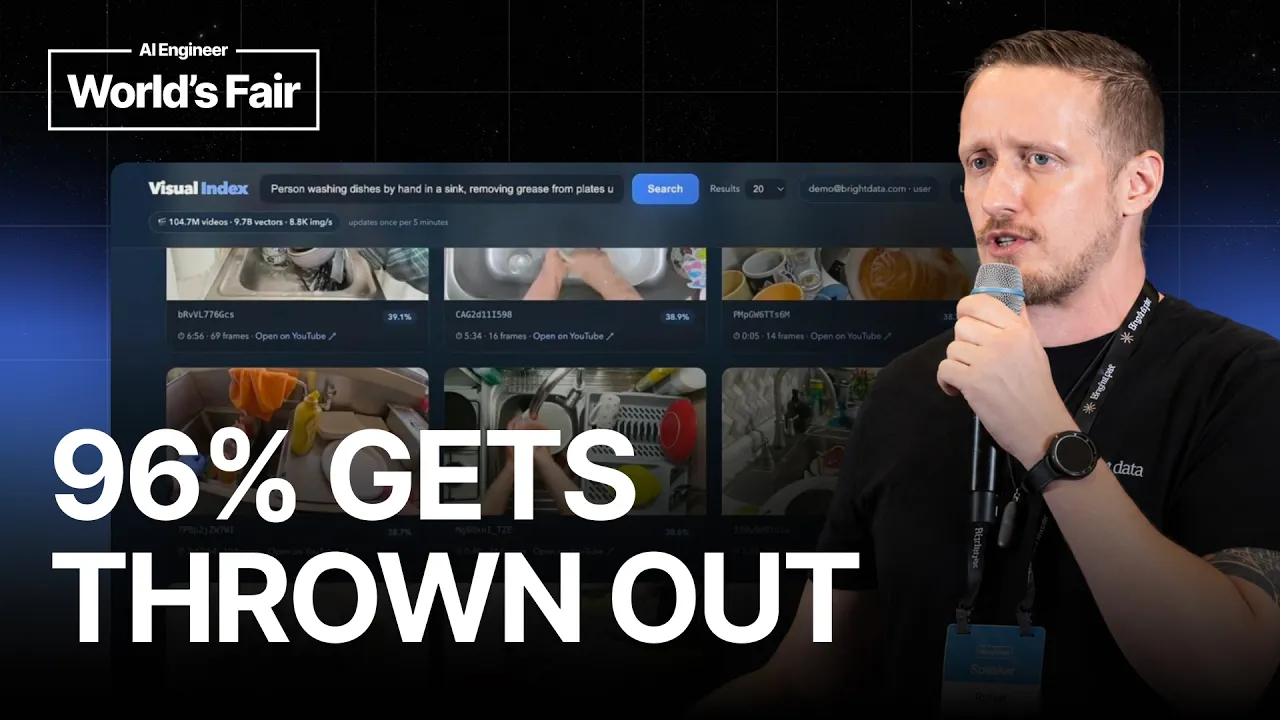
You do need to have some processing on top of that but it's available. It's out there and all you need to do is process it. So a few more examples right? So for example, Nvidia when they train in the Cosmos robot, they're throwing out about 96% of the video. So what does that mean? They download a million hours of video and the only part is 4% is actually useful. Everything else gets thrown out. That's wasted compute.
That's wasted bandwidth. That's wasted storage. That's just a lot of wasted money. Okay. Stable video diffusion is throwing out 74% of the videos that they're downloading. So in bright data we are trying to solve that problem and we're trying to take it a step forward. So what we propose is search first collect second. What we do is we are actually indexing videos and we are allowing you to search for specific actions.
Since we're talking about a person opening a door, let's keep using that uh example. What you can do on our platform is actually input detailed information, right? A query, person washing dishes, person folding a t-shirt and so on. And we will provide the snippets from the videos of these actions. So what does that mean? That means that there's less waste of data collection. there's less waste of storage and bandwidth, right?
So, a little more on how it works. Obviously, you define what you're looking for. We search through billions and billions of pre-indexed videos, not by keywords, but by actions, and we provide you with ready to use clips. And obviously, they're already trimmed, prepared for your training. So all you got to do is process them a little bit for maybe motion distance sensors and so on and it's ready to be ingested into a robot.
I have a small example of a video of how it actually works on our platform. So let me just hit play here if I can find it. So here we see person washing dishes by hand in sink removing grease from the plate using sponge and soap including rinse and placing dishes into drying rack. close-up hand interactions. So, right now what is happening is it's searching through billions of videos. Now, on this video, it's a bit old.
We only got about 100 million index there, but now we're up to 1.1 billion videos. And it will literally like this is a little sped up, so I didn't want to waste your guys time, but it will provide to you clips from videos of people washing dishes. And you can see right here all the videos in That would be fine. Now, some of these videos might not have to do anything with washing dishes. They might have cleaning kitchen.
They might have to do something else. And here's another example. For example, human folding different types of clothes, right? So, a little more description. The more description you give, the more you actually get back. So, again, a little speed up. Let's see. I want you to understand it could be anything. A person putting on makeup. Let's say you have a brand and you want to find videos where your brand is being found.
All that can be also provided. So you see people folding clothes. So now you can train a robot on how to fold clothes. Of course everything is available via API. We don't expect people to actually do anything manually, right? So you can trigger it by API. you get a returned snippet of the video, the URL. We give you the link to the original video if you want to watch it. But the main thing here is that we can give you the snippets of the video to train your robotics.
Now, I'm not sure if any of you training any robots, so I'm going to give you another example of how useful it could be. Let's say you have a brand and you want to know where your brand is being demoed on videos. The video titles doesn't matter because it doesn't actually consume. It's not about your product. It's just a person doing some podcast recording something. But you see a woman putting on makeup and she you see on the table that this is your brand of a makeup.
So now all of a sudden you can find all videos for your brand where it's being used whatever it is right by searching name of the video you won't find it by by video indexing you can actually find specific things that you are interested in apple falling from the tree and so on. So what comes back? We provide to you this time stamp. We provide to you the score matching, how close it is to your query, and of course the frame count.
How many frames are about what you're looking for? So what does this change? This changes a lot. Okay, less waste. You don't need to download million of hours of videos. you can actually get exactly the the specific actions that you are interested in. Again, it's very crucial for robotic training because noise creates problems, hallucinations, right? This removes the noise. What is it useful for? Not only robots, but obviously self-driving for example, Wimo, right? trained on dash cam video cameras and there's millions, hundreds of millions of hours on YouTube of dash cams.
How many of you like to watch accidents? Dash cam c accidents. I'm sure everybody watched them. Crazy driving in Russia, right? So, this is what we're talking about, right? The videos that are out there, okay? A person running a red light, person stopping on red light, making a left turn, making a right turn, and so on. All of that can be a very useful data for training and any other world models. Physics, right? Robots needs to understand physics.
What is the gravity? How to sit? How to walk? How to move? Again, of course, you can pre-record it. Um, a lot of times right now I speak to some of the people and they have millions of people recording videos for them. Hey, can you guys record me how you open doors? That's crazy. Why do you need a million people doing it when everything is available online? Online is one of the hugest databases out there. It's just people don't really like it's it's not that easy to use it, right?
I mean, right now the only search available to us is by the keyword of the name of the video. And of course, one source, the whole public video web in one place. I mean, we got YouTube, we got Vimeo, we got so many different uh video providers out there, billions and billions of hours of training data just there waiting for you to grab it, collect it and process it. So basically this is a new product that we're doing a bright data right indexing videos so that you guys can find specific actions anything you can think about you know again it could be useful for brands uh as well it's not only for training data anything you can think of could be useful maybe you are a gamer and you want to know how do you beat this level but there's no exactly video like that so you can search okay people beating the level on the video game, right?
Anything. The world is yours. So, I'm going to wrap it up. I don't know if you have any questions, but uh if you want to connect with me, talk about it more, feel free to to add me on LinkedIn. And um yeah, I'm going to thank you guys for your attention. And uh I'm at a bright data booth if you want to talk more about it. And thanks for coming.
The words are the caption track's own and nothing is reworded or re-transcribed. Paragraph breaks are placed between sentences so the text reads as prose.
Free tools for your own script. No signup, no login.
Paste your draft and see where viewers are likely to drop off, with a rewrite for each weak line.
Paste the first 30 seconds of your own draft for a hook score and rewrites.
Check your draft against YouTube's advertiser-friendly guidelines before you record it.
Read this channel's public videos and transcripts, and download a writing brief for it.