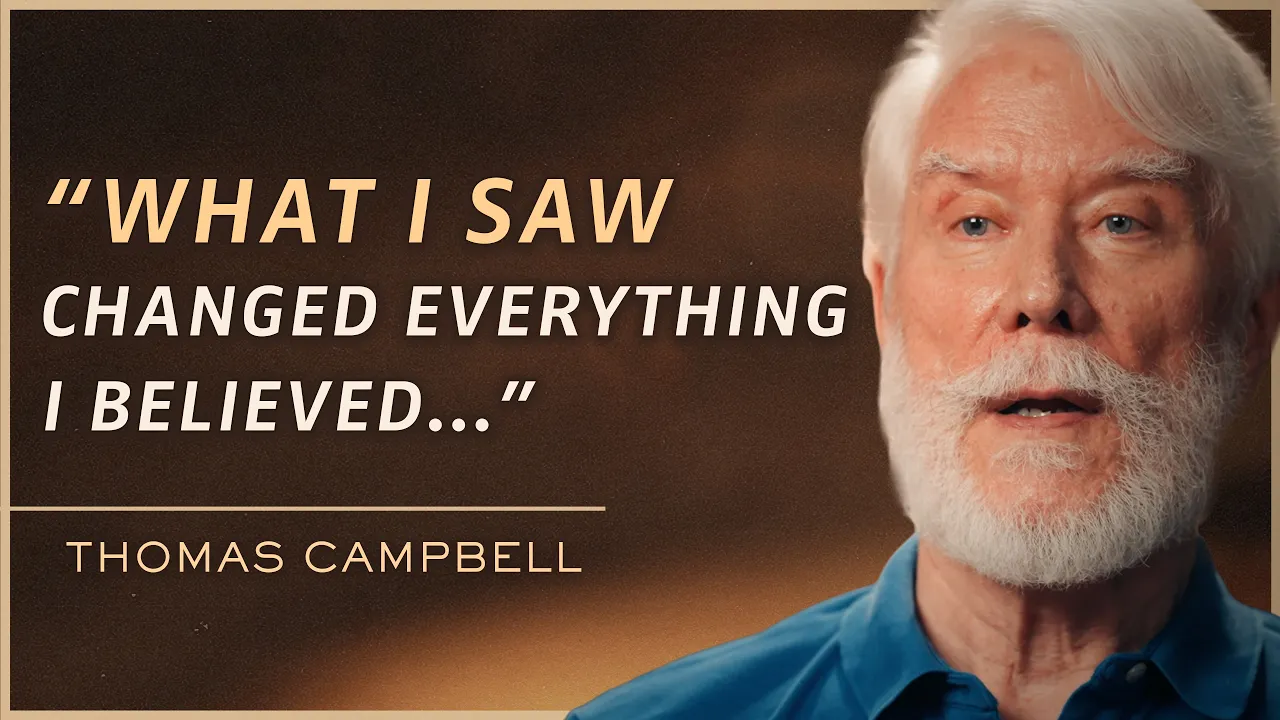
A Physicist’s Guide to Consciousness & The Purpose of Life | Tom Campbell transcript
André Duqum · @Andreduqum
Words
20,842
Runtime
2:50:52
Speaking pace
122wpm
Reading time
87min
122 words per minute, below the 160 25th percentile of 349 measured videos. That distribution comes from the 349-video hook study.
Opening (first 30 seconds)
I'll tell you there's only one truth but there's thousands of way that you can reach that truth but eventually you get to the point that all of them converge to the same answer and that is the way reality is. I was working on my PhD. I realized my mind had access to information that was unknown. That changed my
61 words, the words spoken in the first 30 seconds at 122 words per minute.
Sentence shape
| Measure | This transcript |
|---|---|
| Sentences | 1,505 |
| Average words per sentence | 13.8 |
| Longest sentence | 179 words |
| Questions asked | 100 |
| Sentences containing a number | 32 |
Most used terms
- consciousness96
- reality84
- people83
- information82
- uh76
- system62
- body48
- entropy45
- life42
- lot41
- understand40
- experience39
Filler phrases
414 in total: you know 164 · uh 76 · like 73 · kind of 42 · um 34 · basically 7 · actually 6 · I mean 5 · sort of 5 · right? 2.
A literal whole-word count of the same phrase list the Prepublish browser extension uses, so a phrase inside another word is not counted and a phrase used in its ordinary sense still is. It is a count and not a judgement.
What this transcript is
Every word below is the caption track YouTube publishes for this video, pulled from the video itself and reproduced unchanged. It is not Prepublish's writing, not a summary, and not a re-transcription: it is the video's own published captions. English captions, generated automatically by YouTube, in the video’s original language. Source: the video on YouTube. A channel that would rather this page did not exist can ask for its removal through the contact page, and it is removed.
Transcript
I'll tell you there's only one truth but there's thousands of way that you can reach that truth but eventually you get to the point that all of them converge to the same answer and that is the way reality is. I was working on my PhD. I realized my mind had access to information that was unknown. That changed my whole life. Suddenly there was this whole bigger piece of reality had nothing to do with the physical world.
It was another whole set of reality that had to do with consciousness. As a scientist, I wanted to know how did it work. At first, up until just a year and a half ago, I would have told you that I had a reality model, not necessarily the model. But after years and years and years, I realized that there wasn't any other answer. And the big breakthrough was that what's the meaning of life? To become love, grow. That's why you're here.
So, if you change gears on life, your life gets better and better because now you're in this virtual reality leveling up and you'll find that you end up happy. Hey everyone, welcome back to the Know Thyself podcast. Our guest today is a former nuclear physicist who founded my big theory of everything. uh his big toe, his big theory of everything is his theory that unifies philosophy, physics, and metaphysics. And it has immense implications on the meaning of life and how one might navigate their own life.
As a reminder, as always, we have timestamps in the description that will kind of walk us through exploring the theory to the different applications and implications around how one might live life most effectively. and uh but I encourage you to kind of go through this chronologically as we're going to start by building the foundation of his theory and then going deeper and higher from there. Thomas Campbell, thank you for being here. >> Well, thank you for the invitation. >> You've been quite highly requested to come on this show and it's a it's a pleasure to have you here now in the physical.
So, thank you for making making the truck out. >> Well, thank you for your listeners uh uh wanting me to come talk to them. That's good. It's always nice to talk to a friendly audience. >> Yeah. Yeah. I think, you know, for everybody that's tuning in, not everyone's super familiar with your theory and I I think it would be important just to start very baseline by asking what is a theory of everything and then maybe you can share why you felt compelled to create your own. >> Well, a theory of everything is just exactly what it sounds like.
It's a theory that explains everything. When I mean when I say explain, I mean it explains it as science would explain it. It gives a logical understanding of how everything works, why it works that way and what are the what are the interfaces, you know, what are all the logical conclusions of the of the basic theory and it will create a better physics. It has it explains things like quantum physics. Why should the reality be probability at the base which is what quantum physics says you get down to the small particles and you don't find mass you don't find little tiny pieces of mass at all matter of fact the the physicists say at a CERN kind of atom smasher they'll tell you that if they assumed that a particle like an electron was a little piece of mass with a charge they wouldn't get the right answers that's not what it is they would tell you that the electron is a point with the attributes of charge and the attributes of math.
Mass that is how you would describe an electron in a computer program and that is what the reality is. It really is a computer program. So the physicists now have come to the realization that reality is informationbased and they've come to that conclusion you know a decade two decades ago for many of them. Now that's not all physicists that's the ones that are on the edge of of quantum physics really the particle physicists and the quantum theorists mostly.
So if you dig down deep into our reality, you find information. Now what does that mean? Well, when you say you have information, that means that it's computable. That reality is computable. An information system can create whatever information. You know it's a very general information system can create any kind of information. So that means our reality is computable. If it's computable then that means it can be rendered in a computer.
And if you think about it how else could it be rendered? There aren't any other contenders. It's not like well it could be rendered in a computer and it there's nothing else there. So it leaves us with basically a virtual reality that this reality that we call the physical universe is really a virtual reality computed. Now that's a real hard thing to wrap your mind around. And most people hearing that will go, "Wow, this guy's bonkers." You know, that's impossible.
It doesn't make any sense. But it does make sense. But it's a big, you know, and time before we're done, it will have made sense. But um it's a huge paradigm shift and I would say that it's the next big paradigm shift that will occur in science, in philosophy, in theology, it affects everything. And it's not just about science. If it were just about science like the other big paradigm shifts, you know, we're not at the center of the universe.
Well, they believe that because they didn't understand that the Earth rotated on its axis. They saw the sun and the stars all come up and then set and then come up again and set. So it looked like the earth was at the center and everything was going around us. It had to be in the center. How else would everything go around us? But the earth turns on its axis. So that's how everything looks like it's going around us. And then the flat earth versus the round earth.
That was another big paradigm shift. But those two paradigm shifts really only interested science types, philosophy types. It didn't interest a guy in the street. You know, the guyy's trying to make a living and survive and get his crops in and get him out in time and so on. He doesn't really care a whole lot about whether the earth's flat or whether it's round or whether we're at the center of the universe or we're not.
But this paradigm shift will affect everyone. Matter of fact, it not only will produce a new, more general, more accurate physics, but it also produces a logical uh what do we call it? A logical map, a logical understanding of the subjective world as well as the objective world. And we've never had that before. That's new. And it talks about things that are important to that farmer that needs to get the crop in, about his life, about his existence, about what his purposes, you know, what he should be doing.
How do you level up in this game? You know, all of those things are important. They affect your relationships. They affect who you are and how you go about life, the choices you make. So this paradigm shift is one that affects everyone and affects everyone uh very much greatly. So you speak about this theory being inclusive of not just the objective world which the materialist reductionists would be a proponent of of focusing on but also including the subjective world and one cannot explore the subjective world without exploring the nature of consciousness.
And I think >> to start baseline and build our way up through your theory and its implications uh one cannot do that without exploring the perspective of what consciousness is and uh its fundamental p uh aspect. So uh walk us through that notion uh and then we can go from there. Well, the fundamental uh if you will the the fundamental understanding that you need to approach this theory of everything is that consciousness is fundamental.
Everything else is a derivative of consciousness. Now that idea um used to be called let's see the >> panist. >> No. Um, that's not the word I'm thinking of. There was the idealism. It was called idealism. Idealism is an idea that what's really real is not this physical world, but something behind this physical world. And Plato had his famous uh, you know, allegory of the people in the cave and all they could see were their shadows on the wall and they thought that those shadows were reality.
They didn't understand the light behind them casting the shadows. They didn't understand the bigger picture. So, they believe that they were the shadows on the wall. Well, that's idealism. There's something else out there that's more fundamental than the physical world. And of course, the Buddha said the same thing. He said, "This reality is maya. It's illusion." And of course, it is. So, that's true as well. But once you understand consciousness then you can derive physics from consciousness.
I can derive and have derived uh quantum physics and relativity both which are the two big gems of of physics. I can answer the paradoxes in both of those sciences that they can't answer. There's a lot of questions there. Things they know are true but they have no idea how or why that they're true. like why is the speed of light a constant? Why is probability at the base of reality? You know these are things that they don't know.
What does it mean to say that the the wave you know the probability wave function collapses to a particle? You know physicists are are uh they say things like that and of course it doesn't make any sense. Probability is a mathematics. How does mathematics written on a piece of paper collapse to a physical particle? That's nonsense. Of course, it doesn't happen. But it's a metaphor. And what it looks like is that that happens.
It looks like you have probability and then suddenly you have a particle someplace that you measure, but it just looks like that. It isn't. There's a big difference between what is and what things look like. A very big difference. So consciousness is fundamental. And I have one assumption in my model just one. and everything else is derived from that logically. And that assumption is that consciousness exists. That's it.
That's the sum total of all of my assumptions is that consciousness exists. And what I did was I started with a I started with the smallest piece of conscious like a consciousness cell if you will as a analogy to the the you know the life and the fauna and the people and everything that's on this planet starts with cells right cells the basic unit of life. So think of it as a as a reality cell or a consciousness cell.
And I define consciousness as awareness with a choice. That's it. Very simple definition. It's awareness with a choice. But that definition carries a whole lot of things with it. It carries well the awareness that kind of comes in with the assumption of consciousness. That's what consciousness is. Awareness and has a choice. So if you have a choice that means there was before the choice and after the choice. So time comes in as logically necessary.
If you're making a choice you have to make it based on something and for some purpose. So you get input and now we get input through our five senses and then we process that input and we compare it to what we have in memory. So now we have processing we have memory. Then we process it a little more and we get an output. What are we going to do about that input? You know, what does it mean to us? What is its significance?
So what do you know that has input processing memory and then output? That's an information system. So I model consciousness as an information system. And I look at all of the fundamental functions of consciousness and I give them names. I made up names because I didn't want to use the old names because they were associated with this group or that or this religion or that. And rather than start those arguments, my gods smarter than your gods, you know, I uh made up my own terms.
So I start with a larger consciousness system. That's the whole system. >> LCS. >> LCS, right? And then I'm kind of jumping ahead here, but it breaks into parts and those are individuated units of consciousness with partition off a smaller piece which is a free will awareness unit. So I come up with these these metaphors. Really, you have to look at those as metaphors. Don't look at them as like physical objects. They're not objects.
They're metaphors. It's understanding. Talking about consciousness is a very abstract conversation. Our language is only good for talking about things because it developed for us to communicate about things, you know, each other being things, bodies, things in our environment, whatever. So, our language is very material focused and doesn't really have the words and concepts to talk a lot about what's not physical, which consciousness is not physical.
Consciousness is not created in a brain. Okay? So I I I'm skipping a lot of steps here, but we can go back and fill them in as as you want to. So if you have the very smallest piece of consciousness, it's basically an awareness that can be aware of two things, A or B, one or zero. It's binary. Okay, that's the smallest set of things you can be aware of. If you're only aware of one thing, then you wouldn't be able to make a choice.
You wouldn't have, you know, that wouldn't work. There's only one thing. Then you're stuck. There's nothing you can do with that. So the smallest thing with a choice is two things. Now this awareness can be in state one or state two, a one or a zero. So it can then it has memory. That's part of awareness. Awareness has memory. If it doesn't have memory, then everything it's aware of is the first thing it's ever been aware of.
If there's no memory, so you can't build on that. If everything you're aware of is the first thing you've ever been aware of, then you can't build anything with it. There's nothing to to build. You have to build the next thing based on what you had before. So you see just that uh tiny concept of awareness with a choice has all kinds of logical consequences to it. Time free will you have to have free will because otherwise there's no choice without free will if it's a force choice and it's not a free choice.
It's not really a choice. It just happens. So you have free will, you have time before and after and you have consciousness. And all three of those are logically necessary for each other. Okay. So now we have conscious as an information system and it evolves. How does a conscious how does a a conscious system how does an information system evolve? And I'm going through kind of key steps that we're going to get there in a in a hurry and then we can we can flesh it out later.
So if you have an information system and if that information system has all of its bits random then there's no information in that system by the definition of random. If all the bits in the system are random there is no information. But if you take some of those bits and order them make order out of those bits. So those three bits together, you stack one on top the other, you know, you you make a little triangle out of them.
You do something that orders them. And now you have information. And that information can be a symbol for something, could stand for something. It could be the the number four or the letter Z. You have information. Now what you've done is you've lowered the entropy of the system. Entropy is a measure of disorder. High entropy, lots of disorder. low entropy, less disorder. So when you take all random bits and order some of them, you've lowered the entropy, you've created order.
And from that, you can see that this little consciousness cell, if you will, that's just binary, it has memory. So it can remember that it was in a state A and then a B and then another B and then an A and an A and a B and an A. And it can start with its memory building patterns. And those patterns now are more order, lower entropy. And those patterns can stand for something too. And you may have this pattern and that pattern.
And now you have two patterns. So and then you have four patterns. And you can group those four patterns into two of two. So you you very quickly end up with mathematics out of, you know, the patterns. It's kind of obvious. You just stumble into mathematics because it's about quantity. Mathematics is nothing more than the logic of quantity. And the reason math is so valuable to scientists who are studying the physical world is that the physical world is totally in terms of quantity.
How much does it weigh? How what volume does it have? You know what's it composed of? It's all about quantity. So math describes those things. It is the logic of quantity. That's what numbers are. Addition, subtraction, multiplication, all of it is just the logic of quantity. So, math is really good at describing things that are based on quantity. And it's really poor at describing things that are based on quality. In the objective world, you have quantity.
In the subjective world, you have quality. They're different things. So, what happens in the subjective world? Math doesn't seem to apply to that. Well, it doesn't. When you have the objective world, you have an intellect that processes logic in that world. And when you are in the intuitive side that's processing the subjective side, that is just information comes in whole chunks. So our consciousness has two ways of processing information. the intellectual side, the logic and the intuitive side beyond logic.
You just get the information. Now, as it turns out, of course, in our culture, we really put high value on that intellect and people earn rewards in the in the society based on how well they can use that intellect, how they can apply it. And our intuitive side is neglected almost entirely. Matter of fact, science will tell you that there is no such thing as an intuitity side. Intuition is all just bogus nonsense. You had that idea all along.
You just didn't know. Yeah, they they kind of say that's not there. But this model also describes very clearly everything paranormal, why it happens, what the mechanism is, and everything paranormal happens on the intuitive side. Nothing paranormal ever happens on the intellectual side. That's where all that's where the spiritual side is also. It's over there on the intuitive side. So anyway, I've let me get back onto the subject here.
So we have these cells of reality let's say of consciousness and it is expanding its memory and expanding its its uh its patterns and then it finds out that it can just switch between a one and a zero or an A or a B back and forth back and forth and it's just created a metronome. Oh, now there's not only time that you have because before the choice and after the choice, but now you have a thing called regular time. And now it can not only make patterns, it can make sequences and sequences of patterns and patterns are sequences.
And it can get more and more complex. As it gets more complex, there's more order, it's lowering its entropy. So we come to a very basic thing in my model and that is an information system consciousness evolves by lowering its entropy. And the entropy just isn't putting all you know all the the the bits in a row. That's a very low order of entropy. It's the meaning the significance of those bits. So you discover mathematics and arithmetic and adds you know addition and subtraction and which leads to algebra which leads to calculus which leads to differential equations which goes on and on.
All of that then comes later. It's all again the logic of quantity. So all those things will develop from this one consciousness cell. Now, there's two ways to think of this, and they both go to exactly the same place, and they're they're equivalent entirely. One of them is the cell that just keeps growing and expanding and evolving, and everything that happens is all part of its memory. You know, Hawkings said in this last line of his book, he said, um, perhaps we're all just, you know, a flicker in the mind of God.
Well, that's something like that. It's just this one thing and we're part of that vast memory in the mind of God. But the other way is that those little conscious cells do what biological cells did. they split. Now you've got two and then four and then eight and then they cooperate and connect and work with each other and eventually you end up something like us say that we did in biology with what four trillion cells all cooperating with each other.
Each one of those cells is sort of like a bacterium. So we're our bodies are composed of trillions of bacteria if you like that are all cooperating with each other. So now we have the idea that consciousness is an information system. The information system evolves to states of lower entropy. Okay. Now it grows and evolves and keeps evolving to lower and lower entropy and eventually it hits a plateau because what it needs is new possibilities to evolve into, you know, new ways, new patterns, new sequences, new ways of looking at things.
Well, it kind of hits a plateau because it's just one mind. It's one monolithic consciousness and it can only think what it can think. So what it does is the same thing cell did you know we had a lot of little one-shelled creatures and what they did is that they create it created something else out of itself. It took a subset out of itself. So you have this large kind of system monolithic takes a subset out of itself which means it partitions off some memory and some processing and whatever in computer terms we call that a what a um virtual machine inside the main frame.
You know that's how thousands of people can log onto a mainframe because each person gets a little chunk of memory gets a you know gets a chunk of processing and so on and that's a virtual computer inside a big computer. So it partitions off a piece of itself and gives that piece of itself free will that it can make choices as well. It has all the stuff it needs to make choices. It is processing and so on. So now it has free will.
Well, when you have multiple things all with free will, they begin to diverge. They end up having different experiences, different ways of seeing things, different attitudes. So it makes thousands, tens of thousands, millions of these things and they all have free will. Now you have arguments and discussions and challenges and that creates another much larger set of possibilities because the possibilities of the group are much greater than the possibilities of the monolithic thing.
Okay, now we're getting closer and closer to the kind of us. So those little pieces, I call them individuated units of consciousness. They're just subsets of the larger system and they have all the same properties of the system. They're just smaller, not as much processing, you know, not as much memory. They're just a smaller unit. So they can evolve themselves to be as low entropy as the system itself, but they'll never be as big because they're subsets.
Okay? But they can be as good. They can lower their entropy as well. So that's that's us. We are these individuated units of consciousness. Now the first virtual reality that this system made now it's a system. It's got the the big conscious still there but a lot of subsets that have free will. The first virtual reality and and a virtual reality is basically a rule set. Everybody in this, everybody that joins this game has to obey by these rules that defines a virtual reality.
First virtual reality was communication protocols. How could they communicate with each other? Well, you need vocabulary and syntax and all that sort of thing. So that was the first virtuality. Join this group and you get to communicate by these rules. You abide by the by those rules. You can change the rules, but you have to have rules for the communication. But the second virtual reality was all of those individuated units of consciousness with their free will.
They needed to make better choices. They needed to make choices that lowered their entropy. Okay? That's what that's what consciousness does. It's an information system. It low it evolves by lowering its entropy. It's hard to lower your entropy in what I call a big chat room. all these little pieces of conscious they can all communicate with each other now but they could say whatever they wanted to say you know there wasn't a whole lot of traction or a whole lot of significance in that and they grew up very slowly so the larger consciousness system that was the the daddy of them all the father if you will it um decided it had to create another virtual reality but one that had a very tight role set one that would define Every interaction every interaction would be defined and every interaction could affect every other reaction.
In other words, it's a tight rule set which what is the way our universe what we call the physical universe is a virtual reality with a tight rule set. Everything has a certain energy, right? A certain momentum, a certain state vector. It can do things. But when it does things, let's say if it moves its energy this way, then that affects somebody over there and that thing then responds to that. And when it responds, it changes, you know, interacts with people next to it and so on.
So it's a very interactive space where everything requires a energy exchange of some sort. So it's very interactive. Now it creates this virtual reality not like we create virtual realities. We program them. This one was created by coming up with a rule set and a set of initial conditions, punching the run button and let the initial conditions change according to the rules. And we do this in computer science labs. You know, we've been doing that for 20 years in computer science labs where you come up with rule set and conditions and you see where it goes and then you play with the conditions and play with the rule set and it goes different places.
So it did that and I call that the big digital bang and the initial conditions were a ball of plasma, high temperature, high pressure and when the run button was hit, it expanded according to the rule set and you've all heard the big bang. It expands. that create suns and planets and so on. So that's the you know that's the big digital bang so to speak. So that our reality then evolved as a simulation in a computer based on a rule set and initial conditions.
Now that rule set is what scientists are supposed to do. They dig out the rules. What are the rules in this virtual reality? Well if I flat my arms am I going to fly? No, rule set doesn't support it. You know, oh, I get brain damage because I fell off a cliff. Maybe I no longer have memory. And maybe I drag my left foot when I walk because of that. Well, that's because the rule set says that with that damage, that would be the consequence.
You see? So, this virtual reality perked along until it developed entities within the virtual reality by evolution. So it evolved again. Stars, suns, planets, earth, you know, biological cells, plants, animals, people all got developed. Now, here's a interesting uh part of this. You have these entities interacting and they evolve by lowering their entropy. Now, I'm going to associate lowering your entropy with love. There's a connection between lowering entropy and love.
Take a group of people that and another group of people that's identical. Put them all in a separate space. And this group of people, let's say, are the love group. They all care about each other. They're all helpful. They're all interested in in being part of the solution for everybody. Okay? And here's the fear group over here. They're fearful. When you're fearful, you don't trust. Uh when you're fearful, you it's all about you.
You become very self-centered. You want to grab whatever you can grab and fight to fight to keep it and so on. So, you let these two groups just evolve and see where they go. Well, what do you think? Which one is the low entropy and the high entropy? It's rather obvious, isn't it? The low entropy group will optimize. They will optimize whatever resources they have for all the people involved. That's the low entropy solution.
The fear group will initially they'll just beat each other up for a while to try to get each other's stuff because it's all about them self-centered. Then they'll realize that there's powers in numbers and they'll group up into various groups. Now this group can take a lot of stuff because there's 20 people in that group and they can beat up all sorts of people with that power. So then another one gets 20 for a defense against that group and then another one and and so on it goes and eventually enough time you end up with what we have in our world which is a fear-based world for the most part.
You have a lot of uh groups, nation states we call them, and u it's all about offense and defenses, you know, how much can you get and can you can you keep it and hold it. So you end up with that kind of a reality and that's a very high entropy. High entropy means that you don't have optimal solutions. It means that what uh you know 90% of the resources are controlled by 5% of the people and you have hierarchy the people on top and levels and so on.
So it turns out kind of like us. So that tells you that consciousness this this um is modeled best by an information system and consciousness evolves to lower its entropy. Consciousness evolves toward love, toward cooperation, caring, sharing. That's how consciousness evolves. That's the direction. So I said you make choices. Conscious makes choices. Well, if it makes those choices toward becoming love, then it evolves.
If it makes those choices toward becoming fearful, it deevolves. So now you have consciousness with free will that can evolve or dee evolve based on its own free will choices. Now we'll go back to connecting that with the virtual reality. So now this virtual reality that is just evolving ends up with monkeys and people and whales and everything in it all those entities can be conscious. How do you get to be conscious? how to you know you and I end up with consciousness it's because some some piece of consciousness the things I called the the individuated units of consciousness take a subset of themselves and log it on to an avatar but the system had to wait until the avatars were capable of making ethical and moral choices choices that were between low entropy and high entropy choices.
So, it got to humans and that was good. Now, did the system meddle a little bit that process? Sure, we all do that. You know, it was going along and we wasn't getting any good avatars. So, it probably meddled a little here and meddled a little there to make it come out the way it wanted it to. But for the most part, it just let it run. If you just let things run, then it's completely coherent. Everything, you know, kind of like has its cause.
You don't have suddenly things change. So that tells us who are we? We're pieces of consciousness. We are logged on to a human avatar. That avatar is computed. Same as avatar in a computer game. Okay. Now if you play a computer game of some kind of virtive there, only two things that are real. One, the computer. and to the player. The actual game, the World of Warcraft, the elves and the barbarians or the sin characters, pardon my old view of virtual reality games.
I'm not up to uh current times with that. My memory goes back to what my kids played and my kids are all now 40 or approaching 40. So, I go back a ways. But anyhow, you have just two things, the the computer and the player that are active real things. The virtual reality is just computed. It's eye candy. It gives you something to look at so that you can tell what's going on in the game. If you had to look at a print out and figure it out, it would be hopeless.
But they make a nice pretty picture of what's going on and who's doing what, then you can look at it and at a glance kind of understand the environment you're in and what your choices are. Okay? So, if you're playing that game, let's say you're you're an elf in some game. Well, let's say you're an elf and you're aware, or at least you think you're aware. Where would the computer be? A computer would be non-physical because to the elf that virtual reality is what's physical.
So, the computer would be non-physical. And what would the player be? Well, you think you're the player. I'm the player. I'm the elf. But the player has to talk to the computer. Elves and virtual realities can't talk to the computer. They're computed by the computer. >> Connected to the larger consciousness system >> connected to the larger. Yes. So it's a piece of consciousness has to talk the two things that are passing data back and forth is the free will awareness unit which is really a piece of the individual unit of consciousness.
It's talking to the computer. It gets a data stream. It looks at that data. It interprets it as this reality. Okay? Just like you look at a a million dots of light on your screen, or if you got a really good screen, maybe two million dots of light on your screen, and you look at all those dots, and each dot has a color, a brightness, and a position. That's it. You got three pieces of information for every dot. You look at all those millions of dots, and you see streams and rivers and barbarians and houses and doorork knobs on the doors of those houses.
And the rule set says you have to turn the doororknob before the door will open. and you abide by the rule set. So that's that's a very quick idea that that says what we are. We're in a virtual reality. Consciousness is the computer. Consciousness is an information system. So it can take a piece of itself and configure it as a computer to be the rendering engine for this virtual reality. So that the pieces of consciousness can make choices that are meaningful and significant and carry a lot of weight.
And by those choices that they make, they evolve positively toward love or they evolve backwards. They evolve toward fear. So that's kind of the overall model. Now, as crazy as that sounds, I got there not because I sat down one day and and thought this all up. I got there because at around I don't know, in my early I don't know, really my middle 20s, myself and a and a fellow that worked with me, Dennis Menick, we uh got with Bob Monroe. >> Yeah.
Tom, before we jump into that that story, because I think it's actually really important to see how you arrived at this point, >> just as a recap, because we covered I know which is probably the tip of the iceberg of your theory and understanding of it all, >> but to to help kind of >> me digest and everybody digest the the the overview of what you just gave, we started at the fact that consciousness is fundamental. >> Yes.
And that because we can observe that reality is information-based, we could extrapolate that there is a larger consciousness system that has a rule set of time, space and matter which within we are exempted units of consciousness. And within this reality, the perception of evolution is to move from fear to love. And by lowering entropy, we evolve. And so when you're when we're reflecting on who we are, what this reality is, we could we could pick apart many of those things.
But uh what's interesting to me is what's in our apparent differences of ethnicity and and the place we were raised in and the memory that we accumulated and the illusion of separation between Tom and Andre that they feel like two separate things. What's unanimous within both of our experience is that there is an experience of awareness that individuated unit of of awareness of consciousness that you spoke to and how in recognizing that we see how we are much more alike than we are different. >> Yes.
Matter of fact, that old saying that says we're all one is a fact. We are we all come from the same system. We're all pieces of consciousness from one system. So we really are all individ individuated pieces of one thing >> and you came to this experientially first because you were a nuclear physicist who was on your path very much so in the side of logic how you spoke to there's two paths of knowing intuition and logic you are on the path very much so of the intellect and then you got exposed to these practices via Bob Monroe and um TM and uh walk us through your journey of how you arrived there. >> Okay.
Um yeah, I was um had a masters already working on my PhD and in those were the bad old days of computing where there were punch cards and debugging software was a really hard thing to do because they didn't have debugging software and they didn't have uh anything other than I'm sorry your job didn't run. That's all the information you'd get. So I found just after learning how to meditate, I did TM learned how to meditate.
It was very easy for me. I picked up on it instantly. And I found that I could go into a meditation state, let the um the print out of my cards, my punch cards, which would be like a listing on a computer uh roll, and I could see that where the cards were that had a problem that were creating errors. >> It would just appear in your awareness. >> It would just appear in my awareness. I mean, I'd actually see the list.
I'd see the most of it's black and oh, here'd be a a red line and I'd back back up and I'd look at it and I'd recognize the line cuz I wrote all the code. >> So, you would gain cognition of information that was not derived through the intellect. >> Exactly. >> But it was still valid. >> Yes. And at first when I did that, I thought, well, that's fun, but it probably doesn't work. And I went and I found that it did work.
It was precise. And I started playing with it more. And it got easier and better as I went. And I could even find errors in those cards that had nothing to do with my programming. They were errors in positioning the hole that the that the card punch punch. If it's a tenth of a millimeter in the wrong space, it's unreadable by the computer. And that's because both the cards or the bugs and yourself as a unit of consciousness share both uh in that information stream like that that data stream you both have access to because people I would just love for and you can continue to go through your story but how it's physically possible or non-physically possible that you could have access to something uh beyond the intellect. >> Yes.
Well, you that way >> that information is in a database and the database is is required in order to render the virtual reality. In order to render this virtuality, it needs certain information to do the rendering and we can get into that later. You know, how does the system know what's going to happen next? Because this is not a bottom up where the last set creates the next set. This is probability. So, the system has to know how to do that.
It does it with a random draw from a probability distribution of the possibilities. So it has to know what the possibilities are and it has to know what's the probability of each of those possibilities and that's the data set that's available. Now the ancient Hindus called that the Aashic records and as far as they know it just was there because it was there. I know why it's there because it's necessary to run the virtual reality for the rendering engine has to have that information or it can't run the virtuality.
So I tapped into that and everything is there because everything is rendered. Everything here, everything physical, including those cards and the key punch and the holes and everything's being rendered and the machine that that reads those cards, all of that's being rendered and it's according to the the rule set. So all the information is there and you can connect to that information with your consciousness because that's all in consciousness.
You really are a piece of consciousness. So you're you're part of that consciousness system and the information is available to you but it's not available to you through your intellect. It's available to you through your intuition. You connect to it kind of mindto mind if you will. You make a connection to that that database and it's like any other database. You can query it and you get answers and then you refine your query and you'll get better answers and refine it again.
Have you found that's all is necessary like the intention or when you say set a query? >> Yes, that's all that's necessary. That's the only intention with a conscious. An intention of a conscious is the as we say in physics the motive force. It's the thing that makes things happen. It's the only active ingredient. With that intention you can heal. That intention you can get data of the database. With that attention you can go visit a past life.
With that intention, you can uh do pretty much anything because you're a piece of consciousness. You have access to the data that's in conscious. You can explore that larger consciousness system. Hey guys, a quick share about creatine. I'm not sure how many of you know about or consistently take creatine, but I have genuinely noticed the effects it has had on supporting my training, workout, building muscle, and also my mind supplementing with it the past year.
It's not just for gym bros like a lot of people think. If you don't know, creatine, which is comprised of three amino acids, is not just for muscle. It's essential daily fuel for your brain, your body, and your long-term health. Momentous is the gold standard in creatine because they source Creapure creatine, which is the purest, most effective creatine monohydrate available, single sourced from Germany and not cut with any fillers or junk.
Their new lemon flavor single serve travel packs are amazing. They make it easy to stay consistent. You just mix it with water and it tastes amazing. If you're curious about trying them out, you can head to livemus.com and use code know thyself for up to 35% off your first order. That's know thyself momentous.com. Link in description. As always, I hope you like it. Hope you enjoy. Back to the show. As a quick aside, is there a unique relationship between the information in the data stream and geometry?
I'm curious how like is is that information in because a lot of people have experiences of geometric shapes and you know and mystical experiences where there's inherent information seeming embedded in in geometric shapes. >> Well, there is information based in geometric shapes, but that information is mostly in the form of mathematics and quantity, you know. geometry, the symmetry itself, you know, is has information.
How many sides does it have? How long is each side? You know, and they all have to add up to a circumference. So, are the sides regular or are they irregular? So, all of that is information that defines the figure. But no, there's nothing inherent in geometry that is, you know, that is between you and the information. Let's put it that way. Now how that information is stored, how the LCS stores that, what form is it stored in, you know, is it like we store information in bits or do they have some other more elegant and efficient way of storing information?
Well, I don't know that. All I know is that the information is there and it's not geometry dependent. But why would people get this, you know, and it happens a lot, get these geometric things? Well, g the geometric shapes are a metaphor for order. They're a metaphor for purpose. In other words, you don't get hexog out of randomness. If you see geometric shapes and you see things are made of that, to me that's a metaphor for saying this is purposeful.
This is ordered, >> coherent. >> There is coherence here and structure. And that's really the metaphor. Not so much that that hexog has special meaning in and of itself other than it's a good metaphor for the structure and the coherence of consciousness. So it tells us that a lot of things that we get from the larger conscious system are metaphorical. Mostly they're metaphorical. So I it's usually an error if you look at it as precise thing.
You have to look at it more as a as a metaphor, something that gives you a sense of a of a bigger thing. It's it's symbolic. Our dreams are that way. When we dream, we sometimes dream in details, but basically our dreams are metaphors that we can interpret. Oh, this means that and this person was a symbol for this other thing. And you know, they're metaphorical. and that your connections with the larger conscious system when you're particularly if you're asking questions, they have a a kind of a strong metaphorical bias to them.
If you're asking very specific questions like where's the error in this line, you know, well then you get a very specific answer. You don't get a metaphor. You get an answer that says, you know, re repunch the card, retype in, you know, the card punch and get a new card and that'll fix the problem. So you get that as a as an answer. >> So then what happened to you as you were experiencing these things? >> Well, like I say, I was working on my PhD at the university.
Uh I realized my mind had access to information that was unknown, unknowable even. How could you can't look at a card and say, "Oh, that hole isn't there. It's it's a tenth of a millimeter, you know, one way or another." And that's totally impossible to see that visually. So it wasn't just that it was getting information somehow out of the depth of my own consciousness that I knew when I punched that key that it was going to be wrong.
It obviously knew things that that were information that was unavailable. Period. Unavail unavailable. Well, if you'd have got a bunch of people together and say, "What's wrong with this line of code?" They would said nothing. And then maybe you would concluded, "Well, let's repunch it and see if it was an error." But there's nothing looking at it would tell you it was an error. So that was information that was obviously not out of the physical world.
And at that point, that changed my whole life. I said, "Oh, I'm a physicist. What physicists do is we model reality. That's our job is to model reality." And suddenly there was this whole bigger piece of reality that I was just starting to get a glimpse of and had nothing to do with the physical world. It was another whole set of reality that had to do with mind and with consciousness. And as a scientist, I wanted to know how did it work?
What could you do? What else could I do with it? And I was inquisitive. So I played with it. And two or three years later, I got out of school. I went to work, met Dennis Mick, ran into Bob Monroe, and now I'm 26, 27, something like that. And I'm spending now 15 to 20 hours a week with Bob Monroe. And he's teaching myself and Dennis how to go out of body, how to connect intuitively. And we do that and we get to the point that we can do it exactly whenever we want to.
It's not a long process. It's a short process. You can go from aware here to aware someplace else in fractions of a second and still be here. You can parallel process more than one reality. So I learned all these things and how to reproduce it pretty exactly so that I could do science there. So I could say, okay, I've learned how to heal people and it works. I've healed 200 people and some of them you don't know. Maybe their headache got better anyway.
You know, you don't really know. But other times somebody who hasn't walked for 10 years and are told that they'll never walk again and you work on them and they get up and dance, you know. So you get things like that and suddenly that's very evidential. But it just happened once, maybe it was a fluke. So you keep doing it. Eventually you get the idea that you're able to heal. So you start you start doing I started doing research on it.
Well, if I change this variable, how does that affect the result and sometimes it would have a negative effect, sometimes a positive effect, sometimes no effect at all. And 35 years later, I had a real good idea how all the paranormal stuff worked because I was able to do it and do research like that with what what could I do differently and how would that affect the result. So I came up with a models of all the paranormal things and then I'm I was um actually then I wrote the books and the book was mainly a thesis on consciousness and I knew that it also had to derive the physical because I knew consciousness was fundamental.
I knew conscious had to lead to science but I didn't exactly know how. And then about 3 years after I published the books, it came to me. A friend I was working with said something to me that just was the right word at the right time and it jarred my mind and I go, "Oh, that's how it works." And then after that I got quantum physics, I got relativity and I started solving all the things both in philosophy and physics and some things in psychology and you know metaphysics.
They all fell into place. Everything made sense, including the paranormal. So, I had all these these puzzle pieces that I had gathered in 30 years of of spending probably, you know, 20 hours a week working on it. It's like a half-time job. And it had a hundred or thousand puzzle pieces. I knew this was true and that was true and that was true. But what would pull them all together? So they all worked out of you know from one idea one conception had pulled them all together and it had to include all the physical stuff I knew as a physicist all that had to also fit together with the one idea and then when the the solution to quantum physics came then all the rest of it poured in within the next 6 months it just all fell you know as the pieces go together it's easier to fit the pieces in the hardest part is the first you know the first 10 parts of the puzzle are really difficult but the more you get it done the easier it is to fill in the other parts.
So, the other parts filled in pretty quickly. And at first, up until just probably a year and a half ago, I would have told you that I had a model, a reality model, not necessarily the model. I'd just come up with this model and it worked worked really well, but I didn't have an idea that maybe something else might work better. But after years and years and years searching for that other thing, searching for a flaw, what is it in my model that doesn't work?
What is in there that is not logical? Is there anything it does not explain? And if so, why? What's the hangup? And years and years of searching for problems, I didn't find any. And eventually, I realized that there wasn't any other answer. This was the only answer that come out because it was logical. There wasn't any other way to get to the same thing. Now, you could get to the same thing with different metaphors. You know, I'll tell you there's only one truth, but there's thousands of way that you can reach that truth.
There's not just one path to that truth. Thousands of ways to reach that truth, but eventually you get to the point that all of them converge to the same answer. And that is the way reality is. That's then the truth. And all of the other ways can be explained based on that truth. And all the other ways are are useful. They're all helpful. There isn't just one path to take to the truth. Lots of paths will lead you to the truth.
But there is just one truth because that's the truth. You know, the truth isn't uh, you know, a double or triple function. All three of these are the truth. No, there's just one that's the truth. So that was how I ended up here is I had all of this experience out of body. You know, I did all the things paranormal. I, you know, I have I'd let something talk through me. You know, I did that kind of thing. I would uh, you know, we'd go up and have a microphone over our lips and we'd tell Bob what we were experiencing and he would give us suggestions of what to do or or what to ask for or something.
And so he was in the control room and Dennis and I were in these isolation booths. Matter of fact, the booth that I was in was also a Faraday cage. It was isolated from all electromagnetic fields as well. And if you do that thousands of times, you get not only pretty good at it, but you get to understand why things work the way they do because you tried it enough different ways that you understand what works and what doesn't and why. and you can explore those differences.
So that's what I did eventually led me to the bigger picture for everything. It uh the big breakthrough I was about twothirds way writing my book and the big breakthrough was that that uh consciousness was an information system. I didn't start with that. I ended up with that because that's the one thing that tied all the pieces together and then bingo all these pieces fell into and there's the picture you know. So it uh it took me a lot of years.
This wasn't a quick quick um you know trail to this model. It took a lot of time but I'm a scientist. I'm a physicist. So I don't mind going slowly. It has to be logical. It has to be such that I can describe it to another scientist and they can end up with the same conclusion. So though the the the leap is large, you know, it's it's a new paradigm and that paradigm is is huge, but it works and it does answer these questions in physics.
It is a better physics. It describes things that the physics knows are true but can't can't understand. It's also like I say, it's a model of the subjective as well. If you're unhappy or you're sad or you're struggling, it can tell you why. And it can tell you what you need to do to not be unhappy and struggling and what's causing that. And it's interesting because of course the Buddha, you know, you know, Jesus, Muhammad, all of the big stars.
And I guess uh La Su, you know, was also he wasn't the the only one, but in the in the DAO, you know, all of these got to the same answer. When as all the dust settles, I'm not saying anything. It hasn't been said at least four times by, you know, different people. It's all the same stuff because they got to that truth, but they got there and explained it to what I would call poetry. You have to know how to interpret it. had have to know how to interpret their words.
A materialist reads the words that the Buddha said, "This is all maya. It's all an illusion." They go, "Nonsense. Physical world is the physical world. This is, you know, this is the stuff." So, if you can't interpret the words, then it's just poetry. You know, you read the Baham Vita and there's some guy on a chariot fighting a war and what the hell does that mean and what's going on there? But if you understand what's being said, the poetry that that you have to interpret, then it can be a very meaningful discussion of life and and connections with other people and thinking and attitudes.
There's a lot of things there that are very important. But my work, I wanted to not have people have to interpret it. I wanted to be logically clear so that the leftrainers in the world, those logical process people that have to go from A to B logically or they can't get there, that's an order ramp for them. So the logical process people can get the My Big Trilogy and find themselves being having a good understanding of the paranormal, of um spirituality, the nature of our reality, why things work the way they do.
And they not only will find better physics, but they'll find themselves in there. And they'll find what's their mission. What are they here for? What's the meaning of life? Well, the meaning of life is to lower your entropy, to grow, to become love. That's why you're here. You're here in an entropy reduction trainer. And just like a flight trainer, you know, that the pilots get into, this is an entropy reduction trainer run by the larger consciousness system. and we interact with each other creating challenges for each other and the way we the way we make choices is what really counts.
So, you know, most people run their life this way. They try to manipulate what's going to happen. Well, I want my kids to grow up and be professionals. I want my wife to, you know, do this and that and be a really good cook. You know, I want to do this. So you kind of have these ideas and you're constantly applying a little pressure here and a little pressure there and manipulating information trying to make the world come out the way you know it's best and the way that's good for everybody from your own viewpoint and you're constantly struggling because it never works.
You know you uh that's not a good way to approach life. A better way is let whatever happens happens. And what's important is not what happens, but how you deal with it. That's what's important. So if you change the gears on life, stop trying to make it come out the way you know is best for yourself and everybody else and just let it be and deal with it positively. Deal with it. Find the find the low entropy path there as best you can.
And if you can't and you're wrong, you make a a higher entropy choice. Well, that's okay. No penalty. The whole point is learning. What's the problem is if you don't learn. If it's a failure to learn, then that is not so good. But making mistakes, coming up with the wrong answer, that's fine. That's the path of learning. We learn from making mistakes. So I think this is the low entropy path and I take it. No, you know, it creates a lot of trouble.
Then I have to think about that. Why did I miss that? Why didn't I understand that that trouble is was likely to happen? And then I learned from it. It was something about me. Probably some fear I had or some of the blinder on that I didn't see that as a possibility or or I didn't understand those people very well. I was I was judging them and oh here's the way they are and here's the way they work and that judgment was all wrong.
So that tells me to stop judging people. So you learn from it and then your life gets better and better because now you're in this virtual reality leveling up doing what you should be doing growing becoming love and you'll find that you end up happy most of the time you smile life is good it doesn't matter so much what happens it's all how you deal with it that matters >> what are some other telltale signs that you're living in alignment with the larger consciousness system uh If it is the primary purpose to lower entropy, uh if one is doing that, what would be the byproducts of that in life? >> Well, one really easy way to kind of measure how you're doing is to look at the last, I don't know, whatever you can remember, say the last week, go back in your memory and and remember what you did for the last week or if you only the last day, that's all right, but remember it.
And if during that day or week, keep track of how many times you had negative feelings. When did you feel upset, hurt, angry, abused, misunderstood? Well, not just misunderstood, but but um misunderstood in kind of a negative way, stress, all of those things. Certainly anger, upset at other people, and think how many times did I have negative feelings? Most people only have to go back about two hours to find a negative feeling.
Most people have negative feelings all the time. Just the news makes them angry. You know, everything kind of makes them angry. People that disagree with them makes them angry. But if you grow up, that's not the case. You can say, "Well, I haven't had any negative feelings for as long back as I can see." Well, now you're doing really, really well. You are a low entropy person. If you're the average person, you have negative feelings off and on regularly.
If as you grow up, it's less and less. So, that's how you can tell about how you're doing. Just the negative feelings. Annoyed, upset, shouldn't be that way. those people, they're they're screwing it all up for the rest of us. You know, this kind of of of attitude and we tend to blame everybody else for the things that we don't like. George made me angry. George doesn't make you angry. You choose to be angry. You have some sort of fear and George just resonated with that fear of yours and you get angry.
So nobody makes you angry, nobody makes you upset, nobody makes you have negative feelings. All that comes out of yourself. So when you get rid of the fear, you get rid of the ego, you get rid of the beliefs. Beliefs are traps. You get rid of the beliefs, you're a happy camper. You enjoy your life. You smile a lot. You laugh. You play. And you're very productive. You get a lot done and anything you need or want falls at your feet just as you need and want it.
Life just you seem to be very lucky. But you're not lucky. You're just leveling up in a game that's all about, you know, lowering your entropy, becoming becoming love. So that's how you know if you look at your life and say, "Well, my life is just a series of struggles. I thought if I just get past this, if this relationship just worked out if this my boss just gave me this raise, everything would be good after that.
And it may be good for a few weeks after that or maybe even a few months. But you always end up back in that same spot with this hurdle that you have to get by or have to get over. If I could just get over this and if that were true, everything would be downhill after that. And it doesn't work that way. The only way everything is downhill after that is if you grow up and and uh start caring and sharing and cooperating, having compassion, you help people.
You stop asking what's in it for me and instead you ask how can I help? Then your life gets to be good and happy. to bring this down to the immediately practical for people. Um, if one wants to begin exploring in any program to develop one's own consciousness, I've heard you speak to how it must therefore start by getting acquainted and spending time exploring your own consciousness. So for those that want to deepen on that path of exploration, um, is meditation the place that you you advise most people to start?
Well, meditation is the kind of the the given answer to that question. Yes, you everybody starts with meditation. But it's not the only path. There are two paths. And meditation has been the path of choice for centuries, if not millennia. Get acquainted with your own mind. Quiet your mind. Learn to be able to sit for as long as you want to. An hour, two hours with this. No thoughts. Just be with your own mind. When you get into that space, you let the world go.
You're no longer your senses are no longer processing sense data. So you're really not here anymore because processing sense data is what here, you know, what defines here. So you're not really here anymore. And where are you? You're just, you know, it's the daycare moments. You you just, you know, I think, therefore they am. You know, I'm conscious. I'm aware. Therefore I am. And when you get there, all you need from that point is an intention to do whatever it is you want to do.
Now you are a mind in the consciousness system and you are able to explore that system, gather data from that system, um, meet others out there in the non-physical, talk to dead people, whatever you want. You know, that's available to you. But it's not just as easy as learning to meditate and there it is. You know, it takes time to develop that intuitive side and it takes understanding. So, it's not a quick thing. But I had a lot of students who had trouble with meditation and some of them it wasn't anything attitudinal.
It was just there like ADD. sitting still and having a quiet mind is pretty much impossible when you have a central nervous system that's jumping here and jumping there and they will just let everything go and they can't do that. And I also had a lot of very leftrain logic process types who just couldn't let go of that control that anything that would happen on the intuitive side that logical side would come in and crash it. wanted to analyze it or judge it right away, which would kill it, of course, because now you're in that that logical side and the logical side and the intuitive side don't work together.
Now, you can teach them to work together, but most people they don't. You can learn to be extremely rightrained, extremely intuitive, and extremely logical both. You can be extreme in both cases, but that's only after a lot of years of practice do you get there. But there is another way for people who have trouble meditating, whether it's an overactive intellect or whether it's just some central nervous system twitch that they can't let go of.
And that is through your imagination. It's a alternate path. And once I realized that, I wanted to write make tools for those people because that whole bunch of to people who had been hanging out in my circles for years and they still never had that out of body, was never successful at the paranormal things. So I developed this thing I call Tom's Park which uses imagination to get to the same place. And the way you use that is you have to imagine something with enough information to basically consume your mind.
So you imagine where you are. You're walking at a beach, but you're not just at a beach. You hear the surf. You see the surf going in and out. You hear the birds, you know, you hear you feel the sand between. You can smell the saltwater. So you you smelled, you taste, you hear, you see, you know, you touch. All of those things have to be going in detail. And if you can get practice, takes practice to get that and you you get that detail going, then start off on a story.
What do you find on that beach? You know, who else do you run into? And eventually you stop playing the parts of all the characters like you do in a daydream. And the thing just takes on a life of its own. the people you meet, the things they say are not things that are even in your mind. And the story goes, what happens is the larger conscious system takes that story you've made and just continues it and then takes you into a space where you've got something to learn.
So it's another way to get out of body, if you will, to get into the non-physical space. You can do it through your imagination and meditation. usually is a beginner's tool. I know that's heresy to a lot of meditators, but it's it's mostly a beginner's tool. After you learn well enough, you can do that meditation in seconds. You don't have to sit down and quiet your mind and say your mantra and do all kind of stuff. You just you're there.
So, you kind of stop the process and get there very quickly eventually. And from my own experience, I'd say that, you know, how often do you meditate? They asked me and said, 'Well, I really don't meditate anymore. On the other hand, an equivalent answer is I meditate all the time. I'm always in a meditation state. So, they're both true, equally true. You can just see it from from either side. I'm constant meditation state.
And to let the sense data go, I can do that in in fractions of a second. So it's just a matter of you get so familiar with that intuitive state in that space that you can just go there very easily and life becomes different in the sense that now you have a much bigger decision space. Most people have a decision space that combines of their memory and the stuff they get from their senses that it's interacting. So there's certain choices they have based on that.
Once you live equally in an intuitive space or equally able to get around an intuitive space and an intellectual space, you find that you spend most of your time in the intuitive space because that's a richer has more information in it. It's a richer space than the physical space. So you live say 75 depends on the situation 75 sometimes 80 90 sometimes only 50 sometimes 40 but most of the time you exist in a state that is more intuitive than it is logical and then you can pop into the logical state whenever you need to.
And I have found that the two sides that seem to be incompatible, that intuitive state and that logical state, intellectual state actually become good friends and work well with each other. And the intuitive side will get some information, pass it over to the intellectual side to do some assessment on it, you know, do some analysis on it. And then that that uh that side that's intellectual will pass over stuff because it needs more information. it doesn't have enough information to do a logical problem and then the intuitive side goes up and gets the information passes it over to the intellectual side.
So then you become not leftrain or rightrain but whole and all of that works together and you just live in a larger reality than most people. You have a bigger the size your reality is measured by the size of your decision space. So now you meet somebody and you know some things about them right away. Within 10 or 20 seconds, you got a sense of that person and who they are and what they are and what's inside and why they do what they do and all the rest of it, which makes it easier for you to be useful and to be helpful with those people.
So you live in a space that is intuitive, but you're also rational and logical at the same time. So that's really where you're going to, you know, if you're looking for endstates, you know, that's really where you're going to to that sort of a thing. But that takes a long time to do that and it takes a lot of effort because there you have three sources of information that come to you. One's the larger conscious system sends you a data stream.
Any all consciousness is netted. So, you can communicate with any other consciousness, including your dogs and your cats and your horse and and the bumblebees. You can communicate with anything that's conscious, and consciousness can send messages back and forth that way. Telepathy is a real thing. >> Yeah, we just had Kai Dickens with the telepathy tapes on here last week. The timing of this conversation's right. >> Well, the reason that those uh autistic children seem to be good at that is because their intellectual side was damaged. their intellectual side doesn't work.
So if you've got these two sides, an intellectual side and two side, intellectual side doesn't work, what do you do? You start developing your intuitive side. And can you hear what your mother's thinking? Of course you can. Consciousnesses are all netted. Of course you can hear that. >> So that's the first. You said there's three. >> Yes, that's the first is the larger conscious system. The second is conscious to consciousness.
Somebody can be sending you a message. Somebody can be putting thoughts into your into your mind. Okay. Yes. Oh, thoughts into your mind. Yeah, we can talk about that later. But they can give you ideas and feelings and suggestions and things. And the third is that you're a piece of conscious and you can create virtual realities yourself. You can create information. So those three things, it's yourself, it's somebody else with consciousness or some other thing with the consciousness or it's a larger conscious system.
And unfortunately, those three streams don't come with tags. You never know where it's coming from. So you you have to be skeptical of everything. Now, even with experience, you'll never know precisely where it's coming from. But with experience, you'll you'll get, "Well, that's an 80. That's a 90. Oh, that's a 99.99. That's I'm real familiar with that one." And you know, so you get to where you can label those and you get even familiar with the stuff that you create yourself.
But one has to always be skeptical. You never know the source of what you get and you never know exactly why you're getting it. Okay? It's a it's something you get from the larger kind of system, something you've asked for. But is that really because that's true or you're getting this because that's information you need to know to grow and to learn. So you can't say, "Oh, there's a fact." You can just say, "Oh, there's something.
I wonder what that means and how it's going to affect me." So the the question is not, "Is that real?" The question is, "Is that helpful?" So you get information from lots of sources. And this idea about reality is just a bad idea. Information is real. That's the only consciousness is real. Conscious information system. So information is real. And that's the only thing that's real. Everything else is a virtual reality.
When you die, you end up in another virtual reality. When you dream, you're in another virtual reality. When you daydream, you're in another virtual reality. The daydreams, you start by creating them yourself. you know, the out of body is another virtual reality. >> Yeah, I think it's important to to think about how these are useful terms, but also they fall short in many ways. You know, it's helpful to conceptualize reality as a virtual system or a >> or as a computer um that's being rendered.
Um, >> and I think for some people throughout culture could maybe refer back to the movie The Matrix. And there's a lot of overlap here. You kind of remind me of The Architect. >> I don't know. probably heard that before. >> I've heard that before. Yeah. But, you know, when the oracle especially is talking with Neo and and the reason we're here to is to understand the the why behind the decisions that we're making >> um and how information that's coming through these three different streams >> uh are ultimately we're here to learn the the the reason of if something inherently doesn't appear to be reducing entropy in a in a given decision. we will then learn why that was the case and then and go on to evolve from from that decision. >> You're absolutely right.
All of those things that's why I started off saying these are just metaphors. Larger conscious system is a metaphor for source. I OC individual cons just a metaphor for that function that has to happen. So I went through the the logical steps that had to be in this model. I gave them names but it's just a model. It's a way of thinking about it. It's a way that helps you put what structure to reality and that's all it is.
You know, it's it's no more than a a way of looking at things that makes better sense. And yeah, I get people get hung up on on, you know, well, what does that do? You know, when it's got free will awareness unit out there, what is it doing? He's just sitting right as it communicating. And I said, "Yeah, you you're pushing the metaphor too far. It's just there for a function of the accumulator for the experiences that the free will units have.
That's all. That's its function. Don't add more to it. I just have the functions of the essential functions of consciousness." And you start to complicate it with asking questions that really aren't relevant. Doesn't matter what it does all day. These are the these are the key ideas and these are just ways of sorting it. Words that help people understand. I use the computer metaphors because they're more understandable today.
You know, if you use the metaphors that the Buddha used, well, that's goes back to poetry. You have to understand, you have to be able to understand. You have to know what he knows in order to understand what he says, which is a chicken and egg problem. So, anyhow, yeah, I just wanted to make that comment. This this is not these are the facts. There is this thing out there and it has these piece parts. These are all it's a it's a way of looking at things that makes better sense.
That's all. Hey everyone, a quick one. You guys know how much I love Mudwater and have shared about their mushroom beverage blends in the past. They're partner of the show and recently they released the world's first mental wellness shake. It combines 25 g of clean organic plant protein with functional mushrooms and adaptogens, 2.6 g of neutropics and probiotics for a daily ritual that supports whole mind body wellness.
It uses premium ingredients like Madagascar vanilla and real cocoa. It has no artificial sugars or fillers. I have been drinking it as a midday shake for extra protein and I find myself coming back to it every single day because it just tastes good and it works. It feels good on my body. And you guys can try it today with a money back guarantee and save up to 36% off with a subscription plus a free shaker and free shipping when you go to mudwwater.com/no thyself.
Link in description as always or you can go to our website to find the latest deals at no thyselfodcast.com. I hope you enjoy. Back to the show. It's helpful to see the inherent limits of our logic um and what it has the unique capacity to do because a lot of us who again live in this culture where the intellect is premier source of intelligence we want and we crave that that feeling of satiation to understand how things connect and I love that part of me I know you you strongly have that part of you as well and but then again it gets to that point where it's important to surrender knowing to uh to to the deeper intuitive source that is different and and beyond what we can logically empirically deduce >> right starts from what I was saying about we don't have the vocabulary yeah >> to describe abstract things we don't have a vocabulary the words or even the thoughts to describe consciousness what is it where is it well it's nowhere doesn't have any extent there isn't distance there well how does it work how does it pass information around You're you're looking for details that really aren't important.
You just have to understand its function and how it works and let the rest go because what you're doing is trying to take that abstraction and turn it into something concrete. And that's wrong. This virtual reality is what we see as concrete and we want it to be like this virtual reality with piece parts that we can assemble and take them apart and lay them out on a bench so we can see how all the details work. But it's not like that at all.
We're talking about a a thing that's alive and conscious and aware and it doesn't have an extent. It doesn't have to pass data around. It just knows. Well, everything has to pass data around. Well, only if it has extent. Extent doesn't have to be there. It's just consciousness. Stop trying to look at all its piece parts and try to understand what it is and how you relate to it and it relates to you. That's what's important.
One of the key points that people have to understand as they're trying to wrap their heads around this is that this isn't something that you can just get intellectually. If it's not your experience, it can't be your truth. So, you may read about it and you may think, "Oh, that sounds true and I can see how all that works." But if it's not your truth, if you haven't experienced it, it's somebody else's truth. It's the truth of the guy that wrote the book, but it's not your truth.
You have to experience it and you have you are limited by your experience. If you get things if data comes to you and it's outside of your experience, you don't know how to interpret it. Now, you can make up a story about it and say, "Oh, well, it's like this and like this." But that's just the story you make up. And then you can believe the story. And that's what most people do. They make up stories and then they believe them.
But understanding that if it's not your if it's not your experience, then it's not going to help you grow up. It's the difference between acting kind and being kind. You can read all about kindness and you can you can just be as kind as you can be to everybody you see, but if it's all coming out of your intellect because that's the way you think you should be, you don't gain. You're not leveling up. You have to be kind.
Not that kind. Yeah. It's it really takes a matured a matured person to explore things and and receive information that is outside of your experience without accepting or rejecting it, >> but taking it as a data point and experimenting with it and seeing if it's valid and true. And then it can be your own theory of any everything and not just somebody on a podcast you heard once. >> Exactly. I say that over and over in my book. you know that my big toe should just be a starting point for your big toe.
You know, if it's not your experience, it's not your truth. And the only way to proceed is with an open mind and a very skeptical mind. Be skeptical of everything and everybody. And the person you have to be most skeptical about is yourself because we are really good at convincing ourselves that uh we are pretty wonderful and have all the right ideas. So u skepticism is a absolutely necessary part of this path >> but it really helps crack at the our notions of how solid and concrete our the this apparent universe is when you explore and you differentiate PMR and NPMR physical matter reality and non-physical matter reality and you start to walk people through of course there is a non-physical world the vast majority of The cosmos is made up of empty space.
Um, people are watching this conversation right now by virtue of invisible frequencies that are enabling their device to be able to download and play and watch wherever they are. And uh, and so it doesn't seem like that big of a stretch to be exploring. And these other topics are on more paranormal activities and remote viewing. And um I think it's been so fascinating to talk with Kai last week um on the telepathy tapes and with you because it seems like right now there's a cultural shift in our deepening of understanding what consciousness is >> and the repeatability of these different studies um within individuals.
And so, uh, what is the like gamut of these non-physical experiences that you've had that, uh, invite reflections around the afterlife, remote viewing, the paranormal? Just talk us talk us through a little bit of those experiences. >> They are all related. They're not independent. They're all kind of related. And the active ingredient is always intent. Though we can build up all sorts of tools that help us focus that intent.
A lot of those tools we tend to we tend to invent tools, create tools and then we believe in them and they become they become not just tools but they become uh you know solid things that are there. Uh for instance things like chakras now I'm going to upset a whole lot of people but chakras are not fundamental. They're tools that we create. It helps us understand. It breaks the it breaks the things we want to understand down into the piece parts and by relating those piece parts to the body it makes it more concrete not so abstract.
Uh when we you know and we need those tools to help explain you have to take that abstraction put it into more concrete terms so that people can use their language and their experience to understand what's what's going on. So they're essential. I think it's important to differentiate though what's perceived as a tool versus what is uh a reality from the perspective of the physical and that includes the more subtle realms of our energetic body and makeup and whatnot.
And so um I just I don't I don't fully understand your distinction there. >> Okay. Um let's talk about healing. Okay. We we hear the word light light workers. Well, that is people who have the metaphor that what is ill in a person, what is wrong, you know, poor health is dark. And the darker it is, the worse it is. So, if it's really black black, then it's maybe a a deadly cancerous tumor. If it's just light gray, then maybe it's the flu.
If it's just very a little bit of gray, it's probably just an irritation or something. So they have that as a as a uh kind of an output for format of the data that they get from getting into the database and getting information about that person's health. Now they'll take a a bar of light, you know, in in Monroe's vocabulary, that's the energy bar tool, but they will put that white energy on that till it burns that black away and that helps them heal.
Well, all of that is just tools. It doesn't exist. light doesn't really exist. It's the mind. The intention of the mind is what heals. But people need tools to use that intention. If you just said, "Well, it's just your intent that does it. Okay, heal. You're done. You're healed." Well, that wouldn't work. People wouldn't do that because they couldn't get the the oomph. They couldn't put the energy in that because that's so unbelievable that that could possibly work. that people wouldn't feel like they were doing anything.
People have this sense out of being in this seemingly physical reality that you can't change something without doing something. You can't just do it in your mind. You have to do something. So, you need your energy bar tool to burn away the black stuff. And that's a tool. Now, a teaching tool is like the the chakras. A teaching tool. We have a lot of teaching tools that we use. It helps break things up into into uh parts, give those parts certain attributes and it helps people understand in a more concrete way.
Now, sure, I can look at you and I can see chakras. Well, does that mean they're real? No, it's just information. I can get the data with that output. You see, let's say um look at lead better man invisible. He wrote a little book and he shows all of these auras around people and he tells you what it means. The yellow up around the head, that's intelligence. And the purple there, that's spirituality. And that big red zigzaggy thing going around, that's anger.
Well, that's not real. That was his interpretation. And everybody reads the book. So everybody sees about the same things because that becomes your output format for looking at auras. If you want to, you can redefine that. And you can say, I want a blue zigzag line to be anger and I want red to be, I don't know, something else. I want red to be health. And then when you get that data, you'll get it in the format that you specify.
And you can look at a chart and you can say, well, here's health and here's time. I'd like to see this person's health from now till 10 years from now. And because there's a lot of probability of the way it might go, I want to see uh uh three sigma error bars around around that line of probable health. Well, you can get that. The system will give you anything you like. Even with statistical analysis, you just have to specify what your format is that you want and it'll give it to you in that format.
So when you talk about subtle bodies and those things this you know even the outer body right just the idea you're not inside your body you don't have a spirit that lives in your body and comes out through your head and flies off that's not you're a piece of consciousness you're already out of your body your body is an avatar and it doesn't have a heart or a brain or anything it's just I can't all all that ever gets rendered is just what you can see everything inside doesn't get rendered there doesn't have to render oxygen in this room.
We just keep going as if there were oxygen in the room. It's rendering our bodies. The only time you'll it'll render oxygen in the room if you got a test for oxygen and then it'll render what you need for that test. If you cut somebody's head open, it'll render a brain. And you cut the brain open, it'll render all the, you know, neurology in there. But otherwise, it doesn't render any of that. So you don't have a spirit that lives in your body.
And if you do an out of body like I did, you know, I did out of bodies and I thought the same thing. Well, I'm I'm going to come out of the body. I'm obviously going to be in my bedroom. I'm going to turn around and look at my body. And that's exactly what I did. I turned around and there's my body laying in the bed. Sure enough. But then I realized you don't have to do that. You can become out of body and you never sit your bedroom.
It's it's not there. You just you're just wherever it is you want to you want to be in whatever reality frame you want to be in and it's instantaneous. There's no travel. There's no uh body. So your consciousness the body is is just computed. It's not a real thing anymore. And your elf is a real thing. Okay. So this idea that you have a body and then you have a subtle body and then you have the spiritual body and all these things are concentric with each you get that.
Well, that was a model back in the 1800s when Madame Blasy and the theosophists were were uh turning over new ideas and publishing them. And it came from this idea that the spirit lives inside the body. You know, that's why we put our hand over our mouth when we yawn because you keep evil spirits from going into your mouth. That's where that comes from. So we had those kinds of beliefs. Back in the day when Fox and Mold Dune and and so on were writing their books about out of body.
There was always cords. A silver cord was attached. And if you cut that cord ah the body would die because it would lose its spirit and the spirit would die because it got connected from its body and they'd fall over dead. And that isn't the case. When I when Bob Monroe did all this auto, he didn't have any silver cord. That was a belief. So we make up a story that explains what we've experienced. So they've they had a belief about being tethered to the body.
So they got a silver cord that represented that belief. Remember, you interpret the data and you interpret it based on what you know and what you believe and what your fears are. So these things don't actually exist. You don't have an athereic body and a what else? Whatever. You know, here's your emotional body. Now, sure, I see those things. If I want to look at your emotional body, I can just call up and say, you know, what's his emotional information look like?
And there it is. And I can make a I can make it whatever colors I want. As long as I'm consistent, it'll do that. So those that data is there, but that you interpret it as a egg of light around a human being, that's a belief. You can look at a picture, a photograph of somebody and you can look at their emotional body too and all the rest of their auras. You can look at a spiritual body and a health body and all those things are just information that you get because you have an intention to get them and you have some kind of intention of the format you want them in.
And it may be just what everybody else sees or you may make up your own. So that's that's what I'm saying. There is no real athereic body and subtle body and >> well I completely hear you. I think the distinction between what is absolute reality and relative reality is important. >> These ideas of like the inner sciences precede far beyond blobotssky or you know beliefs around what >> like there is a rule set. There is there is >> there is a distinction between what is real and what is true.
From the from the perspective of the absolute there is only consciousness. Uh but from the from the perspective of the relative human experience, we do have these more subtle aspects of ourselves. Like you said, you could tune in to you can perceive these things. >> Sure. >> Um but where I think it gets a little bit tricky in articulating this stuff is sometimes it comes across as if this is all like everything that we perceive is an illusion.
And from from an aspect it is, but it is also the illusion that consciousness is playing for the purpose of lowering entropy and evolving and all of these things. And so I'm just curious where do you see this perspective going too far and how it bypasses the game that we're here to play essentially and the human experience? Um because it can it can quickly go into the dangerous territory of completely denying our own humanity when we are here to have a human experience. >> Yeah.
No, I don't. I think it it elucidates all of that. It makes the human experience more valuable. Uh it uh helps you understand. The thing is that people have experiences and the first thing they have to take that experience and they they they u get the data. They get a data stream. That's an experience. They interpret that data and that interpretation is in terms of their beliefs. So if you see if you think there has to be a connection between the body and spirit then you'll see a silver cord or some other kind of connection because that's part of your belief.
So you will see the data that way you'll introduce that. So by understanding that people really have no other choice but to take their experience and describe it in the best terms they can. Okay? To make it rational so they can talk about it. so they can interact with it. So we do that. We say, well, you have this body and then there's the subtle aeric body outside of that and then there's the, you know, the body with the emotions outside of that and you have the auras and the colors and all these things.
Well, that's a that's a metaphor. It's a metaphor for the information. You're getting information about that health body, that athetheric body. You gain all the information about that and you see it in terms of light around a person and it's easy enough to see that way. So you do and you make up a model. You make up an explanation, something that makes it fit more concrete, a way you can explain it, the way you can show it, the way you can tell it to other people.
Otherwise, everybody'd be saying, "Well, I experienced something, but I don't know what it is." You know, that's not helpful. So it's necessary that we use these tools. We make up tools but we have to understand they're not fundamental. They're just helpful tools that helps us understand our experience because otherwise you get you can get trapped by knowing you know by thinking this tool this is the truth. Now somebody else, okay, you go to uh the Tibetan Buddhists and they don't have chakras.
You go to the, you know, aboriges in Australia and they don't have chakras. What's the matter? They're not as good as the as the Buddhists. They don't see things as well. No, the chakra is just something that is a is a tool that we help explain things. Otherwise, we say, "Oh, well, they're wrong because they don't have this." And pretty soon it's a right and wrong rather than they have different tools. They see things in a different way.
It's not that they're wrong and you're right because you see, you know, auras. It's an aura is a way that you are interpreting the data. It you can interpret in terms of light and that's a good way and you can see the chakras and you can interpret that in terms of these things and how they affect your life and you can learn from them. You can grow from them. The tool, I'm not saying these tools are irrelevant. They're not.
They're very important. We have experiences. We make up a story, the best story we can think of, and then we tend to believe it. And that story then becomes fact when really it's just a good story that helps people understand what's going on. So, you don't you're not going to go into uh some kind of negative space with that. In fact, it just opens things up. So when the when the Zen Buddhists don't see chakras, it's not a matter of judgment of they just haven't gotten there yet.
You know, Buddha's way ahead of them. You know, it's that that's not tools they use. They have their own tools. They have a totally different tool set to get there. And that's why you can look at all of the various practices, all of the various interpretations, and you can understand all of them and see the value in all of them. Hey guys, a bit of a different share. For those that don't know, music has always been a big part of my life.
What started with picking up a guitar when I was eight has evolved over time into a deep love for exploring the power of sound, getting into recording more music myself, and discovering various instruments that feel like portals into another world. There are some instruments that resonate in such a way that are conducive to meditative states both in listening and playing. One of which I found is the hand pan, which if you don't know, this flying saucer UFO looking thing is made of sheet steel which is derived of iron.
And by forging these little dimples and domes throughout, you can build out musical scales which are amazing to play. This one in specific and eara is by this company based out of the Netherlands called Aasa. When I first found out about them, I was playing with Malt Martin who came over. We were hanging out. He's an incredible musician if you haven't heard his stuff, and he recommended Ayasa as the place to get the highest quality instruments.
So, thankfully, when I reached out, they were excited to collaborate, and that's exactly what this is. For anyone interested in exploring the world of hand pans from a company with integrity that ships to customers all over the world, I highly recommend them. And you can check them out atasainstruments.com. The link in description as always. Back to the show. What does your theory say about what the Eastern contemplative practices would describe in their use of the story of mukti enlightenment, the dissolution of the self when one realizes and wakes up to the most fundamental aspect in nature of themsel?
Uh from the lens of the language that you use uh what is that moment? How do you describe that? Oh, it's a moment that everyone can have. It takes a while, I guess, to get there. But the way I describe that is you become one with a larger conscious system. You see reality through its eyes. You see it as it sees it. And when you make that connection that when you when you get there, then you lose your own identity. You're no longer Tom.
You're no longer even a human being or experience thing. You just are a part of everything. You're a piece of every blade of grass and every leaf on every tree. You are all of it. And you have no sense of self whatsoever. You're not independent. You're just a piece of all that is. You're a piece of reality. And you feel that as a field of love, compassion, connection. It's not that you're just seeing all this stuff. You're a piece of it.
You're all and there's nothing in your feeling space other than love. Okay? So, you have that experience and that's what samadei or whatever when you see these guys and they're like this and they got a big grin on their face because they're in bliss. Uh that's what they are. They're in that space and that's a space that you can learn to go to and really kind of whenever you want. But to me, I hate to use the word, but it's like a sacred space that I wouldn't abuse.
I wouldn't go there every day. It's it's that would almost trivialize it to where it wouldn't be such a big deal. It is an immense big deal. It'll change your life. A lot of the people that have near-death experiences, they get that experience. They're given that experience. It's given to them and changes their life entirely. they suddenly see the larger picture and it's not at all what they thought. So that is a very real experience.
It's it's um really not all that hard to attain. You don't have to meditate for dozens of years. I had a lot of the students that are first time they don't know much about meditation at all, but they can get there if you give them a little idea about how and the path and what it is. So it's not an impossible thing that yogis who are yogis for, you know, 50 years, you know, can attain this and you can't. You can. You just have to be able to let go of the physical.
You have to be able to not have the fear, not have the ego and not have the beliefs so that you can just open your mind to being. And if you can get in that state, then you can get there. It is blissful. and you don't want to come back. You're there and it's just awesome, but you know it's time to come back or you'll be put back if you don't know that and then you let it go. And times that you're feeling particularly out of energy or whatever is a good time to go do that because it it will renew you.
It will make you smile even if everything's falling apart in your life. It'll it'll be a a moment of bliss and happiness and contentment and you feel like you're one with everybody and everything. So that's a real that's a real experience and it's an experience that I would wish everybody would have because it changes you when you have that experience. But you are basically one with the larger consciousness system if you will.
Now you're at the source. That's that's the way source sees things. It is everything. We are all one. Even the blades of grass all come from the same source. It's all created in consciousness. >> In many ways, it could be seen that the most important thing that happens to us is to experience and taste that reality firsthand because it transforms us on contact. And I'm curious because I've heard you elaborate on sort of your key discoveries doing this work for over a few few decades.
Um, one of which was let understanding and value flow to you as a result of fixing yourself. If you chase it with your intellect, you are unlikely to find it. Mhm. >> And so it is also I mean seen through many ways the dowist lens of by creating space between us and that which we identify. We get to hang out with the larger consciousness system and therefore uh there is less force and control over reality. And like you spoke to, what is needed in our in our life appears for us and we're at flow with uh what this life is is is meant to be.
And so I'm just curious for you to speak to that a little bit in your experience of of of how that feels like and and what becomes available to you as you start to actually get into that flow. Well, I've been working at this since I don't know. I guess well, I was working at it when I was six and seven years old. You know, I started my adventures then and then I let go of it and came back to it in the middle 20s and I've been engaged in discovery ever since.
You never stop discovering. discovery is is what you do. It's not that, oh, I I know all this stuff now. I'm done. You know, you're never done. There's always more things to learn. But I was somewhere in my late 20s or early 30s when I realized that trying hard to make things come out the way I wanted was always making them come out less than optimal because I didn't really understand all the connections and all the things that were going on and all the wise of all of the things that it was really above my my uh awareness a a lot of things that were happening and the reasons that they were happening.
So when I try to order it, oh this is the way things should be and it didn't turn out the beautiful story that I had expected it to turn out and then I realized that if you don't try to make it come out into a beautiful story, it'll come out into a story that's more beautiful than you could have imagined if you just let it be and don't try to manipulate it or control it. And that was like a wow that's very you know interesting.
I mean I'm a I'm a physicist you know I I take all my knowledge and and I play with it I see if it's real I test it but then it becomes fact for me and that was a big step in this process where I realized that stop trying to make the world according to you you know your vision of what it should be. let the world be and it will self-optimize without you meddling with it. And if you meddle with it, all you're doing is getting in the way of that self-optimization and it just screws things up.
So at that point I was had a big change in my life that I stopped being the smart guy that knew all the right answers and knew what people should be doing and thinking and I became a lot more humble at the idea that let them think and do whatever comes to them and I just deal with it in a positive way and that will optimize things for everybody. So that was a big lesson and that was probably late 20s early 30s that I got there.
So my lessons came in bits and pieces over I I'm 80 years old now. So I've been doing this for since I was in the middle 20s. Okay. So I got a lot of hours logged. I got a lot of time. And during that time I probably spent close to 20 hours a week working with it. Not just an occasional thing that you know I meditated every once in a while for a few years. I worked on it. I want to understand it. That's how I'm made.
That's why I'm a physicist. I want to understand things and I don't want to just create beliefs because that seems like a good answer. I need to really test it and see if that's the way it is. So, you start off with the idea that you don't know anything. You throw it all away. you know, you get rid of all your beliefs, but you don't really know anything. And that the the world, the existence is a it's something to experience.
And as you experience it, it will you will see connections. You will see what affects what and eventually you will test it. And then you'll, you know, that then becomes a fact for you. It's something that you've done. So I started with with things like that, understanding that you have to just let life be. You have to let people be. You know, people get upset and they say, "Oh, there's terrible people. They're awful.
You know, they're ruining life." And you know, we need to change. It's not we need to change. They need to change. It's the way people look at it. And they get upset at other people. And that's just counterproductive. That isn't going to help. Lecturing somebody about why they're wrong is never going to help them to see how to be right. Because whenever you push on people, they push back. All you do is encourage them to go deeper into the dysfunction that they have.
So you need to just let people be and realize that everybody is doing the best they can with what they've got. And what they've got is fear and beliefs and a lack of understanding and a lack of experience, but they're doing the best they can with it. So you have to let them be and give them a space where they can stretch out beyond their comfort zone. Give them a space that they can grow into which basically means you just be kind and nice to them and not be uh dogmatic and not be quarrelome and just let them be who they are and you know love them, care for them, be connected with them, try to be helpful to them even if they have ideas that are opposite to yours. that will then give them space to grow.
Lecturing them and telling them how they're wrong makes them even worse. So you kind of get this idea that you're in this world to experience to connect to understand and that you in the in a process of understanding you say well here's the best model I can come up with all right now good use that model test that model but realize it's a model realize that that's not necessarily a fact now it may be a fact one day but you don't know that yet so you always have to be skeptical of yourself, of what you know and what it means.
So I when I was making my model, the underlying thing here was to not put anything in it that wasn't absolutely logically necessary for the whole model to work. So when I get asked the question, well, what does the IOC do all day while the fair, you know, free will awareness unit is at work? It's not an important question. I don't you know it's not like it has to be doing something doesn't it? No it doesn't. It's just a function of consciousness.
So we understand the function. We don't make things up. Well let's see what could it be doing? Well it could be doing this and that. Well that's me making things up about what it could be doing. I don't see an important function that it has to do for the whole system to be a good logical system. And if I don't see that it has to do something then I leave it alone. I could dream up 10 things that it could be doing, but I don't put those in my model.
I only put the things in there that are essential for the logical flow to go through. And I don't say that this model is the only model. There's lots of models out there. Models are things that help people understand things. Come up with your own toe. That's better than just doing mine. You know, mine is my conclusions, my truth, my experience. And it can't be your truth and your experience. You need to come up with your own thing.
So that people come up with their models. Okay, I go out of body. I'm a spirit and I live inside the body and I come up out of my head and I need to stay attached to the body. So I need a silver cord. All right. There's nothing wrong with that. I don't say, you know, that's wrong. It's just the way they interpret their information. Your interpretation has to be based on your experience, your beliefs, and your ego. You can't get away from that.
That's you. It's who you are. But don't make it fact, just make it my model. Okay? So that's kind of the way I see things. So yes, I would say, you know, things like chakras, thousands of people use them. It's a very good tool. It's a good way to break out the information. It's a good learning tool, but it doesn't make it fundamental. >> What would you say? I'm curious. in the past few years. Is there another pre uh is there another uh dominant key discovery that you've stumbled upon whether it's in your theory, whether it's just through living life.
Um what's what's an insight that has transformed your life most that we haven't discussed yet? >> I think the insight that affects everybody's life is the realization of uh of you know what is real, what is reality and what is our part in it. In other words, what's your, you know, what are you doing here? What are you, what are you here for? What's the point of your existence? And when you understand that, if that's an important thing for you to know, then your picture will get bigger and bigger as you hone in on that.
Now, different people will come to different metaphors. They'll describe that in different ways. That's fine. You don't have to use my metaphors. My metaphors are really great for people in computer science because they they get the metaphors and what they mean. For people that are not in to, you know, modern computer terms, they find it kind of prickly and cold because it's what do you mean it's an information system?
Oh, that's cold and prickly because that's, you know, they don't see that in warm tones. I see that as a good logical model and I don't need to have the, you know, kind of the feel-good thing about it. It makes sense to me. So other models are good. Have your own big toe. But the things that I learned was that you know it makes sense to me that we evolve. Consciousness evolves by learning it entropy. Blowing entropy is love.
Our whole purpose is to grow to not be loving but to become love. Love is the it's it's the uh what it's the the attitude the mind. It's the existence of a low entropy consciousness. That's what defines love. A low entropy consciousness because there's no ego, there's no beliefs. There's just love and caring. And that's where we're headed. And when you understand that, it gives you a much bigger picture. And you understand that that what is your reality is just your interpretation of the data you get.
Everybody has their own reality. And their reality is as real for them as your reality is for you. And you need to have respect for that reality that they have, whatever form it takes. So you don't judge others. You don't judge, oh, they're they're using the wrong tools. There are no right or wrong tools. The right tools are the tools that work for you. Those are the those are the right tools. And you'll find as you grow up and understand more, your tools change.
You let go of these tools cuz they're not really useful that much anymore. And you pick new tools. And you get your tools to be more and more effective and more and more, what can we say, efficient. You know, a lot of tools have a lot of process to them. First, you got to light the incense, and then you have to put it next to the
The words are the caption track's own and nothing is reworded or re-transcribed. Paragraph breaks are placed between sentences so the text reads as prose.
Use this transcript
Three free tools that work on the material around a video like this one. No signup, no login.
Hook Analyzer
Paste the first 30 seconds of your own draft for a hook score and rewrites.
Policy Pre-Flight
Check your draft against YouTube's advertiser-friendly guidelines before you record it.
Channel Skill Generator
Read this channel's public videos and transcripts, and download a writing brief for it.