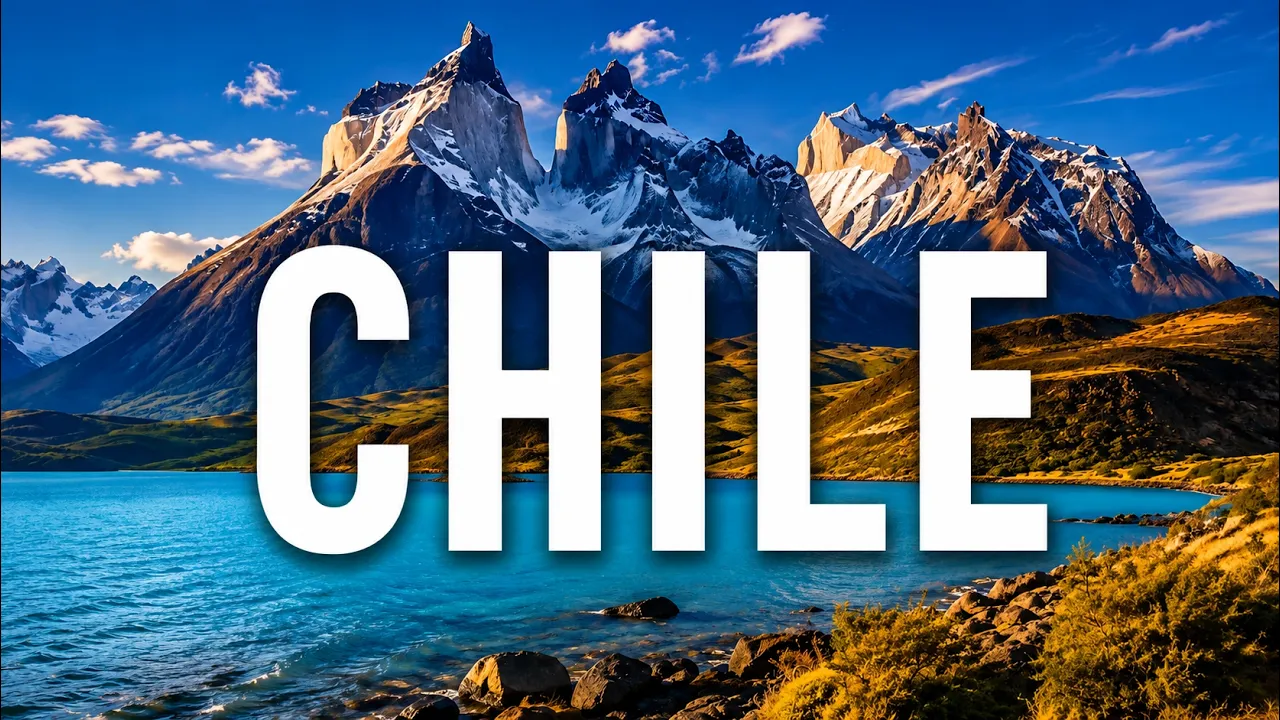
CHILE 🇨🇱: The Country That Shouldn’t Exist Atacama, Patagonia & Easter Island transcript
World Facts Explained · @WorldFactsExplained2025
Words
2,261
Runtime
14:03
Speaking pace
161wpm
Reading time
9min
161 words per minute, between the 160 25th percentile and the 181 median of 349 measured videos. That distribution comes from the 349-video hook study.
Opening (first 30 seconds)
Welcome to World Facts Explained, where every country has a story to tell. From breathtaking landscapes and ancient cultures to fascinating history, unique traditions, and surprising facts, we explore what makes every corner of our world extraordinary. So, get ready to discover new places, uncover incredible stories, and see the world from a different perspective. This is World Facts Explained. Let's begin our journey. Along the western coast of South America lies an extraordinarily long and narrow [music] country that may
81 words, the words spoken in the first 30 seconds at 161 words per minute.
Sentence shape
| Measure | This transcript |
|---|---|
| Sentences | 136 |
| Average words per sentence | 16.6 |
| Longest sentence | 44 words |
| Questions asked | 1 |
| Sentences containing a number | 11 |
Most used terms
- music69
- chile53
- country28
- world19
- south13
- region12
- enormous11
- important11
- pacific10
- regions10
- atakama9
- famous9
Filler phrases
4 in total: like 4.
A literal whole-word count of the same phrase list the Prepublish browser extension uses, so a phrase inside another word is not counted and a phrase used in its ordinary sense still is. It is a count and not a judgement.
What this transcript is
Every word below is the caption track YouTube publishes for this video, pulled from the video itself and reproduced unchanged. It is not Prepublish's writing, not a summary, and not a re-transcription: it is the video's own published captions. English captions, generated automatically by YouTube, in the video’s original language. Source: the video on YouTube. A channel that would rather this page did not exist can ask for its removal through the contact page, and it is removed.
Transcript
Welcome to World Facts Explained, where every country has a story to tell. From breathtaking landscapes and ancient cultures to fascinating history, unique traditions, and surprising facts, we explore what makes every corner of our world extraordinary. So, get ready to discover new places, uncover incredible stories, and see the world from a different perspective. This is World Facts Explained. Let's begin our journey.
Along the western coast of South America lies an extraordinarily long and narrow [music] country that may look like a thin strip on the map, but within its borders, it contains an [music] incredible collection of natural landscapes, cultures, and wonders of the world. The name of this country is Chile. In its north lies one of the driest regions on Earth. To the east stretches the massive Andes mountain range and in the south are the glaciers and wild landscapes of Patagonia.
Thousands of kilometers away in the Pacific Ocean lies the mysterious Easter Island with its [music] enormous moai statues. But Chile is not only about nature. [music] This country is one of the most important economies in South America, one of the world's largest [music] producers of copper, and one of the best places on Earth for observing the sky and studying the [music] universe. In this video, we will take a complete journey through Chile, from Santiago to the Atakama, from the Pacific Ocean to the Andes, and from Patagonia to Easter Island.
Chile is located in western South America. The country borders Peru to the north, Bolivia to the northeast, and Argentina [music] to the east. Its entire western side faces the Pacific Ocean. But the strangest [music] geographical feature of Chile is its shape. The country stretches for more than 4,000 km [music] from north to south, while its width in many areas is only a few hundred km. [music] This unusual shape has given Chile an enormous variety of climates.
Within a single country, you can see an extremely dry desert, snow-covered mountains, Mediterranean regions, rainforests, volcanoes, lakes, islands, and enormous [music] glaciers. The Andes mountain range stretches along the eastern side of the country and like a natural wall separates Chile from much of Argentina. The capital and largest city of the country is Santiago. Santiago is located in central Chile in a valley surrounded by mountains.
[music] The city is the political, economic, and cultural center of the country and a large portion of Chile's population lives in the Santiago metropolitan area. Santiago is a modern city with tall towers, shopping centers, universities, parks, and an extensive transportation network. On clear days, the massive Andes mountain range can be seen behind the city's buildings, creating one of the most beautiful urban landscapes in South America.
Chile has a population of around 20 million people, and the majority live in urban areas. [music] The dominant language of the country is Spanish, but Chilean Spanish [music] has its own distinctive characteristics. Chileans usually speak quickly and use many local expressions [music] to the point that even some Spanish speakers from other countries may initially find it difficult to understand everyday Chilean conversations.
Alongside the Spanish-speaking population, several indigenous peoples also live in Chile. [music] One of the most important of these is the Mapuche people whose history and culture form an important part of [music] Chilean identity. Indigenous and Indian communities also live in the north of the country while the Rapanoui people live on Easter Island. Before the arrival of Europeans, different regions of Chile were home to numerous [music] indigenous communities.
In the 16th century, the Spanish arrived in the region and Chile [music] became part of the Spanish Empire. However, gaining complete control over this land was not easy for the Spanish. The Mupuche [music] people resisted colonization for a long time. In the early 19th century, [music] the independence movement emerged and eventually Chile gained its independence from Spain. [music] Chile's modern history has also gone through very different periods, ranging from democratic governments to the military coup of 1973 and the rule of Agusto Pinoched.
Since 1990, Chile has once again entered a period of democratic government. One of Chile's most important natural resources is copper. For decades, the country has been one of the world's largest producers of copper, and the mining industry plays a very significant role in its economy. Enormous mines exist in northern Chile, supplying a very large share of the world's copper. [music] But Chile's economy is not limited to mining.
Agriculture, fishing, forestry, services, tourism, and food exports are also very important. Chile is also famous for producing wine. The country's central valleys provide highly suitable conditions for growing grapes and Chile and wine is exported to many countries. Chile is also an important producer of fruits such as grapes, cherries, apples and various types of berries. Now we come to one of the most astonishing regions of Chile, the Atakama desert.
The Atakama is located in northern Chile and is considered one of the driest regions on Earth. This region is a combination of salt flats, sand, rock, volcanoes, [music] and ancient lava flows. Some parts of it are so dry that the landscape looks more like the [music] surface of another planet. Official Aome sources describe the Adakama as covering an area of around 181,000 km and state [music] that this desert environment is more than 20 million years old.
One of the reasons for the extreme dryness of this region is its geographical location. [music] The Andes mountain range on one side and the conditions of the Pacific Ocean and the cold humbled current on the other cause very little moisture to reach parts of the desert. Despite the harsh appearance of the atakama, the region is not completely [music] devoid of life. Vunas, flamingos, foxes, and other animals live in parts of the region.
Some plants have also adapted to these extremely harsh conditions. The dryness of the Atakama has created an extraordinary advantage. The skies in this region are extremely clear and light pollution is very low in many areas. For this reason, northern Chile has become one of the world's most important centers for astronomy. One of the most famous scientific facilities in the region is ALMA. ALMA is an array of 66 highly precise antennas located on the Chajantar Plateau at an altitude of around 5,000 m.
The facility is used to study the universe at millimeter and submillimem wavelengths. It helps scientists investigate star formation, molecular clouds, and the early universe. In fact, one of the [music] wonders of Chile is that some of humanity's finest eyes for looking into the depths of the cosmos [music] are located in the middle of one of the driest deserts in the world. Chile [music] is located in a highly active geological region.
A large number of volcanoes can be found [music] along the Andes mountain range and some of them are still active. For example, Lascgar volcano in northern Chile is one of the country's active volcanoes. Snow-covered volcanoes alongside lakes and forests, particularly in the more southern regions have created some of Chile's most [music] famous natural landscapes. Chile is one of the most earthquakeprone countries in the world.
The main reason is the country's location along the boundary of tectonic plates. The Nazca plate is being forced beneath the South American plate and this process releases enormous amounts of energy. In 1960, the Valdivia region in [music] southern Chile experienced the most powerful earthquake ever recorded with modern instruments. The earthquake had a magnitude of approximately 9.5. [music] It generated a massive tsunami whose effects were observed even in distant parts of the Pacific Ocean.
For this reason, earthquake resistant [music] engineering is extremely important in Chile. If we travel thousands of kilome [music] south from the dry desert of northern Chile, the landscape changes completely. We arrive in Patagonia. Patagonia [music] is divided between Chile and Argentina and is one of the wildest and most spectacular natural regions in South America. >> [music] >> Sharp mountain peaks, glacial lakes, rivers, forests, and enormous glaciers can all be found in this region.
One of the most famous places in Chilean Patagonia is Torres Delp Peni National Park. The enormous rock towers of this region [music] have become one of the symbols of tourism in Chile. Mountaineers and nature lovers from around the world travel to southern [music] Chile to see this region. In southern Chile, the land transforms into a [music] complex network of islands, channels, and fjords. Here lies the straight of Mellan, the historic maritime route between the Atlantic and Pacific oceans.
Before the construction of [music] the Panama Canal, this route was extremely important for ships traveling between the two oceans. In the southernmost regions, the climate becomes colder and nature becomes harsher. Now we must travel thousands of kilometers from mainland Chile into the Pacific Ocean. Here lies one of the most [music] mysterious islands in the world, Easter Island or Rapanoui. The island belongs to Chile, but is located a great distance from the mainland.
It is famous around the world because of the enormous statues known as Moai. Hundreds of Moai statues can be found across different parts of the island. They were created by the Rapaanoui [music] people and many of them feature enormous faces with elongated heads. [music] Interestingly, what is often seen in photographs as giant heads is in many [music] cases not just a head. A number of the Moai have complete bodies, parts of which are buried in the ground.
But one of the [music] greatest mysteries is how the island's inhabitants moved these heavy statues without modern machinery. Various theories exist. Archaeological experiments have shown that some [music] of the statues may have been moved using ropes and controlled rocking movements. Rapanui is listed as a UNESCO [music] World Heritage site because of its exceptional cultural heritage. Chilean [music] cuisine combines products from the Pacific Ocean, agriculture from the central regions, and indigenous and European traditions.
One of the most famous foods is impanada de pino, a type of stuffed [music] pastry usually filled with meat, onions, and other ingredients. Pastel [music] de shook is another famous dish made with corn. Because of Chile's extremely long coastline, fish and seafood are also an important part of the country's cuisine. In the south, seafood [music] and traditional cooking methods on islands such as Chiloa are particularly famous.
Football is one of the most [music] popular sports in Chile and the country's national team has a long history in international [music] competitions. Chile won the Copa America in two consecutive editions in 2015 and 2016. But Chilean culture is not only about football. Literature [music] holds a special place in the country. Two Chilean poets Gabriella Mistral and Pablo Nuda have won the Nobel Prize in Literature. Traditional music, the national dance [music] known as queka and indigenous cultures are also important parts of the country's identity.
Now we come to the most fascinating part of our journey. First, Chile has one of the most unusual geographical shapes of any country in the world. [music] The distance from north to south stretches for thousands of kilome while the country remains extremely narrow. Second, during a long journey through Chile, you can travel through one of the driest regions on Earth and then continue onward to rainforests, [music] snowy mountains, and the glaciers of Patagonia.
Third, the skies of the Atakama are so suitable for astronomy that some of the world's most advanced [music] observatories have been built in northern Chile. High altitude, extreme dryness, clear skies, and low light pollution create exceptionally rare conditions. Fourth, in the middle [music] of the atakama stands an enormous sculpture called mono delierto or the hand of the desert. It is a giant hand rising out of the ground that [music] has become one of the strangest and most famous images of northern Chile.
Fifth, Chile is home to Rapanoui and the Moai, one of the most isolated and recognizable ancient cultural heritages of the Pacific. And sixth, Chile is a country whose natural environment constantly reminds us that Earth is still a living planet. Massive earthquakes, volcanoes, the Andes mountain range, [music] glaciers, and ancient deserts are all found within a single country. Chile is a country of contrasts. In the north lies the Atakama with its dry landscapes and star-filled skies.
In the center are Santiago and the fertile valleys. To the east stands the enormous wall of the Andes mountain range. In the south begins Patagonia with its mountains, [music] glaciers, and wild landscapes. And thousands of kilometers away in the Pacific Ocean, the Moai of Rapanoui continue to stand silently. Perhaps it is precisely these contrasts that make [music] Chile one of the most distinctive countries in South America.
From a desert that looks like Mars to telescopes that gaze billions of light years into the distance, Chile is full of extraordinary contrasts. From active volcanoes to statues [music] whose method of transportation is still debated, Chile is a country where almost every corner has a story to tell. If you could visit only one place in Chile in person, which would you choose? The Atakama Desert, Patagonia, Santiago, or the mysterious Easter Island.
If you enjoyed this journey, follow the channel World Facts Explained in the next episode. Join us so that we can country by country get to know the world better. Thank you for listening to us. [music]
The words are the caption track's own and nothing is reworded or re-transcribed. Paragraph breaks are placed between sentences so the text reads as prose.
Use this transcript
Three free tools that work on the material around a video like this one. No signup, no login.
Hook Analyzer
Paste the first 30 seconds of your own draft for a hook score and rewrites.
Policy Pre-Flight
Check your draft against YouTube's advertiser-friendly guidelines before you record it.
Channel Skill Generator
Read this channel's public videos and transcripts, and download a writing brief for it.