Getting the transcript
Reading the captions from YouTube. A video nobody has opened here before takes 10 to 30 seconds; this page fills in on its own.
Getting the transcript
Reading the captions from YouTube. A video nobody has opened here before takes 10 to 30 seconds; this page fills in on its own.
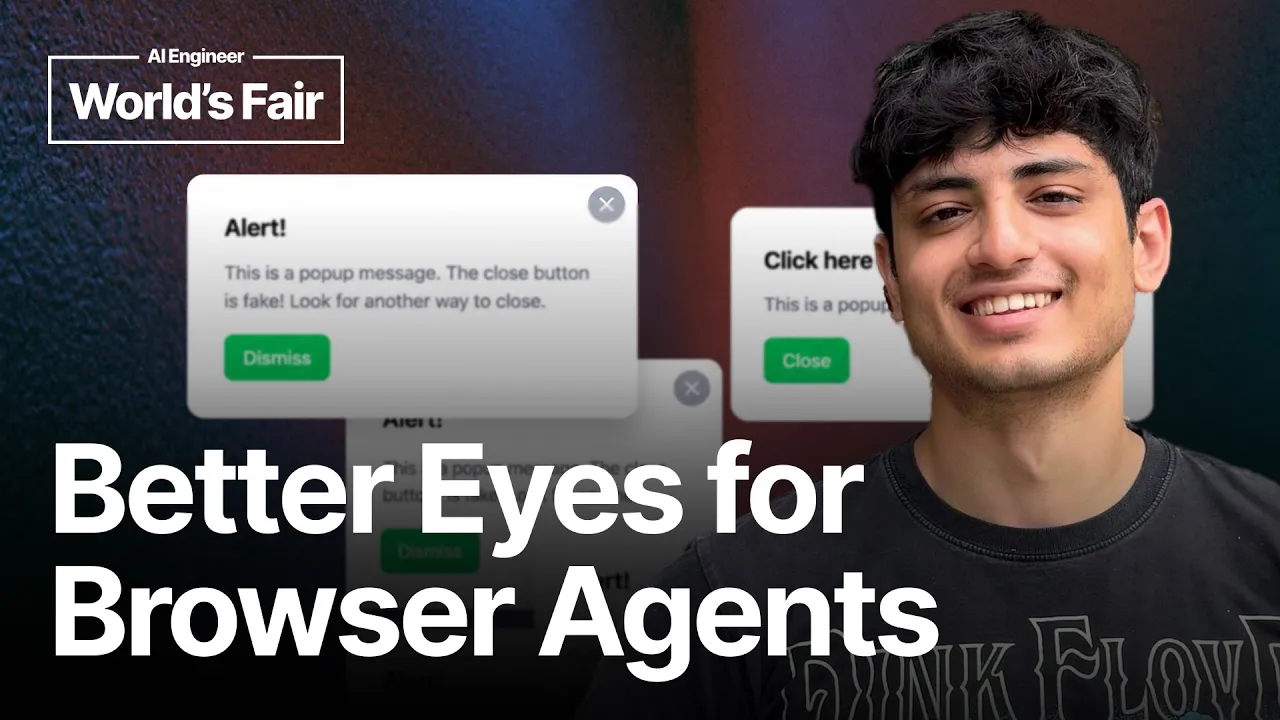
AI Engineer · @aiDotEngineer
This video has no Most replayed graph yet: YouTube shows one only once a video has enough views. These are the moments viewers replayed most in AI Engineer's most watched videos.
Most replayed moment at 18:45
4.8x that video's typical replay level
that they're they're changing they're changing things in the database not yet. You want to run them through the ontology first and make sure that works. Okay. I only got an I've got I've got another I've just a short time. I'm going to try to show you some of the things that um that you can
Said at 18:37
Most replayed moment at 16:13
3.6x that video's typical replay level
method signatures, the program layout and the call stacks. So here's some examples. I don't think you'll be able to read this one, but this is like the level of abstraction we're at. It's how we're actually going to lay this stuff out and how these systems are going to interact. Dylan Mulroy from Cloudflare talks a
Said at 16:06
Most replayed moment at 6:57
5.9x that video's typical replay level
do light mode. It's I It's not my nature, but sometimes. That's better, yeah? Okay. So we have we have a model and we're trying an old LG Sorry. We We shouldn't have seen that. No, we'll
Said at 6:50
The graph counts replays. It does not show where viewers stopped watching.
Words
937
Runtime
4:25
Speaking pace
212wpm
Reading time
4min
212 words per minute, above the 201 75th percentile of 349 measured videos. That distribution comes from the 349-video hook study.
Opening (first 30 seconds)
Okay, everyone. I am Kushan. I worked at Seraphim as a founding engineer for 2 years. Let's talk about what I'm interested in right now, and that is browser agents. Browser agents as an idea are so cool, right? The browser agent should go crazy, right? I personally have not seen that adoption, and me myself, I don't use browser agents that much. I've been exploring that for some time. I've been trying to understand why that is. So, on my screen right now, we have the browser challenge. But, this is a very interesting benchmark for browser agents because there are so many things that
106 words, the words spoken in the first 30 seconds at 212 words per minute.
Free, no signup. See how the first 30 seconds hold attention, with rewrites.
Sentence shape
| Measure | This transcript |
|---|---|
| Sentences | 72 |
| Average words per sentence | 13.0 |
| Longest sentence | 37 words |
| Questions asked | 15 |
| Sentences containing a number | 8 |
Most used terms
Filler phrases
30 in total: right? 11 · you know 6 · um 4 · like 3 · actually 2 · basically 2 · sort of 1 · uh 1.
A literal whole-word count of the same phrase list the Prepublish browser extension uses, so a phrase inside another word is not counted and a phrase used in its ordinary sense still is. It is a count and not a judgement.
What this transcript is
Every word below is the caption track YouTube publishes for this video, pulled from the video itself and reproduced unchanged. It is not Prepublish's writing, not a summary, and not a re-transcription: it is the video's own published captions. English captions, generated automatically by YouTube, in the video’s original language. Source: the video on YouTube. A channel that would rather this page did not exist can ask for its removal through the contact page, and it is removed.
Okay, everyone. I am Kushan. I worked at Seraphim as a founding engineer for 2 years. Let's talk about what I'm interested in right now, and that is browser agents. Browser agents as an idea are so cool, right? The browser agent should go crazy, right? I personally have not seen that adoption, and me myself, I don't use browser agents that much. I've been exploring that for some time. I've been trying to understand why that is.
So, on my screen right now, we have the browser challenge. But, this is a very interesting benchmark for browser agents because there are so many things that you have to do, long rising sequencing of your tasks. And this actually reveals, you know, why browser agents suck. If you saw at the beginning of the video, the browser this agent took like maybe 10-20 seconds just to click the start button. And now, we're on step one.
There are 30 steps, and it has taken so long just to click one button. Um so, enough of this. I want to show you what I've been building. So, same website. Um I've tried to sort of replicate the feeling of seeing what's happening, you know, you can see what the browser agent is thinking. But as you can see, it is so much faster and so much quicker, and I'm using a much cheaper model, right? The hypothesis here is models are pretty smart, but it's the infra around them that sucks.
If you noticed in the video earlier, maybe I'll put a screenshot, the agent is trying to debug what's going on. It's trying to click something, but it doesn't understand what's going on. So, my core thesis here has been give a nice environment for the agent to use, right? So, where it can plan long sequences, it can figure out where it failed, what is going on, and it can plan the click correctly. I figured out is a cool representation which compresses the website and lets the agent see the entire page in very few few tokens.
Now, I want to show you some actual examples. Let's say I want to download my Aadhaar. Um so, this is Claude trying to do it. So, I'd assume that this is very simple for a browser agent. I take a screenshot, you see the button right there, click it. Uh but then, what's interesting is that it got stuck after this point. So, from 46 seconds until the end of this video, it took a screenshot, it scrolled for some reason, it took a screenshot.
Basically, this entire process took 2 minutes, whereas in my case, in our video, so, it just boots, and boom, done. And that's the beauty of a browser agent. Just how quick was that? And I'm using such a cheap model for this. Another interesting example is So, my friends and I are going trekking on on Sunday. I was wondering, you know what? Because this this site is in Canada and I am not very fluent in Canada. Like it took me some time to figure out this website.
So, I asked Claude like, "Hey, can you book this for me?" And by the end of it, it's unable to pick a date and it just stuck. This is the video of my agent. You can see it selects it and puts in the date and boom, done. Right? It's so simple and convenient to use in theory. So, what's next, right? What am I planning on doing? I'm thinking of open sourcing this project because again my this code is not super defensible.
The product that I want to give is again maybe an API that as you can see we were running these commands. Maybe I just want to expose this command as an API. Give me a URL, give me your intent and I will execute it for you and give it back to you and or maybe open this as a website or expose this as a plugin. But yeah, so bottom line is I want to make browser agents faster, cheaper and more reliable and just make sure everybody in the world is using them because they can just do so much for you.
So yeah, that's the broad idea here. Thank you for watching. This entire markdown presents the website, that particular page. And let's actually do this interesting comparison, right? Let's go to AIS. The full DOM for this would be around 20,000 tokens. But so, let's say we have this screenshot. All right, this screenshot's about 1,100 tokens. My markdown's about 1,800 tokens and instead in one screenshot where you could see only one particular snippet, you can see the entire website, right?
A couple of other things that it's important to give feedback, right? So, we say that okay, hey, these are the new things that have popped up on the page. This is now gone, right? And similarly, we can say that you know, this thing that was blocking up things that you wanted to click has now been removed. You know, we give it feedback that you tried to click this, but that didn't happen because you know, we're keeping track of the entire end-to-end browser page.
Right? So, all of this together, what I built is a very clean representation that that basically compresses the website, and you can give this along with the screenshot. It's pretty cheap token-wise. Um so, the model can reason really well, and then it can construct this long sequence of tasks to execute.
The words are the caption track's own and nothing is reworded or re-transcribed. Paragraph breaks are placed between sentences so the text reads as prose.
Free tools for your own script. No signup, no login.
Paste your draft and see where viewers are likely to drop off, with a rewrite for each weak line.
Paste the first 30 seconds of your own draft for a hook score and rewrites.
Check your draft against YouTube's advertiser-friendly guidelines before you record it.
Read this channel's public videos and transcripts, and download a writing brief for it.