Getting the transcript
Reading the captions from YouTube. A video nobody has opened here before takes 10 to 30 seconds; this page fills in on its own.
Getting the transcript
Reading the captions from YouTube. A video nobody has opened here before takes 10 to 30 seconds; this page fills in on its own.
AI Engineer · @aiDotEngineer
This video has no Most replayed graph yet: YouTube shows one only once a video has enough views. These are the moments viewers replayed most in AI Engineer's most watched videos.
Most replayed moment at 18:45
4.8x that video's typical replay level
that they're they're changing they're changing things in the database not yet. You want to run them through the ontology first and make sure that works. Okay. I only got an I've got I've got another I've just a short time. I'm going to try to show you some of the things that um that you can
Said at 18:37
Most replayed moment at 16:13
3.6x that video's typical replay level
method signatures, the program layout and the call stacks. So here's some examples. I don't think you'll be able to read this one, but this is like the level of abstraction we're at. It's how we're actually going to lay this stuff out and how these systems are going to interact. Dylan Mulroy from Cloudflare talks a
Said at 16:06
Most replayed moment at 6:57
5.9x that video's typical replay level
do light mode. It's I It's not my nature, but sometimes. That's better, yeah? Okay. So we have we have a model and we're trying an old LG Sorry. We We shouldn't have seen that. No, we'll
Said at 6:50
The graph counts replays. It does not show where viewers stopped watching.
Words
1,867
Runtime
15:37
Speaking pace
120wpm
Reading time
8min
120 words per minute, below the 160 25th percentile of 349 measured videos. That distribution comes from the 349-video hook study.
Opening (first 30 seconds)
Hey everyone, I'm Surim. I'm the CEO and co-founder of Starling Search and today my talk is a signal's die after retrieval boundary. So, we'll look into uh what are agents essentially, why agents fail, what is uh the cause of fails in retrieval particularly, and how to make actually signals cross the retrieval boundary, and how to make your
60 words, the words spoken in the first 30 seconds at 120 words per minute.
Free, no signup. See how the first 30 seconds hold attention, with rewrites.
Sentence shape
| Measure | This transcript |
|---|---|
| Sentences | 127 |
| Average words per sentence | 14.7 |
| Longest sentence | 47 words |
| Questions asked | 7 |
| Sentences containing a number | 15 |
Most used terms
Filler phrases
86 in total: uh 59 · actually 8 · like 7 · basically 6 · kind of 3 · right? 2 · um 1.
A literal whole-word count of the same phrase list the Prepublish browser extension uses, so a phrase inside another word is not counted and a phrase used in its ordinary sense still is. It is a count and not a judgement.
What this transcript is
Every word below is the caption track YouTube publishes for this video, pulled from the video itself and reproduced unchanged. It is not Prepublish's writing, not a summary, and not a re-transcription: it is the video's own published captions. English captions, generated automatically by YouTube, in the video’s original language. Source: the video on YouTube. A channel that would rather this page did not exist can ask for its removal through the contact page, and it is removed.
Hey everyone, I'm Surim. I'm the CEO and co-founder of Starling Search and today my talk is a signal's die after retrieval boundary. So, we'll look into uh what are agents essentially, why agents fail, what is uh the cause of fails in retrieval particularly, and how to make actually signals cross the retrieval boundary, and how to make your agent basically outcome fair. So, uh let's get started. What is an agent? An agent is an LLM that has agency to reason, invoke tools, uh interact with the real world, retrieve uh the memory to complete the task.
One major loop here is missing is uh learning. It should also learn from what worked and what didn't work. Suppose uh if I had to uh explain what is agent, I I can explain with react agent. So, if I had to explain uh what agent does, I would explain with react agent. So, basically use it from the agent and execute it in a loop, uh client to retrieval search, and then pause when the task is complete. This is very basic react architecture.
One thing that is missing is how to make agent learn from the outcome. So, agent keeps failing at the same task. Gartner reported 85% of AI just failing traction. So, it's in McKinsey's 2025 report. The problem came out to be most of the time is that retrieval is static. 73% of our uh pipelines fails because of retrieval, not generation, and context stuffing. So, a recent uh post from Ram Sriram, the ex-CTO of Pinecone, said, "Uh we have been optimizing for the wrong thing.
You are paying a lot for your agent's memory. This is probably broken, and we have been optimizing for the wrong things. We made wrong answers appear faster and cheaper, but we forgot to make retrieval learn." So, why does this does does does it matter? Again, uh, the third problem is agents are not outcome-informed. So, there's a missing layer between evals and action. Your observability has all the traces, uh, all the stack that capture observability is the stack that capture every tool call, every LM completion, every exceptions.
Your eval suite judges whether the final output was correct or wrong, basically pass or fail. But, these evals are not reflected in agent, uh, context, skills, and defines my agent action in any ways. Right? So, the agent doesn't have any access to why yesterday's runs, uh, runs passed or failed. The eval signal dies in the dashboard. This is a missing layer, a system that consume traces, absorb eval, and convert both into retrieval guidance for future runs.
So, there's a manual improvement task, and engineer actually has to sit and see if the eval and observability perform well. Rewrite the prompt, redeploy it, upgrade either and create your expensive model, restructure to our harness, or fine-tune the custom models. Why are current memories failing? Why memories was designed to actually address this, but, uh, uh, it's not. So, let's see, uh, a what we have in our the current system uh, and current memory is that they basically store user preferences, profile, conversation history, or long-lived personalization.
So, chat experience is not self-improving learning systems for production. If you see the already existing approach in the market, there's a LangChain, there's Mem0, which does extracted past preferences. The user's retrieval signal is embedding similarity. Does it learn from outcome? No. Uh so, we have come up with something called utility score, which is a similarity weighted by how useful it is for the agent to execute the task.
It has actually the history of past pieces and past outcomes. So, we came up with Agent RX, and that is agent's the runtime experience. It's a runtime layer that let the large language agent improve from experiences without retraining, fine-tuning, or manual prompt engineering. How it's a little different from compile time like DS5 because of you bake in all the lessons in the prompt, here is actually improving while it is executing the task.
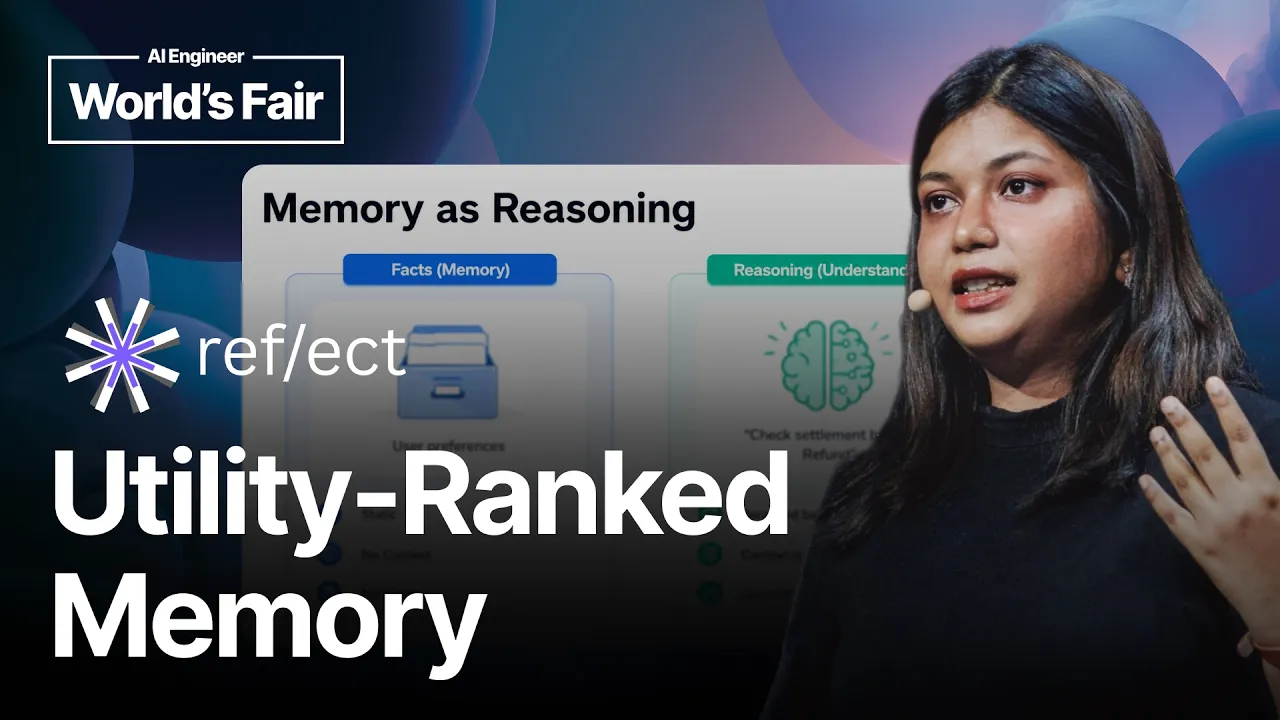
So, which again introduces utility score. So, you do not retrieve by keyword, you do retrieve by semantic similarity to the current task weighted by whether those memories have historically helped or hurt the execution or the outcome. The event outcome becomes a first-class signal in the retrieval re-ranking and not just for retrieval. One of the key things is it treat memory as reasoning, not as facts, statistics, fact with no context and no history, but reasoning.
Like suppose if if there's a if there is a customer support bot looking for a refund, you will not really say, "Hey, user prefers uh uh dark theme or user prefers to be called by a shorter name." It's actually reason about query like if some someone asked for refund, you should check the settlement before refunding it so that the the the customer doesn't get paid refund twice. So, we act based on usefulness. Context is updated based on task.
So, this is a very big thing because most of the agents deal with context stuffing and this has been brought up in the past and learn from history and reasoning, right? Talking about benchmarks. So, we have benchmarks our memory system reflect on towel bench which essentially measure if agents have followed a policy well or not. So, we have seen the performance improve from 66 to 76% without baking in uh skills and with skills reflect performance at 80.
So, once there are enough memory like 10 memories, uh what we do is we bake in the reasoning and the understanding into skills so that your agent always remains updated. What happens most of the time we have seen suppose you have a product SQL agent and there's a system there's a column in system prompt. Even though that column is no useful anymore, it remains in the system prompt. So, there's no system right now that can update that, "Hey, there's no column uh right now called this.
So, maybe probably you shouldn't entertain it in the future. And this is possible with skills that because it is always uses calls that skill updated skill all the time. And the similar behavior has been seen in GPT-5.4. Uh, we have also benchmarked it on agentic task. Which essentially test a model's ability to reason, plan, and use tools or extended multi-step workflows rather than measuring a static Q&A. So, you can see here, uh, when does it was the human last exam with drug, it get 47.5.
If it is starting from the baseline 35.7. Uh, with the other memory system, it gets to 58.2. But with the refined memory system, uh, it gets to 61.3%. So, this this kind of trend is shown in another, uh, agentic benchmarks, uh, as well, like Big Code Bench, like Long TV, etc. So, of course, there are limitations to this, uh, to this approach. First of all, there's a cold start. So, in the beginning, it's pure semantic search until, uh, enough reviews have been accumulated.
Uh, there's a utility drift. Maybe sometimes, uh, similar memories could come up. There are a lot of problems that could come at scale with this experience, but we have combat most of them. Uh, there's a review quality. So, noisy labels can make the utility noisy as well. And there is, uh, hyperparameter called lambda that is associated with credit and re-ranking. So, we have built reflect in such a way that most of these problems and most of these elements are now reduced except for cold start which we cannot do much about it.
Uh let's get into the demo. So let's check this demo. Um So it's a basically a product SQL demo. I'll give ask it to search some product in SQL database and see if it is able to find it out. So can you find me a gaming mouse? Zero memories retrieved. I couldn't find a gaming mouse. Uh okay. So maybe let's just go and see what's happening in the dashboard. Okay. It came out that I'm going on another benchmark that with the agent bench with actions essentially measures if agent has actually done the right reasoning, planning, and uh have followed.
Which essentially test a model's ability to reason, plan, and use tools over extended multi-step workflows rather than measuring a static Q&A. So you can see here uh with the suppose the human last exam uh with drug you get 47.5. If it is starting from the baseline 35.7. Uh with the other memory system, it gets 258.2 but with the result memory system, uh it gets 261.3%. So, this this kind of trend is shown in another uh adaptive benchmarks as well like big code bench, my long TV, etc.
Wait, let's check. I couldn't find I couldn't find any gaming mouse in the product catalog. So, suppose I want to market fail and sell it give any relevant No. Because there is a there is a wireless mouse in the database. And I have submitted the failure. Uh this was the input. This was the response. I couldn't find any. And this was a trajectory and tool quality. So, you can see the product is empty with this product or with this query.
Let's uh let's check again what happens now. Let's see now now what happens. Okay, ID uh So, it searched a wireless mouse. Uh Let's see what happens in the dashboard now. Finally, a gaming mouse was input. The response was I found a product related to mouse as the mouse failed to find any kind of relevant. Let then, The most important thing is how the tool call evolved. You can see that previously the tool calls or the trajectory used to look just with one search, that is search products it called.
And the product was empty. Now, the trajectory has changed in the production and it found something in the product and it uh is still calling search product to call but it is getting some answer that we fed in as a feedback. So, uh that's the demo and the most important thing that is happening over here is it's forming memories which is retrieved based on the utility score that is the score which basically keeps improving keeps re-ranking itself on the basis of how useful that memory was.
So, uh You can see from this traces past traces which memory uh so this memory scores keep changing and after certain while after suppose uh five reviews maybe can bake in these findings or these new updates in a skill. Without so without changing the existing prompt you can actually update certain things that agent draws a lot from. So, uh you can update the skill which is very cool. So, uh I hope everything was I hope you get to try this new feature this new uh runtime experience that we have built.
You want more details you can visit our website and you can also contact me if I have still my grace@alishascollection.com. I will reply. Thank you.
The words are the caption track's own and nothing is reworded or re-transcribed. Paragraph breaks are placed between sentences so the text reads as prose.
Free tools for your own script. No signup, no login.
Paste your draft and see where viewers are likely to drop off, with a rewrite for each weak line.
Paste the first 30 seconds of your own draft for a hook score and rewrites.
Check your draft against YouTube's advertiser-friendly guidelines before you record it.
Read this channel's public videos and transcripts, and download a writing brief for it.