Getting the transcript
Reading the captions from YouTube. A video nobody has opened here before takes 10 to 30 seconds; this page fills in on its own.
Getting the transcript
Reading the captions from YouTube. A video nobody has opened here before takes 10 to 30 seconds; this page fills in on its own.
9x · @go9x
This video has no Most replayed graph yet: YouTube shows one only once a video has enough views. These are the moments viewers replayed most in 9x's most watched videos.
Most replayed moment at 11:14
2.9x that video's typical replay level
Anthropic blocking OpenAI's API access and Google launching their new Deep Think feature for $250 a month. Now, obviously, this is something that just ran once. For me to turn this into my daily agent, what I want to do is I'm going to click on this little schedule button. What's going to
Said at 11:06
Most replayed moment at 7:29
3.7x that video's typical replay level
Studio. So, over in Google AI Studio, a studio.google.com. Um depending on where you land you might see a different first interface but what you want to do is on the left hand side if you head to playground and then here I can select images and then we see here Nano Banana Pro new so I can just click
Said at 7:22
Most replayed moment at 6:13
2.7x that video's typical replay level
when you start using AI inside automations, you quickly realize that nailing your prompts becomes more important than ever. This is where the anthropic prompt generator comes in. It's a tool that I use so I never have to write a prompt from scratch. All you need to do is give it a highlevel one or
Said at 6:07
The graph counts replays. It does not show where viewers stopped watching.
Words
6,180
Runtime
29:45
Speaking pace
208wpm
Reading time
26min
208 words per minute, above the 201 75th percentile of 349 measured videos. That distribution comes from the 349-video hook study.
Opening (first 30 seconds)
This email took Chat GBT over eight minutes to create and came back totally generic. This one took a fraction of the time and it's perfectly on brand and is already locked and loaded to send to our community without me having to do anything. The difference, just one well-written skill. Skills are the most important thing to learn in chat GBT right now. They're how you take the step from just asking questions to getting it to do real work for you, saving you and your team hours of repetitive, mundane work. In this video, I'll show you what a skill actually is,
104 words, the words spoken in the first 30 seconds at 208 words per minute.
Free, no signup. See how the first 30 seconds hold attention, with rewrites.
Sentence shape
| Measure | This transcript |
|---|---|
| Sentences | 360 |
| Average words per sentence | 17.2 |
| Longest sentence | 59 words |
| Questions asked | 11 |
| Sentences containing a number | 21 |
Most used terms
Filler phrases
78 in total: actually 37 · basically 18 · like 14 · sort of 4 · um 2 · literally 1 · uh 1 · you know 1.
A literal whole-word count of the same phrase list the Prepublish browser extension uses, so a phrase inside another word is not counted and a phrase used in its ordinary sense still is. It is a count and not a judgement.
What this transcript is
Every word below is the caption track YouTube publishes for this video, pulled from the video itself and reproduced unchanged. It is not Prepublish's writing, not a summary, and not a re-transcription: it is the video's own published captions. English captions, generated automatically by YouTube, in the video’s original language. Source: the video on YouTube. A channel that would rather this page did not exist can ask for its removal through the contact page, and it is removed.
This email took Chat GBT over eight minutes to create and came back totally generic. This one took a fraction of the time and it's perfectly on brand and is already locked and loaded to send to our community without me having to do anything. The difference, just one well-written skill. Skills are the most important thing to learn in chat GBT right now. They're how you take the step from just asking questions to getting it to do real work for you, saving you and your team hours of repetitive, mundane work.
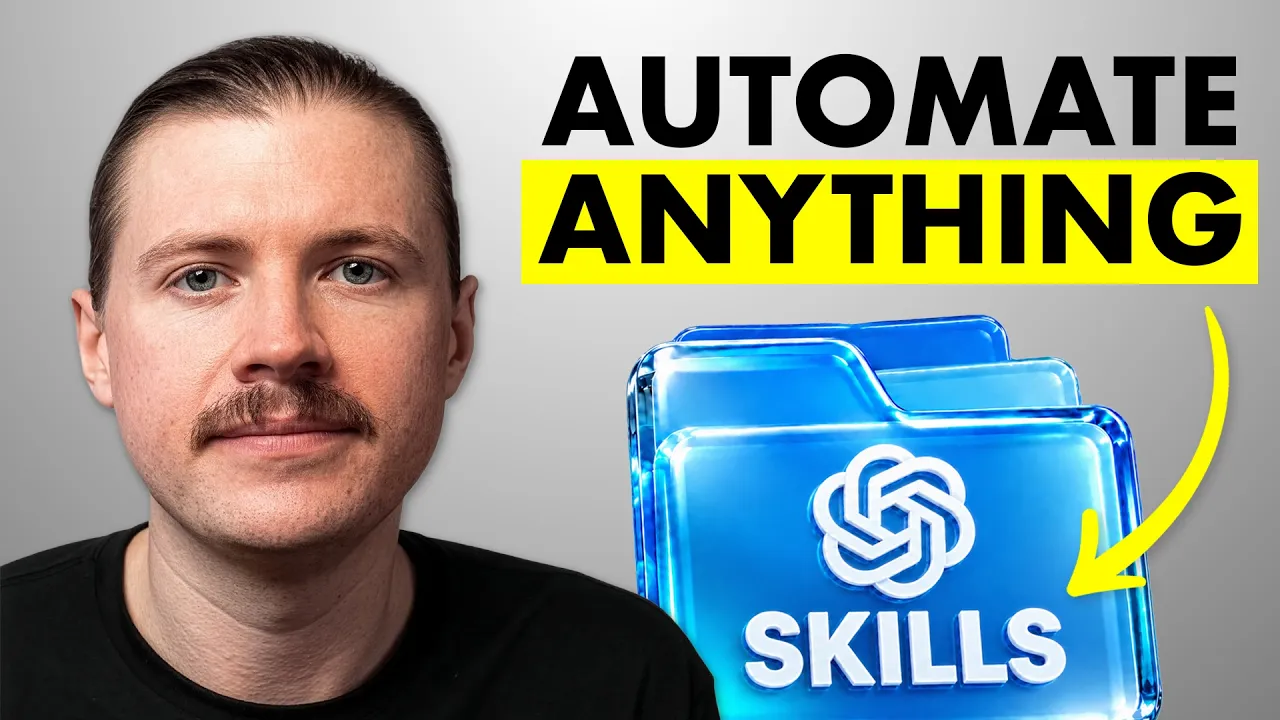
In this video, I'll show you what a skill actually is, how they're different to custom GBTs and projects. I'll explain why they matter and walk you through the exact process we use to build skills better than 99% of people out there. So, give me your attention for the next 30 minutes, and I promise you're going to level up how you use chat GBT. Let's get started starting with what a skill actually is. So, a skill, sometimes referred to as an agent skill, is a reusable set of instructions that tells an AI agent, in this case, chat GBT, exactly how to perform a specific task.
Now, before I show you exactly how skills work under the hood, and then more importantly, we'll be building a live skill together from scratch, let's take a look at a skill in action. So, here I am in chatbt work mode in the desktop app, and the skill that I want to show you is the one that I've set up to help me create the assets for our 9x live workshops. We run live workshops every single week for our community and this is something that we used to do manually in Figma.
For every single event that we'd run, you can see we were creating a new set of assets in different formats to help us promote that event. But now for that we have created a skill. So here in chat GBT I can just type the dollar symbol and that brings up my list of skills. And the very first one here you can see 9x live create assets. I'm going to click on this skill. I just need to give it the name of the event. So, I'm just going to go with master skills in chat GBT, which is a free workshop and will be hosted by me.
So, I can send this one off. And we can see here it's got to work. I'll use the 9x event asset skill to create all four images. And here we go. We already have our images just 30 seconds later. Created all four 9x live assets. We can see all of them featuring the title and my face as the speaker of the event. We have a larger thumbnail, then a smaller one which we can use for our emails to make sure the size isn't too big.
We have a square image to use in our aluma platform and then also the more rectangular banner that we need for our community. These four assets in 30 seconds compared to the old way of doing things where we're probably spending 10 to 15 minutes creating these four assets for every event. I think that's a great example of just what you can gain when you start using skills in chat GBT. First of all, it allows you to stop repeating yourself because you can just define the workflow once and then run it with a single command.
On top of that, you're going to get faster and more importantly more consistent results because the skill locks in exactly how the process should be done. Exactly like they're exactly how our assets should be created. It's going to follow that structure every single time. This also means that you'll use fewer tokens and make it less likely that you hit either your fiveh hour or your weekly usage limit because chatgbt based on reading the skill knows exactly what it needs to do to complete the task.
It's not wasting any tokens in terms of figuring out what needs to be done. And finally, and perhaps the most important benefit is that you're going to create a ton of leverage for you and your team because you can share skills so that everyone benefits from the expertise they contain. If we look at this example of creating the assets, there used to be a bottleneck being a designer would always need to create those assets or whoever is working in Figma.
Now, everyone in our team has access to this create assets skill and anyone is able to publish a workshop when they need to. Now, before we take a look at how skills actually work under the hood, I just want to touch on the main problem skill solve. And this will be particularly relevant if you're someone who has previously used custom GBTs or projects in ChatGBT. Previously in either of those systems, in order to give a custom GBT or a project multiple capabilities.
So in this example here, if we wanted to have a content marketing custom GBT, what we'd need to do is craft a very very long system prompt telling it, hey, here's all the guidelines for writing LinkedIn posts. Here's all the best practices for writing our blog articles. Here's how we want you to create our newsletters. Here's how we want you to write website copy. And pretty much any capability you wanted to give that custom GBT or project would need to go inside its project instructions.
And the main problem with this is that it uses up the context window. Now, if this is the first time you're hearing the term context window, don't worry. We don't need to get too technical here, but basically the way you need to think about this is is the context is everything that CatchBT knows when it comes up with its answer. And in this case, when you provide such a long system prompt, even if that turn with a custom GBT, we're only interested in writing blog articles, it still has all of that context, all of those details about how our LinkedIn post should be structured, how our newsletter should be written, how our website copy should be written.
And this can really hinder the performance and the outcomes that you're going to get from chat GBT because it can get confused about all of these different instructions. Now the way skills solve this problem and how they are different. An analogy that I like to use a lot is one of a filing cabinet. Instead of chat GBT and that custom GBT or project having all of the instructions up front, it basically has this little filing cabinet and it sees these little tabs.
It knows, hey, I know I have the ability to write LinkedIn posts. I know I have the ability to write blog articles, newsletters, website copy, Instagram captions, PR releases, whatever a content marketing agent would need to know. It knows. It has the ability. has these skills in order to do them. But only the moment that it actually needs to write a LinkedIn post, it'll basically take out this folder from the filing cabinet, read all the instructions, then it knows exactly what to do.
But if you give it a task where LinkedIn posts aren't relevant at all, it's never going to open up this folder and never going to read those instructions. And the reason that it's able to do this is the fact that skills are documented on three layers. First up, we have metadata. So this is just the name and the description of the skill. When should it be used and what does it do? Next up we have the instructions and this is a very very long text file that basically lays out the entire workflow of the task that needs to be done.
And then finally the third layer resources. These are additional files maybe documents, templates or even scripts that the skill needs to use when it executes the workflow. Now, let's take a look at these three layers for that skill that I just ran here for creating the assets of our live workshop. Whenever you run a skill in the chat GBT desktop app, what you're actually able to do is to click into this one and view the skill and open it up.
And so, what you'll notice here at the top here, we have metadata, which is the name. So, in this case, it's 9x live create assets. Now, there's a little bit more to it. As I showed here, it's the skill name and the description. For whatever reason, in this preview, we're not showing the description or chatbt isn't. But when you actually toggle up here from preview to view the source. What you'll see here is we have this name 9x live create assets.
And then we also have the description. The description is what helps chatbt know when it should use the skill. So here it says generate branded event images for 9x live events. Both free 9x live sessions and the paid pro sessions. So you can see here obviously it looks like more text than it is but it's a short one paragraph summary of what the skill does and when it should be used. Next up we have the instructions. And as you can see here, this is all contained in this skill.md file.
So the skill.md contains the metadata at the top, the name and the description. But then we get into this long written instructions. I can make this one a little bit bigger here. So we see here the event image generator. And this is all the details. And basically whenever Chhati executes this skill, it's going to read all of this. And typically the skills are set up with sort of these steps in mind. So step zero, step one, step two, step three, everything it needs to do to actually execute this task in a markdown file.
Now you might be thinking like, holy hell, this is a lot of text. How am I even going to be writing this? Don't worry, for all the skills that I have built, I have not written a single word of any of them. And I'll show you my process for creating them and generating all of these a little bit later on. But first, let's get into the third layer here, which is the resources. Now, this is one that is not so easily able to see here inside the chatbt desktop app.
What you're also able to do is on the skill after you've called it is if we rightclick this one here, we can show it in the finder. All the skills that we are going to create here in the chat GBT desktop app to start with, they all live locally on your computer. So when you actually take a look at the skill folder, this skill itself is a folder that contains that skill.md the description and the instructions but then it can also contain additional resources.
So in this case here for creating of our assets we need to have an additional folder called assets and this contains things like the fonts that this skill is going to use so it can make sure that any designs that it creates are on brand. Also, we need to have the images of myself and my co-founders, Alex and Piv. You can see here when I said that I was hosting the workshop, obviously it used my image in all of the mockups.
But let's say if Alex is hosting a workshop, it's going to use Alex's image. If Piv's hosting a workshop, it's going to use Piv's image. We also then, for instance, have the different backgrounds that we use for the different formats. So, basically any files that this skill needs, it has access to here. Then we have some dedicated scripts that it has created for actually creating these mock-ups. Now the beauty in how these skills are designed is the fact that chat GBT reads them at different times.
Whenever it starts a new task, it doesn't straight away go and say, "Hey, what are all the resources for all the skills I have access to?" It actually works through a process. So when does chat GBT see each of these layers starting with the metadata? This is what is always in the context of chat GBT in your agent. just this name and description. This is that filing cabinet that I mentioned earlier. Chat GBT knows it has the ability to write LinkedIn posts to our style.
It has the ability to create newsletters, has the ability to create event assets, write emails. Whatever skills you create, Chat GBT knows what skills it has access to. This is always in the context. Next up, the instructions. These are only read by ChatGBT when the skill is triggered. So in that example here where I used the 9x live create asset skill only at that moment did it go ahead and actually read the skill file.
And in terms of resources these are only used or read when the skill actually needs it. If we take a look at the example here of the different assets that I mentioned before when I say that I'm the host chatbt doesn't even need to worry about Alex's picture or PV's picture. It knows that depending on a certain circumstance, we're going to have a light background or a dark background for our images. If it's the skill says, "Hey, use the light backgrounds." It just goes and grabs these file and doesn't worry about these whatsoever.
And so this multi-layered approach is what makes skills both so powerful but also so efficient. And having an understanding of this structure is going to enable you to build better skills. Quick thing, keeping up with AI is basically a full-time job these days. and most people simply don't have the time to stay on top of the new developments. But it literally is our full-time job. We spend all week training companies on AI and everything we learn along the way lands in our community.
Now, we found that the best way to stay ahead is to learn live with others. So, every week we run a free live workshop, real use cases for marketing, sales, finance, whatever you do, and the tools behind them from Chat GBT to Claude Code and everything in between. There's a link in the description below. Just drop your email in there and you'll get a link to the community. Now skills actually work across the three products of chat GBT whether that's the regular chatbt chat chat GBT work or codec.
So the big question is where should you be creating your skills? Now, if you are an engineer or a developer watching this and you primarily use codecs, obviously you should also be creating your skills in codec. But for the rest of us mere professionals, maybe not so technical between chatbt and chatbt work, I do highly recommend that you start using chatbt work and especially start creating your skills inside chatbt work and also inside the desktop app.
And the way that we're going to build our skills here in the chatbt desktop app, making sure that we are in work mode is actually using a builtin skill that comes with the chatbt desktop app and that is the skill creator skill. So when you download the desktop app, open it up, make sure you sign in, head over to work mode, and then you'll see this skill creator skill and this is a system skill that should be here by default.
If for any reason you don't see this skill creator skill in your skill list when you type this dollar symbol, what I want you to do is head over to plugins. Then here, change over to skills. And we can toggle here between our personal skills and system. And here we see basically the pre-built or pre-created skills that come with the app. And so you just want to make sure this skill creator one is enabled and has this tick next to it.
Basically any of these system skills you can uninstall if you want to. Maybe that has happened. In my case, I just downloaded the app and this was already available. But this is the area where you can check it. Now, the number one mistake that I see a lot of beginners make when they're creating skills for the first time is they'll jump here into chat GBT, go and use this skill creator and now basically provide chat GBT a prompt about the skill that they want to create.
But this is not the method that I would recommend at all. And instead, I recommend the following process. What you want to do instead is first start by actually doing the task together with chatbt work once from start to finish step by step. Basically teach chatbt work your process, how you want it to work and how you want the task to be done. And we'll see an example of this in a second. Now don't stop there. Next up comes actually verifying.
We want to make sure that whatever chatbt work has done for us basically meets our standard. So it's important here to as you're doing the task step by step with chatbt really make sure you review and refine everything until it is perfect. Don't go off and maybe for an example if you're asking chatbt to create a sales proposal for you if it gets some things wrong and then you go and make some edits. Really work with chatbt.
It will take a little bit longer the first time but make sure you get the outcome that you're looking for. And only then will we then basically save this as a skill using that in-built skill creator. And then finally, and this is another step that a lot of people leave out, is actually iterate on this. As you use the skill in new sessions, you want to be continually improving it. If it goes in the wrong direction, again, don't go and fix it yourself, but rather use that skill creator again to improve the skill.
So now let's walk through this whole process with an example task that we're going to create a skill for. And what we're going to have chat GBT create a skill for is teaching it how it can create these Twitter style images that I can use on social media. This is something that is quite popular at the moment in sort of for using sort of thought leadership pieces. We can see here this one from Alex Horoszi that he uses this style quite a lot.
Very very simple but you see it gets quite good engagement. Now, important here is don't worry too much about the specific example, but what you really want to learn here is the process of creating skills. So, the very first thing that we want to do is we're going to do the task together with chat GBT work. And that starts by collecting all of the important assets that we need for this task. So, what I'm actually going to do is I'm going to save this image.
And what I've gone ahead and done is create a project folder which contains that image. If we take a look here at the files, we have that image that I have downloaded. Now, I've also supplied a few other assets. First of all, I want this to create tweet images for me, not for Alex Hormosi. So, I've also added here my picture that I want it to use. I've gone ahead and found the Twitter blue tick icon and also the font that I want it to use in coming up with these images.
Now, we can get started in our process by walking chat GBT through this task. So, I'm giving the following prompt, telling it that in the folder it'll find a tweet image from Alex Hozi, giving some context that it performs well on social media, and that I want to now create one for myself. Again, as I said here, all I'm doing is I'm doing the task step by step. I'm not asking it to create hundreds of them for me. Let's just nail this task once.
So, I want it to do it, but use my name, my handle, put my image in, and then I will provide you with the text of the exact tweet. And I've also provided the font. I've given here the details of the aspect ratio. Then I've provided my name, handle, and the first tweet that I wanted to create. So, let's send this one off. Now, while that one's working away, if you're interested in trying this out for yourself, you'll be able to find this exact prompt, plus all of the files in this folder in the link in the description below.
It's inside our free 9x community. So, you'll basically just need to uh join the community, find this video, and then you'll see all of these resources. All right, and we can see our result. Chatbt has now created its first version of this image. It's already looking pretty good. Let's take a look. Now, I have to say this is pretty pretty good for a very first shot. There are a few minor tweaks that I would like to make.
I think it can make the font slightly bigger cuz what I ideally wanted to do is maximize the font size. Right now, we have a bit more room on the right hand side than we have on the left. So this now comes the second part of our process and that's that we really want to work chatb through the task and review and refine until we're completely happy with it. So I'm going to go ahead and do that and then I'll jump ahead in the video.
Thousands of people are watching our tutorials every single day right here on YouTube. If you want us to cover any topic in particular, just let us know in the comments. We're here to help you automate the boring stuff so that you can focus on the fun stuff. All right, so I've been going back and forth with chat GBT. You can see we've had a few rounds of iteration here until I'm finally happy with the result. What I also went ahead and did was actually ask it once I got it to nail the first version also create this as a image in dark mode because that's what I want the skill to be able to do.
So we've basically completed now the first two steps of our process by doing the task together with chat GBT and importantly verifying the result. And now it's time to turn this into a skill using the skill creator. So, I'm just going to type dollar skill creator. And so, the first thing you want to do when you call the skill creator skill is actually give your skill a name. You can also just have chatbt create this for you, but I like sort of deciding this one.
So, I'm calling this one generate tweet image. And now, we also have the ability to provide some additional information. And for this, I want to share one framework with you. And that's the idea of skill inputs. This is really thinking when you're designing your skills, thinking hey where is this skill going to get its information from? And this breaks down into three categories. Starting with first of all any information that is hardcoded in the skill.
So what I expect when I create the skill for this social media tweet image generation is that all of the design decisions will be hardcoded in the skill as well as all of those reference files. Next up, we also have the ability to fetch information from a source. So if you're building a skill based off a task that maybe involves chatbt plug-in. So maybe you have a skill for your daily morning routine and you want it to go and fetch some information from your notion.
Maybe it needs to go and fetch some information from your calendar from your email. That is also a skill input. Chatbt based on the skill will go and find some information from a source. But finally and this is the one that I want to highlight here. It can be provided in the prompt when the skill is called. This is the information you should be giving when you create your skill. So I'll show you an example of this. Let's say I call that skill that I demoed earlier the 9x live create asset skill without providing any additional information before chatbt goes ahead and actually creates images for me.
What it realizes it needs information. It needs to know hey what's the event title? Is it a live workshop or is it a paid one? Is there one speaker or two? Who is the host? The skill tells me to always ask for this information and that's the way that you especially if you're building skills for others. This is something that you should specify at the moment you create it. So for this skill that I'm creating, I'm going to give two extra pieces of context.
I'm going to say whenever someone uses this skill, they need to provide the tweet text that should be used. And I'll add an additional line. If they do not provide the text, make sure you ask for it before creating any images. And then I've also given an additional context here saying they should be able to provide whether they want this to be in light or dark mode. But if they don't say anything, always default to light mode.
So you as the skill builder basically have the power to decide how this skill should behave. What information does the person who calls this skill in the future need to provide when they call it? And then you can also set any defaults. And so I want you to keep this in mind, these three different input categories. This is really what I've seen separates like let's say the beginner skill builders to the more advanced ones.
So let's send this one off. And just like that, our first skill is built. We can see here created and installed the generate tweet image. And this really is the beauty of using this skill creator that it doesn't only just create it but it immediately installs it. Means if I have a look here and press the dollar symbol and type generate, we can now see in my list generate tweet image create Yan's tweet images in light or dark mode. it's immediately available to use.
Now, before you go ahead and test this out, which is the next step in our process, what I always recommend is actually opening this one up and seeing how chat GBT actually created this. So, any skill that you create here in the desktop app will be saved locally. You can see that path there that it's saved in this codeex folder under skills. This is actually a hidden folder on your computer, but what you can easily do here is rightclick, at least on Mac anyway.
I'm sure there's a Windows equivalent. And here I'm going to reveal it in my finder. And here we have that created skill. So you can see here the folder generate tweet image has a skill MD and then has a couple of reference folders. We have assets and we have scripts for simply reading the skill.md. The actual best way is probably just clicking on this skill here. As I showed before, you can see the description and you can also see exactly how it actually writes out how the task should be done.
But really what I'm looking for here is has it actually saved all of the necessary assets. So in my case, what I know here is if I share this skill with someone else in order for them to create tweets using my image, using the right style, what it probably needs is a few different things. It needs the image that I provided of myself. It needs that Twitter blue verified logo and it needs the font file. So if we take a look here under assets, we can see it's done a very very good job of that.
In some cases, it does forget this. So, what you want to look out for is make sure that anything any file that you know is needed to be actually bundled in the skill. Make sure you take a look that it's actually made its way here. Now, because the skill is actually created locally here in a file form, that's also the way that skills are installed using the chat GBT desktop app. It means this skill is not available right now in the web version.
So, if we do want to have a skill that is available in both, it needs a little bit of a workaround. What you want to do is head to the web version of chat gbt. So you can see here chatjbt.com. Then click on plugins on the left hand side. And we can toggle over to skills. And here I can simply then upload a skill from my computer. And what this one expects is either a dotzip or akll file. So either what I can do is just go back to the file.
I'll go one level up. And you can see here are all of the skills that I have installed in my chatbt desktop app. So then I can find the folder of the skill that I want to upload. Simply turn that into azip file. Or you could simply ask chatgbt work in the desktop app to create a skill or a dotzip file for you that you can upload. That's probably the quicker way. Then upload the zip file. And we can see here skill uploaded. meaning that our generate tweet image skill is now available both in the web and the local version.
This is a little bit of a limitation I have to say and I hope that they improve this in the future. But now before we call it a day, we have to go to the fourth step of our process and that's actually using the skill that we have created and then improving it if anything goes wrong. So here now in a brand new session in chatbt work, I'm going to use that generate tweet image and I'm going to ask it to generate images for the following seven tweets.
If you remember, that skill is trained on only creating one tweet. But what's great with the skills because they are agentic, you can just train it on doing it once and then have it do it for a bulk operation like this. I'm going to say generate images for the following seven tweets. I've asked it to alternate between light and dark mode. And then I've provided here the text for the seven tweets I want to generate. Let's send this one off.
And we can see just like that, very, very quickly, only 50 seconds to create these seven images. It alternated between light and dark mode, no problem, and added in their dynamic text, but keeping my image and my name. But I feel like these are not optimal. I also challenged it a little bit here in the way that I gave it the text. I just had it um on a new line without an empty space. But what I actually want to have whenever text comes in like this is that we do have line breaks between each line.
So this is where it comes in to now improving the skill. And again, instead of now updating the skill straight away, what I'm going to do is I'm going to first have chat GBT correct its behavior. And so what I went ahead and did is actually corrected chat GBT, telling it I was expecting it to have these line breaks. And you can see it immediately then went ahead and corrected all of those images. So these are now looking very, very good.
And the way that you update a skill is the exact same way that you create it. Again, I'm just going to call the skill creator. And then we simply need to tell chatbt what it should update in its skill. And here it was about these adding these line breaks in between new lines. Send that one off and basically chat GBT immediately updates its skill. Now, one last pro move that I want to highlight if you're serious about creating skills in chat GBT and that's the fact that skills can call other skills.
And this is really what takes your skill building to the next level and will allow you to achieve a lot more efficient results. I'll give you a couple of examples of skills that we actually use here at 9X. So, what I want you to remember is that create marketing email skill that I highlighted right at the very start of this video. So, we actually have a couple of skills. First of all, we have a weekly newsletter skill.
And what this one does is it goes and checks all of our content sources. It looks at any new videos that we've posted on YouTube, any new live workshops that we have in our community or any other resources that we've shared. And each week basically puts all of that together and sends that out as a weekly update to our email list. Now, this weekly newsletter skill also then tells it to call this other skill when it should actually create the email.
So, there's a bunch of other steps for this newsletter. As I said, finding the information, crafting the content, but then when we actually want to send the email, it uses this create marketing email skill. It doesn't need all of those instructions. Again, we also have another skill for publishing our live workshops, which uses that create event asset skill that I showed you earlier and then also tells it to draft the invitation email using the create marketing email skill.
So, when you're building out your skills, really think about like what's the smallest application um of a skill and see where you can repurpose them rather than having chatb save this information in several different places. The beauty of this is if we ever change our email marketing template, we don't need to go and update 30 skills, we just need to go and update one. And it also gives us the ability to, as I said, create emails for specific workflows.
But let's say any member of our team needs to just create an ad hoc email. They have that skill there ready to use. So that's how you build chatbt skills properly. Do the task once, let chatbt build the skill, then test it, correct it, and share it with your team. So the impact of your work multiplies 10fold. So as you can see, the times have changed. The people getting the most out of AI aren't the ones with the best prompts anymore.
They're the ones building systems to improve and automate their own work and the work of others. If you're a founder or a CEO watching this thinking your team should be building this stuff themselves, that's the exact job we do. We've trained over 20,000 business professionals and we take teams from simply asking Chat GBT questions to shipping their own skills and internal tools in weeks. If that's something you're looking for for your team, book a call with us using a link in the description below.
Now, everything I showed you today happened inside the new chat GBT work mode. And skills are actually just one part of ChatGBT work. If you want to master the rest, the plugins, the inbuilt site builder, the agents that go and do work while you do something else, then watch this video right here next. Check it out and in about 45 minutes, you'll understand chat GBT work better than almost anyone in your company. I'll see you over there.
The words are the caption track's own and nothing is reworded or re-transcribed. Paragraph breaks are placed between sentences so the text reads as prose.
Free tools for your own script. No signup, no login.
Paste your draft and see where viewers are likely to drop off, with a rewrite for each weak line.
Paste the first 30 seconds of your own draft for a hook score and rewrites.
Check your draft against YouTube's advertiser-friendly guidelines before you record it.
Read this channel's public videos and transcripts, and download a writing brief for it.