Getting the transcript
Reading the captions from YouTube. A video nobody has opened here before takes 10 to 30 seconds; this page fills in on its own.
Getting the transcript
Reading the captions from YouTube. A video nobody has opened here before takes 10 to 30 seconds; this page fills in on its own.
EeZeE Company · @eezeecompany
Where viewers went back to watch this video again, from YouTube's public Most replayed graph, lined up with what was said at that moment.
Most replayed moment #1
3:014.0x the video's typical replay level
juggernauts are there. And now your strikers are there, too. One section of the enemy army is suddenly taking fire from more units than it can answer. The enemy thought they were defending against a flank attack. What they really did was move part of their army out of
Said at 2:55
Most replayed moment #2
5:042.2x the video's typical replay level
A lot of players see a weak flank and immediately send their best unit wide. Now the opponent knows exactly where you want the important fight to happen. That gives them time to make the weak flank less weak. >> [music] >> The exposed unit can fall back toward support. A tougher unit can move into
Said at 4:57
Most replayed moment #3
4:102.1x the video's typical replay level
tabletop, we can see the whole battlefield. We know where the objectives are. >> [music] >> We know where the table edge is. That makes flanking cleaner than it usually was in real warfare. But the principle is still the same. Find or create the part of the line that [music] cannot
Said at 4:03
The graph counts replays. It does not show where viewers stopped watching.
Words
1,308
Runtime
8:09
Speaking pace
160wpm
Reading time
5min
160 words per minute, between the 160 25th percentile and the 181 median of 349 measured videos. That distribution comes from the 349-video hook study.
Opening (first 30 seconds)
Flanking is not a tactic. It is barely even a plan. Coming from a Warmachine fantasy background where I focused on mobile melee heavy armies, I quickly learned you cannot win the battle on the edges of the board alone. You need to overwhelm the opposing line anywhere [music] you can. And if I picked the wrong moment or location to put pressure on, my units would be wiped out instead. The tactic is making more of your army fight
80 words, the words spoken in the first 30 seconds at 160 words per minute.
Free, no signup. See how the first 30 seconds hold attention, with rewrites.
Sentence shape
| Measure | This transcript |
|---|---|
| Sentences | 138 |
| Average words per sentence | 9.5 |
| Longest sentence | 29 words |
| Questions asked | 10 |
| Sentences containing a number | 1 |
Most used terms
Filler phrases
3 in total: like 2 · kind of 1.
A literal whole-word count of the same phrase list the Prepublish browser extension uses, so a phrase inside another word is not counted and a phrase used in its ordinary sense still is. It is a count and not a judgement.
What this transcript is
Every word below is the caption track YouTube publishes for this video, pulled from the video itself and reproduced unchanged. It is not Prepublish's writing, not a summary, and not a re-transcription: it is the video's own published captions. English captions, generated automatically by YouTube, in the video’s original language. Source: the video on YouTube. A channel that would rather this page did not exist can ask for its removal through the contact page, and it is removed.
Flanking is not a tactic. It is barely even a plan. Coming from a Warmachine fantasy background where I focused on mobile melee heavy armies, I quickly learned you cannot win the battle on the edges of the board alone. You need to overwhelm the opposing line anywhere [music] you can. And if I picked the wrong moment or location to put pressure on, my units would be wiped out instead. The tactic is making more of your army fight [music] less of theirs.
Flanking is just one way to make that happen. And that is where a lot of war gamers get it wrong. >> [music] >> They send something fast around the side of the table and call it a flank attack. But being on the side does not mean anything by itself. If that unit is too far away to help, it is not a flank attack. If it arrives after the main fight is already decided, [music] it is not a flank attack. It is just separation.
And separation cuts both ways. Yes, your unit is away from the enemy's main [music] force, but it is also away from your own army. So the real question is not, did I get around the side? The real question is, did I make the fight unfair? That is what flanking is supposed to do. >> [music] >> It creates local superiority. More guns into fewer targets. Better angles, less return fire, fewer safe move options. One part of the enemy army under pressure before the rest of their force can help.
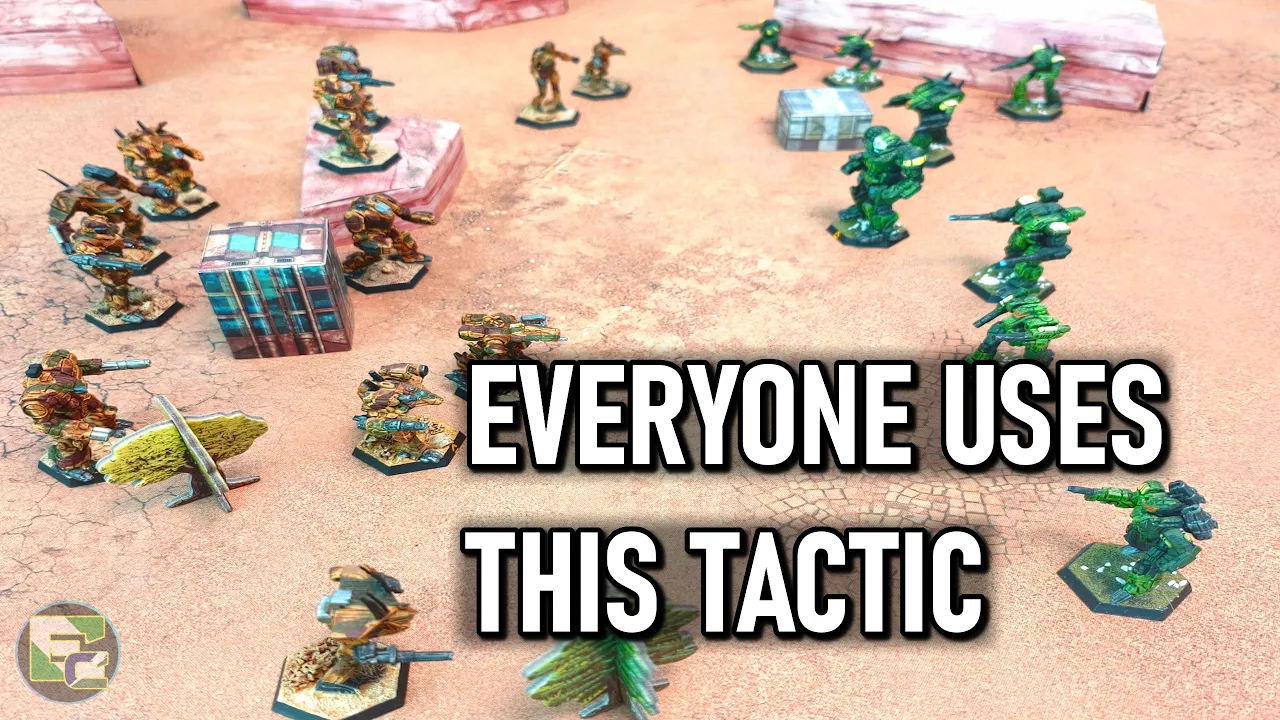
That is the [music] tactic, not the flank. The unfair fight. Let's use BattleTech as the example. Your heavy units move up the center. >> [music] >> Brawlers, Juggernauts. Units the enemy has to respect. They advance, occupy space, and create [music] pressure. On the sides, you have your mobile units, strikers, skirmishers, units fast enough to reposition. At first, this looks like a normal flank setup. Your center moves forward.
Your mobile units spread out. Your opponent sees the shape of the battle and responds. They send fast units to the flank. They turn weapons outwards. They prepare to stop your strikers before they get behind them. That is the moment you wanted, because your mobile units do not have to take the flank fight. They showed the threat. They made the enemy answer. And then they leave. Instead of continuing around the edge, your strikers and skirmishers collapse back towards [music] the center battle.
Now the enemy flankers have a problem. They moved to fight something that is no longer there. Their shots are poor. Their angles are bad. They need another turn to matter again. Meanwhile, [music] your mobile units have joined the main fight. Your brawlers are there. Your juggernauts are there. And now your strikers are there, too. One section of the enemy army is suddenly taking fire from more units than it can answer.
The enemy thought they were defending against a flank attack. What they really did was move part of their army out of the decisive fight. They defended the location. You attacked the weakness their movement created. The flank did [music] not win that fight. The force shift did. If five of your units can attack two of theirs, that's a problem. If three of their units are stuck on the flank trying to get back into the game, >> [music] >> that is a bigger problem.
You do not need local superiority forever. You need it long enough to break something. Destroy a unit, clear an objective, open a gap. >> [music] >> Real commanders were not chasing the word flank, either. They were trying to hold part of the enemy army in place, then commit strength where it mattered. Sometimes that was a flank. Sometimes it was a section of the line stretched too thin. Sometimes it was reserves going in after the enemy had already committed.
On the tabletop, we can see the whole battlefield. We know where the objectives are. >> [music] >> We know where the table edge is. That makes flanking cleaner than it usually was in real warfare. But the principle is still the same. Find or create the part of the line that [music] cannot take the hits. So, how do you use this in your own games? >> [music] >> Do not treat the flank as a destination. Treat it as a test.
Did it pull enemy units away from something important? Did it threaten an objective? Did it help your main force win a real fight? If the answer is no, the flank may not matter yet. It may just be movement. Local superiority does not come from being on the side of the board. It comes from making the right part of your army matter [music] at the right time. This is also why committing too early is dangerous. A lot of players see a weak flank and immediately send their best unit wide.
Now the opponent knows exactly where you want the important fight to happen. That gives them time to make the weak flank less weak. >> [music] >> The exposed unit can fall back toward support. A tougher unit can move into its place. And the rest of their force can keep fighting the main battle while your striker is still wide. That is not local superiority. That is a good unit becoming less relevant. So, do not move your unit to the [music] flank just for the sake of it.
Make sure it will matter regardless of the enemy responding to it or not. Even if it might not seem relevant right now, be sure it's in a position to become extra relevant next turn if the enemy does nothing to hamper it. The better moment comes after the enemy has already committed. They moved flankers wide. They turned guns outward. They pushed a heavy unit forward. Good. Now, decide whether that is still the fight you want.
If it is, hit it. If it is not, leave it and hit somewhere else. That is the point of mobility. You are not obligated to fight the battle your opponent prepared for. And once you create local superiority, spend it immediately. Damage something. [music] Break something. Take the objective. Collapse the position. Do not spend three turns setting up an unfair fight and then spread your fire across five targets. The whole reason you created the advantage was to make part of the enemy army disappear faster than expected.
[music] So, make it disappear. Flanking is not bad. It is just not the point. The point is local superiority. So, the next time you look at a table and think, "I should flank them." Pause. Ask the better question instead. Where can I make [music] this unfair? Where can I make more of my army fight less of theirs? Where can I make their units irrelevant for one turn? Because that is the real tactic. Not the flank. The unfair fight.
If this helped you rethink how you use fast units, hit like. It tells YouTube this kind of tactical breakdown is worth showing to more wargamers. >> [music] >> And if you play BattleTech, 40K, Bolt Action, Legion, historicals, fantasy, or anything else, I want to know this. What move do players in your game keep calling a flank attack even when it's not really what is happening? Put it in the comments. Because I suspect a lot of us are using the same tactic. >> [music] >> We're just giving it the wrong name.
Before we go, a special thanks to our two newest channel members, [music] Doug Young and Dan Hale. Appreciate the support. It genuinely helps the channel. Now, go out there and pick some unfair fights. MechWarrior.
The words are the caption track's own and nothing is reworded or re-transcribed. Paragraph breaks are placed between sentences so the text reads as prose.
Free tools for your own script. No signup, no login.
Paste your draft and see where viewers are likely to drop off, with a rewrite for each weak line.
Paste the first 30 seconds of your own draft for a hook score and rewrites.
Check your draft against YouTube's advertiser-friendly guidelines before you record it.
Read this channel's public videos and transcripts, and download a writing brief for it.