Getting the transcript
Reading the captions from YouTube. A video nobody has opened here before takes 10 to 30 seconds; this page fills in on its own.
Getting the transcript
Reading the captions from YouTube. A video nobody has opened here before takes 10 to 30 seconds; this page fills in on its own.
Tim The SEO Guru · @TimSEOGuru
Words
2,440
Runtime
13:30
Speaking pace
181wpm
Reading time
10min
181 words per minute, the same as the 181 median of 349 measured videos. That distribution comes from the 349-video hook study.
Opening (first 30 seconds)
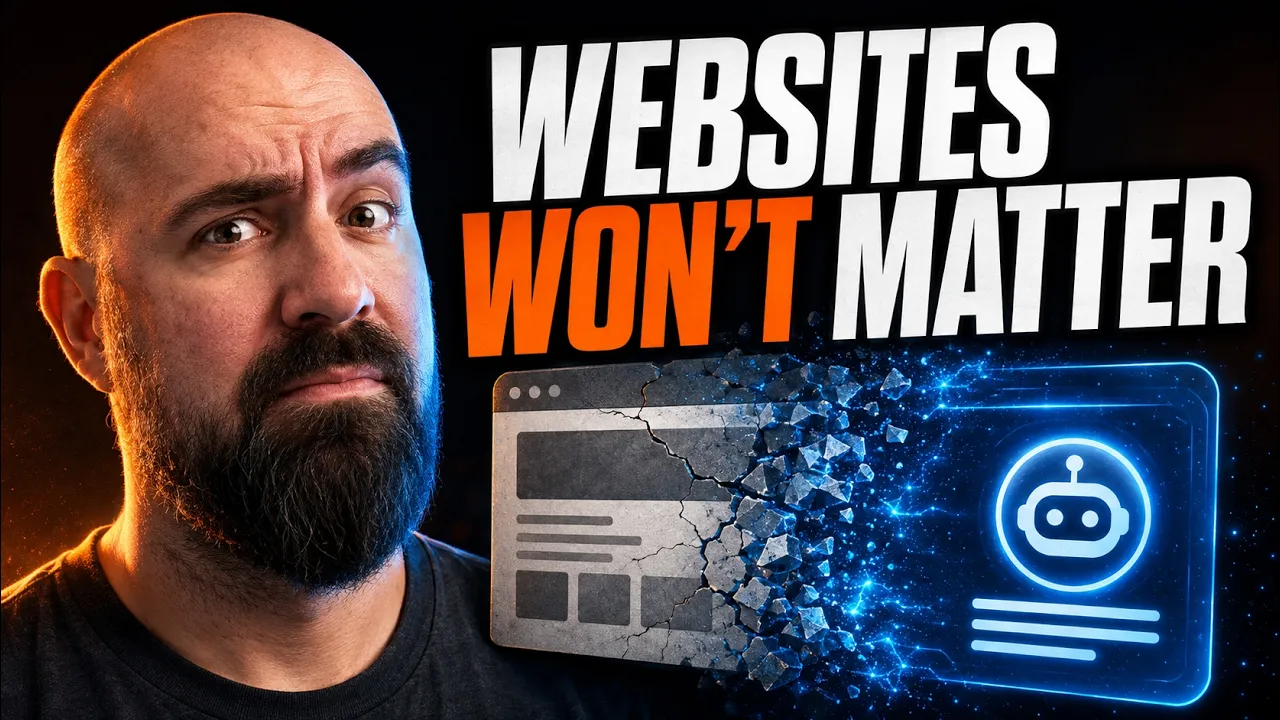
Recently the CEO of Google said the year 2027 is the year of the AI agent which means that websites for businesses are becoming less and less important. AI agents are going to replace a lot of the function and purpose of websites and people are clicking a lot less because they are using AI agents, AI overviews, AI citations. So today I'm going to talk about what to build instead or in addition to with your website to make it mean more than what it does now and how to
91 words, the words spoken in the first 30 seconds at 181 words per minute.
Free, no signup. See how the first 30 seconds hold attention, with rewrites.
Sentence shape
| Measure | This transcript |
|---|---|
| Sentences | 149 |
| Average words per sentence | 16.4 |
| Longest sentence | 75 words |
| Questions asked | 5 |
| Sentences containing a number | 5 |
Most used terms
Filler phrases
93 in total: uh 39 · you know 16 · like 15 · basically 11 · um 11 · right? 1.
A literal whole-word count of the same phrase list the Prepublish browser extension uses, so a phrase inside another word is not counted and a phrase used in its ordinary sense still is. It is a count and not a judgement.
What this transcript is
Every word below is the caption track YouTube publishes for this video, pulled from the video itself and reproduced unchanged. It is not Prepublish's writing, not a summary, and not a re-transcription: it is the video's own published captions. English captions, generated automatically by YouTube, in the video’s original language. Source: the video on YouTube. A channel that would rather this page did not exist can ask for its removal through the contact page, and it is removed.
No Script X-ray for this video: YouTube shows a Most replayed graph only once a video has enough views.
Recently the CEO of Google said the year 2027 is the year of the AI agent which means that websites for businesses are becoming less and less important. AI agents are going to replace a lot of the function and purpose of websites and people are clicking a lot less because they are using AI agents, AI overviews, AI citations. So today I'm going to talk about what to build instead or in addition to with your website to make it mean more than what it does now and how to overcome this shift in search behavior.
All right. So understanding where we're going is it's important to understand where we're at now. So half of searches right now never reach a website. 58% of Google searches now end with zero clicks. people get the answer and then leave the page. For a decade, the whole game was the same loop. Rank on Google, pull traffic to your site, convert the visitor into a lead, and then every dollar chase that funnel. Uh, now that funnel is leaking from the top because people aren't going any further.
So, 2027 basically, like I just said, is going to be the year of AI agents and how they are going to evolve search even more than what has already happened. So keywords are becoming conversation. So you know the old way of searching is you query like AC repair near me. You scan a list of blue links, you read reviews, you pick a site, you land on a page, you fill out a form, you call the business, whatever the case may be.
Now in the AI search area, you basically query the problem or what is going on to try and find a solution first. So maybe you you query like thermostats on, fan runs, no cold air, why? Uh maybe you even upload a photo of the unit. Then you get a diagnosis in second and then the result decides whether um to basically move on and then find a place to fix this for you or you basically fix it for yourself. So it really changed the whole process or basically you can even go back circle back and ask more questions um and try to u distinguish what's going on even more.
So it becomes an ongoing conversation that may never even leave that AI conversation tab. So your content isn't fighting for ranking. It's fighting to become the source of that AI trust. So the whole game now is getting to show up as a source in that AI citation, the AI overview, and making sure all of your content and your structure is doing everything to match that. So what is winning right now in the AI search area era and the things that you can start to tweak on your website and landing pages is transparent pricing content.
So people ask AI what things cost constantly. So if your pricing isn't published, the AI has nothing to reference and sends people elsewhere. So you don't need your price to book. You need the authority on the range. So you can basically, you don't have to put the exact price, but you can put the range in your content when you're creating, you know, blog posts and things like that. You know, put the pricing ranges because people want to know that.
Uh, agent ready scheduling is important. So, um, basically the way that things are going is AI agents are going to be able to people are going to be a use AI agents to book their consultations, book their appointments, book their reservations. So, the more prepared you are for this and the more you have that type of integration uh, is going to help you. people are going to be able to book with you over the competitors not using uh agent scheduling.
So your CRM or whoever you're using, start to check and make sure that they're going to be implementing that functionality. Uh content from real questions. So this is a big one. Google's own white paper says commodity content like seven tips for summer or seven tips for new home buyers. That's commodity based content. it's going to hurt you. What you have to do is make sure you're releasing non-commodity based content, content with a unique perspective, con variable type content, content that sets you apart uh in those ways.
So, what I use just a piggyback on this to create this type of content that's doing really well right now is I use Arvo to create this content, but what you can do, there's a link below to this. So, you can create amazing content from an SEO standpoint. Uh so you can go in here and create uh content from a you know SEO article, you can do a news article, YouTube to blog post, but you can also do variable type content.
So like we have we have content on like real estate. So basically you can enter your your year and your topic. Um so these are all these are all variable type content. So all of these are variable articles uh that we created. We created a temp. So you can go in here and you create a template. You basically give it a generation prompt and you give it a markdown outline. Uh and then what you do is you can then use that template to create variable content.
So you enter in different variables every time related to your business. So it's going to be unique content, non-commodity content. So just by adding variables in your content is going to help you, you know, match this part and what Google wants to create non-commodity uh based content. You can also when you're creating content, you can uh basically set this up in a way to include your brand assets. So it's going to make it even more branded and even less commodity based content because you can go in here and add as far as your knowledge base, you can add case studies, you can add training materials, you can add your website.
So it's going to pull that in when it's creating the content to make it original to you and your business and even less commodity based content. Um, so that's one of the tools that I use. So you're using AI but you're using it in a tweaked way where it's not creating slop. It's creating unique variable original content. So uh the other thing is in order to write content you can you should be listening to your customers.
So listen to, you know, what questions they have before booking appointments, what questions they have during booking appointments, you know, listen to the conversations, you know, how are your sales calls going, how are your visits going, you know, what are the common questions and topics that people are talking about, you know, looking at the questions you're getting in emails and how your your clients are what what they're asking you through email.
So basically your client database and your and your uh people like looking to book appointments and anyone that's interacting with your business has the potential for content. Uh and this all of that stuff you can use and then create content on it. So, especially like the question content does really well because you can pose the question and answer it uh from your business's perspective. And you can easily do that, you know, inside here when you're when you're doing a new question, you can do um I can go in here uh and create an article.
So, when I do generate article, I can go in here and do SEO article. And then what I can do is I can put the keyword. So, maybe it's like HVAC repair, right? Would be the keyword. And then the question will be like how long is uh how how long does it take for a full HVAC repair replacement or what is the cost for an HVAC uh repair replacement something like that. So you're doing the question targeting a keyword and then you're generating the content but again you can add in your brand assets in here and generate the content based on your brand.
Uh and this is what's working really really well right now and that's what I would do. The next part of this is um you know agents just understanding how agents are going to work in the future. So Google's Gemini Spark is a personal agent. So right now it researches books and works on your behalf 24/7. Um and then they have a A2A protocol that lets agents talk to agents. So you ask yours to track a package. It talks to Target's agent which talks to UPS's agent and then comes back with the answer.
So no search, no websites, no form. So, this is going to be the future is going to be interacting with the AIS and then they're going to go out and do the tasks and interact with the other agents and bring you back the results and the outputs that you want. So, knowing that and setting your website up in that way that's easy for agents to get this chunk of information, bring it back is going to be really, really important.
So, here's what you can do. Uh and here's what you should be building and getting prepared for this. So you should be building a knowledge catalog and your c this is going to be a big term coming in the future and your competition is not even probably aware of this. So Google has already rolled out the pieces verified knowledge catalog, search console, domain verification and discoverability API. A a knowledge catalog is a structured verified data set of everything your business knows.
The foundation and agent deploys on your behalf. your website is a knowledge cataly too. It's just stuck waiting for Google to crawl it. Um, so you can go in and then create your own knowledge catalog to get prepared for this in addition to your website. So your knowledge catalog uh is an asset for your brand. So what should be included in the knowledge catalog? Customer questions and answers, you know, all the main questions and answers your uh your clients will have. services and service areas.
You know, which services do you have? What are the service areas that you uh that you serve? Expertise and credentials. Really important to add this in everywhere just to show that you are an expert source and the reason why people should choose you over someone else. Frequently asked questions, transparent pricing information, policies and processes, uh reviews and testimonials. Obviously, social proof is always important.
Uh, and then real call transcripts and insights. So, old content is SEO, keyword, backlinks, which is, don't get me wrong, that's still going to be important. It's just this new phase is going to give it a nod up. It's going to be even more important. So, the new intent is trusted content, structured data, an agent that can speak on your brand. Um, the edge isn't the best looking site anymore. It's the most complete data because more people are less people are coming to your website.
The UX is less important. Sure, you still want to look decent in case people are jumping there, but less and less people are going to be going crawling your website. The agents are going to be doing that. So, you got to make sure all the information is readily available uh readily available and structured uh in a friendly way. So, here's your five-step head start. So publish trans transparent pricing, audit your online scheduling, you know, see if your CRM can uh transact with AI agents or has that on the road map.
Turn real calls into public content, calls, emails, interactions, start a list so you can create content on that. Build your knowledge catalog like we just talked about. And then optimize for citations, not rankings. You know, track uh share a voice and mention rate, get recommended. Uh so that's important. So tracking the uh how you're showing up across AIS is important. Arvo has that too built in. So you can go here and they have LM brand monitor.
So you can enter your website right once you enter your website. It'll automatically give you prompts to track visibility how you're showing up and then sentiment positive or negative. But then you can add in your own prompts. So, I would go in, do this, add a bunch of prompts, like a bunch of things that people are asking, questions that people are asking, questions that you want to show up for, and then monitor the performance and visibility of your brand.
And you can click into each of these and see across the AIS how you're performing. So, like for instance, this is just an example one we did for Sam Rush. What I do is then this is a question I have no very little visibility. I'm going to then take this question and then pop that into uh an article, an SEO article, and create content on it. Create branded non-commodity content on this question so I can start chipping away at this visibility and start to show up for this question.
That's the whole point. Um, so that's one of the features. Lots of other features built in here. You can do technical audit of your website. Uh they have Google business page integrations, Google b business page posts, review replies on Google business, which is really important. That plays a key role for local businesses uh in showing up and and creating authority. Uh so that's something that they have in there too.
Uh so that's it guys. That's what's changing. That's what I would prepare for. But the main takeaway of this is build that knowledge catalog so you can have that all that chunk of information that the AIs can crawl and you can get ahead of the game, ahead of your competition because it's going to become more and more important. So hopefully that helps you guys out. There are links below to Arvo if you want to use that.
Fantastic resource for SEO and staying on top of uh the AI game. And check out this other video. I'll vex him with some good stuff for some more good stuff for
The words are the caption track's own and nothing is reworded or re-transcribed. Paragraph breaks are placed between sentences so the text reads as prose.
Free tools for your own script. No signup, no login.
Paste your draft and see where viewers are likely to drop off, with a rewrite for each weak line.
Paste the first 30 seconds of your own draft for a hook score and rewrites.
Check your draft against YouTube's advertiser-friendly guidelines before you record it.
Read this channel's public videos and transcripts, and download a writing brief for it.