Getting the transcript
Reading the captions from YouTube. A video nobody has opened here before takes 10 to 30 seconds; this page fills in on its own.
Getting the transcript
Reading the captions from YouTube. A video nobody has opened here before takes 10 to 30 seconds; this page fills in on its own.
The AI Advantage · @aiadvantage
Words
3,012
Runtime
14:19
Speaking pace
210wpm
Reading time
13min
210 words per minute, above the 201 75th percentile of 349 measured videos. That distribution comes from the 349-video hook study.
Opening (first 30 seconds)
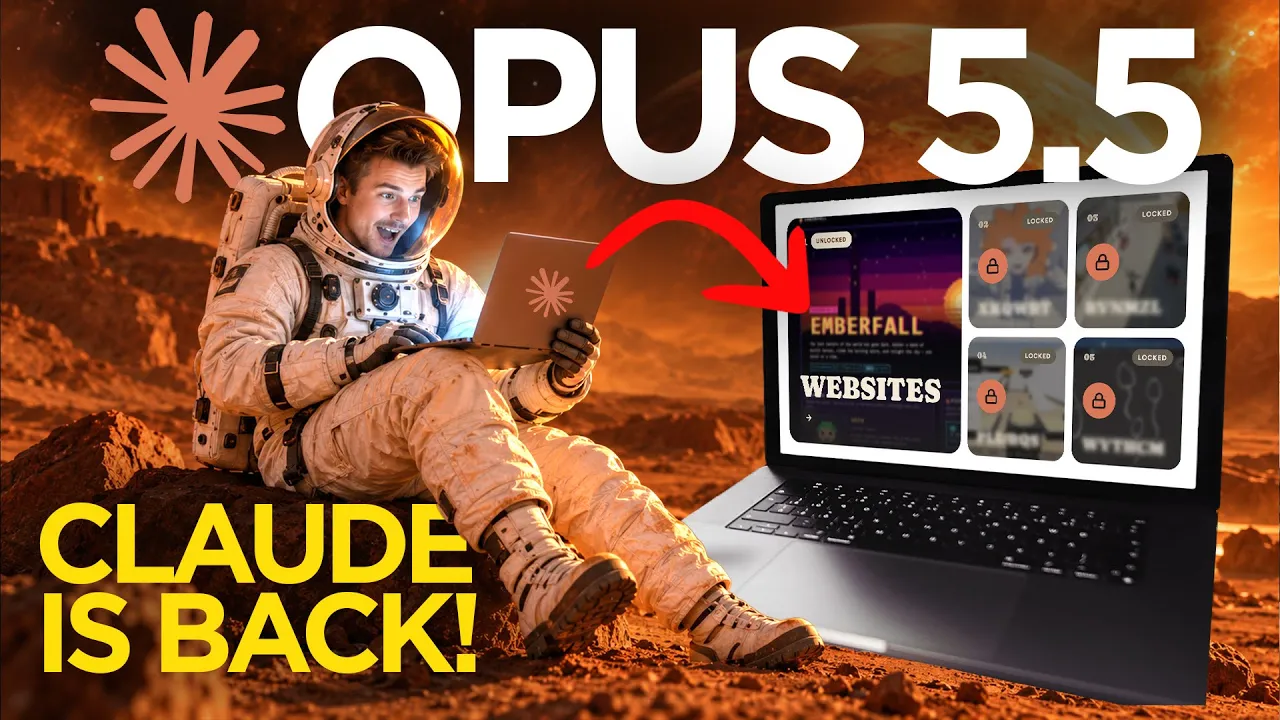
Big week in AI, as you might have noticed. We have Opus 5.5 releasing. We have OpenAI releasing GPT-6 Saul. And then they're making a bunch of product changes. I want to talk about all that together, but mainly through this lens of, "Hey, is it worth switching from one to the other because of the new models?" Namely, Opus 5.5. Everybody has been talking about these things. So, what I did is I took bunch of different use cases that are novel, things that were just not possible before with some of these other models or were really at the frontier of what they
105 words, the words spoken in the first 30 seconds at 210 words per minute.
Free, no signup. See how the first 30 seconds hold attention, with rewrites.
Sentence shape
| Measure | This transcript |
|---|---|
| Sentences | 266 |
| Average words per sentence | 11.3 |
| Longest sentence | 39 words |
| Questions asked | 16 |
| Sentences containing a number | 37 |
Most used terms
Filler phrases
73 in total: like 39 · actually 9 · right? 9 · you know 6 · I mean 3 · kind of 3 · basically 2 · literally 1 · uh 1.
A literal whole-word count of the same phrase list the Prepublish browser extension uses, so a phrase inside another word is not counted and a phrase used in its ordinary sense still is. It is a count and not a judgement.
What this transcript is
Every word below is the caption track YouTube publishes for this video, pulled from the video itself and reproduced unchanged. It is not Prepublish's writing, not a summary, and not a re-transcription: it is the video's own published captions. English captions, generated automatically by YouTube, in the video’s original language. Source: the video on YouTube. A channel that would rather this page did not exist can ask for its removal through the contact page, and it is removed.
No Script X-ray for this video: YouTube shows a Most replayed graph only once a video has enough views.
Big week in AI, as you might have noticed. We have Opus 5.5 releasing. We have OpenAI releasing GPT-6 Saul. And then they're making a bunch of product changes. I want to talk about all that together, but mainly through this lens of, "Hey, is it worth switching from one to the other because of the new models?" Namely, Opus 5.5. Everybody has been talking about these things. So, what I did is I took bunch of different use cases that are novel, things that were just not possible before with some of these other models or were really at the frontier of what they could do.
Bunch of really examples, yes. And then I also ran my big 50 website generation benchmark and compared Opus 5.5 with Astra to answer the question which one should you be using for which task. But, let me just say up front in case you wonder. If you want the overall best user experience, I think ChatGPT is just the one for that now. It's all the little things, like you scheduling a task and it just working in the first shot.
Astra works really well with creating websites. We'll look at examples and it can go both ways. But, if you want one overall recommendation, I think it is ChatGPT right now for most consumers. Now, if you want the very best model for specific tasks, I think Opus is a real contender. I'm super impressed with what it can do. I've had some wow moments while exploring this. And the writing is just darn good. They kind of fixed it.
I want to open the meme that has been, you know, making its rounds on Twitter. This is This is too good. It's accurate, though. 4.6 was incredible. I'm not sure what started going on after that. Like, we saw a higher number, but it wasn't necessarily better. Opus 5, a lot of people jumped ship from Claude because of Opus 5. We talked about this before. It was just unreliable. And now 5.5, I mean, >> [laughter] >> they didn't even say 5.1.
I think they really wanted to make a point that, "Hey, this is like a brand new category of product." And it is. It's an amazing model. It writes so well. It's just more concise. It's to the point. It speaks a human language. I would say about the writing. But, now let's get to some of these examples because yeah, that's what you're here for. Okay, so here's the first example. This is just something that I don't know a few months ago was unfathomable.
You just go to Claude dot AI in the web and with this one prompt in our testing, we generated an entire world. And you see many examples of this out there. I wanted to see for myself if this actually works as well as people describe. Conclusion, it works really well, but not as well as some of these demos where they like rebuild Spider-Man. Those are larger projects. You're not going to get that from a one-shot prompt.
But what we managed to get out of our one-shot prompt was well, actually a fun little idea that we had. So basically all this is is giving it the website of any business. In this case, we took our company AI Advantage AI Education, right? Then we said build a 3D playable world and then we specified a goal. And the goal was understand what the company does and what products it has. Okay? You can replicate that for any business with any website and literally put that into Claude web and you're going to get something like this.
Takes about an hour to generate, but there you go, the 3D AI Advantage world. Let's just enter this and there you go. We're looking at something like a computer game, right? So I can move around. Welcome to the AI Advantage. We teach everyday people how to use AI in plain language one step at a time. Beautiful. You can navigate this like you would any game and there's a bunch of stuff in here. I'm just going to knock over this domino.
This talks about strategic automation. I like it. You can see there's all of these little simulations in here are low going 3D. It's kind of cool. You can see it created the room for the various products. But just think about the potential here. I think that this one is actually super cool. Look. Hey, if you're learning with guidance, then you have guardrails. If you're learning on your own, it's more like this. Then let's take all this busywork.
Let's say a social post. Uh oops. Pick it up. >> 2 hours later. >> Throw it in here. Boom, and I saved 2 hours a week. >> [laughter] >> So, you can see this is really fun and it's so simple. You can make this with anything, any website, any idea you have. And on the top right, you have a checklist of the tour. You can just make things like this because it has a version of Blender inside of the cloud computer that it can run for you.
But, there is a gap between, you know, this and a version of Spider-Man with wonky animations like this one. By the way, on the animation note, I found this interesting tweet I'm not a game designer, but I always find that it's super interesting what people do. And Varuna here is saying, as I said before, the last bottleneck will almost remain animation like as it pertains to these games, right? Animation is deep and modern AI still struggles to do a good job.
So, you can see AI can do a lot of the elements of this type of stuff if you let it run for a day or two and not just an hour like in our case. Crazy if you compare it to Will Smith's spaghetti from just What is it? 3 years ago. So, another thing that a lot of people show off is this ability to turn a quick sketch into something proper, whether it's a 3D environment or an interactive app or a website or something. So, let me just try that.
Antonio, who just joined our team, had this cool little idea of doing a little bow simulator. So, check it out. I'm going to do my best at drawing a bow. Not bad. There's the arrow. And then we'll have like little balloons there. This looks more like a flame. And then what I'm going to do is Well, I'm just going to screenshot this. Get it into Claude. And then I'm going to use my foot pedal to speak. Hey, I want you to create a mini game where I have a bow and I shoot these different balloons that rise up from the bottom part of the screen and go above the screen.
Give it a medieval look and also make it gloomy and dark. And make sure to add balloons that are red that I need to avoid that would lose me points. All right. So, this little balloon game was rendering for about 7 minutes. Let's have a look. The cloth balloon is plus 10. Ooh, the cursed red balloon is minus 25. All right. Ooh, look at this guy. Okay, this might be the best game I ever make. Boom. Oh, wait, this is a tricky one.
Can we No. So, for comparison's sake, quickly, same prompt ran in Astra would produce a result like this. Ooh, oh my look at this Astra. Like this visual is crazy. This is where the visual image generation of ChatGPT comes in, right? Cloth doesn't have an image generator, whereas this does. So, that's where the background comes from. I think everything else is similarish. I actually prefer the game experience inside of Opus, but this background visual is sick.
So, maybe you could use ChatGPT for visuals and Opus 5.5 for the build. It ain't easy out here in AI land. All right. Next up, people keep posting these shiny ads. They're like, "Oh my god, I made this with AI, no problem." Well, turns out that when I looked into this, these workflows are a bit more intricate than you would expect. Like they give a lot of templates, examples. It's not just a fancy prompt. It's people doing real work to prepare some of these impressive, and they are impressive, visuals like this one. >> [music] >> It's really impressive, right?
And then also, I just wanted to show this example that I'm prompt shared if you haven't seen this yet. This is crazy. Look at this little like brick building simulator. Amazing. All of this are components. Like a few months ago, we used to show off these demos always, right? in all the YouTube videos. And we were like, "Hey, you can create this cute little application." Now, this can create a proper app that I don't know what kind of business would actually use this one, to be honest, but I don't know, maybe you're doing custom Lego builds.
I'm not sure. It's a full suite. It's like something that you would usually pay a subscription for, right? Whereas these previous apps, they were like nice little mini games or online apps that are freely available. This is proper. Like I wouldn't be surprised if this was a tool on the Lego website. And I think one thing that I find across trying these out and we'll really see that in the next test here is that it's just visually more appealing.
It has taste. Claude always was the taste company. It was just a little better. It felt right. But before we get to the 50 different websites compared and some of the highlights of that comparison, I want to show you this build that I thought was really impressive for a fellow YouTuber, Matthew Berman. And he let it run for what was it? I think like one and a half days straight. He just opened it in Claude code, set a slash goal where you just tell it what you want, which in this case was that replication of San Francisco with traffic and buildings and everything.
And yeah, it just kept coding for almost two days straight. And look at this. Now, I've been saying this across the past few months, a lot of this is amazing technology waiting for use case. I understand that most people watching this will not be recreating cities and getting use out of that. But I hope that some of the examples that we look at here, including the websites that are up next, can show you how you could create something for yourself.
Maybe a 3D onboarding demonstration. I don't know. Honestly, I'm on the same page in terms of like, how do I really use this for my life? It's not obvious yet if you're not a builder that is creating things for a living. But what is clear, and I'm going to touch on this briefly before the last set of examples, is that this thing is just more efficient. So, I was looking into these usage numbers and I have a little comparison chart here for you.
These are the prices of the frontier models from both OpenAI and Claude next to each other. As you can see, Opus is cheaper than Fable, but often times it's not the price that matters the most, right? Often times it's how much usage do you get out of your account before the limit fills up. And in this case, Claude Dev's account claims that you get 25% more usage. You can go 25% further with Opus 5.5 than you would with Fable 5.1.
So, while the price might be cheaper overall and depending on the thinking level, it varies as you see, expect to get 25% more mileage out of using Opus 5.5. But then at the end of the day, I think one of the things that people do the most is create websites, whether it's single-purpose sites or, you know, their main homepage, whatever it might be. Like, creating sites and slide decks and documents is just up there in terms of use cases that I see people doing.
So, you might have noticed if you've been following the channel, but I created a benchmark recently where I generate 50 different websites across various categories. And by looking at all of these, I want to show you and highlight a few examples of sites that would perform very differently in Opus 5.5 versus Astra versus Fable 5.1. Answering the question of, "Okay, if I want to create an app or a site, which one of these should I use?" So, instead of showing you all 50 examples, let me show you the more significant ones.
Starting with this global AI usage map. I think the interesting thing here is the details of the map because it creates it with SVGs, which are basically computer-generated geometric forms. As you can see, Opus 5.5 creates something that is like a world map, but not very precise. The precision on Astra is way higher when it comes to the continents. Still not perfect. The feel of these websites is different. Honestly, with these fonts, I could immediately tell that it's probably a cloud-generated, AI-generated site, whereas Astra feels a bit more distinct, a bit more professional.
That was also the conclusion of my last comparison between Fable 5.1 and GPT-6 Astra. All these names, right? But when you take that and put it up against Fable 5.1, I actually think that the Opus one is a step up. I mean, look, Fable, this is overlapping. The SVGs are even more off. Okay, more examples. This would be a launch site for a in-the-game, okay? Let's start with Fable 5.1. This is what it made. It's good. Now to Opus 5.5.
It's better. It's just more concise. There's less nonsense. I like this title image. I realize a lot of this is going to be personal preference, but my personal preference here is with Opus 5.5. And then if you look at Astra, again, it's it's It's It's a bit more polished. I think this is good, but honestly, if I needed this site, I prefer this one every time. Maybe you have a different opinion and that's fine. That's the point of this, but you can see the functionality is there.
But in terms of style, I like Opus. All right, then we have this little pinball game. Opus 5.5 versus Astra. Again, the theme of Astra just being a bit more professional, a bit more polished holds. For pinball game, I personally prefer Opus 5.5 here. By the way, for reference, this is the Fable version, which is also good, but I do have a preference for this Opus one. And also, functionalities right there. So, you can see a theme here.
Let's look at a more professional site to give Astra a fair shot here. Like this educational website where it's supposed to explain rag to people that are learning about it. Look at this Opus generation. It's more playful and I think this one looks more AI-esque, which I personally actually don't prefer in this case. I mean, you know, it's good. It's a good website. I can't say anything bad about it. Just think when it comes to education, I would prefer a more clean look like Astra provides by default here.
And then I want to show you this one, which simulates a flock of birds, I suppose. Fable did a good job with this, you know, it works. It looks good. Astra, again, created just this more polished look. But then Opus created this full-screen experience that is a bit more immersive. I love the font on the side. Everything works. You have all of these sliders. It's clean. It's full-screen. It's a full experience. I think it's better when it comes to something like this.
And that's the theme of this. I'll say this to round it out. When it comes to something like a tool or a dashboard, apples to apples, sure Astra is more professional as I can see here. And these dashboards all look good. I think Opus has a bit more soul when it comes to websites and I would prefer it over Fable 5.1 in most cases, actually virtually all cases. And when it comes to writing, you'll just see when you interact with Opus, it just feels human.
It feels better. It's concise. It speaks a language you can understand. In conclusion, this image of, you know, Dario drawn in different ways, I think is accurate. I think Opus 5.5 is Anthropic's best model yet. It will be my default, but I switch to ChatGPT as my daily driver including my agent usage and everyday tasks. But 5.5 does have a strong pull. I like the creativity, I like the writing. So, if you're into those things, try them out.
I hope this video was helpful to make up your mind in terms of what you should be using. And finally, this hasn't rolled out yet, but if you haven't seen it, check out the new ChatGPT voice features where it connects us all the connectors. You can be on the go and checking your calendar, writing emails, doing things like that. It looks really cool. Hasn't fully rolled out yet. I'll cover it once it does, so make sure to subscribe.
And that's pretty much everything I have for today. I hope this was helpful. My name is Igor, and I hope you have a wonderful day. >> AI news you can use. Breaking down the stories you actually care about. AI news you can [music] use. Igor's here to help you figure it out.
The words are the caption track's own and nothing is reworded or re-transcribed. Paragraph breaks are placed between sentences so the text reads as prose.
Free tools for your own script. No signup, no login.
Paste your draft and see where viewers are likely to drop off, with a rewrite for each weak line.
Paste the first 30 seconds of your own draft for a hook score and rewrites.
Check your draft against YouTube's advertiser-friendly guidelines before you record it.
Read this channel's public videos and transcripts, and download a writing brief for it.