Getting the transcript
Reading the captions from YouTube. A video nobody has opened here before takes 10 to 30 seconds; this page fills in on its own.
Getting the transcript
Reading the captions from YouTube. A video nobody has opened here before takes 10 to 30 seconds; this page fills in on its own.
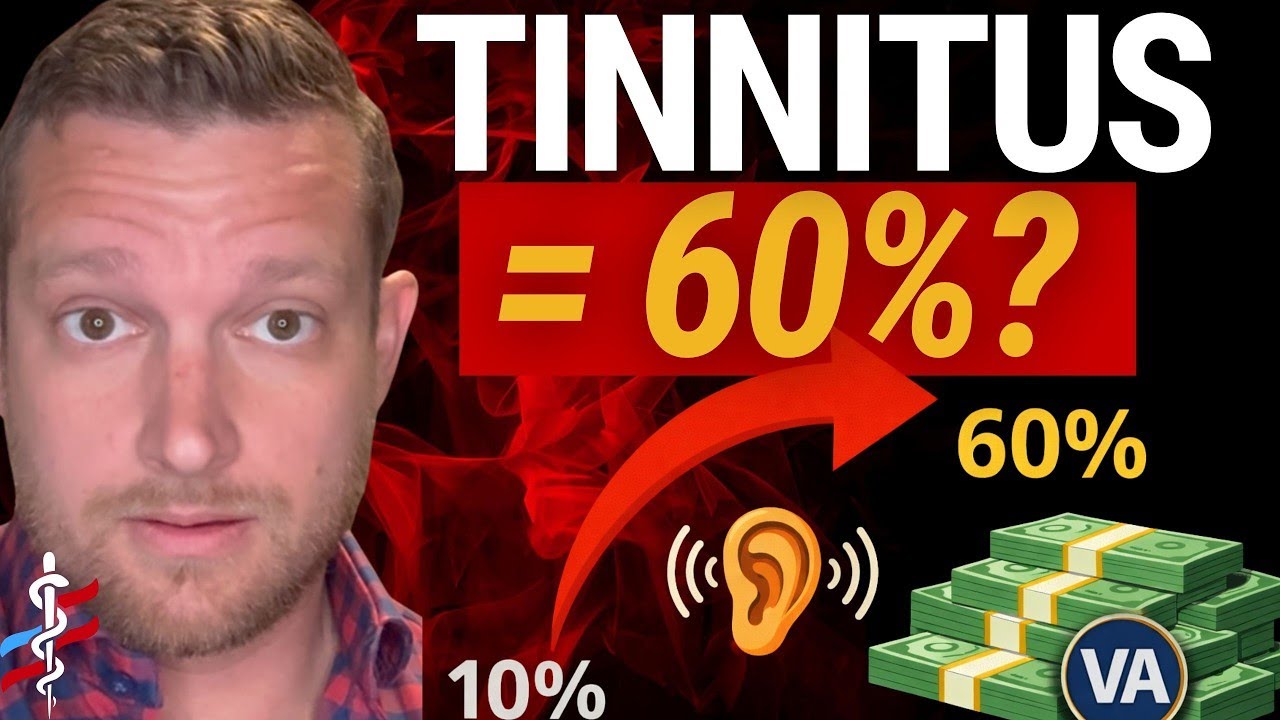
Dr. Marshall Bahr | Xterra Health · @XterraHealth
Where viewers went back to watch this video again, from YouTube's public Most replayed graph, lined up with what was said at that moment.
Words
2,579
Runtime
15:57
Speaking pace
162wpm
Reading time
11min
162 words per minute, between the 160 25th percentile and the 181 median of 349 measured videos. That distribution comes from the 349-video hook study.
Opening (first 30 seconds)
You're rated 10% for tinnitus and you've accepted that's it. That's the ceiling. There's nowhere else to go, but you'd be wrong because that ringing in your ears, it's not just annoying. It's causing other problems. Problems the VA will actually pay you for. Today I'm going to break down the conditions that tinnitus causes. Conditions most veterans will never think to file. One veteran I worked with was stuck at 10% for tinnitus for 7 years. We filed for four
81 words, the words spoken in the first 30 seconds at 162 words per minute.
Free, no signup. See how the first 30 seconds hold attention, with rewrites.
What this transcript is
Every word below is the caption track YouTube publishes for this video, pulled from the video itself and reproduced unchanged. It is not Prepublish's writing, not a summary, and not a re-transcription: it is the video's own published captions. English captions, generated automatically by YouTube, in the video’s original language. Source: the video on YouTube. A channel that would rather this page did not exist can ask for its removal through the contact page, and it is removed.
You're rated 10% for tinnitus and you've accepted that's it. That's the ceiling. There's nowhere else to go, but you'd be wrong because that ringing in your ears, it's not just annoying. It's causing other problems. Problems the VA will actually pay you for. Today I'm going to break down the conditions that tinnitus causes. Conditions most veterans will never think to file. One veteran I worked with was stuck at 10% for tinnitus for 7 years.
We filed for four secondary claims. Now he's at 60%. Same ears, same ringing, just knew what to file this time. If you've got that ringing, the tinnitus, you need to watch this video because that 10% rating is just the beginning. So let me tell you what happens to almost every veteran with tinnitus. You file for tinnitus, you get awarded 10% and you think, "Okay, well, I'm done." And you move on with your life with that constant ringing in your ears and you never file another secondary claim related to it.
Here's the problem. Tinnitus is rated at 10%. That's it. That is the max. There's no 20% or 50% tinnitus. So veterans think, "Well, there's nowhere to go, so I'm stuck at 10% forever." But what they don't realize is tinnitus doesn't just ring. It destroys. Destroys your sleep. Destroys your concentration. It destroys your mood. It destroys your peace and every single one of those things separate ratable condition. That 10% for your tinnitus is not the end.
It is really just the beginning. It is your anchor, your primary condition that opens the door to a bunch of secondary claims. Think of tinnitus like that one friend who shows up to the party and brings five other people you didn't invite. Except in this case, every uninvited guest comes with a a check. Now let me tell you about a veteran, I'll call him Dave. Dave was an artilleryman. 15 years in the service, worked with howitzers.
You can guess what his ears sound like. He got out in 2018, filed for tinnitus, got 10%. For 7 years, that was it. He just lived with it. He couldn't sleep, he was irritable all the time, his wife said he changed. He was getting headaches now, he felt anxious in quiet rooms because the ringing got louder when there was no background noise. When I talked to him, I asked, "Dave, have you filed for literally anything else?" And he said, "Like what?
I'm It's just ringing. They gave me 10%. That's the max you can get for tinnitus." And I said, "You just described four more claims." So, I helped him file anxiety secondary to tinnitus, insomnia secondary to tinnitus, migraine secondary to tinnitus, and his hearing loss, which he'd never filed for separately. Dave went from 10 to 60%. Same ears, same ringing. He just didn't know what that ringing was causing. Now, before we get into the specific conditions, let me explain why tinnitus causes all these other problems.
Tinnitus isn't just a sound, it is actually your brain misfiring. When your inner ear gets damaged from explosions, gunpowder, gunfire, loud engines, whatever it may be, the nerve sends scrambled signals to your brain. Your brain then interprets those signals as sound, even when there's no actual sound going on. But here's the thing. Your brain doesn't compartmentalize. When one system is misfiring, it affects everything else.
That constant signal, that never-ending eeeee, it just keeps your brain in a state of alert, hyper-alert. Your nervous Your nervous system thinks something is wrong, and it just can't relax. So, what happens? Well, you can't sleep because the ringing won't stop. You get anxious because your brain is always on alert. You get headaches because your auditory system is connected to everything else. You get depressed because you're exhausted and frustrated, and you lose your hearing because the same damage that caused tinnitus, well, it's still there.
Tinnitus is not just one problem. It is a chain of problems, and every link in that chain is a completely separate chain. So, let's start with the obvious one. Hearing loss, all right? Here's something that surprises a lot of veterans. Tinnitus and hearing loss are often caused by the same thing, inner ear damage, but they're rated separately. You can be 10% for tinnitus and get a separate rating for hearing loss. A lot of veterans file for tinnitus, get their 10%, and never actually file for hearing loss because they think, "Well, they already looked at my ears." No, those are different conditions, different ratings, different checks.
Hearing loss is rated on a scale from 0 to 100% based on how well you can hear at different frequencies. The VA uses a specific test, pure tone audiometry and speech recognition to measure your hearing and assign a rating. So, even if you're rated 0% for hearing loss, that's still important because now you've got service connection for your hearing. And if it gets worse, which it will with time, you can file for an increase.
So, if you have tinnitus and you haven't filed for hearing loss separately, go do it. The same damage that's causing the ringing is probably affecting your hearing, too. And let's be honest, if your spouse has been saying, "You never listen to me, honey." for 10 years, maybe it's time to get that documented. It's not that I'm ignoring you, it's service-connected disability. All right, number two condition, mental health conditions, specifically anxiety and depression.
Let Let you something. What would it do to your mental health if you had a sound in your head that never stopped? Not for a minute, not when you're trying to work, not when you're trying to sleep, not when you're trying to have a conversation with your kids. It never stops. Studies show that veterans with tinnitus are significantly more likely to have anxiety and depression than veterans without it. This is not a coincidence.
It's cause and effect. The constant noise creates constant stress. Your brain never gets a break. You're always on edge. Here's what tinnitus-related mental health problems actually look like. You get anxious in quiet places because the ringing gets louder when there's no background noise. You avoid social situations because you can't hear conversations and you're too embarrassed to keep asking people to repeat themselves.
You start to feel hopeless because you know the sound will never go away and you get irritable because you're exhausted and you're frustrated. Mental health conditions are rated from zero all the way to 100% based on how much they affect your work and social life. So, a lot of veterans with tinnitus are anxious. They are depressed. They just never connected to the ringing. It's If that constant noise is affecting your mood, your relationships, your ability to function, that's not just tinnitus.
That is a mental health condition secondary to your tinnitus. Number three condition, sleep problems. This one is almost too obvious, but that's exactly why veterans miss it. Can you sleep well with a sound in your head that never sleeps or never stops? Here's what veterans with tinnitus tell me. I have to have a fan on or I can't sleep. I use white noise apps every night. I wake up multiple times because the ringing bothers me.
I haven't had a good night's sleep in years. That's not just bad sleep. That's insomnia secondary to tinnitus and insomnia is ratable. Sleep conditions can be rated from 0 to 30% based on severity. And here's the bonus, the kicker. Sleep problems make everything else worse. When you can't sleep, your anxiety gets worse. Your depression gets worse. Your headaches gets worse. Your concentration and focus get worse. So not only is insomnia ratable on its own, it's also evidence that your other conditions are more severe.
The VA should at least pay you for all those white noise machines and box fans you bought over the years. Consider it like a reimbursement. Now quick pause. If you're watching this and you've got tinnitus and you've got sleep problems, anxiety, depression, or really any of these other issues I'm talking about, you need to file these claims as secondary. We can help you connect them properly. It is a free consultation at X-Terra Health.
The link's in the description below. We'll review your records for free and show you exactly what you qualify for. So let's keep going now. So number four condition, migraines and headaches. Your auditory system, the part of your brain that processes sound, is connected to a lot of other systems. When those nerves are misfiring, when your brain is constantly processing a sound that isn't actually there, it can trigger headaches.
So here's how it works. Tinnitus creates constant neural activity. Your brain is always on a state of on. That constant activation can trigger tension headaches. For some veteran, it triggers full-blown migraines with light sensitivity, nausea, the whole thing. Research has actually shown that people with tinnitus have higher rates of migraines than people without it. The Board of Veteran Appeals has even granted migraines secondary to tinnitus many, many times.
And migraines are rated anywhere from 0 to 50% based on how prostrating they can be. Remember that keyword is prostrating, which means headaches that are so bad you have to stop what you're doing and actually lie down. Now, 50% for migraines alone is well over $1,100 a month. If that ringing in your ear is giving you headaches, that's not just annoying, that's a ratable condition. Now, condition number five, vertigo and balance problems.
Your inner ear does two things, hearing and balance. When the inner ear is damaged enough to cause tinnitus, it can also affect your balance system. Veterans with inner ear damage often experience things like dizziness, vertigo, which is that sensation of the room spinning, feeling unsteady, problems with balance, especially in the dark or on uneven surfaces. Some veterans develop what's called Meniere's disease, a condition that includes tinnitus, hearing loss, and vertigo, all three together.
So, if you have all three, you might actually have Meniere's, and that's rated separately from tinnitus alone. Vertigo and balance problems can be rated anywhere from 10% to even 100% if you have Meniere's disease. If the same blast, explosion, or noise exposure that gave you tinnitus is also affecting your balance, that is a secondary claim. Same incident, same damage, separate rating. Condition number six is cognitive problems, trouble concentrating, memory issues, short-term memory issues, mental fatigue.
This one is especially important if your tinnitus is related to your TBI, traumatic brain injury. So, here's what happens. When you have constant noise in your head, your brain has to work harder to filter it out. That takes mental energy. So, you end up with trouble concentrating, difficulty following conversations, mental fatigue, memory problems, trouble focusing at work. If your tinnitus came from a blast exposure, an IED, a concussion, or any head trauma, there's a good chance you have a TBI, too.
And TBI has its own rating criteria, its own symptoms, and its own secondary conditions. TBI is rated based on cognitive, emotional, and physical symptoms, rated anywhere from 10% all the way to 70% based on severity of impairment. If you can't concentrate because of the ringing, if your brain feels tired all the time, if you forget things more than you used to, just document it. That's not just getting older. That could be cognitive impairment secondary to tinnitus or a TBI.
Now, let's see what happens when you start to stack all these claims together. So, you got a veteran rated at 10% just for tinnitus. That's it, just the ringing. But, then they file secondary claims. Hearing loss gets rated at 10. Anxiety gets rated at 30. Insomnia at 10. Migraines at 30%. Using VA math, that 10% becomes approximately 60 to 70%. 10% alone is about $170 a month. 60% is about $1,400 a month. And 70% is about $1,700 a month.
Same ears, same ringing. Just understanding what tinnitus does to your body, and then getting paid for all of it. Now, I want to give you three pieces of advice if you have tinnitus. Advice number one, document everything the ringing affects. Every time you can't sleep, tell your medical provider. Every time you get a headache, tell your medical provider. Every time you feel anxious or down, tell your medical provider.
It's not If it's not in your medical records, the VA will say it doesn't exist. Your job is to connect the dots between the ringing and everything else. Advice number two, don't assume 10% is the end. I see veterans all the time who say, "Well, tinnitus maxes out at 10%, so I'm done." No, you are not done. You're just getting started. That 10% is your anchor diagnosis. Now, file the secondaries. Advice number three, consider getting a nexus letter that explains all the connections.
The VA knows tinnitus is annoying. What they need to see is how it's causing other conditions. A good Nexus letter will explain this. It'll explain the mechanism, the why tinnitus causes sleep problems, anxiety, and headaches, the timeline or the when these problems started to re relative to your tinnitus diagnosis. It also explains the medical evidence, the studies that show these connections exist. And that is what we do at X-ray Health.
We write the Nexus letters and DBQs that make these connections crystal clear. Now, quick summary. The six conditions caused by tinnitus: hearing loss, same damage, separate rating. Anxiety and depression, constant noise wrecks your mental health. Insomnia means you can't sleep with the ringing. Migraines because auditory system triggers headaches. Vertical imbalance issues because inner ear does hearing and balance.
And cognitive problems because the brain overworked is is the brain is overworked filtering noise. So, if you're stuck at 10% for tinnitus, you're leaving money on the table. That ringing isn't just a sound. It is a cause, and every effect has a rating. Now, here's what I want you to do next. If you have tinnitus and chronic pain, like back pain, knee pain, shoulder pain, anything, there's even more you should be filing.
Chronic pain causes its own set of secondary conditions. Depression, sleep problems, stomach issues, migraines, does that sound familiar? Well, if it does, I made a video breaking down the five easiest claims to win if you have chronic pain. These are almost automatic wins because the science is so clear and strong. One veteran I worked with went from 20 to 70% for the same back pain, just filed the right secondaries.
So, if you've got pain on top of your tinnitus, you need to watch that video next. The link's in the the below. Now, look. Tinnitus is the most common VA disability. Millions of veterans have it, and most of them are stuck at 10% because they don't know what else to file next. But, now you know. That ringing is not just annoying. It's causing real problems, and every problem has a rating. I am Dr. Marshall Bar, Army Ranger, actual doctor, former C&P examiner.
Stop accepting 10%. Start filing for what the ringing is actually costing you. I'll see you in the next video, and until next time, stay mission ready.
The words are the caption track's own and nothing is reworded or re-transcribed. Paragraph breaks are placed between sentences so the text reads as prose.
Free tools for your own script. No signup, no login.
Paste your draft and see where viewers are likely to drop off, with a rewrite for each weak line.
Paste the first 30 seconds of your own draft for a hook score and rewrites.
Check your draft against YouTube's advertiser-friendly guidelines before you record it.
Read this channel's public videos and transcripts, and download a writing brief for it.
Most replayed moment #1
2:432.8x the video's typical replay level
said, "You just described four more claims." So, I helped him file anxiety secondary to tinnitus, insomnia secondary to tinnitus, migraine secondary to tinnitus, and his hearing loss, which he'd never filed for separately. Dave went from 10 to 60%.
Said at 2:36
Most replayed moment #2
11:592.7x the video's typical replay level
document it. That's not just getting older. That could be cognitive impairment secondary to tinnitus or a TBI. Now, let's see what happens when you start to stack all these claims together. So, you got a veteran rated at 10% just for tinnitus. That's it, just
Said at 11:52
Most replayed moment #3
6:332.2x the video's typical replay level
You avoid social situations because you can't hear conversations and you're too embarrassed to keep asking people to repeat themselves. You start to feel hopeless because you know the sound will never go away and you get irritable because you're exhausted and you're
Said at 6:27
The graph counts replays. It does not show where viewers stopped watching.
Sentence shape
| Measure | This transcript |
|---|---|
| Sentences | 231 |
| Average words per sentence | 11.2 |
| Longest sentence | 33 words |
| Questions asked | 7 |
| Sentences containing a number | 41 |
Most used terms
Filler phrases
20 in total: actually 9 · like 7 · you know 2 · literally 1 · right? 1.
A literal whole-word count of the same phrase list the Prepublish browser extension uses, so a phrase inside another word is not counted and a phrase used in its ordinary sense still is. It is a count and not a judgement.