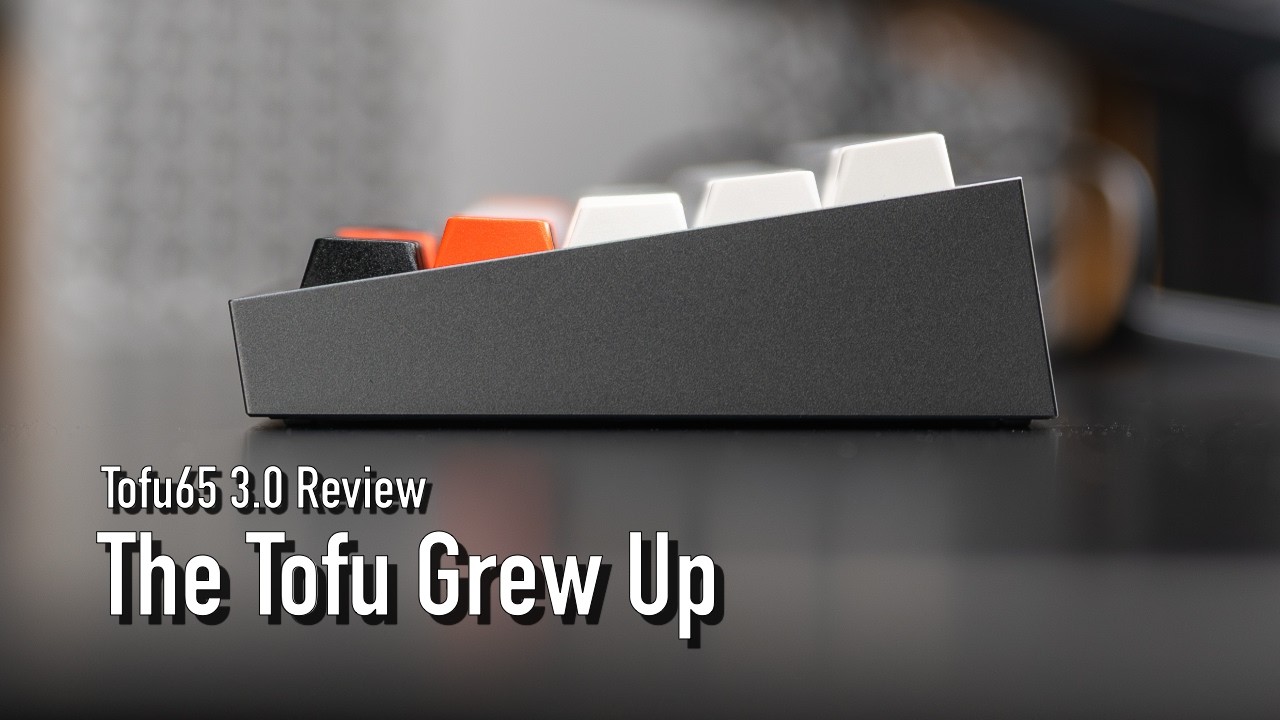
The Tofu Finally Grew Up — Tofu65 3.0 Review transcript
Scooped Bar · @ScoopedBar
Words
1,252
Runtime
9:32
Speaking pace
131wpm
Reading time
5min
131 words per minute, below the 160 25th percentile of 349 measured videos. That distribution comes from the 349-video hook study.
Opening (first 30 seconds)
The Tofus one of those keyboards everyone's owned at least once. This is the version that actually feels like it belongs in 2026. >> [music] [music] >> Everyone, welcome back to Scoob bar. Today we're looking at the Tofu 65 3.0, the latest 65% from KBDfans. And yeah, this isn't just a refresh. This is a full rethink of what the Tofu line is supposed to
66 words, the words spoken in the first 30 seconds at 131 words per minute.
Sentence shape
| Measure | This transcript |
|---|---|
| Sentences | 100 |
| Average words per sentence | 12.5 |
| Longest sentence | 27 words |
| Questions asked | 1 |
| Sentences containing a number | 14 |
Most used terms
- mount13
- top11
- bottom8
- pcb8
- music7
- top mount7
- aluminum6
- plate6
- board5
- build5
- dual5
- gasket5
Filler phrases
6 in total: like 3 · actually 2 · kind of 1.
A literal whole-word count of the same phrase list the Prepublish browser extension uses, so a phrase inside another word is not counted and a phrase used in its ordinary sense still is. It is a count and not a judgement.
What this transcript is
Every word below is the caption track YouTube publishes for this video, pulled from the video itself and reproduced unchanged. It is not Prepublish's writing, not a summary, and not a re-transcription: it is the video's own published captions. English captions, generated automatically by YouTube, in the video’s original language. Source: the video on YouTube. A channel that would rather this page did not exist can ask for its removal through the contact page, and it is removed.
Transcript
The Tofus one of those keyboards everyone's owned at least once. This is the version that actually feels like it belongs in 2026. >> [music] [music] >> Everyone, welcome back to Scoob bar. Today we're looking at the Tofu 65 3.0, the latest 65% from KBDfans. And yeah, this isn't just a refresh. This is a full rethink of what the Tofu line is supposed to be now. And the TLDR, this is a dual mount board. You can run it top mount or PCB gasket mount in the same chassis.
No adapters, no weird compromises. The case is fully CNC machine aluminum and you can choose between sandblasted anodized finishes or a fine e-coat if you want something more matte and smooth. Bottom cases come in aluminum, copper, or stainless steel. And on top of that, you can add internal weight bars in matching metals if you want to tune the heft. Layout support is solid, winkey, winkeyless, HHKB, ANSI, and [music] ISO.
Typing angle is 9°, and the front height sits around 17 mm, which gives it a low comfortable stance without forcing you to wrist rest situation. Price-wise, the base kit starts at around 130 USD, and a more typical build, say with a copper weight, lands closer to 190 USD. Pre-orders run from late January through February with delivery expected end of Q2 2026. Before we go further, quick moment. Scoob bar is a passion project run by me and my good friend V alongside our full-time jobs.
If you enjoy this kind of no-nonsense keyboard content, a like or sub genuinely helps. It really goes a long way. A few links are down below if you want to check out pricing or configuration. All right, let's get back to the board. KBDfans doesn't need much introduction at this point. They've been around forever. And this project was led by Wei, who's been steering a lot of their recent design updates. Availability is global, US, UK, Korea, [music] EU.
So, you're not locked into one region or a vendor. PCB options are where things get [music] interesting. Wired PCB is 1.6 mm FR4, VIA and Vial support, so easy remapping and no drama. Dual mode PCB is wired and wireless using ZMK with a 1,000 mA hour battery and they're claiming over 6 months of battery life in real use. In so far my testing, it's lining up to be about that. Also, nice touch here. Firmware are uploaded directly on the product page, so you're not hunting through Discord or GitHub repos at 2:00 a.m. in the morning.
The entire design revolves around flexibility without clutter. You've got a dual mount chassis, PCB gasket mount if you want something softer or more cushioned, top mount if you prefer something firmer and more direct. Or you can add silicone tabs to the plate that makes this an isolated top mount. The bottom case features a bold exposed rear accent that splits a USB-C cutout. That detail alone makes a two-tone build look intentional instead of gimmicky.
Inside KBDfans baked in silicone [music] force break pads. These isolate the top and bottom halves and shut down any metallic pings right out the [music] box. They also include Teflon pads and silicone dampeners to decouple the plate and calm things down even further. Mount specifics here. Gasket mount is softer, controlled, and works great even with a solder PCB for plateless builds. Top mount mounting points are positioned away from the spacebar, which helps avoid that hollow thunk that a lot of top mount 65s suffer from.
Silicone spacers make installation smoother and reduce resonance. Build experience is something I really appreciate about the 3.0. Four screws on the bottom and that's it. Flip it over, remove them, and you're inside. No hidden fasteners, no guessing. The magnetic daughterboard uses pogo pins instead of a JST cable. It snaps in, flexes independently, and just works. Hardware bags are labeled, assembly order is obvious.
There's also an online configurator where you can preview color combos, weight options, plates, PCB, foam, and even wrist rest while watching the price update live. Visually, this is still a Tofu, and that's a good thing. Clean rectangle, thin bezels, no loud logos. The new bottom wedge gives a bit more of presence without turning it into a spaceship. The machine bottom pattern adds texture and hides fingerprints better than glossy finish.
Branding is minimal, just a small internal marking on the cover plate. Color matching is where this shines. You can mix top and bottom colors, choose matte or textured finishes, then throw in contrasting metal weight because, let's be honest, shiny metal is fun. At 65%, it's also easier to pick up and move around than larger Tofu variants. A few honest notes. Corners can feel a little sharp. Light color bump ons will look better in certain case colors, so a dark and light bump ons to be included would be nice.
The wrist rest has a removable wood accent, which some of you might prefer a solid color instead of a dual tone. Add force break tape to the wrist rest screws to avoid metal on metal marks. Now, none of these are deal breakers, just things you'll notice if you're picky, and if you're watching this, you probably are. This board actually has two mounting styles that both sound good, in my opinion. With the aluminum plate, the gasket setup hits a really nice balance.
Soft enough to absorb impact, but still lively, not mushy or dull. Top mount is brighter and a bit more resonant out of the box. Neither mounting styles sound hollow or have any pings. Now, some plate notes. Aluminum is bright and controlled, great space bar consistency. PE has got a bit more flex, better in gasket than top mount, in my opinion. Other options are FR4, PC, and carbon fiber, all there if you want to further tune your sound and feel.
Big one here. Foam isn't required. The case sealing and force break system do enough on their own. Foam kits are optional, not mandatory. Overall, typing feel sits right in the middle, comfortable for long sessions, stable under your fingers. This isn't a trampoline board, it's a daily driver that doesn't get boring. This is for enthusiasts who want a flexible 65% without diving into boutique pricing. Anyone who values clean design with real configurability.
It also hits a strong middle ground between cost and features. Who it is not for? If you're chasing the deepest, most dense sound possible, heavier copper focused boards will still win out. A few practical reminders. Handle corners carefully during disassembly. The USB-C port depth is forgiving, so most cables will fit just fine. Don't over tighten the daughter board screws because they're Phillips and can strip easily if you over tighten it.
Peel the adhesive sheet slowly so the glue stays put. My recommended build, aluminum top and bottom, stainless steel weight, dual mode hot swap PCB, aluminum plate, battery, roughly 202 USD, and around 1,300 g unbuilt. There's something about this wedge design. It's a little brutalist, a little restrained, and it works. More than anything, it feels like KBDfans is listening, refining, and tidying everything that used to be rough around the edges.
If you find this helpful, links are in the description and I appreciate you all for being here. Love you all, and I'll see you in the next build. >> Mhm.
The words are the caption track's own and nothing is reworded or re-transcribed. Paragraph breaks are placed between sentences so the text reads as prose.
Use this transcript
Three free tools that work on the material around a video like this one. No signup, no login.
Hook Analyzer
Paste the first 30 seconds of your own draft for a hook score and rewrites.
Policy Pre-Flight
Check your draft against YouTube's advertiser-friendly guidelines before you record it.
Channel Skill Generator
Read this channel's public videos and transcripts, and download a writing brief for it.