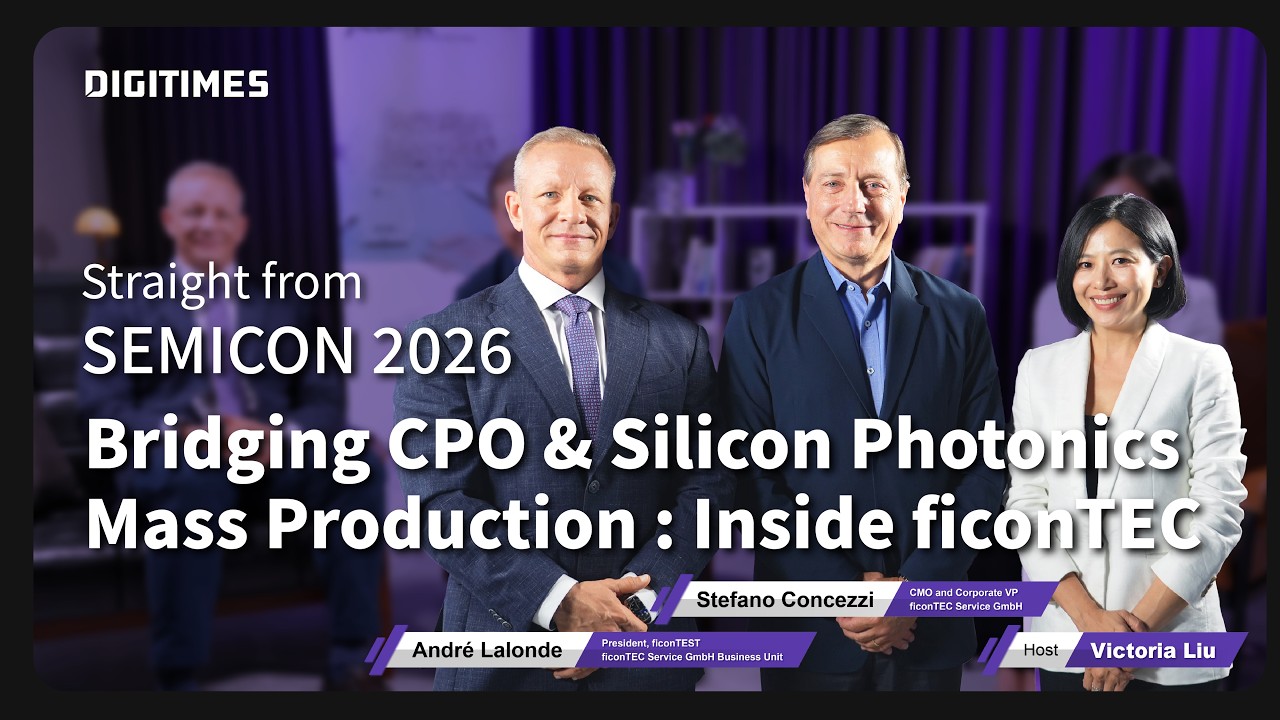
SEMICON Exclusive Interview|Enabling Mass Production of Silicon Photonics & CPO for AI transcript
DIGITIMES English · @DIGITIMESEnglish
Words
1,957
Runtime
14:15
Speaking pace
137wpm
Reading time
8min
137 words per minute, below the 160 25th percentile of 349 measured videos. That distribution comes from the 349-video hook study.
Opening (first 30 seconds)
this year. Co- package optics CPO has become one of the hottest topics in the market. SAI drives demand for higher bandwidth and lower power. Silicon ponics is moving closer to the processor. CPO is at the center of that shift. So today we're going to talk about the challenge because it's not only the chip it is how to assemble, align, test and manufacture these devices at go.
69 words, the words spoken in the first 30 seconds at 137 words per minute.
Sentence shape
| Measure | This transcript |
|---|---|
| Sentences | 124 |
| Average words per sentence | 15.8 |
| Longest sentence | 57 words |
| Questions asked | 7 |
| Sentences containing a number | 6 |
Most used terms
- testing20
- cpo16
- develop14
- process14
- manufacturing12
- test12
- optical11
- okay10
- andre8
- product8
- high7
- level7
Filler phrases
15 in total: like 6 · uh 6 · actually 2 · you know 1.
A literal whole-word count of the same phrase list the Prepublish browser extension uses, so a phrase inside another word is not counted and a phrase used in its ordinary sense still is. It is a count and not a judgement.
What this transcript is
Every word below is the caption track YouTube publishes for this video, pulled from the video itself and reproduced unchanged. It is not Prepublish's writing, not a summary, and not a re-transcription: it is the video's own published captions. English captions, generated automatically by YouTube, in the video’s original language. Source: the video on YouTube. A channel that would rather this page did not exist can ask for its removal through the contact page, and it is removed.
Transcript
this year. Co- package optics CPO has become one of the hottest topics in the market. SAI drives demand for higher bandwidth and lower power. Silicon ponics is moving closer to the processor. CPO is at the center of that shift. So today we're going to talk about the challenge because it's not only the chip it is how to assemble, align, test and manufacture these devices at go. So this is Victoria. Today I'm very honored to have two guests here in the studio.
First I would like to introduce Stephano Conci, president and CEO of FCont US a and the company's global CMO. Hello Stephano. >> Hello this is Stephano. >> Okay. Second would like to introduce Andre Lon, president of FC context test business unit FC contest. >> Hello, I'm Andre. >> Hello there. Okay, thank you for joining us. So, first of all, we would like to walk through the opportunities and manufacturing challenges especially for CPO by contact is a global leader of automated assembly and testing solutions for photonic devices.
So, in your point of view, Stephano, okay, you see the booming industry business along with the ears. So why is silicon platonic and especially co- package optics become so important especially for uh now and also in the future. >> Thank you Victoria. It's a very good question. So we are living the revolution of artificial intelligence. So artificial intelligence is creating a extraordinary demand for computing power.
We need to understand that the traditional data center are using the CPU almost as single computer. When you move to the AI, the large language model and the inference for the answer of the output of the eye will need an incredible bandwidth. So the conventional electrical interconnects face growing limitation in bandwidth, power consumption, eeneration, transmission distance. Silicon Photonix brings optical communication much closer to the processor.
Copage optic takes the next step by integrating optical engine directly alongside high performance electric devices. However, developing the photonic and electronic chip is only part of the challenge. This technology must also be assembled, aligned, test and manufactured scale. This transition from working design to reliable volume production is precisely where advanced automation becomes essential. CPO is the center of that and we arriving to CPO through linear plugable optic near NPO near package optic and finally CPO that will be the top of the technology.
Okay, to follow up, we would like to go into the environment. Actually, people are wondering what are the main manufacturing challenges for them still holding CPO back from high volume manufacturing. >> Again, a good question. The main challenge is achieving semiconductor level productivity while handling optical component that require extremely precise alignment. Manufacturers must integrate multiple photonic and electronic components.
Align fibers and optical interfaces with some micron accuracy, dispense and cure epoxy and verify optical and electrical performance. They must to do all the above with high throughput al excellent heal complete resability and competitive cost. It's not enough to demonstrate one successful device in a lab. The process must consistently produce thousand or million of devices. The real challenge here is therefore the industrialization transforming a complex optical process into a stable repeatable and scalable manufacturing flow and this is what we do today. >> Okay.
So next I would like to dive into the testing part Andre. So Andre people are wondering okay why is CPO devices testing more complex than testing conventional semiconductor devices? >> Very good question. I'm glad you asked. For the past 50 60 years, traditional semiconductor testing has primarily been electrical only. Now, CPO testing, it combines different disciplines. It combines electrical, optical. Sometimes it requires access from multiple sides of the wafer of the device.
Now, also very demanding alignment and thermal requirements are also coupled in. Now, the trusting strategy has to also cover many production stages. It has to cover wafer level, known good die selection, assembly and also final module qualification. So detecting the failures early in the process is very important because manufacturers want to avoid assembling very expensive components around a photonic die that hasn't been fully characterized.
So the objective is really to create a complete test flow that delivers really accurate results, very short test times and also the data that's necessary to improve the yield. So testing is not just a quality control step. It's really a fundamental part of building an economically viable CPO manufacturing process as a whole. >> So make sure we are fully prepared in advance. So how does by contact approach testing across different stages uh for example like CPO, MO and LPO? >> Thank you for asking.
So there's there's many different test stages. So if we wanted to sum everything up, we would approach CPO testing in four main insertion points. So insertion one addresses the singlesided wafer testing requirement. Insertion two enables double-sided wafer testing where we combine the electrical and optical access with full thermal characterization. And not only that, we also include the AT supporting platform as well for the automated test equipment.
Insertion three is going to focus on D-LE testing and also includes a high throughput SLT or a system level test type of process within OSAT environments and insertion 4 is going to cover testing at the assembled the fully assembled module level. So what this does is this this gives customers the flexibility of testing at the most appropriate point in their manufacturing process. But more importantly, the information collected at each point, it's going to help identify defects earlier, improve process control, and reduce the cost of downstream failures.
But not only that, it's going to help correlate and trace all the way back to the wafer level, which is very important. Now our goal is not just to provide one individual machine. It's really to work with customers to develop an integrated testing strategy that supports a complete journey from R&D all the way at the beginning through validation through high volume production manufacturing. Now along with these four various insertion steps again to create that correlation and that traceability that's going to go all the way back to the beginning of the process to help solve end of line issues.
Now for LPO or linear pluggable optics we developed a fully automated test solution at 800G and also upgradable to 1.6T 6T that leverage CS or commercial off-the-shelf components and measurement instruments. And we're also working with the industry to develop our own embedded measurement instruments in order to increase density, reduce the size, optimize the cost, and also increase the throughput for all of our customers. >> Okay, Andre just walk through through the procedures how CPO from the lab to the FAB.
So Stephano know actually uh we want to have the niche in the area, you know. So uh what sets font tech apart from other equipment suppliers especially in the market? >> So fic contact has been focus on photonics for 25 years. So we develop all the information all the expertise all the competencies to develop high precision automate automation system. So we have process knowledge, we have pro production experience, we work with lead user to develop these processes and again for more than 25 years we've been all these across the global photonic ecosystem.
We with customer from Asia, Europe, North America. We provide both assembly and testing solution as Andre just mentioned and we develop our own equipment including active alignment system fiber and receptical attachment addive dispensing and curing wafer and D level testing and model level integration. This experience is not uh achievable by many other companies and is extremely important. Each product has different optical, mechanical, thermal and production requirements.
Our application teams works directly with customer to refine their processes and develop solution that are customized to their to their product and that can evolve with initial development to scalable manufacturing. We do not view ourself as a machine supplier. We aim to be an industrialization partner that helps customer transform innovate photonics technology in real product that can be manufactured in IBU processes.
So one point that I want to add is that during this 25 years we develop not only mechanical design and platform but we develop also software architecture both for machine control with machine learning. So we can learn from the process itself and also improve the performance of the machine. We develop also digital twin in order to train our our engineer and the customer with this process. So again we have hardware and software platform that are combined and make our solution unique. >> Okay.
I think the integration is very important for those who >> doing semiconductor industry. So Stephano follow up. If companies okay worldwide they want to develop silicon photonics or CPO product today. So what should they do to prepare for volume manufacturing for those who they are expanding their mass production? >> Victoria is a is a very key point. This one they should involve their manufacturing partners as early as possible.
Product architecture, optical interface, tolerance, material, test success, uh packaging decision all influence whether a device can be manufactured efficiently. Designing for automating assembly and test from the beginning can really reduce develop time mainly risk and cost. >> Okay. So Andre any suggestions to our fellow companies? Yeah, as we also get into this test sometimes is always an afterthought and so as Stefano was mentioning from the testing perspective companies really should define their product testing strategy during product design.
So what we can do is we could work with them to determine what should be tested at the wafer, at the die, at the module and also which optical, which electrical, which thermal, which alignment that they need to do and and also as far as the interfaces are concerned, what do we need to access? So as we mentioned earlier, testing is often considered way too late in the development process. So working together early allows us to develop all the tooling, all the automation, all the methodology alongside the product rather than to wait at the last minute just before production.
So CPO is really a major opportunity for the entire photonix and the semiconductor ecosystem to grow and also to meet the demands for AI. Now the technology is advancing so rapidly and the transition to industrial scale is really now underway. It's not going to happen. And it's happening right now. And so FCON Techch is ready to work with the foundaries, with the OSATs, with the component manufacturers and also the system companies and also the technology partners to be able to support this transition. >> And Taiwan is at the hub of semiconductor industry.
So for you, where can interesting company meet Fonte and start working with you, Stephano? >> Well, FContech operates globally. We are a global company with application labs, sales, service capability in Europe, Asia, North America, and of course here in Taiwan. In Taiwan, we have a local organization and manufacturing and support partnerships that allow us to work very close with the local customer throughout the region.
We welcome companies to engage with us early whether they are evaluating an initial concept develop a pilot process or preparing for evolution manufacturing. Our branch our team is here to serve. >> Thank you very much pre insight Andre and Stephan know and CPO is moving fast. So the next step is industrialization turning a work design into stable high volume process. For more information you can check the website of font tech.
And until then, this is Victoria. See you next time.
The words are the caption track's own and nothing is reworded or re-transcribed. Paragraph breaks are placed between sentences so the text reads as prose.
Use this transcript
Three free tools that work on the material around a video like this one. No signup, no login.
Hook Analyzer
Paste the first 30 seconds of your own draft for a hook score and rewrites.
Policy Pre-Flight
Check your draft against YouTube's advertiser-friendly guidelines before you record it.
Channel Skill Generator
Read this channel's public videos and transcripts, and download a writing brief for it.