Getting the transcript
Reading the captions from YouTube. A video nobody has opened here before takes 10 to 30 seconds; this page fills in on its own.
Getting the transcript
Reading the captions from YouTube. A video nobody has opened here before takes 10 to 30 seconds; this page fills in on its own.
Apex Psychology · @ApexPsychologyYT
Where viewers went back to watch this video again, from YouTube's public Most replayed graph, lined up with what was said at that moment.
Most replayed moment #1
5:559.7x the video's typical replay level
sounds straight out of a sci-fi movie, hypnagogia, the twilight state between waking and sleeping. At this point, the thalamus has already locked the outer door tight, but the cortex inside still hasn't fully shut off. Suddenly starved of input, the cortex
Said at 5:48
Most replayed moment #2
11:588.8x the video's typical replay level
feel the absence of your own awareness when feeling anything at all requires you to be aware in the first place? By now, someone is definitely going to push back. "But I clearly remember being awake all night. I was tossing and turning. I could hear the AC running. I
Said at 11:52
Most replayed moment #3
8:525.1x the video's typical replay level
jolted him awake at just the right moment to grab whatever strange idea had just flickered through his head before it vanished. Salvador Dalí did the exact same thing. In other words, this twilight zone you forget every single night is the same place some of the most
Said at 8:46
The graph counts replays. It does not show where viewers stopped watching.
Words
2,753
Runtime
15:32
Speaking pace
177wpm
Reading time
11min
177 words per minute, between the 160 25th percentile and the 181 median of 349 measured videos. That distribution comes from the 349-video hook study.
Opening (first 30 seconds)
What if you could actually remember the exact moment you fell asleep? Try rewinding last night. You got into bed, turned off the lights, closed your eyes. Instead of a clean cut to black, you could actually feel your muscles letting go, your thoughts slowing down. You witnessed the very moment your mind officially disconnected from the real world. Sounds kind of magical, right? But here's the truth, that never happens. Here's what actually goes down. You remember pulling up the covers. You remember lying there thinking about an
89 words, the words spoken in the first 30 seconds at 177 words per minute.
Free, no signup. See how the first 30 seconds hold attention, with rewrites.
Sentence shape
| Measure | This transcript |
|---|---|
| Sentences | 183 |
| Average words per sentence | 15.0 |
| Longest sentence | 52 words |
| Questions asked | 15 |
| Sentences containing a number | 8 |
Most used terms
Filler phrases
33 in total: like 18 · actually 11 · right? 3 · kind of 1.
A literal whole-word count of the same phrase list the Prepublish browser extension uses, so a phrase inside another word is not counted and a phrase used in its ordinary sense still is. It is a count and not a judgement.
What this transcript is
Every word below is the caption track YouTube publishes for this video, pulled from the video itself and reproduced unchanged. It is not Prepublish's writing, not a summary, and not a re-transcription: it is the video's own published captions. English captions, generated automatically by YouTube, in the video’s original language. Source: the video on YouTube. A channel that would rather this page did not exist can ask for its removal through the contact page, and it is removed.
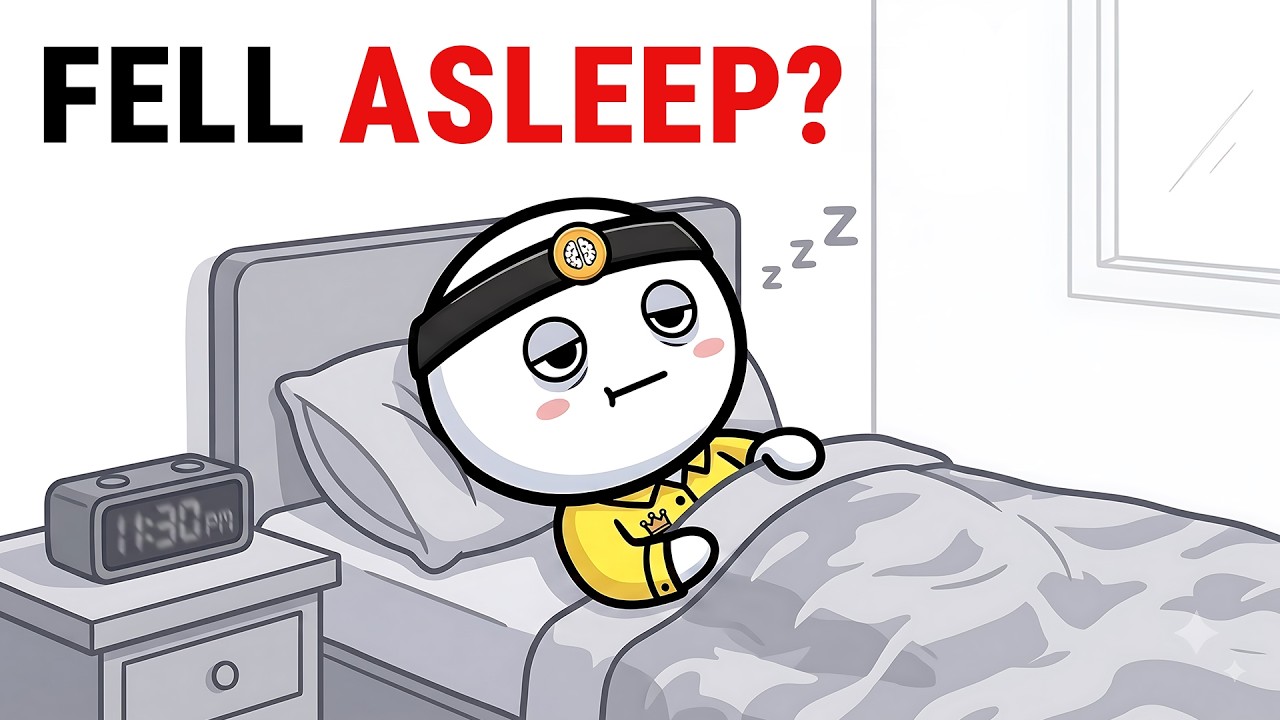
What if you could actually remember the exact moment you fell asleep? Try rewinding last night. You got into bed, turned off the lights, closed your eyes. Instead of a clean cut to black, you could actually feel your muscles letting go, your thoughts slowing down. You witnessed the very moment your mind officially disconnected from the real world. Sounds kind of magical, right? But here's the truth, that never happens.
Here's what actually goes down. You remember pulling up the covers. You remember lying there thinking about an email you forgot to send your boss, or humming a song that's been trending on Instagram. And then, bam, your alarm goes off. 8 hours just vanished completely from your timeline. No boundary, no final moment where you got to think, "Okay, I'm falling asleep now." You spend a third of your life sleeping. If you're 30 years old, that means you've fallen asleep more than 10,000 times.
You'd think you'd know exactly what it feels like by now. But, no. Every night, it disappears without a trace. So, what is your brain actually doing to make it erase exactly that moment? And where does that moment actually go? I'm Apex. Today, we're going to step into one of the strangest corners of neuroscience to answer the question, "Why can't you remember falling asleep?" When it comes to sleep, I think comparing it to your smartphone is the most accurate way to go.
You use it all day, the battery drops to 1%, the screen goes dark, it shuts down, and everything goes completely silent. So, logically, you'd think the brain turns off. So, of course, it can't record the moment it falls asleep. No camera works when the machine is off, right? Sounds totally reasonable, but sorry, that's completely wrong. Your brain has no off switch. Even when you're in your deepest sleep, that 3-lb organ is burning almost as much energy as when you're up making your morning coffee.
It doesn't shut down like a dead phone. Instead, a whole system is quietly pulling off an incredibly sophisticated shift change, like the night shift handing off to the day shift at a hospital. Here's how it works. Every hour you stay awake and use your brain, your body burns energy and leaves behind a chemical waste product called adenosine. Think of adenosine like an electric bill. It silently stacks up from the moment you open your eyes in the morning, and you're not allowed to pay it off until you go to bed.
The later you stay up, the harder you grind, the higher that bill gets. And it slowly drags down one system after another that was keeping you alert, like a car running out of gas, gradually slowing before it finally stalls. That's also why coffee works, by the way. It doesn't give you more energy. It just blocks your brain from reading the adenosine bill, tricking your brain into thinking you're not tired. When night falls, the body quietly sends out a wave of chemical signals.
Neurons deep in the hypothalamus start shutting off all the signals that were keeping you awake, one by one, like someone turning off the lights in an office building at the end of the day. The brain gradually talks itself back from the edge of wakefulness. And who's the first one to clock out? Your storage drive, the hippocampus. It flat-out refuses to take in any new data, redirecting all its energy towards sorting, cleaning up, and reorganizing the day's old memories.
But that's just the tip of the iceberg. The real break happens somewhere else entirely. So, why does your internal camera lose its signal so early? The answer lives deep inside a tiny but incredibly powerful structure, the thalamus. Picture the thalamus like the strictest bouncer at the most exclusive club you've ever tried to get into. He stands at the door with his arms crossed, deciding who gets in and who stays in line.
When you're awake, absolutely everything passes through him. The images you see, the sounds you hear, the feeling of your blanket against your skin, the smell of pizza from your neighbor's oven. All of it has to get through the thalamus before it earns a VIP pass up to the cortex to become actual conscious experience. But when sleepiness hits, that bouncer slams the door shut. He cuts off the flow of information from the outside world.
Traffic noise, the hum of a fan, your neighbor arguing through the wall. All of it gradually gets blocked. None of it gets clearance to travel up to the brain anymore. Interestingly, out of all your senses, hearing is the most stubborn one. It holds on the longest, refusing to shut down early like the others. That's why even after your vision and touch are long gone, your ears can sometimes pick up a few last sounds like an alarm going off or someone calling your name in the middle of the night.
At this point, your cortex, the part responsible for processing and storing everything, suddenly finds itself starved of input. And to form a memory, you need raw material to build it from, right? But once the thalamus has shut the door, the hippocampus has nothing left to work with. In other words, the process of falling asleep is really your brain dismantling its own ability to record. It's like trying to film a video on a phone that's powering down 1 second at a time.
The last few frames are going to be glitchy, blurry, or completely black. Not because nothing's happening, but because the camera died before the event was even over. Okay, here's a paradox that had me scratching my head for a while. If the thalamus already locked the door shut, shouldn't your mind go completely dark and silent right away? So, why do you sometimes hear your name being called out of nowhere or jerk awake just as you're drifting off?
The answer is, your brain doesn't go quiet in a neat, orderly way like you'd expect. Before it completely disconnects from the world, you have to pass through an incredibly chaotic border zone with a name that sounds straight out of a sci-fi movie, hypnagogia, the twilight state between waking and sleeping. At this point, the thalamus has already locked the outer door tight, but the cortex inside still hasn't fully shut off.
Suddenly starved of input, the cortex reacts by making stuff up. It starts generating strange floating shapes, sounds that come out of nowhere, like a TV that's lost its antenna signal. The screen doesn't go black, it fills up with white static, hissing and crackling. Your cortex works the same way. It's still on, it just has no real signal to display, so it fills the void with its own junk data. This is actually a wild little hallucination trip you take every single night, like a free light show playing inside your own head, but you forget it completely by morning.
Why? Because the recording system was already disconnected before any of it happened. Those random images and sounds have no plot, no logic for your brain to hold on to, so they pop like soap bubbles the second they appear before they ever hit the ground. Worth noting, this isn't dreaming yet. Real dreams don't show up until you've sunk much deeper into REM sleep, about 90 minutes later, complete with storylines and characters.
This is just the opening act, short but vivid. But sometimes that noisy static decides to mess with you in a pretty spectacular way. The most classic example, and I'd bet most of you have felt this at least once, is that sudden sensation of missing a step and falling off a ledge. Your body reacts like you're about to die, and you jerk awake with a full body spasm. Science has an actual name for this, a hypnic jerk. Studies suggest somewhere around 60 to 70% of adults have experienced this at least once, and it happens way more often in people who are stressed, sleep deprived, or loaded up on caffeine, which means that the adenosine build we talked about earlier has come back to haunt you one more time.
And here's the part I find most fascinating in this whole video. One theory suggests this is actually an evolutionary leftover from our primate ancestors. When your muscles relax as you start to fall asleep, the ancient part of your brain suddenly panics, completely misreading that signal as we're falling out of the tree. So, it fires off an emergency alarm forcing every muscle to grab on for dear life. That poor reflex clearly never got the memo that humans moved into houses and started sleeping on mattresses tens of thousands of years ago.
The sudden jolt forces your brain to partially restart, and that's exactly why you always remember that heart-dropping sensation, because your brain just got switched back on for a moment to record the panic. Some people have actually turned this blurry state into a creative tool. Thomas Edison used to sit in a chair holding steel balls in his hands, letting himself drift into hypnagogia. The moment his grip loosened enough, the balls would drop to the floor.
The sound jolted him awake at just the right moment to grab whatever strange idea had just flickered through his head before it vanished. Salvador Dalí did the exact same thing. In other words, this twilight zone you forget every single night is the same place some of the most creative minds in history went hunting for ideas. A lot of us assume the brain flips one big master switch and pulls all of consciousness across the sleep threshold in one clean instant.
Neat as flicking off a light. But, reality hits back pretty hard on that one. Sleep actually works through something called local sleep. Sounds strange, but you don't fall asleep in a single moment. Your brain turns off the lights area by area in no particular order, like the floors of a skyscraper going dark at random. One floor is pitch black, while the one right next to it is still fully lit. And maybe the elevator is still running while the offices are completely empty.
If local sleep sounds hard to believe, look at dolphins. A dolphin's brain sleeps in shifts. One hemisphere shuts down while the other stays awake handling swimming and coming up to the surface to breathe. The human brain doesn't split that cleanly, but the underlying principle is the same. Different regions can genuinely exist in two completely different states of consciousness at the exact same time inside the exact same head.
This is also why sleepwalking and sleep talking can happen. The motor part of the brain is still awake enough to move the body around while the conscious and memory parts have already gone dark. That's why a sleepwalker can get up, walk around, even open the fridge, and remember absolutely nothing in the morning. And you might be wondering which part of the brain clocks out first and sneaks out the door ahead of everyone else.
That would be the prefrontal cortex. This is the control center for logical thinking, planning, and self-control. And most importantly, it is your self. It's the part that knows, "This is me. I exist. I'm experiencing this right now." Once the prefrontal cortex has already packed up and gone to sleep first, your hand might still be scrolling your phone on autopilot, your ears might still be picking up faint music from a speaker somewhere.
In other words, the process of falling asleep is really the slow piece-by-piece dismantling of your own identity. Your body also builds in one more layer of protection. During REM sleep, a mechanism called REM atonia temporarily paralyzes nearly all of your muscles, keeping you from physically acting out whatever is happening in your dream. Ancient Greek philosophy had a perspective on this that's genuinely unsettling.
Aristotle once described sleep as a state suspended somewhere between life and death. You go to sleep and, in a very real sense, you, the conscious, thinking, observing version of you temporarily stops existing. The threat connecting you to your own awareness gets cut. To remember the moment you fall asleep, you'd need your conscious mind to be standing right there to confirm, "Okay, I'm asleep now." But that conscious mind is the first one to get kicked out of the room.
The audience already went home before the curtain ever came down. How can you feel the absence of your own awareness when feeling anything at all requires you to be aware in the first place? By now, someone is definitely going to push back. "But I clearly remember being awake all night. I was tossing and turning. I could hear the AC running. I definitely didn't sleep." If you've ever sworn up and down like that, I have some uncomfortable news for you.
You can't fully trust that feeling. Scientists call this paradoxical insomnia. In sleep studies, many participants have insisted they were completely awake the entire night without closing their eyes once. But when researchers checked their EEG readings, the data said otherwise, clearly showing their brain waves matched hours of sound sleep. Their bodies slept just fine. But that little inner voice inside their heads had written itself an entire script insisting they were still awake.
Here's the irony. Those popular sleep tracking watches can sometimes make things even worse. You strap one on, open the app every morning to check your sleep score, and you start obsessing. "Wait, I only scored 62 last night. I must have slept terribly." But that fixation on monitoring is actually perfect fuel for your brain to generate even more illusions of wakefulness. The culprit is that same messy, out-of-order shutdown.
Almost all of the brain has gone to sleep, but one small corner that runs the inner voice gets stuck, like a stubborn background app running on a phone whose screen you locked ages ago and forgot to close. That persistent little consciousness app just keeps muttering away, flat-out lying, we're still awake, this is miserable, why can't we fall asleep already? And the next morning, you wake up carrying that entire fictional file with you, absolutely convinced you just had a terrible sleepless night when in reality you didn't.
So, even when you're lying there thinking, why can't I fall asleep already? There's a very real chance you already crossed that line a long time ago. Your brain is just ghosting you. So, the reason you never remember the moment you fall asleep has nothing to do with anything being wrong with your memory. It's not some random glitch in the system. That machine is running exactly the way it was designed to, without a single flaw.
It is a biological magic trick that is both ruthless and breathtakingly beautiful. Your brain takes you apart piece by piece in a precise sequence. It locks down your senses first, then cuts off the memory storage, and finally shuts down your own conscious existence. You can't remember that moment simply because the you that does the remembering was already unplugged before the event even had a chance to happen. Think about it.
You have already disappeared from this world tens of thousands of times. Eight full hours of being completely gone in exchange for a version of yourself that comes back repaired, strengthened, and a little more whole than before. Remembering every detail of that unsettling handoff was never part of the deal you signed when you were born. And maybe that's the fairest thing nature has ever done for us. And honestly, after learning all of this about the strange hallucinations, that falling sensation, and the way your brain gaslights itself, I actually think not remembering any of it might be a genuine blessing.
Because if we did remember every bit of it, I'm not sure any of us would have the nerve to climb into bed at night ever again. If this video helped you see a little deeper into one of the quiet mysteries living inside your own mind, please hit subscribe and share it with someone who has ever wondered about the same thing. I'm Apex. Thank you so much for watching all the way to the end, and I'll see you in the next video.
The words are the caption track's own and nothing is reworded or re-transcribed. Paragraph breaks are placed between sentences so the text reads as prose.
Free tools for your own script. No signup, no login.
Paste your draft and see where viewers are likely to drop off, with a rewrite for each weak line.
Paste the first 30 seconds of your own draft for a hook score and rewrites.
Check your draft against YouTube's advertiser-friendly guidelines before you record it.
Read this channel's public videos and transcripts, and download a writing brief for it.