Getting the transcript
Reading the captions from YouTube. A video nobody has opened here before takes 10 to 30 seconds; this page fills in on its own.
Getting the transcript
Reading the captions from YouTube. A video nobody has opened here before takes 10 to 30 seconds; this page fills in on its own.
AI Engineer · @aiDotEngineer
This video has no Most replayed graph yet: YouTube shows one only once a video has enough views. These are the moments viewers replayed most in AI Engineer's most watched videos.
Most replayed moment at 18:45
4.8x that video's typical replay level
that they're they're changing they're changing things in the database not yet. You want to run them through the ontology first and make sure that works. Okay. I only got an I've got I've got another I've just a short time. I'm going to try to show you some of the things that um that you can
Said at 18:37
Most replayed moment at 16:13
3.6x that video's typical replay level
method signatures, the program layout and the call stacks. So here's some examples. I don't think you'll be able to read this one, but this is like the level of abstraction we're at. It's how we're actually going to lay this stuff out and how these systems are going to interact. Dylan Mulroy from Cloudflare talks a
Said at 16:06
Most replayed moment at 13:49
2.3x that video's typical replay level
Fable uh and it runs into an unknown, ask it to log it, right? So that um you uh you can see where the deviations happened and then you can sort of figure out why as well, you know? It will usually give you some context about what happened.
Said at 13:43
The graph counts replays. It does not show where viewers stopped watching.
Words
1,900
Runtime
10:07
Speaking pace
188wpm
Reading time
8min
188 words per minute, between the 181 median and the 201 75th percentile of 349 measured videos. That distribution comes from the 349-video hook study.
Opening (first 30 seconds)
[music] >> Hello, hello. Um Have you ever given a task to Claude code and uh you give it a feature and you be like, "Okay, cool. Uh can you build this for me?" And Claude code starts putting it out into subtasks and you see it very Okay, this is pretty cool. You see it running a multiple sub agents. They're all right, that's really cool and you can see like ripping through all of your tasks, sub agents being completed and it gives you like a final output. Task completed. Like, "Amazing.
94 words, the words spoken in the first 30 seconds at 188 words per minute.
Free, no signup. See how the first 30 seconds hold attention, with rewrites.
Sentence shape
| Measure | This transcript |
|---|---|
| Sentences | 152 |
| Average words per sentence | 12.5 |
| Longest sentence | 58 words |
| Questions asked | 19 |
| Sentences containing a number | 2 |
Most used terms
Filler phrases
63 in total: like 31 · actually 14 · uh 8 · um 7 · basically 1 · sort of 1 · you know 1.
A literal whole-word count of the same phrase list the Prepublish browser extension uses, so a phrase inside another word is not counted and a phrase used in its ordinary sense still is. It is a count and not a judgement.
What this transcript is
Every word below is the caption track YouTube publishes for this video, pulled from the video itself and reproduced unchanged. It is not Prepublish's writing, not a summary, and not a re-transcription: it is the video's own published captions. English captions, generated automatically by YouTube, in the video’s original language. Source: the video on YouTube. A channel that would rather this page did not exist can ask for its removal through the contact page, and it is removed.
[music] >> Hello, hello. Um Have you ever given a task to Claude code and uh you give it a feature and you be like, "Okay, cool. Uh can you build this for me?" And Claude code starts putting it out into subtasks and you see it very Okay, this is pretty cool. You see it running a multiple sub agents. They're all right, that's really cool and you can see like ripping through all of your tasks, sub agents being completed and it gives you like a final output.
Task completed. Like, "Amazing. Great." But when you actually try to run it, actually be like, "Oh, well, it's it's not Something else failed. Hey Claude, can you fix this little bit thing?" Uh well, you just try it again. Okay, it's fixed. Everything should be working. Oh, no. Actually, there's this tiny little thing is just missing. So, and that's and that's what my talk is about. All I want to do is play Cyberpunk uh on my Xbox while I have Claude code do do some work for me.
And what I realized was the problem is the problem is that I kept on uh telling Claude like, "Hey, fix this, fix that, fix this, fix that." Even though if I give it a spec, if I give it some instructions, if I give it little to no instructions, every time there is something that I need to tell it. So, what that means is like I am the enforcement. I am the enforcement layer. I have to tell Claude on what exactly you need to do and how exactly this needs to be enforced.
So, the agent says it's done and but you have to check it anyway because there's nothing else that can check it for you. So, what I wanted was something to be very deterministic. So, when an agent says it's completed, have this enforcement layer deterministically check something like whether it's actually been done or not. Actually, the way I wanted it to be done because it says it is done, but is it the way that I want it?
So, I needed some way deterministic way to do that. So, I tried it. I built my own vector, I call it my own product called vector V1, and it deterministically checks Claude's output. And the way I did that is through using Claude hooks. So, that way whenever Claude finishes its its session, it automatically the hook calls my vector product or program, and then it checks it for me. Cool. And this is how it essentially looks.
So, I basically give it a config file, define all of my test cases over here, like what I needed it to be checked. And if it fails, it can actually keep on telling Claude like, "Hey, look, this is failing. Try again. Try again. Try again." Sorry if it's a little bit little. So, you can see one of the test outputs over here. So, it's like, "Okay, first the test test passed versus failed. Then it retries again. Then all of the things passed.
Okay, cool." So, what that means is it's not about whether Claude can actually do the task, it's about trust. Can I trust Claude to actually do everything for me? And by the way, when I say Claude, I'm just talking in general about LM agents in general. Is when I give a task to a coding agent, does it actually complete it? So, yeah. So, and then that's something that and then and what I started doing was started telling this about to people about and going to different events.
And it was it was really cool. Like, "Hey, look, what about this verification feature that I built? It was so good. It was so amazing." And then I met one of the Anthropic engineers. And he and and they just told me that "We're not going to need this anymore. Like, we'll have like another agent or another model that will be so smart that you won't need enforcement." Okay. Um So, crisis mode. Did I just waste my time?
What did I just like what was what was the point of all of this stuff? But let's dig in a little bit deeper. And then also they released this project Claude Swing that shows Project Methuselah, which is supposed to be so good that it will solve everything for us. So, what I saw when I started thinking about it, like, "Okay, what is it that is actually happening? When a new model comes out, doesn't it increases in capability, but that's not necessarily the same thing as reliability.
Sure, the models make it may become a lot more capable, but are they more reliable? The other thing is like argument is like, "Oh, well, I can have the best spec. I can have the best MCP servers. I can have the best sub-agents. I can get all the right context to it." Amazing. We should do that. But, in giving thought instructions is not the same thing as giving it verification. So, you can give as much instructions as you want, very good instructions, very little instructions, but you still will need to verify.
And what I realized was that just what I realized having these small guardrails or having as many guardrails you want, technically, you can use a smaller model like a Haiku or even like an open source models because it's got these guardrails on, it'll most likely be succinct and get you to the output that you want. So, in theory, what it means is that if you use a frontier model like an Opus Opus model that can get you a task, okay, cool, that will be the most expensive one.
You can have Vector with a little bit of guardrails, but it gets you a little bit cheaper, but if you put on more guardrails, that means invest a little bit more time in the harness itself, like you can reduce the cost drastically. Or maybe even use like async tasks as well. So, okay, I was feeling I was feeling good and I started talking about it about Vector again at two different events. And as as I spoke to more and more people, um What it There is missing something missing here.
What it When I spoke to more people, what I realized was everybody's building their own stuff. Anthropic is building their own stuff. My company is building their own stuff about enforcement. Facebook is building their own stuff. Meta is every company is building their own thing. So, if I had built if I built something that is specific to me, then I can't really share it with others because everybody has their own way of doing it.
And what I enforced doesn't necessarily mean that somebody else would enforce the same thing. So, what that meant was what realized was, okay, so it's actually a pattern. So, it has to be a pattern that is applicable to everyone. So, what that means is that we can it has to be language agnostic. It has to be something that I can be shared by everybody else, and everybody can bring their own version of enforcement to it.
And that's and and it should run on every level. So, it should start start off with in conversation, when a conversation ends, you can have checks when uh before committing, you can have checks when your part is part of a multi-agent workflow. You can have it on checks on asynchronous operation or asynchronous agents, and as well as you can have a check that nondeterministically calls like um LLM an LLM as a judge sort of a thing.
And it can run on any any different language on any different code. As long as there's a capability to run it deterministically, we should we can have that. So, what what I realized was, what we needed was essentially a contract that just says like, "Hey, given this task, I want you to fulfill this. What is in the middle that you can that developers and sales can define." So, this idea is really cool. And it was like, "Okay, so we're moving towards where we want verification always." All right, cool.
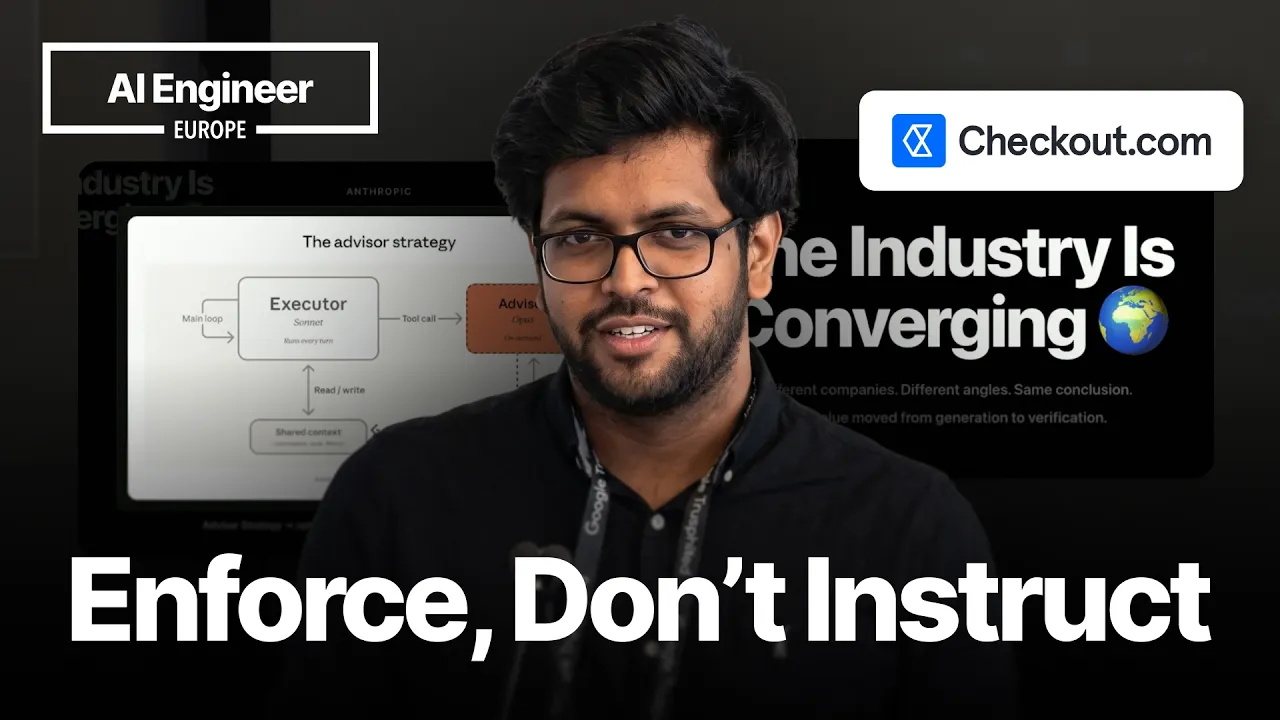
Um so, a lot of different companies have actually started doing this as well. So, Cloud Anthropic has recently released their new thing called executed advisor pattern, where you've got one agent that actually does the all the code all the code work, and then there's advisor that, you know, feeds in essentially creates a feedback loop. Or in other words, verify. Anthropic uh sorry, OpenAI build their own harness engineering, and it's the same idea like you give an agent a lot of a lot of things to do, but how do you verify it to work?
You give it different tools, you give it different context, and that's essentially what a harness is for OpenAI. There are companies like Cudo who are who are over here that provide a very comprehensive code reviews. And again, it's the same thing. You have the agent has done all of its work, but do you trust it? No. So, what do we do? You do a very comprehensive PR review with all the different issues and findings and create this feedback loop.
Some something from today as well from work OS. So, it says enforce don't instruct. So, it is all about like running these checks deterministically. When I say checks, it's just about the verification. Another one, which is my favorite, is one of the favorites like you still have to go slow. And the reason for that is not because the the agents themselves are not able to produce code as fast as they want, but it's because the verification layer.
You need to verify that everything is working or not. And my favorite >> [laughter] >> is is this one in the in our keynote. It's to slow the slow the hell down. So, so what is the shift that we're seeing here? Initially, what we thought was like the value is in the code that we create. But it's actually now in reality is what we're seeing here is the verification that we design. So, it's not about can you code, but can you verify?
So, TLDR is work on the harness and not on the code. So, you work on the verification system and that it produces a little bit better better outputs. And that's it. Thank you. >> [applause] >> Any questions? I've got 40 seconds. Yep. >> Does it exist? Is it public? >> Yeah. Yeah. Yeah. Yes, it is public. Um it's called Vector Harness, but if you if you send me a message on LinkedIn, I can share that with you. >> Can you put the LinkedIn back up? >> Oh.
There you go. >> Thanks. >> Cool. Yep. >> You mentioned that adding the verification layer allows you to use smaller models. Uh what do you say to the allegations that you're a top token spender at your company. >> [laughter] >> I need I need those tokens to build a verification layer. >> [laughter] >> Cool. Um I think that's it. >> [applause] [music]
The words are the caption track's own and nothing is reworded or re-transcribed. Paragraph breaks are placed between sentences so the text reads as prose.
Free tools for your own script. No signup, no login.
Paste your draft and see where viewers are likely to drop off, with a rewrite for each weak line.
Paste the first 30 seconds of your own draft for a hook score and rewrites.
Check your draft against YouTube's advertiser-friendly guidelines before you record it.
Read this channel's public videos and transcripts, and download a writing brief for it.