Getting the transcript
Reading the captions from YouTube. A video nobody has opened here before takes 10 to 30 seconds; this page fills in on its own.
Getting the transcript
Reading the captions from YouTube. A video nobody has opened here before takes 10 to 30 seconds; this page fills in on its own.
Deep Explained · @DeepExplained-j3p
Where viewers went back to watch this video again, from YouTube's public Most replayed graph, lined up with what was said at that moment.
Most replayed moment #1
10:063.8x the video's typical replay level
grocery chain has ever figured out how to sell it. It remains a fruit you find at farmers markets in the Midwest and Appalachia or growing wild in river bottoms waiting to be discovered by someone who doesn't know it's been there all along. Salak, snake fruit. The salak earns its
Said at 9:58
Most replayed moment #2
4:373.6x the video's typical replay level
carnitas at restaurants across the United States, now in most cases cooked by chefs who have never seen the whole fruit. miracle fruit In 1725, a French explorer named Chevalier des
Said at 4:31
Most replayed moment #3
7:153.6x the video's typical replay level
is white, creamy, and almost liquid in the way it dissolves on the tongue. People describe the flavor as a simultaneous combination of banana, pineapple, strawberry, papaya, and vanilla. It tastes like someone figured out how to make tropical fruit-flavored
Said at 7:08
The graph counts replays. It does not show where viewers stopped watching.
Words
3,480
Runtime
21:56
Speaking pace
159wpm
Reading time
15min
159 words per minute, below the 160 25th percentile of 349 measured videos. That distribution comes from the 349-video hook study.
Opening (first 30 seconds)
There are thousands of fruits growing on this planet right now that you have never tasted, never seen, and in most cases never heard of. Some of them have been eaten by kings. Some of them can change the way your tongue works for an entire hour. And at least one of them smells so bad it's been banned from public transportation. Here are all those fruits. Durian. Durian is native to the rainforests of Borneo and Sumatra, where it
80 words, the words spoken in the first 30 seconds at 159 words per minute.
Free, no signup. See how the first 30 seconds hold attention, with rewrites.
Sentence shape
| Measure | This transcript |
|---|---|
| Sentences | 232 |
| Average words per sentence | 15.0 |
| Longest sentence | 46 words |
| Questions asked | 0 |
| Sentences containing a number | 18 |
Most used terms
Filler phrases
25 in total: like 23 · actually 2.
A literal whole-word count of the same phrase list the Prepublish browser extension uses, so a phrase inside another word is not counted and a phrase used in its ordinary sense still is. It is a count and not a judgement.
What this transcript is
Every word below is the caption track YouTube publishes for this video, pulled from the video itself and reproduced unchanged. It is not Prepublish's writing, not a summary, and not a re-transcription: it is the video's own published captions. English captions, generated automatically by YouTube, in the video’s original language. Source: the video on YouTube. A channel that would rather this page did not exist can ask for its removal through the contact page, and it is removed.
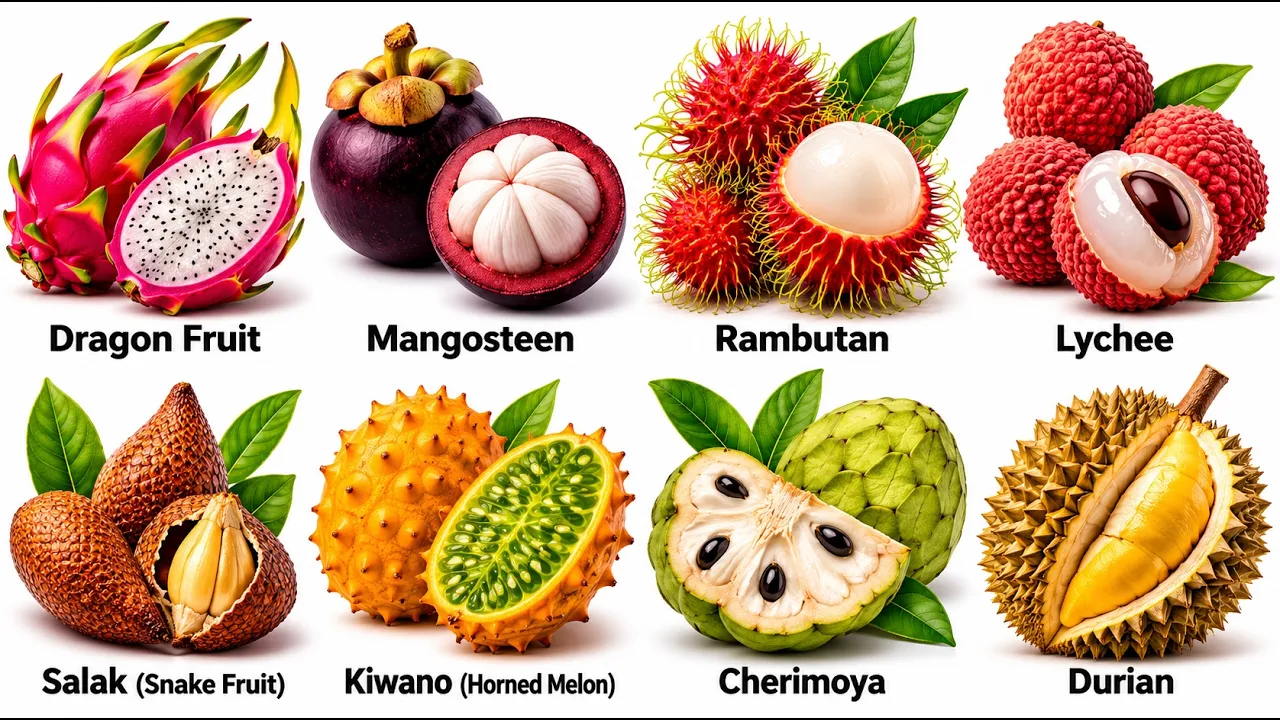
There are thousands of fruits growing on this planet right now that you have never tasted, never seen, and in most cases never heard of. Some of them have been eaten by kings. Some of them can change the way your tongue works for an entire hour. And at least one of them smells so bad it's been banned from public transportation. Here are all those fruits. Durian. Durian is native to the rainforests of Borneo and Sumatra, where it has grown wild for thousands of years.
The name comes from the Malay word duri, meaning thorn, a reference to the thick spike-covered shell that makes the fruit look more like a medieval weapon than something you'd eat. Images of it appear on the 9th century bas-relief panels of the Borobudur temple complex in Central Java. It has been part of Southeast Asian life for at least that long. The smell is the first thing anyone mentions. It has been compared to rotting onions, raw sewage, turpentine, and gym socks that have been left in a locker for a month.
Singapore bans it from the subway system. Hotels across Southeast Asia post signs prohibiting it. The smell travels through walls. The flavor, however, is something else entirely. The flesh is pale, yellow, creamy, and soft, almost custardy with a richness that people describe as a combination of vanilla, caramel, and ripe banana with a savory undertone that doesn't belong in any fruit. In Malaysia, the most prized variety, Musang King, can sell for the equivalent of 50 to 100 dollars per fruit.
In Thailand, which produces around 700,000 tons annually, there are festivals dedicated to it. People either become addicted to durian or they never touch it again. There is almost no middle ground. Mangosteen. For centuries, European explorers, botanists, and monarchs returned from Southeast Asia with the same opinion about mangosteen, that it was the finest fruit they had ever tasted. There was no debate. There was no runner-up.
A rumor began circulating around 1890 that Queen Victoria would grant a knighthood to anyone who successfully delivered her a fresh mangosteen. Whether the story is true or not, it stuck and it stuck well enough to earn the mangosteen the title it still carries today, the queen of fruits. The fruit is small, roughly fist-sized, with a deep purple exterior that is thick and almost leathery. Inside are six to eight white wedges, each one translucent and moist.
The flavor is extraordinary, sweet and delicately tart with layered notes of lychee, peach, strawberry, and pineapple that arrive in sequence rather than all at once. David Fairchild, a food explorer for the United States Department of Agriculture, who spent his career traveling the world looking for crops to bring back, encountered it on the island of Java in 1896 and wrote that the flesh had a flavor which is indescribably delicious.
It is almost impossible to find fresh in the United States. The fruit spoils within days of harvest and doesn't survive long-distance shipping in any practical way. Most Americans who have tried it have done so only while traveling in Asia. Most Americans haven't tried it at all. Jackfruit. The jackfruit is the largest fruit that grows on a tree anywhere in the world. A single fruit can reach 35 kg, roughly the weight of a 7-year-old child, and grow up to 90 cm long.
It is the national fruit of both Sri Lanka and Bangladesh. It grows throughout South and Southeast Asia and has been cultivated in India for at least 6,000 years. The ripe fruit has a yellow flesh with a flavor that most people compare to a combination of mango, pineapple, and banana sweet, tropical, and slightly musky. But, it is the unripe jackfruit that has caused a significant disruption in the American food industry.
When young jackfruit is cooked, the flesh shreds into long fibers that closely mimic the texture of pulled pork. It absorbs marinades and sauces readily, holds up to heat, and has almost no flavor of its own when unripe, which makes it an ideal blank slate. Over the past decade, it became the go-to meat substitute for vegetarians and vegans who wanted something with actual texture. You can find jackfruit tacos, jackfruit BBQ sandwiches, and jackfruit carnitas at restaurants across the United States, now in most cases cooked by chefs who have never seen the whole fruit. miracle fruit In 1725, a French explorer named Chevalier des Marchais was traveling through West Africa when he noticed something unusual.
The local people were chewing small red berries before meals, particularly before eating sour foods. He tried one, then he tried a lemon. The lemon tasted like lemonade. The berry is called Synsepalum dulcificum, and it contains a glycoprotein called miraculin. When you eat one, this protein coats your taste buds and binds to the sweetness receptors. For the next 30 minutes to 2 hours, everything sour you consume, lemons, limes, vinegar, pickles, plain Greek yogurt intensely sweet.
The sourness doesn't disappear, it converts. The fruit itself tastes like almost nothing. The transformation only happens with acidic food. The FDA classified miraculin as an illegal undeclared sweetener in the United States in 2011, which makes importing the raw berry from certain countries a regulatory issue. The berry has an extremely short shelf life, spoiling within days of harvest, which keeps it far from mainstream markets even where it is legal.
In West Africa, people use it to sweeten palm wine and make sour fermented foods more palatable. In the United States, you can occasionally find it freeze-dried in tablet form sold at specialty stores as a party novelty. Lemon slices, someone will say at the table. Trust me. Cherimoya. Mark Twain tasted a cherimoya in Hawaii in 1866 and wrote about it for years afterward. He called it the most delicious fruit known to men.
Mark Twain was not a man who was shy about opinions, and this one never changed. The cherimoya is native to the Andes mountains of Ecuador and Peru, where it has been cultivated since before the Inca Empire. It appears in pre-Columbian ceramics, depicted by cultures that considered it one of the most valuable things the Earth produced. Some historians call it the lost fruit of the Incas. The name comes from the Quechua word chirimuya, meaning cold seeds, because the tree grows in the cool, high-altitude valleys of the Andes, rather than the tropical lowlands where most exotic fruits originate.
The fruit is green and conical, covered in overlapping scale-like bumps that give it the appearance of an artichoke crossed with a reptile. The flesh inside is white, creamy, and almost liquid in the way it dissolves on the tongue. People describe the flavor as a simultaneous combination of banana, pineapple, strawberry, papaya, and vanilla. It tastes like someone figured out how to make tropical fruit-flavored ice cream in the shape of a fruit.
There is one caveat. The seeds are toxic if crushed. You eat around them. Rambutan. The name comes from the Malay word rambut, which means hair. When you see one, the name makes complete sense. Rambutan is a small, round fruit covered in flexible red spines, soft, almost tentacle-like that give it the appearance of something that should be living on the ocean floor rather than hanging from a tree in Malaysia or Thailand.
Peel away the skin and the inside is nothing like the outside. The flesh is white, translucent, and tightly wrapped around a single seed. It is moist, slightly chewy, and sweet with a faint floral quality often compared to lychee, which is a close relative but a little softer and less intensely perfumed. Rambutan has been grown in Southeast Asia for centuries and is deeply woven into the food culture of Malaysia, Thailand, Indonesia, and the Philippines.
It is also one of the fruits most likely to cause a double take when Americans encounter it for the first time at an Asian grocery store. The visual is genuinely startling. People pick one up, stare at it for a few seconds, and set it back down. The ones who buy it and try it usually come back for more. Pawpaw. This one grew in your country. It still does. The pawpaw is the largest edible fruit native to North America growing wild across a two-six state stretch from Nebraska to the Atlantic coast.
It has been here for millions of years. Native American communities ate it, traded it, and used it medicinally long before European contact. George Washington ate them chilled as a dessert. Thomas Jefferson grew them at Monticello and sent seeds to France. During the Lewis and Clark expedition, the crew documented surviving on pawpaws alone for several days when other food ran out. The fruit looks something like a stubby green mango, yellowing when ripe.
The flesh inside is yellow-orange, custardy, and almost melting with a flavor most people describe as a cross between banana, mango, and vanilla pudding. It is genuinely tropical tasting. It has no business growing in Ohio or Kentucky or West Virginia. And yet it does. The reason most Americans have never tasted one is simple. The fruit goes from ripe to overripe in about two days and bruises so easily that commercial shipping is nearly impossible.
No grocery chain has ever figured out how to sell it. It remains a fruit you find at farmers markets in the Midwest and Appalachia or growing wild in river bottoms waiting to be discovered by someone who doesn't know it's been there all along. Salak, snake fruit. The salak earns its common name entirely from its appearance. The skin is thin, reddish-brown, and covered in tight overlapping scales exactly like the skin of a snake.
To peel it, you pinch the narrow tip and pull back and the skin comes away in sections revealing what looks like two or three garlic cloves packed side-by-side inside. The flesh is dry and firm with a crunchy texture somewhere between an apple and a water chestnut. The flavor is a shifting combination of sweet, sour, and slightly astringent varying by variety and ripeness. Some people taste apple and pineapple. Others get a dry tannic quality that reminds them of unripe persimmon.
The most prized variety, called sugar salak or salak gula pasir from Bali, is sweeter and juicier than most and commands the highest price. The palm trees that produce salak are small, rarely more than 3 m, but covered so densely in sharp black spines that harvesting them requires thick gloves and significant care. The palms grow in such tight groupings that farmers in Indonesia have historically used them as natural fencing around properties.
A wall of salak palms is, in practical terms, impassable. The fruit is deeply embedded in Indonesian culture but remains largely unknown outside Southeast Asia and a small network of specialty importers. Dragon fruit. Dragon fruit is one of those fruits where the appearance and the flavor are having a completely different conversation. The outside is striking. Bright pink or red skin covered in green scale. Like extensions that curl outward like flames.
It looks like someone designed it for a fantasy novel. The inside white flesh studded with tiny black seeds or occasionally a vivid magenta continues the theatrical effect. It photographs beautifully. It became a fixture of smoothie bowls and acai shops across the United States partly because of what it looks like in a photograph. The taste is mild. Very mild. People expecting something dramatic from a fruit that dramatic looking are often surprised by how subtle it is.
A gentle sweetness slightly reminiscent of melon or pear with almost no acidity and no strong aroma. What most Americans don't know is that dragon fruit is actually native to Mexico and Central America where it grows on a cactus called Hylocereus and is known as pitahaya. The Aztecs ate it. It spread from the Americas to Southeast Asia through colonial trade networks, became enormously popular in Vietnam, Thailand, and China and was then reintroduced to American consumers as an Asian fruit.
It traveled from Mexico to Asia and back again picking up a new name and a new identity along the way. Lychee. In 7th century China, the Tang Dynasty Emperor Xuanzong maintained an elaborate system of relay riders, horses traveling in shifts day and night that could move goods from the southern province of Guangdong to the imperial capital in Xi'an within 3 days. That system was put in place for one purpose to deliver fresh lychee to Yang Guifei, the emperor's favorite consort, who considered it the finest fruit in existence and would accept no substitute.
The writers rode hundreds of miles to keep a woman's fruit fresh. Poets wrote about it. The story became one of the most famous in Chinese literary history. Lychee has been cultivated in southern China for at least 2,000 years. The fruit is small and round with a rough bright pink red skin that peels away to reveal translucent white flesh wrapped around a single dark seed. The flavor is sweet, floral, and intensely perfumed with a fragrance that carries before you even bite through the skin.
In the United States, most people encounter lychee in canned form floating in syrup. The canned version gives you the flavor, but loses the texture. The fresh flesh has a snap and juiciness that disappears in preservation. Fresh lychee is available seasonally at Asian markets in most American cities, and the difference between fresh and canned is not subtle. Longan. Longan is lychee's quieter cousin, smaller, rounder, and wrapped in a thin brown shell that looks almost like a small walnut.
Peel it away, and the flesh inside is translucent white wrapped around a single black seed. The combination of white flesh and black seed, visible through the translucent skin, is what earned it its name, dragon eye in Chinese and mata kucing cat's eye in Malay. The flavor is sweeter and more musky than lychee, with a honey-like quality and a texture that is slightly firmer and chewier. It doesn't have lychee's sharp floral burst.
It's warmer, rounder, and more lingering. Longan is one of the most widely consumed fruits in the world by volume. Hugely popular across China, Vietnam, Thailand, and the broader Asian diaspora. Dried longan is used in traditional Chinese medicine and appears in teas, soups, and tonics. Fresh longan floods Asian markets during its short summer season. And despite all of this, despite being consumed by hundreds of millions of people, most Americans have never tasted one, and many have never heard of it.
Tamarind. There is a very good chance you have eaten tamarind today without knowing it. Tamarind is a tropical tree fruit native to Africa that spread to India, Southeast Asia, and Latin America thousands of years ago. It grows in hard, brown pods that look like broad beans. Inside is a sticky, dark paste, deeply sour, sweet in the way that dried fruit is sweet, and intensely concentrated in flavor. A small amount goes a long way.
It is the primary souring agent in Worcestershire sauce, the condiment sitting in millions of American refrigerators. It is an essential ingredient in pad thai. It is the base of tamarind chutney, served alongside samosas in Indian restaurants across the country. It is the defining flavor of Jarritos Tamarindo, one of the best-selling Mexican sodas in the United States. Most Americans consuming all of these things have no idea what tamarind is, what it looks like, or where it comes from.
It is one of the most globally influential flavor ingredients in existence, operating almost entirely without recognition in the countries where people eat it most. The raw pod, eaten fresh, tastes like a very intense, fruity version of the paste, sour and sweet and almost candy-like, with a pull on the back of the throat that lingers. People who grow up eating it find it immediately comforting. People encountering it for the first time find it startling.
Passion fruit. The name has nothing to do with romance. When Spanish missionaries arrived in South America in the 16th century, they encountered a flowering vine unlike anything they had seen in Europe. The flower was extraordinary intricate, with a structure they interpreted through the lens of Christian symbolism. The five petals and five sepals represented the 10 apostles present at the crucifixion. The crown of filaments suggested the crown of thorns.
The three stigmas represented the nails. The five stamens were the wounds. They called it the flor de la passion, the flower of the passion of Christ. The fruit that the vine produced inherited the name. The fruit itself is small and oval, about the size of an egg with a wrinkled purple or yellow exterior that looks slightly deflated when ripe. The inside is hollow and filled with orange seeds, each one wrapped in a small sack of intensely flavored yellow-orange pulp.
The flavor is sour and tropical and almost perfumed with a sweetness that comes through in waves. A single passion fruit has enough flavor to change the character of a full glass of water. A tablespoon of the pulp can define a cocktail, a salad dressing, or a dessert entirely. It is native to Brazil, cultivated throughout South America, and now grown across tropical regions worldwide. Its popularity in American cocktail culture has accelerated significantly over the past decade.
Pomelo. If you have ever eaten a grapefruit, you have eaten the descendant of a pomelo. The grapefruit does not exist without it. Pomelo is the largest citrus fruit in existence and the ancestral species from which grapefruit was created. In the 18th century, a pomelo growing in Barbados cross-pollinated naturally with a sweet orange. The result was a new fruit slightly smaller, more bitter, more intensely acidic that became the grapefruit.
The pomelo, the parent, is now less well known than its own child. The pomelo is massive, often the size of a softball or larger, with an extremely thick rind, usually green or pale yellow, that accounts for a significant portion of the fruit's weight. The flesh inside is less juicy than a grapefruit, drier in texture, and noticeably sweeter. The bitterness that defines grapefruit is almost absent in a good pomelo. The segments are large and come apart cleanly from the membrane.
In Vietnam, China, and Southeast Asia, pomelo is a fruit of celebration eaten at Lunar New Year, offered at ancestral altars, and displayed at Tet as a symbol of luck and prosperity. The whole fruit, piled in stacks, is a standard feature of market stalls and temple offerings across the region. In the United States, it occasionally appears in Asian grocery stores and is slowly gaining visibility. Most American shoppers, seeing it for the first time, assume it is a very large, oddly colored grapefruit.
It is not. It is the original. Kiwano, horned melon. The kiwano belongs to the cucumber and melon family. It is native to sub-Saharan Africa and has been eaten there for centuries. It looks like nothing else in a produce section. The exterior is bright orange when ripe, covered in rigid, pointed yellow horns that stick out in every direction, which is exactly how it earned its other name, the horned melon. The interior is a vivid lime green, filled with translucent, jelly-like seeds arranged in chambers like a cucumber, which is its relative.
To eat it, you cut it in half and squeeze or scoop out the seedy pulp. The flavor is genuinely difficult to describe. Most people land on some combination of cucumber, banana, melon, lime, and kiwi, mild, refreshing, slightly sweet, slightly grassy, with a faint tropical quality underneath. It is not an aggressive flavor. It is a strange one. The kiwano is now grown commercially in New Zealand and California, which means it is actually available in American stores with some regularity, though most shoppers pass it without stopping.
It has appeared in multiple science fiction films and television shows as a prop meant to represent alien or otherworldly food, most famously in the original Star Trek series. It is unusual enough to read visually as something that shouldn't exist on Earth while being mild enough that once you try it, you realize it's just a fruit. It's just a very strange looking one. Most of these fruits have been growing for thousands of years.
Some of them helped build civilizations. Some of them fed explorers who would have otherwise starved. Some of them are sitting right now in markets 20 minutes from wherever you are reading this, waiting for someone to pick one up. The world has always had more to offer than whatever is in the produce section at your nearest grocery store. You just have to know where to look.
The words are the caption track's own and nothing is reworded or re-transcribed. Paragraph breaks are placed between sentences so the text reads as prose.
Free tools for your own script. No signup, no login.
Paste your draft and see where viewers are likely to drop off, with a rewrite for each weak line.
Paste the first 30 seconds of your own draft for a hook score and rewrites.
Check your draft against YouTube's advertiser-friendly guidelines before you record it.
Read this channel's public videos and transcripts, and download a writing brief for it.