Getting the transcript
Reading the captions from YouTube. A video nobody has opened here before takes 10 to 30 seconds; this page fills in on its own.
Getting the transcript
Reading the captions from YouTube. A video nobody has opened here before takes 10 to 30 seconds; this page fills in on its own.
Alexander Lyon Communication Coach · @alexanderlyon
Where viewers went back to watch this video again, from YouTube's public Most replayed graph, lined up with what was said at that moment.
Most replayed moment #1
2:081.7x the video's typical replay level
talk about. First of all the biggest limitation is that the model reflects the time in the place that it was created. Shannon and Weaver came up with a model of 1940s. They were working in the telephone industry and so it has this technology angle to it where it helps explain texting well and other
Said at 2:01
Most replayed moment #2
1:401.7x the video's typical replay level
communication has occurred. According to this model communication has occurred when a message has been sent and received. And there's some limitations there that we'll get to in a second. There's also another aspect of that and it's "noise," this idea that noise sometimes interferes with the message. So you might
Said at 1:33
Most replayed moment #3
1:131.6x the video's typical replay level
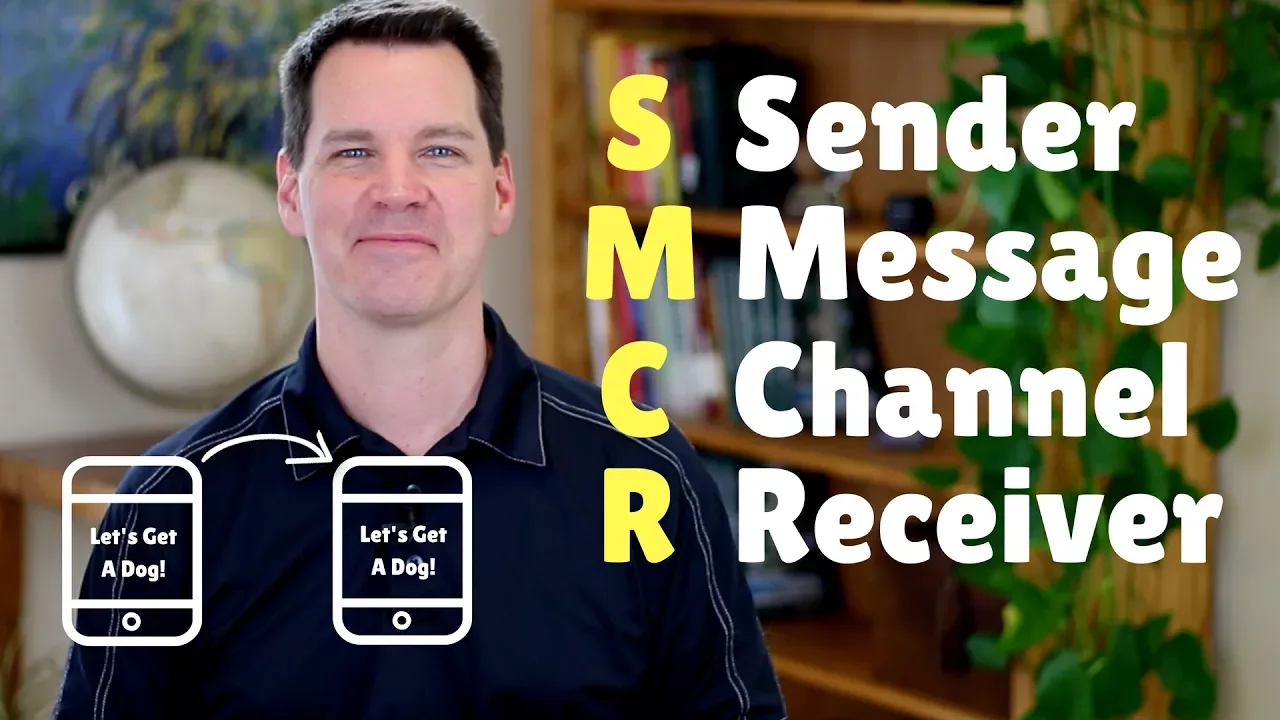
Let's say I am the "sender" and I write into my phone a thought that I have. I "encode" a "message" into words that says, "Let's get a dog." And I send that message through the phone system, through the "channel." And that's all the technology
Said at 1:09
The graph counts replays. It does not show where viewers stopped watching.
Words
737
Runtime
3:48
Speaking pace
194wpm
Reading time
3min
194 words per minute, between the 181 median and the 201 75th percentile of 349 measured videos. That distribution comes from the 349-video hook study.
Opening (first 30 seconds)
In this video we're going to define and unpack the basic model of communication. Sender, message, channel, receiver. Let's get into the details. Hello again friends. If we haven't met yet, I'm Alex Lyon. And this channel, Communication coach, is here to help you increase your impact so you can lead the teams around you to higher levels of excellence. And today we're going to do a little education. We're going to talk about the basic communication model by Shannon and Weaver that you may have seen if you have a communication background. It's the one that
97 words, the words spoken in the first 30 seconds at 194 words per minute.
Free, no signup. See how the first 30 seconds hold attention, with rewrites.
Sentence shape
| Measure | This transcript |
|---|---|
| Sentences | 54 |
| Average words per sentence | 13.6 |
| Longest sentence | 38 words |
| Questions asked | 2 |
| Sentences containing a number | 1 |
Most used terms
Filler phrases
4 in total: kind of 2 · like 2.
A literal whole-word count of the same phrase list the Prepublish browser extension uses, so a phrase inside another word is not counted and a phrase used in its ordinary sense still is. It is a count and not a judgement.
What this transcript is
Every word below is the caption track YouTube publishes for this video, pulled from the video itself and reproduced unchanged. It is not Prepublish's writing, not a summary, and not a re-transcription: it is the video's own published captions. English captions, published by the channel, in the video’s original language. Source: the video on YouTube. A channel that would rather this page did not exist can ask for its removal through the contact page, and it is removed.
In this video we're going to define and unpack the basic model of communication. Sender, message, channel, receiver. Let's get into the details. Hello again friends. If we haven't met yet, I'm Alex Lyon. And this channel, Communication coach, is here to help you increase your impact so you can lead the teams around you to higher levels of excellence. And today we're going to do a little education. We're going to talk about the basic communication model by Shannon and Weaver that you may have seen if you have a communication background.
It's the one that you'll see in almost every single introductory communication textbook in college. So I'm going to talk about some of the benefits of this but also some of the limitations. And my main point here on this model is that the model is simple, but people are complicated. So it does help explain some aspects of our experience but it's not perfect. So let's talk about the main pieces of this. First there are four main parts of this: the sender. the message, the channel, and the receiver.
And you'll often see it abbreviated by the first letters of those words. So let's unpack this just a little bit with an example. Let's say I am the "sender" and I write into my phone a thought that I have. I "encode" a "message" into words that says, "Let's get a dog." And I send that message through the phone system, through the "channel." And that's all the technology that involves. And it arrives at my wife's phone.
And she's the "receiver" and she "decodes" the message, "Let's get a dog." And at that point in this process, communication has occurred. According to this model communication has occurred when a message has been sent and received. And there's some limitations there that we'll get to in a second. There's also another aspect of that and it's "noise," this idea that noise sometimes interferes with the message. So you might get a voicemail that's garbled and you can't make out some of the words.
Sometimes noise from the environment can interfere with our understanding of a message. So there are some real limitations built in here that I want to talk about. First of all the biggest limitation is that the model reflects the time in the place that it was created. Shannon and Weaver came up with a model of 1940s. They were working in the telephone industry and so it has this technology angle to it where it helps explain texting well and other kind of information technology but it doesn't really capture the face-to-face dynamics very well.
A couple of things that are missing from it, for example, are nonverbal communication. That's obviously a huge part of life but the model doesn't account for that. Another part is that it doesn't account for the notion of feedback. Feedback might be implied in the model but it's really not directly part of it. So when a message has been sent and received communication has occurred. So, my wife gets the message, Let's get a dog, but then I'm thinking well did she get the message and what does she think it this?
Because feedback is not built into the original model. People added that kind of thing later. So those are two obvious limitations. The other obvious limitation is that even though the model is simple people are complicated. Like I mentioned. And the idea there is that when I write in, Let's get a dog, I may have a completely different imagination about what that looks like and what that means to me. And my wife reads that message, Let's get a dog, she might be thinking of something that's in the opposite direction so she might respond to it in a way that I didn't expect. so the model is really amazing for demonstrating a foundational understanding of the information transfer of that data from one point to the other point.
It really helps us understand how messages get sent and received but it doesn't really account for the face-to-face dynamics as well as the interpretive dynamics that are often going on in people. So, question of the day. What are your opinions about this model? I would love to hear your comments in that section below. So, thanks. God bless. And I'll see you in the next video.
The words are the caption track's own and nothing is reworded or re-transcribed. Paragraph breaks are placed between sentences so the text reads as prose.
Free tools for your own script. No signup, no login.
Paste your draft and see where viewers are likely to drop off, with a rewrite for each weak line.
Paste the first 30 seconds of your own draft for a hook score and rewrites.
Check your draft against YouTube's advertiser-friendly guidelines before you record it.
Read this channel's public videos and transcripts, and download a writing brief for it.