Getting the transcript
Reading the captions from YouTube. A video nobody has opened here before takes 10 to 30 seconds; this page fills in on its own.
Getting the transcript
Reading the captions from YouTube. A video nobody has opened here before takes 10 to 30 seconds; this page fills in on its own.
AI Engineer · @aiDotEngineer
This video has no Most replayed graph yet: YouTube shows one only once a video has enough views. These are the moments viewers replayed most in AI Engineer's most watched videos.
Most replayed moment at 18:45
4.8x that video's typical replay level
that they're they're changing they're changing things in the database not yet. You want to run them through the ontology first and make sure that works. Okay. I only got an I've got I've got another I've just a short time. I'm going to try to show you some of the things that um that you can
Said at 18:37
Most replayed moment at 16:13
3.6x that video's typical replay level
method signatures, the program layout and the call stacks. So here's some examples. I don't think you'll be able to read this one, but this is like the level of abstraction we're at. It's how we're actually going to lay this stuff out and how these systems are going to interact. Dylan Mulroy from Cloudflare talks a
Said at 16:06
Most replayed moment at 13:49
2.3x that video's typical replay level
Fable uh and it runs into an unknown, ask it to log it, right? So that um you uh you can see where the deviations happened and then you can sort of figure out why as well, you know? It will usually give you some context about what happened.
Said at 13:43
The graph counts replays. It does not show where viewers stopped watching.
Words
4,955
Runtime
28:18
Speaking pace
175wpm
Reading time
21min
175 words per minute, between the 160 25th percentile and the 181 median of 349 measured videos. That distribution comes from the 349-video hook study.
Opening (first 30 seconds)
[music] >> Good to go? Can people hear me okay? Awesome. Cool. Thank you. I'm slightly embarrassed by the grandiose title. Uh now that I've had to leave it up for a few seconds. Um but anyway, um who here works in government? Can I ask? Show of hands. Very good. That's what I was hoping for. You might be very well acquainted with some of the stuff that I'm going to grumble about. Who can't think of anything worse? All right. Good. What gets measured gets improved,
88 words, the words spoken in the first 30 seconds at 175 words per minute.
Free, no signup. See how the first 30 seconds hold attention, with rewrites.
Sentence shape
| Measure | This transcript |
|---|---|
| Sentences | 325 |
| Average words per sentence | 15.2 |
| Longest sentence | 54 words |
| Questions asked | 23 |
| Sentences containing a number | 27 |
Most used terms
Filler phrases
297 in total: um 164 · uh 49 · like 34 · actually 12 · sort of 12 · you know 12 · basically 5 · kind of 5 · I mean 3 · right? 1.
A literal whole-word count of the same phrase list the Prepublish browser extension uses, so a phrase inside another word is not counted and a phrase used in its ordinary sense still is. It is a count and not a judgement.
What this transcript is
Every word below is the caption track YouTube publishes for this video, pulled from the video itself and reproduced unchanged. It is not Prepublish's writing, not a summary, and not a re-transcription: it is the video's own published captions. English captions, generated automatically by YouTube, in the video’s original language. Source: the video on YouTube. A channel that would rather this page did not exist can ask for its removal through the contact page, and it is removed.
[music] >> Good to go? Can people hear me okay? Awesome. Cool. Thank you. I'm slightly embarrassed by the grandiose title. Uh now that I've had to leave it up for a few seconds. Um but anyway, um who here works in government? Can I ask? Show of hands. Very good. That's what I was hoping for. You might be very well acquainted with some of the stuff that I'm going to grumble about. Who can't think of anything worse? All right.
Good. What gets measured gets improved, so we'll do another one at the end. Actually, I won't in case more hands go up. Um hi everyone. I'm Owain Mulgrew. Um I work in the data science team just down the road in 10 Downing Street. Um I run our cross-government transformation work, uh including our fellowship program, which is predominantly what I'm going to talk about today. Um Yeah, I wanted to come down here tell you what we're doing in the hope that some of you might decide you want to be a part of it, which would be quite cool.
Um quick bit about us. So, the number 10 data science team, 10 DS, we were set up um sort of during the pandemic, partly in a response to the pandemic. Um our core business is making sure that the most important decisions in the country are informed by the best possible evidence. Um however, we are in the process of quite radically scaling up our own AI engineering and development capability, not just with the intention of driving AI adoption within number 10 itself, but also across strategically important parts of the state.
Um and the way that we're going about doing that is quite novel in itself. Before we get into that, just a little bit of context to set the scene. I know some of you are flying in from the West Coast, et cetera. Uh some of you might not follow the news. Um believe it or not, there are some challenges when it comes to public public service delivery in the UK. Um I say that half in jest, but it's pretty serious, you know.
At the moment, there are 7 and 1/4 million people that are on NHS waiting lists. There are I think about 350,000 court cases that are stuck in a backlog. Um only one in five planning application decisions in this country are currently decided on time. Um Sitting behind all of this um is a public sector productivity crisis um that was bad and has only been exacerbated since the pandemic. There are different figures for the sort of extent of this crisis.
Um I've gone for a Tony Blair Institute figure um that says there's a sort of 40 billion prize annual productivity gains from AI in government. Um but it's clear to anybody that works in the system and most most of society um that if any industry is ripe for disruption over the next few years, government is one. And I call it an industry rather than an organization. It's a big, complex industry of 400,000 people. Um and I think we should look at it through that lens.
Unfortunately, however, government has traditionally not been great at building and nurturing high-performing technical teams. Um a lot of these issues are not specific to the UK. A lot of our American friends will be familiar with them. Um but just some of the commonly cited ones, um pay is a, you know, an obvious one. It makes it quite hard for us to compete for the best talent out there and then retain it. Um but also some barriers that are both real and perceived.
Um so, government is a very hierarchical organization in many parts. There's a lot of bureaucracy. Um as a result, it can often move incredibly slowly. Um not just for those reasons, but also the fact that, you know, there are regulations and safeguards in place that are very sensible because we're ultimately accountable to the public and to Parliament. Um but all of this can result in a system that is not always that appetizing for high-performing technical people to join, especially the sort of people that we want, people that are impatient to leave their mark on the world.
So, what do we do that or what do we do about that? Um Changing a lot of these things is it's quite like a systemic challenge. It's like turning an oil tanker, which is a bit of a tired cliché, but it's a good one. Um we're a little team at the center. Um You know, turning that oil tanker is beyond the remit of of any one team, let alone a scrappy little startup like ours. However, um I think Calum Beer, our chief AI officer, is going to be closing out the conference this evening.
That's very much his job and he's doing great work at the Department of Science and Technology to do just that, so I recommend everybody goes along to it. But there is a lot of political will at the moment um to get stuff done and to make sure that this time around we are seizing new technology to actually make a dent in some of those problems I just mentioned. So, the question put to us was, "Well, what can you do about it?" And this was sort of the answer.
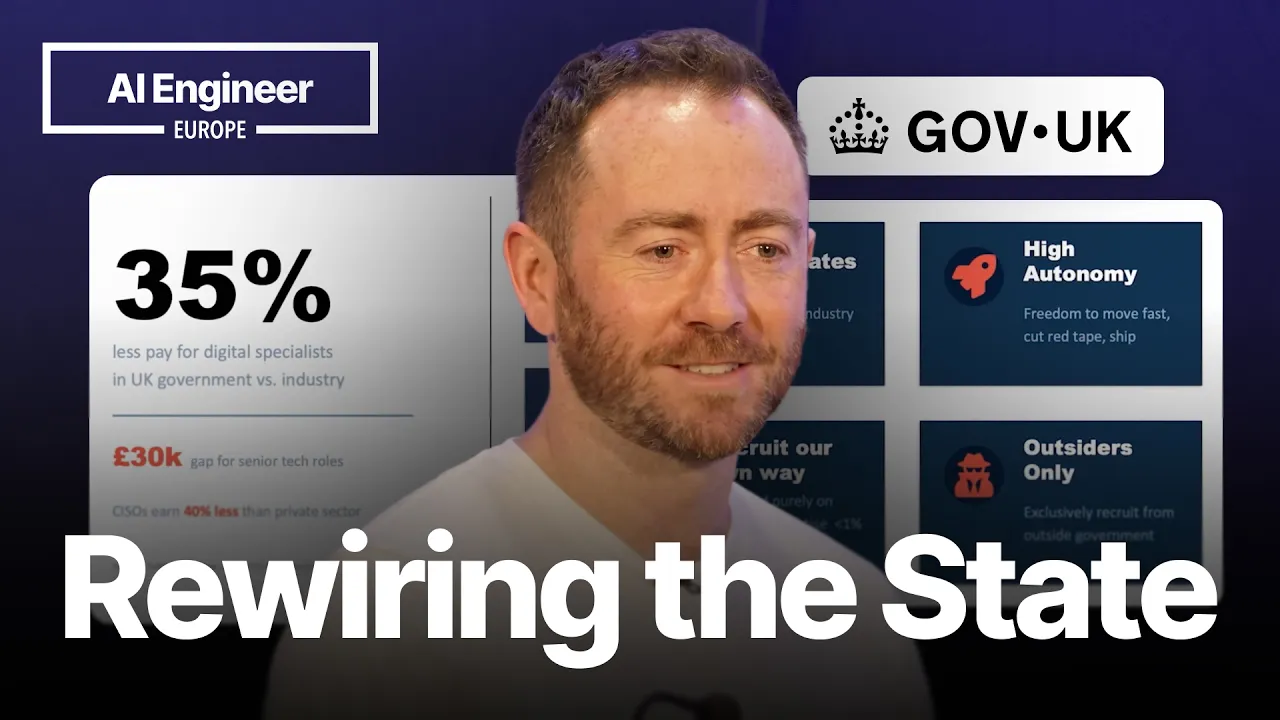
Um As I said, we're like quite a small team at the center. Um in terms of what we can do, um we said, "Okay, well, let us take the shackles off." Let us basically set up a small insurgent unit unit at the very center that is not um sort of burdened by some of the constraints that I just described to you. What do I mean by an insurgency model? Um so, we're setting up a new team. Um it operates with a mandate from number 10.
We operate with an unusually high level of political backing to go into departments and get stuff done. We're able to pay market rates within reason. We're not paying like meta money necessarily. Um but the thing is, a lot of people will happily take pay cuts if we make it economically viable to come in and work on some of these challenges because they're interested, right? Uh we operate with an unusually high level of autonomy as well.
We're able to be fairly opportunistic about the challenges we take on, where we go into a department and see opportunities to have impact. Also, this one's pretty crucial. Um the civil service recruit standard recruitment process is optimized for a lot of things, but not necessarily recruiting exceptional technical talent. Uh we've been allowed to recruit our own way. We've got a fairly grueling selection process that's laser-targeted on technical skills.
Uh we've got a success rate of about 0.7, 0.8%. Um and most interestingly of all, and this is what differentiates us, uh we recruit exclusively outsiders. Um one of the best ways that I can have impact is by getting some people the likes of this conference into government um because what has happened in the past is they tend not to leave and some of them end up setting up their own teams. I'll get into that later. Just when we're on this though, I don't want to make this sound like overly simplistic.
Um a lot of people from the outside, particularly particularly the tech industry, think that this bit alone is the only important thing that you need, that if you have a big enough stick from ministers, you can go in, you can, you know, break down data silos, you can do what you want. In practice, it's a lot harder than that, otherwise everybody would be doing it. And it's really early days. Like we're we're only setting out on this journey, but it turns out there's a huge amount of appetite for it.
So, we have been taking people from the labs. We've been taking people from big tech, from top research institutes. We've been taking YC finders, serial entrepreneurs. Um people who probably did not think they would be working in the civil service this time last year. Um but when you think about it, the decisions that go across a minister's desk are like some of the most important things you could possibly work on. So, if you make it economically viable and you promise people that you're going to put them in an environment where they can do their best work, it makes it really interesting.
Um it's also worth pointing out as well, we do want to recruit missionaries, not mercenaries. Um so, the pay matters, but it's not alone because a paycheck is not going to get you out of bed in the morning when stuff gets hard and doing the stuff that we do um does tend to be difficult. In terms of how we operate then, um again, a bit different from normal government teams. Um some of the There's like an abundance of low-hanging fruit around the system.
As you can imagine, it's a legacy organization. Um there's lots of simple AI use cases that you can do in a few days to save money, to improve service delivery, all that good stuff. When it comes to that, we largely do it ourselves. Um that's the easiest and most satisfying part. Um As we speak, we've actually got the first forward-deployed engineers in the history of 10 Downing Street embedding themselves with policy and operational teams, teams of policy advisers, teams of lawyers, teams of comms people, pollsters, and everything in between.
They're observing their workflows, their pain points, co-designing solutions with them to help them do their job more efficiently and effectively. And generally taking things from idea to implementation uh in a couple of weeks and getting new capability into the hands of users quickly. Um and then some of the other problems we talked about. I mentioned, you know, some of the huge backlogs in the system. That is not low-hanging fruit.
That's really complicated stuff and normally, when it comes to those, we take more of a partnership model, where we will deploy some of our people into another team or another department, sometimes for prolonged periods. And I'm going to give you examples of both of these in a minute. I'm going to start with some of the low-hanging fruit. It's worth pointing out actually um a lot of the stuff that we do in number 10 I can't really show you.
Um I know that sounds like an easy get-out-of-jail card, but trust me. Um some of the stuff is a little bit sensitive. Um we're doing a lot of workflow auto- automation, augmenting existing teams as you can imagine. And here are a few other examples of stuff we've done just in the past few weeks. Um so policy simulation, that's turned out to be really interesting. Um so here we can uh allow policy teams in the building to test out the impact of different policy decisions before they're made.
Um I think in this one here we're looking at different decisions around universal credit and how they might impact Oh, I've paused it. How they How they might impact household finances amongst other things, but this can be applied to a broad range of stuff. Um not replacing human analysis necessarily. We're not putting ourselves out of a job. Um but what it has meant is that far more decisions in the building are being informed by high-quality modeling and at a far faster rate than otherwise would have been the case.
And this is another one just from the past couple of weeks. Um so the cabinet office was about to spend 1.5 million pounds on getting an outside firm of lawyers to come in and do analysis of the entire UK statute book. Uh granted the statute book is the height of four African elephants um of legalese, um but still pretty obvious AI use case. So we were going to spend 1.5 million. Instead one of our engineers embedded with that team of of in-house lawyers for a couple of weeks.
Um the benefits of this is not just money saved. Obviously 1.5 million isn't is not nothing. Um but also speed. Um so the issue with the analysis that we were going to pay for is that it could have it it was going to be done slower uh than the pace at which new laws and regulations are made. Uh which means you're going to have to do it again after a certain period of time. So now we've got this tool uh that that team can use and they can do it whenever they want at the drop of a hat.
And we can also uh potentially open source it and share it with other teams in government. Um and then this is another one. Um so in number 10 we're responsible for the delivery of every major project and manifesto commitment in government. That means a lot of reports come in on how various things are doing. Um this is a little sort of delivery red teaming tool uh that the team's spun up a couple of weeks ago that is now being used every day.
Um it's essentially a PMO that we've put in the pockets of delivery teams in number 10. Not just so that they can interrogate the delivery reports that reports that are coming across their table, but also give a second judgment on the teams that are reporting them. Um so it will flag up to decision makers in number 10, you know, does this team does this department normally have a bit of optimism bias? Uh do they tend to disproportionately rate their risks as amber?
And are their mitigations usually effective or not? Also aside from like AI adoption, having this capability in-house is really good. I think transparency is one thing that this that this country can do a bit better at. Up until a couple of months ago um the government had never published a public-facing dashboard so that you lot can actually see how we're doing uh when it comes to delivery. Um but now we've published two in as many months.
I think some of you might be familiar with the one on the left. This is the AI Opportunities Action Plan that Matt Clifford drafted about a year ago. This is how the UK is doing when it comes to rolling out compute and generally setting up the UK to be a leader in AI adoption. Um and now you can go online and see how how we're actually doing. Um yeah. Um also another thing that I can't show uh but in 2.5 weeks' time we one of our ministers is going to launch a new public service that millions of people in the country are going to use.
I can't go into more detail and steal their thunder. Um but um in their words it's hard to believe this didn't already exist. I assumed something like it already existed. Um that's something that we thought of 2 months ago and is now going to be live and used by the public. It is not an understatement to say that normally in government that pro- project like that might be in discovery for a year or more. Um so yeah. Let's get into the media stuff then.
So um that's nice low-hanging fruit within the building. Um now I want to talk about some of the work that we're helping um other teams with across different parts of the ecosystem. Uh for the purposes of this I'm just going to focus on um three of our partners. Um the AI Safety Institute, the Incubator for AI, and Just AI. AISI I think pretty much everybody in this room will be familiar with it. Massive win for the UK.
It's great thing that we set up. Um we're leading government body for evaluating frontier models and it was also the world's first. And we were really proud from day one to support it by putting a couple of our fellows in there to help them set set up their cybersecurity work stream amongst other things. I'll not dwell too much on this. Uh but one of our early fellows was Dr. Harry Coppock. I don't think Harry's here, but we put him into AISI from day one.
Um and he led on their Inspect tool amongst other things. Um so there's a CFI isolated environment for testing what AI agents actually do when you give them autonomy and tools. And the Incubator for AI um which now sits in DC. Um the Who here is familiar with the Incubator? A few people. Um so the Incubator is essentially a spin-out of our program. Um it's a team that exists in the Department for Science and Technology that does what it says on the tin.
It incubates new AI solutions for usage across the public sector. Um its original uh finding team, most of the technical team were our fellows. And what's really cool now is not just seeing the work that they produced while they were there, but also the fact that we're able to collaborate with them when it comes to scaling up some of that work. Um here's one recent example. Um so this tool is Extract. Um so a bunch of our people have worked on Extract.
It's a collaboration with DeepMind. It's built on Gemini and it essentially digitizes large swaths of the planning application process, especially those bits that are currently um largely handwritten including handwritten uh hand-drawn maps there as well. Um this was unveiled by the Prime Minister at London Tech Week last year and we're currently in the process of rolling it out to every local authority in England. As I said, only one in five planning applications are currently decided on time.
That has a massive impact on economic growth and economic growth is basically the biggest challenge this country faces right now. So anything we can do to make a dent on that is really significant. I think aspirationally as well this will hopefully get us to a place where more and more planning applications can be decided um by AI um automatically. And then another interesting one. Um this is very current. Um the education gap uh is a big problem not just in the UK but elsewhere.
Um many of you will have read the papers about AI tutors. It's a really exciting moment. Um the the prospect of being able to level the playing field somewhat and put world-class tutors in front of every child regardless of their socio-economic background. Um but it's something that has to be done really carefully. Um so currently we're working um uh we're working on producing safeguards and evaluating various frontier models against benchmarks.
Um not just to make sure that children can interact safely with these in a classroom environment, but also measuring them against various metrics. I think in this one uh the relevant benchmark is the cognitive load placed on the student. And then last but not least, the new kids on the block uh Just AI. Some of you might have been here for the Just AI talk yesterday. Was anybody here? Yes. Okay, good. For most of you this is new.
Um Just AI are new team that have been set up in the MOJ, some of whom are over there. Hello. Um um again I wouldn't say a spin-off from the fellowship, that gives us way too much credit. Uh but the founder of Just AI is one of our former fellows Dan James who's doing brilliant work in there. And they're deploying forward-deployed engineers into prisons and into other parts of the criminal justice system. Um so kind of taking an approach that we're doing in number 10 with like policy people and comms people and lawyers, but instead they're embedding with parole officers and prison wardens.
And they're doing loads of really interesting work. I can't go into too much detail, um but most of it is around using the AI to stop the flow of drugs into prisons, to find efficiencies where currently there's quite manual processes involving lots of people, and generally improving the uh security and safety within the prison system. Um and one of those AFEs is over there. It's Will. Uh Will's one of our current fellows.
Sorry Will, I've embarrassed you. I I just added in your photo last night because I thought this was um sort of a good point to end on. Um Will is So to give you an idea, a few months ago Will was in California getting a tan. Uh that's him outside HMP Wandsworth on a rainy day. Um but yeah, Will dropped out of Harvard, started a company, got it into Y Combinator, made a bit of money, but wanted to come and work for us.
And that's his second week on the job, and he's standing outside a prison with the keys to that actual prison about to go in. And that is that is exactly what we're trying to do through this program. You've maybe done good stuff in industry, that's brilliant. Come join us, and we'll give you the keys to the state and see what you can do. So, yeah. Um look, it's really early days. Um it's sort of an experiment what we're doing.
Um but I think the proof points so far have been that actually like small elite teams can actually achieve quite a lot. Um we're already already saving money. We're already shipping new public services at an unprecedented speed. Um we're already reforming frontline public services, and we're already um putting new AI capabilities into the into the hands of other teams um at the top of government. So, yeah. Um surprise, surprise, this was a recruitment pitch.
We are hiring. Um so, please do sign the uh scan the QR code, and I'll be here the rest of the day if you want to come up and chat. Thank you. >> [applause] >> I um I think I've got time for a couple of questions, possibly. Somebody can tell me if not. Calls? Oh, it's Uh so, one on the on one of the earlier example you showed, there was this uh chat to explain policies and um not explain, but try different like projection and see how they would behave.
Um do you have to deal with uh sycophants sycophancy? Uh with the fact that you know, like if like you have a user that's not necessarily very well versed in AI, like just wants to hear what he wants to hear, can direct the tool towards oh, look, I'm an absolutely brilliant mastermind. My policy is going to be fantastic uh despite the policy being actually bad, but the AI just >> Yeah, yeah, yeah. is basically Yeah. Should I cut income tax to 0%?
You're absolutely right. Um yeah, that that's a very real risk. Um so, it's it's not something that we've encountered too much, but it's only because we have um sort of red team the models for that before we've put it into the hands of users. We also provide quite a bit of upskilling. Um so, like a lot of the teams that we work with, we're creating tools for them. They're possibly lawyers, they're possibly sociologists, professors, whatever.
So, we do coach them on some of the risks that this presents. Um but yeah, it's a good question. Thank you. Hello. Thank you very much for the speech. Uh I'm Jack from Accenture. I think you beat our pitch for hiring, but uh we'll try as well. Um but my question on the the policy side is as you progress with this FDE type of model actually making an impact, how do you see oh, as you said, it's early day experiment. How do you see start to scale and essentially start dealing with the center central governments, with local governments, the different party lines, and so on and so forth.
This kind of real kind of Yeah, yeah. governmental kind of, human kind of stance. How how do you see that's going to play out? Yeah, 100%. So, in terms of how this scales, so I suppose at the end I said, oh, you know, we can do quite a bit, and some of the people that join us then set up their new teams, that's great. Is it enough to turn the oil tanker itself? No, possibly over time, but it would take a long time, and we need to solve these problems quicker than that.
Um so, we have been thinking about that. Um I think realistically some of this stuff requires strategic intervention. Um so, we need to change the way the rest of government operates. Part of the reason part of the bargain that we basically made with ministers was, you know, let us take the shackles off, let us set up a small team at the center that abides by different rules, and use it as a proof point. So, this is this is almost like a pilot.
I would like to see a lot of what we're doing uh become the norm, become BAU. This at the moment is basically a hack to get around the system. So, we we need to change that first of all. Um I think also another Like if we're if we're talking really about scale, uh we we talked about some like fairly targeted use cases there. Um I think what we want to do over the next sort of 12 to 24 months is do more horizontal work.
Uh looking at processes. So, I should explain this to people as well, like um when you think of the civil service, you probably think of policy people working in some of the buildings around here that you can see out the window. That is a very small sliver of the civil service. It's about 400,000 people. Most of them are call center operators, they're uh prison wardens, they're nurses, etc., etc. Um there are a lot of processes out there, whether that's like transcription uh that every police person will tell you is the bane of their existence, or it will be those massive call centers in DWP, HMRC.
So, yeah, if we want to dial up the ambition, I would like to see us going after more of those like horizontal use cases that can be applied en masse across the system. Um yeah, sorry, that was a bit of a long answer. >> [laughter] >> Uh I think this is the last one. Yeah. You can shout if you want. I'm It's up to you. Uh yeah, so I work for an EdTech company that among other things is making AI tutors. So, I'd love to talk to you more about that.
But one thing we find, I mean, the big problem with most kids is that uh you know, you can make the best AI tutor in the world, but you um the real problem is motivation. You know, if you sit a kid down in sit a 12-year-old down in front of a computer, they're they're going to do everything they can to avoid learning. So, my question is like how I mean, first of all, I'm just interested to know more about like what what the vision is at the gov- the government for this.
Like is this going to be going into schools? Are kids going to be sitting down in front of computers and using it? And secondly, like how do you solve that motivation problem? Yeah, 100%. So, um at the moment, I think our plan is largely not to necessarily develop products that compete with yours, but rather set >> but rather set benchmarks and guardrails for how schools can then adopt whatever whatever products they want.
Um in terms of student uptake though, that's not something we've done too much on yet. Um the test that you just saw uh was our initial test, and which has been done I think with 70 teachers who were then role-playing their pupils. Um so, actually your experience might be quite valuable. Um so, we'll we should chat after. I'm from Norway. Uh so, it's very great to see your ambitions, and I'm sure that many countries across Europe are doing exactly the same thing.
Are you doing any form from collaboration with other countries? Experiencing and sharing ideas, etc. Yeah, a bit. Um Norway, no, but if you've got contacts, I'd be very happy to chat to them. Um yeah, we we do a bit. Um there are a couple of teams that are like sort of similar to what we're doing, albeit a little bit differently. Uh there are a couple of different initiatives underway in the US government, which are not a million miles away.
Um stuff like that task force, um parts of US digital service, um Singapore as well. We talk quite a bit with Singapore. Um but yeah, we we could do more. Um so, yeah, if you have any contacts in the Norwegian government, I'd be very open to it. Done. >> [applause] [music]
The words are the caption track's own and nothing is reworded or re-transcribed. Paragraph breaks are placed between sentences so the text reads as prose.
Free tools for your own script. No signup, no login.
Paste your draft and see where viewers are likely to drop off, with a rewrite for each weak line.
Paste the first 30 seconds of your own draft for a hook score and rewrites.
Check your draft against YouTube's advertiser-friendly guidelines before you record it.
Read this channel's public videos and transcripts, and download a writing brief for it.