Getting the transcript
Reading the captions from YouTube. A video nobody has opened here before takes 10 to 30 seconds; this page fills in on its own.
Getting the transcript
Reading the captions from YouTube. A video nobody has opened here before takes 10 to 30 seconds; this page fills in on its own.
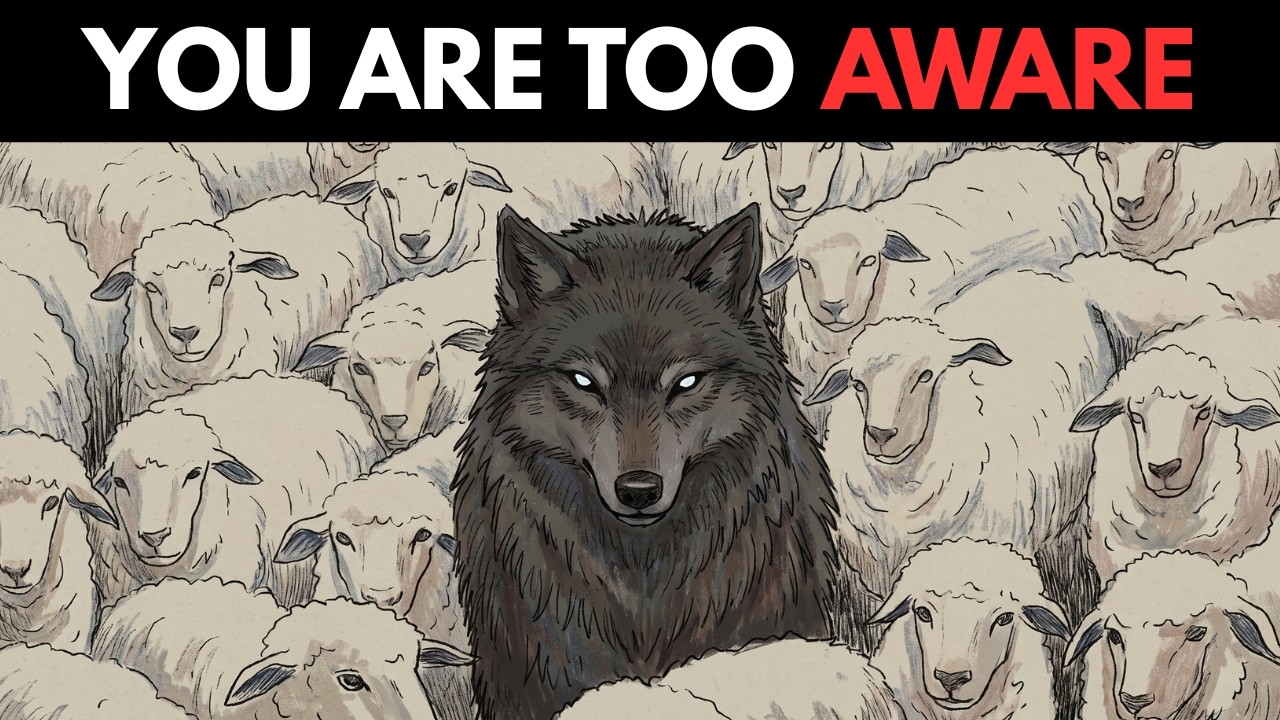
PsychToons · @PsychToonsHQ
Where viewers went back to watch this video again, from YouTube's public Most replayed graph, lined up with what was said at that moment.
Most replayed moment #1
3:313.1x the video's typical replay level
boat like that to a dock and it doesn't feel safe. It feels wrong. It knocks against the pilings. It was never designed to sit in the harbor and no amount of better rope will change that. You've spent years thinking you needed better rope. You didn't. You have a different hull. And here's the part that
Said at 3:23
Most replayed moment #2
6:542.7x the video's typical replay level
You walk alone for the same reason a founder leaves the company, for the same reason an artist leaves the movement. Not because you can't follow the group, because you were never built to be steered by one. Sign four, your circle is small because your standard is total.
Said at 6:49
Most replayed moment #3
5:581.6x the video's typical replay level
surrounded by obligation, the gap is everywhere. That's a loneliness, and you've been fluent in it since before it had a name. Sign three, it's not shyness and it's not even really introversion. Here's what surprises people. You can talk. You can charm a room when you
Said at 5:51
The graph counts replays. It does not show where viewers stopped watching.
Words
2,140
Runtime
11:42
Speaking pace
183wpm
Reading time
9min
183 words per minute, just over the 181 median of 349 measured videos. That distribution comes from the 349-video hook study.
Opening (first 30 seconds)
Some people are meant to walk alone. And if you clicked on this video, part of you already suspects you're one of them. You felt it your whole life. At the party, surrounded by people who like you, there's a version of you standing slightly outside the moment, counting the minutes until you can leave. On the group trip, the best part isn't the dinners or the photos. It's the early morning when you slip out before anyone wakes up and walk by yourself for an hour. And late at night, when
92 words, the words spoken in the first 30 seconds at 183 words per minute.
Free, no signup. See how the first 30 seconds hold attention, with rewrites.
Sentence shape
| Measure | This transcript |
|---|---|
| Sentences | 186 |
| Average words per sentence | 11.5 |
| Longest sentence | 46 words |
| Questions asked | 7 |
| Sentences containing a number | 5 |
Most used terms
Filler phrases
17 in total: like 10 · actually 4 · you know 3.
A literal whole-word count of the same phrase list the Prepublish browser extension uses, so a phrase inside another word is not counted and a phrase used in its ordinary sense still is. It is a count and not a judgement.
What this transcript is
Every word below is the caption track YouTube publishes for this video, pulled from the video itself and reproduced unchanged. It is not Prepublish's writing, not a summary, and not a re-transcription: it is the video's own published captions. English captions, generated automatically by YouTube, in the video’s original language. Source: the video on YouTube. A channel that would rather this page did not exist can ask for its removal through the contact page, and it is removed.
Some people are meant to walk alone. And if you clicked on this video, part of you already suspects you're one of them. You felt it your whole life. At the party, surrounded by people who like you, there's a version of you standing slightly outside the moment, counting the minutes until you can leave. On the group trip, the best part isn't the dinners or the photos. It's the early morning when you slip out before anyone wakes up and walk by yourself for an hour.
And late at night, when the world finally goes quiet, something in your chest unclenches. You've never told anyone how good that feels. Because you already know how it would sound. And you've asked yourself the question, quietly, more than once, is something wrong with me? The people around you have their own answers ready. You're lonely. You're afraid of intimacy. You're pushing people away. You just haven't found your people yet.
Keep trying. Put yourself out there. But here's what the actual psychology says, and it says something almost no one will tell you. You are not failing at connection. You are not broken in some way that more socializing would fix. Walking alone is not the wound. For some people, walking alone is the design. Your nervous system was built for a different mode of living, and everything you've been taught to read as a defect is actually the signature of that build.
Today on Psych Tunes, we're going to decode the psychology of people who are meant to walk alone. Not why they failed to belong, but why they were never supposed to belong the way everyone else does. And by the end, you'll understand exactly what you are, maybe for the first time. Science actually has a name for what you carry. Researcher Robert Coplan at Carleton University has spent his career studying people who genuinely prefer solitude.
And one of his most important findings is a distinction most people have never heard. There is shyness, which is wanting connection but fearing it. And then there is what he calls unsociability, a real, non-fearful affinity for being alone. Not tolerance of solitude, and not settling for it. An actual pull toward it, the way other people are pulled toward a crowded room. Coplan's research goes further. He coined a term for something you've felt a thousand times and never had words for, a loneliness.
It's the measurable distress of not getting enough time alone. Science has documented that for people like you, the suffering doesn't come from solitude. It comes from being denied it. That drained, scraped out, strangely sad feeling after a full week of people, meetings, dinners, and noise. That's not depression. That's not you failing socially. That's a loneliness. You've been starving in the middle of a feast. So, what's actually happening inside you when you finally get that time alone?
In 2018, researchers To EV and Nguyen, Richard Ryan, and Edward Deci published a series of studies with a finding that explains your entire life. Just 15 minutes of solitude produced what they called a deactivation effect. High arousal emotions dropped. The nervous system settled. Calm rose. And here's the detail that matters most. The effect vanished the moment another person was in the room. Not a difficult person.
Not a draining person. Any person. Solitude wasn't a retreat from something bad. It was the only condition under which the system could fully power down and restore itself. Think of it this way. Most people are built like harbor boats. They're designed to be tied to something, to sit close to other hulls, to feel the dock under the ropes. That's where they're safe. That's where they run best. But some vessels are built with a different hull entirely.
A deep keel made for open water. Tie a boat like that to a dock and it doesn't feel safe. It feels wrong. It knocks against the pilings. It was never designed to sit in the harbor and no amount of better rope will change that. You've spent years thinking you needed better rope. You didn't. You have a different hull. And here's the part that might rewrite your whole story. You were probably like this before anything ever happened to you.
Think back. You were the kid who could spend an entire afternoon alone in your room, building something, reading something, drawing something, completely content until an adult opened the door with a worried look and asked why you weren't outside with the other children. That look taught you something false. It taught you that your contentment was a symptom. The psychoanalyst Donald Winnicott saw it differently all the way back in 1958.
He argued that the capacity to be alone isn't a deficit at all. It's a developmental achievement, one of the most sophisticated things a psyche can learn and one that many people never reach. While the adults were worrying about you, you were already doing something most of them couldn't do. Being complete in an empty room. You weren't behind, you were ahead. So, how do you know if this is really you? Not a phase, not a rough patch, but the actual architecture of who you are?
There are five signs. Count how many land. Sign one, solitude charges you, it doesn't just rest you. Everyone enjoys a quiet evening sometimes. That's not this. This is the specific experience of coming home from three days with people you genuinely love, closing the door, standing in the silence, and feeling energy physically return to your body, like water filling a glass. The trip was good, the people were good, and still this moment, alone in your own space, is the best part.
Other people recover from work by seeing friends. You recover from friends by seeing no one. That's the deactivation effect running in real time, and if you know exactly the feeling I'm describing, that's the first sign. Sign two, crowds make you lonelier than solitude ever has. This is the strange one, the one you've never been able to explain. You can sit alone on a Saturday and feel completely full, and you can stand in the middle of a party, mid-conversation, drink in hand, and feel a loneliness so sharp it almost hurts.
Everyone else has it backwards, and you've always known it. For you, loneliness was never about the number of people in the room. It's the gap between where you are and where your system needs to be. When you're alone by design, there's no gap. When you're surrounded by obligation, the gap is everywhere. That's a loneliness, and you've been fluent in it since before it had a name. Sign three, it's not shyness and it's not even really introversion.
Here's what surprises people. You can talk. You can charm a room when you decide to. You can hold the meeting, work the dinner, make the stranger laugh, and then you leave and no one watching would ever guess you're someone who walks alone. In 2022, Nguyen, along with Netta Weinstein and Richard Ryan, published a study that overturned the standard assumption. Introversion did not predict who genuinely seeks and enjoys solitude.
What predicted it was something called dispositional autonomy, the tendency to run your life from the inside, by your own compass, free from the pressure to be a certain way. Let that land. What sets you apart isn't social fear or even social battery. It's self-governance. You walk alone for the same reason a founder leaves the company, for the same reason an artist leaves the movement. Not because you can't follow the group, because you were never built to be steered by one.
Sign four, your circle is small because your standard is total. People look at your two or three close relationships and see scarcity. They have no idea what they're looking at. When you give someone a place in your life, you give them the whole thing. Full attention, no performance, no version of you edited for consumption. The friend who has your loyalty has all of it. You'd rather have three relationships at full depth than 30 at arm's length, and this was never a compromise.
It's a preference for the real over the many. The crowd runs wide, you run deep. Both are ways of loving people. Yours just doesn't photograph as well. Sign five, you've stopped auditioning. Somewhere along the way, quietly, without announcing it, you stopped performing belonging. You stopped laughing at things that aren't funny. Stopped patting your calendar to look wanted. Stopped shaping yourself into whatever the room required.
Not out of bitterness, out of arithmetic. You ran the numbers on being edited versus being alone, and alone won. This is the sign people misread the most, and it's the one that marks you most clearly. Because ending the audition isn't withdrawal. It's the moment you decided your own company would no longer be the thing you apologize for. Now, is there a price for a life like this? There is, and you already know it. The world misreads you.
Some invitations stop coming. Some people will tell the story of your distance in a way that makes them feel better about it. That's the toll on this road, and you've been paying it for years. Mostly without complaint. But notice something, you've never seriously tried to become someone else, even when it cost you. Some part of you always knew the trade was worth it. Trust that part. It's been right the whole time. And this is where I'm supposed to give you the fix.
The five steps to open up. The plan to build your tribe. I'm not going to do that, because there's nothing here to fix. You don't repair a deep water hull by teaching it to love the dock. But there is one distinction worth carrying with you, because it's the difference between the two kinds of alone, and only one of them is yours. Loneliness is the ache of absence. Connection you want and don't have. Solitude is the fullness of presence.
You, undiluted in your own company, needing nothing added. The person meant to walk alone knows the difference in their body. One alone drains, the other alone feeds. If your alone feeds you, then it was never a symptom. It was a homecoming. And when I caught would tell you that what looks like your limitation is actually your completion. You found in yourself what most people spend their lives outsourcing to a crowd.
Because here's what happens to people like you over time. The road doesn't get emptier, it gets richer. The same depth that made you unfit for the harbor is what lets you cross distances most people never see. Your solitude stops being the thing you explain and becomes the place you create from, think from, build from. The thinkers, the builders, the artists, the ones who came back from somewhere with something new. Overwhelmingly, they were people who could stand long stretches of open water.
Not because suffering makes genius, because depth requires room. And room is exactly what you gave yourself when you stopped apologizing for the way you're built. The psychiatrist Anthony Storr spent his career pushing back against the idea that relationships are the only measure of a life. In his book Solitude, he argued that the capacity to be alone sits at the root of the deepest human work, creation, thought, and the long conversation a person has with their own soul.
Some lives are structured around the table, others are structured around the road. Neither is the lesser life. And the poet Rilke told a young man something you needed to hear years ago, that his solitude was not a punishment to escape, but a home to inhabit, and that he should love it because it was where his real life was happening all along. So, here's my question for you. Of the five signs, which one hit hardest?
The recharge, the crowd loneliness, the self-governance, the small deep circle, or the end of the audition? Tell me in the comments, and I think you'll be surprised how many people on this road thought they were the only one walking it. If this video finally put words to something you've carried alone for years, hit like and send it to the one person who you know is built the same way. They've probably never heard anyone say their solitude is a design and not a defect, and hearing it might change how they see their entire life.
And subscribe with notifications on so we can keep decoding the hidden corners of the mind together. Thank you for walking this far with me. Goodbye and see you next time.
The words are the caption track's own and nothing is reworded or re-transcribed. Paragraph breaks are placed between sentences so the text reads as prose.
Free tools for your own script. No signup, no login.
Paste your draft and see where viewers are likely to drop off, with a rewrite for each weak line.
Paste the first 30 seconds of your own draft for a hook score and rewrites.
Check your draft against YouTube's advertiser-friendly guidelines before you record it.
Read this channel's public videos and transcripts, and download a writing brief for it.