Getting the transcript
Reading the captions from YouTube. A video nobody has opened here before takes 10 to 30 seconds; this page fills in on its own.
Getting the transcript
Reading the captions from YouTube. A video nobody has opened here before takes 10 to 30 seconds; this page fills in on its own.
Cue Banks · @CueBanks
Words
3,062
Runtime
12:53
Speaking pace
238wpm
Reading time
13min
238 words per minute, above the 201 75th percentile of 349 measured videos. That distribution comes from the 349-video hook study.
Opening (first 30 seconds)
I think my main issue is that I'm not satisfied with small profits. So, I try to size up and tight my stop losses just to hit those sniper entries to satisfy my view of the number, you know? So, this came in this week and I wanted to sit on this for just a second, right? Because both of these things [music] he's describing, I size up, I tight my stop losses. That's not the problem. The problem is the order on how he's doing [music] things. And that order is going to cost him his entire account. There is no strategy in this video, by the way. Like, there's no entries, there's no new setups. It's one
119 words, the words spoken in the first 30 seconds at 238 words per minute.
Free, no signup. See how the first 30 seconds hold attention, with rewrites.
Sentence shape
| Measure | This transcript |
|---|---|
| Sentences | 215 |
| Average words per sentence | 14.2 |
| Longest sentence | 74 words |
| Questions asked | 35 |
| Sentences containing a number | 28 |
Most used terms
Filler phrases
97 in total: actually 33 · like 29 · right? 16 · you know 14 · I mean 2 · kind of 2 · basically 1.
A literal whole-word count of the same phrase list the Prepublish browser extension uses, so a phrase inside another word is not counted and a phrase used in its ordinary sense still is. It is a count and not a judgement.
What this transcript is
Every word below is the caption track YouTube publishes for this video, pulled from the video itself and reproduced unchanged. It is not Prepublish's writing, not a summary, and not a re-transcription: it is the video's own published captions. English captions, generated automatically by YouTube, in the video’s original language. Source: the video on YouTube. A channel that would rather this page did not exist can ask for its removal through the contact page, and it is removed.
No Script X-ray for this video: YouTube shows a Most replayed graph only once a video has enough views.
I think my main issue is that I'm not satisfied with small profits. So, I try to size up and tight my stop losses just to hit those sniper entries to satisfy my view of the number, you know? So, this came in this week and I wanted to sit on this for just a second, right? Because both of these things [music] he's describing, I size up, I tight my stop losses. That's not the problem. The problem is the order on how he's doing [music] things.
And that order is going to cost him his entire account. There is no strategy in this video, by the way. Like, there's no entries, there's no new setups. It's one decision and it happens before you can even touch your lot size. Most people never actually make it on purpose, [music] but it gets made for them. So, let me show you the trade. Two actions. He does them. I do them. Same two. So, here's his way. He wants a bigger number on the trade.
So, he bumps up the lot size. I get [music] it. So, now the risk is too big. So, now he drags the stops a little bit tighter to put the risk back down to something that he could actually stomach. Size came first, the stop got moved to fit it. That doesn't [music] make sense. So, here's how I would look at the chart. So, here's my way. I look at the chart and I find the price where the trade is actually dead, where I'm wrong, completely invalid [music] trade.
Turns out that's closer than the standard stop. So, my stops end up smaller. Because it's smaller, I tend to carry now a more lot size based off of that [music] exact area. Same two actions, just flipped around a little bit. One version of it is position sizing. The other one basically gambles with a couple extra steps right in front of it. All right, chart. US 30, August 5th, and I'm going to show you guys a quick little analysis because it's not what we're here for, but, you know, when it comes to the charts, you guys have to pretty much understand standards to really understand like my perspective.
[music] So, we're at an all-time high on the higher time frame. Nothing above us, no structure, no levels, nothing to lean on. And when there's no structure, [music] all you have to do is go left. See where price is itself. Whole numbers, half numbers, quarter points, that's what actually matters. So, when we push up, we reject and then we look underneath. Highs, lower highs, >> [music] >> lower lows, you know, things of that nature, overall structure.
This is a little downtrend forming inside of the bigger trend. [music] Fibs point A to point B, watch for the 23.6% here because this is going to mess up a lot of people if they don't pay attention to this because plenty of people bought it. So, personally, I don't like to enter off of 23.6s because I've been burnt from them so many times. So, I kind of like just try to pull back from that zone and just let it consolidate.
Cuz normally, you get a lot of consolidation, you get a lot of continuation, yes, but you'll get chopped up very, very easily as well. So, the 38.2% is the first pullback is what I call a proper lower high [music] point in this example or a higher low point in the other trend example. So, in this case, you broke 23.6%, you came down to to 38.2% and now we've got a level of support broken below and that counter trend is now making higher lows.
So, higher lows in a counter trend, I draw two lines, my point A and point B, just two points, right? Not waiting for the third touch Third touch is what actually is benefiting from that actual line, but you cannot try to look for three touches. All you need is just two points to then look into where price can actually go. So, while this line holds, I do nothing. That's the rule. It holds, I stay out of the way, all [music] right?
There it goes. And there's my candle, wick on top, bearish body right after the break. That's the trigger right there. Entries [music] at the exact close, right? Stop loss. If you learn this the normal way, stops go above the previous swing high. Give it some room, you get wicked out. You've got hundreds of times of just getting messed up. There's nothing wrong with it, but it's based off of where the starting point is.
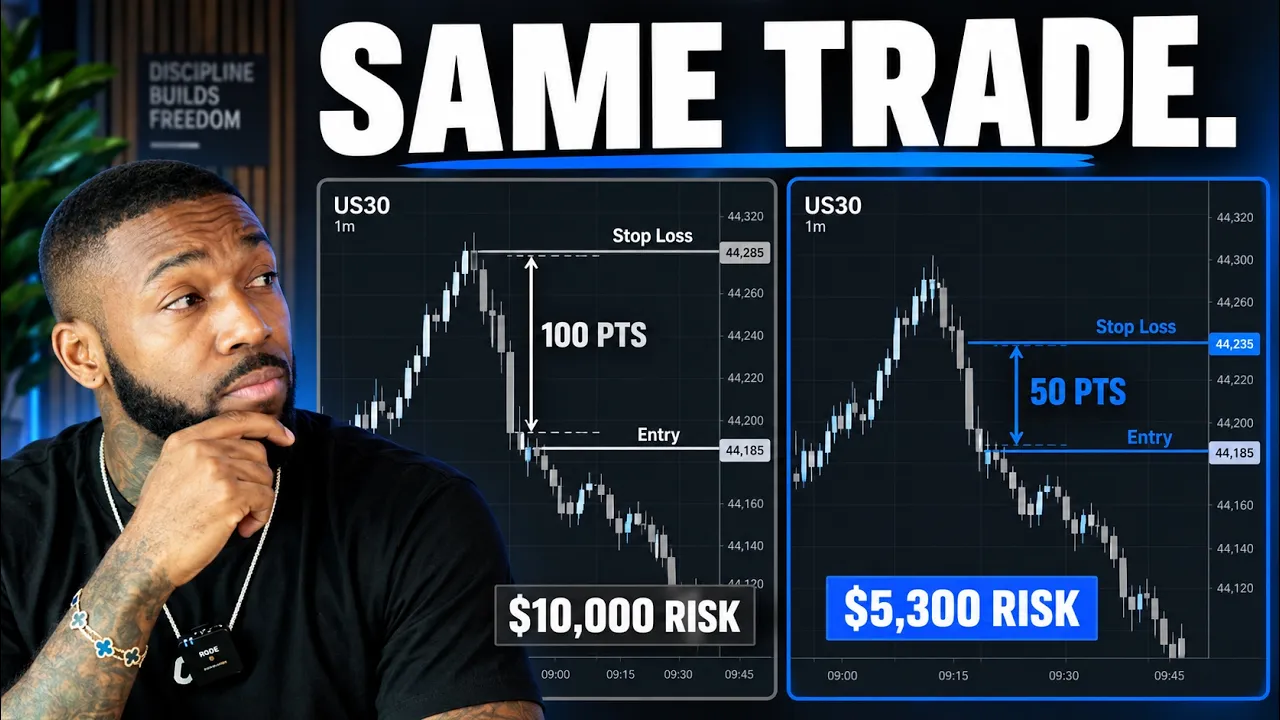
So, I like to use 100 points. And let me put that in real numbers real quick, all right? Because points mean nothing till they actually mean dollars. So, one standard lot, 100 points, that's $10,000 risk. Obviously, it depends on your broker that you're using to actually use the margin requirements for this. But, in this case, a 1.00 is a standard lot, which means 100 points equals $10,000 [music] risk. So, $10,000 on one trade, one setup, but you don't love it, that's a problem.
So, let's try to benefit with the risk now. And this is where most people actually make a decision without even clocking that they're even making one. They see 10 grand of risk and then all of a sudden they say, "You know what? That's too much. I'll take a smaller trade." They cut the lot size in half and the risk comes down to five. They move on, they feel safe, and all of a sudden they just throw the entire trade away but not even asking the real question.
The real question is not how much you're comfortable losing. It's what price you're actually looking at and is that area a good reason to actually put your parameters there. So, it's two different questions and they give you two different numbers every single time. So, walk it with me. Why am I even in this trade? Support broke, [music] counter trend line break, 38.2% lower high point, candle after break. That's the case for the trade.
Like it's and it always varies. Now, what breaks that case? Not the swing high. The swing high is miles up there. And if price gets near, this trade has been dead for ages. So, why even let it get there? I'd just be sitting there and watching a loser become more of a loser at that point, all right? Waiting for the numbers to actually print knowing it's been gone. So, what actually kills it is this. So, this level price comes back above here.
The lower high point's gone, the line break means nothing, and I'm wrong. Not I might come back or or anything or I might not be wrong. You're wrong. 50 points. Where does stop should go? 100 points, right? Big difference. Where the trade actually dies, 50 points a lot of times. The other 50 was >> [snorts] >> never really doing anything for me anyways. Like it wasn't just for protection. Like you pretty much had a reason to get out of the trade at 50 points.
So, let's get out. It wasn't me just hanging around waiting for a wrong like a longer wronger move, you know? So, same trade, same entry, and same stops. And watch what that does to the numbers. One lot size, 100 point stops, $10,000. Same lot size, 50 point stop, call it 5,300 based off of what you're actually being placed at. So, my risk here is just a little bit of half, all right? Most people stop right here [music] and they they good about it because, you know, they're saving money.
So, my risk budget for the trade never changed. I just always was happy with the numbers. So, I put the stops in half for the main fact that I had a better area in the market to not have to put my full 100 point stop. So, I just needed to put 50 because if I went beyond a certain area, I was going to have a dead trade anyways. So, like why would I even put an extra 50 points on top of there? Now, double up the lot size.
So, now if this trade actually goes in my favor, I'm pretty much making pretty much double the profit with half the risk knowing that I was open to risking that in the first place. So, now let's run the boring version, right? One lot size, 100 points, same [music] stop, same 76 points, you know, in this example. $7,600, $10,000 risk. Like how does that make sense? Right? This is when you can actually understand that like if you could pretty much like minimize that risk based off of where you currently are inside of the market, that gives you a better spot into making the trade actually makes a bit more sense, but also feeling a bit more satisfied based off of >> [music] >> using all of the same charting, you know, same areas, same lot size, same risk overall.
You're still risking everything the same exact way, but you're benefiting from this trade a lot more if everything actually plays out in your favor. So, doing this allows you to actually be a lot more comfortable with the money that you're making, but also it puts you in in [music] a sense of being able to take a bit more risk in a different dynamic way. So, that's when you can actually become a bit more comfortable with how you're trading and become a lot more comfortable with the numbers that you're seeing a lot [music] faster as well.
So, with a 100 point stop, the first target is always 1:1, right? This first first off first off. With a 50 point stop, that's exactly the same target with a 1:2, right? I didn't move the [music] target. I didn't get greedy. I didn't hold longer. The ratio moved because the bottom number just moved, right? The area of the market just got a lot better, so I never needed to risk that extra [music] amount if I never had to.
And personally, I don't like to take 1:1s. I I personally feel like it's like damn near gambling, honestly, you know? So, if I could actually find a trade that makes a bit more sense within that entire area, I'm going to try to actually double up if I could. Once I get my entry right and once I could actually put an area that I don't have to put my full risk all all the time. So, one to twos is like my minimum. I love those.
One to threes I aim for because that's like that's that's like what I hunt for, you know? So, if somebody tells me that they can't really find a one to three type of setup, half the time they're just trying to find things all day and they're probably trying to just overlook it [music] when they could settle with a one to two and still make a great amount of money without having to to like strive for that one to three all the time.
I only go for the one to threes if the market allows me to maintain that trade to the point I could actually go from a one to two to a one to three ratio based off of the the movement and the flow of that entire structure. All right, the other side of this because I don't always want anybody to actually just look at this video and all of a sudden think that they're going to, you know, swing for the fences with every single trade.
You get in, you're up, price stalls, and now you're sitting there going like, "Yo, is it at my ratio? Is it not? What should I do?" How about this? Just close out, call it a day, and revert back to the chart when the market can actually show you a great amount of detail to then get back in the trade based off of your same bias, right? [music] Once price stalls and you overthink, that's when you say, "You know what? Wipe your hands clean.
I'm done." Things like that keeps you in the game longer cuz at some point you have to look at the money that you're making. You can't just look at the price all the time. Ratios is not everything. Yeah, like you could be at a one to one or a one to two and you could still be up a good amount of money. You have to to understand like you can never go broke taking profit. And always make that stick in your head. The ratio is not always the goal.
The tool is for deciding if a trade is worth taking based off the risk and based off of the reward. Once you're in, the goal is pretty much balance. That's the scoreboard. That's it. So, if you're in a trade and you got any kind of uncertainty on how the trade is moving, just close out. You're not breaking a rule, you know, like just close out, call it a day because the rule was never for your entry [music] to be the most perfect entry.
The rule is to make money and add to your balance. And it compounds in a way that people don't really think about. The bigger the balance, everything gets a little bit easier, yes, you got more cushion, yes, a loss doesn't put you in a hole, but you stop making scary decisions [music] because there's nothing to be scared of when you have a good amount of money in your account. But the risk can also be as big as well if you're not managing things as you should.
So the trader who protects their balance ends up being the calm one a lot longer and staying in the game a lot longer, and there's no way around that. So here's the real answer to [music] what's underneath that message. He wants bigger numbers, and he's chasing them by looking for more trades and forcing them based off of, you know, how you're looking at charts, and at that point it could get very, very messy. So you can't just try to justify you up'ing your lot size to just make more money, but your position is is pretty much whack.
There's no way to justify that unless you're putting in the extra work and understanding what you're looking at to then minimize that risk to then be able to up your lot size to make it all make sense. So you already got a couple of week [music] that you bet on, all right? Those are the ones. The next level isn't just 10 more setups to risk every single time. It's putting a real lot size on two that you pretty much trust because your invalidations are tight, and that's enough to let you take on that extra risk.
So that's what I mean by quality. I don't mean by wait around for some perfect setup. I mean squeeze [music] every little bit out of a quality trade that is already in front of you that you pretty much trust, [music] that you've been hunting for quite a while, and that you pretty much understand where it's able to go. And last thing, and this is the part that nobody likes. So you have to listen and listen carefully. You can't size up on a setup that you cannot define.
Everything in this video runs on one thing, knowing exactly what price makes you wrong. Like what area in structure makes you wrong. And you only know that it's a wrong price because you understand the conditions that makes it invalid. Trade state, location, triggers, invalidations, write all that down, and write that down every single time because that keeps you in track of where the market is actually going, and what makes the the trade valid or invalid.
So if your setup is feeling that you have an invalidation that you are just guessing around and you can't really find like the correct precision for a certain entry, let's get out. There's no reason to keep on guessing, right? There's no reason to take a smaller guess based off of your your lack of of confidence in that certain trade. Things like that is what actually blows accounts and we don't want to actually go there.
So, this is where us self-taught traders get stuck all the time because it's not because they're missing information, it's because every single thing that is already on their chart, they understand to an extent but it's never to the full extent. The details actually matter. Where you're putting your stop loss matters. Where your entry is going matters. All of this is based off of off of a level of precision that most people don't actually take time to actually learn.
So, spot these areas, understand these areas, and and benefit from these areas to get a better R to R. So, there's a market framework in the link below. It's a sequence that I ran from the start. Written out about an hour to properly do one pair. So, if you're going to do this and it takes 1 hour, do it right. If you're not going to even download it, it does nothing just sitting in your files, honestly. So, you have to use it.
And drop your invalidation rules in the comments and I want to see how you guys are pretty much looking at the charts right now. So, the one sentence below, what makes your trade setup invalid? Drop it below and I want to see that. And what price makes your chart incorrect? Well, like what area and structure makes your chart and setup incorrect? And I can't wait to read the comments to see how you guys are going about it and I'm catch y'all on the next video. >> [music] >> Peace out.
The words are the caption track's own and nothing is reworded or re-transcribed. Paragraph breaks are placed between sentences so the text reads as prose.
Free tools for your own script. No signup, no login.
Paste your draft and see where viewers are likely to drop off, with a rewrite for each weak line.
Paste the first 30 seconds of your own draft for a hook score and rewrites.
Check your draft against YouTube's advertiser-friendly guidelines before you record it.
Read this channel's public videos and transcripts, and download a writing brief for it.