Getting the transcript
Reading the captions from YouTube. A video nobody has opened here before takes 10 to 30 seconds; this page fills in on its own.
Getting the transcript
Reading the captions from YouTube. A video nobody has opened here before takes 10 to 30 seconds; this page fills in on its own.
Epic History · @EpichistoryTv
Where viewers went back to watch this video again, from YouTube's public Most replayed graph, lined up with what was said at that moment.
Most replayed moment #1
31:465.5x the video's typical replay level
Politburo. But in reality, Deng is calling the shots. Deng Xiaoping is finally free to enact the reforms he believes China desperately needs.
Said at 31:43
Most replayed moment #2
9:115.3x the video's typical replay level
Many other senior officials are purged – among them Xi Zhongxun, the father of future Chinese leader, Xi Jinping. Zhou Enlai survives as Premier of the People's Republic of China,
Said at 9:05
Most replayed moment #3
24:212.9x the video's typical replay level
a place where any dissent is quickly and ruthlessly suppressed. In the words of veteran Communist Chen Yun,
Said at 24:15
The graph counts replays. It does not show where viewers stopped watching.
Words
3,015
Runtime
35:17
Speaking pace
85wpm
Reading time
13min
85 words per minute, below the 160 25th percentile of 349 measured videos. That distribution comes from the 349-video hook study.
Opening (first 30 seconds)
[Music] The 1960s… and China is back as a major world power. A nuclear-armed Communist state, charting its own course... with access to vast reserves of human and economic potential. And yet, recent years have seen disastrous mistakes by China’s leaders... with horrifying
43 words, the words spoken in the first 30 seconds at 85 words per minute.
Free, no signup. See how the first 30 seconds hold attention, with rewrites.
Sentence shape
| Measure | This transcript |
|---|---|
| Sentences | 207 |
| Average words per sentence | 14.6 |
| Longest sentence | 45 words |
| Questions asked | 2 |
| Sentences containing a number | 47 |
Most used terms
Filler phrases
2 in total: like 2.
A literal whole-word count of the same phrase list the Prepublish browser extension uses, so a phrase inside another word is not counted and a phrase used in its ordinary sense still is. It is a count and not a judgement.
What this transcript is
Every word below is the caption track YouTube publishes for this video, pulled from the video itself and reproduced unchanged. It is not Prepublish's writing, not a summary, and not a re-transcription: it is the video's own published captions. English captions, published by the channel, in the video’s original language. Source: the video on YouTube. A channel that would rather this page did not exist can ask for its removal through the contact page, and it is removed.
[Music] The 1960s… and China is back as a major world power. A nuclear-armed Communist state, charting its own course... with access to vast reserves of human and economic potential. And yet, recent years have seen disastrous mistakes by China’s leaders... with horrifying consequences for its people. The blunders of the ‘Great Leap Forward’ mean Communist Party Chairman Mao Zedong has taken a back seat in running the country.
But his presence still looms large. And he is already planning his return to frontline politics. A new book helps to prepare the way: ‘Quotations from Chairman Mao’, published in 1964. The famous ‘Little Red Book’. It contains 427 sayings that encapsulate ‘the essence of Mao Zedong Thought’…. … And is small enough to be carried, and studied, by every woman and man in China. More than a billion copies are printed in the next decade – second only to the Bible.
Then in 1966, Mao makes a very public political intervention. Mao believes that the success of the Chinese Communist Revolution relies upon continuous momentum. He now feels support for that project is waning, and plans a radical programme of renewal. Warning of hidden enemies within the Chinese Communist Party, he calls for a new state of permanent ‘Cultural Revolution’. The youth must rise up, he says, and 'Smash the Four Olds’ – old thought; old culture; old habits; and old ideas.
Mao can rely on a group of loyal attack dogs to support him in his new campaign. They include defence minister Lin Biao, who controls the military… and Mao’s wife, former actress Jiang Qing, who controls much of the media. Initially, students and youths respond to Mao’s call with enthusiasm. They organise themselves into units known as ‘Red Guards’, donning red arm bands and brandishing Mao’s Little Red Book. Millions travel to Beijing, where Mao reviews them at mass rallies in Tiananmen Square.
The ‘Red Guards’ will be Mao’s enforcers. They quickly turn on their university lecturers and high school teachers - symbols of ‘the old order’ – many of whom are beaten and humiliated. Jiang Qing encourages the violence at a student rally: “If good people beat bad people, it serves them right; if bad people beat good people, the good people win glory.” Within weeks, the chaos spreads from campuses to society at large.. and from Beijing to every city and province in China.
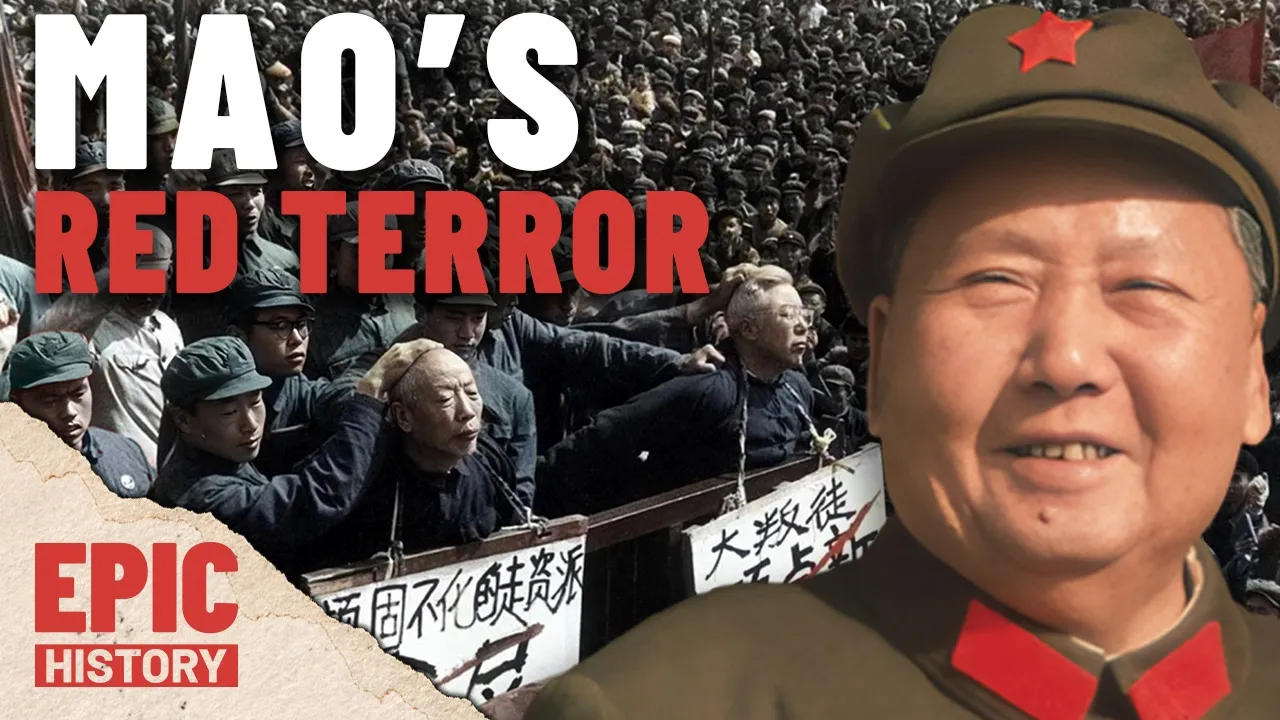
Mobs of Red Guards, often thousands-strong, roam the streets, attacking anyone they deem bourgeois or reactionary. Millions of ordinary people are targeted on trumped up charges, or simply for being literate, or interested in traditional Chinese culture. No one is safe. Victims are subjected to “struggle sessions,” in which they are publicly humiliated, tortured and beaten, sometimes to death. Friends and relatives of the accused are often forced to lead the attacks.
Millions of books, artworks, and monuments linked to pre-Communist China, are destroyed. On 26th December 1966, at his 73th birthday party, Mao calls for “All-round Civil War”. Party officials are to be purged, and replaced with revolutionary committees. These will consist only of supporters of the Cultural Revolution. In other words, those loyal only to Mao. The military is ordered to support the purge, leading to a much bloodier phase of the Cultural Revolution.
In 1967 alone, an estimated quarter of a million people are killed, and three-quarters of a million left permanently disabled. In 1968, Mao launches a new campaign to ‘Cleanse the Class Ranks’, spreading further terror. All sections of society, across all ages, are affected. A further thirty million are subjected to “struggle sessions”. Mao's wife Jiang Qing - a key leader of the Cultural Revolution - is now one of the most powerful and feared figures in China.
The chaos reaches the very top of the party – as Mao settles scores with perceived rivals. Liu Shaoqi, China’s head of state, is dragged to ‘struggle sessions’ along with his family. They are publicly beaten by Red Guards, and imprisoned. At the 1969 Party Congress, state premier Zhou Enlai denounces Liu as ‘a criminal traitor, enemy agent and scab in the service of the imperialists, modern revisionists and the Nationalist reactionaries.’ A broken man, Liu dies in prison seven months later.
Other prominent victims include Deng Xiaoping, a leading pragmatist and reformer on the Politburo Standing Committee. He is sent to work in a tractor factory. His brother is driven to take his own life. His son is tortured by Red Guards for months, and then thrown from a third-floor window, leaving him paralysed for life. Many other senior officials are purged – among them Xi Zhongxun, the father of future Chinese leader, Xi Jinping.
Zhou Enlai survives as Premier of the People's Republic of China, though his adopted daughter Sun Weishi is arrested, tortured, and dies in prison. Zhou expresses no public criticism, and endorses the persecution of former colleagues. It is a strategy of political survival. His personal relationship with Mao is uneasy. Mao envies Zhou’s popularity, but relies on him to run the government, and mastermind China’s foreign relations.
However, Mao names loyalist defence minister Lin Biao – not Zhou – to be his successor, when the time comes. In July 1968, Mao orders the Red Guards to end their attacks, which have served their purpose. But bloody suppressions and campaigns will continue for years. In the final reckoning, Mao’s Cultural Revolution claims the lives of unknown thousands, perhaps millions. It inflicts cruel and inhumane treatment on countless more, and destroys huge swathes of China’s cultural heritage.
The deep trauma - for victims and perpetrators - lasts to this day. The excesses of the Cultural Revolution seem to give Mao a stranglehold on power. But there are now few within the leadership he trusts - and few who trust him. Mao’s relationship with defence minister Lin Biao begins to sour. Each suspects the other of plotting their downfall. In 1971, Lin Biao decides he must flee China for his own safety. With his family, he boards a flight to the Soviet Union… only for the plane to crash in Mongolia, killing all on board.
Lin’s former allies within the People’s Liberation Army are soon purged. With Lin out of the picture, Premier Zhou Enlai rises further in status and authority. Never a diplomat, Mao relies on Zhou to restore harmony at home, and build bridges abroad. And in the early ‘70s, Zhou oversees a series of foreign policy successes that further enhance his prestige and popularity. Since 1945, China’s seat at the UN has been held by Taiwan – formally, the Republic of China.
This is the state created by Chiang Kai-shek’s Nationalist government, when it fled at the end of the Civil War. But in 1971, after years of diplomatic manoeuvring, the UN votes to recognise the People’s Republic of China - Communist China - as the country’s sole, legitimate representative – and transfers to it Taiwan’s seat as one of the UN Security Council’s five permanent members. Since the ‘60s, China’s relations with the Soviet Union have been frosty.
There have even been bloody border clashes between the two nuclear-armed Communist powers. The first is in 1969, in the east… but fighting later spreads to Xinjiang, leaving scores dead. Zhou now seeks to thaw relations with the world’s other superpower, the USA. Rapprochement begins in 1971, when the US ping pong team is invited to tour China. It’s the first official visit by an American delegation since 1949. The US players are personally welcomed by Premier Zhou, who tactfully instructs the dominant Chinese team not to win every game.
The tour is considered a diplomatic triumph - in Zhou’s words, “opening the door for friendly exchange between the two nations.” Building on the foundations of ‘ping pong diplomacy’, US President Richard Nixon visits China in 1972. Nixon is a zealous anti-Communist, but both sides see better relations as a means to gain leverage over the Soviet Union. As a result, a US trade embargo, in place since the Communists came to power in 1949, is lifted.
In 1973, Zhou’s long-term ally Deng Xiaoping is allowed to return to Beijing from internal exile in Jiangxi province. Mao agrees to rehabilitate him. By 1974, Deng is once more Vice-Premier, working closely with Zhou on foreign policy and day-to-day government. Dogged by ill health, and increasing paranoia, Mao's hold over the party begins to wane. But he will outlast one old rival... A giant portrait of Chiang Kai-shek had once overlooked Tiananmen Square, just as Mao’s does now.
Since his defeat in the Civil War, the former Nationalist leader of China has headed an authoritarian government in Taiwan. He has overseen stunning economic growth, but failed in his ultimate goal, to reconquer the Chinese mainland. Chiang dies in Taipei, in April 1975, aged 87. The rivalry between the two leaders passes to a new generation, but remains as fierce as ever. Four months later, China is hit by a powerful typhoon.
Heavy rain in Henan province causes dozens of dams to collapse. The resulting floods destroy millions of homes… but the authorities suppress reporting of the disaster. The official death toll is 26,000. More recent estimates point to a number several times higher. The failure of the dams, built at the height of Mao’s ‘Great Leap Forward’, is a tragic reminder of past mistakes… Just as China’s future path is suddenly thrown into doubt.
By 1975, the Chinese Communist Party is divided between modernisers, and loyalists. Leading the modernisers, Deng Xiaoping, Zhou Enlai and others… who now openly point the finger at a ‘Gang of Four’, for inciting the worst excesses of the Cultural Revolution. The ‘gang’ – all Mao loyalists – is led by his wife Jiang Qing... and includes Zhang Chunqiao, a political theorist... literary critic Yao Wenyuan... and labour activist Wang Hongwen.
All hold key positions in the party or state apparatus. Through the Central Cultural Revolution Group, they largely control state media - from newspapers and radio, to revolutionary opera and theatre. The Gang of Four fight back against the modernisers, turning their propaganda machine against Deng and Zhou, who are labelled counter-revolutionary ‘rightists’. Anxious to protect his legacy, Mao seems to be siding with the Gang of Four.
Then, in January 1976, Zhou Enlai dies from cancer. Zhou had received an early diagnosis. But Mao had personally intervened to delay potentially lifesaving treatment. Such was his determination to outlive his political rival. As Chinese Premier since 1949, Zhou was one of the key architects of Communist China. President Nixon had called him ‘the greatest statesman of our era’, and as a skilled diplomat and stabilising force, he’d shaped foreign policy and helped to modernise the country.
But his attempts to moderate Mao’s mistakes had only limited success. His legacy is inescapably entwined with the disasters of Mao-era China. But Zhou remains hugely popular. And on 4th April crowds gather in Tiananmen Square to mourn his death, and protest against the attacks made on him by the ‘Gang of Four’. The following day, the army is sent in to clear the square, with around 40 arrests. Zhou’s ally Deng Xiaoping is blamed for the disturbance… and dismissed once again.
Amidst rising tensions at the top of the Party... Mao Zedong – plagued by heart and lung problems for years - dies, aged 82. Many millions of Chinese have known no leader but Mao. The country is in shock. A week of national mourning is declared. Over seven days, a million visitors file past Mao’s body, as he lies in state in the Great Hall of the People, in Tiananmen Square. The people are urged to “Turn grief into strength, carry forward Chairman Mao’s legacy, and see the proletarian revolutionary cause through to the end”.
To most Chinese, Mao is – and remains - ‘the Great Helmsman’. A titanic figure who guided China through stormy seas, to security and prosperity. But his successes were matched by disastrous failures. His agricultural reforms, motivated by pure ideology, triggered the largest man-made famine in history. Tens of millions died as a result. The ‘Cultural Revolution’ saw suffering inflicted on many thousands of innocent victims.
Mao’s rule has left Chinese society highly regimented, and riven with distrust; a place where any dissent is quickly and ruthlessly suppressed. In the words of veteran Communist Chen Yun, “Had Mao died in 1956, his achievements would have been immortal. Had he died in 1966, he would still have been a great man but flawed. But he died in 1976. Alas, what can one say?” The Chinese Communist Party is now deeply split - between those loyal to Mao and his legacy, and those who oppose the brutality of the Cultural Revolution.
Mao’s designated successor is Hua Guofeng. He is an able if uninspiring party official, but lacks prestige and personal authority. Officially, his mantra is clear: “Whatever policy Chairman Mao decided upon, we shall resolutely defend. Whatever directives Chairman Mao issued, we shall steadfastly obey.” In practice he pulls off a delicate balancing act, between honouring Mao’s legacy, and modernisation. His first task is to deal with the Gang of Four, led by Mao’s widow Jiang Qing.
For many, they embody the worst excesses of Mao’s rule. After the period of national mourning comes to an end, Hua moves against them. On 6th October 1976, the Gang of Four are arrested. They are accused of orchestrating the chaos and violence of the Cultural Revolution. In a televised trial, Jiang Qing defends herself passionately - but all four are found guilty of counterrevolutionary activities. Jiang Qing and Zhang Chunqiao are sentenced to death.
Their sentences are later commuted to life imprisonment. In 1991, Jiang takes her own life in prison, a Mao loyalist to the end. With blame for past mistakes pinned on the Gang of Four, Mao’s status as ‘the Great Helmsman’ can remain unquestioned, and inviolable. But it is clear that in Communist China, a new era is beginning. The Gang of Four had represented one extreme of the Chinese Communist Party – the Mao loyalists.
If one figure represents the opposite wing of the Party, it’s Deng Xiaoping. Now aged 72, Deng’s fortunes within the party have fluctuated wildly. In the 1930s, he’d supported Mao in the rural Soviets, and the struggle against the Kuomintang. He’d become a willing enforcer of the brutal Anti-Rightist Campaigns of the 1950s... an economic reformer in the 1960s... then, a sudden and dramatic fall from favour at the height of the Cultural Revolution.
Deng is now seen as a natural leader, a talent too great for the party to ignore. In July 1977, Hua Guofeng rehabilitates Deng for a second time, appointing him Vice-Chairman of the Communist Party. From now on, all the momentum is with the reformers. Deng is acutely aware that China is in a disastrous state, weakened by Mao’s Great Leap Forward, and the Cultural Revolution. The average income of a Chinese peasant – still 80% of the population - is just 40 US dollars a year.
Because of the Cultural Revolution, crucial positions across the country are held by unqualified military officials and Mao loyalists. Universities have been shuttered for a decade. Thousands of educated people and party officials have been exiled to the countryside to perform menial labour. Infrastructure and industry are in a state of neglect and disrepair. Deng believes the solution must be radical reform. He will deviate from decades of Maoist ideology… and advocate openness to new ideas and technologies, wherever they come from.
Students and officials are encouraged to spend time abroad. The goal will be the ‘Four Modernizations’, introduced by Zhou Enlai: in agriculture, industry, science, and defence. Deng steadily increases his power and support within the Party. By late 1978, he is officially the third most senior member of the Politburo. But in reality, Deng is calling the shots. Deng Xiaoping is finally free to enact the reforms he believes China desperately needs.
The consequence will be a transformation unprecedented in history. If you love history as much as we do, you’ve probably collected some interesting memorabilia over the years. Perhaps it’s hidden in a box or sitting on a shelf somewhere. But how about owning a true piece of history that you can wear on your wrist? Today’s video sponsor, REC Watches, can make this a reality. Take their new HABU series, celebrating the SR-71 Blackbird – legendary Cold War spy plane, and fastest aircraft in the world.
Not only is the watch design inspired by the Blackbird’s engineering and aesthetics, each timepiece contains titanium from the actual aircraft’s engine nacelle exhaust ejectors. These “turkey feathers” once managed supersonic afterburners at Mach 3. Now, they form the Habu’s lower dial. Or imagine wearing a watch infused with the spirit of Steve McQueen’s Triumph T6 Motorcycle… Ayrton Senna’s Lotus F1 car… or the famous Supermarine Spitfire.
Most watches simply mark time - REC Watches capture history. The company was founded in 2014 to craft bespoke timepieces from legendary machines, transforming the past into a wearable time capsule. Their materials come from historic and nearly impossible-to-find parts, sourced with great care and respect for their provenance. And Epic History viewers can get an exclusive discount. Head to RECwatches.com and use the coupon code EPICHISTORY at checkout to receive 10% off any item, including pre-orders.
Unique designs such as the HABU series are limited editions, so move fast to avoid disappointment. Thanks to REC Watches for sponsoring our video. Big thanks to our series historical consultant, Dr Lily Chang of University College London. And thanks as always to the Patreon supporters who help to make this channel possible – from builders, such as Ulises Gutierrez, Colin Legrand, and Loyal Piper… To citizens like Martin Alvariza, Blair Bunke and Ijatm2… And heroes, like thomas griffin.
And now you can also support the channel by joining the ranks of ‘the Grognards’ – our valued Youtube members who gain access to loyalty badges, custom emojis, and merch discounts. Click the membership link on our channel page to sign up now!
The words are the caption track's own and nothing is reworded or re-transcribed. Paragraph breaks are placed between sentences so the text reads as prose.
Free tools for your own script. No signup, no login.
Paste your draft and see where viewers are likely to drop off, with a rewrite for each weak line.
Paste the first 30 seconds of your own draft for a hook score and rewrites.
Check your draft against YouTube's advertiser-friendly guidelines before you record it.
Read this channel's public videos and transcripts, and download a writing brief for it.