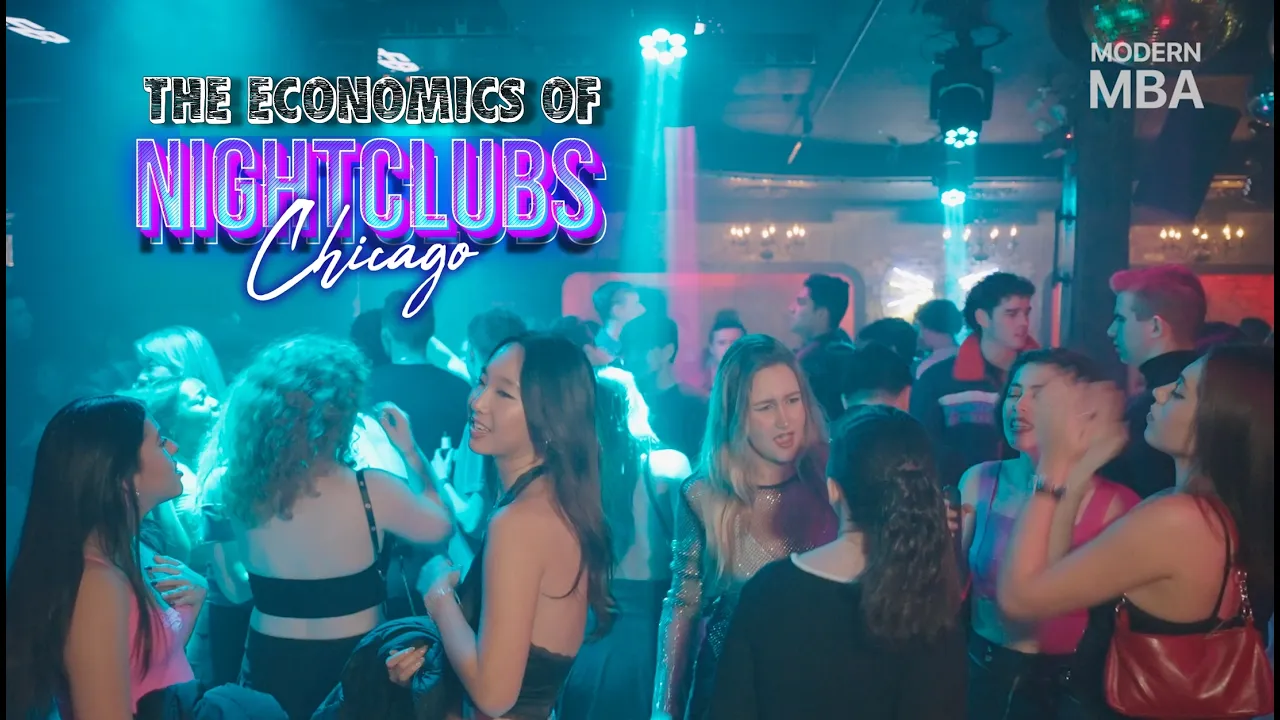
The Secret Business of Nightclubs transcript
Modern MBA · @ModernMBA
Words
6,108
Runtime
32:23
Speaking pace
189wpm
Reading time
25min
189 words per minute, between the 181 median and the 201 75th percentile of 349 measured videos. That distribution comes from the 349-video hook study.
Opening (first 30 seconds)
Every city has nightclubs: social venues where people can mingle with strangers, dance with friends, and escape the monotony of life in an environment of darkness, music, and chaos. As businesses, all nightclubs face the same challenge every week. They have to convince you that their club is the place to be where you’ll have the most fun on a Thursday, Friday, or Saturday night. It’s a simple formula - people want to have a good time when they go out. If a club is empty, people will turn around and go somewhere else. If
95 words, the words spoken in the first 30 seconds at 189 words per minute.
Sentence shape
| Measure | This transcript |
|---|---|
| Sentences | 261 |
| Average words per sentence | 23.4 |
| Longest sentence | 87 words |
| Questions asked | 7 |
| Sentences containing a number | 29 |
Most used terms
- club62
- jay44
- people42
- tables42
- women42
- night37
- eric36
- derrick34
- venue33
- promoters27
- ladies25
- party23
Filler phrases
34 in total: like 27 · kind of 2 · you know 2 · I mean 1 · actually 1 · basically 1.
A literal whole-word count of the same phrase list the Prepublish browser extension uses, so a phrase inside another word is not counted and a phrase used in its ordinary sense still is. It is a count and not a judgement.
What this transcript is
Every word below is the caption track YouTube publishes for this video, pulled from the video itself and reproduced unchanged. It is not Prepublish's writing, not a summary, and not a re-transcription: it is the video's own published captions. English captions, published by the channel, in the video’s original language. Source: the video on YouTube. A channel that would rather this page did not exist can ask for its removal through the contact page, and it is removed.
Transcript
Every city has nightclubs: social venues where people can mingle with strangers, dance with friends, and escape the monotony of life in an environment of darkness, music, and chaos. As businesses, all nightclubs face the same challenge every week. They have to convince you that their club is the place to be where you’ll have the most fun on a Thursday, Friday, or Saturday night. It’s a simple formula - people want to have a good time when they go out.
If a club is empty, people will turn around and go somewhere else. If you’re a club owner, how do you make your nightclub a desirable place to be? How do you pack your nightclub with people so that more people will come? You can book a famous artist to perform at your venue, but that’s not sustainable without connections and taking into account just how much money the biggest artists charge per show. How can you make your nightclub pop on a regular, run-of-the-mill Thursday, Friday, or Saturday night when you don’t have headliners?
The answer is promoters. Where there are nightclubs, there are promoters. Promoters are a trade as old as the clubs themselves. Promoters are the invisible men and women who work to turn clubs from slow, empty venues into packed, exciting, desirable destinations every weekend. Cities are defined by their nightlife and Chicago is home to some of the best clubs in the world. In this Modern MBA exclusive, we’re diving deep into the secret world of nightclubs and club promoters.
We’ll ride along with 3 of Chicago’s leading promoters in Derrick, Jay, and Eric, observe their hustle In the simplest term, the job of a promoter is to bring people, primarily women, into a nightclub and make the club look desirable, exciting, and attractive at all times. Nightclubs are businesses built on psychology as much as function. To comprehend what they do, we have to accept two realities of life. The first is the law of physical attraction.
There are objective measures of attractiveness and humans by extension are attractive, unattractive, or somewhere in between. People who are good-looking get better results in professional, dating, and social markets and this same law applies in nightlife. It’s a fundamental truth of nightlife that when people go out to a club, concert, festival, or bar and they see good-looking men and women, they’ll stay for longer especially if they’re single.
The second reality is the gender division of labor and pay. Through history, men are expected to be breadwinners and in most cases, do indeed get paid more than women in the same roles. While this all might sound like off-topic, tangential pseudoscience, it’s essential to understanding the core business of nightclubs. Like any animal, human males will go to great lengths to pursue their mates. Where there’s women, there will be men.
And where there’s attractive women, there will be men with money. And men with money will peacock to get the attention of attractive women. Nightclubs give men looking to impress or chase clout a brief yet material platform for that attention and exclusivity. For a couple thousand dollars, you can flex by buying a private table at a nightclub. Men go where women are and nightclubs make money off men looking to make a statement.
As a result, women are essential to a successful nightclub. In the simplest abstraction - without women, there is no one to flex on, which in turn means no men and no spenders. If a club is empty, slow, has too many dudes, not enough women, or not enough attractive women - the spenders won’t come. If the spenders do come, they won’t stay for long with these bad vibes and they’ll take their dollars elsewhere. And as the night progresses, it becomes that much harder for a club to sell those thousand-dollar private tables and hundred-dollar bottles.
We can see this dynamic play out with Derik on this Saturday night. The club has just opened and the venue is understandably empty. There’s a few people trickling in, the music is playing, the lights are on, but the dance floor is desolate. All you have is Derik and his group of ladies at two tables. At this venue, there are 8 tables. These private tables by design are clearly segregated away from the public areas and the dance floor.
There’s a bouncer at the entrance to make sure that only the right people are allowed into these private tables. If you don’t have a table, your only option is to stand or lean against the bar. Even though the club has just opened, they can’t afford to look completely dead with empty floors and empty tables. There has to be some energy to liven things up and it can’t be coming from the staff. Promoters are generally assigned to fill one or more tables and on this night, Derrick has filled 2.
The club has kept the other 6 tables vacant so it can readily sell this inventory as the night progresses. In the scenario where the club takes off and sells all its tables, Derrick would be bumped and need to give up his 2 tables to the paying customer. But this isn’t a big deal because promoters like Derrick work in partnership with clubs. Derrick would simply bring his entourage down the street to fill a different club.
But for now, none of this is a concern. The only people and energy at the club in this very moment is all coming from Derrick's tables. And all the people you see right now at Derrick’s tables are the women he’s brought in to help fill the room and breathe energy into the venue. It’s no coincidence that Derrick and his ladies are seated right in front of the entrance to the club. The first thing that you see when you enter the venue and turn the corner from the bar are all the women dancing, talking, and having fun at Derrick’s table.
This is the exact value that promoters create for nightclubs - to give people that strong first impression that the club is popping or in this case, about to pop soon - and that it’s worth staying around for. While it looks natural, in reality, the existence of women and the placement of them at these tables are all deliberate, strategic, and pre-planned. But these ladies aren’t paid actresses - they’re not pretending to have fun or under contract with Derrick or the club.
They’re real people and Chicago locals with the freedom to do what they want - if they want to leave this club, visit friends at a different venue, go home early, they can do so anytime. We know what’s in it for clubs to have women, but what’s in it for the women themselves? Ladies who come in with promoters like Derrick get to sit and drink at his private tables for free. Promoters bring in the women and the clubs supply the complimentary drinks and tables that will make these women comfortable, happy, and want to stay in the venue for longer.
Thus, Derrick is not paying out-of-pocket for these tables or drinks. By having these women present, the club by extension looks good, the place looks busy, the more people will come, the longer they stay, and the better the sales will be for the night. Good promoters like Derrick build relationships with every lady at their table and are constantly growing their networks through word-of-mouth the same way that a good sales rep assembles a Rolodex of business contacts.
And just like how a sales rep is only as good as their last deal, a promoter is only as good as their last night. Derrick’s professionalism is how he’s built up his credibility and name over the years in spite of what his face tattoos and appearance might suggest. His name is his brand and his standards are what elevates him above other promoters, and his power is in the results - things that he can’t jeopardize as he scales.
His tables get priority service, he gets to keep his tables when a big artist performs, he’s last to get bumped on a busy night, and he enjoys a deeper rapport with the club staff as a familiar, respected, and trusted face who’s rolling up his sleeves every week to help make the club successful. Derrick tonight is even elevating the experience by surprising the ladies at his tables with bottle service that he’s paying for out of his own pocket.
It’s relatively unorthodox for promoters to buy bottles for his own tables, but these are all ways in which Derrick invests for the future. That way, after tonight, these same ladies who were blown away by the experience will hit up Derrick first when they want to go out again and will even recommend him to their friends. It’s important to note that these ladies are not getting high-end bottles like Clase Azul, Dom, and Ace of Spade for free.
What they get is standard, everyday, inexpensive drinks and mixers and free is better than nothing at all. Yet for an expert promoter like Derrick, filling his tables with ladies is just the beginning of his night. “So there’s a hundred different promotion companies in the city. What do I offer [ladies] that they don’t? I mean everybody’s got bottles, everybody’s got this, everybody’s got that. But at the end of the day, who gave [the ladies] the best experience is what’s really going to sell them and bring them to you and keep them coming back out with your company.” Derrick serves as an all-in-one chaperone, club liaison, and bodyguard of sorts for the women he’s brought in - his job is to make sure they’re all comfortable, have a great time, and get home safe once the night ends.
He strategically positions himself like an additional barrier between the public area and his tables - and he maintains this position through the night. From this elevated position, Derrick can see everything happening at his tables right in front of him but also make himself available for anyone looking for him. He monitors the vibes of his tables, entertains any ladies who seem bored, and makes the effort to make a personal connection with each guest.
From open to close, Derrick is watching to make sure that no one, whether it’s strangers from the floor or neighboring tables, is messing with drinks, stealing purses, or harassing his ladies. Some of the women will naturally flow from the table to the dance floor. Even as the club is filling up, as the table is getting crowded, and the people around him are partying - he’s not joining in, dancing, goofing around, or pounding drinks.
When Derrick’s not watching his tables, he’s on his phone coordinating with the next wave of ladies coming in, keeping track of the arrivals and departures, posting Instagram stories to build his brand, managing his team, and remotely checking in with male clients at other clubs that his company is managing around Chicago that same night. Chicago nightlife is an opaque, connection-based world where you’ll find everyone on Instagram and next to nobody on LinkedIn.
Word travels fast and reputation is everything. “Basically, promoters come and go and the main reason for that is they get too full for themselves and they just crash out. Then they disrespect women which is like, you’re in hospitality, that’s the main…that’s the last thing you should do.” By developing close relationships with those club owners, he can create the best possible experience for the women that he brings in.
By midnight, the club is popping and Derrick’s tables are the life of the party. The women at his tables from opening have generated that energy and momentum that has now spilled out onto the dance floor. You have guys buying tables and bottles around Derrick to join in on the fun in this exclusive section. At opening, the only area with life was Derrick’s tables and now 2 hours later, the whole place is vibing on its own.
Everywhere you look, people are having fun, dancing, and mingling. No one would have suspected that Derrick is a promoter and that the women at his tables were technically planted - but at the same time, no one would have really cared. When people go to clubs, they want to go to a place where they’ll have the most fun, meet the most people, and experience the best energy. This is the power of expert promoters like Derrick who can jumpstart a party, breathe life into a venue, and energize a club without any headliners on a random Saturday night.
And even as the club is getting more lit, Derrick is sitting in the same spot doing the same things as he was at opening - watching, working, messaging, and planning. Based on the number of women he brought in and the number of tables that he sold for male clients, Derrick earned between $400-800 from this club tonight. This is only what’s happening in just one of many clubs in Chicago on Saturday night. A few blocks ahead of where Derrick is, we find Jay - fourth grade math teacher who moonlights as one of Chicago’s best promoters.
Jay is working at a different club that has significantly fewer tables but a much larger dance floor. And while every club has its own layout, the principles remain the same. By tagging along with Jay, we can understand some of the nuances of what it takes to be a great promoter. There’s a famous artist coming to perform tonight at this club and the event has been well-advertised all over social media. This is not the first time this artist has performed here and every time, the lines to get in have wrapped around the block.
As a result, there’s no need for a promoter like Jay to fill space for tonight as the headliner is guaranteed to energize the venue and draw in the crowd. But instead of saying they don’t need promoters at all tonight, the club has put out requirements. The club doesn’t want to just be busy, they want to look like the best place in town to the hundreds that will come in through the door tonight and to the thousands tomorrow on social media.
“So tonight’s performer, you know, it’s Sommer Ray, a lot of people want to see her, of course. When it comes to me promoting and everything, they want to sell tables, of course, big tables, kind of like the minimum for $1,500-2,000. Usually if it was like a night where it was just a local artist, it would be between $800 to $1,200 but when it comes to big artists, it’s like $1,500-2,000. And then when it comes to girls which is my job, just invite girls to the table, make sure the place is poppin’.
[The club] has expectations, so they wanted the baddies, 10/10s, 12/10s, the top quality, the top of the batch. They wanted the best looking girls for today to make the venue look like its poppin’ to have clients come out to buy tables. You know, that plays a big part on the club itself.” Jay’s MO tonight is to keep ladies flowing into the venue and he doesn’t have to do much to sell the opportunity to his network. For these women, the opportunity to watch this artist perform live, skip the line, drink, and sit at a private table all for free is too good to pass up.
But to maximize earnings, the club has made Jay and all the other promoters fit all their ladies into this one table so that they can keep the rest to sell to paying customers. The table is small and there’s not enough room or much value for Jay to stand there all night once the venue gets packed - especially at his height. As the night unfolds, Jay gives up his spot at the table to his ladies and moves around the venue all while working on his phone.
He’s messaging the next wave of women, answering questions, providing directions, monitoring ETAs, providing guidance on what items are allowed inside the venue, and selling tables to the men in his networks. Jay’s magic is in his numbers. Most promoters rely on a mix of Instagram posts, flyers in relevant Facebook Groups, and word-of-mouth to build up their networks. This organic approach to growth is effective but ultimately slow.
With the help of a childhood friend, Jay has built a system in which his Rolodex of men and women grow every hour, every day - even when he’s at his day job and not just on the nights that he’s working. In business, knowing what you’re good at is 80% of the battle and Jay’s strengths are his in-person skills. His friend in contrast, is great with computers, has a killer texting game but doesn’t drink and has weaker interpersonal skills.
What Jay and his friend have done is combine their strengths and aggregate all the potential sources of where to find women and men who want to go clubbing. Jay has profiles on Tinder, Hinge, and Bumble where he writes in his bio that he’s a promoter, the clubs that he works at, what women can expect when they match - and all these accounts are managed by his friend. His friend swipes right on everyone, handles every conversation, answers questions, directs each match to Jay’s Instagram, and records where each woman wants to go clubbing, their availability, requests, and musical interests.
This last part is especially key since every nightclub specializes in a type of music. By the time Friday rolls around, his friend has already organized all the contacts based on their likelihood of response and where the criteria of the club matches the preference of the individual. Then it’s off to Jay - like tonight, to do the rest in-person. The ladies that Jay brought in tonight thought they were talking to Jay but in most cases, they were actually talking to his friend behind-the-scenes the entire time.
“This profile we pretty much show who I am, what I’m doing, what I’m into, what my interests is, I’m known for DJing, and pretty much, I go here to Tinder and we kind of explain what I’m doing, what’s my job, what ladies can do when they come to the club and they come in and say my name at the table and everything. They can come in depending on the artists, depending on the night, depending on how big the night is. THey come in, say my name, Jay All Access of course, I’ll come and get them, walk them to the table, and from there, sit down, drink, have fun, do all the typical things that ladies do at the club.
It just goes on the rest of the night. You can see on Instagram a lot of messages where it’s just a lot of messages. Usually we keep certain girls in our primary messages but in general we change up throughout the day. We have our top quality girls and then in our private messages, we have our girls who want to go to similar places, who are at the level of they can go this club or that club, and we separate them, we generally have the top quality girls, the 10/10s, the clubs they can get to no matter how they look or how they dress, and in our primary messages, they just have girls who just want to party and everything but they’re not like top notch.” Their system and network has gotten so expansive that they get inquiries from people out-of-state who are coming to Chicago for a weekend and want to go clubbing.
And there are just so many messages every week that they have to regularly clear out the backlog on every single app just to separate the new from the old. Backed by this system, Jay brings in roughly 150-250 women every weekend across multiple clubs in Chicago. As the lines start to wrap around the block, it becomes harder for Jay to bring women in. With the venue nearing capacity, the bouncers outside are getting more selective about who they let into the club - taking measure of how each person is dressed, how they look, if they seem like spenders, and what they’ll add to the crowd.
The only people that aren’t having a hard time getting in the freezing cold are the ones buying tables. Not even Jay’s ladies are getting a pass and Jay has to personally vouch for them to get them in the venue. How Jay handles this scenario is a great example of how important connections and etiquette are in nightlife. Promoters are ultimately outsiders. In the org chart of a nightclub, they simply don’t exist. Promoters are not employees of the club - they work alongside the venue staff but they’re not coworkers.
In the controlled chaos of a nightclub, name-dropping gets you nowhere and even a long-time promoter as respected as Jay still ranks below in priority to a paying customer. Good promoters understand this hierarchy and when to liquidate their political capital to make things happen. In this part of the venue, what the bouncer says goes. Bouncers are more than just security - they’re how the clubs enforce preferences and hold promoters accountable.
It’s bouncers who protect the club’s interests and unilaterally decide if any individual fits the club’s requirements of attractiveness - and this applies even to the people that promoters bring in. Bouncers can find for any reason to deny entry to anyone and a good promoter needs to advocate to get his ladies in. Jay has to exercise patience and only once the bouncer has shown that he is ready to listen can Jay make a case for why his women should be let in.
Despite his long-standing reputation at this venue, Jay doesn’t get any special treatment. After a quick back-and-forth, Jay reaches a deal with the bouncer. “What’s happening right now is that you have to negotiate something pretty much. There’s a group here right behind me and the only negotiation was for them to pay $20, if not, then they can’t come in. That’s pretty much what they’re doing right now. They’re pretty much just charging them $20.” For most of the women that Jay is bringing in tonight, this is their first time meeting him in-person.
Jay takes the extra step to make these women feel at ease by waiting for them outside before they arrive, introducing himself, escorting them through security, and walking them into the venue. Once the group is inside the club, he points out where the table is, how to get in, how to reach out to him if they have a problem, but for the ladies that he’s bringing in, he explains that they can go to the table and get their free drinks but they can only sit and stay there once they see someone leave.
The small table has complicated logistics in that it’s not easy for Jay to keep track of who’s where. His ladies are spread all over this club - some are at the table, others are at the bar, and a few more are downstairs at coat check. Jay makes himself tall and walks through the entire venue regularly so it’s easy for his ladies to spot him if they need anything. And sure enough, another unforeseen issue occurs. One of his ladies calls over to him and points out a man who’s been harassing her friends on the dance floor.
Jay immediately tails the culprit, reports the problem to the nearest staff member, points out the man in question, explains the situation to security, and makes certain with management that the man is never allowed back into this venue. This is something that only Jay can pull off given his familiarity and political capital at his venue. Because the staff know him and he knows them, they can take Jay’s words at face value and instantly act.
Once the situation is resolved, Jay checks back in with the lady - provides an update, makes sure she and her friends are OK, apologizes for what happened, and thanks her for raising the issue. In an environment as chaotic, dark, crowded, and loud as a nightclub, communication is difficult, trust is expensive, and simple messages turn into long-winded games of telephone. As a promoter, you have to use the limited tools you have at your disposal to provide a good, safe, comfortable experience for all the people you bring in - and for Jay to do this all as an outsider is no small feat.
On this Saturday night, Jay brought in the most women out of any promoter at this venue and earned $150 at a flat rate of $5 per lady. But since Jay also sold tables to the men in his network, he earned an extra $350 for a total of $500. And just like with Derrick before, these are just the numbers from one venue. As a promoter, you can take your entourage to other venues and get paid multiple times in the same night for having the same people.
Jay eventually brought his group to different clubs and earned a grand total of $990 for this Saturday night. As we’ve seen with Jay and Derrick, promoting is ultimately a numbers game where the more women you bring in, the more you get paid. But is it possible to fill a club on Wednesdays and Thursdays? Can a promoter create an experience that’s fun for men and women and along the way generate even greater business for a club?
Meet Eric Boss, a veteran of the Chicago nightlife scene who’s redefining the value that promoters can create. It’s 9PM on a Thursday and Eric is at his apartment doing the final touches for his weekly House & Sushi party. He’s coordinating with venue staff on the phone, reviewing his to-do list, texting his team, and posting Instagram stories to hype up his party. No detail is too small and no part of the experience can be compromised.
There’s bubble guns, cash cannons, sunglasses, megaphones, light sticks, and even custom fortune cookies branded with Eric’s Instagram handle - all of which will be given away for free over the course of the party. There’s so much props that the only way to get it all from his apartment to the venue is with moving boxes and in checked luggage. Eric is an one-man-army - he’s the planner, designer, host, and maestro for each of his parties and this Thursday is no different.
Nightclubs generally only operate Fridays to Sundays. Unless there’s a famous artist or a major holiday, there’s typically not enough customers for a club to justify opening Monday to Thursday. The target audience for Eric’s parties are not socialites and wealthy elites but rather everyday men and women. There’s no ticket, no cover at the door, no strict RSVPs, and no emphasis on the traditional nightlife factors of gender, attractiveness, or wealth.
“The immediate impact is the club wouldn’t have that many people, that much revenue, that much allure on a weekday. It gives them a different demographic, when I am at a club and I do my party, you’re getting my network, my social media network, people that come, eyes on the party, eyes on the venue that would not normally be there. Now I’m doing the marketing and the experience now that when people come there, it’s different than any other place that a night is open, it’s giving them an experience they’re not going to get any other time and it’s something that you saw is very very fun but now they’re going to remember that place forever and it’s just one of those parties that it just takes one time because any of the other time it’s not going to look the same or feel the same.
So that will be forever etched in their head. Why venues bring me out with 2 of my parties is because I set the tone the rest of the night, whereas some parties are only late at night, if that party was just to start late night, it would be dead right from the start. That’s why with my parties, I set the tone, create the vibe, and it’s an environment where it can thrive otherwise it will not.” On the way to the venue, Eric picks up sushi from a fancy restaurant which he’ll later hand out to every person at the party - and he never stops responding to the hundreds of messages blowing up his phone.
Based on who comes into the venue and when, every party to some degree takes on its own energy, life, and tempo. Eric arrives at the venue, sets up his station, reviews the game plan with his assistants, the party begins shortly after and the first people trickle in. Even at opening, Eric is in the thick of it - he’s running around, thanking people for coming out, reminding his team to interact with every single guest, handing out fortune cookies, making it rain with a cash cannon, blasting sirens on his megaphone, handing out bubble guns to anyone who looks bored, and giving pointers to the DJ on what to play and when.
Eric doesn’t just plan the party and host it by name - he is the party and he’s the conductor of this orchestra. Everything that happens has a purpose and Eric is constantly reading the room to determine when and how to elevate the energy. Every prop, snack, and entertainer are all surprises that Eric strategically reveals to the crowd as the night progresses.Even though Eric throws these parties every week, there’s just no set formula.
Tonight, he’s handing out fortune cookies and sushi - but on other nights and at other parties, he’s giving away fries from McDonald’s, frosties from Wendy’s, sliders from White Castle, and chocolate strawberries. Before all this, Eric had worked for over 10 years as a traditional promoter for various clubs around Chicago. He had long felt that the conventional focus on filling tables with women to be simplistic - in his mind, if a venue is busy, if the space is packed, and if people feel like they’re part of the party, that’s all that matters.
Eric’s parties like tonight are by design inclusive, non-pretentious, unorthodox environments where you don’t have to be rich, to be a 10/10, or to flex to have a good time. Everywhere you look on this Thursday night, something is happening - bubbles flying in the air, snacks being handed out for free, a body painting show, and bills raining down from the ceiling. And since people are seeing Eric champion and embody these vibes all night long, the energy is contagious.
Eric gives and people give back. Not everyone at this club right now is here for Eric’s party but the energy is so dynamic that they just end up staying. Sure enough, as the night unfolds, people start buying tables, bottle service, or just drinks at the bar - and Eric makes himself present to connect with every individual. But even as the party picks up towards midnight, Eric gets even busier. He flies around from the floor to the kitchen and to the storage, setting up the lights for the next entertainer, checking in on attendees, delegating to his team, and coordinating the headline event with staff.
The climax of this party tonight is body sushi, where attendees can eat sushi off the body of a woman that Eric wheels around on the dance floor. This is just House & Sushi - at Eric’s other parties, there are pole dancers, sword swallowers, fire breathers, dominatrixes, and more. Nothing ever repeats and every party has its own theme, entertainers and snacks. The only time Eric gives himself a break is to scarf down his dinner consisting of a single protein bar - and even then he’s still wired in - responding to messages, posting stories to get more people to come out, replenishing props, and monitoring the vibes.
As soon as he’s done eating, Eric is right back out on the floor directing, coordinating, and interacting. Eric’s parties, by design, peak at midnight and then conclude at 1AM so that the vibes, energy, and people carry on until the club closes at 4AM. The bartenders can barely keep up, the bottles keep flowing, the tables are packed, and people keep streaming in. No other club in Chicago is this lively, animated, and crowded on this Thursday night and for the people that are coming out, this venue is the hottest place to be.
This in a nutshell, is the value that Eric creates. By the end of his party, Eric is spent. But even as Eric decompresses, he can’t fully turn off. He’s still on his phone, catching up on the messages, posting highlights of tonight’s party to his followers, and pushing this club for anyone still looking to go out on this Thursday night. In business, greater value creation often translates to greater value capture - and Eric is a great example of this.
Eric can fill a club between 150-250 people on any night with one of his parties. While clubs pay promoters between $5-7 flat for each woman that they bring in, Eric earns a $500 base and 10% of the bar revenue for each party. On Thursday night for House & Sushi, Eric earned $1,875. After paying for the snacks, props, DJs, and entertainers out-of-pocket, his take-home was $1,100. With 4 parties in Chicago every week, Eric nets between $3,000-4,000 a week on the low end.
While the money is solid, it’s not his primary motivation. Chicago is his home and these parties are like Eric’s children - they’re labors of love fueled and that passion is what keeps him going every Wednesday to Saturday, every week, all year round. “Sometimes during the night, things move so fast and I never get to stop and smell the roses. Certain times I will stop and look around and then I’ll see a person with a bubble gun and a person eating the food I gave them there and I say to myself, I created that.
And it’s validation there because it’s what I do, it’s what I eat, live, and breathe. I’m constantly striving to do things that you don’t see or feel at other places and I think I do a pretty good job at it. But it’s constantly thinking of things that you can do at a club, there’s certain things you can’t do at a club, and it’s something you don’t see anywhere else, I haven’t seen it anywhere else - and that’s a pretty good starting point.
Usually anything you play with when you’re a kid is translatable into a club. I feel that another thing is that I unleash the inner child in people, you give a bubble gun to a girl or anyone, the elation, the screaming, the joy, you don’t see that anywhere else. I just feel like maybe it’s not that important there in that moment, it feels good, looks good, and I know that person is feeling good.” His long-term strategy is to bring his parties beyond Chicago, to help drive business to club owners on slow nights, and to give people in other cities an unorthodox, inclusive, non-judgemental nightlife experience that they can’t get anywhere else.
Nightclubs are a secretive business where information and numbers are rarely shared with outsiders. But through the grind of Eric, Jay, and Derrick, we can see that Chicago nightlife is ultimately no different than any other industry where the core business principles of differentiation, professionalism, and value creation still apply. From the outside, being a club promoter looks like a fun and glamorous job where you’re paid to party, but in reality, there is nothing easy about it.
To be great at any job requires hard work and while most of the world is in bed sleeping from 10PM to 4AM on a Thursday, Friday, or Saturday - people like Jay, Eric, and Derrick are all working - making the nightclubs in their town the hottest place to be.
The words are the caption track's own and nothing is reworded or re-transcribed. Paragraph breaks are placed between sentences so the text reads as prose.
Use this transcript
Three free tools that work on the material around a video like this one. No signup, no login.
Hook Analyzer
Paste the first 30 seconds of your own draft for a hook score and rewrites.
Policy Pre-Flight
Check your draft against YouTube's advertiser-friendly guidelines before you record it.
Channel Skill Generator
Read this channel's public videos and transcripts, and download a writing brief for it.