Getting the transcript
Reading the captions from YouTube. A video nobody has opened here before takes 10 to 30 seconds; this page fills in on its own.
Getting the transcript
Reading the captions from YouTube. A video nobody has opened here before takes 10 to 30 seconds; this page fills in on its own.
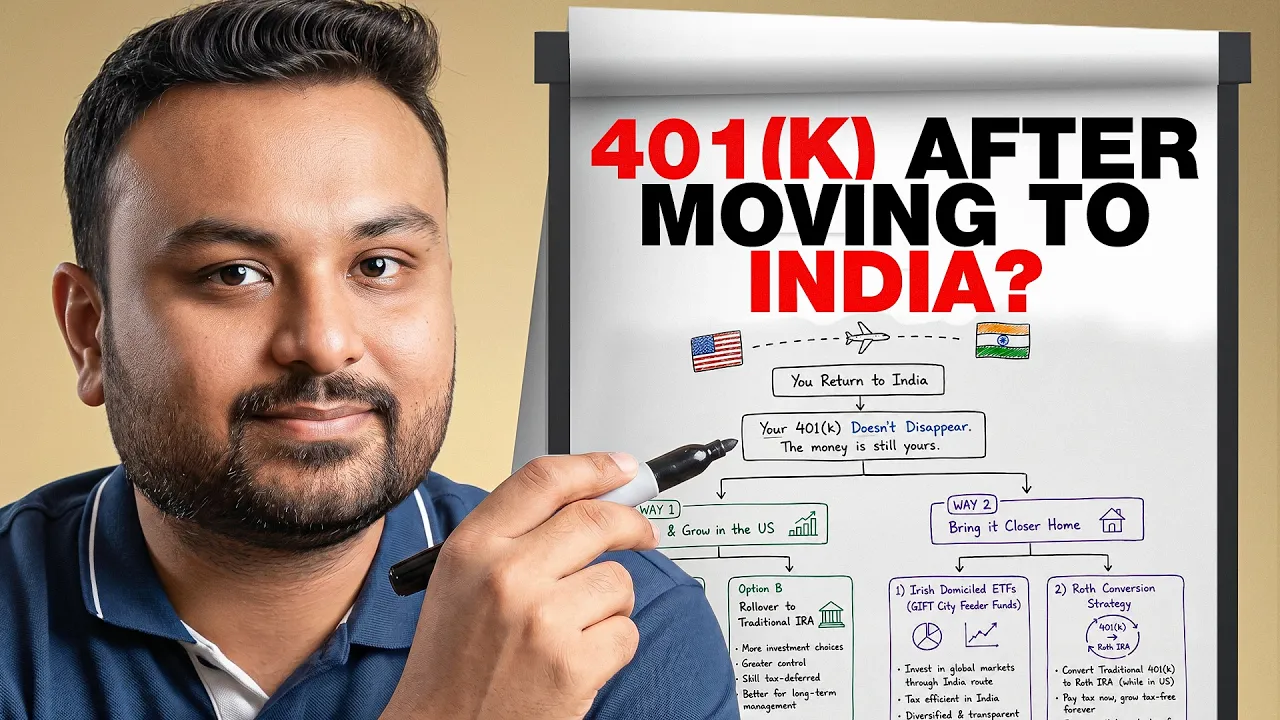
Alok Dubey, CFP® · @NRIMoneywithAlok
Where viewers went back to watch this video again, from YouTube's public Most replayed graph, lined up with what was said at that moment.
Most replayed moment #1
15:542.4x the video's typical replay level
parked in an RFC account, which stands for resident foreign currency account. Now, in this this is a category of bank specially designed for returning NRIs to continue holding to their foreign currencies in dollars. So, the money sits in dollar, does not have to be converted to rupee, and you have full
Said at 15:47
Most replayed moment #2
26:542.2x the video's typical replay level
slab bracket in India. Make sure that you calculate your RNOR window. Don't assume that it is always going to be 2 years. It might be three, it might be one also. So, make that make sure that you do the right math and then execute your plan correctly. You can if if you have already left your job in the month
Said at 26:46
Most replayed moment #3
22:162.1x the video's typical replay level
called as rule 72t, or substantially equal period payments, sometimes referred to as SEPP, S E P P. Under this rule, if you commit to a formula-based equal periodic withdrawal schedule from your retirement account, you can avoid the 10% early penalty even
Said at 22:08
The graph counts replays. It does not show where viewers stopped watching.
Words
5,464
Runtime
28:55
Speaking pace
189wpm
Reading time
23min
189 words per minute, between the 181 median and the 201 75th percentile of 349 measured videos. That distribution comes from the 349-video hook study.
Opening (first 30 seconds)
If you are on an H1B visa and you have started thinking seriously about returning back to India, one of the most uncertain question sitting on your mind is what to do with your 401k. It is not a small question. For most people on H1B who have worked for 5, 10, or 15 years in US, 401k is one of the largest piece of their net worth. By the end of this video, I want to give you a framework that lets you sit down with your tax advisor and have an informed conversation
95 words, the words spoken in the first 30 seconds at 189 words per minute.
Free, no signup. See how the first 30 seconds hold attention, with rewrites.
Sentence shape
| Measure | This transcript |
|---|---|
| Sentences | 269 |
| Average words per sentence | 20.3 |
| Longest sentence | 69 words |
| Questions asked | 4 |
| Sentences containing a number | 88 |
Most used terms
Filler phrases
20 in total: actually 7 · uh 5 · you know 4 · like 3 · kind of 1.
A literal whole-word count of the same phrase list the Prepublish browser extension uses, so a phrase inside another word is not counted and a phrase used in its ordinary sense still is. It is a count and not a judgement.
What this transcript is
Every word below is the caption track YouTube publishes for this video, pulled from the video itself and reproduced unchanged. It is not Prepublish's writing, not a summary, and not a re-transcription: it is the video's own published captions. English captions, generated automatically by YouTube, in the video’s original language. Source: the video on YouTube. A channel that would rather this page did not exist can ask for its removal through the contact page, and it is removed.
If you are on an H1B visa and you have started thinking seriously about returning back to India, one of the most uncertain question sitting on your mind is what to do with your 401k. It is not a small question. For most people on H1B who have worked for 5, 10, or 15 years in US, 401k is one of the largest piece of their net worth. By the end of this video, I want to give you a framework that lets you sit down with your tax advisor and have an informed conversation instead of just guessing what are the ifs and buts using some AI tools.
What I will cover today is what happens to your 401k when you stop being a US tax resident, why your status as a non-resident alien changes everything, and what the RNOR in window in India actually means for you. Why leaving the money to grow till the age of 59 and a half sounds smart on paper, but often turns out to be most expensive choice for H1B returnee. >> [music] >> And I usually recommend instead of doing this a different strategy including how you can keep your US dollar exposure without keeping the money inside US financial system.
Now, this is a cross-border decision and not just a simple investment decision. The answer that works for a US citizen or a green card holder is often different than what is for somebody who is on an H1B. That distinction is what we are going to spend time in this video on. Now, before we go further, let me make sure that we are on the same page what a 401k actually is because a lot of mistakes happen when people treat it as a normal investment account.
It is actually not. A 401k is a US retirement account. During your working years in US, you contribute money to it from your paycheck before taxes. And your employer often matches some part or to this contribution. The money gets invested in the funds that you choose and it grows inside the account without being taxed every year. Now, the trade-off is that when you withdraw it later, the entire withdrawal is taxed as ordinary income in US and [music] at the tax slabs in that financial year.
So, if you stayed in US for your entire life, the system is very straightforward. You build a corpus during your working years and then you withdraw it during your retirement years. And you pay tax on what would be a tax bracket in that financial year because you no longer might be earning an active salary. But, this is not your situation as an H-1B returnee. You are planning to leave US and once you leave, the same account sits in both tax systems.
The US still says that this is a US retirement account. We will tax it when you withdraw. Now, India says that you are an Indian tax resident now and we want to know what your global income is and your global assets are so that we can tax you here. Now, the same dollar inside this account will be potentially visible to both the countries for taxation purposes. Now, once you understand that the 401k is a cross-border tax account, the next question is how do you decide what to do with it?
Now, two H-1B holders, both returning to India, can end up with completely different right answers. Three things drive it mainly. The first is your US tax status after you leave. While you are on H-1B or physically in US, you are a US tax resident and the same holds for green card holder and US citizens for most income tax purposes. Now, the moment you leave permanently, that changes. You become a non-resident alien or an NRA for US tax purposes.
Unless you have taken a green card and decided to keep it even after returning, which is rare for someone who generally wants to settle back in India, your US tax position will be an NRA. Now, that status comes with specific consequences. The withholding on the retirement distribution completely changes. The filing requirements also change and the estate tax exposure changes very dramatically. Green card holders and US citizens carry a much higher estate tax exemption with them, but you do not.
The second thing is that your Indian tax residential status after returning. After landing back in India, you typically pass through three stages. First, you are still considered an NRI for the part of the year that you were not in India for more than 182 days. Then you fall into an RNOR, which is resident but not ordinary resident tax status. And then eventually you transition to a resident and ordinary resident status.
The RNOR is a transition phase and it matters because the period that you are in India is not going to tax you on your foreign income as long as it is not received in India and it is not from a business or profession controlled or operated from India. Now, RNOR can last for one or two years in many cases and sometimes a little longer depending on certain specific situations. But this period needs to be calculated before you return.
Not figured out after you have returned. Now, once you cross over to ROR, India taxes your global income and you have to report your foreign assets every year in your Indian tax return. Now, the third thing is the type of account you actually hold in India. Not all US retirement accounts behave the same way. The most common one that the H-1B holders have is the traditional 401k and sometimes traditional IRA where the contributions went pre-tax and the withdrawals are fully taxable.
Now, some of you might have Roth 401k or Roth IRAs also where the contributions were done after tax dollars and they qualify for a tax-free withdrawal in US. Now, India does not necessarily mirror the US tax treatment of Roth accounts and India does not recognize Roth accounts and we will come to that later in this video. So, three things together. One is your US tax status after returning, which for most of the H-1B holders is non-resident alien, your Indian residential status, especially how long your RNOR window is going to last, and the exact type of retirement account that you hold.
Without these three things in place, no one can give you a meaningful answer. By the way, if you're new to this channel, I am Alok. I am CEO at Prime Wealth, and we are an NRI only wealth management firm specializing in US NRIs returning planning. Now, the 401k question comes up in almost every conversation when you're planning to return back to India. So, now what will follow in this video is how I genuinely think about this thing for my clients.
There are three options that we need to mainly look at. The first option and the most people gravitate towards is to leave the 401k untouched. Now, the logic feels very solid. You do not disturb the compounding. You do not pay any taxes now, and you do not pay the 10% penalty also which applies for an early withdrawal. You just let the money grow tax deferred until you are 59 and 1/2, and then start drawing from it as a retirement income.
Now, on paper, this might look as the cleanest option, but for someone who is a US citizen or a green card holder, this is often a reasonable starting point. But, for an H-1B holder who is permanently returning to India, this strategy has three structural problems that don't show up in your spreadsheet or through the AI tools that you run this by. They show up much later, often when it is too late for us to undo anything.
The first problem is the US estate tax problem. Now, this is the most important part that people simply don't realize that exists. As a non-resident alien, the US estate tax exemption that you get is only $60,000, not the 13 or 14 million dollars that US citizen or green card holders get, but only $60,000. Anything about that sitting in US domicile assets like your 401k or your taxable brokerage account can be taxed at rates of 40% if something happens to you and your money is still there.
So, imagine if you have built up a corpus of, let's say, 5 crores or 10 crores in your 401k, and when you pass away for any unfortunate reasons, US will end up taking almost 40% of your money as estate tax. Now, this applies on the entire balance, not on the growth or different kind of amounts. On top of that, the income tax is still has to be paid on the eventual withdrawal. So, your nominee in India, who has never dealt with US tax system in their life, is suddenly trying to claim that money, file estate tax forms, and deal with two governments at the same time.
Now, this is the part that gets ignored when most people optimize only from the income tax angle or the penalty angle. Now, the second problem is what I think is the compounding paradox. The whole reason for leaving money in 401k is to let it grow tax deferred, and I will use it when my kids eventually grow and go to US. But, that growth itself eventually becomes the problem for you. So, let's suppose you have 401k balance of 2 crores today, and you are, let's say, 40 years old.
Now, when you return to India, you decide to leave it as it is. Over the next 10-15 years, you will get a reasonable uh returns on your equity, and let's say this 2 crores end up becoming 5 or 7 crores in dollar terms. Possibly depending on how the market moves and the currency movement happens. Now, again, so far this can look great on paper, the corpus has tripled. Now, you are, let's say, 55 or 60. You are an Indian tax resident, and you have ROR tax status, and now you start withdrawing your 401k money.
India taxes that withdrawal as ordinary income at your India tax slabs. So, once your annual withdrawal crosses a certain threshold, you are sitting on almost 30-35% tax slab with surcharge and cess on top of it. If you add surcharge and cess, this will bump up your Indian tax slab to 39 or 40% tax slab also. That is before you add the US withholding tax on the distribution and other annual cost of compliances, CPA cost, and everything.
So, yes, you saved on the 10% early withdrawal penalty by waiting for so many years, but you are now paying close to 35 or 40% tax in India on that corpus that has now grown three times larger. The absolute tax outflow is dramatically going to be very higher and not lower. And here is the part that catches out people. It does not matter whether you are spending that money on your own retirement or planning to pass it on to your children.
Either way it has come out from a 401k and the moment it comes out, it is taxed as per the tax lab in US as well as in India. Now there is no version of this where the money is quietly transferred without going through any tax thing in India at least. Now the third problem is the operational side of things. Many providers do not actively support non-resident alien clients. Some will not let you change the investment, some will not let you update your Indian addresses, your Indian contact details.
Two-factor authentication breaks because you don't have a US phone number anymore. And then every year the same account has to appear in your Indian tax returns as your foreign asset under the schedule FA section. Now once you get that wrong, the consequences under the black money act in India is not very small. So this is not just a question of returning, it is a question of whether you are willing to maintain a foreign account through let's say 10 years, 15 years time where your life events will change, the cost of acquisition, the rebalancing inside the portfolio and how do you report that in India from a taxation point of view will be a very big question.
Now I am not saying that never leave 401k where it is. For a smaller balance where estate tax exposure is limited and the operational friction is manageable or your kids are old enough that in next four to five years you will need that money in US, it will work. But the default assumption that leaving it untouched is safe, you know, this is a conservative choice, but it won't hold up well for H-1B returnees. So now coming to the second option is to withdraw the entire 401k before you leave US.
Now while you are a US tax resident, that might not be the smart decision. Some people prefer this because they feel that it is a clean exit. They do not want to have any US assets hanging around by the time they are moving. Now, the problem with this option, specially for H1B holders, is the timing of it. If you're still working in US and you withdraw or start withdrawing the money, the withdrawal lands on top of your US salary in the same tax year.
So, your salary is already pushing you into the 22 or 24% federal and state tax slabs, and possibly higher if you are in a senior role. Now, the 401k withdrawal stacked on top of that will again be taxed as ordinary income, plus the 10% withdrawal penalty if you are, let's say, under 59 and 1/2, and then, you know, US state tax on all these compliances. This combined hit will cross you take you at least across by 40%.
So, while the option might be looking very simple, it usually does not so because you will be taxed at the highest tax slab. Now, unless you have stopped working, and this is one of your lower tax income before you leave, that is the time where it will start making sense that you can pay a penalty and then withdraw wherever whatever you withdraw will be taxed at a lower tax slab. The third option for most H1B holder is where my recommendation usually lands is to withdraw during your RNOR period after you have returned back to India.
Now, let's recall that during RNOR, India will not tax any foreign income unless it is received in India or it is from a business controlled from India. So, your 401k withdrawal taxed in the US may not face any India taxes during your RNOR period window. And how it is received and structured is only going to matter in US. Different facts produce different outcomes here, and this is where you need to coordinate both with your Indian CA and your US tax preparer carefully.
But, the structural advantage of withdrawing during your RNOR is real. And let me show you the math. When you leave US permanently, you stop earning salary in US. Now, the year you do withdrawal during RNOR period, the US source income is which is your 401k distribution, will only be taxed in US and not in India. Now, as a non-resident alien with limited US income or no US income in that year, the effective US tax bracket will be as low as possible.
And if you let's say it is 12% and if you add 10% penalty, effectively you can withdraw your money by paying just 22% net outflow. Now, add the penalty on top of it and let's say you are under 59 and a half, so you will not be ever looking at a blended cost of more than 22-24%. Now, compare that to waiting till 60, which I walked you through in the last section, and end up paying eventually 35-40% tax on that outflow, where the corpus has also grown to a very large sum.
So, when some people argue that I should wait till 59 and a half to just to avoid the 10% penalty, what they're actually telling you is that they are willing to pay 35% tax that too on a very larger pile later in the future rather than compromising on a very small outflow today itself. Now, that arithmetic does not favor waiting. It favors only paying penalty now and getting done with this during your RNOR period. And this is a core insight that I want you to take from this video. 10% penalty looks like an enemy now, but it is actually not.
The real enemy is the tax lab rate in India that you will eventually end up paying later in the years combined with the operational hassle, CPA cost, estate tax issues of holding a US retirement account for more than 10 or one or two decades. Now, what do you do with the money once you have withdrawn it? Withdrawing during RNOR makes sense for most H-1B returnees with a meaningful balance. Now, the question that follows immediately is what to do with the money once you have withdrawn it?
Because if you bring it back to India and just put it into Indian fixed deposits or mutual funds, you have now solved the US problem, but lost on your dollar exposure that you eventually wanted for yourself or your kids. And for someone whose career was built on dollar earnings, who may want their children to study abroad abroad or they would want some dollars outside so that they can spend on traveling and all, this is not an option.
Now, it is part of how you balance the rest of the portfolio where the trick comes in. So, here's what I usually suggest people. After withdrawing your 401k, the dollar proceeds can be remitted to India and parked in an RFC account, which stands for resident foreign currency account. Now, in this this is a category of bank specially designed for returning NRIs to continue holding to their foreign currencies in dollars.
So, the money sits in dollar, does not have to be converted to rupee, and you have full control on your RFC account. So, if you want money to be kept invested in US dollars and have exposure to US currency or any foreign markets, there are two routes that makes a lot of sense than just continuing holding into 401k. The first route is to invest into Irish domiciled ETFs. These are exchange-traded funds registered in Ireland that invest into US equities including S&P 500 or Nasdaq 100 trackers.
Now, because these funds are domiciled in Ireland and not in US, they sit completely outside of US tax system. So, there is no $60,000 exposure of the US estate tax. Now, the dividend withholding inside this fund is lower because they this is how Ireland tax treaty structure works with US. And in India, when you sell, you are only taxed on the capital gains and not at your tax slabs. So, for long-term holding, this becomes a meaningfully different tax outcome as compared to withdrawing from your 401k later in the year.
The second route is the GIFT City feeder fund route. Now, GIFT City is set up in IFSC and I have talked about this in most of my previous videos where several Indian asset managers now offer feeder funds based out of GIFT City to invest into these US ETFs. These give you a US dollar exposure. The regulatory framework is in India and the reporting is very simple. You don't have to go through Indian taxes immediately. And again, the most important thing is that you don't have US tax estate tax exposure because you do not hold US situs assets directly.
Both routes give people what actually they want is to have US exposure eventually, which can be continued but not from a 401k by holding a direct investment in your name, which will get taxed as capital gains and not as per your ordinary tax lab. Both of these options serve one single purpose. They remove what you don't want, which is the US estate tax exposure and the slab rate taxation on withdrawal. And the other operation hassles along with it, which is reporting, tax filing.
So, if the rupee weakens further against the dollar over, let's say, next 10-15 years, your corpus in rupees term will still benefit exactly the way it would have happened if you would have left the money in 401k. Your currency exposure stays. What goes away is the structural risk. You have full control on your assets. You can sell when you want. You can rebalance when you want. And you do not depend on US providers or US custodians, US brokerage account cooperation for doing this.
And the money is completely reachable in your name, in your country. And that is the trade I usually represent to the H-1B clients. Just pay 20-22%, 25% effective tax plus penalty during your R&OR period. And in exchange, take a 20- or 25-year tax-free exposure to US without any friction and having full control on your money and just paying the capital gain tax in India. The fourth option is what most H-1B holders accidentally end up choosing simply by not having any decision in place.
They return to India. They do not withdraw during their R&OR window and the window closes. And now they are ROR. Now, once they become ROR, India taxes your worldwide income including your 401k withdrawal, at full tax slab. So, if you're coming to India and working, then you are already in the higher tax slab. Now, I have covered why this is structurally a worse outcome for H-1B holders. And, you know, with Indian tax slab plus the foreign asset reporting, it is not a good deal for us.
And, this is a piece of relief that Indian income tax act has given you, which is section 89A. Now, this is one section that can help somebody who is just leaving out money there. Section 89A and rule 21 AAA were introduced to address this timing mismatch. Now, India was taxing your income based on accrual inside a foreign retirement account on accrual basis, even though the foreign country was not taxing it until withdrawal.
Section 89A allows eligible taxpayer by filing form 10EE to align with Indian taxation within the year on their foreign withdrawal. This is a useful relief and worth qualifying, but it saves you from the timing problem, not the rate problem. So, when eventually the rate happens, Indian government is going to tax you at the tax slab. So, section 89A becomes a bad situation, but a more manageable one. It does not turn into a good tax situation.
So, for H-1B holders with meaningful balances in their 401k, the recommendation remains the same. Do not drift into ROR with a large untouched 401k account. Now, there's another fifth option, which is to convert your traditional 401k to a Roth IRA before leaving the US. Now, this is one of the most misunderstood option that I see. US-based advisors love Roth conversions. And, for someone staying in US, this can be a very sensible tax planning move.
You pay the tax now at your current tax bracket and qualify for a tax-free withdrawal later, but in US. Now, the problem with H-1B holder returning to India is that India does not necessarily honor the Roth treatment. From India's point of view, when you eventually withdraw money from your Roth account as an Indian tax resident, the income is potentially taxable in India regardless of what US calls it. So, once you have paid US taxes at the time of conversion, you may face Indian tax at the time of withdrawal also.
And the foreign tax credit mechanism does not cleanly bail you out on this either. Because the US tax paid was in a completely different year, and now your Indian tax will arise in a different financial year. There are situations where Roth conversion still makes sense, especially let's say if you are a green card holder who plan to retain their status, or US citizen who is returning back to India. But for a typical H-1B returnee, converting to Roth before leaving rarely improves the outcome over a clean withdrawal during your R&R period.
Now, it often makes things more complicated, not less, because when someone tells you that Roth is tax-free, the right question that you need to ask them, if it is tax-free, which country is it tax-free in? Now, there is one more option that I want to mention, mainly so that you know it exists. It is called as rule 72t, or substantially equal period payments, sometimes referred to as SEPP, S E P P. Under this rule, if you commit to a formula-based equal periodic withdrawal schedule from your retirement account, you can avoid the 10% early penalty even if you are under 59 and 1/2.
Now, for someone who is genuinely retiring early and wants a steady income from his retirement account, this can be very useful. But it has hard constraints. Once you start, you typically have to continue it for at least 5 years, or until you reach 59 and 1/2, whichever is longer. Once you break the schedule, you have to take an extra withdrawal, modify or change the payment if they are incorrect, and the penalty can come back retrospectively on the prior year withdrawals also.
So, for an H-1B holder who is actively planning to settle in India, SEPP usually is not the right tool. It is very rigid. It ties you up with the structure of the withdrawal for years, and coordinating with it with your changing Indian residential status can add a layer of complexity on top of it rather than reducing. I mention it for completeness, but I would point out that most clients who are returning back to India from an H-1B visa should only take the RNOR withdrawal route.
So, even if you have decided on your strategy, now there is a checklist that you need to follow before you think that uh things are sorted and you decide to leave. This is not an operational thing, but skipping them might usually create headache for you further. So, confirm that your 401k and IRA providers, whether they continue to support NRAs or not. Not every provider does. Some Some will block your transaction. Some will not update your foreign addresses.
Some will allow you to hold, but not rebalance or change your investments. So, ask this question directly in writing to them whether uh they will allow you to continue holding this account and allow you to operate or maybe do rollover to a different account. Sort out your login and authentication while you are still working in US and I have a US phone number and US addresses. Now, this might sound trivial, but it is not.
I have seen people who are locked out of their own retirement accounts because their authenticator app was tied to a US phone number that no longer works. Update your email ID, set up backup authentication options, and document recovery codes also somewhere you can have access in India in any situation. So, think about whether you need to keep at least one uh US bank account for time being. Some providers prefer or require a US banking for distribution of the amount that you withdraw.
So, closing every US bank relationship the day you leave can create unnecessary friction for you. Download everything you can, your annual statements, your contribution history, your employer matching records, your old W-2s, your 1099s accounts, your account opening documents, beneficiary designations, and any rollover or conversion documents that you have done in the past. These records become difficult to retrieve later, and you will need them for both Indian as well as US tax filing going forward.
Review your beneficiaries. For H-1B holders with cross-border family, this matters more than anything that people can think of. Make sure that the right people are nominated as your beneficiary, and make sure that they have the right contact information and the documents of the beneficiary required in case something has to happen in the future. Calculate your RNOR period before you make the return, not after returning.
This is one of the most common mistakes I see. People who come back to India and settle, and later discover that their RNOR window had already started, or it is not 2 years, it is only 1 year, and they they cannot take the most out of it. So, sit with your CA before you decide to make the return, and have a tentative month of return in in plan, and then decide how you are going to schedule your finances. Because in your 2 years of Indian financial year uh RNOR period, there are three US financial year that you go across.
And we can discuss this in detail in my future videos. So, let me summarize everything together so that you can have a clear answer. For most H-1B returnees coming back to India, 401k was a meaningful piece of their net worth, and the temptation to continuing this might be higher. But the tax math and the cross-border complication, the estate tax complication, will not support you. It is okay to pay a certain penalty and tax today rather than paying a very high tax in the future when you turn 59 and a half, and your Indian tax slab not supporting any withdrawal.
A simple 100k withdrawal, or let's say a 50k withdrawal in US might be in the lowest or zero tax slab, but that 50k withdrawal will put you in the 35% tax slab bracket in India. Make sure that you calculate your RNOR window. Don't assume that it is always going to be 2 years. It might be three, it might be one also. So, make that make sure that you do the right math and then execute your plan correctly. You can if if you have already left your job in the month of let's say January and you are planning to come back in the month of June, you have one low tax year in US during your first R&OR period, then you have another second and then you have third window in US, which is Jan to March of your last quarter of the second R&OR year.
So, you need to make sure that you're planning your withdrawals rightly. Sometimes you can do it in two chunks, sometimes you can do it in three chunks. And please please do not ignore the US estate tax. I have seen cases where people had million dollar worth of RSUs and retirement accounts in US and due to any unfortunate event, they lost 40% of their wealth and their beneficiary in India could not get that processed or follow up with that.
So, US estate tax is one of the biggest fear that will loom on to you till the time you continue holding these accounts. If you want to bring your proceeds or continue holding to your dollars, look at RFC accounts or if you want just exposure to US markets, you can reinvest these dollars into you Irish domicile ETFs or gift city structures investing back into these ETFs or there are other methods how we can strategically plan these investments for you.
Now, whatever I told you is not the right answer for everyone and like I said in the beginning of the video, it depends on your situation. Most of this advice is applicable for H-1B holders and the advice completely changes if you are a US citizen or a green card holder and there can be much cleaner way to manage things for you. Thank you for watching this video. I am Alok. My firm Prime Wealth works with NRIs planning to return back to India and organize finances in a structural and tax efficient manner for them so that they can make the most out of their money.
Join my NRI only WhatsApp community for this, the link is in the description below. Thank you and I'll see you in the next.
The words are the caption track's own and nothing is reworded or re-transcribed. Paragraph breaks are placed between sentences so the text reads as prose.
Free tools for your own script. No signup, no login.
Paste your draft and see where viewers are likely to drop off, with a rewrite for each weak line.
Paste the first 30 seconds of your own draft for a hook score and rewrites.
Check your draft against YouTube's advertiser-friendly guidelines before you record it.
Read this channel's public videos and transcripts, and download a writing brief for it.