Getting the transcript
Reading the captions from YouTube. A video nobody has opened here before takes 10 to 30 seconds; this page fills in on its own.
Getting the transcript
Reading the captions from YouTube. A video nobody has opened here before takes 10 to 30 seconds; this page fills in on its own.
Ray Amjad · @RAmjad
Words
6,297
Runtime
27:28
Speaking pace
229wpm
Reading time
26min
229 words per minute, above the 201 75th percentile of 349 measured videos. That distribution comes from the 349-video hook study.
Opening (first 30 seconds)
Okay, so I almost never make videos about brand new models, but this one was far too good to not make a video about. So I want to go over a model called Jev, named after Jevon's paradox, what it is, and how we can combine it with agentic coding tools like Claude Code and Codex to become even better engineers. So if you already know what Jev is by now, then you can skip to timestamp shown on the screen right now. Otherwise, I'll first go over what Jev is. So one of the simplest to understand videos about what Jev is, is this one over here. So for a normal LLM, you would
115 words, the words spoken in the first 30 seconds at 229 words per minute.
Free, no signup. See how the first 30 seconds hold attention, with rewrites.
Sentence shape
| Measure | This transcript |
|---|---|
| Sentences | 319 |
| Average words per sentence | 19.7 |
| Longest sentence | 62 words |
| Questions asked | 17 |
| Sentences containing a number | 91 |
Most used terms
Filler phrases
158 in total: like 68 · basically 36 · kind of 33 · actually 19 · you know 2.
A literal whole-word count of the same phrase list the Prepublish browser extension uses, so a phrase inside another word is not counted and a phrase used in its ordinary sense still is. It is a count and not a judgement.
What this transcript is
Every word below is the caption track YouTube publishes for this video, pulled from the video itself and reproduced unchanged. It is not Prepublish's writing, not a summary, and not a re-transcription: it is the video's own published captions. English captions, published by the channel, in the video’s original language. Source: the video on YouTube. A channel that would rather this page did not exist can ask for its removal through the contact page, and it is removed.
No Script X-ray for this video: YouTube shows a Most replayed graph only once a video has enough views.
Okay, so I almost never make videos about brand new models, but this one was far too good to not make a video about. So I want to go over a model called Jev, named after Jevon's paradox, what it is, and how we can combine it with agentic coding tools like Claude Code and Codex to become even better engineers. So if you already know what Jev is by now, then you can skip to timestamp shown on the screen right now. Otherwise, I'll first go over what Jev is.
So one of the simplest to understand videos about what Jev is, is this one over here. So for a normal LLM, you would basically give it a prompt as well as some data. So for example, is this invoice fraud alongside the invoice itself? And then it would generate you a sentence kind of like, hey, this appears to be legitimate, token by token. And because of the architecture of LLMs, this can take quite some time. Whereas in the case of Jev, you can give it the same prompt alongside the same data itself and then also give it options as well.
Okay, these are the options you can pick from: fraud, clean, or doesn't need human review. And then it would score your options for you by probability. So for example, in this case it says 88% probability that this is clean. And you can kind of pass this data into an if statement so you can quickly make decisions about this. And because of the way that the architecture works, it is really fast. So often you can get a response in less than 200-300 milliseconds.
So one way of thinking about it is that Jev does not generate any text. You can give it some text input like a prompt, and then it will give you probabilities from a set of answers that you provide it. So because you're then taking these probabilities and then doing some action based on them, you can imagine it as a really smart switch statement. And as we will be seeing later in the video, this has a whole bunch of use cases.
So you can make AI-powered workflows, make decisions over massive amounts of data for really, really cheap, unlock real-time applications like real-time moderating, for example, and also build really good verification systems for your agentic coding setups. So on the website down below, there is a waitlist, but once you're off the waitlist, then you can go to console.typeSafeAI. And then go over to Playground over here to kind of experiment around with it.
And then play around with the three primitives inside of Jev. So I'll quickly go over what exactly they are. Because even though we will be using our agents to implement Jev for us, and they will be using the skill over here, it still helps to understand how exactly Jev is working behind the scenes. So we basically have the primitive of bool to evaluate how true something is, a score so we can set up a rubric to grade against, and then we have a choice, so asking a multiple choice question.
And each of these comes back with probabilities. So we are defining the answers upfront and then giving it something to evaluate. So if I go for bool over here, I can edit this part over here. So I can say, is this invoice fraud? So is this invoice fraud from earlier? Then in the left-hand side, I can give it some unstructured data. So pasting this in over here, this is basically a fraud invoice that I made up. And if I then press a run request, then it will say 85% true.
Because when you're reading through the invoice, it is kind of sus. And pressing run request over and over again, I will see that the probabilities are roughly the same. So it varies by about 2-3%. Now I can add something over here to change my criteria, what is true. So it says matches the following and then paste in some fraud signals. For example, this one over here and then press run request. And I can see that it's changed to 94% true and running it over and over again, it'll roughly hover around that figure.
Now this is great because in an application we can basically say if the probability is greater than like 85-90%, then then automatically rejected an invoice or something. So the nice thing is that we can define what true and false actually means by adding additional information over here. And also we're getting an answer really fast. So often in about 100 milliseconds. That is reliable because it's roughly the same every time.
Now if I go for a multiple choice option, then I can pick one from here. So basically add some instructions such as, we're evaluating invoices for fraud. Fraud signals are this. Is it fraud? And I can change these options to, for example, like, human review, fraud, clean. And then I can remove the descriptions because I think the names are like self-explanatory. And now I can see that after running it, I get 98% fraud in less than 100 milliseconds with 2% human review as well.
So this is better than true or false because now I can define multiple options that I can pick from. And inside of the list over here, I can provide up to 255 options. And when it comes to score over here, you can basically imagine it kind of like a spectrum. So for example, if I was asking a question of how good is this inbound lead for our sales team, I could have my own spectrum defined that I can give to Jev. So for example, I can say that 0 is a student or a hobbyist, someone with no budget.
Then we have a small team, we have a company with a named problem and a timeline, and then we would have some kind of enterprise over here. So if I quickly define all of this inside of Jev, then it will look something kind of like this. So for example, this is 0, this is 1, and then this is 2 and 3. And then I could put a lead in on the left-hand side, which is a pretty big enterprise lead, press a run request, then it will give a score of 2.91.
So basically along the spectrum, it would sit kind of over here. So it would be kind of like this over here. So 2.91. And then when it comes to your own logic, you can kind of define different things that would happen. So greater than 2.5, the founder would reply the same day. Between 1.5 and 2.5, a sales rep would reply this week. Between 0.5 and 1.5, for example, they'd get an automated reply. And I could also define another rubric such as how serious serious is this log line for an on-call engineer.
And number 0 would be basically a routine request happening. And number 3 would be like an outage, for example. And if I pasted in something over here and press run request, then it would be like 2.99, for example, because this is a connection pool being exhausted. And if I define it to be like greater than 2.5, would call an on-call engineer immediately, then they'd be pinged immediately. And if you wanted to, because Jev is really cheap and also really fast as well, you could have it monitoring a critical system in almost real time, and then letting you know if something bad happens.
Now when scoring, you can only define up to 11 rubrics, which means you get a score between 0 and 10. So you can't populate this list with like 255, but when it comes to options, then you could populate it with 255, for example. And if I wanted to, then I can ask multiple questions at the same time by pressing add question and choosing another primitive. So I can paste in a bunch of questions over here. So this is about 4 questions.
So for example, this is a state whereby I gave a coding agent a task. It then gives me a diff back of what changed. And then Jev can answer all of these questions super quickly. So for example, it says that it addresses a task, it hasn't weakened a test. It tells me how strong the verification is on a spectrum with a rubric that I've defined. And then the risk surface area as well over here. And if you are interested in what makes it so fast, then this tweet kind of goes into it over here.
I won't bother explaining it 'cause the video will get too long. So when deciding which primitive to use, I think this is pretty handy. Basically, is it a yes or a no question? If it is a yes or no, then you can use bool. If you can sort it along some kind of spectrum like I showed, then you can use a score. If you can't, then you can basically use choice instead. Okay, so now I want to talk a bit about System 1 and System 2 thinking and also how it applies to Jev.
So TypeSafeAI, the company, basically called JevAI a System 1 model, a new class of front-end models built to make fast structured decisions. And I guess that this is inspired by the book Thinking Fast and Slow that was published 15 years ago. Which basically says, if you haven't already heard about it, you have two distinct modes of cognitive processing. System 1, which is the fast, automatic, and reflexive thinking that operates with little to no conscious effort.
And then you have System 2, which is much more slow and deliberate. And one of the important ideas here is that you can move something from System 2 into System 1 through practice and training. So for example, when you were first learning to drive a car, that was a very System 2 activity because you were checking your mirror, signals, your gear, and stuff like that all the time. And then with enough practice on familiar roads, it became a system 1 activity.
Now this does not mean that driving is system 1 all the time. If you encounter an unfamiliar road, then it may switch into a system 2 activity. But essentially with enough practice, something can go from being a system 2 into a system 1 activity. And going back to this, we can kind of imagine that Claude Fable 5.1 and GPT-6 Astra are system 2 models because they're slow and deliberate, whereas Jev is more of a system 1 model because of how fast it is, which means that you can have it being always on and running continuously in the background on some kind of task.
Now where this becomes really interesting is that if you combine system 1 and system 2 models together. So for example, if Jev is your system 1 model, then it would be giving decisions with a whole bunch of probabilities back. And then you can assign if statements to the probabilities. So for example, if it's greater than like 0.5, then this action happens automatically. Kind of like what this guy did over here, whereby he built a trading bot with Jev.
Of course, I don't think it's profitable, but basically it can quickly decide whether to buy and sell because it gives it probability and then you quickly execute a function with an if statement. So for example, that would look something kind of like this over here. We have a state, then we have the questions that we're giving, which is a simple bool, as we talked about before. We send the request over to Jev's servers with our API key.
And then depending on the probability that it gave back, we would decide whether to place an order. Now if we started recording all the decisions that we made and the outcome as well, we could then set up a regular process where a system 2 deep head model would be thinking about like, hey, what is the strategy we're doing here? Can we improve it in some kind of way? And then it would basically rewrite any of the criteria, the examples, or the threshold for us.
And then that would pass back into the System 1 model. So for example, for this wording over here, for the criteria or the instructions, it could be rewriting that. Now, of course, I don't think that you should be trading with this, but given Jev is really fast, I think it's a pretty good example of real-time AI. And I actually thought that this was a much better example where this guy basically asked Jev and GPT-5.6 Astra to play Minecraft in real time.
So Jev would make quick decisions about what to do next, and then Astra would plan ahead. And after seeing this myself, I was like, wow, I gotta try this as well. I don't think that I replicated his exact setup, but essentially I asked Astra like, hey, can you basically set a long-term objective and monitor Jev's strategy whilst Jev actually plays the game itself? So I can see that Jev is playing Minecraft right now.
I told it, hey, can you go ahead and build a shelter? And then get a diamond pickaxe. So Astra is planning the higher level strategy and Jev is actually going ahead and executing it. So this was running for about like 10-20 minutes and it's actually doing pretty well from the very beginning. And I think this is very similar to how many people play games, whereby their System 1 is doing most of the work when it comes to playing the game itself, and their System 2 often reflects on like, okay, what exactly caused me to like fail that particular mission?
And then it's kind of retraining their System 1 to be better at the game itself. So I can see that it now went ahead and made a door for itself, and it's going to go back and actually put the door on the shelter that it made. And essentially what Jev does, anytime it requires any feedback about what it should do next, it pauses the game and then Astra is like, okay, let me assess the situation and give Jev the next set of mini goals.
So it's saying over here that the house and roof are complete and Jev has installed a door and checking the entrance and then moving on to stone tools and lighting. Towards an iron pickaxe and eventually diamonds. So I will leave that running in the background during the rest of the video and then see how far it gets. So I'll have it continue playing the game in the top right whilst I explain what is happening. So I had it set an overall goal, which was build a house and then obtain a diamond pickaxe.
So this is what I handled over here. And then GPT-5.6 Astra is handling the strategy, which is one level below. So it's prioritizing shelter before nightfall and like starting mining once food and tools are ready. So that would be an example of something it decides to do. And then Codex is reviewing every 2 minutes and after significant setbacks and milestones. So for example, if Jev died in the game Minecraft, then Astra would be reviewing like, okay, what exactly led to Jev dying and how can we make this better for next time?
Any immediate tasks Jev is doing, such as gathering more wood, crafting a furnace, or finishing a roof. And Jev is basically choosing and switching tasks based on the state. And Jev is also using local tactics. So it's like, okay, use that tree over there, try a different approach, stop mining and retreat because there is like a creeper nearby. So any frequent decisions from fresh observations, Jev is automatically making.
And then for the physical execution itself, that's happening via a controller mod that I have installed. So this would be one example of the input that would actually be given to Jev of like, hey, this is your intermediate goal. So it has a goal over here, the current state, so the health, the hunger and stuff like that. The time of day, the mining progress, a recent history of what exactly happened as well, and then available tasks that it can pick from.
And then this is what it would look like in JavaScript. So we have the objective over here, the state, and then it's picking from all of these with a multiple choice. You can see it's already gotten a stone pickaxe. It made one for itself right at the top. So I'll have Jev continue to play Minecraft in the top right for the rest of the video. But essentially this unlocks a bunch of use cases. So for example, when you make a bunch of skills, you usually know which skills are most relevant because you made them.
And during that process of making them in your System 2, you kind of trained your System 1 in a way. Now, one of the problems that people have with Claude Code is that when they use skills, they may have dozens of skills inside of their projects and at their user level. And essentially the skill description is being fed into context window every single time, and each of them are using tokens. So some people who have a lot of skills installed, like over 100 or 200, they have all these extra tokens inside of their context window that they don't really need.
So what if Jev could look at your prompt, look at the context so far, and then automatically decide which skill is most relevant for you right now? And this is what they also mention in the official Jev Cookbook as well. So they basically say for the Hermes agent, Jev can pick the most relevant skill out of 182 skills that you may have installed inside of your agent. So they have a whole example over here of which skill is most relevant.
And they find that with the agent alone, it would load the wrong skill 17% of the time. And with Jev suggesting it, it would load the wrong skill 7.3% of the time. And this is with Haiku 4.5, for example. So this means that I can probably put all my skills behind some kind of like proxy or behind Jev, and then Jev would decide which skills are most relevant. So I can then remove about 10,000 tokens from my context window from all these skills I have installed.
Next up, we know a lot of people mention that you should give your agent a good feedback loop when it comes to writing code, and your output will be 10x better. And just as a quick aside, I will be talking even more about giving your agents good feedback loops to build even better software inside of my upcoming Agent to Engineer cohorts. So essentially this will be a 2-week cohort where we'll have about 200 lessons and it will be starting in around 11 days and the price will be increasing in about 7 days.
So if you do want to get in before the price increase, then there will be a link down below. There will be around 230 free lessons with about 8 hours of live Q&A. So you can show up with your own questions as well. And there will be around-the-clock Q&A happening on Discord as well. So if you do want to get in on the most comprehensive agentic coding class that you will find online, then the link will be down below. And if you have any questions about it, then you can also email me.
My email will also be down below as well. For my previous classes, engineers from some of the world's biggest companies have taken this, including many of your favorite engineers, and have gotten a lot of value out of them. Anyways, one of the ways of making our feedback loops even faster for our agents is doing something kind of like this. So for example, what they did is they used browser use with Jev to basically find flights in about 7 seconds and it costed about 0.4 of a single cent.
So they basically talked a bit about their approach and they open sourced it. It will be down below, but you can kind of watch it over here. It quickly finds a flight from Zurich to London for a particular date. So this means that if we have Jev running locally on our machine doing some kind of browser use, then it can quickly validate like hundreds of different user flows for our application and quickly find all the defective ones.
So I guess you could describe what we're seeing over here as a System 1 agent. So a really fast agent built on a System 1 model that would be navigating a website kind of like you would navigate a website that you're already familiar with. So when you go to a website that you're not very familiar with, you may be using your System 2 quite a lot, but on a website that you're really familiar with, like Google Flights, you would be using your System 1.
Now this means that you can build really tight and really fast and cheap feedback loops that can take seconds and cost fractions of a cent into your agentic coding workflows so that as soon as a feature has been implemented, for example, then it could quickly verify if that feature works for really cheap. So this means that if you're running Opus or Fable to build out a feature, when it comes to your verification step, you can quickly have it hand it over to a browser user agent powered by Jev.
It'll quickly verify everything. Give the feedback being like, hey, this is broken. And then your main System 2 agent would actually go ahead and fix it. And if the System 2 agent decides like, oh, you know what, the choice that Jev gave actually wasn't that useful. Maybe I should add a bit more choices. Maybe I should change the criteria in some kind of way. It can rebuild the System 1 agent to give even better feedback to the System 2 one.
And if we take this Jev-based browser use agent just a little bit further, then we can do something very similar to these guys whereby they said, Thanks to Jev, we now have a massively parallel browser-based adversarial testing suite that tries to break each release and it costs pennies. So they have dozens of browsers running in parallel over here, clicking around through the website randomly, probably, or behaving like a real user would, trying to notice anything that they think is off in some kind of way.
So this means that for every single PR, you could probably spin up dozens, hundreds, maybe even thousands of agents in parallel, all based on Jev, that are clicking around trying to break your application in some kind of way. And with the feedback that they can give back to Claude, for example, it can quickly make all those fixes. And then we can verify those fixes again. Now I will be trying this myself over the coming week and then sharing all my learnings in my upcoming cohorts as well.
That will be linked down below if you are interested. Now this is really great because it means that for my own applications, I can do something like having massive amounts of adversarial testing happening around the clock trying to find bugs. And it would probably cost like $5 or $10 every single day. For like thousands or even tens of thousands of browser sessions. And if you do something very similar, then you will find that your limiting cost is no longer your tokens, 'cause your tokens have become really cheap, and instead your compute.
So if you're running your agents on sandboxes and you want to save up to 90% of the cost on your sandboxes, then my AgentStack sandboxing service will be down below. It is 10 to 15 times cheaper than other leading providers. Now another example that I really liked over here is Jev is coming for your garbage comments. So this guy basically used Jev to like determine how accurate and how useful are the code comments. So for example, this is really accurate because it says multiply the value by 2, which is exactly what is happening, but it's not very useful because that is very obvious from the code itself.
So let's actually go ahead and do this right now. So there will be a link down below to the TypeSafeAI skill. So you can just download the skill, but I'm just going to quickly copy it over for the sake of this demo and then go to a project which I know has a lot of garbage comments. Because a lot of older models had used this and then paste this in over here. And then I will quickly get an API key. So I'm just going to do test and this will not be working by the time you're watching this.
Paste it back over here alongside the skill and then say, hey, so my goal here is to improve the comments from my entire codebase. Can you use Jev to identify all of them based on criteria that you think will be useful? Confirm with me before actually going ahead with the criteria and then make a shortlist of all the comments that you think are worth improving. And then you can fan that out to like Haiku agents, which will actually go ahead and improve them.
Do it on a small sample first and then tell me how much it will cost for all the comments in my codebase. So I can press enter over here and then see what it comes up with. So whilst we're waiting, I'm gonna check what Jev and Astra are doing together. So basically they decided to put Jev into a hole in the ground and wait until daylight comes back to avoid the monsters. And then it will like prioritize healing before continuing on to a diamond pickaxe.
So we managed to do 150 comments in 9.3 seconds for about 1 cent. And it said that it can analyze all the comments in the codebase for about 57 cents. And it expects the shortlist to be about 1,700 comments that would need to be rewritten in some way to make them better. Now this is actually insane because it means that we can analyze entire codebases really quickly for things that we care about with a pretty smart classifier.
So one of the things that we can do here is because Jev is a fast, cheap, and pretty smart classifier, we can now make AI qualitative linters. So instead of defining like really long linter code that may not capture everything and can often break in pretty complicated code, for example, we can now define rules kind of like this instead. So for example, a qualitative linter could be, does the name describe everything this function does, including the side effects?
Or for example, for all our logging inside of our codebase, we could ask something like, what kind of value is being logged? And if it is a secret or a financial value, And then we would basically throw an error. If it is personally identifiable information, then we may want to add some kind of warning instead. And then we could have these linters running on basically every single PR for incredibly cheap. Another really interesting example is I can have Jev analyze my entire codebase for really cheap and then identify all the code smells inside of a codebase.
So if you don't know of the idea of code smells, then it's mentioned in the book by Martin Fowler called Refactoring: Improving the Design of Existing Code. And a quick example over here would be something like duplicate code. Another would be dead code, for example. Another one would be having magic numbers and strings, for example. You can basically look for the entire list of code smells online, but I could go over to Claude and then say something like, hey, so can you use Jev to basically find all of the code smells in my entire codebase?
Give me the strategy that you would follow here. And then it will do a really fast and cheap job at analyzing my entire codebase for code smells and then basically pointing towards any smelly code. Of course, there are certain types of code smells that it would not be able to find given the way that Jev works. But I think the meta point stands whereby we can have things that we want to enforce inside of our entire codebase, whether they're invariants or like removing smelly code, finding potential security vulnerabilities, for example.
And we can do it for really cheap as well. So you can kind of imagine it like this. We have Jev being the instant reflex, the system one, where it looks at code and automatically decides whether it's a code smell. We then create a shortlist from the probability that Jev gave back about that being a code smell. And then for anything above the value, we would redirect it to another model to basically give it more deliberate thoughts.
So actually, if I go back to Minecraft over here, then I can see that Jev finally got his hands on a diamond, which is really good. So it's making good progress. And now when it comes to code smells, I have a measure of my codebase right over here. It then told me that I can use static analysis for these code smells over here. And then the questions that it would actually ask Jev are these ones over here instead. So we have a bunch of questions that would be asked to Jev.
And it said that during an exhaustive pass of the entire codebase, would be 28 million input tokens and only cost $1.19 for all those code smells that it listed right over here that I can actually check. Now, one of the things that we can do is have System 2 train System 1 to do a small pass, then look at the results, and then readjust and change the criteria of System 2. So for example, Jev is making hundreds of thousands of decisions for us, really fast decisions.
Look at the decisions that we got back. Get a system 2 model to analyze it, revise the criteria and the rules, and then get Jev to continue until it does a better job at identifying the things that we care about. And what's interesting is that it led to some people making Jev-based code review tools. So you could have like 100 questions asked about a diff for really cheap and then score all of them and then pass the most important ones over to actual coding agent to resolve and then maybe fix.
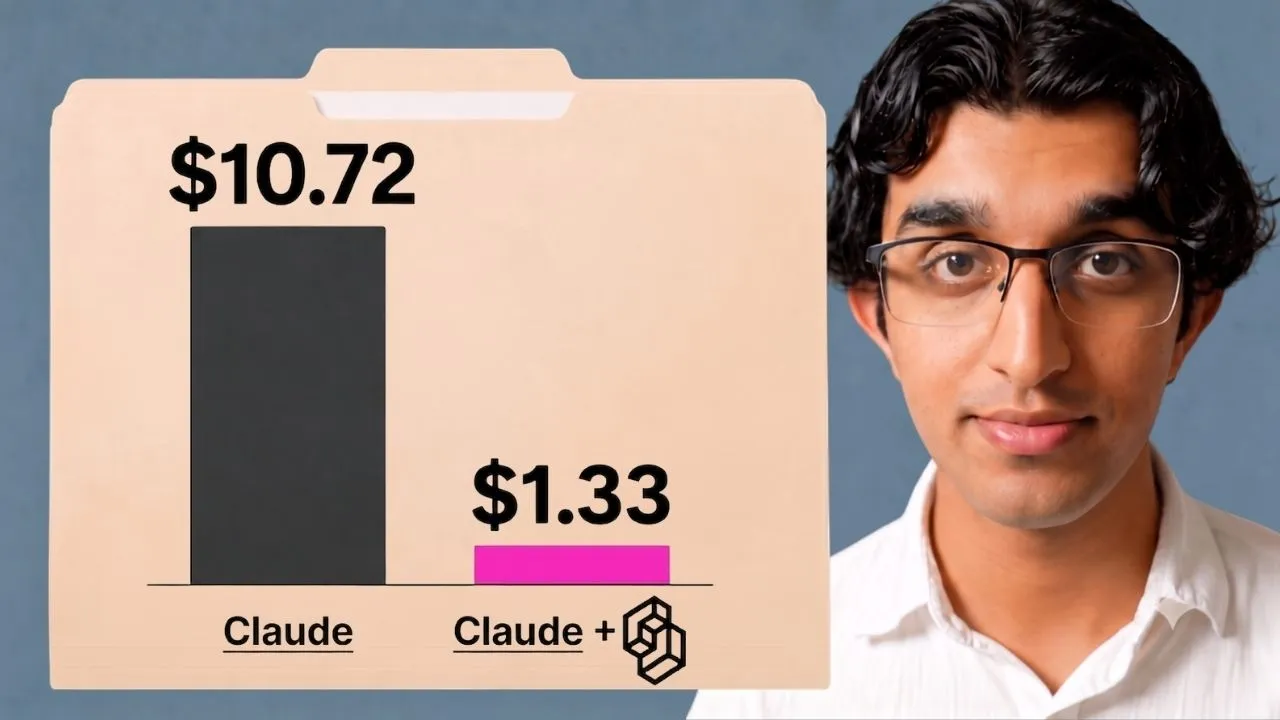
And after seeing that, I basically thought to myself, If I made a Jev-based code review, how many tokens would I actually save? So I passed that over to my Slack agent running Opus 5, and it basically said to me over here, whilst it cannot replace the default code review tool built inside of Claude Code, it can cut what it reads by 10 times. And I previously had Claude analyze my past sessions to see where my costs are going.
And it basically said, your output tokens are 10% of the cost. So if I can reduce the amount of tokens for my code review by 10 times, that is like a huge win on cost alone. So I will be experimenting around more with making a Jev-based code review tool, and I will be sharing any of those learnings inside of my Agent to Engineer cohort coming up as well. So if you do wanna learn those as well, then there will be a link down below.
Okay, to see how Jev is doing on Minecraft, this is really cool because it now has a diamond pickaxe and it's going all the way to nether. Now, random idea that I just had on the spot right now is basically getting your coding agent to build its own system 1 understanding of your code base. So basically has a whole bunch of invariants that need to be followed, any code smells, any rubrics and stuff like that. And then for every PR, it automatically checks your entire PR against a checklist of like 50, 100, or even 500 things.
So basically have the intuition of a senior engineer reviewing a similar PR for the codebase of like, hey, I think this is potentially a problem. And those problems would be passed over to your main System 2 agent that could make any fixes. So imagine a really fast gut-check review from 100 or 1,000 different angles of any PR that you have. And it could probably start off with a pretty broad search at the very beginning.
Such as like security or compatibility or something like that. And then your coding agent can rank the severity and anything that are severe goes to specialized agents instead. So for example, anything security related could go to GLM 5.3 because the Claude and the GPT models right now refuse any security related thing. Or you could probably do something very similar whereby you have a broad search happening at the very beginning and then you have additional asks that are generated depending on which category that it falls into.
So if it's like security, You could have like 100 more questions being asked and then the things that are ranked the most high get passed over to a specialized agent. So I guess it could look something kind of like this. We have really cheap screening happening across our entire codebase, our entire diff. Then only the strongest few require the most amount of attention from System 2 models. So I guess from one lens, we could give our System 2 coding agent like Claude Code, really cheap System 1 reflexes specialized to our particular codebase.
With tons of tiny questions from a really smart classifier. And this can be running in the background the entire time before the coding agent is about to make some kind of grave mistake. And I think that this Jev-based code review could be really promising because of this tweet over here, whereby one of the engineers at Sentry basically said, "These are the results of using Jev on one of our security pipelines." So they say that they already use smaller LLMs to make it economical, and this model does it over 5 times cheaper faster and whilst maintaining a high accuracy.
So they basically showed a bunch of models over here, including GPT-OSS 120B, and it is more accurate, faster, and also cheaper as well. So that is really surprising. I'm sure they'll probably develop on it and build even better security pipelines. But I think for code review pipelines, it could be really powerful. Okay, so it seems that Jev actually got all the way to the nether, which is really impressive, and I could probably get it to slay the Ender Dragon as well.
So yeah, honestly, this is super surprising. So yeah, I haven't been this excited about a brand new model in a really long time. I think the last time I remember being this excited was when ChatGPT was released for the first time 4 years ago. But I really think this is going to be a pattern that we see going forwards whereby we have System 1 models like Jev or maybe even others released by OpenAI or Anthropic working alongside System 2 models like Claude Fable to achieve even better outcomes when it comes to agentic coding.
I think that Jev has many use cases in the AI software development lifecycle that I will be talking more about in detail. Inside of my Agent to Engineer cohort that will be starting in just over a week, link down below if you're interested. But I think that some of the ones we're already seeing right now is even better and more robust security pipelines, cheaper and better code review as well, massive amounts of adversarial testing happening around the clock, qualitative linters as well, quickly analyzing our codebases to make them even more agent-friendly, and maybe even giving our System 2 agents reflexes as well.
So imagine that if this actually does work really well in many benchmarks, then most coding agents going forwards will be combination of system 2 models and system 1 models. So yeah, that is pretty much all for the video. And finally, I will be sharing even more thoughts and learnings that I have through my experimentations with Jev inside of my Agentic Coding School newsletter. There will be a link down below if you're interested.
The words are the caption track's own and nothing is reworded or re-transcribed. Paragraph breaks are placed between sentences so the text reads as prose.
Free tools for your own script. No signup, no login.
Paste your draft and see where viewers are likely to drop off, with a rewrite for each weak line.
Paste the first 30 seconds of your own draft for a hook score and rewrites.
Check your draft against YouTube's advertiser-friendly guidelines before you record it.
Read this channel's public videos and transcripts, and download a writing brief for it.