Getting the transcript
Reading the captions from YouTube. A video nobody has opened here before takes 10 to 30 seconds; this page fills in on its own.
Getting the transcript
Reading the captions from YouTube. A video nobody has opened here before takes 10 to 30 seconds; this page fills in on its own.
AI Edge · @AIEdgeHQ
This video has no Most replayed graph yet: YouTube shows one only once a video has enough views. These are the moments viewers replayed most in AI Edge's most watched videos.
Most replayed moment at 4:10
6.2x that video's typical replay level
different sections, but I think it came out super cool. And my plan is to make it better over time. So, once I was happy with the design, I exported it into Claude code. This is how you actually take it from a design into a functional website. And I got Claude code to mock the entire architecture,
Said at 4:03
Most replayed moment at 10:36
3.5x that video's typical replay level
up agents on your behalf. So, by understanding looping and scheduling, I'm also going to give you a bunch of loop ideas as well to actually show you some examples of what you can do in your, you know, life or your business, um you're actually using AI agents already. You don't need to build an agent, they're built
Said at 10:28
Most replayed moment at 15:58
3.4x that video's typical replay level
people do is they you guys just set up a local folder. You just voice prompt, you use Whisper flow, you use the voice transcription feature, whatever you want. You voice prompt everything about your situation, everything about your business, everything that it needs to know. You put that into a documents folder, so
Said at 15:51
The graph counts replays. It does not show where viewers stopped watching.
Words
4,893
Runtime
20:22
Speaking pace
240wpm
Reading time
20min
240 words per minute, above the 201 75th percentile of 349 measured videos. That distribution comes from the 349-video hook study.
Opening (first 30 seconds)
If you want to actually make money with AI, then you've come to the perfect video because today I'm going to run you through the best free GitHub repos to help you actually make money with AI. In the last video, I did a breakdown of my favorite repos for productivity. But in today's video, I'm specifically going to be focused on the repos that I either use in my business or think you can use in your business or to start a side hustle that are actually going to move the needle in terms of what you're able to offer to a either potential clients or b help you make more money in your business. So, I went through
120 words, the words spoken in the first 30 seconds at 240 words per minute.
Free, no signup. See how the first 30 seconds hold attention, with rewrites.
Sentence shape
| Measure | This transcript |
|---|---|
| Sentences | 289 |
| Average words per sentence | 16.9 |
| Longest sentence | 77 words |
| Questions asked | 2 |
| Sentences containing a number | 22 |
Most used terms
Filler phrases
107 in total: you know 35 · actually 25 · like 23 · basically 19 · literally 3 · I mean 1 · kind of 1.
A literal whole-word count of the same phrase list the Prepublish browser extension uses, so a phrase inside another word is not counted and a phrase used in its ordinary sense still is. It is a count and not a judgement.
What this transcript is
Every word below is the caption track YouTube publishes for this video, pulled from the video itself and reproduced unchanged. It is not Prepublish's writing, not a summary, and not a re-transcription: it is the video's own published captions. English captions, generated automatically by YouTube, in the video’s original language. Source: the video on YouTube. A channel that would rather this page did not exist can ask for its removal through the contact page, and it is removed.
If you want to actually make money with AI, then you've come to the perfect video because today I'm going to run you through the best free GitHub repos to help you actually make money with AI. In the last video, I did a breakdown of my favorite repos for productivity. But in today's video, I'm specifically going to be focused on the repos that I either use in my business or think you can use in your business or to start a side hustle that are actually going to move the needle in terms of what you're able to offer to a either potential clients or b help you make more money in your business.
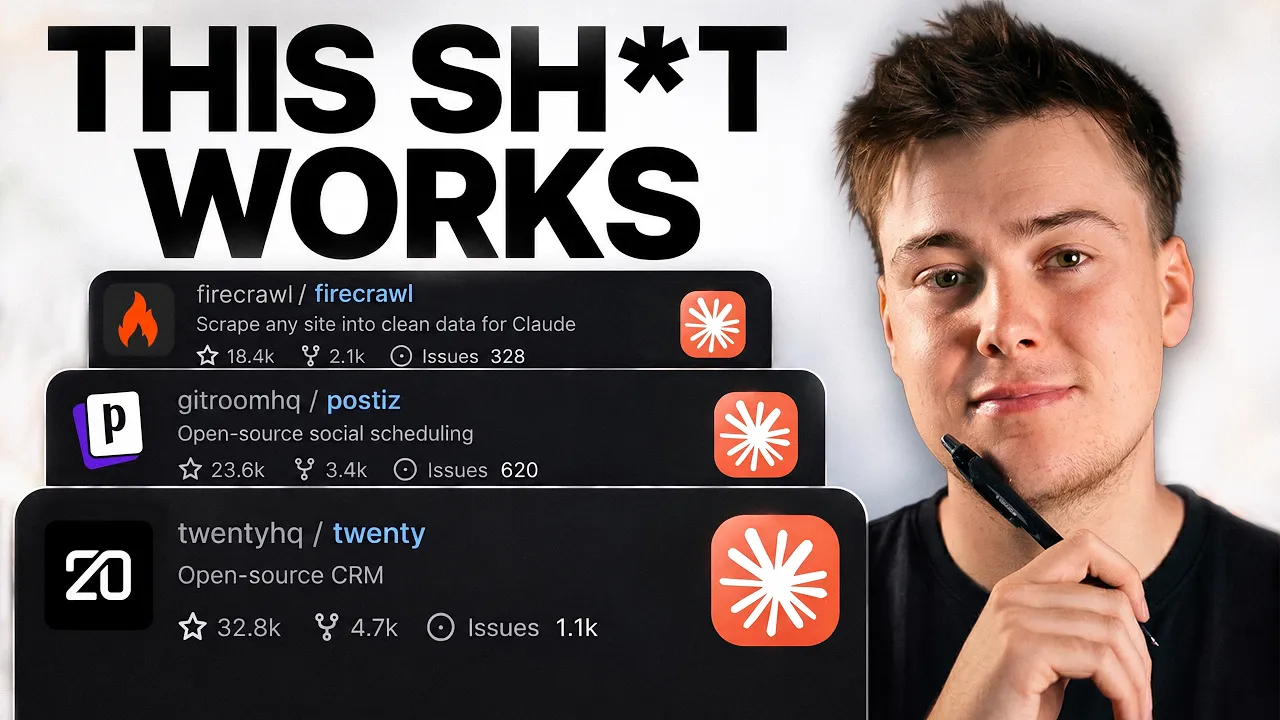
So, I went through all of the top GitHub topics and I picked my top six free GitHub repos that you can start using today to make money. The first one is Firecrol. So, Firecrawl has 182,000 stars, one of the most highly rated GitHub repos on GitHub. And essentially, it's an API that enables you to search, scrape, and interact with the web at scale. It's one of the fastest ways to browse the internet with agents. And it's able to take that data and structure it in the form of clean markdown or JSON files that make it really easy for your AI to respond.
So, these are essentially the core features. The first feature is the search feature, enabling you to search the web and get a full page content from the results. The next feature is the scrape function which allows you to convert any URL to a series of markdown files, HTML, screenshots or a structured JSON. And the third feature is interact enabling you to scrape a page and then interact with it using AI prompts or code.
To connect this repo or any of the other repos that we'll speak about in today's video, all you need to do is copy and paste the MCP into your Claude or you can even give Claude code the URLs for the links and it will install them on your behalf. offer to make it easy for you in the free school community. Below, I've provided you guys all of the links from all of these repos in the form of a single prompt. So, you can actually just drag and drop that prompt into Claude or GPT if you're using codecs and it's automatically going to install all of the repos so you can start using them in fresh sessions once they're installed.
So, you might be wondering, Miles, how can you actually use firecrawl to make money? Well, if you're already running a business, it's one of the best ways to study your competitors, look at competitor products because you can basically take your competitor's product and have it create a series of MD files or screenshots for your agent to then use, either recreate or repurpose to develop your own products. Also, if you're doing market research and you want your agents to do research overnight on a competitor or, you know, let's say you're doing a feasibility study on a new market that you want to enter, it's a very easy way to get clean text into your LLM.
The possibilities are endless because this is basically just a more efficient way to get data from the internet into your LLM. So you could use it, for example, to track price and stock of an inventory on a product or service. If you're in ecom or drop shipping, or if you're in real estate, you can get it to scrape listings of, let's say, Airbnb or study a specific property market. You could use it for lead enrichment, reputation monitoring.
The possibilities are endless, but the main one I would say if you run an agency or if you're client-f facing, which we've spoken about in recent videos, is using this to write reports, conduct competitive research and feasibility studies, so you can actually understand your client's needs better. For example, you know, if you onboard a client into your consulting or concurge business, you can simply use firecrawl to crawl through their entire site, all of their online information.
You can spot gaps. You can come immediately to that client with improvements that you want to make on the information front, on the web design front. You can scrape competitors to help them develop their own products. It's basically just a tool for you to be able to serve your clients better. So, you could add this on as a service of $200 to $300 per month. You could basically tell one of your clients, "Yeah, we're going to track all of your competitors if any new trend comes up either in the pricing model or in the fulfillment model.
You know, we'll keep you up to date and we'll help suggest changes for you or potential pivots that you can make in your business to make more money." And you can basically just run that on a scheduled loop. You can just build a skill for it and have that process happening for your clients on repeat. So, I think it's a great addition to your stack. And this is really the beauty of the free GitHub repos is that you can just plug in things that developers have already spent a lot of time working on into your cloud.
Like Firecrol, for example, it has 173 contributors. A lot of these guys are like full-time devs. It has 182K stars. It has many, many forks. And these are really active repos. So, you can see here 2 weeks ago, 2 hours ago, there's constant changes happening all the time. So, the benefit of using these free repos in general is the fact you get to tap into dozens or hundreds of developer power essentially without having to build this from scratch yourself.
Like imagine you having to develop a methodology for scraping competitors, pricing websites, like you're just going to be running uphill. And especially as we get into some of these other ones today, it's literally just impossible without these repos. So, you could really run an agency business with just a combination of repos with automatic scheduled tasks and you could run a really, really effective agency. And then you know just an idea you could take that setup a combination of repos and package that and actually sell it to other agencies or teach people how to start an agency.
But obviously that is you know one step in the future. All right so that is firecraw. Moving on to repo number two out of number six. This one is called posters. Posters has 36,000 stars over 81 contributors and it's essentially your ultimate AI social media scheduling tool. So, if you want to repurpose content, which I think is just an essential if you're doing social media, and pretty much any business now needs to use social media as a form of top of funnel to actually get leads through the door, then this is going to be very, very useful.
Now, I've been experimenting with it recently, and where it really shines is unlike Typfully where, you know, it's just on X. So, unlike Metricool where it's just on YouTube, Instagram, and Tik Tok, you can actually use this as auler across absolutely everything. So you can go onto Facebook, Reddit, LinkedIn, Tik Tok, YouTube, Instagram. You can repurpose content all at once and you can actually develop skills. This is really smart.
Let's say you do a long form YouTube video like this. I can take this video. I can then develop a skill to repurpose it into an article. I can then develop a skill to repurpose it into a LinkedIn post in a more professional format. And I can then develop a skill for it to repurpose it as a Reddit post in a way that Reddit would find engaging. And then I could get it to develop a short form script that would work on Instagram and Tik Tok.
And I can develop these skills for my agents. And then I can tap into post is and automatically have all of the content going out across all platforms. And if I run a private community, let's say on Discord, or I want to give my team internal summaries in Slack, you could also have content variations being posted in there as well, which is really, really cool. It's basically a way to supercharge your social media growth.
And you can see here, this is post is an action. You could schedule and generate posts with AI. You could tap into analytics on the app itself. And then you can even have team members on here. You can manage like a mini content team on the app. And you could even hire agents as I showed you in my last GitHub video. You could basically have these team of agents which are essentially just a bunch of MD files and skills that actually work on your behalf.
So you could have a content strategist, you could have an analyst, you could have a chief copywriter, and you can actually just train them up. So you can run pretty much a one person social media team. Now the clear use case is for your own product or agency. So if you're offering a service, if you have a product, if you're a creator, you can obviously use this to become more efficient yourself. But if you learn to get really good at posters, there's no reason why you can't offer this as a service to your clients.
So you can basically use this as your own agency social media management tool where you could actually just manage multiple clients at once on the application, which I think is really useful because, you know, a lot of your clients, they, for example, I don't know, you take on a YouTuber as a client. You tell them, look, I could get you on X with no extra work. I can get you on Tik Tok with no extra work. I can repurpose your content on LinkedIn with no extra work.
I'll manage all of your social medias. All you need to do is film long form YouTube videos. I'll do everything else. I'll do 20 posts a month. You can even offer this to local businesses. If you're good with the creative side, you can even go end to end with the entire process. And you know, here I've got an example of $400 a month. I'm telling you, there are creators that would pay thousands of dollars for this. Now, obviously, you know, you need some credibility.
You need some testimonials. Maybe you need some social proof by starting one or two social medias first before you can offer this to people and you know that they're actually going to pay thousands of dollars. But as an add-on to your package, you know, when you're going to a client as a concurge or an agency and you say, "Look, I'm offering this, this, and this. This is a fantastic add-on." Because there are so many businesses that just don't understand social media.
There is a massive arbitrage here. And most businesses, and this is the beauty of a video like this, they don't know GitHub exists, and we do. They don't know that this stuff is just free and open source, and we can download it, and we can automate a lot of these stuff. Even if you're not an expert social media manager, even if you're not an expert web scraper or researcher, we have these tools now. And a lot of businesses, they don't even want to bother worrying about this.
AI is super overwhelming for them. So there's a natural arbitrage here that takes place. So local businesses, content creators, this pretty much applies to everyone or even, you know, you could run it internally. So we've covered the content side, which involves research, websites, landing pages, scraping, etc. Now let's move on to number three of six, which is 20. Now 20 is like Salesforce. So Salesforce is basically an ultra powerful CRM which enables you to manage clients from outbound to inbound and relationship management, but it's really expensive.
It's overengineered in many cases and it's not optimized. It's a bit heavy for the use of AI agents. So, this is basically an open- source version of Salesforce designed for AI. It has 57,000 stars. It has a whopping 746 contributors. And you can see here that it provides you pretty much all of the building blocks that you would need to start your own custom CRM from objects, views, workflows, and agents and lets you extend them as code.
Now, I think this is particularly powerful if you combine it with an agent, an agentic operating system like Buzz, which I spoke about in my last video, because you can have all of your agents doing the work, giving you updates on client, inbound, outbound, you know, all of your outreach, etc. And then you can have a CRM, an agentic CRM actually combined with your AI employee workforce on buzz. And this is a way that you can integrate everything together.
So, I'll give you a live example within Claude of this in action. So, I've entered this prompt here. I'm setting up a CRM for a small business service in 20. Do all of this in one go. Don't ask me questions. Here are the contacts. One per line, name, company, email, etc. So, I pretty much imported my entire database. Obviously, it's not my real database for for privacy reasons, of course. One, create each company in 20.
Two, create one opportunity per line. Three, set the pipeline stages. Four, five, and six, which pretty much just give it the parameters that I wanted to use. And it's going to go ahead now and format my CRM. Now, what's the difference between using this and vibe coding it yourself? Well, essentially these developers that have contributed over 700, they've already worked on all of the components in terms of formatting, in terms of views, in terms of workflows.
So, they've already built all of that into the stack. This is very powerful because you can do your own enrichment. You can have your own algorithm for lead scoring. You can handle all of your own outbound workflows. For example, if you want to go full end to end with agents from, you know, scraping LinkedIn for contacts at a certain company to organizing the wording via a skill of how to word the outbound messages to particular contacts to getting the response rates and follow up of those contacts to then logging it in the CRM.
Everything can be done with this cuz it's a modern stack that is, you know, purely agentic. Unlike if you use a HubSpot or a Salesforce, which definitely have their place like I still use HubSpot mostly because I've been familiar with it for so long and there is a cost to migration. But if I was starting from scratch and I wanted something really custom, I think this is a great option because you just have way more customizability.
So it really depends on the type of business you're running. But I think it does make sense for anyone that wants to be, you know, super agentic forward with their business. And I'm assuming, you know, a lot of you would want to be because obviously that's why you're consuming this type of content. This does require a bit more thinking than a traditional CRM like Notion, which is very light and then obviously scaling up to HubSpot and Salesforce.
They have a lot of like pre-built parameters, but this strips away your customizability. So if you're trying to run an end toend process which is run by agents which is run by skills let's say you have your BDs in buzz and [clears throat] you have agents and they're trained to behave in a certain way then you actually might want to customize it with 20 because it'll be better integrated. Then you're not fighting against you know the API or the MCPs of these big corporations who frankly they're not building their tools for AI agents.
They're maybe doing integrations now cuz they're forced to but they're not AI native. And that's one of the reasons why a lot of people switch to Buzz instead of Slack because it's AI native. And I guess it really depends on what company you're running. You know, if you're running a company with dozens of real human employees, then maybe use the other stuff that's optimized for that. But if you're running a company that's AI first, let's say you're a soloreneur, you only have a few people, then it does make sense, I think, to build from the ground up with these AI solutions in mind.
So once the data has been input, it'll prompt you to load up the website so you can install your first apps. And this is basically what the 20 workspace looks like. And you can see here's the CRM. So you have all of your contacts, you have your companies, opportunities, tasks, etc. And you can interface with whatever you want. So that could be claude code, that could be codecs, that could be on buzz through your agents with one of the LLMs as the brain.
And then it will basically sync to Google Chrome. So this is a way that you can actually manage your clients internally if you run an agency for example. And the other thing you can do is you can actually set up your businesses with an AI first CRM if they are that type of business. This is going to be something you actually offer as a service. CRM management setups. This would go handinhand with likely other AI builds that you're doing.
Let's say you were building a business operating system or an AI system for a business. You would basically just plug this in as well and have an AI native CRM. Now, part of a CRM that you will need is obviously a way to email people. A lot of businesses are sitting on big email lists. You might have an email list that you've been developing. For example, I have a couple of newsletters that I run. We have big email lists and we need a way that we can activate email campaigns.
So reach out to users if we have a new offer, a new webinar, you know, something that we're putting out. A lot of businesses, they will have lots of contacts on an email list that they could follow up with. There's potentially untapped leads there, and you need a solution to run email campaigns. If you run a newsletter, you need a solution to manage that. Now, the best open-source one on GitHub that I could find is called Listmon.
And this is an application that allows you to run email campaigns, but you could also do your newsletters fully open source. So you could have your agents writing newsletters, managing an email list. You could have your CRM managed on 20 and you could have everything integrated. Or if you take on a client, so if you run an agency, what you could do is you could reactivate, let's say, you know, you go to a gym and you want to potentially help them land more members.
You could get their email list. You could do a campaign entirely through Listmon Monk and you could reach out to old members with, let's say, a special discount, a summer discount for a few weeks or they get a week free if they invite a friend or something like that to try and re-engage old contact. And this is a campaign that you could probably offer as a standalone or of course, you know, it's something that you could add on to the other services that you offer.
This has 23 and a half thousand stars, 264 contributors, and it uses a Postgress database to store all of the data, which makes it really easy to use with agents inside an LLM. And you'll notice a theme across all of these. The reason we're using open source is so it can all be integrated and managed as one operating system. Now, you might not want to use all of these. You might just want to use one of these GitHubs for a specific use case.
And that's also great. Just pick and choose based on what you do. And my real advice would be just test this stuff out. If you're running an agency model, just try it out, see what you like, and decide whether you like it, whether it's useful. And if it is, then you can start offering it to clients. You can see in Listmon, you can hit the start a campaign button and you can blast out, you know, a bunch of emails at once.
You could have different templates. You can have, you know, your email list manager here. You can have subscriptions for a newsletter manager here. You have a dashboard with all of your stats. kind of like beehive but fully open source. Of course, the good thing about open source is that you own everything. If the platform gets shut down, you still have access. You own all of your emails. You own all of your skills. You own all of your IP.
That's another benefit worth touching on of doing things open source. So, that is number four. Getting into the final two now. And these ones I'm not seeing many people speaking about, especially this one called Pipcat. Pipcat is very interesting because it's basically an open source framework for voice agents and multimodal apps and real-time AI. basically meaning you can build voice assistants, multi- aent systems, AI companions, business agents for customer intake.
This is so important because such an important component of sales are phone calls and voice agents. It's so important because most of the creators that I'm seeing now marketing offers are doing phone number intakes and then they are relying on setters to sell. Basically set someone up or get them over the line. Now although I still think there's a place for real human setters in some cases the AI is catching up quick firstly and secondly for a lot of inbound let's say you are a gym or you are you know an agency and you know you're asleep you could even set up agents overnight to have the agents trained to handle requests so you don't lose a lead so it just doesn't go to a dead phone.
You can have 24/7 voice assistants running around the clock. And this is powerful cuz it is something that you could set up for a business. This is a service that a lot of businesses need. You could pretty much walk into any business that requires a receptionist. You know, it could be a dentist, it could be a gym, it could be a clinic, whatever it is. You can actually charge them for the setup of custom voice agents.
So, you just go to the business, you try and understand what they need, you try and understand if they're missing leads, and you can use Pipecat to build the entire system out. They've got multiple chat bots. So, they've got, you know, a simple chatbot, storytelling chatbot. They have access to a variety of different speechtoext models. So, you know, you can tap into 11 Labs, which is the best one in the market. You can use any LLM for the brain behind it.
Pretty much you can develop an entire full stack voice agent solution from scratch. Literally just download this. It'll make it really easy for you to set up a custom solution. I even recommend going to the website, testing it out. They have live agents that you can play with and you can test this stuff out in real time. So, I'm literally speaking, you know, to the assistant right now. This is managed daily by the Pipecat developer community.
This is really really cool and once again I think an underrated one that not many people are talking about especially considering how important voice agents are pretty much across any business and if you are running a concurge or a consultancy business you're basically just now stacking on things you can offer. I mean with AI you can offer the full stack you can basically just do an audit. So if you walk into a local business, you can find out what their pain points are.
Do a quick assessment and whatever their gap is, whether they're missing leads, whether they don't have a proper CRM, whether they are, you know, not re-engaging their email list, whether they are not scraping the web for competitors, whatever it may be, you can now plug in an open source solution, which I think is super cool. Now, if that is a business model that you are running and you're going to local businesses, I talked about this in the last video, but something you can do is you can scan Google Maps to find potential businesses that you can even pitch these services to in the first place.
And the best one that I found for this, and honestly, it's super super cool, is Google Maps Scraper. So, this basically scrapes the data from Google Maps. So, it can give you the data such as the name, address, phone number, website, URL, ratings, etc. of anything on Google Maps, which becomes particularly powerful if you are using it to hunt for businesses. Let me show you an example. So, let's say I'm in Dubai and I'm searching for dental clinics.
Of course, you could do this across a variety of businesses at once, but this is just an example. Use the Google Map Scraper skill. Don't ask me questions. Use these settings and report at the end. Find local dental clinics that are likely to have unhappy customers so I can pitch them a reactivation campaign. Do a quick validation run on the first query. Filter to clinics with a rating under 4.5, more than 50 reviews, and a phone number. flag any with no website.
That's also an opportunity building websites for these businesses. Once again, it's just about auditing and then you can come up with a custom solution for them. Give me a table with all of the information. So, this is really good for lead genen for real businesses. This is the perfect GitHub if you want to scan businesses for example with no website. If you are providing a website, this is absolute gold. If you're looking for local businesses to visit, this is absolute gold.
Google Maps worldwide, not in America so much, but worldwide is definitely, you know, the leader. So, it's a perfect way to turn like a map that looks like this into data. It's so inefficient to be having to go through Google Maps yourself. And I was using Claude for this in the past, but once I started trying this GitHub, I realized that it was just doing a much better job at scraping obviously cuz it's tapping in to the backend data instead of, you know, using a web scraper, which was actually missing stuff.
So, this is a better solution for pretty much anyone wanting to do this. So, you can see here it's found the outliers. It's formatted a table. It sent me a short message that I can send. I actually recommend with these things you batch them and you actually go in person. I feel like the likelihood of actually landing a client in person is so much higher than a cold email. But obviously if you're not in the city you can run cold email.
Like you've got nothing to lose if you live in New York and you want to do cold emails to clients in London. If you're not going to London then, you know, it makes complete sense. But if you're in the local area, then I would recommend, you know, actually visiting in person. But this is amazing. The possibilities with a repo like this are endless. And because of the amount of data points, I think it's going to help you get a lot of leads for your business.
So, those are the six free GitHub repos that I think can help you make money today. If you want the full list and the one prompt setup guide, you can just drag it into Claude or GBT. Then join the free school community below. It'll be under the resource section. I post all of the resources from all of these videos in that community. And make sure to subscribe for more content like this. I'll see you in the next one. Have a lovely rest of your day.
Peace out.
The words are the caption track's own and nothing is reworded or re-transcribed. Paragraph breaks are placed between sentences so the text reads as prose.
Free tools for your own script. No signup, no login.
Paste your draft and see where viewers are likely to drop off, with a rewrite for each weak line.
Paste the first 30 seconds of your own draft for a hook score and rewrites.
Check your draft against YouTube's advertiser-friendly guidelines before you record it.
Read this channel's public videos and transcripts, and download a writing brief for it.