Getting the transcript
Reading the captions from YouTube. A video nobody has opened here before takes 10 to 30 seconds; this page fills in on its own.
Getting the transcript
Reading the captions from YouTube. A video nobody has opened here before takes 10 to 30 seconds; this page fills in on its own.
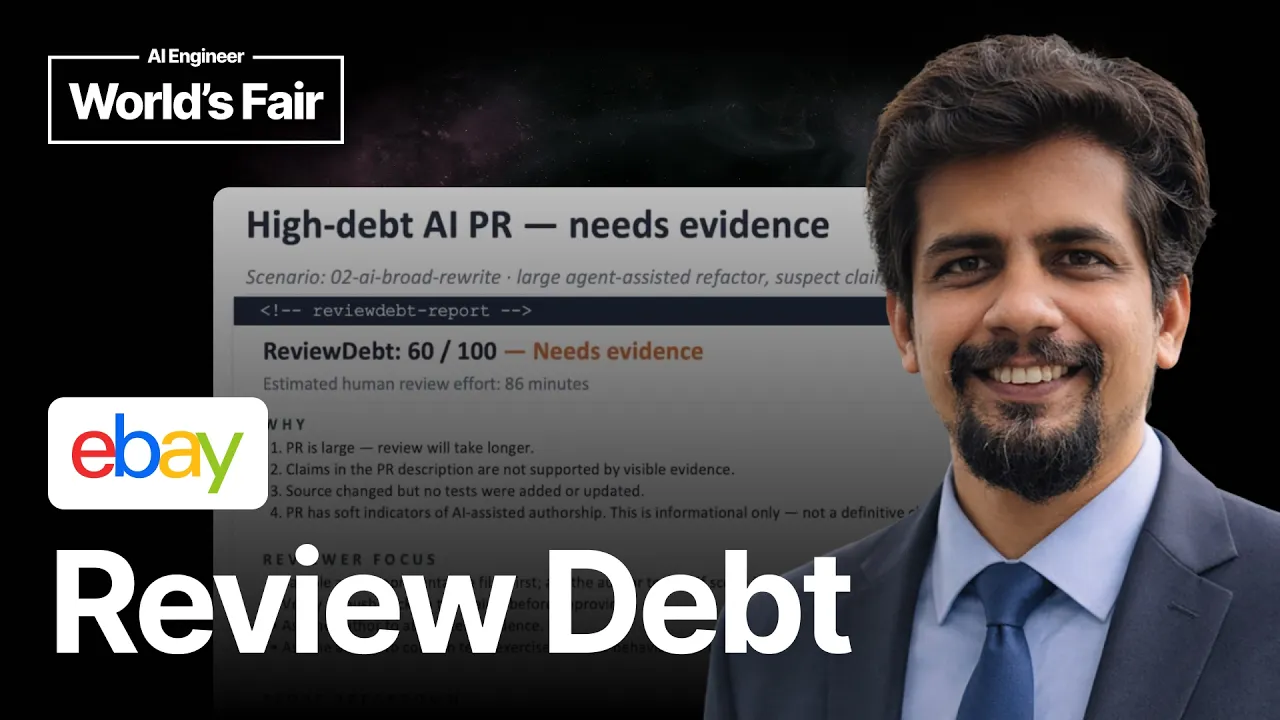
AI Engineer · @aiDotEngineer
This video has no Most replayed graph yet: YouTube shows one only once a video has enough views. These are the moments viewers replayed most in AI Engineer's most watched videos.
Most replayed moment at 18:45
4.8x that video's typical replay level
that they're they're changing they're changing things in the database not yet. You want to run them through the ontology first and make sure that works. Okay. I only got an I've got I've got another I've just a short time. I'm going to try to show you some of the things that um that you can
Said at 18:37
Most replayed moment at 16:13
3.6x that video's typical replay level
method signatures, the program layout and the call stacks. So here's some examples. I don't think you'll be able to read this one, but this is like the level of abstraction we're at. It's how we're actually going to lay this stuff out and how these systems are going to interact. Dylan Mulroy from Cloudflare talks a
Said at 16:06
Most replayed moment at 13:49
2.3x that video's typical replay level
Fable uh and it runs into an unknown, ask it to log it, right? So that um you uh you can see where the deviations happened and then you can sort of figure out why as well, you know? It will usually give you some context about what happened.
Said at 13:43
The graph counts replays. It does not show where viewers stopped watching.
Words
3,885
Runtime
25:00
Speaking pace
155wpm
Reading time
16min
155 words per minute, below the 160 25th percentile of 349 measured videos. That distribution comes from the 349-video hook study.
Opening (first 30 seconds)
Hi everyone. I'm Sachin Gupta and I'm a software engineer. The title is exactly what it sounds like. Your coding agent is creating review debt. Before I start, sit with the title for a second. Notice what it is not saying. I'm not saying that coding agents are bad. I'm not saying they don't make us faster. I'm saying they they're creating a kind of debt that nobody is measuring. And that debt is going to come to
78 words, the words spoken in the first 30 seconds at 155 words per minute.
Free, no signup. See how the first 30 seconds hold attention, with rewrites.
Sentence shape
| Measure | This transcript |
|---|---|
| Sentences | 378 |
| Average words per sentence | 10.3 |
| Longest sentence | 39 words |
| Questions asked | 22 |
| Sentences containing a number | 51 |
Most used terms
Filler phrases
70 in total: actually 25 · basically 20 · like 17 · uh 5 · kind of 2 · you know 1.
A literal whole-word count of the same phrase list the Prepublish browser extension uses, so a phrase inside another word is not counted and a phrase used in its ordinary sense still is. It is a count and not a judgement.
What this transcript is
Every word below is the caption track YouTube publishes for this video, pulled from the video itself and reproduced unchanged. It is not Prepublish's writing, not a summary, and not a re-transcription: it is the video's own published captions. English captions, generated automatically by YouTube, in the video’s original language. Source: the video on YouTube. A channel that would rather this page did not exist can ask for its removal through the contact page, and it is removed.
Hi everyone. I'm Sachin Gupta and I'm a software engineer. The title is exactly what it sounds like. Your coding agent is creating review debt. Before I start, sit with the title for a second. Notice what it is not saying. I'm not saying that coding agents are bad. I'm not saying they don't make us faster. I'm saying they they're creating a kind of debt that nobody is measuring. And that debt is going to come to you.
Over the next few minutes, here's what I'm going to do. I will define what review debt is. I'll walk five signal families that are going to compose it. I'll score three real pull requests side by side and I will show you a cross repo scan of over 500 PRs, which is nothing but three public code bases. So let's go. Look here. Here's the gap nobody's measuring. GitHub's 2025 October's report that covers almost every public pull request on the planet shows that the commits climbed 25% year over year.
And now over the same year, comments on the comments dropped 27%. Now, these comments are nothing but the proxy for review activity. Code production volume actually went up, but the review attention went down. They moved in opposite directions that to in the same year. Now, look at the teams for this along the AI adoption curve. Faros AI tracks this cohort in their 2026 benchmark. Median PR review time is up by 441.5% and if you see like if you calculate, you'll figure out that the reviewed PRs take 5.4 times longer than what they used to.
And then 31% more PR are now merged with no review at all. So AI produce AI is producing the code very fast. AI is producing the pull request very fast, but humans cannot responsibly review them at that pace. This gap is called as review debt. It actually accrues quite a bit. It compounds and right now nobody has a number for it. But by the end of this talk, I will make sure that you will have a certain number. Now, if you look at this particular slide, here is the story every team is telling right now.
PR per developer are up 16%. That's the Faros AI acceleration Whiplash benchmark and that from April 2026. There were like 22,000 developers, 4,000 teams. And the median PR size is up 63%. 44 lines to 72 lines per pull request. That is basically 16 months of long-term data from DX 2026 study, which includes 400 organizations. Now, if you see the cycle time, open to merge, that is modestly down and it is coming from the same DX study.
The framing is really generous. PR throughput grew actually about 8% and the AI usage rose about 65%. The gain that we see today is real, but it is actually smaller than the hype that that is present. Every one of these numbers are real. None of them is a lie, but everyone is a vanity metric. PR count goes up when one PR splits into seven PRs. Median PR size going up is not a benefit, it's actually a bloating. Cycle time going down when reviewers stop pushing back.
These things tell you the speed of production. They do not tell you the speed of trust. Now, we will go into the next slide to see more. Now, if you go looking for the second story, here is what you're going to find. Reviewer fatigue. Engineers carry far more review load than a year ago. They're not happier about it. Late-night merges. PRs are sitting unreviewed for 3 days, 4 days, and then they suddenly get a thumbs up at 11:00 p.m. before a Friday deadline.
Test theater. Tests are getting added, but they're actually asserting what the code did, not what the code should do. They lack in behavior, including bugs. Architectural drift. Again, the same problem that is solved in three different ways in three different files. Nobody is actually holding up the architectural trade. Finally, incident lag. When something breaks, the bug lags week or months after month uh after merge.
Nobody connects the dot back to the AI authored change. These costs don't show up in any dashboard until now. We'll look into the next slide to know more about it. So now, let me give you the definition. Review debt. It's the accumulating gap between code your agent has produced and the code humans have actually reviewed, trusted, and understood. It rhymes with technical debt, but it is more like a financial debt because it compounds.
It actually accrues interest, but this interest is not money. This interest is paid in human attention. It compounds because of the three feedback loop. First, the agent learns from your code base, fine-tuning, rag grounding, in-context suggestions. Code that was not deeply reviewed yesterday grounds tomorrow's PR. This debt becomes generative in nature. Second one, reviewers seed the architectural call. When most of a PR was generated, attention contracts to syntax and obvious bugs.
Big picture decision moved from review time to never. Third one, velocity expectations reset. Once leadership sees the new throughput, you don't get to hire reviewers in proportion. There is no slack left to pay the debt back. Each loop on its own is survivable. Together, you will have a runway, but the next question is, how are you going to measure it? So, how do we measure review debt? There are five signal families that has like 10 deterministic checks.
Remember, the keyword here is deterministic. Every check is computable from a pull request and its repository. No, we don't need any language model. Why? Because LLM, when it acts as a judge, it possibly can break two things. Number one, the score becomes a moving target. The same PR, basically the score that you got for the same PR, will score differently when your model will change. Two, the score stop being defensible in an engineering review.
You cannot put it on a slide. You cannot put it in front of a leadership. So, what do you want? You want a number that is traceable to a deterministic computation, different size and coupling. Second, test evidence gap. Third, directory and ownership spread. Fourth, AI authorship indicators. Fifth, evidence and rational gaps. These are the five families that will have 10 checks under them. Let's walk each of them. The first one, the first signal that we have is dev size and coupling.
This is the simplest one to calculate, basically. It's also the most often misread. What it measures is the net lines changed, the files touched, whether changes cluster in one module, or is it sprawling across many. Why the agent is struggling here? Agents are biased toward fix at the call site. A human engineer routes a fix to the root cause. That keeps the difference very small. But an agent will reach into many files looking for the same symptom.
The review cost of a sprawling difference is not proportional to the size. It is actually much steeper. So, the cross-file coupling explodes the mental model and reviewer has to hold. We'll look into the second signal, which is test evidence gap. So, what is test evidence gap? Test evidence gap is nothing but test lines added divided by the production lines added per pull request. So, AI authored PRs, they ship with a far lower test to code ratio.
Sometimes there is no test file in place. And if there is any, it's minimal. So, this gap is actually a consistent gap. And the problem with this particular thing is the number The reason this number is basically brutal is the agent generate test. They generate a lot of test. But these test basically assert what the code is doing. It base It does not generate the test cases what the code should actually do. They lock in the behavior including the bugs.
The ratio does not capture the quality gap. It just measures whether the test showed up at all. So, the deeper signal is the next step that is a layer down. We'll see the next one, which is directory and ownership spread. So, what is directory and ownership spread? Count the distinct code owner teams whose file appear in the difference. Now, what does it mean? Basically, a well-shaped PR concentrates in one team directory.
But a sprawling one reaches across many team file. And the review cost is enormous in this scenario. No single human hold the whole mental order model. You need multiple approvals from multiple engineers in multiple different context. The coordination overhead easily exceeds the time the agent save producing the code. This is where you start to feel the economics of review debt. The agent gave you three hours of typing.
You spend those three hours by multi-party reviewer attention. And the next one we are going to see is AI authorship indicators. So, what is AI authorship indicator? Before everyone gets defensive, this is not for the blame. We are not flagging that engineers use coding agents. We wait the scores for a PR shape like agent assisted authorship get extra reviewer attention. So, that way you know, right like, okay, this is the PR that is directly coming from the agent.
And there are like the very common three detection mode. I must I I think everyone must have seen it by now. One is the co-authored footer, which is basically one of your strongest signal. You see that co-authored by Copilot. Second one is the branch name pattern. Generally, you must have seen it says codex, Copilot, cursor prefixes. Third one is basic generated by assisted by, which is nothing but your PR body. your commit message phrases.
We did actually a real data check on three public repos, which comprised of 524 PRs. I'm not going to name the company, but for the sake uh we are just calling it A, B, and C. Now, if you see the highest signal was the co-authored footer. And the second one uh the lowest signal was 0% on the repo C. Even though it was done by coding agent, but they might have blocked it uh saying any co-authored or uh like generated by etc. etc.
The next thing that we are going to see is evidence and rational gaps. So, evidence and rational gaps. I think this is one of the most deterministic that I personally feel. It's the one that destroys review ability the fastest. What it measures basically? Does the PR explain the why or just the what? On the left, if you see, we have an high gap. On the right, we have a low gap. The title says "Fix leaky test" and all the data that you're seeing here is actually from some public repos.
Now, the PR body length is 18 characters, the commit message says updates. Obviously, I will not be if you give it to me, I won't be able to review this. Okay, I cannot accept this. But then on the right, if you see when there is actually a low gap, the title actually is telling you what the change is all about. The body has a symptom, the diagnosis, the change, and the link to the benchmark. Now, a reviewer can do the job.
So, in our regression fixtures and hands code teams, this signal destroys reviewability fastest. In the real open source data, PR bodies follow conventional commit format. So, it fires most rarely there. But if you see the regression fixtures are just the demos. Okay, let's see how those five signals combine. You will only have one number that is going from zero to 100. And the exact weights are basically your defaults.
Now, if you're planning to adopt this, I would like you to do this first. Run it backwards over the last 200 PRs that have been merged in your company. Calibrate the weights against your team's actual reviewer experience. The score has to feel right against your actual guts. We you you are going to divide it into four bands. If you are zero to 24, which means you have very low review burden. If you have 25 to 49, you are normal, proceed with the standard care. 52 74, you need evidence from the author before senior review.
And if you're 75 and above, definitely it's high split or request more context. Same shape as technical debt categories, but the unit is different. Now, we are going to see what the scanner actually did. Now, if you see this is the clean PR. Unfortunately, I won't be able to give you a live demo today, but I will walk you through a CLI. I wanted you to show three scored pull requests side by side, the level where the framework become useful as a repeatable review conversation.
This is the first one. If you see, this is what the scanner says when a PR is all changed. Score out zero out of 100. The burden is basically nil. It's zero. We have a low review burden. The estimated minutes is six. No checks were fired. And if you look the structure here, that is why the list is empty. Reviewer focus is empty. Author next action is empty. The framework only generate advice when it has something specific to say.
A healthy PR produces a tiny, almost ceremonial report. That's exactly what you want. And the takeaway is most healthy PRs produce zero noise. They get the work done without making any noise. This is not a tool that complains by default. Running it on every PR cost you one comment that says look good. That's it. Let's see the high debt PR now. Now, you see what you see actually on the screen is from a public repo. This is a real scenario from the scanner regression suite.
If you see, the score is here 60 out of 100. It requires evidence. It's on the audit and it says needs evidence. 86 estimated minutes of review effort. Look at the structured output. It's actually not a score. A wire list explaining what fired. A reviewer focus list telling the reviewer what to do next. An author next action list telling the author how to bring the score down. This is the part most PR quality tool miss.
The score alone is useful. The structured advice is what actually moves the team behavior. Now, if you read the bullet point, it says PR has soft indicators of AI assisted authorship. This is information only, not a definitive claim, and not a penalty on its own. This particular step sentence is in the scanner output. The AI indicator check contributes five of the 60 points, which is nearly about 8%. The other 55 came from a different size claim mismatch and missing test.
Those would be high burden signals on any PR, agent authored or not authored. This is not an anti-AI scorecard. Basically, this is more of a review burden scorecard. The agent did not cause the score, but the shape of the PR that is created by the agent did this. Let's see the next one. This is a PR, basically, which is AI authored. It's very well shaped, and the score is seven, seven, which is low review burden. Now, if you see the same agent, it has done the same kind of work, but the test were added.
So, the CI is green. The risky path is called out in the PR description. That's why we got the score as seven out of 100. It's very low burden, took only 14 minutes. The AI indicator check still fires, but it contributes 2.1. One, low severity. Second, the framework explicitly says, quoting the report itself, "Information only, not a definitive claim, and not a penalty on its own." So, when your team is going to ask, "Will this tool penalize us for using coding agents?" No, the answer is on your screen, low review burden.
It's a very well shaped AI PR. We are going to see the next one, which is basically our three public repos over 524 PRs. I wanted to show you a 90-day AI search slope across three public repos and 524 pull request. The review burden climbs even when the AI authorship doesn't. If you see this particular scan, we observe three things. One of them is the volume is the actual variable. AI authorship was flat and it was 5 to 20% steady state, but the review burden was not.
If you see one repo accumulated 186 senior reviewer hours in 27 days and another one took 43. The window length is same, but the volume was not the same. The burden was not the same. That is what PR volume is. Second is amplifier only holds up under real data, which means AI indicators fired on 5 to 20% of PRs every week across all three repos. None of those AI authored PRs disproportionately landed in the high burden band.
The positioning contract holds against real code bases. Third one is complexity drives burden, not authorship, which means across 524 PRs four landed in needs evidence or high bands, which means all four were structural changes, which were large migration, SDK rewrites, multi-team refactors. The framework score complexity fairly. AI driven volume creates the condition under which these accumulate. So now, what 524 PR look like under the lens?
Where does the review debt actually show up? In absolute terms, the scanner saw 524 real pull request in three public repos, 228 senior reviewer hours cumulative across three public repos that were scanned over 27 to 90-day windows. Second one is nine PR per day sustained merge rate the high velocity repo. So, if you see, it's all about the volume that is basically driving the burden. Third one is 5,036. These are the minutes that are basically spent on a single PR, which is nothing but 84 hours of review effort estimated for one single pull request.
The score that we received there was 73, which said it requires an evidence band. Now, 5 to 25% of these PR every week across every week fired at AI indicator signal. Again, remember this is volume, which is causing the review debt, which is changing the game altogether. We'll move to the next slide. Measure the problem. We have shown the cost. Now, what do we do about it? So, first thing is you should have one logical change per PR.
I'm not saying like not small PR in the abstract. One logical change, that is enough. Second, test ship with the change. Even if the agent wrote the code, even if the agent wrote the test, the human author confirms the test assert what the code should do, not what the code is doing, what the code is supposed to do. Okay? Third, stay in one owner territory. Cross-cutting work splitting into per per team PR. Remain in your own territory.
One approval, one context, one mental model. Author writes the why. The agent should not write the PR body. That's the moment the human author commits to understanding what they are actually shipping. Same review standard for the AI PRs as human PRs. The AI indicator amplifier only fires when other signals are weak. Keep the other four strong. The amplifier is invisible. So, make sure there is no exception for AI. None of these is actually requiring you to have a new tool.
These are the moves that you already are aware of. You just need to implement it. Now, how are you planning to adopt this? If you see, we again have five steps. Backfill, threshold, surface, aggregate, and talk about it. Backfill. So, you run the scorer over your last 200 merge PR. Look at the one basically that has the highest score. Second, threshold. Set a basically justify line. Default, let's say you want to give it 50.
So, any PR scored at 50 or above requires a comment from the author. As simple as that. Surface it. Post the score as a PR comment on every PR. Don't block it. Just for the visibility purpose, surface it so that everybody should know what's happening over there. Aggregate weekly per team. Which means the slope of each team deadline is the leading indicator. That's what your engineering manager should watch. Talk about it.
Bring the number to a retrospective, every roadmap view. In every meeting, you should discuss about that number. Like, what was your score when you did this particular PR. That's it. Why this number matter? Because of this conversation? Absolutely not. Without a number, what you are just conversing is why. But if you have a number, it's actually structured. You can tell like, okay, with AI coding agents, we have a rollout which has added X percentage of the throughput.
But you need to make sure you are also adding the Y points of the review debt that has been occurred over Z weeks. Now, at your current slope, that's roughly N senior N senior engineer hours that you need to talk about. That moves the discussion from feeling to measurement. So, you should always have a number. If you see 2026, we are adopting things. But, 2027 is the year when this conversation will shift to the governance model.
And, it's actually starting right now. Can you trust the code that you're shipping? If yes, we are good. If no, then who is accountable when an AI authored change causes an incident? Where is the audit trail? So, reviewed it is basically the bridge between these two columns. It's the first number that lets you have the right-hand side conversation without abandoning the left-hand side gains. We'll look into the final slide now.
Now, three things I would like you to take away. First one is, measure the gap. Don't build the tooling yet. Take 20 PRs from the last week, score them using the five signals that we discussed. You will basically get a number so that you will understand, okay, whether the framework is working right or not. Try to make the slope visible. The slope of a reviewed it over time matters most than the level. So, plot it weekly, and then discuss it with your team maybe in a meeting or in a sprint planning, whatever the way you feel like.
Have this conversation. Bring the number to your next review. Like, say that, okay, we do have extra report, wide it, and this is the slope. And, then you are basically moving away from the wide culture to the measurement culture. One quick callout on anti-patterns to avoid. First thing is, approve with comment merges. The AI did the boring part. No. We'll catch it in QA. No. PRs smaller now. No. Stop writing LGTM on the PRs.
Make sure whatever we have discussed, the habits that we have discussed, we are going to follow them. This is the entire point of the talk. Thank you very much for listening.
The words are the caption track's own and nothing is reworded or re-transcribed. Paragraph breaks are placed between sentences so the text reads as prose.
Free tools for your own script. No signup, no login.
Paste your draft and see where viewers are likely to drop off, with a rewrite for each weak line.
Paste the first 30 seconds of your own draft for a hook score and rewrites.
Check your draft against YouTube's advertiser-friendly guidelines before you record it.
Read this channel's public videos and transcripts, and download a writing brief for it.