Getting the transcript
Reading the captions from YouTube. A video nobody has opened here before takes 10 to 30 seconds; this page fills in on its own.
Getting the transcript
Reading the captions from YouTube. A video nobody has opened here before takes 10 to 30 seconds; this page fills in on its own.
ExPlaned · @ExPlaned1
Words
3,218
Runtime
21:31
Speaking pace
150wpm
Reading time
13min
150 words per minute, below the 160 25th percentile of 349 measured videos. That distribution comes from the 349-video hook study.
Opening (first 30 seconds)
In 2016, Lufanza bought the rest of a national flag carrier. Not a stake, not a partnership. Every remaining share it did not already own. The price was €2.6 million. That is less than the cost of refitting one longhaul cabin. It is less than a single spare engine. For that money, Germany's biggest airline took complete ownership of Belgium's national airline. and almost nobody in Belgium objected. This is Brussels Airlines. And the price
75 words, the words spoken in the first 30 seconds at 150 words per minute.
Free, no signup. See how the first 30 seconds hold attention, with rewrites.
Sentence shape
| Measure | This transcript |
|---|---|
| Sentences | 211 |
| Average words per sentence | 15.3 |
| Longest sentence | 52 words |
| Questions asked | 1 |
| Sentences containing a number | 91 |
Most used terms
Filler phrases
4 in total: like 3 · actually 1.
A literal whole-word count of the same phrase list the Prepublish browser extension uses, so a phrase inside another word is not counted and a phrase used in its ordinary sense still is. It is a count and not a judgement.
What this transcript is
Every word below is the caption track YouTube publishes for this video, pulled from the video itself and reproduced unchanged. It is not Prepublish's writing, not a summary, and not a re-transcription: it is the video's own published captions. English captions, generated automatically by YouTube, in the video’s original language. Source: the video on YouTube. A channel that would rather this page did not exist can ask for its removal through the contact page, and it is removed.
No Script X-ray for this video: YouTube shows a Most replayed graph only once a video has enough views.
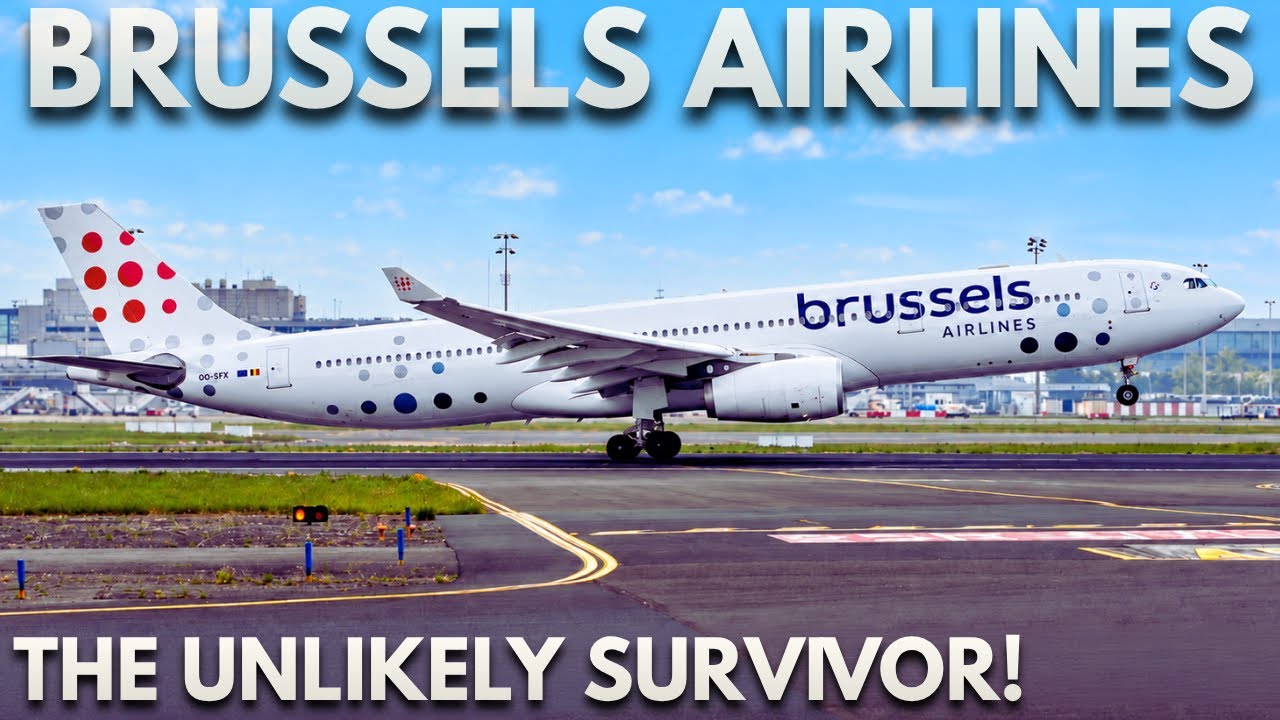
In 2016, Lufanza bought the rest of a national flag carrier. Not a stake, not a partnership. Every remaining share it did not already own. The price was €2.6 million. That is less than the cost of refitting one longhaul cabin. It is less than a single spare engine. For that money, Germany's biggest airline took complete ownership of Belgium's national airline. and almost nobody in Belgium objected. This is Brussels Airlines.
And the price is not the strange part. The strange part is that this airline was never supposed to exist. It was assembled out of the wreckage of the biggest corporate failure in Belgian history. built on top of a small regional carrier flying propeller aircraft out of Antworp and it inherited a route map drawn by a colonial empire that stopped existing in 1960. Today it is the smallest of the four network airlines inside the Lufansza group.
It has just posted a loss of 70 million and its chief executive walked out of the building at the last day of August 2026. And yet Lufansza will not sell it, will not fold it into anything else, and will not close it down. There is one reason for that, and it has almost nothing to do with Belgium. To see it, you have to start with the old airline that died. Sabina was founded on the 23rd of May 1923, and flew its first commercial service that July from a field at Har outside Brussels to London by way of Ostend.
Belgium at that point was a small country with a very large problem. It governed Congo, a territory roughly 76 times its own size, nearly 8,000 km to the south. And the journey there took weeks by sea. So in February 1925, three Belgian aviators climbed into a Hanley Page biplane named Princess Marie Jose and set off for Leopoldville, the city we now call Kinshasa. It took them 51 days in an open aircraft across the Sahara and the Congo basin to prove that a line on a map could be flown.
That flight is the reason for everything that comes later. By 1935, Sabena was running a regular passenger service between Brussels and Leopoldville that took about 5 1/2 days. On the 19th of January 1960, it flew the route non-stop for the first time with a Boeing 707. Belgium had built an airline whose entire longhaul identity pointed at one continent and it kept pointing there long after the colony was gone. And for a while, Sabina was inventive.
In September 1953, it launched the first scheduled international helicopter network in the world. Flying Sakorski machines out of Brussels to Rotterdam, Leil, Mastri, Leazge, and eventually Paris. eight passengers at a time, hopping between European capitals decades before anyone else tried it. It was also for most of its life losing money. Belgian travelers had a joke about the name. Sabina, they said, stood for such a bad experience, never again.
In the last 40 years of its existence, the airline turned a profit in exactly one of them. And it was marked by two events that had nothing to do with balance sheets. On the 15th of February 1961, Sabina flight 548 was on approach to Brussels after an overnight crossing from New York in a nearly new Boeing 707. A smaller aircraft had not yet cleared the runway, so the crew began a go-around, and during that maneuver, they lost the ability to stop the nose rising.
The aircraft circled, banking harder each time, and came down in a field at Burke Compenhout, a few kilome short of the airport. All 72 people on board were killed and a farmer working the field was killed on the ground. Among the passengers was the entire 18 member United States figure skating team traveling to the World Championships in Prague along with 16 coaches, officials, and family members. The American program lost a generation in a single morning.
Investigators never established the cause. Mechanical failure was suspected and never proven. 11 years later, on the 8th of May 1972, a Sabana 707 flying from Brussels to Tel Aviv by way of Vienna was taken over by four members of the Black September organization. The captain was a Britain named Regginal Levy. He kept his voice level on the intercom and told the cabin in words that became famous they had friends on board.
He did not mention that his own wife was sitting behind him. Levy landed at Lad airport in Israel as instructed and the hijackers demanded the release of 315 prisoners. The following afternoon, 16 Israeli commandos walked up to the aircraft in white overalls carrying tool bags, having convinced the hijackers the jet needed repair. Two hijackers were killed, two were captured, and one passenger died of her wounds. The team was led by Ahood Barack.
One of the men on it, wounded by a shot from his own side, was Benjamin Netanyahu. Both would later become prime minister of Israel. By the 1990s, Belgium went looking for a partner. And in 1995, Swiss Air bought just under half of Sabina. On paper, it looked like rescue. Swiss Air was the byword for a well-run European airline, and it was assembling a block of smaller carriers to take on Lufthanza and Air France. In practice, Sabina was pushed into an order for 34 Airbus aircraft it could not afford, while Swiss Air's own strategy collapsed underneath it.
By early 2001, Swiss Air had reported a loss of nearly $2 billion, removed its chief executive, and backed away from its promise to raise its stake and inject more money. Then came the 11th of September. Air travel fell off a cliff worldwide. Swiss Air grounded its own fleet at the start of October. On the 3rd of October, Sabina filed for protection from its creditors [music] and it never found the money. On the 6th of November 2001, the chairman of the board read out a statement and the following day, the president of the Brussels Commercial Tribunal declared Saba bankrupt. 12,000 people lost their jobs.
It was the largest corporate failure in Belgian history and the first time a flag carrier of a European Union member state had simply stopped existing. The final flight was SN690, [music] an Airbus A340 inbound from Avagon by way of Cottono. The last thing Sabena ever did was fly home from Africa. Belgian courts later ruled Swiss Air bore responsibility. The administrators sued for €3 billion and were awarded provisionally 18.2 million.
Here's the part that almost nobody outside Belgium knows. Sabina died on a Wednesday and by the Saturday Belgian aircraft were flying its roots again. Sabina had owned a small subsidiary called Delta Air Transport founded in Antworp in 1966 which had spent years flying regional routes on Sabina's behalf. Delta Air Transport was legally separate. It had its own license, its own crews, and it survived the bankruptcy untouched.
On the 10th of November 2001, 3 days after the flag carrier was declared dead, Delta Air Transport restarted operations with a flight to Geneva and it received Sabina slots at Brussels airport. The Empire had gone. The feeder had inherited the gate numbers. What happened next was national improvisation. Belgian investors, banks, regional funds, and the Brussels and Walloon governments put together a holding company called SN Air Holding, chaired by Viccount ATN Davinon, a former European commissioner and one of the most connected men in the country.
In February 2002, it took over Delta Air Transport, took over part of Sabina's assets, and renamed the whole thing SN Brussels Airlines. Those two letters at the front were not decoration. SN was Sabina's airline code and the new company kept it and still uses it today. Then it went shopping. Brussels airport had a second Belgian carrier on it, Virgin Express, a lowcost operation Richard Branson had bought in 1996 and never quite made work.
In April 2005, Branson agreed to hand SN air holding control. And in March 2006, the two airlines announced they would merge. And on the 7th of November 2006, at a press conference at Brussels airport, they revealed the new name, Brussels Airlines. 5 years to the day since the tribunal had declared Sabana bankrupt. The logo they unveiled was a lowercase letter B made out of 13 dots. The designer, Ronain Hoit, had chosen 13 because that was how many destinations the airline served in Africa.
The map was built into the brand. Then complaints arrived from the United States and Italy from passengers who did not want to fly on an aircraft marked with a number 13. The airline considered dropping to 12, decided 12 carried religious associations it would rather avoid and painted on a 14th dot instead. Aircraft already sprayed went back into the paint shop. Brussels Airlines began flying under its own name on the 25th of March 2007. 18 months later, Lufansza announced it was buying 45% of the holding company for 65 million euros with an option to take the rest from 2011.
That deal brought Star Alliance membership and on the 9th of December 2009, Brussels Airlines joined as the alliance's 26th member. Four of the African cities it brought with it, Bjin Bura, Konukree, Kegali, and Monrovia were served by no other Star Alliance carrier anywhere in the world. Hold on to that because on the 22nd of March 2016, everything stopped again. Two suicide bombers detonated in the departure hall at Brussels airport and a third on a metro train in the center of Brussels. 32 people were killed and more than 300 injured.
The airport, the home base of Brussels Airlines and the source of nearly all of its flying, was shut completely for 12 days. When it reopened on the 3rd of April, it did so with three symbolic Brussels Airlines departures to Athens, Turin, and Farro at around 20% of capacity. Before that morning of March 16th, the airline had been heading for a record year. The direct financial hit came to more than€100 million, only part of which insurance covered.
And it still closed 2016 with an operating profit of 20.4 million and 3.2% more passengers than the year before. That is a small airline absorbing a blow that would have finished a lot of larger ones. Lufansza had been due to decide on the rest of its shareholding that spring and postponed because of the attacks. Then in September 2016, its supervisory board exercised the option and the price for the remaining 55% split across a consortium of around 30 shareholders was €2.6 million, around $2.9 million at that time.
The deal closed in January 2017. Belgium's flag carrier changed hands for less than the cost of a used narrow body. And Lufansza's plan for it at that moment was to make it disappear. The stated intention was to fold Brussels Airlines into Euroings, the group's lowcost platform from 2018. Belgian identity, Belgian branding, Belgian network strategy, all of it was going into a German budget airline. It never happened.
And the reason it never happened is the map. Look at what Brussels Airlines actually holds. 18 destinations across subsaharan Africa. That is roughly a fifth of its total network, but around 40% of its longhaul capacity. And it represents about 56% of every subsaharan destination the entire Lufansza group serves. More than half of Germany's largest airline group's presence on that continent runs through a Belgian airline with fewer than 50 aircraft.
Kenshasa is the flagship flown daily and non-stop in a little over 8 hours. On the same city pair, three Belgians opened in 51 days in 1925. Around it sit the routes almost no other European carrier wants. Banjul in Gambia, Bjinura in Burundi, Freetown in Sierra Leon and Monrovia in Liberia. These are not tourist markets. They run on people visiting family and on trade. They are thin. They are difficult. And they need relationships with civil aviation authorities that take decades to build.
You cannot buy that. And when it gets hard, this airline does not leave. During the Ebola epidemic of 2014, when carriers across the world suspended West African flying, Brussels Airlines was the only airline still operating between Europe and Guinea, Liberia, and Sierra Leone. So the Euroing's idea was quietly killed. In June 2019, Lufansza reversed course and from January 2020, Brussels Airlines moved into the group's network airlines division alongside Lufanza, Swiss and Austrian rather than underneath a budget brand.
It launched a turnaround plan called Reboot, targeting an 8% operating margin. 10 weeks later, the pandemic grounded it. The fleet stopped for 12 weeks from late March 2020 and by the end of September the airline was €233 million euros which was almost $260 million in the red. It took a €290 million euro or $331 million alone from the Belgian federal government and a 170 million euro $194 million injection from Lufansza cut its fleet by around 30% and its workforce by about a quarter and renamed the plan Reboot Plus.
And then it worked. 2023 delivered an operating profit of 53 million euros or 57 million. 2024 beat it with a record 59 million and a margin of 3.8% and the airline ranked among the most punctual network carriers in Europe. It also in November 2023 took delivery of an Airbus A320 Neo straight from the factory at Tulus. That was the first brand new aircraft in the entire history of Brussels Airlines. 16 years operating as a national flag carrier and every single jet it had ever flown had been somebody else's first.
Sabina's castoffs, Virgin 737s, secondhand A330s handed down from Lufansza. The airline that inherits everything had finally been given something of its own. Eight of those Neos are now in the fleet with five more coming. Today, Brussels Airlines runs 46 aircraft, employs more than 3,500 people, and serves over 90 destinations. Which brings us to the problem. But before we get to that, I would like to take a little time to tell you that from now on, we have our own companion book for explained 116 pages that install a permanent mental model of the airline business built on the same real cases we cover in the videos.
After you [music] read it, you can open an airlines annual report, watch a news segment about a bailout, or hear that a carrier just ordered 40 wide bodies and know within about 20 minutes whether the story makes sense and if it doesn't, which specific joint is lying. There are 12 forces in play, and if you want to know what these are, click the link in the description and get the book. Right now, you can use a special discount code launch.
So, make that the first thing you do after watching this video. Back to the problem. 2025 should have been the breakout year. The airline flew 11% more, carried 9.1 million passengers, and grew revenue 7% to 1.6 billion or 1.81 billion. Operating profit fell by more than half to 28 million and the margin dropped to 1.7% against 4.9% for the Lufansza group as a whole. The reasons are almost absurd. National demonstrations in Belgium shut down operations on seven separate days, hitting more than a 100,000 passengers and costing around 15 million.
Brussels airline staff were not the ones on strike. Technical problems grounded parts of the longhaul fleet and forced wet leases in at a cost of roughly 19 million more. There were drone sightings and a cyber attack at the airport. 2026 has been worse. In the first half, the airline carried 4.5 million passengers, up 8% on revenue of €821 million, and lost €70 million at the operating line. That is 50% worse than the same period last year.
Fuel alone costs 64 million euros more than in 2025. An Ebola outbreak in East Africa hit exactly the network the airline depends on. The strikes came back. So in August, in agreement with Lufansza, the growth stopped. The two extra A330s planned for 2027 are cancelled and the longhaul fleet stays frozen at 11. The four Air Baltic aircraft leased in for peak capacity leave in October and are not coming back. The investment in passengers survives.
More than€100 million euros of new business premium economy and economy cabins for the A330 fleet still arrives in 2027 along with high-speed Wi-Fi and a rebuilt lounge at Brussels airport. And on the 31st of August 2026, Dorothia von Boxberg leaves. She ran Brussels Airlines through the three profitable years and she is not going to another airline. After more than two decades in aviation, she is leaving the industry entirely for the automotive sector.
Her replacement arrived on the 1st of September 2026. Lorenza Majio is 48 Italian and comes from ITA Airways where since January 2025 she has been chief strategy and integration officer. Her job there was to fold ITA into the Lufansza group and Lufansza has described that integration as the fastest it has ever run. Alongside running Brussels Airlines, she also takes on the role of Lufanza's representative to the European Commission.
Lufansza says the appointment is continuity and that her task is to develop Brussels Airlines as an integrated hub airline inside the group. That is one reading. The other is that Germany's largest airline group has handed Belgium's flag carrier to the person who specializes in absorbing airlines. In the same month, it froze the fleet. Here is where I land. I do not think Brussels Airlines is a flag carrier anymore, and judging it as one is why it keeps disappointing people.
A flag carrier flies the flag. This company does something narrower and harder. It is the custodian of the only European route map into subsaharan Africa that cannot be rebuilt from scratch. And it maintains that map on secondhand aircraft on margins a quarter of its parents. In a country whose strike calendar costs it 15 million a year for arguments it is not part of. Its greatest asset and its greatest liability are the same thing.
It is Belgian. The Congo route is why Lufansza keeps it. The Brussels airport is why it cannot make money. Sabina took 51 days to reach Leopoldville and 78 years to go bankrupt. Its successor has spent 19 years proving that the flight was worth more than the flag. So tell me what you think in the comments because I want to see this one argued out. Is Brussels Airlines still Belgium's national airline or is it now simply Lufansza's Africa division wearing a Belgian paint scheme?
There is a real case on both sides and I cannot decide which one I believe. And if you enjoyed this video, please like it and subscribe to explained. Don't forget to also hit the bell so the next video finds you easier. And remember that we are also on Spotify, so give us a follow and take a look at the link in the description for our very first book. That is it for this video. Stay safe, healthy, and kind. And I will see you in the next one.
The words are the caption track's own and nothing is reworded or re-transcribed. Paragraph breaks are placed between sentences so the text reads as prose.
Free tools for your own script. No signup, no login.
Paste your draft and see where viewers are likely to drop off, with a rewrite for each weak line.
Paste the first 30 seconds of your own draft for a hook score and rewrites.
Check your draft against YouTube's advertiser-friendly guidelines before you record it.
Read this channel's public videos and transcripts, and download a writing brief for it.