Getting the transcript
Reading the captions from YouTube. A video nobody has opened here before takes 10 to 30 seconds; this page fills in on its own.
Getting the transcript
Reading the captions from YouTube. A video nobody has opened here before takes 10 to 30 seconds; this page fills in on its own.
EverythingProfessor · @EverythingProfessor
Where viewers went back to watch this video again, from YouTube's public Most replayed graph, lined up with what was said at that moment.
Most replayed moment #1
12:496.1x the video's typical replay level
you get cash without selling anything. Banks give you a loan at low interest rates because they know you're good for it. Now you have money to spend, and you still own the stock. No sale means no taxes. The wealthy do this constantly. They borrow against their assets to fund
Said at 12:44
Most replayed moment #2
7:295.2x the video's typical replay level
Japan experienced this during the 1990s. Prices fell, people stopped spending, and the economy stagnated for decades. Inflation feels painful, but deflation is paralysis. Economies need prices to rise slowly. Movement keeps the system alive. Falling prices might sound good,
Said at 7:21
Most replayed moment #3
12:314.9x the video's typical replay level
necessity, and use it to multiply their wealth while avoiding taxes. Here's how it works. Imagine you own $10 million worth of stock. If you sell it to buy a house or start a business, you pay capital gains tax on the profit. The government takes a chunk, maybe $2
Said at 12:25
The graph counts replays. It does not show where viewers stopped watching.
Words
2,527
Runtime
15:16
Speaking pace
166wpm
Reading time
11min
166 words per minute, between the 160 25th percentile and the 181 median of 349 measured videos. That distribution comes from the 349-video hook study.
Opening (first 30 seconds)
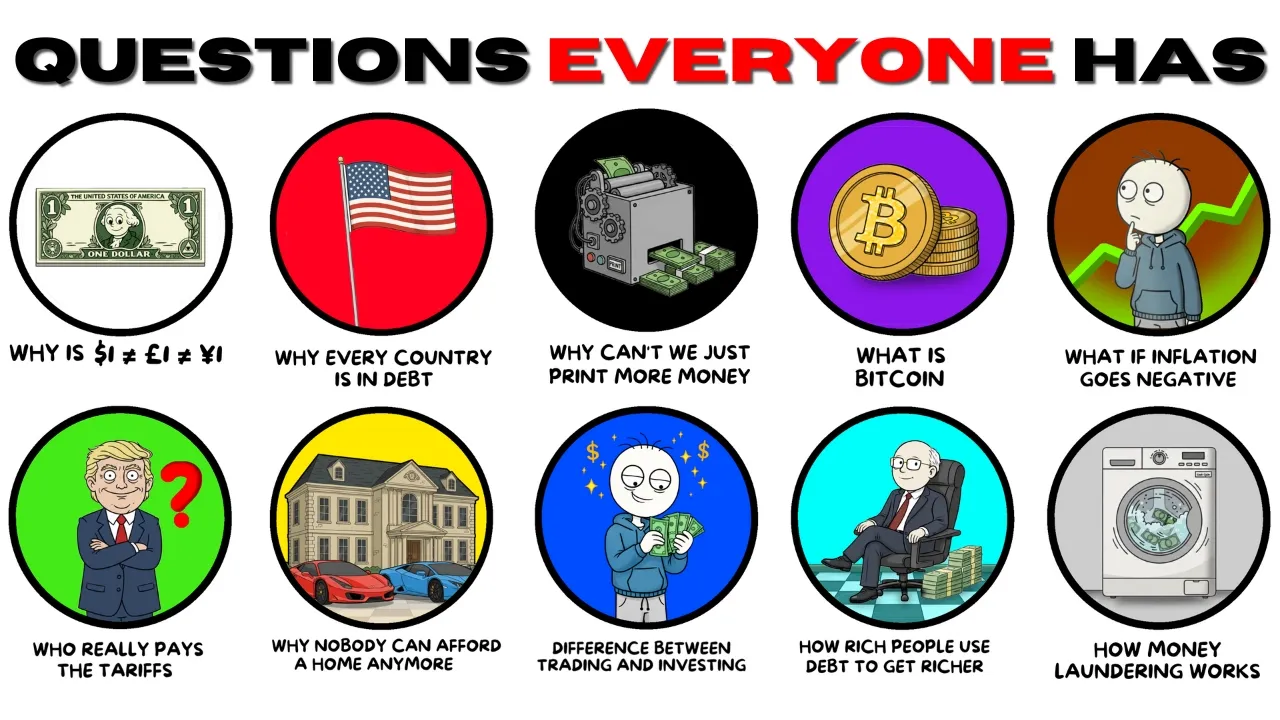
Why is $1 not the same as 1 pound or 1 yen? A dollar, a pound, and a yen are all just pieces of paper or numbers on a screen. So, why isn't $1 worth the same as 1 pound or 1 yen? It seems random, like someone just decided what each currency should be worth. But, currency value isn't about the symbol printed on it. It's about what that currency can buy and how much people trust the economy behind it. Every
83 words, the words spoken in the first 30 seconds at 166 words per minute.
Free, no signup. See how the first 30 seconds hold attention, with rewrites.
Sentence shape
What this transcript is
Every word below is the caption track YouTube publishes for this video, pulled from the video itself and reproduced unchanged. It is not Prepublish's writing, not a summary, and not a re-transcription: it is the video's own published captions. English captions, generated automatically by YouTube, in the video’s original language. Source: the video on YouTube. A channel that would rather this page did not exist can ask for its removal through the contact page, and it is removed.
Why is $1 not the same as 1 pound or 1 yen? A dollar, a pound, and a yen are all just pieces of paper or numbers on a screen. So, why isn't $1 worth the same as 1 pound or 1 yen? It seems random, like someone just decided what each currency should be worth. But, currency value isn't about the symbol printed on it. It's about what that currency can buy and how much people trust the economy behind it. Every currency represents the strength of the country that issues it.
When a country's economy grows, produces goods, and attracts investment, demand for its currency rises. More demand means higher value. When an economy struggles, loses jobs, or prints too much money without backing it with real value, trust falls. Less trust means the currency weakens. Exchange rates shift constantly because economies are always moving. A dollar might buy you 100 yen today, but tomorrow it could buy 98 or 102, depending on what's happening in America and Japan.
The value also depends on trade. If Japan sells more products to America than America sells to Japan, demand for yen increases because American companies need yen to pay Japanese suppliers. That pushes the yen's value higher compared to the dollar. It's a marketplace where currencies compete based on economic performance, trade balance, and investor confidence. So, a dollar doesn't equal a pound because America and Britain have different economies, different amounts of money in circulation, and different levels of global trust.
Currency value reflects reality, not randomness. The number on the bill means nothing. What matters is the economy standing behind it. Why every country is in debt and who they owe. Every major country on Earth owes money. America, China, Japan, Britain. Trillions of dollars in debt. But, if everyone owes money, who are they paying? The answer is each other and their own citizens. When a government needs money to build roads, pay soldiers, or fund hospitals, it doesn't just print cash.
Instead, it borrows by selling bonds. A bond is essentially an IOU. You give the government $1,000 today, and in 10 years, they pay you back $1,200. Individuals buy bonds, banks buy bonds, other countries buy bonds, pension funds and investment firms buy bonds. The debt gets split across millions of lenders. So, when America owes $36 trillion, it owes that money to American citizens holding savings bonds, to China holding Treasury bonds, to Japan, to investment funds managing retirement accounts.
China holds over $1 trillion of US debt, but America also holds Chinese debt. Countries lend to each other constantly because bonds are considered safe investments. Governments almost never pay off the full debt. They just keep refinancing, selling new bonds to pay off old ones. As long as the economy grows and people trust the country will keep paying interest, the system works. National debt isn't like personal debt.
You can't repo a country. Debt becomes a problem only when trust collapses and nobody wants to lend anymore. Until then, everyone stays in debt and everyone keeps lending. Why can't we just print more money? If the government needs money, why not just print more? Run the printing press, create a trillion dollars, and suddenly everyone's problems are solved. But money only works when it represents something real. Imagine your town has 100 people and 100 loaves of bread.
Each person has $10, and each loaf costs $10. Supply matches demand. Now, imagine the government prints another $1,000 and hands it out. Suddenly, people have more money, but there are still only 100 loaves of bread. Everyone rushes to buy bread, and the baker realizes people will pay more. Prices rise to $20, then 30. The money in your pocket didn't make you richer. It just made everything more expensive. That's inflation.
Printing money doesn't create value. It dilutes value. When more money chases the same amount of goods, prices climb until the extra cash becomes worthless. In Germany during 1923, the government printed so much money that people needed wheelbarrows full of bills to buy groceries. A loaf of bread cost billions of marks. The money became wallpaper. Governments can print money, but only if the economy grows with it. More products, more services, more value.
Print without growth and you destroy trust in the currency itself. Money represents work, resources, and productivity. Creating bills doesn't create any of those things. You can't print wealth. You can only print inflation. What is Bitcoin? Bitcoin is digital money that exists only online. No coins, no bills, just code. But unlike the dollars in your bank account, no government or company controls it. Bitcoin runs on a system called blockchain, a public ledger that records every transaction ever made.
Here's how it works. When you send someone Bitcoin, that transaction gets broadcast to thousands of computers around the world. These computers, called nodes, verify the transaction by solving complex math problems. Once verified, the transaction gets added to a block, and that block gets chained to all previous blocks. Everyone can see the transaction happened, but nobody knows who you are. Your identity stays hidden behind a string of random letters and numbers.
Because the system is decentralized, no single person or institution can control it, freeze your account, or print more Bitcoin whenever they want. There will only ever be 21 million Bitcoins in existence. Scarcity is built into the code. That's why people call it digital gold. But Bitcoin has problems. Transactions are slow compared to credit cards. The price swings wildly, making it hard to use as actual currency. And because there's no central authority, if you lose your password, your money is gone forever.
No customer service, no reset button. Bitcoin proves you can create money through math instead of trust in governments. Whether that makes it the future of finance or just a speculative asset depends on who you ask. Either way, the code doesn't lie and the ledger never forgets. What if inflation goes negative? Falling prices sound like a dream. Your groceries get cheaper, your rent drops, everything costs less every month.
But when inflation goes negative, when deflation sets in, the economy doesn't celebrate. It freezes. Here's why. If you know prices will be lower next month, you wait to buy. Why purchase a car today for $30,000 when it might cost $28,000 in 6 months? Consumers delay spending. Businesses notice fewer sales, so they cut prices further to attract buyers. But that just reinforces the cycle. People wait even longer because they expect prices to keep falling.
As demand collapses, companies lose revenue. They lay off workers to survive. Unemployment rises. People have less money, so they spend even less, and prices fall harder. The economy spirals downward, feeding on itself. Deflation turns into a trap where everyone waits, nobody spends, and commerce grinds to a halt. Debt becomes crushing during deflation. If you borrowed $50,000 to start a business, you still owe 50,000, but now your revenue is shrinking because prices are dropping.
The loan stays the same size while your ability to pay it back gets smaller. Defaults rise, banks fail, and credit disappears. Japan experienced this during the 1990s. Prices fell, people stopped spending, and the economy stagnated for decades. Inflation feels painful, but deflation is paralysis. Economies need prices to rise slowly. Movement keeps the system alive. Falling prices might sound good, but they signal that the engine is dying.
Who really pays the tariffs? When a government puts a tariff on imported goods, it sounds like the foreign country is getting punished. A 25% tariff on Chinese steel feels like China writing a check to America, but that's not how it works. The foreign country doesn't pay a cent, you do. Here's the actual process. An American company wants to import steel from China. The steel costs $1,000, but because of the tariff, the US government charges the American company an extra $250 at the border.
The company pays that tax, not China. The Chinese supplier still gets their $1,000. They don't lose anything. Now, the American company has a choice. They can absorb the extra cost and lose profit, or they can raise prices to cover it. Almost always, they raise prices. That steel gets used to make cars, appliances, and buildings. Every product made with that steel becomes more expensive. The tariff gets passed down the chain until it reaches the final buyer, you.
Sometimes, tariffs protect local industries by making foreign goods less competitive. American steel might become cheaper than Chinese steel after the tariff, so companies buy domestic. But even then, prices stay high because local producers know they don't have to compete as hard anymore. Either way, consumers pay more. Tariffs are taxes on imports, and taxes always get passed to the end user. Foreign countries don't foot the bill, the cost just quietly appears in your shopping cart.
Why nobody can afford a home anymore. 50 years ago, a single income could buy a house. Today, two incomes barely qualify for a mortgage. Housing prices have exploded while wages crawled forward. The gap between what people earn and what homes cost has become a chasm. Here's what happened. In 1970, the average home cost around $23,000. Adjusted for inflation, that's about 170,000 today. But actual home prices now average over 400,000.
Wages didn't keep pace. A middle-class salary in 1970 could cover a mortgage, groceries, and savings. That same job today struggles to cover rent. Supply is part of the problem. Cities restrict new housing through zoning laws, environmental reviews, and neighborhood resistance. Fewer homes get built, but population keeps growing. Limited supply with rising demand pushes prices higher. Then investors entered the market.
Corporations and wealthy individuals started buying homes not to live in, but to rent out or flip for profit. Housing became an investment vehicle instead of just shelter. When Wall Street treats homes like stocks, regular buyers get priced out. Low interest rates made borrowing cheap, so people borrowed more, which drove prices even higher. Banks approved bigger loans, sellers raised asking prices, and the cycle fed itself.
Millennials and Gen Z now face a market where saving for a down payment takes decades, not years. Homes were once places to build a life. Now they're assets in a portfolio, and the people who need them most can't compete with the people who already own 10. Difference between trading and investing. Trading and investing both involve buying stocks, but the goals and timelines are completely different. One is a sprint, the other a marathon.
Understanding the difference changes everything about how you approach the market. Trading means buying and selling quickly to profit from short-term price movements. A trader might buy a stock in the morning and sell it by afternoon, or hold it for a few days or weeks. They're betting on momentum, news events, or technical patterns. The goal is fast profits from volatility. Traders watch charts constantly, looking for the perfect moment to jump in and out.
They thrive on movement, whether prices go up or down. Investing means buying assets and holding them for years, sometimes decades. Investors choose companies they believe will grow over time. They care about earnings, business models, and long-term potential. When the market crashes, traders panic. Investors wait it out, knowing history shows markets recover. Warren Buffett, one of the richest investors alive, built his fortune by buying quality companies and holding them for 30 or 40 years.
Trading requires constant attention, quick decisions, and nerves of steel. Most traders lose money because timing the market is nearly impossible. Investing requires patience, research, and the ability to ignore daily noise. Compound interest does the heavy lifting over time. Both can make money, but they demand different mindsets. Trading bets on the next move. Investing bets on the future. One plays the game, the other plays the long odds.
Choose based on your personality, not just the promise of quick cash. How rich people use debt to get richer. For most people, debt means owing money on credit cards or student loans. Something to avoid. Something that drags you down. But for the wealthy, debt is a tool. They borrow on purpose, not out of necessity, and use it to multiply their wealth while avoiding taxes. Here's how it works. Imagine you own $10 million worth of stock.
If you sell it to buy a house or start a business, you pay capital gains tax on the profit. The government takes a chunk, maybe $2 million. But if you borrow against the stock instead, using it as collateral, you get cash without selling anything. Banks give you a loan at low interest rates because they know you're good for it. Now you have money to spend, and you still own the stock. No sale means no taxes. The wealthy do this constantly.
They borrow against their assets to fund their lifestyle, invest in new ventures, or buy more assets that appreciate in value. The debt costs less than the growth of their investments. If your stock portfolio grows 10% a year, but your loan only costs 3% interest, you're making 7% by borrowing. Meanwhile, average people can't access these loans. Banks won't lend millions against a modest retirement account. Debt for the poor means high interest rates and mounting payments.
Debt for the rich means leverage and tax avoidance. The system rewards those who already have wealth, letting them borrow their way to more while others drown trying to pay theirs off. How money laundering works. Money laundering is the process of making illegally earned cash look legitimate. Drug dealers, corrupt politicians, and criminals can't just deposit millions into a bank without raising suspicion. They need a story that explains where the money came from.
That's where laundering begins. The process has three stages. First is placement, getting dirty cash into the financial system. Criminals might deposit small amounts across multiple bank accounts to avoid detection, or they buy expensive items like cars and jewelry with cash. The goal is to convert physical money into something trackable without triggering alarms. Next comes layering, moving the money through complex transactions to obscure its origin.
They transfer funds between shell companies, offshore accounts, or foreign banks. Buy a property in one country, sell it in another, wire the proceeds through three more accounts. Each transaction buries the trail deeper. Investigators lose track of where the money started because it's been sliced, moved, and reassembled dozens of times. Finally, integration brings the money back as clean income. Criminals invest in legitimate businesses like restaurants, car washes, or real estate.
These businesses report inflated earnings, mixing dirty money with real revenue. Now the cash looks like profit from a legal operation. They pay taxes on it, and suddenly drug money becomes a paycheck. Money laundering works because the financial system is massive and complicated. Millions of transactions happen daily, and most look normal. Hide your illegal cash inside that noise, and it disappears. Laundering doesn't hide the money, it hides the crime.
The words are the caption track's own and nothing is reworded or re-transcribed. Paragraph breaks are placed between sentences so the text reads as prose.
Free tools for your own script. No signup, no login.
Paste your draft and see where viewers are likely to drop off, with a rewrite for each weak line.
Paste the first 30 seconds of your own draft for a hook score and rewrites.
Check your draft against YouTube's advertiser-friendly guidelines before you record it.
Read this channel's public videos and transcripts, and download a writing brief for it.
| Measure | This transcript |
|---|---|
| Sentences | 239 |
| Average words per sentence | 10.6 |
| Longest sentence | 29 words |
| Questions asked | 9 |
| Sentences containing a number | 29 |
Most used terms
Filler phrases
10 in total: like 9 · you know 1.
A literal whole-word count of the same phrase list the Prepublish browser extension uses, so a phrase inside another word is not counted and a phrase used in its ordinary sense still is. It is a count and not a judgement.