Getting the transcript
Reading the captions from YouTube. A video nobody has opened here before takes 10 to 30 seconds; this page fills in on its own.
Getting the transcript
Reading the captions from YouTube. A video nobody has opened here before takes 10 to 30 seconds; this page fills in on its own.
J.J. McCullough · @JJMcCullough
This video has no Most replayed graph yet: YouTube shows one only once a video has enough views. These are the moments viewers replayed most in J.J. McCullough's most watched videos.
Most replayed moment at 17:46
9.9x that video's typical replay level
cartoon characters drawn in this very unique flat style that hasn't really been seen much since. Good morning, McCullen [music] way. CORN FLAKES. NOW, I WOULD say that nostalgia for the mid-century era began basically the moment it ended. Certainly
Said at 17:40
Most replayed moment at 15:35
4.9x that video's typical replay level
running large complex institutions our last two prime ministers by contrast hadn't ever run much of anything and number four he is a relatively good communicator throughout his long career as a globalist elitist he has often gone
Said at 15:28
The graph counts replays. It does not show where viewers stopped watching.
Words
4,227
Runtime
26:50
Speaking pace
158wpm
Reading time
18min
158 words per minute, below the 160 25th percentile of 349 measured videos. That distribution comes from the 349-video hook study.
Opening (first 30 seconds)
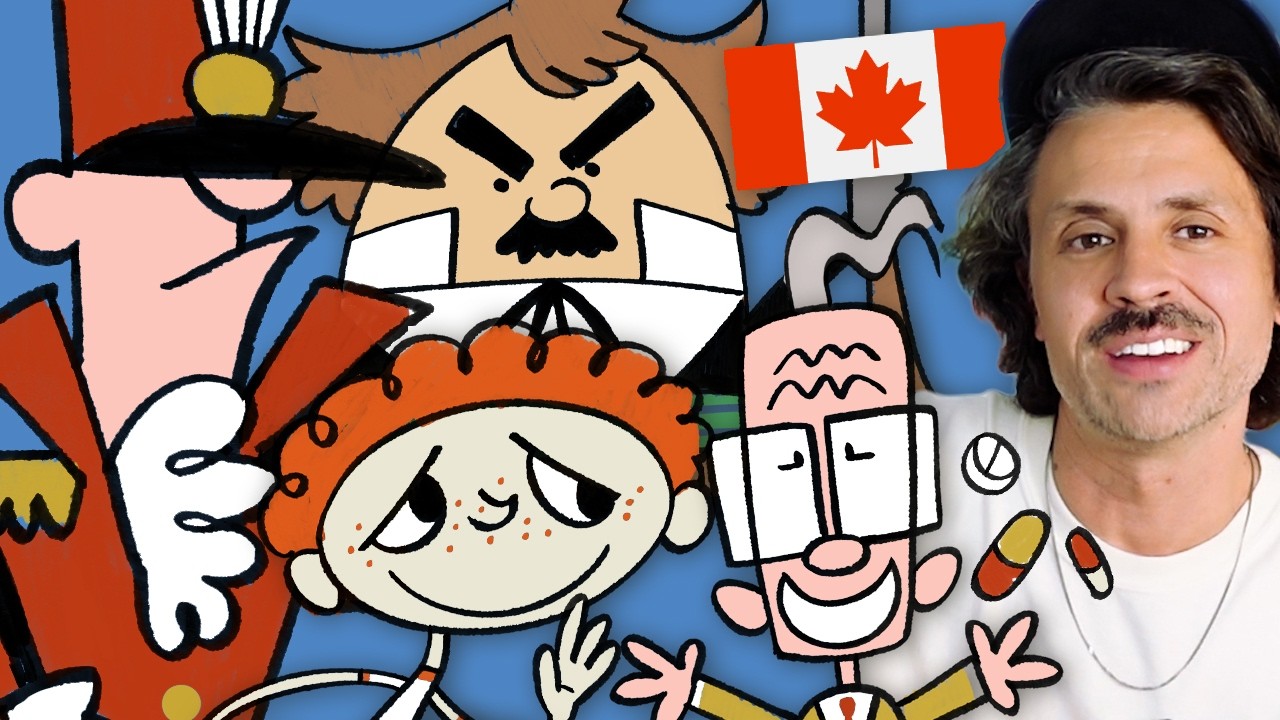
Hello friends, my name is JJ and people often come up to me and say, "J, I love learning about Canadian things from you. I wish they taught us more Canadian things in school." And I hear this both from foreigners whose education system generally ignores Canada, but also from Canadians who feel our education system isn't doing a great job of teaching Canada facts either. So today I have come up with a list of 10 [music] Canadian
79 words, the words spoken in the first 30 seconds at 158 words per minute.
Free, no signup. See how the first 30 seconds hold attention, with rewrites.
Sentence shape
| Measure | This transcript |
|---|---|
| Sentences | 184 |
| Average words per sentence | 23.0 |
| Longest sentence | 68 words |
| Questions asked | 2 |
| Sentences containing a number | 36 |
Most used terms
Filler phrases
36 in total: like 15 · sort of 12 · actually 3 · kind of 3 · basically 2 · literally 1.
A literal whole-word count of the same phrase list the Prepublish browser extension uses, so a phrase inside another word is not counted and a phrase used in its ordinary sense still is. It is a count and not a judgement.
What this transcript is
Every word below is the caption track YouTube publishes for this video, pulled from the video itself and reproduced unchanged. It is not Prepublish's writing, not a summary, and not a re-transcription: it is the video's own published captions. English captions, generated automatically by YouTube, in the video’s original language. Source: the video on YouTube. A channel that would rather this page did not exist can ask for its removal through the contact page, and it is removed.
Hello friends, my name is JJ and people often come up to me and say, "J, I love learning about Canadian things from you. I wish they taught us more Canadian things in school." And I hear this both from foreigners whose education system generally ignores Canada, but also from Canadians who feel our education system isn't doing a great job of teaching Canada facts either. So today I have come up with a list of 10 [music] Canadian historical figures that traditionally all Canadians would have been expected to know.
The sort of people who an educated Canadian would be expected to recognize and understand the significance of when referenced in newspaper articles or speeches or pop culture. I didn't put any value judgments into this list. It's not diverse and I'm not saying the people on it are uncomplicated heroes or anything. They're just people who come up a lot and will thus improve your Canadian cultural literacy by knowing. So, let's go through them all in chronological order.
Starting with [music] in the official opinion of the Canadian government, Samuel Champlain is the founder of Canada. At the Governor General's House in Ottawa, they have this big list of all of the rulers of Canada, and Samuel Champlain is the very first name. I talked about this a bit in a video I made a few years ago, but in terms of the transfer of political power over the centuries, it is possible to draw a line from Samuel Champlain all the way to Mark Carney if you try hard enough.
Though that being said, I feel like in modern Canada, Champlain is mostly thought of as the guy who founded French Canada. Samuel Duchamplain was a French explorer who was later appointed the first governor of New France, the colony that modern Canada more or less evolved out of. He wasn't the first Frenchman to set foot in Canada, but he was the first to create a permanent colony. In6008 he founded the settlement that would later become Quebec City with that settlement in turn expanding outward into a larger colony that France would run for the next 150 years.
If you go to Quebec City today, you will see lots of champagne statues and souvenirs and guys in costumes pretending to be him and that sort of thing. The French Canadians are often thought of as being very romantic and sentimental about their history and caring a lot about heroic figures from the New France era. And I feel like most Canadians today think of Champlain as one of these characters because he existed at a time when the colonization of North America was still in such an early state.
He's not really of much obvious relevance to the rest of the country, but he's definitely one of these very historically officially important men whose name you have to memorize to pass 9th grade social studies. At one time, General Wolf would have been considered one of the greatest, most obviously important, and heroic men in all of Canadian history. There is a famous Canadian patriotic song from the late 19th century called the maple leaf forever that contains this line.
In days of your from Britain's shore, Wolf the Dauntless hero came and planted firm Brana's flag on Canada's fair domain. So in other words, Wolf was the guy who conquered Canada for England. In the 1750s, the British went to war with the French over control of North America. the so-called French and Indian War and under General Wolf's leadership, the French were defeated. New France became a British colony and would remain one for the next two centuries.
Wol was killed in that war in the Battle of the Plains of Abraham. There is a painting of him dramatically dying on the battlefield. That is one of the most famous paintings in all of Canadian history, often parodyied in political cartoons and things. Now, the reason why Wolf has become more controversial over the years is because, of course, the standard telling of his story reflects a certain Anglo triumphalist vision of Canada, wherein Wolf's conquest of the French [music] was obviously a good thing.
Canadian history has been traditionally told from the perspective of the English just because they have been the dominant group here since, well, Wolf. The French Canadians, however, have traditionally framed what they call the conquest as the greatest tragedy of their history. The cruel and unjustified stealing of their land that they stole from the Indians first. By the time I was in grade school, they were teaching a much more consiliatory version of all of this, wherein alongside General Wolf, we were also supposed to learn to respect and appreciate the marquee demon who was the commander of the French forces and a man just as brave and heroic as General Wolf and who also died in the Battle of the Plains of Abraham.
And I remember my father, a conservative AngloCanadian born in the late 1940s, really saw all of this as just a load of woke BS. They lost, he would say. That's the story. [music] General Brock, much like General Wolf, was another martyed English general who died fighting to keep Canada British. In this case, in the war with the United States that lasted from 1812 to 1814, the so-called war of 1812. Canada tends to have a bit of main character syndrome about this war, which was rooted in a breakdown of relations between the US and Great Britain in the early 19th century.
And it culminated in an American invasion of Britain's territories to the north and a British invasion of American territories to the south. The peace treaty that ended the war resulted in neither side gaining any new land, which allowed the Americans to imagine it as their second war of independence and the Canadians to imagine it as a war to save Canada from American conquest. As America and Britain gradually grew closer, the 1812 war was eventually forgotten, which then allowed the Canadians to sort of make it their own thing.
General Brock was recast as a great Canadian hero, a man who had given his life fighting for Canada. A lot of this plays into traditional anti-American sentiment in Canada, and the memory is kept alive in large part because it encourages a kind of anti-American Canadian [music] nationalism. Prime Minister Carney himself has been fond of incorporating the legend of General Brock defending Canada into some of his own anti-American rhetoric during this current trade war with the Trump administration.
He even put out a video a while back where he talks about how he has this little toy of General Brock on his desk that he looks at every day to remind himself of the inherent untrustworthiness of the Americans. Brock was a hero who fought and gave his life for our forebears in the War of 1812. Before Canada even existed on paper, it had a shape in Brock's imagination. Faced with the threat of an American invasion, Brock built alliances across our land and inspired what would eventually become Canada.
These days, Canadians can sometimes get a little bit uncomfortable being reminded that we lived as colonial subjects of the British Empire for as long as we did. When the government of Canada celebrated the 200th anniversary of the 1812 war in 2012, they erected a monument in Ottawa called Triumph Through Diversity that portrays the defense of Canada as something a lot more populist and bottomup than it probably was, involving a rag tag bunch of French Canadians and women and indigenous people rather than just a single aristocratic white general.
A considerably cornier character associated with the 1812 war is Laura Secord. I feel like a lot of countries have characters like her in their official histories. She's not really a historic figure as much as like a little cute anecdote. Laura Cord was some sort of farm girl who was out walking her cow [music] one day and she overheard some evil Americans plotting a big attack on Canada. So she ran many miles with her cow to tell General Brock, who was then able to thwart the attack and save Canada the end.
Laura Seord was a real person who lived for quite a long time and until the end of her life, they would often wheel her out to various patriotic things as an example of virtuous Canadian womanhood. But as is often the case with these sorts of stories, a lot of the details of the Laura Cord tale have been heavily mythologized and exaggerated over time. And for that reason, she is now seen as a somewhat trit or cheesy character who can probably be safely ignored in favor of historic [music] figures who did more things of actual substance. in contemporary Canada.
Her legacy lives on most visibly in the form of the Laura Secord Chocolate Company, which can be found in all of Canada's finest malls. This is a company that was founded in 1913 and named in her honor, which reflects how much more of a front of mind patriotic symbol she was in those days. Lord Durham served as British governor of Canada for a couple of months in the late 1830s. A liberal and a reformer under the old Anglocentric perspective of Canadian history.
He was considered the man who brought parliamentary democracy to Canada. Though other groups have a different take. After the American Revolution and then the War of 1812, there was a thinking in England that the Canadian colonies probably shouldn't be given too much democracy. There was a persistent fear that if the Canadians were given too much control over their own affairs, they might vote to make themselves independent or scarier yet, join the US.
However, as the Canadian population became larger and wealthier, there was growing resentment in the colonies that the British were keeping Canada under such a paternalistic colonial regime. And in the 1830s, there started to be organized protests and even armed uprisings against British rule. It was in this context that the Wig administration in Great Britain appointed the Liberal Lord Durham as governor and he wrote a very famous report that recommended the establishment of a proper British style elected parliamentary government for Canada and ditching the authoritarian system of governor and council government that had been used up until that point.
What makes Durham controversial is that he was also of the belief that the tolerance that the French Canadians had received following the conquest had been a mistake. He said the survival of a distinct French Canadian identity had been at the root of a lot of the political unrest in Canada since it was the French Canadians who obviously felt the least loyalty to British rule who had been the most defiant and rebellious.
Assimilation of the French into the English mainstream, Durham said, had to come handinhand with democratization. [music] Like many British liberals of the time, Durham had a very condescending attitude towards non-English cultures, and he saw the French Canadians as very backwards and childlike. To a lot of French Canadian nationalists, Durham's beliefs are kind of the original sin of the entire Canadian project. The idea that Durham said openly what English elites have always believed and even believe to this day, the French are a [music] problem to be solved.
There are actually at least two important guys named Cartier in Canadian history, which reflects something that tends to come up a lot in Canadian history. Reoccurring French last names. As I discussed in my award-winning video on Canadian races, French Canadians are the descendants of a relatively small number of colonial families. So, you tend to see the same last names a lot. The first Cartier, Jacques Cartier, was a 16th century French explorer associated with the earliest European discovery of North America.
But this Cartier, George Etien Cartier, was a Victorian era politician who is supposed to be understood as like the founder of the grand French English coalition at the heart of modern Canada. After Lord Durham's reforms, there was a Canadian Parliament that was half elected by the French Canadians and half elected by the English Canadians. And there was a cabinet formed by the leaders of the majority faction of each half of the parliament.
What we would today think of as like proto political parties. Cartier was head of the moderate French [music] faction. And in 1858 he formed an alliance with a guy called John A. Macdonald who was head of the conservative English faction. In 1867, they helped write a new constitution for a new Canadian confederation of equal self-governing provinces, which is still the constitutional system that we use today. This is of course a crude oversimplification of what actually happened which involved a ton more people.
But the standard telling is that McDonald and Cartier were the top guys and their pragmatic working relationship in creating the confederation constitution embodies the spirit of French English cooperation that built Canada and we should all still aspire to today. Over the years, their faces have been seen on all sorts of various commemorative knickknacks. And there are a number of things in Canada called the McDonald Cartier this or that, like the McDonald Cartier International Airport in Ottawa or the [music] McDonald Cartier Freeway that connects Ontario and Quebec.
Here is some sort of commemorative medal that I found on eBay. On the back, it has a little paragraph that I think summarizes the standard narrative quite well. leaders of English and French-speaking Canada. They both played a most important part in the movement towards confederation. Macdonald would go on to become the first prime minister of Canada, while Cartier became the [music] first chairman of the parliamentary railways committee, which might not sound as impressive, but that was a very important job in those days.
Unlike Macdonald, who is one of the most well-known personalities in Canadian history, Cartier remains a somewhat mysterious figure. And there's still a lot we don't know about him. This is because he was constantly having affairs. And when he died, his scorned wife burned all of his personal documents, thereby destroying a wealth of primary source material for future biographers. Louis Realel is this sort of wild and rugged character associated with Western Canada in the late 19th century.
He is considered the founder of the province of Manitoba, which although not a very important part of Canada today, was the first part of Western North America to be incorporated into the growing Canadian Confederation. So it carries symbolic relevance as an embodiment of Canada's westward expansion. By the mid 1800s, the central lowlands of North America were home to a sizable population of mixed [music] race people who were the descendants of French Canadian fur traders who [music] had taken Native American brides.
Today we call these people the matei, but at the time they were known by the much crudder term half breeds. And there was this whole distinctive halfbreed civilization that combined traditional indigenous self-sufficient huntergatherer lifestyles with French Canadian farming traditions and an [music] esoteric flavor of Catholicism among other things. Louis Rial was a charismatic matey man who emerged as a leader of his people.
And as the Canadian government moved to colonize his area with white settlers, he led a movement of violent resistance. He did eventually negotiate the surrender of the Matei occupied lands to Canada. And it was from this that the province of Manitoba was created in 1870. A few years later, however, Realel led another violent [music] uprising when he believed the terms of the deal had been broken. And for this, he was arrested, tried, and executed for treason.
Manitoba was aggressively populated with white settlers, and much of the original Matei culture was wiped out. For much of Canadian history, Reel was considered a very contentious and controversial figure. I have this book of great Canadians from 1965 and in the introduction they mention how they thought about including real but ultimately concluded that his contribution to Canada was not a [music] positive one. But in the 1960s and 70s, there started to be more of a celebration of Native American resistance across this continent.
And Real was recast as a sort of heroic revolutionary who had opposed [music] the imperialism of his day and deserved more applause than he had received in his own time. In modern Canada, showing remorse for the historic wrongs done to indigenous peoples is now considered very important indeed. And with the Matei now constitutionally recognized as one of Canada's three legally protected Aboriginal groups, it's unlikely these days to see Louis Realel spoken of as anything other than an unambiguous hero and indeed an honorary founding father of the [music] Canadian Confederation.
A certain sort of Canadian is probably most familiar with him for being the main character of this very acclaimed [music] graphic novel biography by Chester Brown. Next is Scott Pilgrim. It's probably the most famous graphic novel ever written by a Canadian. Tommy Douglas is perhaps the single most famous politician from the NDP, Canada's rather perennially unsuccessful social democratic party. He's associated with the creation of the Canadian public health care system, which is often listed as the thing that makes people in this country the proudest to be Canadian.
[music] Douglas was a Baptist preacher associated with Canada's depression era socialist movement and in 1944 he was elected head of the government of Saskatchewan, the first NDP premier of any [music] Canadian province. His government accordingly introduced the first version of singlepayer [music] health insurance anywhere in Canada which was particularly revolutionary just because in those days and especially in a workingclass rural province like Saskatchewan most people didn't have any form of health insurance at all.
Douglas later became head of the national NDP and ran for prime minister four times though he never came remotely close to winning. The conventional story is that he used his party's third place status in a closely divided parliament as leverage in order to get a national Medicare program based on the Saskatchewan one passed by the Liberal government of the time. Now, I don't mean to yuck the yum of any NDP supporters who may be watching, but revisionist scholarship has argued that there isn't really a lot of hard proof that this is how the Canadian Medicare system was actually created. the liberal administration of Prime Minister Lester Pearson wanted some sort of national Medicare program anyway and didn't really care what ideas the NDP or Douglas did or didn't have since they knew they would just vote for it anyway.
Nevertheless, this idea that Tommy Douglas modeled how the NDP could push liberal governments to the left in an era of closely divided parliaments is a popular legend that helps provide a rationale for voting NDP at all. And to be fair, there is proof of it happening in other eras, even if not necessarily Tommy's. In any case, Tommy Douglas was undeniably a kind and compassionate man, a sort of twinkly grandfatherly spirit.
If we think of Canada as basically being a threeparty system, then his role since his death in 1986 has been to be a sort of patriotic mascot for the NDP, proving that even though their party is small, they too have made a major contribution to the pantheon of great Canadian statesmen. [music] In 1976, Renee Lec became the first Quebec separatist to ever get elected [music] prime minister of Quebec. Even among non-separatist Quebecers, he remains an extremely venerated figure, widely considered the greatest premier in Quebec history.
Quebec politicians still constantly cite his name all the time as a role model and an inspiration. And a lot of this is tied up to the idea that Lec was just a very principled and intelligent man who really loved Quebec and the people of Quebec in this very deep and sincere way. He began his political career in the 1960s working for Quebec's Liberal government. But then in 1968, he quit to found a new separatist party [music] known as the Party Quebec WA because he'd grown disillusioned with what Quebec could achieve within the Canadian system.
He would always describe his vision of an independent Quebec in mostly positive terms. Quebec society had become increasingly modernized and self-confident during the course of the 20th century. And now it was time to take the final step. In English Canada, meanwhile, LC was regarded with enormous derision and scorn, a man who was basically engaging in a form of treason against the country that had given him the freedom to do it.
Many English Quebecers in particular saw him as a kind of chauvinistic bigot. A man whose obsession with the idea of the French Canadians as the only true Quebecers became a pretext for passing all of these laws to limit the use of English and business and schools. Following LeC's election in 1976, a ton of English Quebecer families left and moved to other provinces in what remains one of the most significant demographic migrations in Canadian history.
On a more superficial level, LEC was also a very unusual looking guy, which coupled with his controversial reputation made him an extremely popular target of Canadian cartoonists. He was very short with big bushy sideburns and the world's most obvious comover and was a fivepack a day chain smoker. He had a very tense relationship with Prime [music] Minister Pier Elliot Trudeau and this tends to come up a lot as well.
Le obviously never achieved his dream of an independent Quebec, but his popularity helped him shift the Overton window of Quebec politics quite dramatically. today. A lot of the principles that he fought for, that Quebec should be structured as a homeland for the French Canadians, that the province should have a fundamentally adversarial relationship with the federal government based on extracting concessions, and that separatism should be retained as the ultimate threat are now just the conventional wisdom of the province's political class.
And lastly, we got Terry Fox. Terry Fox is unlike all of the other characters we've talked about today. just because he wasn't someone involved with the political history of Canada. For a time, however, you could probably argue that he was the most famous and beloved Canadian of the 20th century, at least in Canada itself. Terry was an athletic college student with bone cancer. And when he was 18, he had to get one of his legs amputated.
He then came up with the idea that in order to raise money and awareness for cancer research, he would do a one-man marathon across Canada. the 1980 Marathon of Hope and it became this big spectacle of optimism and goodwill. Terry started his run in Newf Finland. And as he passed through all of these small Canadian towns, people would come out of their houses and wave him on as he hobbled by on his prosthetic leg. And then when he arrived in the big urban areas, the mayor would come out and give him the key to the city and all of this.
He was very kind and handsome and Christian and in the context of the otherwise dreary year that was 1980. Terry was a nice feelgood story. He didn't ultimately make it however and after getting barely halfway across the country the run became too painful and he went back to his home in Vancouver where he died of his cancer a year later. Terry had already been portrayed as a sort of Christlike figure in the Canadian press and after his death he really crossed the line into becoming a secular saint, a perfect man who had given his life to better humanity.
I was born not too long after Terry died. And growing up, I remember how much we were taught to see him as like the purest embodiment of Canadian heroism, especially on Terry Fox Day, where we would do a sad little run around the perimeter of the school and then ask our parents to make a donation to the Canadian Cancer Society. But that said, the Terry Fox Foundation does claim to have helped raise over a billion dollars for cancer research since Terry's death.
So clearly, the call to ruin him has literally paid off. So, that would be my list of 10 people who educated Canadians are generally expected to be broadly familiar with. I didn't really talk about the prime ministers because I felt like that would be a little too on the nose. And I've also already made a video about them. If you're an educated Canadian, what additional names do you think should be on a list of Canadian historical figures that everyone should know?
And if you're not Canadian, do you feel like there are any famous Canadians who tend to come up a lot that you would like to learn more about? Let me know in the comments and I will see you next [music] week. >> [music]
The words are the caption track's own and nothing is reworded or re-transcribed. Paragraph breaks are placed between sentences so the text reads as prose.
Free tools for your own script. No signup, no login.
Paste your draft and see where viewers are likely to drop off, with a rewrite for each weak line.
Paste the first 30 seconds of your own draft for a hook score and rewrites.
Check your draft against YouTube's advertiser-friendly guidelines before you record it.
Read this channel's public videos and transcripts, and download a writing brief for it.