Getting the transcript
Reading the captions from YouTube. A video nobody has opened here before takes 10 to 30 seconds; this page fills in on its own.
Getting the transcript
Reading the captions from YouTube. A video nobody has opened here before takes 10 to 30 seconds; this page fills in on its own.
AI Engineer · @aiDotEngineer
This video has no Most replayed graph yet: YouTube shows one only once a video has enough views. These are the moments viewers replayed most in AI Engineer's most watched videos.
Most replayed moment at 18:45
4.8x that video's typical replay level
that they're they're changing they're changing things in the database not yet. You want to run them through the ontology first and make sure that works. Okay. I only got an I've got I've got another I've just a short time. I'm going to try to show you some of the things that um that you can
Said at 18:37
Most replayed moment at 16:13
3.6x that video's typical replay level
method signatures, the program layout and the call stacks. So here's some examples. I don't think you'll be able to read this one, but this is like the level of abstraction we're at. It's how we're actually going to lay this stuff out and how these systems are going to interact. Dylan Mulroy from Cloudflare talks a
Said at 16:06
Most replayed moment at 13:49
2.3x that video's typical replay level
Fable uh and it runs into an unknown, ask it to log it, right? So that um you uh you can see where the deviations happened and then you can sort of figure out why as well, you know? It will usually give you some context about what happened.
Said at 13:43
The graph counts replays. It does not show where viewers stopped watching.
Words
1,504
Runtime
10:51
Speaking pace
139wpm
Reading time
6min
139 words per minute, below the 160 25th percentile of 349 measured videos. That distribution comes from the 349-video hook study.
Opening (first 30 seconds)
Here's something nobody warns you about when you start building agents alone. You think you're building prompts. You think your building skills are worthless. If you build long enough, specially alone, you will start building something completely different. Something that looks suspiciously like CICD. Except worse, because you're building it from scratch, one failure at a time. I'm Sumaiya. I run a 19 skill cloud code agent system. Writing, research,
70 words, the words spoken in the first 30 seconds at 139 words per minute.
Free, no signup. See how the first 30 seconds hold attention, with rewrites.
Sentence shape
| Measure | This transcript |
|---|---|
| Sentences | 165 |
| Average words per sentence | 9.1 |
| Longest sentence | 32 words |
| Questions asked | 13 |
| Sentences containing a number | 5 |
Most used terms
Filler phrases
2 in total: like 2.
A literal whole-word count of the same phrase list the Prepublish browser extension uses, so a phrase inside another word is not counted and a phrase used in its ordinary sense still is. It is a count and not a judgement.
What this transcript is
Every word below is the caption track YouTube publishes for this video, pulled from the video itself and reproduced unchanged. It is not Prepublish's writing, not a summary, and not a re-transcription: it is the video's own published captions. English captions, generated automatically by YouTube, in the video’s original language. Source: the video on YouTube. A channel that would rather this page did not exist can ask for its removal through the contact page, and it is removed.
Here's something nobody warns you about when you start building agents alone. You think you're building prompts. You think your building skills are worthless. If you build long enough, specially alone, you will start building something completely different. Something that looks suspiciously like CICD. Except worse, because you're building it from scratch, one failure at a time. I'm Sumaiya. I run a 19 skill cloud code agent system.
Writing, research, vault sync, analytics sync, hook, transcript, and many more. And the most useful thing I learned from building this was not how to build better prompts. It was recognizing the five controls I was rebuilding badly and what you can do instead. Before I show you the problem, let me show you the system that taught me the problem. This is the agent content system. It is open source. Link in the description.
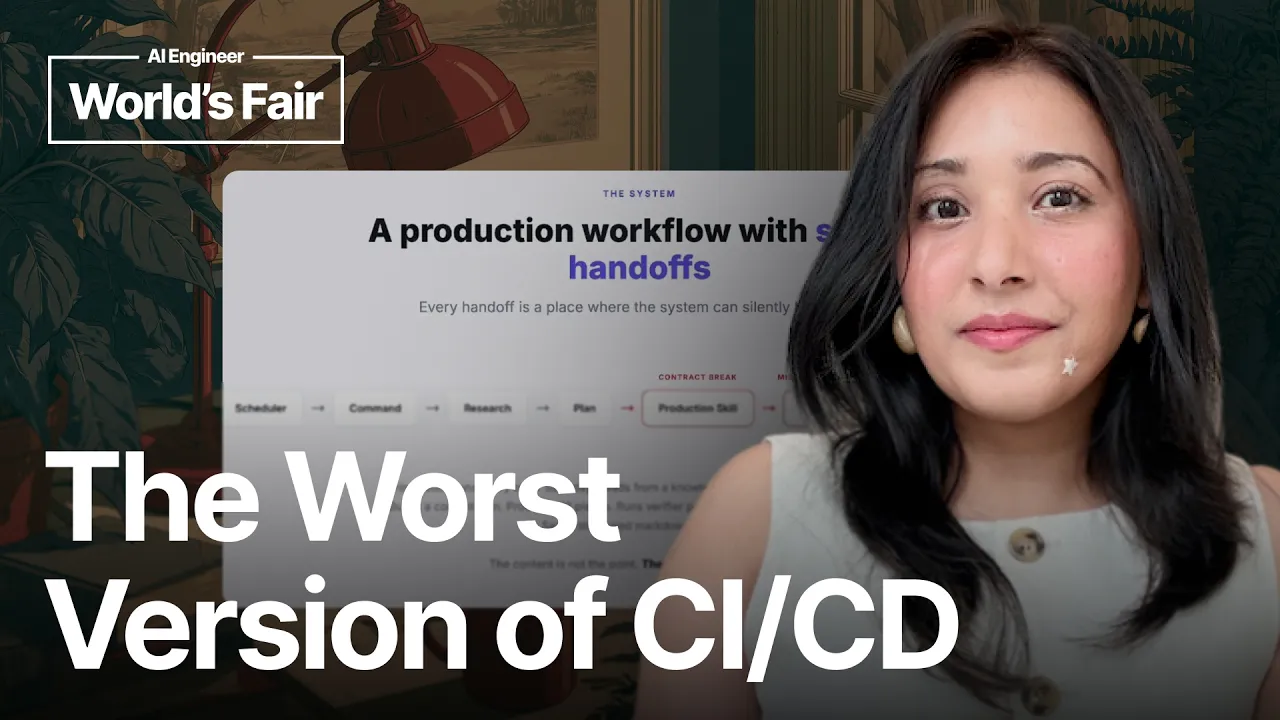
It runs every other Saturday. It reads from a knowledge vault, creates a research brief, builds content plan, produces 12 content pieces, then runs verify passes, reviewer gates, deduplication, and finally saves the output as markdown files. But here's the thing that matters for this talk, not the content. What matters is that this system has seven handoffs. Scheduler to command, command to research, research to content content plan to production production skill to verifier, verifier to reviewer, reviewer to the output folder.
Every single handoff is the place where the system can lie to you. And if you're building the system alone, nobody catches the lies except you, usually after the damage is done. Here's the pattern I want you to watch for in your own systems. If you build agents independently, you will rebuild these five things roughly in this order. You change a prompt or a skill, and something downstream breaks. So, you build a way to test whether the output still matches the expected shape.
Congratulations, you have reinvented regression testing. So, you set up a cron job or scheduled task. One day, it silently fails, but you haven't noticed for a week. So, you build alerts. You just reinvented CI monitoring. One skill changes its output schema, so three skills downstream break. You decided to add a validation at the boundary because of it. You just reinvented contract testing. An artifact looks done, but it shouldn't ship.
So, you add a checkpoint before it goes to the ready folder. You just reinvented staging environments. Something goes wrong, but you cannot find out which prompt, which skill, or which handoff had the bad output. So, you start logging everything. You just reinvented audit trails. The reason the title says worst version isn't because agents are software builds, it's because you end up needing the exact same operational guarantees.
However, the agent systems give you none of it by default. So, you build them independently. The worst version. Without even realizing that you're building it. The dangerous failure in an agent system is never a bad output. A bad output is very easy to fix. You glance at it, and immediately you can understand it's a bad output. The dangerous failure is a polished artifact that looks great at a glance. However, it will never pass your exit gates.
It uses the wrong voice pattern. It makes an unverified claim. It repeats an old angle. It's missing required sections, and it gets leveled ready to publish anyway. That is the agent equivalent of shipping because the code compiled, but the tests never run. This is what I'm going to demo for you. Not the happy path, but the three ways the agent can lie to you and the gates to catch it. Let me start with the happy path because this is what all agent demos show you.
I'm going to run a small privacy-safe version of my content engine pipeline. This isn't the full repo. It's a distilled version of the production problem. The pipeline is simple. Generate a content artifact, run gates, and either allow or block the output. Look at the output. The markdown has a caption, pinned comment, visual brief, verification log, vault assets, production notes, and a ready status. If I demo only this, the system looks done.
The artifact looks professional. The content reads well. This is why agent demos are misleading. They always show you the happy path. But what happens if the path is not happy, but the output still looks ready? Now, let's look at the failure number one, voice drift. Look at the content. Unlock the power of AI adoption. This game-changer will transform how teams operate in today's fast-paced enterprise landscape. If you have spent enough time on LinkedIn, you have seen this exact same sentence thousands of times.
It's generic AI marketing language. It's not my voice. It's not your voice. It's nobody's voice. But, knife mode saved it anyway. Because the artifact has all the required sections. It has a ready status, and it looks complete. Now, what what happens when I add one boundary? Guarded mode blocks it at the voice contract. The pipeline stops before this artifact enters the publish ready folder. This is the point. The gate doesn't make the content better.
If you're building a content system, this is the first gate I would recommend. If you're building any other agent system, the equivalent question is, what does wrong voice looks like in your domain? Failure number two is missing verification. This piece says, "Teams with a clear semantic ownership model reduce AI rollout rework by 37%." 37%. This is a very specific claim. Where did it come from? Check the verification log.
It's empty. The prose is usable. The number sounds plausible. That's what makes the failure dangerous. A confident sounding claim without any verification or reference. And knife mode saved it. Guarded mode blocks it. Claim bearing content cannot ship without a verification trail. "Trust me" is not a verifier. If your agent system makes claims about data, about users, about anything, and you don't have a validation chain, you're shipping unverified assertions with a professional looking wrapper.
That's not an agent problem. That's a credibility problem. Failure three, duplication hook. This is my favorite failure, because this is the most realistic one for solo builders. The output is new. The content looks technically coherent. But, the hook, the opening angle, is a near duplicate of something from your vault history. Yeah, adoption fails when the dashboards looks right, but the workflow is wrong. That angle has already been used.
If your system keeps generating near duplicates, your system looks automated, even if every individual piece is technically fine. Your audience notices before you do. Garden mode blocks it at the data contract. I noticed this. It also wrote an audit record. That audit record is boring, but when a scheduled run fails at 2:00 a.m., the final artifact alone is not enough. You need to know which gate failed. Which contract was violated and why?
That's the audit trail, the fifth reinvention. And that's the one most solid builders had lost after the damage has already been done. So, what's the pattern here? You don't need a platform. You don't need a framework. You don't need the ecosystem to catch up. What you need are a few boring gates. A pre-save output contract. Does the artifact have the required shape before it's saved? A voice or domain contract. Does the output match the rules your system was designed around?
A voice or domain contract. Does the output match the rules your system was designed around? A verification contract. If the output makes claims, can those claims be traced to a source? A deduplication check. Is this genuinely new? Or is the system recycling itself? An audit trail. When something fails, can you reconstruct what happened without rewriting the entire pipeline? In software, we learned not to deploy only because code exists.
In agent systems, we need to learn not to ship just because the artifacts look complete. The problem is not your agent will fail. Your agent will fail. The problem is when your system farmers that failure nicely and ships it downstream. Here's what I want you to take away. Map your handoffs from input to the final output. Every arrow between two steps can be a place where the output gets corrupted. You don't have to fix all of them.
You just have to know where they are. Pick the most expensive handoff. Not the most complex, most expensive. The one where bad data can cost you the most. A wrong claim published publicly, a broken schema that cascades to three downstream skills, a duplicate that errors your audience's trust. That's where your first gate goes. Make it say no. A gate which logs only warnings is not a gate. It's a suggestion. The gate needs to block the artifact from moving forward.
That's the difference between an impressive demo and an operable system. Before you add another agent, add one boundary. Thank you for watching.
The words are the caption track's own and nothing is reworded or re-transcribed. Paragraph breaks are placed between sentences so the text reads as prose.
Free tools for your own script. No signup, no login.
Paste your draft and see where viewers are likely to drop off, with a rewrite for each weak line.
Paste the first 30 seconds of your own draft for a hook score and rewrites.
Check your draft against YouTube's advertiser-friendly guidelines before you record it.
Read this channel's public videos and transcripts, and download a writing brief for it.