Getting the transcript
Reading the captions from YouTube. A video nobody has opened here before takes 10 to 30 seconds; this page fills in on its own.
Getting the transcript
Reading the captions from YouTube. A video nobody has opened here before takes 10 to 30 seconds; this page fills in on its own.
Digital Foundry · @DigitalFoundry
Words
9,627
Runtime
50:09
Speaking pace
192wpm
Reading time
40min
192 words per minute, between the 181 median and the 201 75th percentile of 349 measured videos. That distribution comes from the 349-video hook study.
Opening (first 30 seconds)
Hello there and a warm welcome to this the latest edition of the DF DirectX Q&A show. As usual, you have questions and we apparently have some answers for you. Joining me first of all, Oliver McKenzie. Hello. >> Yes, Rich. Should be a fun episode. Unfortunately, on the eve of some Xbox news we're not totally clued into yet. That sounds kind of unfortunate, but at least this episode should be interesting, >> right? Yes. and um of course Tom Morgan. Hello. >> Yeah, here for consecutive directs. Uh so glad to be back. >>
96 words, the words spoken in the first 30 seconds at 192 words per minute.
Free, no signup. See how the first 30 seconds hold attention, with rewrites.
Sentence shape
| Measure | This transcript |
|---|---|
| Sentences | 528 |
| Average words per sentence | 18.2 |
| Longest sentence | 119 words |
| Questions asked | 65 |
What this transcript is
Every word below is the caption track YouTube publishes for this video, pulled from the video itself and reproduced unchanged. It is not Prepublish's writing, not a summary, and not a re-transcription: it is the video's own published captions. English captions, generated automatically by YouTube, in the video’s original language. Source: the video on YouTube. A channel that would rather this page did not exist can ask for its removal through the contact page, and it is removed.
No Script X-ray for this video: YouTube shows a Most replayed graph only once a video has enough views.
Hello there and a warm welcome to this the latest edition of the DF DirectX Q&A show. As usual, you have questions and we apparently have some answers for you. Joining me first of all, Oliver McKenzie. Hello. >> Yes, Rich. Should be a fun episode. Unfortunately, on the eve of some Xbox news we're not totally clued into yet. That sounds kind of unfortunate, but at least this episode should be interesting, >> right? Yes. and um of course Tom Morgan.
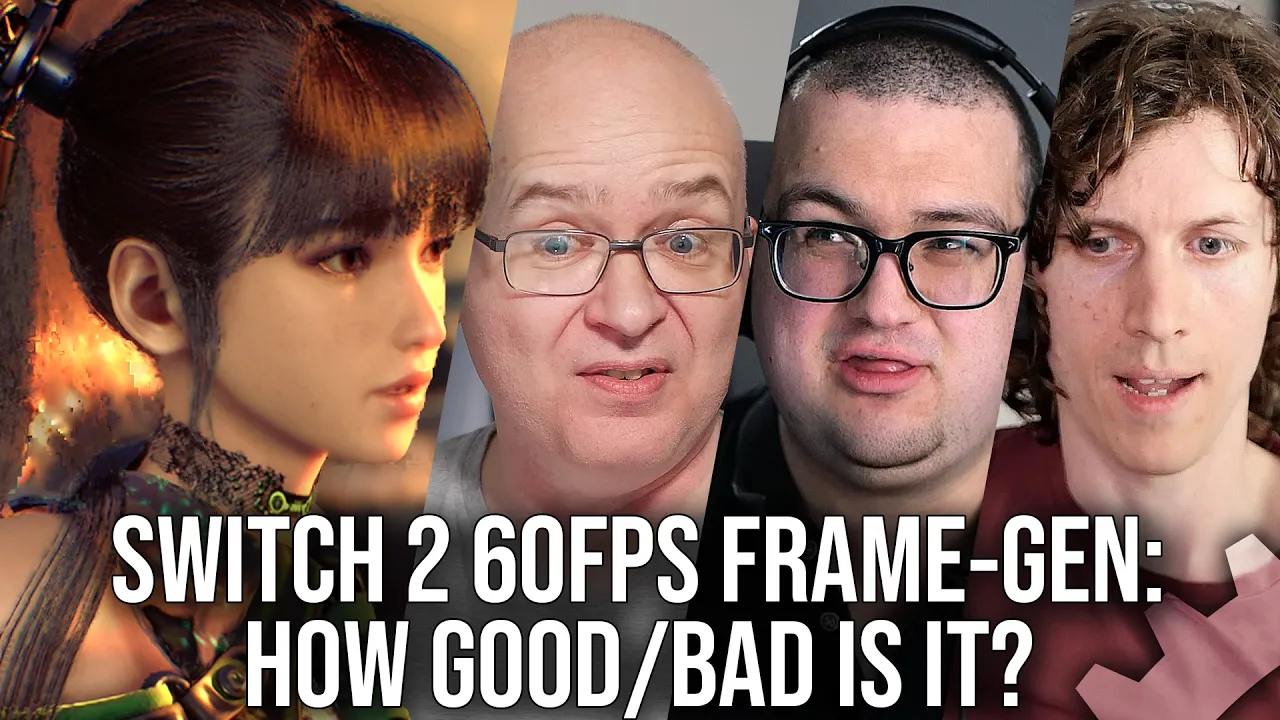
Hello. >> Yeah, here for consecutive directs. Uh so glad to be back. >> Lovely. Okay. Glad to have you. Um lots to get through this week. Um so let's just crack on. Okay then. So uh we're going to kick off with a really interesting subject. Basically um two games have been announced for Nintendo Switch which are going to be using frame generation to work from a base 30 frames per second and deliver what purports to be a 60 frames pers experience.
Now obviously um when it comes to frame generation typically is the case that the people who created it uh Nvidia AMD etc typically suggest a minimum of um 40 to 60 fps 60 fps in AMD's case 30 to 60 um to 60 fps frame generation that's a bit tricky but we've just had a demo released um Stella Blade from Shift Up and Capcom has just announced that um Dragon's Dogma 2 on Nintendo uh Switch 2 is also going to have frame generation.
There is a diff difference, however. It's mandatory with stellar blade. You can't turn it off. However, I believe Dragons Dog 2 is basically offering you the option. So, you can either run at 30 or run at a frame generated 60. This has generated some questions from the audience. And uh we're going to kick off with well, let's just get through them. We got three here. ADF exclamation point says, "I like licorice. I underscore like licorice.
I underscore like underscore licorice. ADF exclamation point. I'm really curious about the frame generation on Switch 2. There was recently news it would be an option in Dragon's Dog 2. I also briefly played the Stella Blade uh demo and putting aside image quality. It felt responsive. I did not play that game on any other platform. However, I'm curious about your thoughts on frame interpol interpolation. If this technique becomes popular on Switch 2, what are its characteristics?
Thanks. Uh exclamation point Dako in brackets Dan. If third party developers are going to go all wild west with their use and abuse of DLSS and FSR frame gen, isn't there a strong case to argue that Nintendo should develop their own version of Nvidia derived frame generation that's specifically designed to play nicely with at least two DLSS variants that we know exist on Switch 2 while being specifically designed to run efficiently on the hardware if only to keep third parties somewhere with insane boundaries.
Uh, this one from Tagen 86. Any idea why Nvidia never created a DLSS frame gen light for Switch 2? Very strange that devs need to use FSR to get frame gen on the little handheld? Nvidia should be able to create something more performant with less artifacts given that they know the hardware inside and out. Why not also implement a version of Reflex? I bet a native version of DLSS frame gen with Reflex on Switch 2 would feel quite good even with 30 going to 60.
I'm going to go to you first on this one, Tom, because um yeah, 30 to 60. I mean, um my view on this is pretty straightforward. There are going to be games where it's probably going to work fine. You know, basically, if you've got like um your image, your buffered image, um if there's not much difference between them, if for example, it's a game with a slower pace, you probably won't be able to tell the difference, right?
Um and there are games where latency isn't a massive um issue, right? you know, it doesn't matter. You know, for example, a turn-based RPG, does it really matter if your response is 16 milliseconds later? But, you know, what do you think about this? Are we on a slippery slope? Yeah. If it's been used as a kind of crutch to get over the line to 60 when maybe there's a path to optimizing at 460 with some cutbacks, uh, obviously there are a bunch of games which would, you know, benefit from being at 60 and I think Stella Blade would be one, >> right?
But you know say if they couldn't get it up there then you know an option to have frame gen there you know is a is a interesting idea it's a good experiment uh as a first run of it and by all accounts I haven't tried it myself but by all accounts it sounds like it's running you know well enough but not having the option there is a bit of a concern in case you know as a fallback in case it's not to everyone's tastes and the latency point yeah there's no skirting around that I mean it's the the the millisecond numbers is the input delay is still, you know, not solved with frame gen.
It's uh it's still giving you the same feedback. So, it's a I don't know. It's a It's a strange situation that it's been rolled out um with this game without much um fanfare, I guess, and that we've got no that it is there's no real I mean, Dragons Dogma 2 coming as well will kind of cement what we feel about it like there whether it is a working solution and if there's any other issues or characteristics that go with it. >> Right.
Um, so I have played Stella Blade, the demo on um, switch to docked and I think it's a very bizarre experience because um, there are certain artifacts of frame generation that you aren't going to get around and they come in all different forms. So for example, the HUD is still updating at 30. So all of the text elements on screen um, operating at at 30 frames per second. Um, that's that looks a bit weird in motion. Uh, secondly, particles don't animate particularly well with frame generation.
So, um you have this weird situation where um you've got a game where um >> it kind of looks 60ish but isn't in some respects and it creates this weird dis disconnect. It's a bit odd. Um it's kind of like 60 but not. >> Um the latency side of things wasn't as bad as I thought it would be, but you know, ultimately it is buffering a frame. So if it wasn't doing that, if it was just running at straight 30, it would be more responsive.
So you know what what why do people want 60 fps in the first place? Well, first of all, obviously you want a smooth looking game, but ultimately it's it's about improving performance, right? And performance does include latency, and that is going to be um higher than it would have been even at 30. So um it's odd. And yes, there are obviously um artifacts on the interpolated frames. they're they're less um easy to spot when you're running from a much higher base frame rate, right?
Because you've got this Constantino effect like a strobe effect where um the interpolated frames are between two uh quote unquote real frames. And therefore, you know, the the the shorter the time a frame persists on screen, the less noticeable it is. But a persistence of 16 milliseconds, you know, it's it's kind of will be noticeable on fastm moving content and Stella Blade is a fastmoving game. Um Oliver, thoughts? >> Yeah, I I came away from it uh I did try Stellar Blade in both handheld and docked mode and I came away from it more interested in the technique than I thought I would be.
Um because you know I don't think there's a realistic path within the constraints that shift up had with this game to get it to 60 fps otherwise and getting the game from 30 fps to what can feel very often like a smooth 60 fps very appealing I think in a sense. Um, there are issues in Stellar Blade. Uh, issues some of which are inherent to the technique, but some of which could probably be sorted out with certain tweaks or content fixes or maybe just designing a game around frame generation in the first place.
Like it has issues with artifacting and interpolation, issues with shadow maps in particular, like they kind of interpolate oddly. They look like they're updating at 30 fps. Rain. I noticed Rain appears to update kind of at, you know, 30 FPS, but like almost with a cross fade on it. It doesn't look very good. >> Uh Eve's hair is super messy in this game, especially in hand handheld mode. Just super super messy. >> Um all kinds of particles basically update at 30 FPS from what I can tell.
Not a super clean look by any means. And I would agree with Rich here that enough of the image appears poorly interpolated that at times your brain is kind of a bit confused because it is updating at 30 fps fundamentally, right? And some elements do a better job of hiding it and some elements do a worse job of hiding that. Um, I also found that in dock play input lag didn't feel that great to me. I'm less offended by the fact that it does probably buffer an additional frame there and you're getting that additional latency.
I that is an issue, but it's also like you're getting a a weird mismatch between the latency that you'd expect for 60 a 60 fps game and latency you're actually getting which is worse than a 30 fps version of the same game in all likelihood. Right? >> So that's a weird mismatch and my brain just struggles with that slightly because it does not feel too good. But I think the bigger issue with this particular game is that it just is dropping frames a lot.
Like I I did take a look at some frame rate capture on my own. And I'm sure Rich has some frame rate capture uh that I'm going to take a look at shortly. But like the game, it seemed in the opening cut scene when I was testing it. It was running at like, you know, 40 fps in spots, 30 fps in spots. During gameplay, it was dropping frames constantly. Um even in handheld play, I could feel it dropping frames. I'm not sure whether it has VRR working or not or if this is just an issue with the frame generation technique, but does seem to be dropping frames a lot.
So, I don't know. I I feel like I'm more open to it now that I've tried it because ultimately on Switch 2, you have to make hard compromises, right? And could this game be 60 fps? I don't really think so. So, is this better than just having the game at 30 fps? At least as an option, maybe not mandatory, but as an option, I think so. I think it could be cool. I think a lot of people would like it. But I also think that it shouldn't come like if you're going to do frame gen to 60 fps, you should really be hitting 30 fps at least internally, very consistently.
And I didn't see that with this title. And then there are a lot of issues with it with the content they have. So, it's not great, but like I' I' I've become used to it at this point that like when a Switch 2 game comes out, a Switch 2 port comes out that's like a high-end title on other consoles, not to expect the world and to expect significant problems in many cases with basic implementation details like having correct frame pacing.
So, I'm less offended by this particular choice at this time now that I've seen what developers uh are are doing a little bit with the console at times. Yeah, >> I would love to see more of it though. Like uh as an option for sure. It is like just recently Fire Emblem um a recent Fire Emblem game would have been a good use case for it. 30 FPS baseline. You know, it's not a very input intensive game. You're going to get away with some a much smoother like feedback in uh you know when you're exploring and in the swoops down to the battle scenes.
That'd work well. And Cyber Punk as well. I think I'd just like an option there just in case I want to give it a try, but by no means like a mandatory fixing in place of it. >> Yeah, I think the uh the dropping of performance from 60 frames per second is a bit of a problem. You're quite right, Oliver. >> Um and that's the other thing to bear in mind is that, you know, you've got a system that's very resource limited compared to other consoles, right? and um uh the the concept of the actual you know computational cost of frame generation is going to be added to that budget of of rendering the frame.
So obviously it's not meeting budget and therefore we're getting frame drops. So you know if it was 30 to 60 um and it was consistent 60 I'd probably have fewer issues with it. I'm gonna be very interested to see what they do with Dragon Stroga 2 and whether they actually implement that in further Switch to uh games, Capcom games going forward. Um it's an interesting choice, but I think that's the key thing. It's got to be choice, right?
I think there has to be a choice for the user to either use it or not use it cuz Stella Blade does look messy and a lot of people are quite happy with 30 FPS on their on their Switch to games. So why why inflict this on them? I mean, yeah, it's it's a very odd thing. That's all I can really say about this. Um Oliver, do you think there is um a uh an argument here for Nvidia and and Nintendo to step in and produce a proper version?
I mean the thing is I think um what's happening at the moment is is FSR3 frame generation that's being used here >> and um >> obviously Nintendo sorry uh Nvidia does have an ML um frame generator at this time. the extent to which it's usable on um on Switch 2 is something we don't know, >> but I'm curious what you think whether they should step in and do something. I think it might be tricky for Nvidia because you know on the one hand it is an MRE chip and I know that Nvidia has their segmentation and their marketing and at the moment uh DSSFG is not available officially on Mier class uh GPUs from Nvidia.
I think we've seen from various community mods that DSSFG can run on 30 series. Perhaps not as well as the other architectures, but it can run on 30 series. The other issue here is that potentially I think DSSFG could be a little bit expensive on the hardware, but you know, maybe it would be okay. And also maybe Nvidia could cook up like a DLSS FG light model or something that would actually deliver pretty good results.
Although I'm less offended by like the nature of FSR3 FG than the frame rate drops inherent in their implementation and just the kind of raw realities of using FG in general. I think actually at least when we were taking a look at FSR3 FG relative to DSSFG that it was a reasonably good frame generation solution as far as these things go. >> Right. So yeah, I'm not I'm not too fussed about that, but I agree that they should be working on it in some form and they should try to deliver something because I think this is a path forward that many developers will take with Switch 2.
And I think it makes sense on a number of levels. Now, this implementation isn't great, but I could see a version of this that I would be interested in for sure. >> Yeah, I think the other thing, of course, is that Stella Blade is kind of like a a frame generation worst case scenario almost. Everything that shouldn't really be done at fra with frame generation at 30 fps is being done here. You know, it's, you know, >> I think you want like a first person game maybe or a slow paced game cuz first person games sometimes have less discclusion issues with like backgrounds and obviously you don't have hair on screen all the time like you do in Stellar Blade.
Like her hair is really just a complete mess like unidentifiable blur of serrated edges and pixels in a handheld mode. It looks awful to be honest with you. So, that's one element where it's like, okay, well, do you have a different like hair design? Maybe she has her hair in a in a bun or something for your Switch version, you know. >> I think there is an outfit. >> Okay. Oh, of course there are outfits. How could I How could I forget?
Yeah, of course. Yeah, maybe that's >> there's another use case obviously which is the 60 fps titles that like Nintendo are well known for first party stuff you know that has a great frame gen uh use case 60 to >> maybe the cost would would get you on that though the case yeah I mean we've seen from FSR3 working on um Xbox and PlayStation in uh like Immortals of Avium >> it's kind of like 60ish um base but you're not getting 120 with with the with the frame gen generation on their own consoles.
So, I think it would be the same there. >> Yeah. I mean, you know, you've got 8.3 milliseconds um well, 16 milliseconds uh for um a 60 fps game and then you've got to add the frame generation um cost on top of that. So, yeah, it's going to be tricky. Uh interesting discussion though. I'm very interested in seeing how Dragon Stoogma 2 is going to play out because it could be more frame gen friendly, should we say, than uh than Stella Blade.
But I would recommend all Switch 2 users download that uh Stella Blade um demo and see what you think yourself, right? Because um I'm very interested in feedback there. I don't really have uh um I've kind of like adjusted my thoughts about um frame generation in general. Um I think 30 to 60 can work according to content, right? Um and specifically um input latency of course is um uh varies within you know from game to game anyway.
So, I noticed, for example, that I I thought it was, you know, slightly odd control feeling on Stellar Blade, but then I actually went to capture it and when we have when we're playing a game through the capture card, there's another 50 milliseconds of lag added on top for the preview window. So, it was it was so noticeable at that point, it was like I had to actually set up an external monitor to play um to play the game to actually be able to play it properly.
So, there's definitely a latency hit there. Um I do think it should be an option though. I do think that. Um, >> yeah, for sure. >> It Yeah, and that's what Capcom's doing. Um, so yeah. Okay. Um, let's move on. >> Okay, a couple of questions here I've grouped together. Let's do this one from Matt GPT. It's a bit of a wall of text, but let's go. Hello, gents. In the recent Direct 282, you all talking about it being a negative that there are no or only one new GPUs until 2028, and the nextG consoles are likely to have a different path than originally planned.
Is that actually a bad thing? Towards the end of a console generation, we generally get more impressive games as developers understand the hardware better. And so, it looks like only GTA 6 will really come close to maxing out the conso's potential rather than just saturating their GPU and and uh CPU. Do the current gen consoles have more in them, or is the lack of native ML upscaling and weak RT compared to PC a bigger difference than in previous generations?
The current Nvidia and AMD cards seem fairly decent to excellent overall with the biggest issue being VRAM on lower spec cards. But if the nextG cards launched this year or next, wouldn't we still get 8/12 GB cards because of RAM costs? I like shiny new hardware as much as the next gaming geek. But especially with the current economic outlook, is it really a bad thing to sit on current hardware for another year or two and be able to spend that money on games instead?
Especially if next gen will offer ever diminishing returns. Cheers. Skyrimfest 26 FPS edition says, "Although I'd personally love a PS6 and for Rubin/RDNA5 to release ASAP, I would also rather wait a little longer than have these product products rejected by the mass market for being overpriced or nerfed to control costs. The industry could be in real trouble if the next generation fails to find a mass market. We've seen that Sony is not invincible, and Nvidia could happily make gaming even more of an after resort in its lineup." Um Oliver, what do you make of this?
I mean, it's kind of like a Kobe Ashi Naru Maru no win scenario at the moment, isn't it? >> Yeah. Yeah. I think in regards to that second question, um I would kind of challenge the assumption that seems to be baked into this question that if we wait a sufficient period of time that this situation won't resolve itself because every indication we have is that this is not getting better and possibly getting worse in the near term in the next year or two.
Um so I think the console, you know, they're going to have to find some way around it regardless in terms of cost, in terms of nerfing it as this user says. I don't know. I don't know in regards to the first question. Um I think our specific discussion of the potential for new GPUs from AMD and Nvidia is less about just wanting new hardware in general and more specifically concerning the uh difficulty of running certain high-end rateraced experiences like 007 first light on PC hardware. even on mid-spec PC hardware very challenging obviously um in part that's a RAM concern but also it's it's it's a concern about just the uh difficulty of running those rate tracing workloads and now you know neural rendering workloads in so far as that expands in the future those are big issues on PC specifically it doesn't really have to do with the consoles I don't think as much and those features you know are not as important to the current workloads and console titles >> but yeah I don't know if it's such a bad thing if hardware is delayed I don't really it's not really bothering me too much if the consoles are delayed.
But I I kind of feel like uh you know when we when we talk about games like GTA 6, I really think that they would still be pretty good if they were cross generation games. I don't really think that the beauty of GTA 6 comes down in particular to optimization necessarily as much as it comes down to just having a massive budget, having gigantic art teams, being able to tackle every single technical problem that you could want to tackle in real time rendering with, you know, realistically uh within a single game.
I think, you know, probably GTA 6 would look pretty good if it launched in two years and if it was a a crossgen PS5, PS6 game. I think it would still look pretty good on PS5 consoles is my supposition, especially when you consider the fact that, you know, by any reasonable estimation, the next generation console market will be a slower starter probably than the current generation console market was. So, that'll be a huge audience of people that game makers are looking to target with their console software.
So, yeah. Um, but I I I I would like to see new new hardware if it makes a meaningful difference and that includes that includes console, but it also includes new uh PC parts for sure. >> Interesting. Um, Tom, >> yeah, new hardware stirs the conversation every time. It gets the market excited. Uh, so on that front, I think we're always after a new console. We're all excited to see what might happen, but the like the practical realities are say otherwise, right?
You know, there are several directions they could take it. They could uh play the conservative card and have something that's, you know, an optimization on existing hardware. It would be, you know, it would just not be the leaprog generational leap we're used to. Uh but they could sell it to the mass market more uh more viably. The other option I was thinking of the other day was that they could actually spec out a truly extreme top- end machine, you know, gunning for a grand plus.
And then we're in the territory of it's there for the excl ex exclusively for the um extreme gamer but also you could use models like and I had to say it like streaming to that console like GeForce Now or renting a console for a set period of time leasing it those uh you know it you know I remember growing up there was a time when we would rent a PS1 console for a little while and that was one of the ways you could get at, you know, a console back then if you couldn't afford it.
So, we might just be back to those times. But, yeah, if they are, if we are really committed to a 2028 console release, then you've got to pick your battles, right? You know, you can't have everything. It's just going to have to be one or the other. >> Right. Okay. I'm still thinking about Oliver's Oliver's read on the uh the next gen Xbox pricing strategy, which is buy on cler. >> Yeah. I mean, hey, that's what they want you to do.
That's what they want to do. >> It just makes me It just makes me chuckle. Uh it's kind of like a sort of apocalyptic viewpoint, really. Um >> Yeah, it is. Yeah, for sure. >> Well, you know, um I don't know, you know, I think there's there's two ways to look at this. I don't think it's so much the the case that the um the new chips are going to be like gigantically more expensive, but it is the memory, right? So it is the case of whether you're going to put out these next generation GPUs with the same amounts of memory as the current uh generation.
Now I think you know that's not a good plan um because I do think that next generation is going to be a new generation right and there should be a step up in the amount of memory that's going to be used. So to you know produce imbalanced cards and it's already happening. The RTX 560 is a really good card in my opinion. Unfortunately it's only got um 8 gigs of memory. Um, and you, you know, I've actually did a video where the 5060 performance-wise is very close to the 2080 Ti, but the 2080 Ti is better because it's got 11 gigs of RAM.
And so there are specific scenarios with RA tracing and that kind of thing where um the extra memory counts and the 5060 is sitting there unable to produce the same effects, not because it can't do it, but because it doesn't have enough memory to do it. So, I think they probably could put out a new generation of card, but do you really want like your 70 series to have um 12 gigs of memory and your and your 60 series to have eight?
Probably not. >> Very, very tricky. Um, let's move on. A question from Eric here. Good day, gentlemen. Exclamation point. Listening to the latest Q&A got me thinking about John's quote unquote frame health coined phrase and the ongoing effort to raise awareness around frame pacing issues. Would there be any value in creating a dedicated quote unquote frame health section or reference that collects clear examples as you encounter them in future coverage?
Some of these problems can be remarkably difficult to see without a highquality video on a good display, which makes them harder to demonstrate outside of DF's normal analysis. Having a one-stop reference showing what the problem looks like, why it matters, and examples of where it occurs could potentially help create that light bulb moment for developers and other decision makers. I'm definitely not suggesting going back through the archives or adding work simply for the sake of it.
I'm thinking more of an ongoing side project built naturally from future coverage. GTA 6 comes to mind as one potential example given the frame health issue you've already discussed and its history in Rockstar titles. The Dusk Bloods from from Software could provide another opportunity given the frame pacing discussion surrounding their games. The goal wouldn't wouldn't be to shame anyone. It would be a clear useful resource.
Here's the issue. Here's what it looks like. Here's why it matters. And hopefully here's something we can see less of going forward. Um, right. Okay. So, I think we do do this as a matter of course in our videos. Certainly, um, in console uh, land, it's very easy to to sort of pinpoint the issues. Um, a 30 fps game that is not producing a frame every 33.3 milliseconds on the frame time graph there, it's going to have this sort of sawtooth effect.
Uh, the most recent example I can think of, Tom, it was actually your video, um, the blood of Dawn Walker, where the 30 fps mode is like quite unpleasant to look at because the frame delivery is uneven. So, yeah, there's that. I mean, frame pacing at 60 fps typically isn't a problem, but you can have like examples where the camera it seems update seems to be detached from the delivery of the frame, which is a different issue.
PC land things are a lot more complicated because typically people are running unlocked on VRR displays. So a frame can persist for many many different frame time lengths and then you get like more egregious stutter that kind of thing. I think m I don't know I don't know what you think about this Tom but maybe the route forward is just to kind of like being a stamp collector here and building up a a resource of bad frame pacing is such a good idea but possibly just a bit more explanation in videos might be a good thing there rather than just sort of saying hey there's it's got fan it's got consistent rate pacing again. >> Yeah.
It's always a challenge with the videos to know where to what level to pitch the explanations at, right? Because we've got the established audience who just are wellversed in frame pacing issues and hitches. Alex has gone through all of that. Um, and it's it's been I've been doing this for long enough that it's like, okay, sometimes I I realize I need to step back and explain to newcomers, people who just haven't seen a DF video before.
Hey, this is an issue. This is the frame time graph. These are the 16 33 and 50 millisecond trills on the left side graph and without that I don't think you um you get that induction to the world that we live in. Um, as far as cataloging the issues, I think it's done in the video. Um, unless we were to make an archive on the website maybe like of all the games with the issues and you know, it's covered the base. >> You know what what what for you know? >> Yeah. >> Um, Oliver, what do you think?
You know, occasionally people do ask us to make some kind of like glossery or some video or something on the website to explain all the technical terms we use in videos and provide examples. And I think that could be a good project that at some point to try to tackle. It seems like absolutely mammoth though, so I don't know how we would do it. But I I don't think that's such a bad idea, you know, because I do think there is this conflict between like I want to get through information in a manner that like is reasonably pleasing to the audience.
They listen to the video, they watch the video, and it it moves quickly enough. Um, but I also want them to understand what I'm talking about. But I I can't break down every single time I say HDR or, you know, global illumination or something and like really break it down in in in full, right? That's not realistic. >> This is the So like there are probably videos where I say in shorthand like here a frame game has messed up frame pacing and at least there you can see it graphically on a graph because we have the graphing running.
So at least you know what it looks like in our tools and that'll be consistent across videos, which I think is pretty important. So if you're watching a couple videos, you'll get a better idea of what's going on. But when games do have unique issues, I I do try to break it down. Like when you know you have a game like Ghostrunner on Series S or High on Life where the they have inconsistent camera travel from frame to frame.
The game will update at 60 fps or 30 fps or whatever, but you'll get this inconsistent camera travel. We'll point that out. or in games like Dead Space where like on PC it has this stutter, but it's not stutter that's manifests as a frame time issue. It's like an animation stop basically on the game even though the game's frames continue to update. Alex explains that in some detail in that video, right? So when unusual things do happen, we do explain them.
But I kind of do expect you to have a basic understanding of like, okay, you want the game's frame rate to like look like a flat line on the graph and you want it, you know, to to work out pretty well and 60 fps shouldn't have drops and, you know, if the frame pacing is messed up, it'll look like jagged lines and it will be unpleasant to play. Like that kind of basic understanding is something that I hope our our viewers generally have, but it could be useful to have a resource to to educate those who don't. >> Yeah.
Yeah. Um, I mean, if you want a kind of explainer for the 30 fps frame pacing issue, there's a video on the channel called for from Software's notorious 30 fps stutter fixed, but only for hacked PS4s. That's where we actually um uh used uh a hacked and exploited PlayStation 4 to fix um the 30 fps caps in from softwares games. And um uh that we've tried to sort of illustrate the issue there. If you do like a slow uh lateral camera um movement uh with inconsistent frame pacing, you'll get a lurching that just isn't there um if you've got consistent frame pacing.
So that's maybe worth a worth worth a look if you want sort of a visual example. But um >> yeah, it's kind of like I mean we've been talking about it for a very very long time now. So I don't think you can put explainers in every video. I mean, if the subject of the video is an issue like this, like I know me and Alex, I think must have been last year now. It was quite a while ago, we did a video on the VRR stutter on PS5 that was fixed, right? >> The whole video, if you watch the video, >> it's all about here's this problem, how we observed it, how we go through it, how we detect it, why it should affect you.
Like, it's all these different factors rolled into one. And then so that's like a good explainer video for like I I kind of feel like maybe over the lifetime of the channel we've done enough little explainers we could maybe stitch them together or put them in a closer or something somewhere. But if if it is the point of the video like if the point of the video is this game has messed up frame pacing of course we're going to explain frame pacing issues to you right in some detail. >> Mhm.
Okay. Um let's move on to the next question. This one comes from James C. Good day DF crew exclamation point. Nintendo seem to have a deathly allergy to DLSS as they avoid it like the plague. Just I'm just thinking about that that sort of sentence literally. Um uh Switch 2 supports it and third party offerings use it, but Nintendo's own games won't touch it. Could it be uh because they don't want to be locked into Nvidia tech forever more?
After all, they've jumped from AMD to Nvidia before. And then on from that point, just say the new Switch uh Cube U3 was AMD or some other alternative. Would third party games using DLSS have backwards compatib compatibility issues or could Nintendo just swap in something like FSR? Keep up the amazing work worth every Patreon dollar. Thank you, James. Um so here's my sort of I mean it's an interesting theory, right, Tom?
But my contention to that theory is that if backwards compatibility and DLSS specifically were that much of an issue, it wouldn't even be in the design itself, >> it wouldn't be a part of the console because, you know, um just supporting Nintendo games for backwards compatibility on a on a future console isn't really going to wash, is it? >> No. And it's it doesn't seem to work to have that strategy to future proof for future hardware. um especially when the features are so solid and robust and they'll help make the game better.
You could say that the same of you know most of the technologies going into the game and if they were to switch architecture in the future it take a whole lot of re-engineering you know to get those games to work um you know the existing library on a Nintendo Switch 3 AMD for example. So yeah, I don't think that quite quite works. make the most of the hardware that you've got at the time and um just press forward. But it is odd.
I'll I'll share that like bafflement, if that's a word, that there's no use of DLSS yet in a Nintendo title, like as far as we're aware, >> is so strange. And yet the third parties are lapping it up. They seem to be just going for it in every chance they've got. I think the closest closest we've got is Fire Emblem actually, Fortunes Weave, we which actually did and that's sort of maybe one degree maybe we could class that as a Nintendo title uh like proper.
I think that's that's fair to say. So yeah, maybe the tide is changing there, but it's been very slow uh in terms of the adoption of it. Okay, I'm still chuckling at this uh death, the allergy, and the plague, two separate things, but uh apparently James C thinks that Nintendo is not too happy about DLSS and therefore isn't using it. Um here's the thing though, Oliver. I mean, you know, we were discussing the Zelda Ocarina of Time um remake where you you kind of can't help but think that DLS could have solved a lot of visual issues there.
Yeah, I mean you can say that again, Rich. I'd love to see DLSS in that particular remake. I mean, jeez. Yeah, talk about image quality issues. Oh boy. Especially in the kind of like big grassy field area, open planes got some big issues there. And the sharpening, you know, don't get me started on that stuff. But, uh, I think I think the reasoning for this is just simple, which is they have internal technology and internal tools. they were never set up to use TAA and they just have not implemented all the necessary work for DLSS or these titles possibly they were in development for quite a while and we know that sometimes it can take developers a little bit after the adoption of a major new graphics technology to implement them into their games right even if it is just an upscaler might take some time here it took a while before like a technology like TA was fully mature and deployed across the vast majority of console titles right the first major console title I can remember that used TA was uh Halo Reach back in 2010.
Like I'd say probably around like 2016 2017 was when I would say a pretty overwhelming majority of AAA titles were using TAA. Before then it was somewhat spottier. But um I I don't think Nintendo has a particular objection to DLSS use because in these titles where they are collaborating extensively with the developer and publishing their titles like uh the Pokémon games for instance or Fire Emblem which are I I wouldn't say they're Nintendo developed games even if they have a Nintendo logo on the front really.
They're they're titles that are developed in collaboration with Nintendo to some degree. At least that's the case for Fire Emblem. >> Um but they're developed primarily by an external partner to my understanding. But still, Nintendo has complete say over, you know, what's gonna happen with the new Fire Emblem. And I feel like they could just, if they didn't want DLSS in there, they wouldn't want DLSS in there. They wouldn't put it in there.
But, uh, you know, I I I I I think this is an interesting theory, but I I fully expect Nintendo to go back to the Nvidia well, for as long as Nvidia will have them as a customer. I don't know how much interest Nvidia has in will have in gaming consoles in however many years that we'll expect a Switch 3 or whatever, but uh but I do expect Nintendo to continue going back to Nvidia. >> Yeah. Yeah, I agree. Um okay, let's move on.
Uh couple of questions here basically asking the same thing. So, let's go through them. Uh Lucas says, "Hello, DF team exclamation point. I recently saw an exciting video by Retro Gamecore on Amardada Omada OS. It allows people to run Steam OS on Androidbased devices. Be interesting if Steam themselves made a cheaper ARMbased Steam Deck. I would much prefer a compact gaming device that's the size of a Switch One or Switch Light to the monolithic handhelds we have nowadays.
Thoughts? Uh, Solid State asks IDF crew exclamation point. Now that we have an official look at Valve's gaming on ARM solution in the Steam frame, do you think there's a chance we see a quote unquote Steam Deck light of sorts using an ARM SOC as a way of offering a smaller, lower power but lower price alternative to the increasingly expensive Steam Deck? Smaller, less exp uh less expensive devices like the Ein Thor have proven capable of running light to medium Steam games, some of which are among the deck's most popular games.
As Oliver has demonstrated in his Apple coverage, ARM SOC's have come a long way with console class titles now being viable on devices the size of a phone. Surely Valve's talented hardware and software team could deliver something pocketable that blows those Android handhelds out of the water. Cheers. Exclamation point. Um well it's an interesting thought because I mean I have uh tried out ARM gaming on the steam on the steam frame and basically it's the case that um that's got a pretty powerful ARM SOC in it but it really struggled in Cyberpunk.
It was it was a very poor experience and um the loading times were so long that you kind of can't help but think that it's a memory sorry not a memory but um a processing issue on the CPU side. But that said, um I kind of like this idea because um the the concept of the Steam library is that it spans decades, right? And so as long as people are aware that you're not going to be running Cyberpunk 2077 on it, that you are going to be limited to um older games or far less challenging modern games.
Um games that don't require 16 GB of memory. >> I think it's a pretty cool idea. I think there's there's legs in it. I think it could it could work, but you've just kind of got to go in with expectation levels uh set. >> Yeah. >> Um it sounds like you agree, Tom. >> Yeah. I mean, it's a it's a matter of transparency in communicating what you can get away with maybe on the menus because we got the Steam verify, Steam Deck verified tick, right?
Uh so if there could be a way to verify compatibility with ARMbased devices if there was such a is made possible then great then that works everyone's happy especially for the older games which you'd presume would translate a bit more elegantly to those um other systems. >> Yeah I mean you on the Steam frame there is a great onframe section. It's not it's not incredibly popular populated at the moment. There's only a handful of games that I saw it but you know you you load the game and it runs well.
I was um playing Streets of Rage 4 and everything was just like pretty awesome. Um an interesting idea, right, Oliver? >> It is interesting and I think it's totally a plausible direction that a company like Valve could go down at the moment. I think it is a viable approach, but I think there's a big problem with it potentially, which is that we're getting a very large volume of increasingly important vendor locked technology in the frame generation solutions, upscaling solutions soon, you know, all kinds of neural rendering solutions, including, you know, ray reconstruction, all kinds of different techniques that are coming down the line.
Um, and if you went down this approach, at least officially, you'd be locked out of those vendor specific solutions, right, that have been developed on PC, by Nvidia, by AMD, by Intel. And so, I don't think it will be a viable approach. Even if you've sorted out translation to a perfect degree, even if you've achieved conquered that that whole problem, I think you're just running into an issue of like, okay, what is running a PC game look like on a handheld in 2028 when you can't use any vendor specific um machine learning upscaling, machine learning frame generation, machine learning rate reconstruction, uh machine learning all other kinds of features that are coming down the line, right?
If you're procluded from that, I think it's just not a viable product for running modern games. Now, older games, sure, but I think people are really into interested in, you know, running pretty decent newer titles with all the bells and whistles, at least to make those games run acceptably on the handhelds. I don't think you're going to get that. >> No, I think you're right. It would need to be a device like those um uh various ARMbased pocketables that are out there, which is very much dedicated to games of a particular vintage.
Um, and there are going to be scenarios where it doesn't run particularly well. And I guess the fact that you that you you will have the um overhead of the translation layer means that it would need to have some kind of decent CPU in it already. So yeah, it's it's going to be a bit tricky, but I'd love to see it. And um I guess though the the question is, you know, how expensive would even a cheaper B armbbased hand handheld be at this point?
You know, if it comes out with a with an arm based handheld that's more expensive than the original Steam Deck, that's that's the the optics on that are not particularly impressive, are they? >> No. >> Yeah. Okay. Um, so let's move on to the final question of the show. Big man upstairs asks, "So Richard of the Kingdom of DF, I come bearing a question about chromatic aberration. I do like this way that, you know, it's kind of like reading a Thor comic book, some of these questions where >> Yeah.
It's kind of like we we need to speak in Shakespearean English for some reason. Anyway, let's let's let's take it from the top. So, Richard of the Kingdom of DF, I come bearing a question about chromat chromatic aberration, namely why developers keep insisting on baking it into their games, usually switched on by default. I fully understand the case for effects like motion blur and film grain. Depending on the genre, they can lend a game a very deliberate look and feel.
But chromatic aberration, let's be honest, more often than not, it detracts from the image. is one of the first things that many of us dive into the settings to switch off. So, why do developers keep reaching for it? What is it actually doing visually that's meant to enhance a game's appearance? I'm going to come to you in a minute on that, Tom. But, um, it's come to the point now where, um, I was watching a TV show the other day, um, uh, Ludvig on the BBC.
It's quite good if you like Detective. Yeah. Yeah. And, um, it has chromatic aberration. natural filmed chromatic aberation. And I probably wouldn't have noticed before, but it's like so prevalent in games now that I'm actually noticing it in actual real world filmed content, and it is slightly bothering. Um, but let's go back to the point that Big Man upstairs is making here. Um, I mean, what do you think? >> I mean, it's it's uh it comes paired with so many other post-processing things, tricks, doesn't it?
Vignetting is the other one. It's a real pet peeve of mine. And uh obviously film grain. And they all serve the same purpose in the end, which is to simulate the look of film uh especially analog film uh old older older lenses as well. Um there is still chromatic aberration on modern uh camera setups to a degree depending on what lens you use. Very wide lenses, especially in sports broadcasts. I see it in the Premier League all the time. uh you just see at the edges.
But yeah, it's just um it's a very it's a curious one because it's it's meant to be if it's too noticeable, it defeats the object, I think, which uh is you're meant to just feel like it's maybe cinematic, whatever that means. And um it can be taken too far as we've notoriously seen in Bloodborne and several other games. I think the only solution there is just to give you lots of op options at the end just to toggle them all off, which I do for most of my coverage because frankly it's uh it gets in the way of the comparisons and gets in the way of just seeing what's actually in front of you.
Um but yeah, it's uh it started to gain traction, didn't it, around I think the PS4 era. I don't think we saw anything earlier than PS4 when it came to chromatic aberration. Might be wrong. >> Yeah, it's I don't know, Oliver. Why? >> Uh I think it primarily comes down to and and I would extend this to other kinds of uh other kinds of post-processing effects we see in games like lens distortion or film grain. I'd include chromatic aberration in that bucket where I think developers just don't want you to look at an image and think that you're looking at a computer render, right?
I don't think they want you to look at an image and think, "Oh, I'm looking at a perfectly crisp computer render with no uh visual imperfections that would be characteristic of other mediums or characteristic of optical systems in general. No motion blur, no whatever. Just like a super clean, crisp framing presentation. Now, that might be good in some sense for gameplay, but for like, you know, for for that feeling of immersion, especially in more cinematic titles.
Not to uh abuse that word too much, but I think it can be I think it can be worthwhile. Um, for sure. And I think that's the perspective. I do turn off chromatic aberation when there's an option, at least for capture purposes. like I turn off film grain because I think it distracts from the underlying image characteristics of the uh footage on screen, but I I don't mind it as much when I'm just playing casually. It just depends on the degree of the chromatic aberration because you can have very intense chromatic aberration.
Often times it's only enabled for, you know, specific moments like you're taking damage, they just dial up the chromatic aberration towards the edges of the screen and give you more of that kind of claustrophobic feeling. But I think it can be used effectively. It's just one of those post-processing effects that a lot of people really don't like. And I I kind of get it in this in this case because it doesn't really seem to be essential to creating that kind of film experience in my opinion.
But depending on how it's implemented, it can significantly negatively affect image quality like we saw with Halo campaign evolved recently, right? I think that was a a big net negative for image quality in some cases. Yeah, and I agree with what you said, uh, Rich, about how it's, uh, you know, it's on TV, but I think that's where the point of origin for before games, a lot of, uh, film studios in the digital age since the mid200s wanted to simulate the look of a lens, an old camera, older film stock in modern productions.
And we're seeing it today in things films like June where they they have uh like a whole production pass on the digital footage which goes through an analog um uh pass and then you get the film grain. So they're going out of their way to simulate that old old look in the actual film industry. And I think there's an overlap between film and video games in terms of the personnel that switch between those two industries sometimes.
So it makes sense. >> I just think generally to round up, it's just a case that has definitely uh a Marmite experience with um uh all manner of post-process effects, which is kind of like a UK phrase, but either you like it or you really hate it. So the concept of basically being able to have these effects as toggleable options at this point, I think it's should be a standard just sort of solves all the problems really, doesn't it?
Um and that's it. That is the end of this particular show. So, please do like, subscribe, share if you enjoyed it. Ring bells for this, that, and the other. Uh hopefully instant notifications whenever new DF content drops. Uh DF supporter program, patreon.com/digitalfoundry. Uh support the team in what we do, early access to DFDirect, the chance to help shape this particular show and others, and uh an amazing community, uh ad free website, ad free video downloads.
It's all good stuff. But that's all from us for now. We'll see you soon in the next direct proper. Thanks for watching.
The words are the caption track's own and nothing is reworded or re-transcribed. Paragraph breaks are placed between sentences so the text reads as prose.
Free tools for your own script. No signup, no login.
Paste your draft and see where viewers are likely to drop off, with a rewrite for each weak line.
Paste the first 30 seconds of your own draft for a hook score and rewrites.
Check your draft against YouTube's advertiser-friendly guidelines before you record it.
Read this channel's public videos and transcripts, and download a writing brief for it.
| Sentences containing a number |
| 93 |
Most used terms
Filler phrases
583 in total: um 146 · like 132 · uh 104 · you know 80 · kind of 38 · right? 25 · I mean 22 · actually 17 · sort of 10 · basically 8 · literally 1.
A literal whole-word count of the same phrase list the Prepublish browser extension uses, so a phrase inside another word is not counted and a phrase used in its ordinary sense still is. It is a count and not a judgement.