Getting the transcript
Reading the captions from YouTube. A video nobody has opened here before takes 10 to 30 seconds; this page fills in on its own.
Getting the transcript
Reading the captions from YouTube. A video nobody has opened here before takes 10 to 30 seconds; this page fills in on its own.
Nate Herk | AI Automation · @nateherk
This video has no Most replayed graph yet: YouTube shows one only once a video has enough views. These are the moments viewers replayed most in Nate Herk | AI Automation's most watched videos.
Most replayed moment at 20:09
3.5x that video's typical replay level
from that exact avatar five different times. So, selling gets easier, you're able to increase your prices, and more clients stay on retainer because you're not just a vendor at that point, you're the person who actually understands their business. So, here's one more prompt for you. Open up Claude and run this when
Said at 20:01
The graph counts replays. It does not show where viewers stopped watching.
Words
8,793
Runtime
38:35
Speaking pace
228wpm
Reading time
37min
228 words per minute, above the 201 75th percentile of 349 measured videos. That distribution comes from the 349-video hook study.
Opening (first 30 seconds)
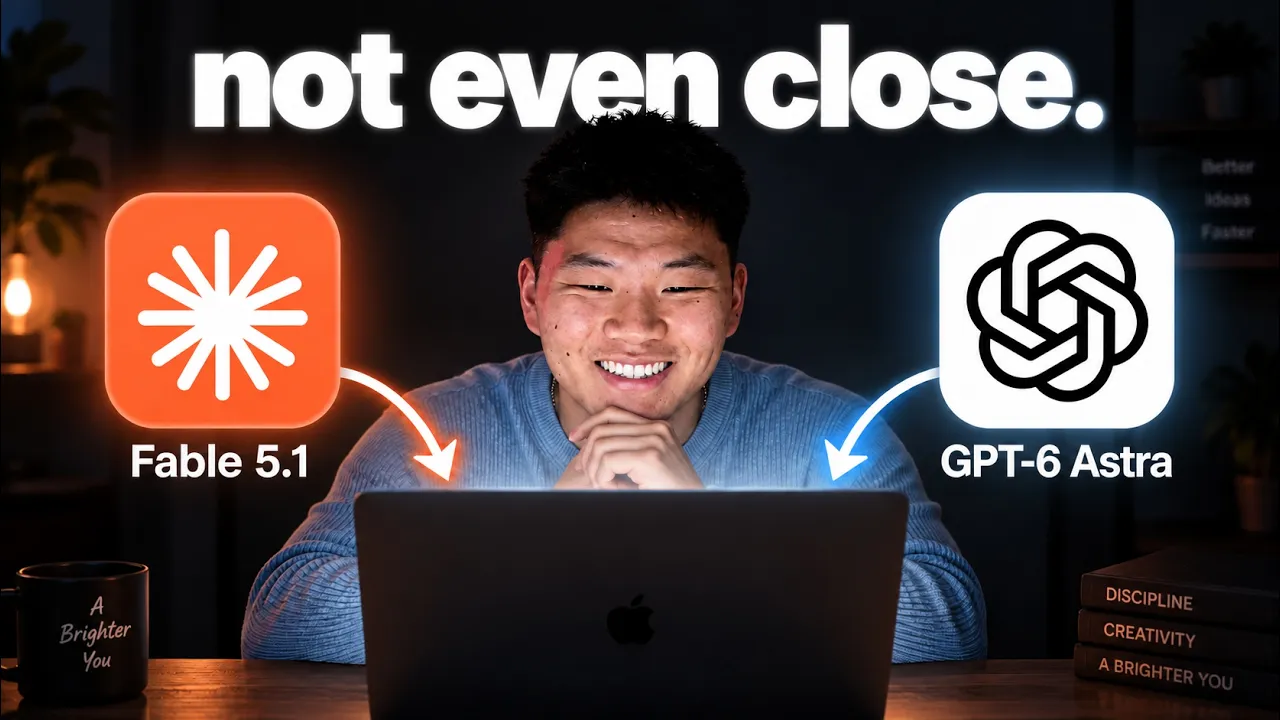
I just put GPT6 Astra headto-head against Fable 5.1 across 15 different use cases that actually apply to my day-to-day. I'm talking things like web design, personal organization, taxes, browser use, vision, and building actual automations and software. For every single one of these use cases, I break down which model did better, how long it took, and what it cost. So, if you've been wondering what model to use for which use case, then this is the video for you. I don't want to waste any time. Let's just get straight into it today. All right, so these are the 15 different use cases that we have. And like I said, I chose
114 words, the words spoken in the first 30 seconds at 228 words per minute.
Free, no signup. See how the first 30 seconds hold attention, with rewrites.
Sentence shape
| Measure | This transcript |
|---|---|
| Sentences | 710 |
| Average words per sentence | 12.4 |
| Longest sentence | 59 words |
| Questions asked | 22 |
| Sentences containing a number | 94 |
Most used terms
Filler phrases
291 in total: like 133 · you know 45 · actually 28 · um 24 · basically 16 · kind of 12 · sort of 12 · right? 9 · I mean 8 · literally 2 · uh 2.
A literal whole-word count of the same phrase list the Prepublish browser extension uses, so a phrase inside another word is not counted and a phrase used in its ordinary sense still is. It is a count and not a judgement.
What this transcript is
Every word below is the caption track YouTube publishes for this video, pulled from the video itself and reproduced unchanged. It is not Prepublish's writing, not a summary, and not a re-transcription: it is the video's own published captions. English captions, generated automatically by YouTube, in the video’s original language. Source: the video on YouTube. A channel that would rather this page did not exist can ask for its removal through the contact page, and it is removed.
I just put GPT6 Astra headto-head against Fable 5.1 across 15 different use cases that actually apply to my day-to-day. I'm talking things like web design, personal organization, taxes, browser use, vision, and building actual automations and software. For every single one of these use cases, I break down which model did better, how long it took, and what it cost. So, if you've been wondering what model to use for which use case, then this is the video for you.
I don't want to waste any time. Let's just get straight into it today. All right, so these are the 15 different use cases that we have. And like I said, I chose these because these are things that I actually see myself doing with these models. So, there are timestamps down below if you want to jump around. And at the very end, I'm going to show the final sort of like takeaways and final cost and time breakdown. And by the way, guys, I've eaten through like three Codex subscriptions, four cloud subscriptions, and thousands of dollars in usage credits.
So, I really hope that this one's helpful. All right, so for number one, I'm not going to read off every single prompt, but here's basically what I asked. I wanted a McKenzie level presentation on the state of SMB report for my Hercules Consulting brand. So, I needed this to be branded and I needed it to apply to our target audience with this fake consulting business. So, that was Claude. You can see that I gave Codex the exact same prompt.
Now, immediately what I've noticed is that Codex asks more questions or GBT6 Astra specifically asks more questions. You can see right here, it already asked me questions, whereas Fable just took this and pretty much just ran. And that is something I noticed overall. So, I just wanted to call that out to start. So, let's take a look at these two decks. Here is deck number one. I won't tell you which model it was yet, but right away I love the way it feels.
It is, you know, capitalized. It has the branding. This feels pretty professional so far. Now, I already did check both of these for the sources and the verification and they are good from like the fact perspective, right? The research they both did was good. Now, I'm looking more so at the way they actually formatted this deliverable. I think we're at a place now where GBT6 Astra and Fable 5.1, they're both so so intelligent.
You don't have to worry as much about fanning out agents and doing research. It's more to me now about how do they come back and present this in a way that tells a story and in something that I can actually like present over, right? because that's what we want is we want to turn that messy data into something that's readable and something that's high quality. And right now what I'm feeling is that this is very very branded.
It matches our color scheme. We have a footer down here which I love. It's consistent. We have like structure. There's columns. Like it did a good job creating this. The thing that I think right now though is it's very very wordy. As far as being able to present over something like this, it would be tough because there's so many words and it's tough to control like where people's eyes will be looking and what they'll be speaking about.
So, as far as a presentation deck, not the best, but as far as like a deliverable you might turn in, you might send to someone and not present, this is very good. And there's a lot of sources down here. This came out to 35 slides. Now, let's look at the other version, which right away I don't like how this isn't capitalized. I don't know. I just feel like that feels very professional. We have some images here, and we have the color scheme as well.
But let's flick through. We immediately notice that this one is not as wordy. I immediately feel like this one's less professional, though, because of the structure. The other one had like I don't know, you could tell in each slide there was like columns. there was a little bit of like a I don't know there was a structure to it whereas this one feels a little bit more abstract. It feels like one big element. You've got one big you know title thing and I think that this one would be a much better deliverable if I was going to present in you know in a room full of people.
But overall as we flick through this one just feels less professional. The vibe I get is less McKenzie and it's more Google Slides or like Canva. I don't know. There's also not like a consistent footer or our logo isn't on every slide. So, you know, this sort of fly, it just doesn't feel very structured and as professional. Even the sources section is way smaller, although that does link the actual sources. So, anyways, this one was GBT6 Astra and this one was Fable 5.1.
And I will say in this specific example, I liked Fable better. So, what I'm going to do here is I'm going to give Fable the win. So, I'm just going to put this down here so we know Fable won this experiment as far as just the output. But, let's look at the time and cost. Fable was 37 minutes and Astra was 23 minutes and Fable was 26 bucks and Astra was 12 bucks. So Astra was a little less than half the cost as well as you know 14 minutes faster.
So the question would be if you used Astra and spent another you know 14 bucks using Astra to improve V1 would you get somewhere that you feel better about than this first version of Fable? So anyways, right now we'll look at the time and cost at the very end, but as far as the deliverable, I liked Fable's output better here. All right, moving on to experiment number two. We did a sales letter. So basically, I said based on what you know about our certification program, I didn't give it information.
I told it to, you know, use my AIOS, use my second brain, use any research to put together a sales landing page. So writing the copy that's optimized to convert. So think about our avatar, think about their pain, think about all this. And I don't want it to sound AI generated. So I'm not going to read the entire sales letters. That would be super boring. Just going to do a quick skim through and talk about which one I actually thought was better and why.
So, here it was. The one that Fable 5.1 wrote out, you can see it is pretty long. This one was longer. It was about 2,800 words. And if we go over to GBT's version, if I come down here, it just output it right in the chat to me. This was the one that Astra wrote up. And this one was more like 1,700 words. So, it was definitely shorter. Now, quick disclaimer here. I am not an expert copywriter. I would want, you know, like John or someone on my team who is really good at writing copy to tell me which one they thought is better.
I will say so far what I've been hearing from my team is that they are liking the GBT models lately better for writing whereas in the past Claude always dominated when it came to writing. But I will say if I was a prospective, you know, certification student and I was reading these, I honestly here would have picked Fable. And the reason is because this is not a cheap program and Fable had things like questions people ask.
Will this get me hired? Does everyone who joins get certified? Am I technical enough? I already run an agency. What if I miss live classes? The way it formatted this makes me feel a little bit more confident or makes me feel more aware of what I'm getting myself into. It also had a section about tuition. It also had a section about who's teaching, who it's for, who it's not for, how this actual program works. Whereas the sales letter over here with Astra just felt a little bit more, I don't know, it just felt a little bit more high level.
And I think with the sales letter, it's supposed to be detailed enough to answer all the questions and pain that someone's thinking about when they're considering paying for a program. So, I will say in this specific example, I do think that I liked Fable 5.1's copy more. So, here is actually what this looked like. Fable was about four minutes. Astra was about 3 minutes. Fable wrote, okay, I was wrong about Astra. It wasn't 1,700.
It was actually more like 1300. So, about half of the words that Fable wrote, but Astra came in at $143 whereas Fable came in at almost four bucks. So, here I will have to say again that I think that Fable won this challenge as far as just like a oneshot prompt and the initial output. All right, so moving on to use case number three. Now, unfortunately, guys, I'm going to have pretty much everything blurred out here because this is about my taxes, right?
And this is one of those things where you want something that is very smart to be able to do this and in a way that you trust. So, I'm just going to go through high level the way I feel when I look at these outputs. This first one was Fable 5.1. And before I get into it, I do want to say in this example, GBT Astra asked me like seven questions before it started, whereas Fable didn't. So that alone makes me feel more confident in Astra's output.
But let's look through here. We go through basically from January of this year to June of this year. So Q1 and Q2 of this year. It pulls all of the numbers. It looks at federal and state. It looks at things that I need to read. It goes to the input and it shows me all of these different things as far as the parameters, the notes, the values, the sources. And Fable gave me like a decision logic. It said, "Hey, if you fit into this bucket, do this.
If you fit into this bucket, do this." Whereas Astra just asked me those questions and then gave me that recommendation. Anyways, we have a um P&L. We have some projections. So, for the rest of the year, what I might be estimating to pay. We have tax calculations here for the individual return and all of the entities that are passed through. We've got payments. We've got things that are flagged. And then we have the actual sources it pulled from.
So, it's not bad. It's a really good deliverable like light years ahead of what used to happen. But now we have the one from Astra. We have the actual information as far as start here. This is what it did. We have monthly results. We have the tax forecast. We have, okay, that looks very good. We have all these payments. We have inputs and open items. So, these are other things that I might need to answer, but this is just way more tailored.
It's easier to read as well. We have the source checks. We have the transaction ledger. And this one is basically every single transaction here. So, this Oh my gosh, this is probably thousands and thousands of rows. This is 3739 rows of transactions here. And then we've got all the sources that it pulled from. Okay, cool. So, overall, this one I think that Astro won like no question. It was more tailored. to ask questions.
I think with taxes alone, it gave me that that feeling of confidence and the structure of the deliverable was just better to me. Now, Astra did cost more here and it took longer to run. So, 40 minutes compared to 22 minutes and 22 bucks compared to 13 bucks. So, even though it's more expensive, we're kind of putting that aside right now. As far as the deliverable, I liked Astra here more. So, right now we're sitting at Astra 1 Fable 2.
All right. So, this next one's interesting. I asked it to go through two of my email accounts and just look through, you know, potentially years of emails to help me find information about subscriptions that I'm paying for, how much total I've paid them, you know, um if prices have increased and things that I need to cancel, things like that. So, let me pull up the two outputs. All right, so here is output number one from Fable 5.1.
Now, as we get into the next tabs on the sheet, I'm sorry, guys, but I am going to have to blur some of this stuff out. It's it's financial information. So, anyways, we have the rundown right here of the audit. We have the different emails it looked at. We have the different types of services, memberships, programs, retainers, contractors, insurance, all this type of stuff. It's looking at the top 10. It's looking at our different categories, and it's showing us how to read this sheet.
So, we have all of our active subscriptions. It's showing me what email they're associated with. It's telling me which day of the month I'm getting build on. It's showing the current price. It's showing the monthly equivalent. It's showing me all of the stats across all the different payments that we've been making on some sort of recurring basis. It's flagging things and it's ranking them as far as priority. We can see um the different actual flag notes.
So, some of these it might be unpaid. This one's getting a price jump. This one's having a seat creep. This one's having I have two subscriptions at once. So, maybe we need to figure out why do I have two different subscriptions on both emails there. So, the point being it's able to look through so much information and give you all of these things that are high priority and you can flag them, you can check them off, you can, you know, delegate that out to your team.
We have all charges, which actually this sheet came back completely empty. I'm not sure why, but this sheet is completely empty. And then we have contractors and big payments. So, these are things it looks like. Anything above um either a few thousand or if it was a contractor that was like a onetime invoice, then it flagged it here as well. And now, let's go over to the Astra 6 version. You can see that they consistently just format Google Sheets a little bit different.
Like, you can kind of tell Astra likes to make the cells larger and and wider and taller, whereas Fable usually keeps them the same. And, you know, they still do a good job formatting, but either way, same sort of thing. At the audit up front, we have the current recurring baseline of subscriptions. We have the annualized baseline tool payments, tool invoices without confirmation, clawed usage, other bills, um price changes.
It's flagging everything right here. Priority review right here. You know, there's a discount ending, there is contract tier or contact tier, there is a price increase, there's a term change, there's seats and tool overlap. So, it's flagging all that right away. We then have all the subscriptions. So, this shows me a list of every single one. It gives me the price. It gives me the um last known bill. Now, this isn't showing me what date.
Oh, there it is. Yeah, it's showing me every single day of the month that we have the next one. We have other bills as well. So, these are kind of the bigger like bigger contracts um contractors or or bigger bills. We have payments. So, this is also like every single one. And I think this is what Fable was trying to do on this tab with all charges, but for some reason just didn't come through. So, we have this here. And then we have also other notes as far as different topics and different things to sort of be aware of.
So, this is kind of like what it was flagging. So, overall here, I will say that Astra gave me a better output. It just, you know, Fable messed up one sheet completely and Astro was cheaper here. So 12 bucks, 12 and a half bucks compared to about $50, which is insane. $50 for that output from Fable. Crazy. It did take 17 minutes whereas Astro took 30 minutes. But anyways, right now we are sitting at 2 to2 Astro and Fable.
All right, moving on to number five. We have meeting analysis. So I asked it to look through all of my leadership meetings and my syncs with John and looking at other meetings that are relevant to the team. And I wanted it to understand or I wanted it to tell me what are the biggest pain points, three biggest pain points and one of the highest value automations that we could build to remove some constraints and help us scale faster.
So Fable gave me the biggest pain points of me being the single production and review engine which is something that I've talked about 25 of 58 meetings. Certification delivery does not scale past one cohort. So we're trying to figure out what that would look like. The critical constraint of the business is also a large cost center. 52 students blah blah blah. And then we also have demand collapsed and every fix is blocked by unknown work and untrusted data.
Weekly leads fell blah blah blah. And yeah, all this makes sense as far as our three biggest pain points. And then the one automation it came up with was an AI customer success layer for theert. One live record per student built from circle activity mastery check outputs and attendance. Students upload case readouts to an endpoint instead of DMing pat weekly due dates and reminders so non-submitters go out through Gmail or behive.
I think this is something that I've wanted to do and that we've talked about a lot and that makes a lot of sense based on all these conversations. And and I also wanted to note here that Fable 5.1 analyzed 58 meetings and if we go over to Astra, Astra analyzed 79 meetings. So it did get the context of 21 more meetings in here. But anyways, let's take a look. The first one was that growth depends too heavily on a few acquisition channels.
Yep, same pain point I think as Fable pointed out. The second one is that the customer journey requires too much personal intervention. This appeared in undefined AIS plus onboarding call reser during certification and leadership still has to reconstruct status and clarify who owns what. Okay, interesting. So these are different pain points than Fable 5.1 found. Now as far as the automation I would prioritize it came up with the same thing.
A customer success workflow which would check each student's onboarding status, unanswered questions, available progress, identify missteps, prepare follow-up, all makes sense. Now in this case I think Astra won again like before I even thought about the cost which is absolutely absurd. Astra still won because I liked its recommendation about the leadership stuff and ownership. And I think that's something that you really want to make sure you have figured out within a team.
But anyways, if you look here, Astra was 5 12 bucks and Fable 5.1 here was 46 bucks, which just makes no sense to me. I I'm very very confused on how it costs that much. I had it look at the session longs. I also did a slash usage and this one cost 46 bucks even though the active agent time was just 6 minutes. So I'm very confused on where those tokens went. Like I don't understand why. It also analyzed less meetings in Astra.
But anyways, that's pretty interesting. This winner is definitely Astra. So now we are sitting at 3 to2 Astra to Fable. All right, so moving on to number six. This one's super interesting to me. I gave it this folder, which has over 150 gigabytes of resources and recordings from our AIS live event in July, and I asked them to make us basically a a recap, like an energetic reel, 60 seconds that shows like a recap of the event that we can use to promote the next ones and things like that.
Now, I'm really impressed with both of these outputs. Let me just say because with how much information it had to look through and how it had to create a story and figure out how to put everything together with music, I think they both did really really well. So, here is Fable 5.1. >> Hello. Hello, AIS Live. My >> Let's Let's get some energy going in here. >> Oh my god, I'm so excited for this. You guys are throwing out a fantastic event. >> Literally like logged off yesterday just buzzing.
I had goosebumps. Let's Let's get you guys paid. This was an experience that didn't feel like a webinar. [music] It's been a great two days. Okay, so that was Fable 5.1. Let's take a look at Astra's version. This has been so energizing. [music] Yesterday I did a workshop where I went all in on every little tool that I use. [music] Cloud code is my primary driver and then I built like my entire second brain/personal agent on top of it.
[music] >> I could go to bed, come back and it'll still be working, you know, 10 hours later to try to achieve that goal. >> [music] >> It's great to be here. You guys have done a a fantastic event. Everything's been super smooth. You guys have been such an amazing audience today. Now, this one, like I said, is really tough. I think that they both did different things well. I think that Asher did a better job of putting like live clips in there.
I think that Fable did a better job of kind of like gearing it up for the next event in October. There were a few moments where there were some things that were off. Like Fable had a few moments where the the timing and the voices were felt like not very synced. Astra had one weird moment where it was showing an a video of Russ, but it said Devon Karns and it was just like that was clearly off. But I am going to give the slight edge here to Astra.
But I will say I'm very very impressed by both of those outputs. I thought it was given the vague goal, they both did a really good job of exploring and creating a story. But anyways, this one is going to go to Astra because you can see this stuff here. Astra took 30 minutes whereas Fable took 50 and Astra cost 16 bucks and Fable cost 26 bucks here. Now, next we did sizzle reels. I basically gave it an example of a scissor reel that I really liked or sort of like a sass I don't know a motion graphic a motion design video that I liked and I told it to analyze what was good about it and I told it to use that as inspiration and create us one for AIS.
So let me show you guys these outputs. First one is Fable 5.1 Heat. Heat. [music] Okay, now let me play you Astra's output. [music] >> [music] >> Okay, so Astro wins this one. I mean, I will say that music is a little bit annoying that, but besides that, it took screenshots from AIS. Like, it went in here and it grabs pictures of the actual courses. Where was the other one? It took a picture here, which I thought was just like I love that idea that it's thinking, okay, why don't I actually go get real proof and screenshots from the thing I'm actually building a reel about and put it in there.
I also love this like these 3D designs. I don't know, it just felt like it had depth. You can see the shadows here as it kind of, you know, zooms in. I thought that this as far as the energy that it had was much better and much higher energy than the first one from Fable 5.1. Now, let's take a look at the cost and time. This one was about similar time, but Fable 5.1 was, you know, a little over half. So 16 bucks compared to 26 bucks.
But once again, I still think that in this case, I'm going to take that output from Astra as the winner. So moving on to number eight. This one's a little more out there as far as I probably wouldn't really be doing this every day for work, but I had them build me these games. So we have two different games where you're a pistachio and you're trying to escape the kitchen. So I'm just going to go through these real quick and you're going to tell me which one you thought was, you know, sort of like which model.
So, you can see here it's it's uh it's pretty smooth. I can double jump. I'm collecting these like cereal bits and I have to hit these checkpoints to get to different spots in order to get out of the kitchen. The physics are real. Like, I'm bumping into these things and I can like, you know, hit the spoon and everything like that. It's pretty easy, but you know, I I I missed a cereal, but I'm able to escape and win the game in about 43 seconds.
Okay, now here is the other version. This one This one definitely looks a little bit more I don't know. It looks a little bit more premium, doesn't it? Um, this obviously this wall isn't there, but it's just because we want to be able to see like this. But this one feels a bit more premium, I'd say. It also feels smoother when I'm actually like controlling this. It is guiding me very specifically, though. I don't know.
I can double jump, I think. Oh, no. I can't double jump. The physics seem to be real still. I can bump into stuff. I can move things. I can fall into there. Um, we've got hot stove. Oops. It's interesting though. They both decided to have like the same flow as far as you jump up on the drawer and then you, you know, you jump up on books to start. You're now on the stove. You're going over to the sink. I mean, that's how most kitchens are, but still the the actual flow is pretty similar.
And now we escaped in this one in 46 seconds. So, similar amount of time. I did get all of the crumbs in this one. They were designed very similarly, but I will say I think that as far as like feeling realistic and, you know, physics, I liked this version better and this version was Astra. Anyways, look at these stats. They were very, very similar. So Astra was eight bucks cheaper, nine bucks cheaper, and it also took about 40 bucks longer.
So very similar stats. Nothing blew anything out of the water here, but I would say that I'm giving this one to Astra. Once again, that one's subjective. Maybe some of you guys liked Fable 5.1 more. But what I think is really important is that you're applying your own taste and you're finding your own use cases because some of these use cases, you guys might be like, "Well, I actually liked Fable 5.1 here." Cool. Then you just figured out maybe you use Fable 5.1 for that use case even though some other people might use Astra for that use case.
It's all about your own use cases and your own experiments. Okay, so moving on to number nine, we have an actual SAS, like kind of a mini SAS, and it's an evaluation app. So you should be able to put in like automations and then run them against some golden data set and see the score and understand like what you need to fix, and then you can rerun them, and you can generate reports and things like that. So you can see here, this is the first version.
This is Fable 5.1. I think that right away this is a little bit more of an intimidating interface. It's very, very wordy, but we can see all of these tests. We can see our different automations here on the left as well. We can add a new one. So if we wanted to put the name, a description, and then actually, you know, say how how do you actually trigger this automation? Is it Python or do you hit an API? And then from there, let's just put in some information.
You would actually put in the URL or you would put in the Python script. You would put in the test cases and then you would write, you know, how to grade it. So that is going to be very valuable. And it also has all of this stored on the back end because it has to store all of these actual um runs and it has to store the code and it has to you know show the improvements and things like that. So here we can see this support ticket one um I think they ran two tests.
You can see that there's also like a visual breakdown of what this actually does. So this is a very deterministic script. We can see the code, we can see the setup, we can see the test cases. So this is essentially our golden data set. There's only 12 examples. You probably need more than that. But this was all generated to actually test the system, right? And if I actually go in here and hit run, what does this do? You put the name, you put what changed, you put any tags, and you compare it with a different version if you want.
And then I just go ahead and start the test. And so this came back. You can see, I mean, there were no changes. So we still got two out of the 10, or sorry, two out of the 12 didn't hit, right? It also went super super fast because I, like I said, this is super simple. But then you can generate a report. So I come in here, you can see all of the different tests that we've ran. And it would show us like what's still broken.
It would show us the improvements we make. So this is something that, you know, I actually do want to keep building out. So we can do this for, you know, our our students and basically give them a better way to evaluate their agents and things like that when they're building them out because eval obviously we all know are super super important and it's also good to be able to see them visually. So this was Fable 5.1's version.
Let's look at Astra's version. So I do like the interface of this one more as from a design perspective. I think that this one feels I don't know it just feels a little bit more premium. It's also less wordy so it's less intimidating right away. I think we have a test library so we can see all of these different versions. We have run history. We also have reports over here that we can look at. So, we can see customer support agent.
Um, I like how this report is structured. Let's see if we look at this next one. We can see how it changes over time. This one feels more branded. Like, this feels like something I'd rather get in front of some eyes and get some feedback on compared to Oops, I just closed out of the other one. Compared to this version, this one just feels way more like a PC compared to this. I feel like is, you know, something we can almost get out there and start testing against.
So, if I come into an automation real quick, let's say we go to the support ticket router and I want to go ahead and see it visually. I like that a lot. We can see all the previous runs. And I can go ahead and run this eval again. And we can see it running a bit better. We're seeing it actually go through the test cases. I like this experience way, way more. And look at this. Astra came back and cost half the price of what Fable spent in order to do this.
It did take a little longer, 2 hours 25 minutes compared to an hour and 20 minutes, but it's just so much better for less cost. So in this case, I'm giving this to Astra once again. So Astra is now up, I believe, seven to two on Fable. All right, moving on to number 10. We now have this Herk brain visual. So this is a local host where I can see basically my brain. We see different clusters over here. Um, this seems more like YouTube videos.
This seems like things that are actually going on in the business. Oh, wait. We can see down here cloud memory, video knowledge, and we can remove things or put them back in. Business wiki, skills and agents, projects, and this is dynamic. It's really cool because we can see only what needs attention. We can see show all labels. We can see 612 notes, 2500 connections. We can analyze things. We can talk to it. We can search for things.
Let's see if I search for um personal OS, personal assistant, open claw. We can open up the specific things. And that is a pretty cool visual. So, we can actually start to see in here inside of the brain. And as we click on different things, we see all of the connections that are linking into it. So, all the relationships. So, that is a pretty cool experience. It does feel pretty smooth and I can control this. Uh, not too well.
Like I feel like I have to click on something to make that the center, but I I think that that's pretty cool. So, that was Fable 5.1's version. Let me now open up Astra's version. Okay, so this one's a little bit different. Um, I can still click on all of these things. These nodes are smaller. I don't like how that feels. I don't like this interface at all, like nearly as much. I have the same sort of vibe. I can click on business strategy or AI and ideas, videos and content.
Um, people, projects, book and writing, all knowledge. Um, this interface is more overwhelming for sure. Like I I definitely like this one more. I wanted just something simple where I can see the brain a bit more visually. And I was honestly expecting Astra to come in here and kick Fable's butt here, but I think that I like Fables more. And now let's look at the cost. Astra took 40 minutes. Fable took 24. Astra and Fable basically cost the same.
Fable was a little bit cheaper, but I am going to give this one to Fable. I think that Fable gave me more of what I was looking for. You know, once again, kind of a subjective grading criteria, but I think Fable won here. So, what does that put us at now? We're at 7 to three Astra to Fable. And we have five more use cases left. So, Fable could still take the lead. All right, guys. So, this one is an HTML explainer doc.
What I did is I gave it my YouTube video, the 25 Grockbot concepts explained, and I told it to explain it to me simply, simply simply and visually, and I told it to take screenshots. I said basically give me a doc that I can read through and it feels like I actually watched the entire tutorial. So we have all these different parts. We can see the screenshot to start. This one obviously is is kind of wordy up front but that's okay.
We see how the team fits together. So me, these executives, these operators, we can see all these different plugins and computers and skills. So that's a good little explanation at first. Now we move into the concept. So we're taking screenshots and it is being analyzed. This is Fable 5.1 by the way. We can see the executive bots. We can see the name and job label. These so far are coming through well as far as these screenshots being cropped and annotated which is really nice.
It's taking a lot of different screenshots. We have the buttons here. We have all this. I think that this is coming out pretty well and it's showing us what we need to see from the actual video. Now, I do think this is pretty wordy. Um I think that but it is getting very specific. Like I do think I could give this doc to some people and they would be able to feel like they actually watched this video. It's it's cropping things.
It's zooming in. It's annotating. I think that this is doing a really good job. It's even showing all of this. Yeah, I mean, this is doing a really good job here. So, let's go over to Astro's output. This one already, it looks a bit better as far as the HTML. And now, let's see if the screenshots are good as well. So, we have one here. It's pointing at a bot. It is pointing at the description, the executives, it's pointing at these different buttons.
I will say Fables was more detailed for sure. Like, this one was designed better, but Fable's screenshots were better. like Fable took more screenshots and made more annotations. And so far, I think that that was a better learning experience, even though this one, like I said, looks a little bit more I don't know, it it feels prettier or better. But if you were really thinking about could you hand this doc to a complete beginner and have them actually go through and feel like they're learning, I think that Fable's going to take this one.
But let's look at the cost. Like I still am going to give the output to Fable, but when we look at the cost, Astra was much cheaper here. So the question is like, you know, if you used Astra and had it spend another, you know, 20 bucks or so, would it be better than Fable's output right here? And I would argue that yes, it would be better. So it was way more efficient here, but it's, you know, its V1 wasn't as good as Fable's V1 in my opinion.
So Fable's going to take this one. So now we are at 7 to4 Fable or 7 to four Astra to Fable. Okay, so moving on to number 12. We have this sort of like painting example in Canva, which is a bit silly, but it does highlight the browser use and the vision really well because GBT6 Astra had to look at this picture, open up Canva, understand how to navigate with the different tools and things and build this out, which it did.
And I think that this does look pretty good, especially when we go over to Fable real quick and I open up Fable's output. If I go to the painting and we open up the browser here, this is literally what it gave me. And this was the reference image. I mean, this is just this is laughable. This is laughable. I I was expecting Fable 5.1 to do something much better, but it like I don't know what exactly it tried to do, but this is obviously just very bad.
So, no question Astro wins this one. And Astra was also cheaper. So, it's pretty ridiculous here how much Fable spent and how long it worked just to give me that crazy output. So, Astra wins. Okay, so moving on to the next example, number 13. What I did is I gave Fable and Astra this doc which said, "Hey, these are this is a new course. I want you to put it into the free community as a draft and I want you to use browser use in order to do this." So they basically opened up school.
They went to the classroom and they put in these draft courses, Astra AIOS and Fable AIOS and they put in their different courses. So they were basically instructed to have the description, the key points, the key quotes, and any resources. And they had to put the video in here. And so this is Astra's output. I told them to do just the first five. And this looks really good. It had to navigate the interface. It had to basically come in here, make a new page.
It had to put in the video. It had to put in the text. And it did it really well and saved everything here as a draft. Now, if we go to Fable's output, there are no videos here. This one arguably might have been structured better as far as like this looks cool and these are numbered, whereas the other one with Astra, it wasn't like numbered as well. Like it just it's longer. But the big big issue here is that Fable ran into an issue and for some reason couldn't upload the video.
There was something issue with having it download locally and whatnot. you know, I gave them everything it needed. I gave them the videos. I gave it the links. This is something that Asha did way better. And I will say I've done this multiple times in my school. And I've used 5.6 soul with browser use. And just in general, codecs and the GBT models are significantly better with browser use. So, this one I'm going to give to Astra.
And honestly, the cost and the time wasn't too different here, you know. Um, very similar and very similar. Astra was a little bit cheaper and Astra's results were much much better. So, this one's going to go to Astra as well. So we are now at the place where the score is Astro has nine and Fable has four. So Fable can no longer catch up. But let's look at the last two outputs as well. Okay. So for number 14, we did a website and basically what I wanted to happen is I gave it this URL and I said, "Hey, I want you to basically help me clone this website.
I like the structure. I like the feel and I want you to make this for Perk Form, which is the fake, you know, um, can company." So this is a really cool scroll dynamic. I know you guys, some of you guys hate this sort of site. That's not the point. The point is, could Astra and Fable analyze this site and make one that has the same feel and the same vibe for Pork Farm? So, here is Fable 5.1's version. It loads up. We have this, you know, 3D dynamic element, coffee reformed.
We have like some, you know, DNA looking stuff here. We keep scrolling down. We've got these coffee beans falling. We've got the can come back. We've got all this going on. I would say that it's doing a decent job here. It's even got the huge like zoom out. It's doing a decent job of making this feel like the other site. You know, obviously there are some issues here, but I think it's doing a decent job. Like for a oneshot prompt, although sometimes I get into these issues with the scroll.
I mean, that's a bit of a bug, right? That's when you hit the bottom of the site, something weird goes on there. So, there's obviously some bugs, but it's not terrible for a oneshot. And now, let's take a look at Astra's version. We have the big can here, which is a little bit dynamic. There's something going on with this text, right? Like the coffee is out of bounds for some reason. Keep scrolling down. I do like this animation.
I mean, that's pretty cool. It's a It's a coffee bean. There's definitely layers in the back. And by the way, this one I didn't tell it to use any skills. I just said, "Hey, I want the same vibe. I want you to analyze the, you know, the original site, this one right here, and make me one like this." Right? So, anyways, we're coming through the little sort of like DNA thing. Coffee and protein together, two drinks in one can.
I like that animation. This one overall does feel smoother than Fables. I do think that as far as a first pass, I like the way this one feels. we get stuck at the bottom and we'd have to scroll all the way back up to the top. Now, I do think that Fable did a better job as of actually just recreating what we saw in the original site, which was the prompt. Now, I do get stuck. There's a little bit of a there's bugs like this.
Like, I get stuck. But, as far as recreating this, Fables felt more similar to this, I think. So, we will give this one to Fable. Um, it kind of needs it as well. But, I still think in general, when it comes to design, you guys have probably seen throughout this video and you've seen my other videos. In general, I do think I like Astram more for design, but that was like, "Hey, show me what you can do. Take this URL.
Build me something crazy in one shot." It was kind of a weird prompt, right? But in this case, I still think that Fable won. But here's a look at the cost and the time for this example. All right. And this is the last one. Number 15. We have YouTube 12-month review and strategy. So, it basically had to look through the past year of my YouTube stuff and give me some stats. So, this is interesting. I mean, these are big docs.
The one on the left is Fable. It's 25 pages. The one on the right is Astra. It's 15 pages. So let's just slowly scroll through and see what's happening here. I like how Astra right away has you know this chart on new viewers and regular viewers whereas over here we have you know the year and numbers we have a monthly review. We have total views across the past um ooh interesting. So actually what they show me first on the left side is from January to now whereas over here I'm getting sort of like the actual past 12 months.
So those stats are going to be a little bit different. It's showing me content type. It's showing me the monthly scorecard. It's showing what my best content actually does. It's showing me some packaging stuff. It's showing me what to worry about. So, it says news brings the views but does not bring the subscribers. It's saying um the news packaging is drifting towards hype. The audience is saying so. It's saying agency mechanics content has stopped working on YouTube.
That definitely feels to be a bit true for this audience. Now, it's deep diving into some packaging. So, it's analyzing my my titles over here. Whereas over here, when we have the packaging, um what I would keep and improve, the evidence, retention, first 30 seconds, who you are reaching and how. So, it's looking at the age, it's looking at the gender, it's looking at the geography, it analyzes what the comments are asking me to do.
So, then at the end, they kind of like put all this stuff together and they give me the next 90 days and they give me some things to look at. Overall, they're very similar. I do like the way that this was packaged more by Astra. It just feels a little bit easier to read and it also feels more visual. So, I'm going to give this one to Astra as well. And you can see here though, Astra did spend more and take longer. So, 42 minutes compared to 17 and 27 bucksish compared to N bucks.
So, Astra wins, but it was longer or slower and more expensive here. But anyways, guys, that was 15. That was 15 different use cases here that we scored and looked at the cost and time. Astra won 10 of them and Fable won five of them. But let's take a look at the total numbers here. I had both Astra and Fable give me these stats to make sure they were consistent. And you can see the numbers are exactly the same. Fable was 9 hours 35 minutes and 45 seconds of total run time here costing us 513 bucks.36 and Astra was 11 hours 19 minutes 24 seconds and cost us 326 bucks.98.
So in total Astra was $186 cheaper but took an hour and 43 minutes longer to run across these 15 different use cases. Now I will say this was 15 use cases. In general, my experience has been that Astra feels quicker and feels more efficient and also it doesn't give us that 5 hour window in Codeex and it doesn't give us that fable limit. You know, we can just use Astra the whole week. So, I do like that we also get more inference with Astra in general because of the codec subscription.
So, right now I'm heavily leaning towards Astra for my my day-to-day my use cases. But the other thing I want you guys to keep in mind is that GBT 5.6 Soul is so so good still. It's so capable and for the majority of my knowledge work, I could use that just fine. And that even honestly might be overkill for the majority of stuff that I'm doing. So it's not like you need to use Astra only for all your use cases. And it's not like you need to go grab Fable 5.1 for all your use cases.
I'm still a very firm believer in they both have different strengths and weaknesses. They both have value. And that's why I love doing things like this to find out what are the different use cases and how do they, you know, behave in different scenarios. And so yes, I am going to be using codeex more right now because that's where it currently is. But this stuff shifts so fast and I will always keep both subscriptions or multiple of both subscriptions so I can keep testing them out as things change, as my use cases change.
Who knows what might happen. But anyways, that is going to do it for this one. I hope you guys enjoyed this breakdown. I hope that it was insightful or you learned something new. And if you did, please give it a like. It helps me out a ton. And as always, I appreciate you guys making it to the end of the video. And I'll see you guys all in the next one. Thanks everyone.
The words are the caption track's own and nothing is reworded or re-transcribed. Paragraph breaks are placed between sentences so the text reads as prose.
Free tools for your own script. No signup, no login.
Paste your draft and see where viewers are likely to drop off, with a rewrite for each weak line.
Paste the first 30 seconds of your own draft for a hook score and rewrites.
Check your draft against YouTube's advertiser-friendly guidelines before you record it.
Read this channel's public videos and transcripts, and download a writing brief for it.