Getting the transcript
Reading the captions from YouTube. A video nobody has opened here before takes 10 to 30 seconds; this page fills in on its own.
Getting the transcript
Reading the captions from YouTube. A video nobody has opened here before takes 10 to 30 seconds; this page fills in on its own.
Lil Fish · @not_a_lil_fish
Words
4,194
Runtime
30:21
Speaking pace
138wpm
Reading time
17min
138 words per minute, below the 160 25th percentile of 349 measured videos. That distribution comes from the 349-video hook study.
Opening (first 30 seconds)
This is something I've never shown on the internet before. This is probably two years old. It is a manual back test I did on Google Sheets. And if you look at the bottom here, there are quite a few of these. Um, and I bring this up because what I'm about to show you is the back test I did with AI where we back tested 10,000 plus
69 words, the words spoken in the first 30 seconds at 138 words per minute.
Free, no signup. See how the first 30 seconds hold attention, with rewrites.
Sentence shape
| Measure | This transcript |
|---|---|
| Sentences | 305 |
| Average words per sentence | 13.8 |
| Longest sentence | 56 words |
| Questions asked | 15 |
| Sentences containing a number | 64 |
Most used terms
Filler phrases
22 in total: like 12 · actually 5 · I mean 1 · kind of 1 · sort of 1 · uh 1 · um 1.
A literal whole-word count of the same phrase list the Prepublish browser extension uses, so a phrase inside another word is not counted and a phrase used in its ordinary sense still is. It is a count and not a judgement.
What this transcript is
Every word below is the caption track YouTube publishes for this video, pulled from the video itself and reproduced unchanged. It is not Prepublish's writing, not a summary, and not a re-transcription: it is the video's own published captions. English captions, generated automatically by YouTube, in the video’s original language. Source: the video on YouTube. A channel that would rather this page did not exist can ask for its removal through the contact page, and it is removed.
No Script X-ray for this video: YouTube shows a Most replayed graph only once a video has enough views.
This is something I've never shown on the internet before. This is probably two years old. It is a manual back test I did on Google Sheets. And if you look at the bottom here, there are quite a few of these. Um, and I bring this up because what I'm about to show you is the back test I did with AI where we back tested 10,000 plus strategies and 5 6 million trades. And that's only valuable if you have a point of reference.
So this sheet in front of you, every day after school or every day after work, I would come home and I would open Trading View. I would do a split screen with ES and then Q. I would take my strategy. I would test it out. And each one of these [snorts] is actually annotated. So, all of these pictures are screenshots I took of Trading View because I annotated the annotated the charts. I took a screenshot. I threw it in.
I took some notes on what I saw. I filled in my time of entry, my pair and the result of the trade. And I entered my little formulas so I could understand my gains and my win rates. And this is how I back tested. And this whole sheet probably took 10 to 20 hours because there's a lot of charts here and every single chart is an annotated chart. I was obsessed with learning how to trade and learning what edges would work.
And so I dedicated myself to the craft. And that same dedication carries into the opportunity we have in AI. And what I'm about to show you is a 5.6 million trade back test with 10,000 strategies. And I'm going to show you the most profitable strategies of anything that's out there. The best strategies to get paid, the best to pass accounts, the best to get payouts, the highest winning, the most money-making, the highest win rates.
There's strategies in here with 100% win rates. There's strategies in here with 17R as an average winning trade. And I'm going to dive deep into all of this and explain how we can actually apply this. And before I get too deep, I want to take a second and preface this video. If you don't know who I am, my name is Luke. I've been I'm known on the internet as Lil Fish. I've been day trading for over three years. I've been using AI for around four years.
I've made over five figures in payouts. And this year, I started using AI to do AI assisted trading. And you'll see why that's important, how that plays with a lot of these strategies. So, that means for me, I wasn't watching the charts. I was getting notifications of valid trade setups, then using my human discretion to decide whether or not to place or skip the trade. That led me to my biggest payouts ever. And now I'm working towards fully automated trading.
So Claude designs the strategy. Claude places the trades. Claude just this past week passed two funded accounts and placed a winning trade on a funded account for me. The objective here is to have AI do the entire thing and AI to be that magical money printer that we're all that we are all after. But before I kind of go into this, I really want to speak to you because I really want you to win. And if you're here to just be entertained, that's fine.
You're going to see a lot of really cool stuff and a lot of interesting information that you can find useful. But information without implementation is just entertainment. And that's fine. If you're here for that, that's fine. But if you actually want to win, this is information that you should be taking notes on and applying to your edges. The only reason I am not is because I already have formulas in place that I believe are going to lead me to make more money.
I'm testing these. They're in the process of working. They are leading me to pass accounts and make winning trades and getting me very close to payouts. But if you're nowhere around there, if you're totally a beginner, if you've never used AI to back test, take notes on these. These strategies are digital gold, if you will. This information, these edges of what AI was able to find in the weeds is really helpful when it comes to how you should approach algorithmic or even discretionary trading.
What is the best approach out there? So, let's get into it because there's a lot of fascinating information here. So, 5.6 million trades, 10,000 strategies. This was done over seven years of data on CFD data. CFD because you can get CFD data for free. This includes futures, but just their CFD version. [clears throat] Let's get right into it. Let's let's not hesitate any longer. Here's all the information we're going to look through and then we're going to look into the best strategies out there, the highest winners, and the ones that you should use.
To start off, here are the most fascinating things that I find that you can implement right now. Cost divided by stop. So, when you enter a trade with a high position and a small stop-loss, you are more likely to eat into your edge because the commissions are so high. And I get a lot of DMs of people saying, "Oh, like I have a profitable edge, but the commissions are eating away. your stop loss is too tight. And this edge, this graph here, represents that.
The smaller your stop loss is, the more you're paying in commissions and the better your edge has to be in order to win. So, this is saying that a commission that is less than 3% of the stop cost is more likely to win than anything else. Which market? So, across all the assets tested, NASDAQ is a dramatic winner. And that makes sense because this is one of the most liquid if not probably I don't I haven't looked it up but this is probably the most liquid asset of any to trade.
That means they're the highest volume and the most points to catch. So NASDAQ is going to be your winner. Which time frame? This is a bit of a killer because there's a lot of people who love the one minute or they love the 3 minute or they love the 302. When I was making most of my money, I never dropped below the 30 minute. The 30 minute was my executionary time frame. And really, I favored the 60 minute. And this proves that system to be true.
Depending on what time frame you're using to trade, the higher the time frame, the more winning strategies there are. And that coincides with lower frequency trading because everybody loves to I'm going to trade every single day. That is not the most profitable approach. It just isn't. You will make more money if you trade less on the higher time frame. That is something I have experienced. That's how I got my payouts.
I was executing on the 30-minut time frame and across 10,500 strategies. This proves that to be true even more. So, which session? Across all the sessions, London has the worst performance, second to worst, second to Asia. And again, that makes sense going along with NASDAQ because these are high volume, high liquidity times of day. And the highest performing strategies, all were New York AM session. This is the market open.
This is that liquidity sweep at 9:30 a.m. that we'd love to see. Hopefully, you're already seeing a bit of a pattern here, and that's going to play into some of our best strategies. The New York AM session is the best in terms of all of these strategies combined. And I'm going to get into all of these different categories because I did not go out and hand select 10,500 different strategies. That would be ridiculous. How the stop loss is set.
I found this one to be interesting because I personally for my biggest payouts was doing structure-based stop- losses. Wick low. That's where it always goes. And this suggests that to not be the best approach. Marginally, fixed stop losses. Fixed meaning no matter where I enter, I'm doing a 15 point, 50 point, 100 point stop loss. nothing else. Nothing to do with the candles, nothing to do with the volume, nothing to do with the time.
That is the highest performing strategy or approach. Second to this was a surprise to me. Time. No matter when you enter, you just let it ride. Very interesting. You let it ride for 80 minutes straight or 80 candles straight and then you exit no matter what. I found that to be fascinating because that is something you never see because prop firms make it in a way where if you do that you are highly unlikely to be profitable because this strategy, this timebased exit is going to lead to dramatic winners and dramatic losers.
And in the prop firm environment, you have consistency rules. You have daily loss limits that prevent those huge winners and huge losers from happening. And that appears to be one of the most profitable approaches. How you enter stop, confirm, market, limit, all are around the same with limit entries being the worst performing. These are the 50 different families of strategies. I asked for it to pick the top 50 retail strategies.
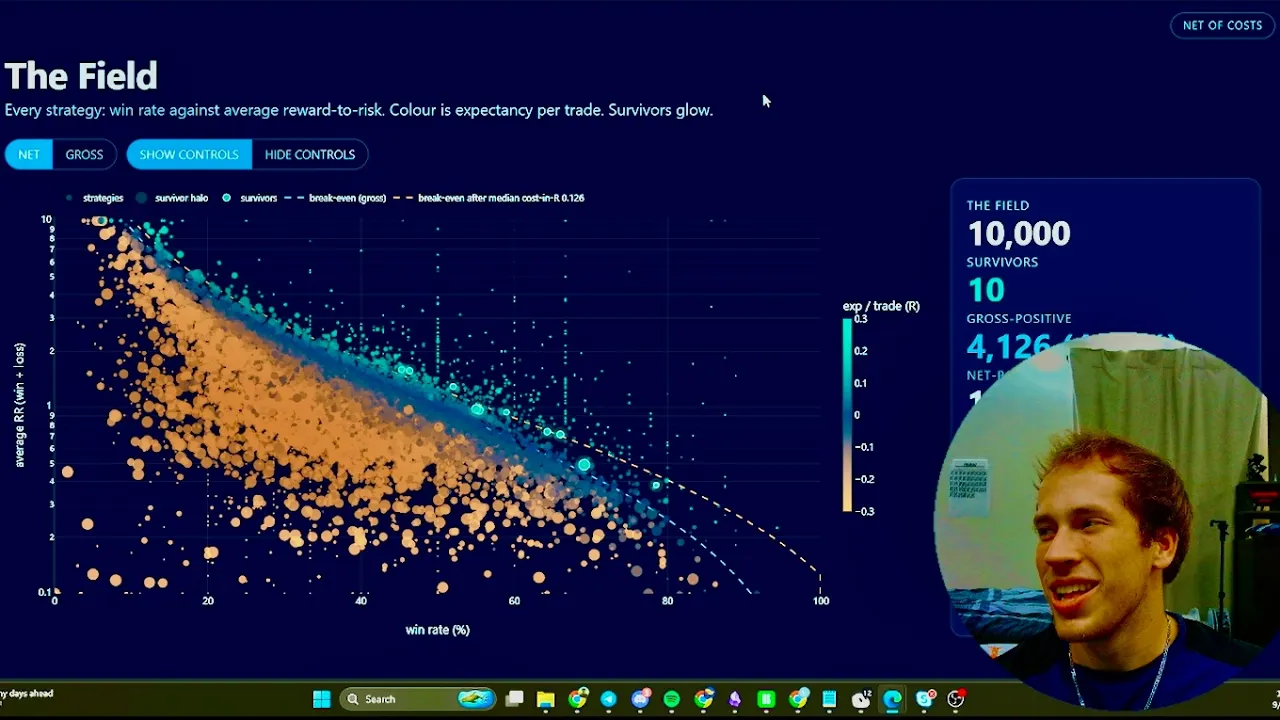
And what should you immediately see from here? The groups mean cumulative R per variant. Every single one is negative. Every single one of these has a negative expectancy. This is the reason that when I made my money and I chose to build an AI assisted system, it was AI assisted and not fully automatic because I knew that from my experience, I have a discretionary edge that when I see a trade setup, I could say hm yes or hm no.
And I might not always be able to put into words why I feel that way, but that decision that I make leads to the success I have with the model. Because the model I traded was, let me see if I can find it. Was this liquidity sweep and reclaim C2 zero survivors with a median trade result of negative.175. This is not profitable. Like any of these, these are not profitable. And these are including the commissions, which is a crucial part of strategy.
You can't disregard commissions. The people who disregard commissions and then go to the live markets are why my DMs are filled with my strategy is not profitable when I don't know why. But this is the reason that I built AI assisted. I get the notifications that I make the decision. I'm avoiding all emotional aspects. I'm shortcutting to the only part where I'm valuable, which is that decision. That being said, I am actively in the process of proving myself to be inferior to fully automatic systems built with Claude.
This is what I find more interesting than anything on this dashboard, and it is how likely it is to pass a 50k eval. So, there's 10,000 strategies. 10. I like imagine that for a second. That screenshot that I showed, that Google sheet that I showed of all the different trades, that was one strategy. This did it 10,000 times. 10,000 times. And all of those strategies only.6% 60 of 10,000 strategies have greater than a 50% chance of passing.
You have a 99.4% 4% chance that if you pick a strategy that is entirely automated, it is less than 50% likely to pass an account. So, choose wisely and make a decision on whether or not you want to keep yourself in the loop or not. This is why I've built systems like discretionary trainers before because I want to get better at my ability to decipher what strategies are winners or what trades are winners and what trades are losers.
Look at all of these negative strategies. This should alarm you if you trade strictly algorithmic and not in a business prop manner because you need to do your due diligence in using AI or testing other strategies or using your discretion which is what I did. Now for all the strategies we can see that a lot of these have a incredible amount of trades. 11,000 trades for all of these, which is unreal. And I'm going to break down what's interesting to me here and how this plays into the proper game because some of these strategies may look freaking awesome.
We're going to see that, especially when we look at average RR and some of these just freaking crush it. 31 RR as an average, that kills it. But it's a 7% win rate. You can't pass an eval with a 7% unless you do I don't know what's that's like 13 tries, 14 15 tries to pass one evaluation that has a single day pass and no consistency. So this strategy would actually suck and it only won one time. probably a huge win because the trade count matters.
Net R per trade. Man, I don't even know where to start because there's just so much here that I want to I want to talk about and I want to look at because you can look at all of these at face value. And this is what's so important. I get DMs all the time of people saying like, "Hey man, I have a 60% win rate and I'm not profitable." 60% win rate alone is not anything to tell me. Like I cannot get anything from you telling me you have an epic win rate because look at all of these 100% win rates, 80% win rate strategies and none of them are profitable.
You have an 84% win rate but you're losing 85 but you're losing all of these 80s that are red. 80%. That sounds great, but look at all these losers because average RR and net R per trade are crucially important. And let me really scare you here because look at how many of these are likely to pass an eval 0000. They're not even getting to 1%. Most of these 1.6% chance of passing an eval. Forget even getting a payout. You're not going to pass the account to begin with.
Okay. Best trades, best strategies, total net R. These are what I think are some of the best strategies, but they're not going to work on prop firms. And you can probably already see that because properforms are stacked against you already, which trading is already stacked against you. This is even more so. So you might be able to make gains with these in the live market, but it's highly unlikely a proper market. And you can see that immediately from the win rates.
Win rates under 50% are almost impossible to make money with in the proper environment because you have consistency rules. Consistency rules have only showed up in the past year or two. The consistency rule is, if you don't know what that is, it means if I make $1,000, I can't have, if I have a 50% consist consistency rule, I can't have made over 500 in a single trade. I must have taken two trades to make up that total or three trades.
And so when a prop firm has instant day funding but a 20% consistency rule, that means you must have had five $200 winning days. And if you lose and you make more on one day, if you accidentally make 300 on one day, now you have to make 1,500 before you can take a payout. Consistency rules will eat you alive. And so win rates that are low and have big average wins like these, volume spike breakout is the most profitable of any strategy. 10,500 strategies.
Volume spike breakout is going to give you the most money and you will not be able to pass an eval and you will not be able to get a payout. Look at these statistics. 0% 0%. Look at the P&L chart over time. Very profitable. It's clear you can't win with it in a prop firm because of this number being 14%. And this number being eight because you're making nine times the amount you risk 14% of the time. And that's awesome and that's profitable.
But that is not going to comply with what's required of profs. So you can't use this Now, let's look at the ones most likely to pass an even. Notice how it's another volume spike breakout. What do we immediately see here? We see high win rate, lower risk-to-reward. Now, unfortunately, this is only 27 trades. So, this is pretty unreliable data. We need much higher trade quantities before we look to use that. But we can see here, I mean, you could set this up to give you a notification when this trade exists.
And so the few times a year when this strategy exists, you should take this trade. You're going to get what 27 trades across seven years. It says 0.07 trades a week. So, what does that mean? Once every 20 weeks, two to three times a year, you're going to get one of these trade setups, and you should take it then because it's probably going to win, but uh you might have to wait an entire year to get this trade. So, if you want this criteria, here it is.
Volume, spike, breakout, the family settings, the directions. How here's your entry, your stop, and your target. Here's your session, your daily flat, your maximum amount of trades per day. So, I know there's only going to be two signals a year, but if for some reason you get two per day, you could take both, but not the third. And you skip Wednesday and Friday, but we want a higher quantity. 121 New York window sweep model.
Let's take a look at this one. So this this looks great on the outside, but it's been unprofitable for the past two years, and it still is a lower frequency. You're taking one trade every 3 weeks. Here's your criteria. It's in the New York open because that's when we're having most of our volume, most of our liquidity. But it's profitable if you use it in 2024. 2026. We're on a hot streak. Random control. I love that.
I just clicked on this one. A random strategy with a 150 trades happens to beat 99% of strategies. What is this telling you? What information is this giving you about automated strategies? Because I'm using fully automated strategies right now to pass accounts and getting close to payouts. So, why am I getting close to payouts with complete automation when after I did a 5 million trade back test, which I didn't do before, and almost nothing is yielding positive results.
I can think of two things that this is telling me. Number one, human discretion is an asset and you should use it to your advantage. And number two, I just shared a tool with my community, Ocean AI, this morning. And this tool is to calculate the probabilities of passing evals and getting payouts including the cost of evals and the size of payouts as quick as possible in a business fashion. Treating profits like a business.
How do we pass and get paid without being profitable? We don't even need to have good edges in the market. We don't even need to have an edge in the market, but we can still win and get paid. The strategies I'm using to pass accounts and make money on funded accounts hardly have an edge at all. In fact, a lot of the strategies that we're looking at perform better, just less frequent. Unreal amounts of data. Unreal. Now, I show a lot of this to expand your understanding of what you can do with AI because a 5 million trade study took me one night to do.
And I did smaller ones that are the reason that I'm passing accounts now. But you should look at this and you should say, "Wow, look what I can do if I take advantage of the opportunities at hand. Look what I'm able to build with these tools." because I already showed you what I had to do manually and how in an afternoon I can do 5,000x that. I hope this is just a testament to use AI to your advantage. I talked about it a lot yesterday for the video last week.
AI is an enhancer. If you are lazy, you can still get these results. And they are more than the results that I who was working hard two years ago was getting. You can beat me from two years ago who is more driven in an afternoon. But I am still the same me and I am still the same driven person. And that is why I am succeeding with AI and making more than I ever have. This year I've made more money trading than I ever have.
And I attribute 95% of that to my use of AI and my optimization. eliminating myself from the loop, giving more work to AI to do, and keeping the only part of me that is valuable, which is my taste. I would argue I'm working and investing myself more than ever. I was spending hours a day to get 10 trades on a manual back test. I'm still spending hours a day, but instead of 10 trades, I get 5 million. And if you want to reap the rewards that I'm reaping, you need to be that highly highly agentic person, but with the tools at hand.
Because I just showed you a whole bunch of information. NASDAQ is the most profitable. New York AM session is the most profitable. Those things are true because they have the highest of volume. What does that mean? News events are likely to play into that. Small stop- losses get eaten away by commissions. Every retrail strategy is going to yield, not every 99.4% of retail strategies are going to yield negative expecties.
So, do you take those strategies and approach them in the market anyways and figure out the percentages and the RRS you need to still get paid or do you add yourself in the loop and build some sort of automation where you only interact with what's valuable where you only do what gets you paid? You make the final decision all off of your taste. That's how I made most of my money in trading, my taste. eliminating the emotion.
I made an entire video breaking down this back test, not this back test specifically, but back testing with one of my students on how I do this. And in my community, we're doing things like this all the time, back testing crazy amounts of edges and talking directly with students on how do we use the information that we have to get paid because that's our goal. It's fun. It's cool to look at a dashboard with a lot of green and red scare squares, but how do we get paid?
How do we take this information, apply it, live test it, not spend any money until we're ready to take that risk and then get paid? If you're interested in being a part of that community, there's a link down below to apply. I only take people who are serious about it. I only take people who really want to make something and build something. I really care about my students and I really want to see them win because I've won and I know what that feels like and I want to deliver that to you.
That's why I'm making these videos as well because I want to show you I want to break the mindset because so many of you guys are just going to AI and saying like make me profitable bro. [laughter] You don't think everybody else has had the same exact idea? You need to go deeper than that. You need to apply this information and connect the dots. go through phases of a systemic approach to actually get paid. This was done with cloud code using fable 5.1 ultra code and it was done in a single night and it's more trades than I could ever hope to back test.
I back tested a thousand manually in my lifetime and to look at the screen that says 5.6 six million trades is absolutely unreal. AI is your opportunity to beat everyone around you. It's your competitive edge and you should be taking the absolute most advantage of it that you can.
The words are the caption track's own and nothing is reworded or re-transcribed. Paragraph breaks are placed between sentences so the text reads as prose.
Free tools for your own script. No signup, no login.
Paste your draft and see where viewers are likely to drop off, with a rewrite for each weak line.
Paste the first 30 seconds of your own draft for a hook score and rewrites.
Check your draft against YouTube's advertiser-friendly guidelines before you record it.
Read this channel's public videos and transcripts, and download a writing brief for it.