Getting the transcript
Reading the captions from YouTube. A video nobody has opened here before takes 10 to 30 seconds; this page fills in on its own.
Getting the transcript
Reading the captions from YouTube. A video nobody has opened here before takes 10 to 30 seconds; this page fills in on its own.
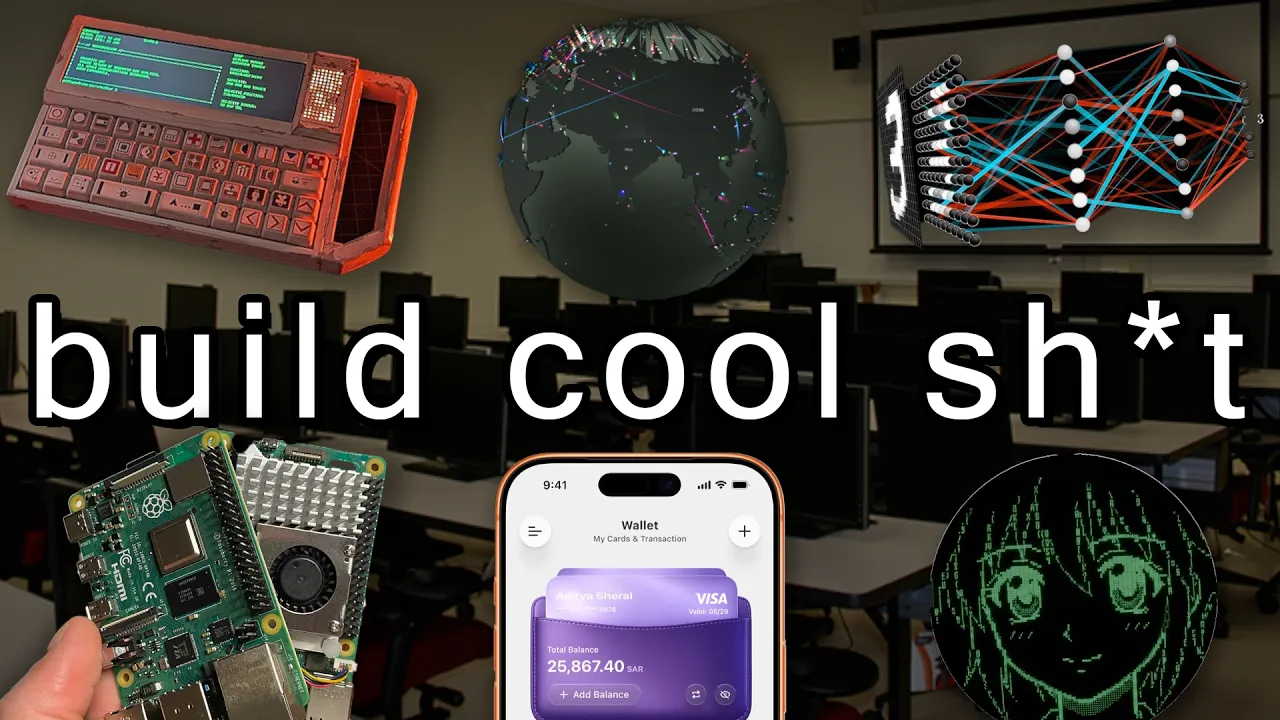
Manware · @IAmManware
Where viewers went back to watch this video again, from YouTube's public Most replayed graph, lined up with what was said at that moment.
Most replayed moment #1
1:293.4x the video's typical replay level
an entire gadget yourself using ESP32. Using this $5 microcontroller, you can build products people normally pay hundreds for. Connected to an LCD and you get your own smart watch. Give it a camera and fans and you get your own drone. You will have built handheld game consoles, Kindles, smart home devices,
Said at 1:22
Most replayed moment #2
1:172.9x the video's typical replay level
registers, memory, and CPU, replicating how real computers work. Meaning, you can create just about anything inside Minecraft. You're already solving problems on the level of a hardware engineer, so why stop there? Let's build an entire gadget yourself using ESP32. Using this $5 microcontroller, you can
Said at 1:09
Most replayed moment #3
0:422.4x the video's typical replay level
we simulate emergence of life, evolution, and colonies, ecosystems, and even conscious entities that rapidly originate, suffer to death, and repeat? Oh, wait, we already do the last one in college. Which gives way through a whole new field of simulating artificial life using pure maths. But, if your ADHD
Said at 0:34
The graph counts replays. It does not show where viewers stopped watching.
Words
760
Runtime
4:07
Speaking pace
185wpm
Reading time
3min
185 words per minute, between the 181 median and the 201 75th percentile of 349 measured videos. That distribution comes from the 349-video hook study.
Opening (first 30 seconds)
[ __ ] Dev. Here are seven insanely fun CS rabbit holes that just might ruin your career. Cellular automation and artificial life. Forget AI and ML. In 1970, a mathematician asked, "What if the universe ran on just three simple rules?" He created a simple game of alive and dead cells inside a grid. A cell dies with less than two or more than three neighbors and comes back to life if it has exactly three living neighbors. Despite just three rules, this system creates moving organisms, self-replicating structures, logical circuits, and
93 words, the words spoken in the first 30 seconds at 185 words per minute.
Free, no signup. See how the first 30 seconds hold attention, with rewrites.
What this transcript is
Every word below is the caption track YouTube publishes for this video, pulled from the video itself and reproduced unchanged. It is not Prepublish's writing, not a summary, and not a re-transcription: it is the video's own published captions. English captions, generated automatically by YouTube, in the video’s original language. Source: the video on YouTube. A channel that would rather this page did not exist can ask for its removal through the contact page, and it is removed.
[ __ ] Dev. Here are seven insanely fun CS rabbit holes that just might ruin your career. Cellular automation and artificial life. Forget AI and ML. In 1970, a mathematician asked, "What if the universe ran on just three simple rules?" He created a simple game of alive and dead cells inside a grid. A cell dies with less than two or more than three neighbors and comes back to life if it has exactly three living neighbors.
Despite just three rules, this system creates moving organisms, self-replicating structures, logical circuits, and even entire computer. Which begs the question, if complex systems can emerge from tiny rules, can we simulate emergence of life, evolution, and colonies, ecosystems, and even conscious entities that rapidly originate, suffer to death, and repeat? Oh, wait, we already do the last one in college. Which gives way through a whole new field of simulating artificial life using pure maths.
But, if your ADHD brain needs something more stimulating, try coding these systems inside Minecraft. And I don't mean in Python, C, or even assembly, but Caveman technology. Using just redstone torches, repeaters, and comparators, people discovered you can build not, and, or, and XOR gates, which are the only logical gates required to create adders, registers, memory, and CPU, replicating how real computers work. Meaning, you can create just about anything inside Minecraft.
You're already solving problems on the level of a hardware engineer, so why stop there? Let's build an entire gadget yourself using ESP32. Using this $5 microcontroller, you can build products people normally pay hundreds for. Connected to an LCD and you get your own smart watch. Give it a camera and fans and you get your own drone. You will have built handheld game consoles, Kindles, smart home devices, and robots around these things.
But, if building an entire product sounds hard, let's take an existing one and add your own creativity into it. No, I'm not talking about GitHub. I'm talking about game mods. Most people think modding just means adding a texture or sword or installing a mod pack, but that's just the surface. You step inside a giant code base without any documentation or guide, figure out coding patterns, game architecture, and change the game logic itself by converting every dead enemy into a pig.
Some games straight away hand you down their keys through APIs and documentation, which feels more like an app developer. But how does a computer even turn millions of triangles and equations into entire worlds? If you've ever wondered about that, the next rabbit hole is for you. You start with a boring gray sphere, then add shadows, reflections, make it metal, and last then into a planet. You're essentially teaching a computer how light behaves, how rays bounce off mirrors, pass through glass, scatter through fog, cast shadows onto nearby objects.
You can create an entire world like magic using just physics and maths, and you'll never look at games, movies, or even real life the same ever again. So far we have only written code to create programs. Now, grab your archaeological hats because the next rabbit hole is about reverse engineering software marvels. >> This video is strictly for educational purposes and doesn't promote software piracy. >> Imagine someone hands you down a mysterious program file with no code or documentation.
Using just that black box, you have to identify what the program does. You investigate what servers is it talking to, what files is it reading. You think you'll read the game's memory, but anti-cheat will detect memory readers. You think you'll hide memory readers, but anti-cheat will detect the hiding mechanism. You think you'll move to kernel, but anti-cheat was there all along. The cat and mouse game never ends. But if even that wasn't crazy enough for you, our today's last rabbit hole is meant for you.
Emulation is building one computer universe inside another computer's universe. But it's actually much easier to start than you think. For example, there are already several resources on how to emulate Game Boy step-by-step. [music] You have to convince Mario that it's still running inside a Game Boy instead of unholy Windows 11. That means translating every CPU instruction from Mario's balls into Windows language. Imagine if a game relies on a random hardware bug from 1998, then your emulator also has to recreate it.
Now, if you want fun CS project ideas that actually gets you a job, check out this video. And thanks for watching. Man bear.
The words are the caption track's own and nothing is reworded or re-transcribed. Paragraph breaks are placed between sentences so the text reads as prose.
Free tools for your own script. No signup, no login.
Paste your draft and see where viewers are likely to drop off, with a rewrite for each weak line.
Paste the first 30 seconds of your own draft for a hook score and rewrites.
Check your draft against YouTube's advertiser-friendly guidelines before you record it.
Read this channel's public videos and transcripts, and download a writing brief for it.
Sentence shape
| Measure | This transcript |
|---|---|
| Sentences | 52 |
| Average words per sentence | 14.6 |
| Longest sentence | 37 words |
| Questions asked | 4 |
| Sentences containing a number | 5 |
Most used terms
Filler phrases
4 in total: actually 2 · like 2.
A literal whole-word count of the same phrase list the Prepublish browser extension uses, so a phrase inside another word is not counted and a phrase used in its ordinary sense still is. It is a count and not a judgement.