Getting the transcript
Reading the captions from YouTube. A video nobody has opened here before takes 10 to 30 seconds; this page fills in on its own.
Getting the transcript
Reading the captions from YouTube. A video nobody has opened here before takes 10 to 30 seconds; this page fills in on its own.
Finance Bureau · @FinanceBureauOfficial
Words
2,548
Runtime
17:53
Speaking pace
142wpm
Reading time
11min
142 words per minute, below the 160 25th percentile of 349 measured videos. That distribution comes from the 349-video hook study.
Opening (first 30 seconds)
Last month, Alibaba put the files behind its flagship AI model on the open internet, essentially everything the model learned during training, and anyone can access it for free. Just prior to that, Moonshot did the same thing, >> [music] >> releasing a 1.4 terabyte model you can download, run on your own machines, and modify yourself. Meanwhile, on the other side of the Pacific, [music] the most valuable company in
71 words, the words spoken in the first 30 seconds at 142 words per minute.
Free, no signup. See how the first 30 seconds hold attention, with rewrites.
Sentence shape
| Measure | This transcript |
|---|---|
| Sentences | 166 |
| Average words per sentence | 15.3 |
| Longest sentence | 45 words |
| Questions asked | 5 |
| Sentences containing a number | 47 |
Most used terms
Filler phrases
15 in total: actually 6 · like 5 · basically 2 · uh 2.
A literal whole-word count of the same phrase list the Prepublish browser extension uses, so a phrase inside another word is not counted and a phrase used in its ordinary sense still is. It is a count and not a judgement.
What this transcript is
Every word below is the caption track YouTube publishes for this video, pulled from the video itself and reproduced unchanged. It is not Prepublish's writing, not a summary, and not a re-transcription: it is the video's own published captions. English captions, generated automatically by YouTube, in the video’s original language. Source: the video on YouTube. A channel that would rather this page did not exist can ask for its removal through the contact page, and it is removed.
No Script X-ray for this video: YouTube shows a Most replayed graph only once a video has enough views.
Last month, Alibaba put the files behind its flagship AI model on the open internet, essentially everything the model learned during training, and anyone can access it for free. Just prior to that, Moonshot did the same thing, >> [music] >> releasing a 1.4 terabyte model you can download, run on your own machines, and modify yourself. Meanwhile, on the other side of the Pacific, [music] the most valuable company in history closed well above a $5 trillion market cap, holding a gross margin of 75 cents on every dollar that it takes in.
But, that gargantuan valuation rests on an [music] all-important assumption, that frontier intelligence stays expensive. Now, if you ask a Silicon Valley bro, he'll tell you the leading US models are still way ahead of anything coming out of China. But, [music] absolute capability isn't what's important here. Price is the key, and that's been set by Beijing, not [music] San Francisco. Because, if China can crash the price of powerful AI, it doesn't [music] just undercut US labs, it starts crashing the economics of the entire AI boom.
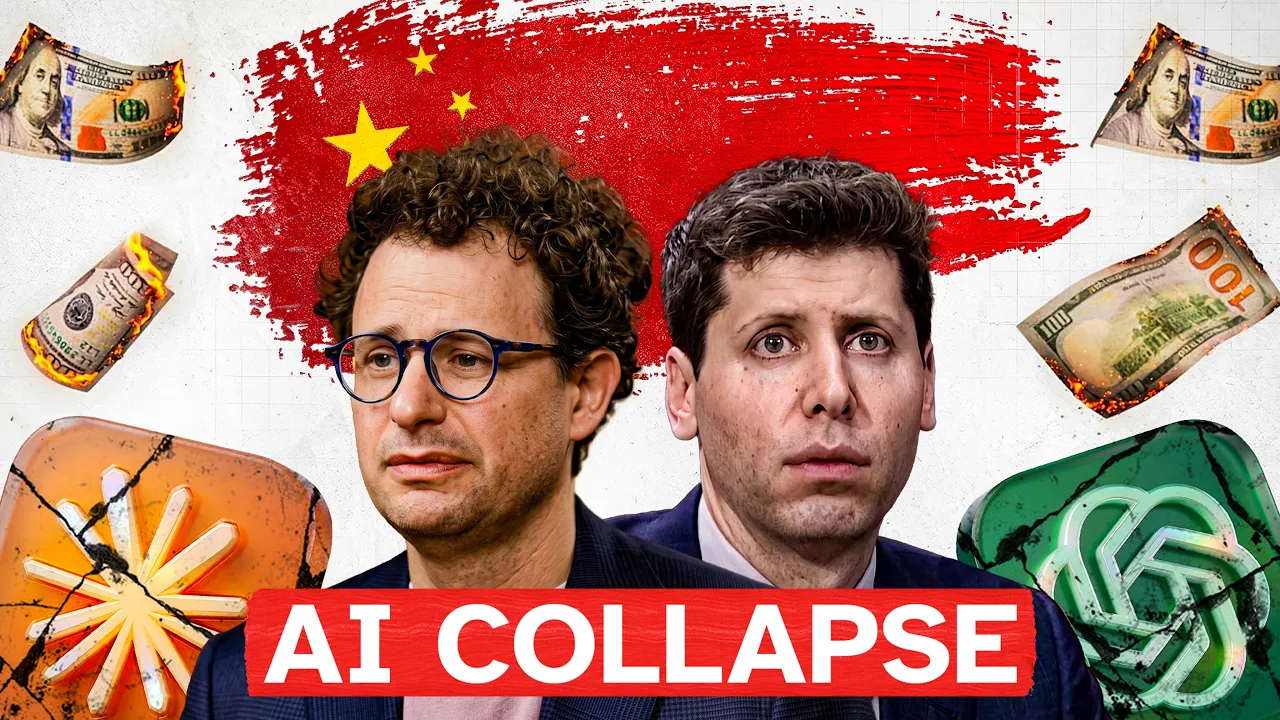
China plans to burst America's AI bubble, and to see how, we'll look at what China is shipping, the tens of billions it spent building a hardware base, and what happens to a trillion dollars of infrastructure when the product behind it goes to zero. My name is Nick, and this is the Finance Bureau. When a company trains an AI model, the end product is basically a very large file of numbers. Publishing open weights means publishing that file, not the training code or the data, just the finished model itself.
But, put it on a public server, and anyone with sufficient hardware can download it and run it themselves. So, you don't get the cookbook, but you do get the meal. And in 2026, China is serving up that meal to everybody who wants it. DeepSeek's version 4 family went out under an MIT license, which is about as permissive as software licensing gets. Take it, sell it, build a business on it, owe us nothing. Alibaba open-sourced its Max class flagship model.
Uh Jiquan's GLM 5.2 went out as plain MIT as well. Moonshot, MiniMax, all of them released frontier class open-weight models within months of each other. And a little closer look at the numbers reveals a lot. DeepSeek's cheapest tier runs at about 14 cents per million input tokens. The premium Western flagships are at $10 in and $50 out. That makes the American model up to around 35 times more expensive, even though DeepSeek is already good enough to account for a fifth of the traffic on major aggregator platforms.
Alibaba's Qwen family has logged nearly 2 billion downloads on Hugging Face, uh the main platform for sharing and downloading AI models. Meta's Llama, the model that was supposed to be the West's open answer, is at a paltry 227 million. Yikes. Now, the point I'm making here is not that the Chinese models are better. They mostly aren't, at least at the very top end. The key detail is that they're good enough. And good enough at zero marginal price beats excellent at $50 for the overwhelming majority of what anyone actually does with this tech.
The gap between the best model and a free model you can host yourself has narrowed significantly. Even if the frontier labs have a lead, it's only measured in months before Chinese competitors actually catch up. And that offers no defensive moat. But that raises an important question. How does China intend to keep this up? Well, listen to this. Back in July, a Chinese memory manufacturer called CXMT listed on the Shanghai Stock Exchange and raised 8.6 billion dollars.
The shares went up 466% on day one. In the second quarter of this year, it held 10% of the global DRAM market, up from about 4% a year earlier, which makes it the fourth largest memory maker behind Samsung, SK Hynix, and Micron. It's already running around 300,000 wafers a month and pushing towards 350,000 by the end of this year with new factories going up in Shanghai and Hefei. And this month, it began early production of HBM 3E, the high bandwidth memory that has become one of the biggest bottlenecks in AI chips.
Now, to be clear, China is still struggling to make this stuff efficiently. Only around a quarter of the HBM 3E chips coming off the production line are usable compared with 80 to 90% in Korea. China's biggest chip maker, SMIC, has a similar problem with advanced AI chips. Too many come out defective, and the ones that work cost far more to produce than they do at Taiwan's TSMC, the world's leading manufacturer. Which, in a normal market, would be a business that you close.
But, as you're likely aware at this stage, AI is no normal market. CXMT poured 185 billion yuan into research and capacity between 2023 and 2025 while booking a combined net loss of over 21 billion yuan. Behind it sits big fund phase three, 344 billion yuan or roughly 47.5 billion dollars of state money aimed specifically at advanced packaging equipment, materials, HBM, and AI chips. Beijing now requires 50% domestic equipment in a factory as a condition of approving its expansion.
Huawei is on track to produce around 1.6 million Ascend AI chips this year and capture more than half of China's domestic AI accelerator market. Nvidia's share of that same market is near zero. And the DeepSeek has ordered at least 160,000 Huawei accelerators for a 1-gigawatt inference facility. So, to briefly summarize, China is absorbing losses at the memory and chip-making level while Chinese AI companies push prices as low as 14 cents.
The US just doesn't have industrial policy like this. This is pretty much a whole supply chain run as a subsidy. And the incentives inside the Chinese system are very well aligned. High-flyer Quant, the hedge fund founded by DeepSeek's Liang Wen Feng, holds a pre-IPO stake in CXMT. So, the people giving away the intelligence own a piece of the memory that makes it possible. However, none of what we just covered tells us what Beijing is actually thinking here.
For that, we shift our focus to Anthropic's Dario Amodei and his recently published essay called We Must Pace the Frontier. We covered this in a different video, by the way, which you can actually watch over here. But, the TLDR of his argument was that the industry should deliberately slow its capability gains so that safety work can catch up. But, alongside the safety case was something else. Emmerdale argued that the US must maintain a 3 to 5 year lead over China, and he listed how.
Tighter chip export controls, a crackdown on smuggling and remote data center access, and action against unauthorized distillation. And that is Chinese labs training on the outputs of American frontier models. Sam Altman endorsed it. Elon Musk posted that Dario was right. And within 48 hours, Beijing responded. Not once, but from four directions at the same time. On Monday the 14th, a foreign ministry spokesman Geng Shuang was asked about the essay and said, "Quotes, fear-mongering, confrontation, and vicious competition will only disrupt the process of global AI governance and serve the interests of no one." End quote.
The Ministry of Commerce called it proof that the United States is pursuing technological hegemony in AI. Global Times ran an editorial branding the proposal a silent AI Cold War playbook, hypocritical and short-sighted, and argued its real purpose was to lock in a corporate monopoly and push China out of international governance. And Xu Xiaocheng of Tsinghua University said the commercial motive was crystal clear. Anthropic is under pressure from Chinese open-source models and wants to protect its position.
Now, forget whether they're right, the messaging and the narrative are all that really matter here. The Foreign Ministry, the Commerce Ministry, the state press, and the academic establishment are all aligned on the same conclusion. This was about protecting US companies and stifling Chinese competition. Forget about the safety concerns as far as China was concerned, this was all about market position, which tells us just how China models this situation.
They're viewing this purely as an economic front. And of course, you don't fight an economic front with better benchmarks, you fight it with price. And when a price war like this starts feeding into markets, policy and capital flows, that's where things get interesting. Which is exactly what we break down every week in the Finance Bureau newsletter. It's completely free and we give you the key stories, the numbers behind them, and what they mean for your portfolio.
Just click the link in the description or scan this QR code on the left of your screen to get started. Back to that price war. The Western AI business was built as a stack. At the bottom, you've got the chips. Above that, you've got the model. Above that, inference, which is the business of running the model every time someone asks it something. And right at the top, you've got the application, which is where you will find all of those AI startups.
And that structure assumes that the model level stays scarce, expensive, and difficult to replicate. But, if powerful models become free and widely available, that pricing power starts to disappear. At that point, inference providers are basically selling computing power, electricity, servers, and rack space with an API on top. And pricing is starting to show us where this is going. The same open weight model costs about 15 cents in and 60 cents out across Grok, Together, and Fireworks.
Three different companies charging almost exactly the same price. If independent competitors converge on an identical price, they're not really selling capability. This is where they begin selling a commodity and the apps above them are packaging that commodity into a subscription. Iconics survey work this year put average AI product gross margins at 45% in 2025. Traditional software ran at 70 to 85%. So, the most celebrated category in tech is already delivering worse unit economics than the SaaS businesses it was supposed to replace even as the underlying AI gets dramatically cheaper.
The problem is that cheaper models don't necessarily mean fatter margins. If everyone is selling access to the same cheap intelligence, profits get squeezed and that makes the huge valuations and infrastructure spending around AI much harder to justify. Which brings us to the part where things get really nasty. Microsoft spent $115 billion of capital expenditure in its 2026 fiscal year. Amazon spent $131 billion. Alphabet $91 billion.
Meta $69 billion. Globally, AI infrastructure spending this year is estimated at around a trillion dollars. The first trillion dollar year of computing infrastructure in history. Oracle has pledged $300 billion of cloud capacity over five years. Stargate is structured to spend up to $500 billion by 2029. OpenAI's compute commitments are somewhere close to $750 billion through 2030. Needless to say, those are some insane numbers.
But, the key detail is this. Each of those numbers is a contract. Land leases, power contracts, supply deals, GPU backed loans. Fixed costs that don't disappear just because AI gets cheaper. And that's the problem. The costs are committed, but the future price of the product most certainly is not. And China is doing everything it can to push that price down. And sure enough, you can already see the strain in the system.
Coreweave has $35 billion of debt against around $129 billion of contracted business. Its interest bill hit $640 million in the second quarter and is rising faster than revenue. And after accounting for the cost of its equipment, its operating margin is only around 1%. In other words, Coreweave needs the price of computing power to stay high enough for long enough to keep paying its debts. But that price, guys, ultimately depends on what AI companies can charge their customers.
And right now, those prices are going lower and lower. The buildout was underwritten at a time when everyone thought intelligence would stay scarce. That world is no more and nobody had to breach a single agreement for it to happen. Now, although the current state of AI technology is unprecedented, we've actually seen a market dynamic like this before. Go back roughly 15 years to solar panels. Chinese manufacturers backed by state capital and provincial credit scaled capacity way beyond global demand and rode the cost curve straight down.
Module prices fell by around 90%. Today, a Chinese model goes for something like 11 cents a watt against 30 cents in the United States. And then, the Western industry simply ceased to exist. SunPower filed for Chapter 11 in August 2024. Sunnova and Solar Mosaic went in June 2025. Freedom Forever, the second largest residential installer in America, filed in April this year and converted to chapter 7 by August, affecting around 190,000 homes.
More than 100 solar companies have gone under since 2023, leaving over 1.3 million American households with orphaned systems and void warranties. And all that really happened was that these were outpriced by Chinese firms that were playing a totally different game. You can see similar dynamics in other industries like steel and batteries, but I think you get the point. Build the capacity, absorb the losses, collapse the price, and own what's left.
It's the most reliably executed industrial strategy of recent times, and there's no reason that it should stop at objects that you can only put on a truck. The only new thing here is the target. Solar was a manufacturing sector. AI? Well, that's the single trade holding up Western equity markets, sitting at the top of an index that's up 11% this year while a handful of AI-heavy names did most of the lifting. The Chinese model releases were a calculated pricing decision executed in typical fashion as industrial policy.
A memory industry and a foundry industry deliberately running at a loss to make that price stick. And China has been pretty clear about how it sees this going. This is an economic fight. The AI bubble was never going to be popped because of just one disappointing quarter because if the whole trade were built on scarcity, then some bad earnings wouldn't be the end of the world. The actual threat is somebody deciding that the thing that's scarce should actually be abundant and cheap or even free.
And China has already made that decision, But that's just our reading of it. What do you reckon? Is this a deliberate campaign to tear down an AI trade that's propping up US markets? Or is China simply pursuing its own interests while America gets caught on the wrong side of it? Let me know your thoughts in the comments down below. And if you want to understand the crazy levels of debt that's barely keeping this AI trade going, then you can check out our video on that right over here.
As always, guys, thank you very much for watching and I'll see you in the next video. This is Nick signing off.
The words are the caption track's own and nothing is reworded or re-transcribed. Paragraph breaks are placed between sentences so the text reads as prose.
Free tools for your own script. No signup, no login.
Paste your draft and see where viewers are likely to drop off, with a rewrite for each weak line.
Paste the first 30 seconds of your own draft for a hook score and rewrites.
Check your draft against YouTube's advertiser-friendly guidelines before you record it.
Read this channel's public videos and transcripts, and download a writing brief for it.