Getting the transcript
Reading the captions from YouTube. A video nobody has opened here before takes 10 to 30 seconds; this page fills in on its own.
Getting the transcript
Reading the captions from YouTube. A video nobody has opened here before takes 10 to 30 seconds; this page fills in on its own.
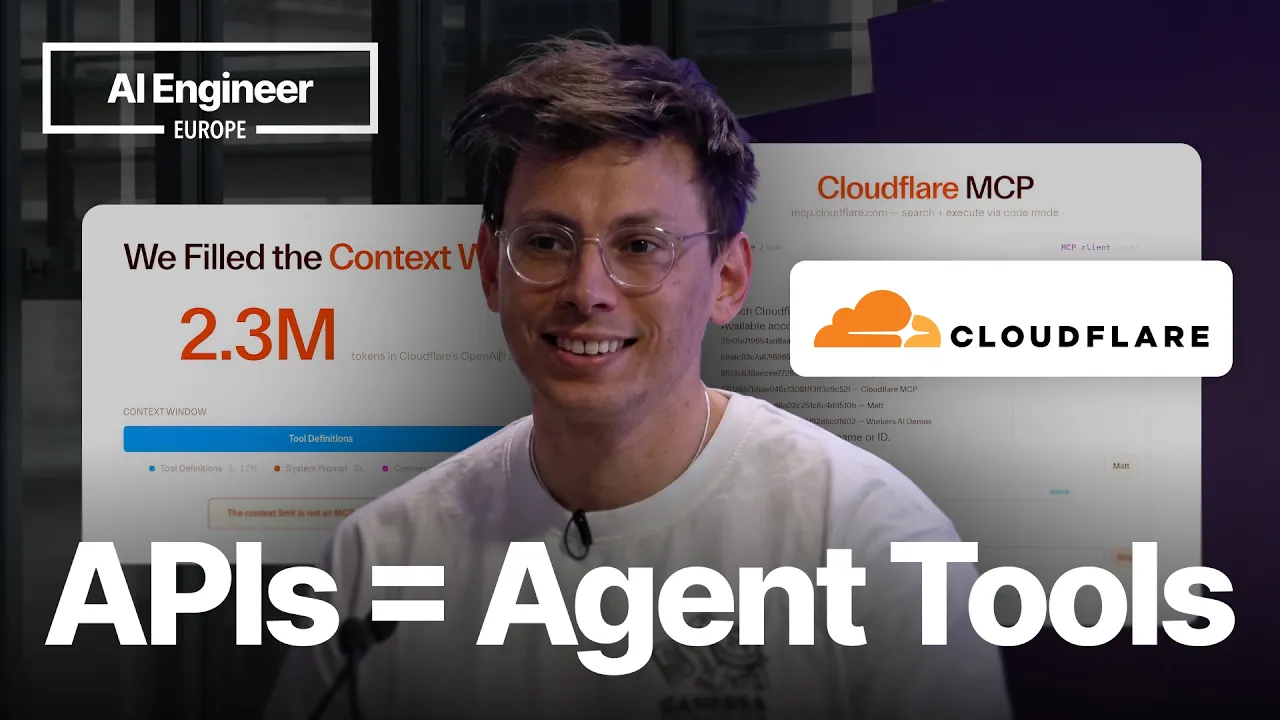
AI Engineer · @aiDotEngineer
This video has no Most replayed graph yet: YouTube shows one only once a video has enough views. These are the moments viewers replayed most in AI Engineer's most watched videos.
Most replayed moment at 18:45
4.8x that video's typical replay level
that they're they're changing they're changing things in the database not yet. You want to run them through the ontology first and make sure that works. Okay. I only got an I've got I've got another I've just a short time. I'm going to try to show you some of the things that um that you can
Said at 18:37
Most replayed moment at 16:13
3.6x that video's typical replay level
method signatures, the program layout and the call stacks. So here's some examples. I don't think you'll be able to read this one, but this is like the level of abstraction we're at. It's how we're actually going to lay this stuff out and how these systems are going to interact. Dylan Mulroy from Cloudflare talks a
Said at 16:06
Most replayed moment at 6:57
5.9x that video's typical replay level
do light mode. It's I It's not my nature, but sometimes. That's better, yeah? Okay. So we have we have a model and we're trying an old LG Sorry. We We shouldn't have seen that. No, we'll
Said at 6:50
The graph counts replays. It does not show where viewers stopped watching.
Words
4,487
Runtime
22:41
Speaking pace
198wpm
Reading time
19min
198 words per minute, between the 181 median and the 201 75th percentile of 349 measured videos. That distribution comes from the 349-video hook study.
Opening (first 30 seconds)
[music] >> Hello everyone. Welcome. Quiet down. Quiet down. All right. Awesome. How is everyone? Yeah, good? >> [applause] >> Ooh, thanks. Um Want to hear some MCP versus CLI debates? Yeah, is that why you all came? Anyway, um Hello, my name is Matt. Uh I work on MCP and agents at Cloudflare. And welcome to my talk. It's all about how we can make every API a tool for agents. APIs exist in the wild. How can we connect them to agents and make them do things? So, I I really love my job because every day
99 words, the words spoken in the first 30 seconds at 198 words per minute.
Free, no signup. See how the first 30 seconds hold attention, with rewrites.
Sentence shape
| Measure | This transcript |
|---|---|
| Sentences | 358 |
| Average words per sentence | 12.5 |
| Longest sentence | 74 words |
| Questions asked | 31 |
| Sentences containing a number | 17 |
Most used terms
Filler phrases
280 in total: like 168 · uh 42 · um 30 · kind of 15 · actually 11 · sort of 5 · basically 3 · right? 2 · you know 2 · I mean 1 · literally 1.
A literal whole-word count of the same phrase list the Prepublish browser extension uses, so a phrase inside another word is not counted and a phrase used in its ordinary sense still is. It is a count and not a judgement.
What this transcript is
Every word below is the caption track YouTube publishes for this video, pulled from the video itself and reproduced unchanged. It is not Prepublish's writing, not a summary, and not a re-transcription: it is the video's own published captions. English captions, generated automatically by YouTube, in the video’s original language. Source: the video on YouTube. A channel that would rather this page did not exist can ask for its removal through the contact page, and it is removed.
[music] >> Hello everyone. Welcome. Quiet down. Quiet down. All right. Awesome. How is everyone? Yeah, good? >> [applause] >> Ooh, thanks. Um Want to hear some MCP versus CLI debates? Yeah, is that why you all came? Anyway, um Hello, my name is Matt. Uh I work on MCP and agents at Cloudflare. And welcome to my talk. It's all about how we can make every API a tool for agents. APIs exist in the wild. How can we connect them to agents and make them do things?
So, I I really love my job because every day I get to decide like uh if an agent looked like this, would he do this or would he do this? And I think it's kind of fun. Um and we often fluctuate weight between the two of them. Uh someone does something slightly you think is slightly funny and then 6 months later we're all doing it and claiming it was the best thing in the world. So, yeah, it's really good crack. But, the main part of the the role I guess and like what I end up doing day-to-day is like how do we give agents hands?
How do we let them interact with the outside world? And you're probably familiar with something like this. This is tool calling, function calling. Uh it's been around for a while now. The LLM writes a function, you execute the function. Bash bash bash, weather in London is 18°. It's not, it's like eight and it's freezing. Um sad times. And then from there we went from uh bundled tools to something like shared tools. Like people made tools in their agents.
And the you probably This is like all like recent history, so everyone's probably aware of this, but before MCP we had like uh people would bundle all their tools in their agents and then they would keep them bundled in their agents and then if I was like trying to interact with Gmail or something, I would make loads of tools for Gmail, bundle them with my agents, and that would be it. And the next person would have to do exactly the same thing.
And then we ended up with this like big explosion of uh MCP and remote MCP about April last year. And the service providers were like, "Oh, we can we can like uh give everyone MCP tools and then everyone can use the same standardized tools and we just make it once and we provide it as another surface for people to consume our API. Maybe there's a CLI, there's an API, maybe there's like I don't know, GraphQL API, um and there's now MCP as like another surface.
But, this got a little bit fun because it was okay with like eight tools. But, then what happens if you added like a few more? Or a few more? Or a few more? And now you you you're like, "I want to give an agent access to our whole API surface." And well, that ain't going to that ain't going to happen. Why is it not going to happen? You've exploded a context window of the agent. You've like completely annihilated it. This is 1.something million tokens.
Uh And this was the problem that we like came across a few uh well, around a year ago now. We were trying to give access to the whole of the Cloudflare API to agents. You put all of the the You try and make naive tools that have every single API endpoint and you fully explode a context window. Uh open API spec is 2.3 million tokens. Into tools, that's something like 1.1 million tokens. And that's like never going to fly even with like the biggest foundational models.
Uh uh And in that time we were like, "We know this is not necessarily an MCP problem, but it's how everyone else is doing it. So, we're we're we're going to we're going to adapt. We're going to adapt. We're going to improvise." Um and we're going to split up our API into lots of different product-based MCP services. So, you've probably seen this like uh a company that publishes 16 MCP service potentially and then users have to uh interact with the one that they want to use when they want to use it.
Um there's much less context, but the user has to select. And most of the time there's kind of incomplete coverage. So, like for instance like uh one of our one of our product suites, we might have like six tools in our MCP server, but the total API maybe has like 30 endpoints. Like you've completely missed some coverage there. Uh And this is not like fulfilling the goal of like how do we make every API a tool for agents.
It's actually kind of kind of annoying. Uh so so I think we did all a little bit wrong. Um well, in Cloudflare we had 16 servers very very quickly. We were hovering around 2 and 1/2 thousand endpoints. I think we're actually at like 2,600 API endpoints now. Um but we basically couldn't split up all of these into all of our servers and the users had to pick the ones that we wanted. What we really needed was progressive discovery of tools.
Who's heard of progressive discovery? Anyone heard? Yeah, cool. And that brings us to the crux of the debates that everyone has on the on online. Um and that is like how do we do progressive discovery? And and like is MCP dead? Like is Was MCP like a really bad idea? Um uh And I'm going to say like I I don't think it was. MCP's a protocol. All of these can be exposed over MCP. We just shouldn't be dumping loads of tools into context.
That's like the main thing. We shouldn't be dumping tools in context. Um and all capabilities like in the future we might have prompts and resources more. Skills are basically resources. Um And we just shouldn't be like loading all of those at once. So, there's like sort of three ways you can get around that problem. Uh there's a CLI which uh people really like. Uh there's tool search. Or there's a third one that we're going to come to a little bit later.
Um But, like how does how would a CLI work for agents? So, this is a a sandbox in the background. And if I use our our CLI and I do something like uh I just call Wrangler. We get a bunch of commands. The agent can like read these commands, pass these commands and be like, "Oh, I want to interact with the database. Let's Let's do Wrangler D1." And maybe we want to list list our databases, whatever. And then after some period of time and some interactive process apparently, uh we get uh we get like the databases I have on my account.
And like an agent can kind of do this um mostly. Uh and it and it can call {dash} {dash} help to get like uh introspection on like which parameters it needs and th- this this mostly works. It mostly works. Uh it's used very popular by things like open claw and like people generally really like CLIs. But, you need shell access. This is like the main thing. This is I guess the crux of it. Like you have to have shell access and that's kind of annoying.
So, for things like Cloud Code, they wanted a bit more of a structured way of doing things. So, they have uh like tool search. They have a uh search tool which loads the tools that they need when they need them into context. So, say I want to like create a worker. Uh what it would do is you it would take the user the user question, it would do some sort of keyword matching, and then it would add K equals say eight tools to context.
And then at some point the LLM is going to look at, "Oh, actually workers create, this is the one we need." And so we're going to use that one. But, the rest of them stay in context. Maybe it's not eight, maybe it's six. They change it changes, but um yeah, you end up with like two 2,100 tokens and only 500 of them are being used. But, like it works. It it it's it works quite well. Um you only load the tools that are relevant.
Uh And then this last thing is a blog post that uh Cloudflare published in the summer of well, last summer. And it's like how can we instead of doing like a um a static search tool or instead of like enforcing an agent to need a CLI, how can we do something where we just let the agent write code? And we let the agent write code against our API. And it turns out that TypeScript is actually well, types are a very concise way of representing inputs and outputs um in in a way that an agent can reason about.
So, say you have all of these endpoints. Have like a get worker scripts or a create a worker or something like that. We generate these types. Uh and then we let the model given these types, write some code against these types. So, here we're doing code mode list workers. I hope you guys can see that. Uh And we're going to try and list some workers. So, this might be like a user request to list workers. The model generates this code um against a typed SDK that we generate from our API.
You can generate them from open API specs. Uh And then we can run that and we can like list the workers that we have on our account. Um we could deploy a worker. That would be fun. Hello world. And we could put it behind one of the hardest things to do at Cloudflare, which is so weird because it's such a powerful product, but we can add access, which is like our our managed IDP. And now this worker is secure behind access.
Kind of cool. With like a access policy to only allow me into it and all of this sort of good stuff. Super super easy. And an agent can generate all of this code given our types. So, this feels like a step in the right direction. We just let the model write code. We benefit from the model getting better. We benefit from I don't know, or like our improving our open API spec. It's like that should be the source of truth.
But, we had this like kind of weird thing where we thought this was awesome and we were pretty stoked about it. Uh but the clients didn't implement it. And then I'm when I mean clients, I've gotten to like MCP terms now. So, the client is the agent. So, we'll be referring to the agent as a client from now on. Um but it So, the clients didn't really implement it. And we're like a little bit confused about why this is the case.
Like this was sort of eight, nine months ago now and it's a better way of interacting with uh with APIs. Just let the model write code against the API, but they didn't implement it. And why not? Uh And that's because like running untrusted code is mega mega scary. Like i- if I had said to you a few years ago, "Oh, we're just going to let a language model write some code that we're going to gen- we're going to execute for our users without looking at it, without reading it, without seeing what it does, that might have potentially like secrets access.
Ideally, it has some secret access. You'd be like, "That's crazy. That's a CV, right?" It's a CV. Like, it's a vulnerability. That's a problem. And now we're proposing you to do this. So, it is quite scary. What loads of things can go wrong. We could It could read a file system, read some secrets that you don't want it to read. It could exfiltrate those secrets into a network request, run infinite loops, consume all your resources, do like really scary stuff, run a crypto miner, you know?
That would be That would be bad. And in the past, people have tried loads of things to let people run code-like solutions. So, if anyone's ever written a DSL, some sort of like JSON spec about how to and to interpret that as code, that is basically this. If you ever used one of those integration softwares where you have to do that, that is this. They just don't trust you to write code on their servers. VMs also, people spinning up sandboxes to run code, big sandboxes, big VMs, that's this.
And also code review. But, it's kind of lucky cuz we have like a pretty cool primitive that solves this. And there will be other primitives that solve this. I just think this is the first and so it's worth like worth shouting about, really. And this is like how do you run untrusted code in a way that's super safe for you and your infrastructure? And it's kind of like this. So, we can execute a worker from a string. And a worker is just a like a little is like an isolat in V8.
There's many blogs about how all this works. I'm not going to go into it super deeply. I'm just going to show you what it can do. So, for instance, we have this like this piece of code that was generated and we're going to run this piece of code that was generated. And this ran on the back end. It didn't run in my browser. It ran in a dynamic worker that's fully isolated. And how how I guess how can I prove that to you?
If we do this one, we are trying to get some secrets here, process.env. And if we print them, there are no secrets. And we also have this weird Cloudflare global. Ooh, interesting. Um if we turn That was with node compat on. If we turn node compatibility off, we don't even have We don't even have process.env there and it all errors out. So, we can like influent We have this like programmable sandbox. It's not quite a sandbox.
It's like a very lightweight thing that you can put load code into it and then run it. And I'll show you some other options later. Like, it's not just us that has this, but we have one that we host for you and goes to like Cloudflare level scale. If you want to do billions of requests, knock yourself out. And now like here's one where the agent's written some code that accesses like an external API. And if we run this one, it's like this worker is not permitted to access the internet via global functions.
Or maybe we want it to access the internet. And now we can give it access. So, it's a programmable sandbox with got with programmable guardrails. And all we're doing here is like flicking a boolean in the server. That's like all that's happening here. But you can provide like a more in-depth function to be like, "Only access things to these domains." And that's what we do on the Cloudflare MCP. Um if we go to next. Oh, speaking of the Cloudflare MCP, this is where I really hope the demo works.
So, this is an MCP client in this slide. And if we ask it a question, we're going to get some We're going to get like a auth screen pop-up. And then hopefully all this works. Oh, insane. So, now we have like complete Well, we have read-only access to the whole of the Cloudflare API. All of my Cloudflare infrastructure, I have read-only access to. Um which is pretty cool. These account IDs, don't worry about them. They're not secrets in in Cloudflare world.
Uh cool. So, so we just listed a worker, but you could do many more things here. Like, you can deploy workers from your command line. You can do what we did earlier and add access to something. You could [snorts] inspect your DNS. You could send emails soon. You can do loads and loads of other stuff. Like, it's very very cool what you can do here because you have access to the whole of the Cloudflare API, all 2,000 and something endpoints.
And I guess like it kind of brings up the question like where where are we going with letting agents access external tools? Like, what does this look like? Like, you have people installing CLIs for everything and running it on their own running it on their own machine. Maybe running it on a VM. That's kind of cool. Um You have us being like, "Oh, you could just run untrusted code in this like other in this other place that's like really isolated." You have people doing tool search.
You have people rendering UI's JSON. I don't know. Um And I guess my main thought is that like we're going to have so many isolated environments on the on the web. And there's going to be loads of infrastructure primitives that allow you to run this type of untrusted code on the web because code is actually a very compact compact plan. Instead of doing tool calls, you can have one tool called code where the model generates the code of your choice and then you run it.
And that code has so many more degrees of freedom than like an individual tool call. So, it makes sense to me that as the models get smarter, this is what this is what we will do. And people will adapt their infrastructure primitives to do this. So, there'll be so many more of this. And you see this starting with like Pydantic Monty, Deno also, and like we also have it with WorkerD, the dynamic workers I showed earlier.
Like, people more people are going to build these primitives because they're going to become more and more useful. So, just like a little explanation. Um this is WorkerD like spawning a dynamic worker in this sandbox and running some code to get a fib sequence. You can do the same thing with Deno with Deno run with some questionable checking. I have no idea what that does. And then you can also kind of do the same thing with Pydantic.
Monty, their new their new code interpreter for running untrusted Python. Because it's Python, we have to download Python. Sucks. This might never work. I actually have no idea. Oh, there we go. Great. Uh So, maybe you can see like where we're trying to go with this. That there is there was a previous time where no one would ever run untrusted code. That was a CV. Like, you would just immediately like you have to like stop allowing that.
Uh And then it seems that LLMs it's actually really good for them to run for them to write code that you can run. And so now we're building the primitives to actually enable us to do that. And it feels like we missed out on this whole part of the the the tech scene that like we've never tried before. Like, in the 1950s, when you wanted to run something on a computer in your local town, you printed out some punch cards and you stamped them and you gave them to the guy.
And that was kind of like running untrusted code, right? Like, that was kind of it. And then when we went to the cloud, we got away from that. And now I think we're going to go much more back to that where your users can write code cuz your users are AI. And AI is very good at writing code. And that is how they're going to interact with your platform, whether through MCP, whether even through like bash and CLI. Like, I don't mind.
I think they're just going to write code against your services. And your services have to be ready for this. Like, your APIs have to be ready to take a beating because they have to have good rate limiting. Cuz I can run this in a for loop on multiple sandboxes at once and just hammer your API. Like, you have to have some way of protecting against that. Like, this is the new world that we're that we're now going to be living in.
And that's like on the server side on the on the services side. Now, what's going to happen on the client side? So, I think that's almost even more interesting because that's the user-facing side of things. Like, the user's not going to see the server. The user doesn't care. The user just What Why is my agent not getting my Gmail emails? Or why has it deleted my whole inbox? They're not going to like They're not going to see that.
But on the client side, like there's a lot of innovation that's going to happen here. And I think we've stalled a little bit recently because actually building an MCP client in particular got really really hard. Like, to to to actually build a client that was performative, that worked, you needed to manage stateful connections, you needed to manage resumability between those connections. There's There's plenty of other reasons why building an MCP client was hard, but like it was a pain, an absolute pain.
And so people had like the most stripped-down clients they possibly could. They mostly offloaded to the MCP SDKs, which are quite bare-bones. And no one was building these like more unique UI experiences on top of that. And I think that that is going to come like very very soon. So, the most the most obvious thing is we're going to have programmatic tool calling in the clients. The the previous slide we just did showing those showing those sandboxes with WorkerD, Deno, and Pydantic, that is like just running untrusted code in a client.
People are going to do that. If your client is remote, you're going to do it like that. If your client is locally, well, just YOLO it, whatever. Just eval it, you know? It's going to be fine. But more people are going to do this programmatic tool calling. It's going to happen. And because you're generating code, people are going to save this code. And they're going to save it in these like mini scripts. And users might be able to decide, "Oh, this action that I just did, that the LLM generated for me, I want to keep that for later." And then it will be a much faster.
So, you can see things for things like cron jobs. A user might set up some web scraping job like without any knowledge of how web scraping works. And then it generates a script and that script is run like every day, every 2 days. And whenever it breaks because web scraping's like pretty brittle, the agent will fix it and resave the script. Like, this stuff is how is going to happen. And I think like these saved mini scripts, they only work when you embrace like programmatic tool calling, but they really do work.
And then and then the the last thing is we're probably going to have many many more clients because they've been so hard to make up until now, and it is going to get easier. There's actually only There's not There's not a huge amount of really well-used MCP clients. That's going to change. And with that change, like more people are going to be able to make them, more people are going to deploy agents to the cloud that end up being an MCP client.
And I think more people are going to try and do this like stateless agent loop thing. Like it it was fine to have sandboxes for every agent like running code code locally if if there were a million agents in this world. I think when there are like 100 agents for each person Oh, hello. Let's not do that. That's going to be That's going to start getting really tough. And you're going to have to like embrace a cloud-native way of doing things, which means that state has to be something you can turn on or off.
And this is I think we're we're nearing the end, but this is my last thing. It's like I work a lot on MCP servers and on the SDK. And this is where I think that bit's going. I think we're going to see MCP as a middleware in an when you build an MCP server. When you build an API, and you build an API service, it will be a flag that you can flag on in your favorite framework. The the SDK itself is getting super, super lightweight.
And I think by the end of this year, we'll be like natively in every single at least TypeScript big full stack framework. It will just be there natively. Because it will be so small, it will literally just express the protocol in itself. And it will be silly for them not to have it. They'll just have a native integration. And they'll be able to do MCP is true on all of your APIs. And because all of the clients will be doing programmatic tool calling, you can express like your thousand APIs from one Next.js app and just do MCP equals true, and expose it over at the MS tools over MCP as well.
And I think that I think that will happen. I've been thinking that's going to happen for a while, but I think we're pretty, really close there. And the last blocker is like fixing the SDK really, so that it's capable of doing that. It's capable of fitting in every single front every single bundle really. And that's the plan. Um You can find out more the We have a Code Mode blog post that came out pretty recently. It's how we gave agents an entire API in a thousand tokens.
If you have a big API, you should probably do this. Any accessibility providers, please just do this, cuz it's really, really good for people to access your data. Um and thank you. Try out NPMI agents. Thank you very much. Woo! >> [applause] [applause] [music]
The words are the caption track's own and nothing is reworded or re-transcribed. Paragraph breaks are placed between sentences so the text reads as prose.
Free tools for your own script. No signup, no login.
Paste your draft and see where viewers are likely to drop off, with a rewrite for each weak line.
Paste the first 30 seconds of your own draft for a hook score and rewrites.
Check your draft against YouTube's advertiser-friendly guidelines before you record it.
Read this channel's public videos and transcripts, and download a writing brief for it.