Getting the transcript
Reading the captions from YouTube. A video nobody has opened here before takes 10 to 30 seconds; this page fills in on its own.
Getting the transcript
Reading the captions from YouTube. A video nobody has opened here before takes 10 to 30 seconds; this page fills in on its own.
UltraVibes L.T · @UltraVibes01
Where viewers went back to watch this video again, from YouTube's public Most replayed graph, lined up with what was said at that moment.
Most replayed moment #1
1:192.4x the video's typical replay level
>> Of course. Well, we have a mixture of regular activities and special events. One of the regular ones is trying to keep the beach free of litter. A few of us spend a couple of hours a month on it. And it's awful how much there is to clear. I
Said at 1:12
Most replayed moment #2
17:292.1x the video's typical replay level
>> I thought it would be hard, but actually, I found it all quite straightforward. What did you think about diet and nutrition? >> Okay, I suppose. >> Do you remember what they told us about pet food and the fact that there's such limited checking into whether or not
Said at 17:22
Most replayed moment #3
2:231.9x the video's typical replay level
>> They certainly are. >> Oh, and we're also running a project to identify the different species of butterflies that visit the reserve. You might be interested in taking part in that. >> Sure. I was involved in something similar
Said at 2:17
The graph counts replays. It does not show where viewers stopped watching.
Words
3,194
Runtime
26:28
Speaking pace
121wpm
Reading time
13min
121 words per minute, below the 160 25th percentile of 349 measured videos. That distribution comes from the 349-video hook study.
Opening (first 30 seconds)
Cambridge 17 listening test one. You will hear a number of different recordings. All the recordings will be played once only. The test is in four parts. You will have 10 minutes at the end of the test to transfer your answers to the answer sheet. Now turn to part one. First, you have some time to look at questions one
61 words, the words spoken in the first 30 seconds at 121 words per minute.
Free, no signup. See how the first 30 seconds hold attention, with rewrites.
Sentence shape
| Measure | This transcript |
|---|---|
| Sentences | 253 |
| Average words per sentence | 12.6 |
| Longest sentence | 47 words |
| Questions asked | 16 |
| Sentences containing a number | 25 |
Most used terms
Filler phrases
16 in total: like 9 · actually 3 · I mean 1 · basically 1 · kind of 1 · sort of 1.
A literal whole-word count of the same phrase list the Prepublish browser extension uses, so a phrase inside another word is not counted and a phrase used in its ordinary sense still is. It is a count and not a judgement.
What this transcript is
Every word below is the caption track YouTube publishes for this video, pulled from the video itself and reproduced unchanged. It is not Prepublish's writing, not a summary, and not a re-transcription: it is the video's own published captions. English captions, generated automatically by YouTube, in the video’s original language. Source: the video on YouTube. A channel that would rather this page did not exist can ask for its removal through the contact page, and it is removed.
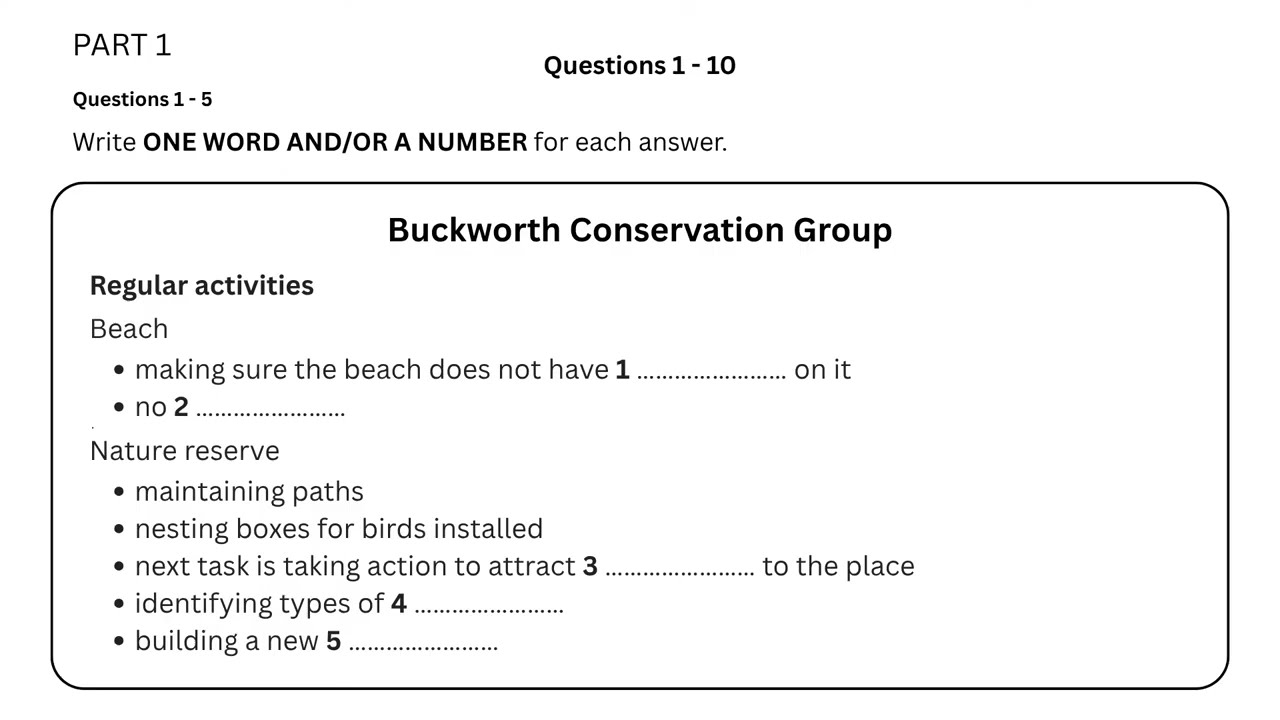
Cambridge 17 listening test one. You will hear a number of different recordings. All the recordings will be played once only. The test is in four parts. You will have 10 minutes at the end of the test to transfer your answers to the answer sheet. Now turn to part one. First, you have some time to look at questions one to five. Listen carefully and answer questions one to five. >> Hello. >> Oh, hello. My name's John. Are you the right person to talk to about the Buckworth Conservation Group? >> Yes, I'm Peter.
I'm the secretary. >> Good. I've just moved to this area and I'm interested in getting involved. I was in a similar group where I used to live. Could you tell me something about your activities, please? >> Of course. Well, we have a mixture of regular activities and special events. One of the regular ones is trying to keep the beach free of litter. A few of us spend a couple of hours a month on it. And it's awful how much there is to clear.
I wish people would be more responsible and take it home with them. >> I totally agree. I'd be happy to help with that. Is it okay to take dogs? >> I'm afraid not as they're banned from the beach itself. You can take them along the cliffs though, and children are welcome. >> Right. >> We also manage a nature reserve and there's a lot to do there all year round. For example, because it's a popular place to visit, we spend a lot of time looking after the paths and making sure they're in good condition for walking. >> I could certainly help with that. >> Good.
And we have a program of creating new habitats there. We've just finished making and installing nesting boxes for birds to use, and next we're going to work on encouraging insects. They're important for the biodiversity of the reserve. >> They certainly are. >> Oh, and we're also running a project to identify the different species of butterflies that visit the reserve. You might be interested in taking part in that. >> Sure.
I was involved in something similar where I used to live, counting all the species of moths. I'd enjoy that. >> Another job we're doing at the reserve is replacing the wall on the southern side between the parking area and our woodshed. It was badly damaged in a storm last month. >> Okay. >> Before you hear the rest of the conversation, you have some time to look at questions six to 10. Now listen and answer questions six to 10. >> Then, as I said, we have a program of events as well, both at the weekend and during the week. >> Right.
I presume you have guided walks. I'd like to get to know the local countryside as I'm new to the area. >> Yes, we do. The next walk is to Ruston Island a week on Saturday. We'll be meeting in the car park at Dunsmore Beach at low tide. That's when the sands are dry enough for us to walk to the island without getting wet. >> Sounds good. >> The island's a great place to explore. It's quite small and it's got a range of habitats.
It's also an ideal location for seeing seals just off the coast or even on the beach. >> Okay. And is there anything we should bring? Like a picnic for instance? >> Yes, do bring one as it's a full day walk. And of course, it'll be wet walking across and back, so make sure your boots are waterproof. >> I must buy a new pair. There's a hole in one of my current ones. Well, I'd definitely like to come on the walk. >> Great.
Then later this month, we're having a one-day woodwork session in Hopton Wood. >> I've never tried that before. Is it okay for beginners to take part? >> Definitely. There'll be a couple of experts leading the session and we keep the number of participants down, so you'll get as much help as you need. >> Excellent. I'd love to be able to make chairs. >> That's probably too ambitious for one day. You'll be starting with wooden spoons and of course, learning how to use the tools.
And anything you make is yours to take home with you. >> This sounds like fun. When is it? >> It's on the 17th from 10:00 a.m. until 3:00. There's a charge of £35 including lunch or £40 if you want to camp in the wood. >> I should think I'll come home the same day. Well, I'd certainly like to join the group. >> That is the end of part one. You now have half a minute to check your answers. >> Now turn to part two. First, you have some time to look at questions 11 to 14.
Now listen and answer questions 11 to 14. >> So, hello everyone. My name's Lou Miller, and I'm going to be your tour guide today as we take this fantastic boat trip around the Tasmanian coast. Before we set off, I just want to tell you a few things about our journey. Our boats aren't huge, as you can see. We already have three staff members on board, and on top of that, we can transport a further 15 people, that's you, around the coastline.
But please note, if there are more than nine people on either side of the boat, we'll move some of you over. Otherwise, all 18 of us will end up in the sea. We've recently upgraded all our boats. They used to be jet black, but our new ones now have these comfortable dark red seats and a light green exterior in order to stand out from others and help promote our company. This gives our boats a rather unique appearance, don't you think?
We offer you a free lunch box during the trip, and we have three types. Lunch box one contains ham and tomato sandwiches. Lunchbox two contains a cheddar cheese roll and lunchbox three is salad-based and also contains eggs and tuna. All three lunchboxes also have a packet of crisps and chocolate bar inside. Please let staff know which lunchbox you prefer. I'm sure I don't have to ask you not to throw anything into the sea.
We don't have any bins to put litter in, but Jess, myself, or Ray, our other guide, will collect it from you after lunch and put it all in a large plastic sack. >> Before you hear the rest of the conversation, you have some time to look at questions 15 to 20. Now listen and answer questions 15 to 20. >> The engine on the boat makes quite a lot of noise, so before we head off, let me tell you a few things about what you're going to see.
This area is famous for its ancient lighthouse, which you'll see from the boat as we turn past the first little island. It was built in 1838 to protect sailors as a number of shipwrecks had led to significant loss of life. The construction itself was complicated as some of the The drawings kept by the local council show. It sits right on top of the cliffs in a very isolated spot. In the 19th century, there were many jobs there, such as polishing the brass lamps, chopping firewood, and cleaning windows that kept lighthouse keepers busy.
These workers were mainly prison convicts until the middle of that century, when ordinary families willing to live in such circumstances took over. Some of you have asked me what creatures we can expect to see. I know everyone loves the penguins, but they're very shy and unfortunately tend to hide from passing boats. But you might see birds in the distance, such as sea eagles, flying around the cliff edges where they nest.
When we get to the rocky area inhabited by fur seals, we'll stop and watch them swimming around the coast. They're inquisitive creatures, so don't be surprised if one pops up right in front of you. Their predators, orca whales, hunt along the coastline, too, but spotting one of these is rare. Dolphins, on the other hand, can sometimes approach on their own or in groups as they ride the waves beside us. Lastly, I want to mention the caves.
Tasmania is famous for its caves, and the ones we'll pass by are so amazing that people are lost for words when they see them. They can only be approached by sea, but if you feel that you want to see more than we're able to show you, then you can take a kayak into the area on another day, and one of our staff will give you more information on that. What we'll do is to go through a narrow channel past some incredible rock formations and from there we'll be able to see the openings to the caves and at that point we'll talk to you about what lies beyond. >> That is the end of part two.
You now have half a minute to check your answers. Now turn to part three. First you have some time to look at questions 21 to 26. Now listen and answer questions 21 to 26. >> So Tim, we have to do a short summary of our work experience on a farm. >> Right. My farm was great, but arranging the work experience was hard. One problem was it was miles away and I don't drive. And also I'd really wanted a placement for a month, but I could only get one for two weeks. >> Mm.
I was lucky. The farmer let me stay on the farm so I didn't have to travel. But finding the right sort of farm to apply to wasn't easy. >> No, they don't seem to have websites, do they? I found mine through a friend of my mother's, but it wasn't easy. >> No. >> My farm was mostly livestock, especially sheep. I really enjoyed helping out with them. I was up most of one night helping a sheep deliver a lamb. >> On your own? >> No, the farmer was there, and he told me what to do.
It wasn't a straightforward birth, but I managed. It was a great feeling to see the lamb stagger to its feet and start feeding almost straight away, and to know that it was okay. >> Mhm. >> Then another time, a lamb had broken its leg, and they got the vet in to set it, and he talked me through what he was doing. That was really useful. >> Yes, my farm had sheep, too. The farm was in a valley, and they had a lowland breed called Suffolk.
Although, the farmer said they'd had other breeds in the past. >> So, were they bred for their meat? >> Mostly, yes. They're quite big and solid. >> My farm was up in the hills, and they had a different breed of sheep. They were Cheviots. >> Oh, I heard their wool's really sought after. >> Yes, it's very hard wearing, and they use it for carpets. >> Right. >> I was interested in the amount of supplements they add to animals' feed nowadays.
Like, even the chickens got extra vitamins and electrolytes in their feed. >> Yes, I found that, too. And they're not cheap. But my farmer said some are overpriced for what they are, and he didn't give them as a matter of routine, just at times when the chickens seemed to particularly require them. >> Yes, mine said the same. He said certain breeds of chickens might need more supplements than the others, but the cheap and expensive ones are all basically the same. >> Mhm. >> So, did your farm have any other livestock, Diana? >> Yes, dairy cows.
Oh, I made a really embarrassing mistake when I was working in the milk shed. Some cows had been treated with antibiotics, so their milk wasn't suitable for human consumption, and it had to be put in a separate container, but I got mixed up, and I poured some milk from the wrong cow in with the milk for humans. So, the whole lot had to be thrown away. The farmer wasn't too happy with me. >> I asked my farmer how much he depended on the vet to deal with health problems.
I'd read reports that the livestock's health is being affected as farmers are under pressure to increase production. Well, he didn't agree with that, but he said that actually some of the stuff the vets do, like minor operations, he'd be quite capable of doing himself. >> Yeah, my farmer said the same, but he reckons vet skills are still needed. >> Before you hear the rest of the conversation, you have some time to look at questions 27 to 30.
Now listen and answer questions 27 to 30. >> Now we've got to give a bit of feedback about last term's modules. Just short comments, apparently. Shall we do that now? >> Okay. So, medical terminology. >> Well, my heart sank when I saw that, especially right at the beginning of the course, and I did struggle with it. >> I thought it would be hard, but actually, I found it all quite straightforward. What did you think about diet and nutrition? >> Okay, I suppose. >> Do you remember what they told us about pet food and the fact that there's such limited checking into whether or not it's contaminated?
I mean, in comparison with the checks on food for humans, I thought that was terrible. >> I think the module that really impressed me was the animal disease one, when we looked at domesticated animals in different parts of the world, like camels and water buffalo and alpaca. The economies of so many countries depend on these, but scientists don't know much about the diseases that affect them. >> Yes. I thought they'd know a lot about ways of controlling and eradicating those diseases, but that's not the case at all.
I loved the wildlife medication unit. Things like helping birds that have been caught in oil spills. That's something I hadn't thought about before. >> Yeah. I thought I might write my dissertation on something connected with that. >> Right. So, actually, I was thinking something along the same >> That is the end of part three. You now have half a minute to check your answers. Now turn to part four. First, you have some time to look at questions 31 to 40. >> Now listen and answer questions 31 to 40. >> Labyrinths have existed for well over 4,000 years.
Labyrinths and labyrinthine symbols have been found in regions as diverse as modern-day Turkey, Ireland, Greece, and India. There are various designs of labyrinth, but what they all have in common is a winding spiral path which leads to a central area. There is one starting point at the entrance, and the goal is to reach the central area. Finding your way through a labyrinth involves many twists and turns, but it's not possible to get lost as there is only one single path.
In modern times, the word labyrinth has taken on a different meaning and is often used as a synonym for a maze. A maze is quite different as it is a kind of puzzle with an intricate network of paths. Mazes became fashionable in the 15th and 16th centuries in Europe and can still be found in the gardens of great houses and palaces. The paths are usually surrounded by thick high hedges so that it's not possible to see over them.
Entering a maze usually involves getting lost a few times before using logic to work out the pattern and find your way to the center and then out again. There are lots of dead ends and paths which lead you back to where you started. The word maze is believed to come from a Scandinavian word for a state of confusion. This is where the word amazing comes from. Labyrinths, on the other hand, have a very different function.
Although people now often refer to things they find complicated as labyrinths, this is not how they were seen in the past. The winding spiral of the labyrinth has been used for centuries as a metaphor for life's journey. It served as a spiritual reminder that there is purpose and meaning to our lives and helped to give people a sense of direction. Labyrinths are thought to encourage a feeling of calm and have been used as a meditation and prayer tool in many cultures over many centuries.
The earliest examples of the labyrinth spiral pattern have been found carved into stone from Sardinia to Scandinavia, from Arizona to India to Africa. In Europe, these spiral carvings date from the late Bronze Age. The Native American Pima tribe wove baskets with a circular labyrinth design that depicted their own cosmology. In ancient Greece, the labyrinth spiral was used on coins around 4,000 years ago. Labyrinths made of mosaics were commonly found in bathhouses, villas, and tombs throughout the Roman Empire.
In northern Europe, there were actual physical labyrinths designed for walking on. These were cut into the turf or grass, usually in a circular pattern. The origin of these walking labyrinths remains unclear, but they were probably used for fertility rites, which may date back thousands of years. Eleven of turf labyrinths survive today, including the largest one at Saffron Walden, England, which used to have a large tree in the middle of it.
More recently, labyrinths have experienced something of a revival. Some believe that walking a labyrinth promotes healing and mindfulness, and there are those who believe in its emotional and physical benefits, which include slower breathing and a restored sense of balance and perspective. This idea has become so popular that labyrinths have been laid into the floors of spas, wellness centers, and even prisons in recent years.
A pamphlet at Colorado Children's Hospital informs patients that walking a labyrinth can often calm people in the midst of a crisis. And apparently, it's not only patients who benefit. Many visitors find walking a labyrinth less stressful than sitting in a corridor or waiting room. Some doctors even walk the labyrinth during their breaks. In some hospitals, patients who can't walk can have a paper finger labyrinth brought to their bed.
The science behind the theory is a little sketchy, but there are dozens of small-scale studies which support claims about the benefits of labyrinths. For example, one study found that walking a labyrinth provided short-term calming, relaxation, and relief from anxiety for Alzheimer's patients. So, what is it about labyrinths that makes their appeal so universal? >> That is the end of part four. You now have 10 minutes to transfer your answers to the answer sheet. >> Hey.
The words are the caption track's own and nothing is reworded or re-transcribed. Paragraph breaks are placed between sentences so the text reads as prose.
Free tools for your own script. No signup, no login.
Paste your draft and see where viewers are likely to drop off, with a rewrite for each weak line.
Paste the first 30 seconds of your own draft for a hook score and rewrites.
Check your draft against YouTube's advertiser-friendly guidelines before you record it.
Read this channel's public videos and transcripts, and download a writing brief for it.