Getting the transcript
Reading the captions from YouTube. A video nobody has opened here before takes 10 to 30 seconds; this page fills in on its own.
Getting the transcript
Reading the captions from YouTube. A video nobody has opened here before takes 10 to 30 seconds; this page fills in on its own.
AI Engineer · @aiDotEngineer
This video has no Most replayed graph yet: YouTube shows one only once a video has enough views. These are the moments viewers replayed most in AI Engineer's most watched videos.
Most replayed moment at 11:58
4.6x that video's typical replay level
issues. Uh I also invented OS certification. I just close the tracker whenever I want, so I have my life back. So, does this work? Yes, sort of. >> [laughter] >> Which leads me to act three, slow the down. Everything's broken.
Said at 11:52
Most replayed moment at 18:45
4.8x that video's typical replay level
that they're they're changing they're changing things in the database not yet. You want to run them through the ontology first and make sure that works. Okay. I only got an I've got I've got another I've just a short time. I'm going to try to show you some of the things that um that you can
Said at 18:37
Most replayed moment at 16:13
3.6x that video's typical replay level
method signatures, the program layout and the call stacks. So here's some examples. I don't think you'll be able to read this one, but this is like the level of abstraction we're at. It's how we're actually going to lay this stuff out and how these systems are going to interact. Dylan Mulroy from Cloudflare talks a
Said at 16:06
The graph counts replays. It does not show where viewers stopped watching.
Words
2,847
Runtime
21:49
Speaking pace
130wpm
Reading time
12min
130 words per minute, below the 160 25th percentile of 349 measured videos. That distribution comes from the 349-video hook study.
Opening (first 30 seconds)
[music] >> Hello and good morning. Chetana gave us a great overview of you know what a bridge does. Today I'm here to talk more from a practitioner's view of you know how we are building health care AI within Hinge Health. So hi, I'm Rashi Agrawal. I lead AI and ML at Hinge Health and today I will be talking about guardrails that are
65 words, the words spoken in the first 30 seconds at 130 words per minute.
Free, no signup. See how the first 30 seconds hold attention, with rewrites.
Sentence shape
| Measure | This transcript |
|---|---|
| Sentences | 298 |
| Average words per sentence | 9.6 |
| Longest sentence | 35 words |
| Questions asked | 15 |
| Sentences containing a number | 19 |
Most used terms
Filler phrases
26 in total: actually 10 · you know 10 · like 4 · uh 2.
A literal whole-word count of the same phrase list the Prepublish browser extension uses, so a phrase inside another word is not counted and a phrase used in its ordinary sense still is. It is a count and not a judgement.
What this transcript is
Every word below is the caption track YouTube publishes for this video, pulled from the video itself and reproduced unchanged. It is not Prepublish's writing, not a summary, and not a re-transcription: it is the video's own published captions. English captions, generated automatically by YouTube, in the video’s original language. Source: the video on YouTube. A channel that would rather this page did not exist can ask for its removal through the contact page, and it is removed.
[music] >> Hello and good morning. Chetana gave us a great overview of you know what a bridge does. Today I'm here to talk more from a practitioner's view of you know how we are building health care AI within Hinge Health. So hi, I'm Rashi Agrawal. I lead AI and ML at Hinge Health and today I will be talking about guardrails that are needed to build member-facing health care AI. I want to talk a little bit about the state of health care AI right now.
We do have a lot of frontier models which are running and believe it or not, 40 million people actually use these models for triaging their health care issues. But there is a caveat and these are some of the headlines that have been happening in the past few in the past one year or so. Poisoned by a chatbot. Let's start with this one person. A 60-year-old healthy man asked a popular AI assistant how to cut salt from his diet.
The LLM told him to swap it with bromine sodium bromide. He did it for 3 months. He landed in the ER with paranoia and hallucinations. Bromide levels 200 times the safe limit. 3 weeks in the hospital. For what? For following diet advice? Let's look at another pattern. The first independent safety test of a consumer health AI out of Mount Sinai found that this health AI is under triaging life-threatening emergency 50% of the times.
Diabetic ketoacidosis, respiratory failure. And it told the people to go see a doctor in a day or two. The right answer was ER right now. And this is in French. In February, ECRI the patient safety group that hospitals trust to rank their top risks named AI chatbot misuse as the number one health technology hazard of 2026. Number one on the list that they publish every year. So this is not this is not really a frontier problem.
This is the production baseline that we're working with right now. So the question comes, how do you ship AI to somebody who's already trusted you with their health? The next 20 minutes are all about that. It starts with three non-negotiable foundations. One, the constraint is the architecture. Most AI safety failures in health care are not model failures. They are architectural decisions that were made before even a single token was generated.
Two, deterministic rules belong above the model, not inside it. What can never be wrong cannot be left to probability. And three, safety is a continuous evaluation layer, not a one-time gate. Launch of your product is where the real risk starts, not where it ends. That's the first part of what I want to talk about today. The second half is what happens when the architecture is not enough and a human has to make a decision of what ships versus what holds. >> [snorts] >> Let's start with layer one.
Protecting PHI takes both policy and architecture. Policy tells you what to protect and architecture makes sure that it actually happens. The first thing that changes when you start shipping member facing health AI is where PHI lives. Most teams treat PHI as a runtime problem. Something to redact when a log gets written to a dashboard. That's the reactive version. The architecture version strips PHI at the pipeline boundary.
At ingestion before it ever reaches the data lake. By the time the data is stored, the PHI is gone. So, a developer opens a dashboard there's nothing to redact. The PHI was never there. The rest of the architecture works in a similar way. Production and non-production stay completely separate. No pipes in between because even a single pipe is all that it takes for member data to leak into a dev environment. And HIPAA laws are very stringent, especially in health care.
You know, the regulatory bar is much, much higher. So, you have to be very careful about the architecture that you're designing. Another big thing access depends on two things. Your role and your geographic region. We all work with the teams which are geographically distributed, but not everybody has access to PHI. That is a certification, a policy that is applied to specific regions only. An engineer outside the regulated region cannot reach raw PHI at all.
And the compliance rules, HIPAA, FDA's good machine learning practice, state laws like Texas, Triaga, they are not afterthoughts. They are the grounding input in how you actually design your systems. You cannot slap on HIPAA on top of, you know, an underlying system or an architecture. You start with it and let the architecture grow around it. When PHI is protected at the architecture level, you're not just trusting that the policies will get followed.
You're actually relying on a system that's incapable of certain failures. Let's move to the layer two. Probabilistic systems are great at generation. We all know that. However, they are unreliable for things that cannot can never be wrong. So, the rule is very simple. Must not fail behavior belongs above your prompt, above the model. And what does above the prompt actually mean? It means that there is a code layer that runs first on every turn before the model even runs.
The code layer is what makes your irreversible decisions. The decision of, you know, whether this is an emergency escalation, should they be routed to 911, should a clinician step into the loop. All of those are irreversible decisions which need to lie at a deterministic code level layer. The model handles the long tail of your conversations and interactions with your members. The picture to hold in your head is a stack.
Code on top, model below. Every turn goes through the code layer first. Most turns do reach the model, but the model never gets a vote on high stake calls. Here's how you can think about it in a different way. A model is not a guardrail. A model with a system prompt is also not a guardrail. Code that runs above the model is closer. Even the labs that be build these frontier models publish the authority hierarchy. Root, system, developer, user, guideline.
Every layer above user is one prompt injection away from being overridden. If the labs themselves don't trust the prompt as a security boundary, neither should you. >> [snorts] >> So, what does live in this code layer? Let's examine it a little bit. Let's take three examples. First, very very relevant to health care, which is emergency escalation. If a member mentions self-harm, suicidal ideation, or an acute medical emergency, the system must route to 911 or 988.
The model should not even see this turn. Code runs first, decides, and routes, and makes a decision right away. Another example, intent routing. Which capability in your underlying multi-agentic system, multi-agentic architecture handles a conversation turn? Is it clinical? Is it tech support? Is it education from the millions of, you know, credited articles? Is it exercise recommendation? The model can help to classify, but high-stakes path must must again take a deterministic route at the top itself.
You You don't want like a clinical question quietly being routed to your generic tech support agent. That's unrecoverable. Third, identity verification. Anything that touches member data has to check that the right member is at the other end. That's an authentication check. And authentication is a security bound boundary. Prompts are not. The underlying pattern across all three, code runs first. Code makes the irreversible decisions.
The model handles what's left. Last but not least, layer three. As we all know, safety is not a gate you pass once. It is a continuous layer that runs the whole time. Most teams treat evals as a pre-launch checklist. You run your tests, you ship, you move on. That's necessary, of course, but that's hardly enough. What actually holds up in production is judges that continuously keep scoring real conversations as they happen.
Not a saved golden data set. Live traffic. Scored on a lot of dimensions all the time. These signals come from three sources, and each one catches something different. First, automated judges. 30, 40, name it, you know, as as much as you can scale. Automated judges with multiple dimensions, always refreshing. Clinical accuracy, safety, escalation, relevance, drift, refusal, etc., etc. I can keep going on. But you you get the point.
These are the automated judges that are always going to catch regressions and any even sensitive drops in quality. Second, your gold mine of information. That's going to be member feedback. Thumbs up, thumbs down on each and every single message. That's the truth signal. That's your member communicating with you. And it's the only one that comes straight from the person that you're serving it to. It catches tone problems and things that judges miss. >> [snorts] >> Third, sample traces.
Random samples spread across capabilities with high-stake cases checked every single time. 100% sampling on those. Ultimately, people need to read these signals. People are going to catch what no single metric is going to catch. And here's the part that nobody really warns you about. The bottleneck is not the compute, the models, the capability. It's actually having enough people to read the signal and act on it. One more thing about layer three.
Some failures, you can't just prompt away. You ship the fix, it comes back under new conditions. New prompts, new tools, the model shifts. You ship the fix again. Each round buys you less and less. The rate never hits zero. At this point, monitoring is not a last resort. It is the first resort, which is always on. A new failure that you see in production simply means you now have a new judge. Your underlying architecture and your system needs to be able to keep scaling with new judges, new monitoring as you keep scaling your, you know, consumers.
And [snorts] that's the point. Monitoring is how you know that the architecture is still holding. >> [snorts] >> But monitoring also tells you when the architecture is not enough. And when the architecture is not enough, a human has to decide. And this is the second part of my talk where I want to focus on the decisioning frameworks. >> [snorts] >> Let's take an example. You're about to ship, you know, uh consumer AI again in the healthcare space, and you have a feature, a specific capability that you're about to launch.
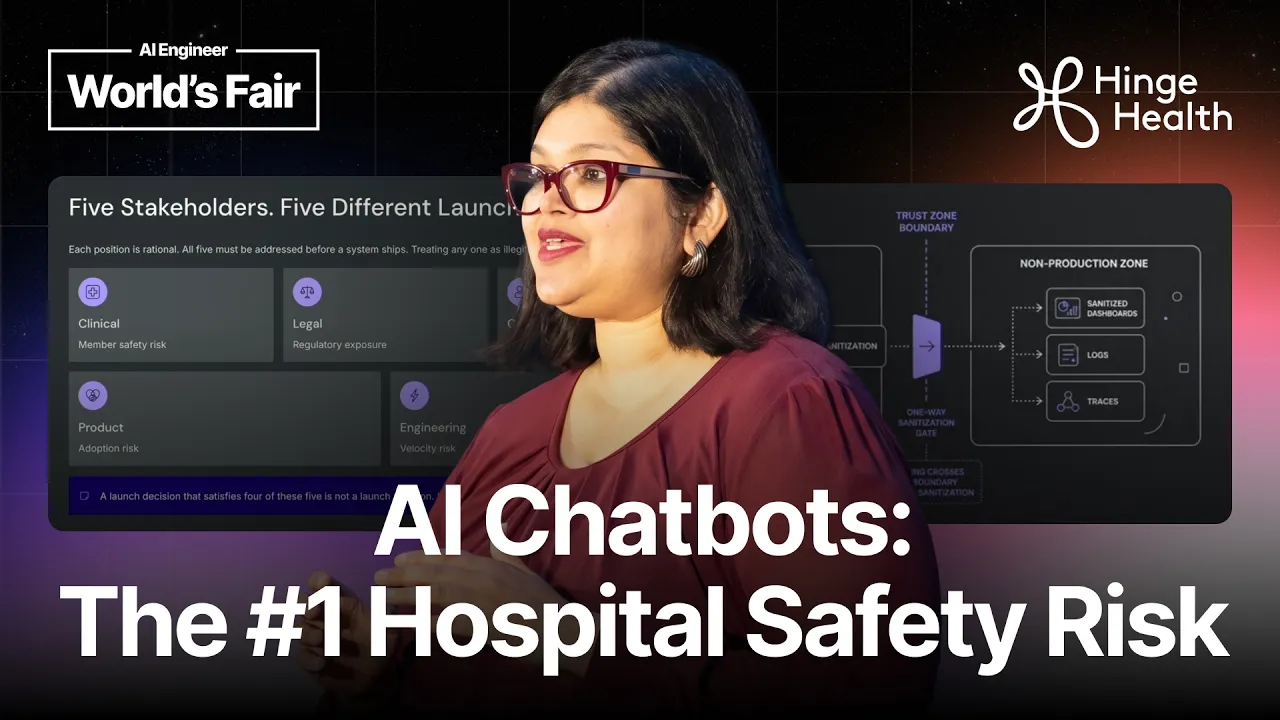
And there is one issue left on the board 5 days before your launch. And you have multiple different stakeholders. Five stakeholders look at the same issue. Each one sees a different risk. And they don't agree what to do about it. Clinical sees member safety risk. They want to hold the launch. Legal sees regulatory exposure. Compliance sees audit risk. Product sees adoption risk. The If the If it ships broken, the feature won't land.
And engineering sees velocity risk. They can't fix it without slipping the date they want to ship. Five rational people, five different risks, and five very different fixes. So, what do you do? Do you hold the launch and fix, or do you actually ship? The next slide is the framework I actually use for making these decisions. Five rules. This is how I think about decisions when stakeholders disagree. Rule one. Worst case always wins.
Severity is set by the worst possible plausible outcome, not the average. And this is extremely relevant in health care. A bug that lightly annoys 100% of users is way less severe than one that could cause serious harm in 0.1% of cases. This is non-negotiable. The worst case matters more than the average case, always. So, when you're triaging, don't ask, "How often does this happen?" Ask, "What's the worst version of this?" That sets the severity.
Rule two. Severity is not capacity. This one keeps politics out of it. As we all know, as we ship features, there's always a little bit of contention between timelines, features, deliverables. But, a bug's severity comes from the harm that it causes. Not who owns it, not whether your team has the capacity to fix it, not how hard the fix is. You have three options in front of you at this point. Fix, delay the launch, or accept the risk with explicit sign-off.
Those are the three. You never quietly downgrade a bug just because you can't get to it. Rule three, asymmetric default. When you don't know what to do, always pick the safer mistake. And there are two spectrums to it. One is safety bugs and polish, the other side is polish bugs. For safety bugs, the math is one-sided. Shipping a real safety bug is much worse than delaying for a false alarm. So, for safety bugs, when you're not sure, always hold and fix.
On the other side, for polish bugs, the math runs the other way. Delaying a launch costs more than shipping a small flaw. So, when you're not sure, ship in case of polish bugs. Ultimately, the framework doesn't decide for you. It just tells you which way to lean. Rule four, revealed risk tolerance, not stated risk tolerance. Your launch bar is what your org already accepts in production, not what it says it will accept.
If a behavior has been live in your existing product for weeks, months, without escalation, without member complaints, without leadership concern, you cannot you cannot call it a launch blocker just for a new thing. Your stated risk tolerance might be no bugs in production, but your revealed risk tolerance is what's actually shipping today. Calibrate to the revealed one. That's the floor. Rule five, humans are the constraint.
Judges scale. Pattern interpretation doesn't. Always, always design for human in the loop. Judges code traces automatically. Dashboards refresh every few hours. None of that is hard anymore. But what's hard is having enough people to read the signal and act on it. One more piece around this. Fast follows are committed debt, not an optional backlog. If you didn't ship it at launch, it's not a wish list item. It's already committed.
The five rules tell you how to decide. But they all assume one thing. That your underlying signal is true. So here's the discipline that needs to come first. In a non-deterministic system, the judge is also non-deterministic. Before you trust the score, verify the scorer. And here's what it looks like in practice. Say you're watching a clinical accuracy judge in production. The score has been steady for at 4.9 for weeks.
Today, it drops to 4.5. And tomorrow, it stays at 4.5. The immediate instinct is, let's start changing the prompts. The agent is broken. Let's fix the agent. That's reactive. And it's risky. You fix one thing and you break another. Worse, you're changing the agent based on a signal that might not be true. And the discipline needs to be different. First, ask whether the judge is right. We can solidify that with a with a concrete example.
Uh let's take it side by side. In scenario A, same question, member asks about caffeine. The agent gives FDA standard guidance. 400 mg for most adults, less if pregnant or on certain medications. The judge flags it as a hallucination. Because the agent mentioned pregnancy and medications without checking. But that's just clinical context. The judge is over calling in this case. Fix the judge in this scenario. For the same question, scenario B, the agent says 1,000 mg a day is fine.
That's well above the safety limits. The judge correctly flags it. And the agent is wrong. In this case, fix the agent. The rule is always ask, is the judge right before changing the agent's response? Fixing a judge prompt is not cheating. Judges are software, too. And they need to continuously evolve. This is what production discipline looks like when the system is not deterministic. Here's the whole talk in one slide.
If you screenshot one thing, this would be it. Six takeaways, three from architecture, three from decisioning. On the architecture side, the pattern is very simple. Don't X what you can Y. Don't policy what you can architect. Don't prompt what you can code. Don't gate what you can monitor. On the decisioning side, the pattern is how humans decide when the system cannot. Score by the worst case and default to the safer mistake.
Calibrate to your org. And always design for the human in the loop. Fast follows are debt, not backlog. Yes, building guardrails first is slower than bolting them on later. But that's the design, not limitation. We are not building a generic low-stakes chatbot. We are building a system that has to be worthy of someone's health. The architecture is how, the decisioning is when, and member trust is why. Thank you. Let's continue the conversation on LinkedIn.
Thank you.
The words are the caption track's own and nothing is reworded or re-transcribed. Paragraph breaks are placed between sentences so the text reads as prose.
Free tools for your own script. No signup, no login.
Paste your draft and see where viewers are likely to drop off, with a rewrite for each weak line.
Paste the first 30 seconds of your own draft for a hook score and rewrites.
Check your draft against YouTube's advertiser-friendly guidelines before you record it.
Read this channel's public videos and transcripts, and download a writing brief for it.