Getting the transcript
Reading the captions from YouTube. A video nobody has opened here before takes 10 to 30 seconds; this page fills in on its own.
Getting the transcript
Reading the captions from YouTube. A video nobody has opened here before takes 10 to 30 seconds; this page fills in on its own.
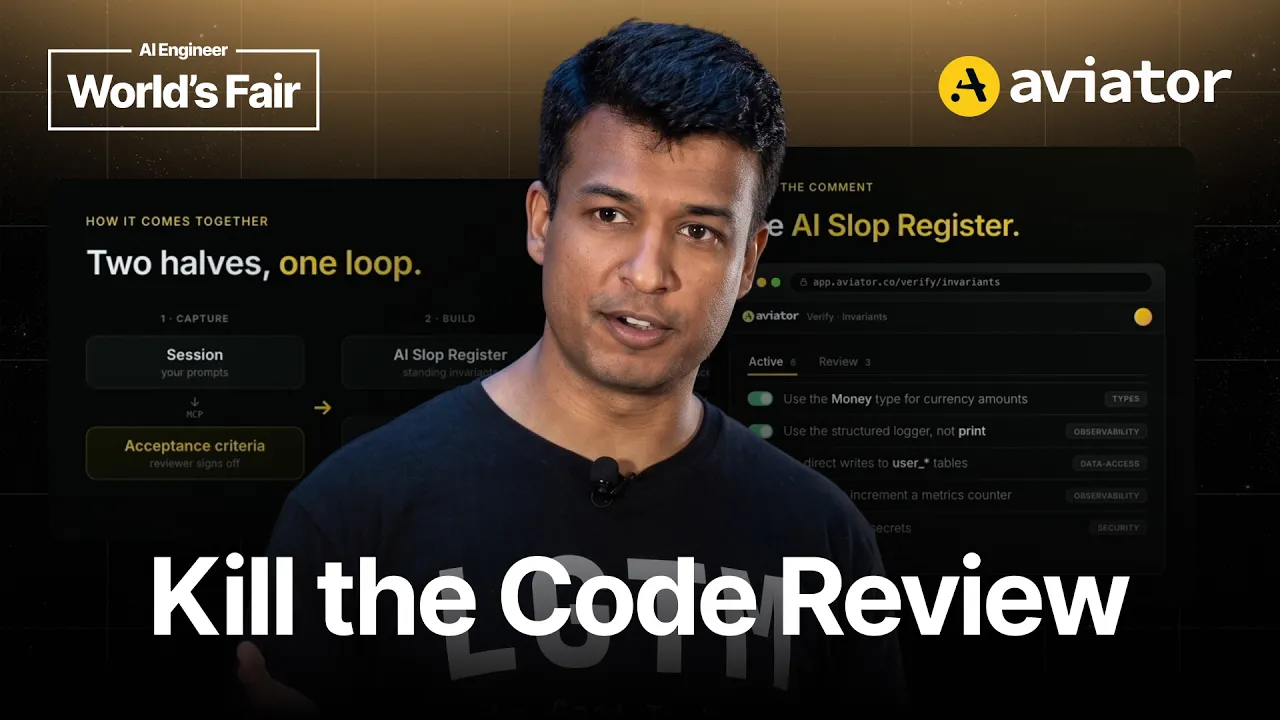
AI Engineer · @aiDotEngineer
This video has no Most replayed graph yet: YouTube shows one only once a video has enough views. These are the moments viewers replayed most in AI Engineer's most watched videos.
Most replayed moment at 18:45
4.8x that video's typical replay level
that they're they're changing they're changing things in the database not yet. You want to run them through the ontology first and make sure that works. Okay. I only got an I've got I've got another I've just a short time. I'm going to try to show you some of the things that um that you can
Said at 18:37
Most replayed moment at 16:13
3.6x that video's typical replay level
method signatures, the program layout and the call stacks. So here's some examples. I don't think you'll be able to read this one, but this is like the level of abstraction we're at. It's how we're actually going to lay this stuff out and how these systems are going to interact. Dylan Mulroy from Cloudflare talks a
Said at 16:06
Most replayed moment at 2:02
2.5x that video's typical replay level
are re-bumbling around the work itself. And the important question here becomes a lot less about what is your title and more what part of the system can you own? Now, I like this taxonomy quite a lot.
Said at 1:56
The graph counts replays. It does not show where viewers stopped watching.
Words
2,603
Runtime
16:25
Speaking pace
159wpm
Reading time
11min
159 words per minute, below the 160 25th percentile of 349 measured videos. That distribution comes from the 349-video hook study.
Opening (first 30 seconds)
[music] >> Okay. Ooh, hello. Hey everyone. Thanks for joining in. Today, uh we will be talking about how to kill the code reviews. Everyone's favorite topic. I'm Ankit, co-founder of Aviator. At Aviator, we are building AI code verification platform. So, we'll bring in some of the ideas and concepts that we talked about in the uh that we build in our product. Uh but first, let's dive into a little bit. So, a few months ago, I wrote
80 words, the words spoken in the first 30 seconds at 159 words per minute.
Free, no signup. See how the first 30 seconds hold attention, with rewrites.
Sentence shape
| Measure | This transcript |
|---|---|
| Sentences | 181 |
| Average words per sentence | 14.4 |
| Longest sentence | 59 words |
| Questions asked | 14 |
| Sentences containing a number | 8 |
Most used terms
Filler phrases
100 in total: like 32 · actually 25 · uh 14 · you know 13 · kind of 10 · right? 4 · sort of 2.
A literal whole-word count of the same phrase list the Prepublish browser extension uses, so a phrase inside another word is not counted and a phrase used in its ordinary sense still is. It is a count and not a judgement.
What this transcript is
Every word below is the caption track YouTube publishes for this video, pulled from the video itself and reproduced unchanged. It is not Prepublish's writing, not a summary, and not a re-transcription: it is the video's own published captions. English captions, generated automatically by YouTube, in the video’s original language. Source: the video on YouTube. A channel that would rather this page did not exist can ask for its removal through the contact page, and it is removed.
[music] >> Okay. Ooh, hello. Hey everyone. Thanks for joining in. Today, uh we will be talking about how to kill the code reviews. Everyone's favorite topic. I'm Ankit, co-founder of Aviator. At Aviator, we are building AI code verification platform. So, we'll bring in some of the ideas and concepts that we talked about in the uh that we build in our product. Uh but first, let's dive into a little bit. So, a few months ago, I wrote a post on LinkedIn space about uh how to kill code review, creating a framework, a five-layer trust model.
So, this model was focused around how do we actually layer by layer build trust into the code that can then be merged without needing line-by-line review. And I got some things right, and I got some things wrong. So, this talk will be about just really diving a bit more more into it. I'm not going to talk about specific layers, but we will talk about some of the concepts that emerged from this session. So, let's just talk about the problem.
We are looking today at the volume of code is increasing every day, and we are struggling to keep up. So, when we think about like how long will it take us to actually stop reading code line by line? And the reality is we've already stopped reviewing it. There is 861% code churn. That means we are like producing more code. The incidents to PR ratio is increasing. That means even if you're doing reviews today, they're not effective.
So, the medium time of review is increasing. We have just increased the bottleneck to from the coding now kind of like coding is solved to now reviewing, where everything just gets stuck there. You're spending four x the time that you were spending before just waiting for the reviews. And today, over 30% of changes are actually getting merged without a review at all. So, let's just think about it a little bit. Think about AI reviews.
So, everyone is probably using some form of AI reviews today. When AI write the code and AI review the code, why are we doing it in a UI? Right? Like we open a GitHub, there's kind of like, you know, maybe two or three AI coding agents who are like doing the reviews. You know, you the review goes back passed to the user and or the agent and it gets resolved and they kind of like you're doing back and forth with the agent.
Where is human here in the loop? Like you're eventually just looking at, okay, you know, if AI has reviewed it, most of the things probably found, let's just kind of like, you know, do a skimming of it and merge it. So, when AI reviews and nobody reads, we have configured the wrong thing. So, let's just take a step back. Code reviews are not very old. They are maybe 15 to 20 years ago. In 2006 was when Google launched Mondrian internally and they made formal code review as a thing.
If you think about it, Windows back in the days, the first versions were actually built without reviews. But if we look carefully, code review is not just about code reviews. You know, obviously we are looking at it like catching bugs, understanding kind of conventions, identifying security issues. But, code review is also about alignment. And this was one piece which was missing from my five layers model that I talked about a few months ago.
So, a big part of code reviews is knowledge sharing, mentorship, architectural feedback, onboarding, being able to collaborate. This is Again, if you're doing uh white coding, you're working as a solo project, this is not a talk for you. If you are working in teams, which I believe most of you folks are, collaborating in teams, you're not likely using completely dark factories, orchestrators, where nobody looks at the code.
You're actually collaborating in teams, you need to do knowledge sharing. Which is the alignment part. And that is the part which is the most important aspect of release. So, for semantic accuracy, we can build better tooling, but alignment must survive. So, let's just kind of like dive into alignment. What does it mean? Like, in today's world, can we actually think of better model than aligning just based on reading line by line code?
So, most folks have probably heard about spectrum development by now. So, spectrum development is like, okay, we write a spec, you know, it covers all the details, we pass it to an agent, it generates a code, and then we verify. So, what's wrong here? If you look back in 1970, this is what waterfall model was. You know, you have requirements, you have specification, you implement, and then you verify. But, there's no feedback loop.
You know, the spec is written before we identified everything else. Right? That's why today everyone still wants to use your coding sessions, whether it's cloud code, codex, cursor, whatever you're using, you want to interact with the agents. And the reason you're interacting with agents is because there were certain things which were not clear in the spec, and we still need to capture that. And second is, as you implement, you identify more issues, and you never go back and update the spec, because like, if you're doing the spectrum development, it's already done.
Once the spec is done, you expect, like, you know, the code will come deterministically. But guess what? LLM is not deterministic. It's going to make decisions itself. So, that's why spectrum development is a great uh methodology, but it falls short in day-to-day software development. But there are some interesting aspects of this, which we should carry forward. The most important part is the intent. An intent doesn't only live in the spec.
Intent live in your Jira ticket. That's the goal, right? Like it's kind of like where you express what we want to do. It lives in your PRDs. It's kind of like details, like it's a plan. But most importantly, it lives in your prompts today. This is where the real decisions are being made. You start with like, okay, this is a Jira ticket I'm going to look at, but you're going back and forth with the agent, and this is where all the user decisions are being made.
But what we do today is we create a change, we create a pull request, and then we throw away the prompts. And this is one of the things that we need to change. Let us first talk also about semantic accuracy because like, you know, you're saying, "Hey, Ankit, okay, I understand the alignment part, but like there are still bugs in the code. Who's going to look at that?" LLMs are also not great at this, and we already talked about how AI agents may reviewers may not always be perfect.
So, this is where I introduce you to the concept of AI slop registry. So, think about this. We are reviewing If you're reviewing code today manually, and I expect everyone should be doing some degree of this. We are essentially possibly identifying the same issues over and over again. Can we actually capture these concepts and codify them so that we don't have to always create those review feedback one by one. You actually also have all of those things automatically identified.
The beauty of this is if you do it a few times, you now build sort of like a system which actually learns over time. So, think of this as sort of like you know, you know, you're doing more training on top of the standard LLM that you have actually extracted like built on top of. So, AI slop registers now can create better results because it's trained it's learning from the review experience that you as humans are providing.
Every recurring comment is now a guardrail that you don't have to review again. Okay, so let's kind of like try to put both of these alignment and the semantic accuracy together. It is two halves of the same problem. We are trying to understand what are the core mechanics of review. How do we actually break it down into two parts which is the alignment and the semantic accuracy and bring them together into a single loop.
So, first thing is you could take your session and you capture the user responses and that essentially forms your acceptance criteria. The acceptance criteria then tied with your AI slot register that you are now constantly maintaining finally creates a test plan. And this is the test plan which then gets verified. This is part of the system that we are building is the verification system where it spins up a preview, takes your test plan and make sure it actually works end-to-end.
Even if the code looks right, does it actually work? So, this verification part has become interesting. And now the kicker is this is now your review surface. You're not reviewing code line by line, but rather you're looking at the evidence of what was the intent, did the user actually implement the capability that was defined in the intent, and did the behavior actually meet the requirements that we had in the as acceptance criteria.
So, you're still having the architectural decisions, you're still having these arguments, but the review surface changes. So, just giving a walk through of like how we have built our system. The session becomes a criteria, so all these decisions that you are doing here with the agent, you're asking uh you know, you're providing this feedback. Like even if there is a simple task, many times you're going back and forth.
Agent will stop to ask questions. These are the decisions that we need to capture. This is the intent. This is what makes your review, makes your collaboration more valuable. This is how you teach your junior engineers on how to improve over time. These are the decisions which make a software engineer valuable today. We convert those into an acceptance criteria. This is where you can also leverage LLM to do so. So, you capture these user uh decisions and make sure you can actually create a test plan based on this.
I know test plan creation is always painful, which is where I would always recommend people to use LLM for this purpose. And finally, the criteria plus invariant is what makes the test plan. Uh and we build the verification systems to actually capture the test plan, run your previews, and be able to test based on this test plan. So, even imagine if you're building a new feature, you don't have to maintain tests at all.
This is creating tests in real time, and this is where you can leverage the power of LLM because the test plan maintenance and creation can be really painful, but the value of human in the loop here is the governance and the review part, and the part where you're reviewing the test plan and not the code. Right? I know it's been like over 20 years we came up with test-driven development. This in some ways is closer to behavior-driven development, where the test plan is now something which even you can share with your product managers, your designers.
Everyone can participate because these things are now in English. At the same time, we have now deterministic verification, which actually verifies whether the particular test criteria has been met or not. Let's move on. So, this is where I would say the system is not supposed to be perfect. It's deterministic where it can be, but LLM where you must. Not everything can be deterministic. Not every system can be built in a way which is 100% built on deterministic systems.
This is where you use LLM as a fallback. Let me give an example. Like if you're making a change in your web application, what you can do is it creates a test plan of what the behavior changes. Let's say you introduce a new payment form. So, it creates a new payment form. The verification here is does the payment system changes? Uh an AI agent can go and browse through your application to fill out a form and capture screenshots as evidence.
And then take those screenshots as well as your database snapshots to identify whether the criteria was met. So, the screenshot testing or like sand flying can then still be done by agents. But at the same time, you're creating more solid evidence, which now a reviewer can look at and build more confidence that this actually works. So, now reviewers are reviewing the intent, not the diff. You're reviewing the intent decisions.
Uh what we said to build out. What we tried and rejected, and capture all of these things from the sessions. Remember, capturing it from the sessions is is key. If we try to build it from the code, you'll end up in the same situation that we were talking about I think Dex was talking about yesterday, which is if your code is built by the same agent which is actually building a test plan, it's not going to build a test plan which will actually catch issues.
So, that's why it's important to actually use the session information to build out a test plan. You can discuss architectural decisions. So, how you're creating the data models, how these services interact with each other. So, you've moved one level above. So, you're essentially instead of like reviewing line by line, you're actually having discussions on architecture, which are very critical for any kind of collaboration.
And then you look at the evidence, everything that was collected from the verification. So, here's a homework for everyone. Go home and mine your last 1,000 review comments and build out a AI slot register for the things which are repeatable. So, a vast majority of the comments that you're providing in your code review are something that we repeat over and over again. This compounds with every merge PR. Every time you capture something as a register, you don't have to capture that comment again.
And this is where you can actually codify some of the best practices of doing code, maintain semantic accuracy, at the same time, do not lose the collaboration part of the review. It does follow a J curve. So, pain is real. Uh you will have to spend some time to actually make it pay off because initially creating a registry can take some time. And this is where I would recommend you folks can come and try out our product.
So, code review is not just about code review. It is about uh really getting the alignment. And where we can build better tools is creating the semantic accuracy and defining your AI slot register. So, if you remember one thing from today, remember code review is not just about code review, it is about getting the alignment. And yes, we are piloting our new product called Verify. Please join and be our early design partners.
We are working with a few companies to uh pilot out a new verification system. This combines both the alignment side of things as well as building tools and capabilities for detecting semantic accuracy using the AI slot register. Thank you, everyone. Thanks for joining. >> [applause]
The words are the caption track's own and nothing is reworded or re-transcribed. Paragraph breaks are placed between sentences so the text reads as prose.
Free tools for your own script. No signup, no login.
Paste your draft and see where viewers are likely to drop off, with a rewrite for each weak line.
Paste the first 30 seconds of your own draft for a hook score and rewrites.
Check your draft against YouTube's advertiser-friendly guidelines before you record it.
Read this channel's public videos and transcripts, and download a writing brief for it.