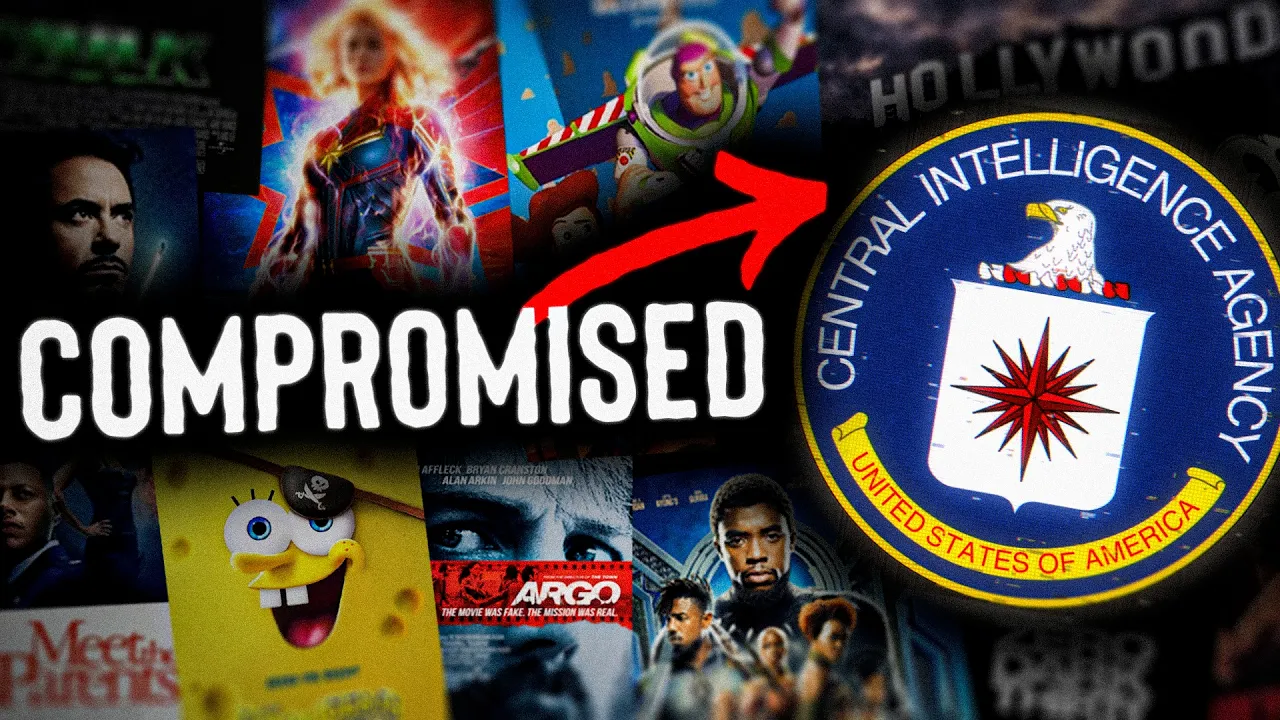
Your Favorite Movies Are CIA Propaganda transcript
Moon · @Moon-Real
Words
4,113
Runtime
23:10
Speaking pace
178wpm
Reading time
17min
178 words per minute, just under the 181 median of 349 measured videos. That distribution comes from the 349-video hook study.
Opening (first 30 seconds)
There's a version of your favorite films and TV shows that you weren't allowed to see. Scripts were rewritten, scenes were cut, endings were changed, and characters were altered. >> They'd stamped top secret on the top and the bottom and the sides in the margins >> What? >> of every single page. And I said, "Guys, this is not top secret. [laughter] This is a Hollywood movie. It's already on video. It's done." >> I'm talking children's animations with rewritten endings, comedy films you've never heard of with
89 words, the words spoken in the first 30 seconds at 178 words per minute.
Sentence shape
| Measure | This transcript |
|---|---|
| Sentences | 266 |
| Average words per sentence | 15.5 |
| Longest sentence | 46 words |
| Questions asked | 11 |
| Sentences containing a number | 18 |
Most used terms
- cia55
- music29
- hollywood20
- people14
- film13
- films12
- government12
- agency10
- media9
- called8
- message8
- power8
Filler phrases
35 in total: like 19 · you know 7 · actually 4 · literally 3 · kind of 1 · um 1.
A literal whole-word count of the same phrase list the Prepublish browser extension uses, so a phrase inside another word is not counted and a phrase used in its ordinary sense still is. It is a count and not a judgement.
What this transcript is
Every word below is the caption track YouTube publishes for this video, pulled from the video itself and reproduced unchanged. It is not Prepublish's writing, not a summary, and not a re-transcription: it is the video's own published captions. English captions, generated automatically by YouTube, in the video’s original language. Source: the video on YouTube. A channel that would rather this page did not exist can ask for its removal through the contact page, and it is removed.
Transcript
There's a version of your favorite films and TV shows that you weren't allowed to see. Scripts were rewritten, scenes were cut, endings were changed, and characters were altered. >> They'd stamped top secret on the top and the bottom and the sides in the margins >> What? >> of every single page. And I said, "Guys, this is not top secret. [laughter] This is a Hollywood movie. It's already on video. It's done." >> I'm talking children's animations with rewritten endings, comedy films you've never heard of with deleted scenes, superhero franchises built in secretive contracts, and a screenwriter who tried to tell the wrong story and was found dead with both hands missing. >> It's not an accident that every Hollywood movie about the CIA is pro-CIA. >> This has been running since the 1940s.
What started with Walt Disney producing propaganda shorts for the military has now evolved into a formal permanent operation, one that now reaches into the biggest franchises on the planet, and it hasn't stopped expanding from there. When John Kiriakou, a CIA whistleblower who went to prison for exposing the torture program, was asked on The Diary of a CEO how the agency would hypothetically design an influence campaign, this was his answer. >> You would have to have a goal that would be specific enough that you could actually track the progress to it.
It has to be a message. You've got to be able [music] to get a specific, well-honed message out there. And the message can be anything. It could be, you know, love the CIA, we're the good guys. It could be, support the overthrow of the Iranian government. It could be, you know, >> [music] >> any criticism of Benjamin Netanyahu as anti-Semitism. It could be anything you want it to be. >> You just have to make sure that it's repeated enough. >> He mentions a couple of things there that are highly relevant right now.
Take Argo, an Oscar-winning film that almost everyone has heard of. The plot follows a CIA officer who poses as a Hollywood producer to smuggle six American diplomats out of Iran all during the 1979 hostage crisis. As you can imagine, the CIA is unambiguously the hero. There's barely a single mention of the CIA's overthrow of Iran's democratically elected government or the installing of a dictator who ruled with a secret police force trained by the CIA.
And given the current conflict in Iran, you could reasonably argue that the public's understanding of who Iran is and how it got there was influenced in parts by films exactly like this. During filming, Affleck visited CIA headquarters multiple times, sat in round tables in the director's conference room, and even emailed the agency promising to do the agency proud. The CIA had actually been promoting the Argo operation as a suggested movie plot in their own website years before the film was made, and even thanked Affleck publicly on Twitter for the film.
Affleck said this when interviewed as part of the press tour. >> Are there many actors in Hollywood who also moonlight as agents, [music] do you think? >> I think there are probably quite a few, yes. I think probably Hollywood is full of CIA agents, and we just don't know it. >> But Argo's only the surface, and you'll be shocked about where exactly the strategy operates in Hollywood, the films it touches, and how smart it truly is.
Take the original script for the Hulk. The canon storyline as per the comic involved Bruce Banner being transformed after a US military program gone wrong. It also included dialogue referencing Operation Ranch Hand, a real program that sprayed roughly [music] 20 million gallons of chemical herbicides, including Agent Orange, over Southeast Asia, poisoning a possible 4 million people. Both details were removed purposely by CIA advisers.
This is according to leaked files seen by The Conversation. They then changed the origin story to a lab experiment gone wrong instead because they couldn't risk anti-government sentiments in a franchise of this size. In the Transformers films, a Pentagon liaison inserted specific dialogue instead of removing it. In one scene just after American troops have been attacked by a deception robot, he added the line bring them home to reinforce US military values.
Numerous superhero films, including practically the entire Marvel Cinematic Universe, which is the single biggest franchise in history, were all built on this from the ground up. Captain Marvel was granted full Air Force support. The Air Force was advertising the film in social media before Marvel had even started marketing it. Captain Marvel and Black Panther were both used directly in recruitment campaigns. The result was a documented spike in female applicants to the Air Force Academy.
They literally called it the Captain Marvel effect. On Iron Man, which was massively supported by the Pentagon with $1 billion worth of equipment, there were literally fights on set between the directors and the agency. A Pentagon liaison Phil Strub objected to a line in which a military character says, "People would kill themselves for the opportunities I have." The director John pushed back, and soon they were standing on the flight lines at Edwards Air Force Base with 200 crew watching.
They eventually settled on they'd walk over hot coals, but even then that didn't make the final cut. But a much weirder example is Meet the Parents, when Ben Stiller's character walks into Robert De Niro's workplace. In the original script, he finds CIA torture manuals. That was rewritten. Now he finds photos of De Niro meeting Bill Clinton. IMDb credits Chase Brandon as a technical advisor and Milt Bearden as consultant CIA on the film, which you can see here.
These examples just cover what we know for certain from a leak of 60,000 pages of documents, which confirmed the CIA has been involved in more than 2,500 productions in total. The Pentagon runs something called the Entertainment Media Office, a formal liaison operation that works directly with Hollywood studios. They support studios financially, offer advice on sensitive topics, and lend them specialist equipment and prime filming locations.
In exchange for permissions, the CIA get to read and approve the script before a single frame is shot. They also have complete veto power, and directors are obliged to follow their word. One Pentagon minder said on record, "If they don't do what I say, I take my toys and go away." A declassified CIA document released in 2019 all but confirms that, logging dozens of meetings between the CIA's Office of Public Affairs and executives from NBC, Time Warner, Viacom, Fox, Paramount, and CAA.
The document covers just 2 years from 2014 to 2016. It includes lunches, development deals, on-campus filming approvals, and meetings to develop CIA-themed TV shows. The CIA has always claimed it merely answers requests on an as-needed basis. The document shows active outreach. The agency is going to the studios, not the other way around. But, you have to stretch back much further to find out when this all began. Because when one of George Orwell's most important works was adapted into a movie, the CIA had the final say over its closing moments.
That film is Animal Farm, a classic anti-establishment story about rebelling against power. After Orwell died, the film's rights to Animal Farm were purchased by two men, and both were undercover CIA agents. This was in 1954, the height of the Cold War and the Red Scare, when the fear of communism was at its peak. The CIA funded the entire animation. They hired British animators, deliberately avoiding American studios to create distance and because the agency distrusted Hollywood animators during the Red Scare.
And they rewrote the ending. In Orwell's work, the animals look through the farmhouse window and can't tell the pigs from the humans. The line says, quote, "The creatures outside looked from pig to man and [music] from pig to man and from pig to man again. But, already it was impossible to say which was which." This is the whole point. Revolution replaces one set of oppressors with another. Capitalism and communism are equally corrupt.
The CIA couldn't have that message going out. So, their version ends with the animals triumphantly overthrowing the pigs in a second revolution. Communism bad, rebellion good, America wins by implication. See, watch how they storm the building and how it doesn't imply the same message as the book at all. It's subtle, but the new version reinforces the division between good and bad. It creates a moral precedent that corrupt systems can be overthrown and replaced with something better, which is a really comforting thought, unless you realize it's exactly the story the CIA tells every time it topples a government.
Orwell's ending says the opposite. That power corrupts regardless of who holds it, and that revolution just replaces one set of oppressors with another. The director, Joy Batchelor, strongly opposed the change. So, the CIA threatened to pull financing. The intelligence officer E. Howard Hunt, who later became involved in the Watergate scandal, said the film was, quote, "carefully tweaked to heighten the anti-communist message." Although it was originally aimed at adults, Animal Farm found its primary audience in school over the US and Europe.
By then, the state and media were already deeply intertwined. Governments had correctly identified that the media was the best way to access the minds of the public. Generations of children were shown a CIA-funded film with a CIA-rewritten ending, as if this was a faithful adaptation of Orwell. So, you may not be surprised to learn that Disney was the testing ground for how effective propaganda could be. While it might be hard to believe today, Disney was actually going broke, and the government offered it a deal.
They accepted, and within 2 years over 90% of Disney's output, mostly propaganda, was government content. Disney characters found their way into all sorts of government materials, including 1,200 military insignia. Walt Disney even personally designed this terrifying Mickey Mouse gas mask, all to make children less afraid during air raids. If you look at Disney films through the ages, like Snow White, The Incredibles, and Frozen, they're often said to carry some level of deliberate messaging.
In a conversation between Theo Von and Robert Greene, the guy who wrote the 48 Laws of Power, Greene said they offer a singular world view that runs through most Western mainstream media. While modern society came to describe this phenomena as woke, the more important aspect is the consent it manufactures. >> And what angered me about Hollywood, you know, people pretending to be these liberal, wonderful people in favor of all the best causes, out [music] there to create art.
What They wanted power. They They loved having the power over people. You know, they would drop the woke stuff tomorrow if they could make more money doing something else. It's just about what's going to bring the bucks. >> Someone upstream decides what the acceptable world view is, and the media is passed accordingly. The Pentagon did it with military values. The CIA did it with anti-communism. Hollywood does it now with whatever sells.
The product always looks like entertainment and not ideology. These are films watched by billions, not just in the West, but worldwide. So, this is also a matter of the image the world's superpowers want to project. Soft power has always mattered enormously to the West. Huge military, invincible superheroes, perfect moral values, intelligence agencies that can do anything they please and always win. Now, you might be wondering what happens if someone breaks ranks and goes against the grain, whether it's possible to subvert the CIA and inform the public of the truth.
Well, there has been at least one occasion when someone tried to do exactly that. He was Gary DeVore, a Hollywood screenwriter with major credits on Schwarzenegger's Raw Deal, Christopher Walken's The Dogs of War, and Back Roads with Tommy Lee Jones and Sally Field. He was deep into a script idea that even his own wife didn't fully understand until after he was gone. >> When I first moved in with Gary, he said to me, "Don't be alarmed if you get a call from a person [music] from a government agency.
Just take their name down and their number and don't be worried about it." >> [music] >> In the first four years, there were two calls. And then, not too long before he actually disappeared, [music] there were several from the CIA at Langley. >> It was called The Big Steal, set during the US invasion of Panama. A friend of his, Hollywood director John Irvin, had lunch with Gary a few weeks before [music] he disappeared.
He could tell that something was off. >> He was troubled. Something was was bothering him. >> [music] >> He was um he wasn't really in the conversation. He was having trouble with the script he was writing. [music] But he talked about more about not the script, but about a government very, very sensitive inconvenient [music] truth. He was speaking more as a journalist than he was as a screenwriter. >> [music] >> He was talking as an investigator. >> A researcher who later investigated the case, called Dr.
Matthew Alford, eventually uncovered what Gary had found, and it's really dark. >> The dictator of Panama, Manuel Noriega, made secret recordings in wired rooms of senior US officials having sex with underage prostitutes, male and female. One British newspaper commented on this, and the story was then buried. And the guy who wrote it got shot by an anonymous sniper. >> Gary planned to put that in a Hollywood film. He was driving home through the desert, and then that was the last anyone heard from him. >> And he said, "I'll see you later." I never heard from him again. >> It's like Gary Devore simply vanished into thin air. >> There was a massive search, foot patrols, helicopters, a hundred thousand dollar reward, but zero leads and no witnesses.
He was missing for 374 days, but then his Ford Explorer was found beneath 15 feet of muddy water at the bottom of the California Aqueduct. Despite the Aqueduct having been searched extensively, his laptop containing the script was missing. His gun was missing, and his hands were missing. >> Why were his hands cut off? >> Listen, the man had his fingers removed. Why? Why? In my own mind, feel that there is crime here.
I do not feel that my husband drove off of this bridge. >> Within a week of his disappearance, agents from the FBI, CIA, NSA, and DOD arrived at the family home. After an official went into his office, his computer was wiped. And here's an unlikely connection to meet the parents and other films years later. It was Chase Brandon, the CIA's entertainment industry liaison officer, who was among those at the scene. When Alfred started digging into the case years later, he received a warning to stop what he was doing and leave well alone. >> You know, of course you've received an informal or semi- formal warning from a CIA and DOD contractor who said to you back off the CIA, you're going to you're going too far with this now.
These people can and will ruin your life and come knocking on mine and your doors. >> A former White House official from the Reagan and George Bush administrations confirmed that DeVore harbored a deep-rooted relationship with the agency and considered the case as the hallmarks of a cover-up. The CIA declined to comment on the entire situation and the case officially remains open. So, that's the other side of the coin.
What potentially happens when the CIA's veto isn't obeyed. We don't really know the truth of what happened, but it does show you that you shouldn't mess around with topics not sanctioned by the agency. As for the impacts this all has on society, Theo and Joe Rogan were very perceptive about how it can change public perception. >> So, in World War I, one of the problems that they had was people didn't want to be over there killing people.
Yeah. so, people were shooting, but they weren't shooting at the actual enemy. And so, then they realized, "Well, we've got to do something about that." And so, after that, they started creating all these really patriotic [music] war movies, where the guys are heroes, they go over and they shoot all the bad guys, and then they're awesome. So, then the next group of people that go to war are all going to be indoctrinated with these films. >> John Kiriakou thinks that nowhere has that indoctrination been more effective or more dangerous than in warming the population up to the idea of torture. >> One thing that bothers me the most is when [music] Hollywood perpetuates the myth that torture prevented acts of terrorism or disrupted acts of terrorism.
[music] And to me, that myth is dangerous in that it affects public opinion. [music] You can put whatever euphemism you want on it. You can call it enhanced interrogation techniques. I don't care what you call it. What we did to some of those [music] people was just illegal. >> Kiriakou would know. He's the only CIA officer who ever went to prison over the torture program. >> I objected to the CIA's [music] use of so-called enhanced interrogation techniques, which I believe to be torture, and I went public with that information in December of 2007.
All this time, by the way, I'm waiting for somebody to come out [music] and say something, and nobody said anything. As a result, I was prosecuted and [music] served 30 months in prison. But, I'm glad I did. Somebody had to do it. >> This is especially true in the film Zero Dark Thirty, which is about capturing Osama bin Laden. John Kiriakou thinks it's the strongest example of making the CIA look clean from every angle. >> Zero Dark Thirty.
So, Zero Dark Thirty, I think, [music] is the most egregious example of CIA interference in Hollywood. >> The CIA gave the filmmakers classified briefings over a classified mock-up of the bin Laden compound. The film essentially pushed that the torture program is what led them to Bin Laden. Kiriakou says that's a complete lie. >> This was a film that the CIA made a policy decision on [music] that it was going to cooperate fully to the point where senior CI officers gave them inappropriately classified briefings over a classified mock-up of the Bin Laden compound.
Okay, that's that's chargeable under the Espionage [music] Act. The CIA just turned it over. Why? Because it made the CIA look good. >> In real life, intelligence work is edgy, gruesome, and morally ambiguous. Mainstream TV and cinema don't need to be accurate. They just need to feel right and not leave the audience with too many lingering questions or ambiguity. They pick up on this exact point in the podcast. >> Even [music] though it they are torturing people.
Now, entire population is so kind of almost like brainwashed into, but they are good guys, so torture is okay as long as good guys are doing it. >> was the narrative. >> And they've got so desensitized towards doing bad And if it's the CIA or if it's Tom Cruise or if it's like Mission Impossible and they're doing bad and they're torturing people, that's okay. Like now the message is that's okay, you don't worry about it. >> So, desensitization and controlling the narrative is essential to this whole strategy.
But there are deeper layers than promoting and suppressing films. The CIA's venture capital arm, In-Q-Tel, literally named after Q from James Bond, has been funding tech companies since 1999. Google bought an In-Q-Tel funded mapping startup called Keyhole that became Google Earth. In-Q-Tel and Google then jointly invested in a company that builds predictive analytics by mining web data. Palantir was one of their earliest investments.
The CIA had established an entire directorate of digital innovation specifically to engage Silicon Valley. So, it's all linked together and practically operates in plain sight. Theo Von told Green about bumping into a construction worker at Century City Mall in LA. >> Yo, what's up? So, I start talking to him. And he's like, "Dude, guess what we're building?" I'm like, "I don't know, you know, I thought maybe it could have been like a Hardee's or something." He's [snorts] like, "We're building like a 20-story building >> [music] >> and 10 floors of it are the CIA and the other 10 floors are a management company, Hollywood management. >> Theo was mixing up the CIA and CAA, Creative Artists Agency, Hollywood's most powerful talent firm.
But Green made it sound like the real thing was even worse. >> And you go to that building and they call it like the Death Star. There are like, you know, politicians who are being represented by CAA, athletes, tech bros, influencers. It's pretty frightening though when you go inside. It's almost like Scientology. Hollywood's version of Scientology. >> He's describing high-level ongoing talks at the intersection of the media, government, and Big Tech.
All in a building lovingly called the Death Star. So, you can now see how this whole influence campaign is far bigger than cutting lines in Marvel movies. It relies on cross-collaboration between multiple arms of state and private power. And the product hasn't stopped at the cinema. It's been actively following the audience, which means you, wherever you go, including online. >> Do you think the CIA are have a strategy for podcasters and for podcasting? >> I think yes, now they do.
It took them a little while to to get current, but just like they over time developed a strategy with Hollywood, sure, they're developing a strategy with podcasters. >> This strategy is consolidating as we speak, which will only make it easier for agencies like the CIA to wield greater control over the narratives. Larry Ellison, whose company Oracle now hosts TikTok US algorithm and controls its content moderation, just bought Paramount through his son David.
And if their bid for Warner Bros. and Discovery goes through, you can add CNN, HBO, Warner Bros., Cartoon Network, Nickelodeon, MTV, Comedy Central, Discovery, TLC, TBS, and TNT to that list. An internal memo obtained by NPR confirmed the Allison led entity will control what's allowed and what's not on the platform. Bernie Sanders called it oligarchy. And Oracle, which sits underneath all of this, has held government contracts with the CIA and the Department of Defense for decades.
Whatever you call it, the media pipeline is now shorter than it's ever been and in fewer hands. There's a through line from Donald Duck selling war bonds to Captain Marvel selling Air Force recruitment to Google Earth tracking your location has never been broken. The methods have evolved. Direct propaganda, covert funding, script consultations, structural incentives, venture capital, and digital surveillance. But the principle itself hasn't changed.
Get the message right, make sure it's repeated enough, and eventually nobody questions this anymore. And if you've seen what happens when someone steps [music] outside that system, a screenwriter at the bottom of the canal with no hands, a researcher warned to back off before they ruin his life, maybe then you understand why so few people [music] ever try. It's not a theory about Hollywood, but a description of what 60,000 pages of declassified documents confirm has already happened and is still happening to the stories you grew up on.
The truth is, we simply don't know how deep this rabbit hole really goes. How much of the information-rich world around us is real and how much is fake or manipulated just enough to maintain a thin veneer of authenticity. Like we saw in this recent video we did on the CIA compromising podcasts, the rabbit hole truly goes deep. In any case, the strategies employed by the CIA and the government to influence the media are not theoretical, and they don't spend millions on them for no reason.
So, ask yourself, when you're next watching your favorite films and TV shows, can you really take them at value? If you think you can, ask yourself for how much longer do you think this will be the case? >> [snorts]
The words are the caption track's own and nothing is reworded or re-transcribed. Paragraph breaks are placed between sentences so the text reads as prose.
Use this transcript
Three free tools that work on the material around a video like this one. No signup, no login.
Hook Analyzer
Paste the first 30 seconds of your own draft for a hook score and rewrites.
Policy Pre-Flight
Check your draft against YouTube's advertiser-friendly guidelines before you record it.
Channel Skill Generator
Read this channel's public videos and transcripts, and download a writing brief for it.