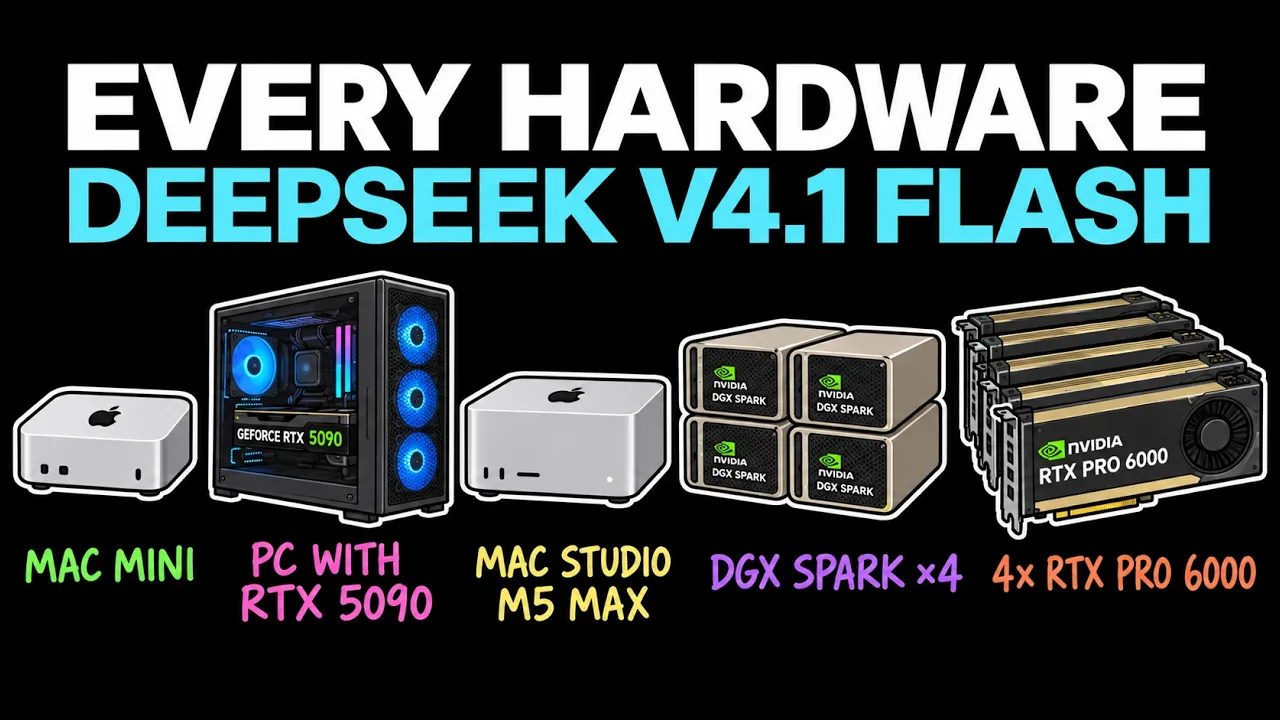
Run DeepSeek V4.1 Flash on ANY hardware (16GB to 512GB): can it work? transcript
Marfil Draws · @themarfildraws
Words
2,168
Runtime
13:26
Speaking pace
161wpm
Reading time
9min
161 words per minute, between the 160 25th percentile and the 181 median of 349 measured videos. That distribution comes from the 349-video hook study.
Opening (first 30 seconds)
Deep Seek V4.1 flash came out on September 10th and the download is about 510 GB. So, what would you need to buy to run it at home and does that beat paying for the API? The most backed request is a smaller light version since this one is so hard to run. Um, so why is it so big? It is a mixture of experts model, many small specialists and only a few work on each token, a word piece.
81 words, the words spoken in the first 30 seconds at 161 words per minute.
Sentence shape
| Measure | This transcript |
|---|---|
| Sentences | 160 |
| Average words per sentence | 13.6 |
| Longest sentence | 35 words |
| Questions asked | 25 |
| Sentences containing a number | 78 |
Most used terms
- gb27
- memory17
- model17
- tokens14
- writes12
- experts11
- mac11
- run11
- sparks11
- token11
- build9
- card9
Filler phrases
29 in total: you know 6 · I mean 5 · um 5 · kind of 4 · uh 4 · like 3 · sort of 2.
A literal whole-word count of the same phrase list the Prepublish browser extension uses, so a phrase inside another word is not counted and a phrase used in its ordinary sense still is. It is a count and not a judgement.
What this transcript is
Every word below is the caption track YouTube publishes for this video, pulled from the video itself and reproduced unchanged. It is not Prepublish's writing, not a summary, and not a re-transcription: it is the video's own published captions. English captions, generated automatically by YouTube, in the video’s original language. Source: the video on YouTube. A channel that would rather this page did not exist can ask for its removal through the contact page, and it is removed.
Transcript
Deep Seek V4.1 flash came out on September 10th and the download is about 510 GB. So, what would you need to buy to run it at home and does that beat paying for the API? The most backed request is a smaller light version since this one is so hard to run. Um, so why is it so big? It is a mixture of experts model, many small specialists and only a few work on each token, a word piece. Each layer has 384 experts and six work per token.
On top of 552 billion main parameters, the numbers the model learned, there are 196 billion more in two engram tables which are sort of giant lookup lists. So, do those engram tables need your memory, too? Each token pulls about 4.51 GB of experts but only about 12.4 KB of tables. So, the tables can sit on your SSD and the experts cannot. The memory for context, the conversation in view, is tiny. A 1 million token prompt fits under 1 GB.
Now, the experts still need memory. So, why not shrink them? That is quantization, storing each number with fewer bits. But, they already ship at about four bits. So, a normal four-bit version saves almost nothing and real savings start below four. Release day missed exactly that need for fewer bits. The idea was that two DGX sparks, small Nvidia desktops with 128 GB or two Strix Halo boxes, the AMD version, would run Q4 with engram on disk.
It It does not work that way. I mean, Q4 does not shrink it. And even with engram on the SSD, two sparks are not enough. So, if those boxes fall short, can you just download it? Well, not with the usual apps. Oh, llama.cpp only offer it in the cloud and standard llama.cpp only has a draft file converter. Non-technical people want a shopping list anyway, you know, or the damn EXE file. So, what does run it? Dwarf Star, a free program by one well-known developer on Macs and one or two Sparks, plus OMLX on Max.
Ordinary Nvidia PCs get only unofficial modified programs with files that are kind of a mess. One published file carries the older chat template, which weakens tool calling. Most people start with Dwarf Star, so how much quality do its two main builds give up? Q2 keeps the experts at about two bits, a 366 GB file needing about 163 GB of memory. Q4 keeps about four bits, a 519 GB file needing about 316. On 100 short prompts, Q2 matched the DeepSeek API on the likely next token 90.08% of the time.
Q4 96.7%. Nobody has run a coding agent test on either. So, um that gap starts the fighting. Some say two bits just makes modern models a little dumber. Others refuse anything below four, calling two bits on a model this size a lobotomy. The Dwarf Star author says Q2 surely beats the older V4 at Q4 with twice the parameters. When When people say it beats a frontier model, others note the model itself on any build tops a hallucination benchmark, a test of made-up answers.
Okay, so with quality still open, how fast is fast enough? Speed is tokens per second, how fast the answer appears. For users, five is like too slow for agent work, but fine overnight. About 15 is their bare minimum, and coding wants at least 20. But a second speed hurts coding agents more, prompt reading. I mean, how fast the model reads what you send before answering. Users call it among the main reasons good hardware owners still pay for APIs.
On a 256 GB M3 Ultra, a 15,688 token prompt took about 99 seconds every call, and 6.6 once it reused what it had already read. Right, so by that ruler, level one is the computer you already own. The most likely report is a 2020 Mac Mini with 16 GB. It streams the experts, loading them from the SSD, 108 seconds before the first word, then about 23 seconds per token. Seconds per token, you know, not tokens per second. About 13 hours, he estimates, for a 2048 token answer.
Uh, so do newer small Macs, also streaming, escape that? A 24 GB M5 laptop writes about 1.2 to 1.3 tokens per second, roughly a sentence a minute. A 64 GB laptop gets 3.3 to 3.8 with a 3-bit build and no quality test. Well, for 64 GB Macs, the Dwarf Star author points to Qwen 3.8 Flash Next at 50 to 70. Anyway, if small Macs stay that slow, what about gaming PCs? Nobody has measured it on a 12-to-16 GB card like an RTX 4070.
An 8 GB RTX 2070, streaming Q2, writes 0.87. A desktop RTX 5090 with 128 GB of RAM writes 5.12. 54% of each token is waiting on the SSD. So, a bigger card, you know, does not help. That card That card jumped to $6,899.99 on September 15th. So, the parts come to about $10,247 before board, power supply, and case. So, what do gaming card owners run instead? Uh, a smaller model. Qwen 3.8 Flash Next on an RTX 4070 with 64 GB of fast DDR5 memory writes about 20, and that memory makes the difference.
A 5090 owner was told, "Keep it for private work. Subscribe cheaply for the rest." So, if a bigger card is not the fix, does more memory help? At 128 GB, it kind of gets interesting. That is unified memory, one pool for processor and graphics chip. The 128 GB M5 Mac Mac Studio costs $5,399. Streaming Q2 writes about 15 to 16.4 for the author, 13.68 for another owner who reads prompts at 5.66 in a 32,000 token window.
Loading only the prompt reading half and 8 second switch got the author about 800. So, can that Mac run Q4, the better build? It streams too at 10.44 to 10.61 on stock Dwarfs star. A modified version loading only the experts the model picks gets 14.38 same output. Well, one warning an early Q4 load on such a Mac rebooted it. And does it code? I mean, on that Mac a two-bit build of an uncensored spin-off, not the stock model, passed three small coding tasks in about 14.2, 11.2, and 6.9 minutes.
So, um does the Nvidia box with the same memory do better? One Spark costs $4,699. With Q2 streaming it writes about 7 to 10. Not for coding, says the Dwarfs star author, unless it works overnight. A pruned build with experts cut out keeps 154 of 384 per layer and gets about 28 on code, though quality can change outside coding. Strix Halo boxes cost about $3,500 to $3,650 and only run it through a change Dwarfs star has not accepted yet.
The author gets 9.1 to 9.7, independent owners 5.1 to 6. Out of the box, the graphics chip only sees about 62 GB having the expert cache until a kernel memory setting fixes it. So, if these boxes code too slowly, what do owners run? The popular answer is, well, not this model. It is It is Qwen 3.8 Flash Next. On One Spark it writes 21 to 23 against 7 to 10 for V4.1. The 96 GB M5 Ultra at $5,499 would have to stream and nobody has measured it.
The top advice, you know, is only sell a 5090 to get 128, nothing less. Now, before picking Qwen or more memory, some settings slow this model down on any machine. Use a small harness, the agent program driving the model. Claude code has a fixed prompt of about 20 to 25,000 tokens, open code about 10,000. It also puts a changing attribution line on every request, so the local program cannot reuse what it read and gets about 90% slower until that header is set to zero.
In the Dwarfs star server, agents like open code or Klein re read about 5,000 tokens after every tool call. Then, reasoning effort, sort of how hard the model thinks. Agent users report high or maximum effort triggering tool call loops. Deep six says effort 60 to 80 keeps most accuracy at under half the tokens. It is wordy, too. In one test writing 788,000 output tokens instead of 141,000. At home speeds, that multiplies the weight, you know?
Uh, but even set right, home speeds mean long waits. So, does joining two machines fix it? 2.5 max max joined by a Thunderbolt cable right about 25 to 30 for $10,867 as two Mac Studios. Two Strix Halo boxes write 15.4 to 15.9 for the author over a 100 gigabit link and cost about $7,300 before network cards. Two Sparks at $9,557 write 21.9 with Q2 in memory. A 2.9 bit build writes 31.6, but one out of memory event froze both machines until a hard reboot.
An owner split. One calls it the smartest local model he has tried, another a step back from V4 flash, and the common line is it is kind of a three or four spark model. So, if pairing Sparks falls short, is a single bigger box better? 256 gigabytes holds Q2 fully in memory. What I mean is nothing has to stream. On the older M3 Ultra, a custom OMLX build wrote 29.85 on code. The The traps are that streaming instead capped writing at about 11 and too little free memory cut prompt reading from 576 to 119.
The 256 GB M5 Ultra costs $9,499 and nobody has measured it. Uh so with that Mac unmeasured, what about a PC? PCs here keep the experts in system RAM where memory channels, the paths to the processor, matter more than core count. A used dual epic server with 512 GB and two 16 GB gaming cards writes 34. Well, only with an unmerged fix. A merged update cut it to 24. One RTX Pro 6000, a 96 GB pro card with 256 GB of RAM writes 22 to 30 and sells used for about $14,899.
But one owner found it much slower than Quinn and the top advice was keep the card, buy nothing else. So yeah, if a pro card disappoints, what does the top floor buy? On a 512 GB N3 Ultra, stock dwarf star holds Q4 fully in memory and writes 18.1 to 18.7. The 512 GB Mac Studio is coming late October with no price, only with the top 80 core chip. At the Apple rate per gigabyte, that is $17,199 as arithmetic, not a price.
That Mac has no price yet. So can stacking sparks do it? Three sparks cabled in a triangle, about $14,532, fit the full model for the first time at 37.9 with only about 32,000 tokens of context. Buyers keep saying three sparks are almost useless and the runs the runs say otherwise. Four sparks, about $20,091, get 1 million tokens of context and 45 to 74 tokens per second. One owner went from sonnet level to opus level agent coding.
Another calls it underwhelming. And adding sparks, one owner says, means paying twice, you know, for at best 50% more speed. Um the clusters have traps, too. On eight sparks, one server program gives empty or garbled answers unless its speed-up mode is off. The recommended switch was out of stock, and one system update broke their link. Right, so if spark clusters are this fiddly, do pro cards buy speed? Two RTX Pro 6000 cards, about $32,000, write 113.3 with a two-bit build.
A pruned build hit 141, but an earlier choice of experts scored 45% on chemistry. Let me put that another way, pruning can quietly delete whole subjects. And on four cards, speculative decoding, where a small helper kind of guesses tokens ahead, crashed on prompts of about 4,000 tokens or more, exactly what a coding agent sends. Four cards, about $77,000 to $98,000 as a machine, write 200 to 260. One buyer who had already ordered them tried the API on his own task and was disappointed.
But yeah, um if even that buyer tried the API, what does it cost? Per million tokens, DeepSeek charges 15 cents off peak for new input, 60 cents for output, double at peak, and writes about 200 a second. Writing 100,000 tokens on the M5 Max takes an estimated 2 hours. The most liked case against buying, a $3 overnight API run, a $9,499 Mac against a $200 monthly plan pays back in 47 and a half months as rough arithmetic ignoring resale, speed, and quality.
Others say just run V4 flash or a smaller model. And those who buy anyway, well, say local AI is never about saving money. I mean, it is about privacy and owning it. So does a machine at home beat paying for the API? On money alone, no, only if privacy and owning it matter more than the bill.
The words are the caption track's own and nothing is reworded or re-transcribed. Paragraph breaks are placed between sentences so the text reads as prose.
Use this transcript
Three free tools that work on the material around a video like this one. No signup, no login.
Hook Analyzer
Paste the first 30 seconds of your own draft for a hook score and rewrites.
Policy Pre-Flight
Check your draft against YouTube's advertiser-friendly guidelines before you record it.
Channel Skill Generator
Read this channel's public videos and transcripts, and download a writing brief for it.