Getting the transcript
Reading the captions from YouTube. A video nobody has opened here before takes 10 to 30 seconds; this page fills in on its own.
Getting the transcript
Reading the captions from YouTube. A video nobody has opened here before takes 10 to 30 seconds; this page fills in on its own.
Clarified Mind · @clarifiedmind
Where viewers went back to watch this video again, from YouTube's public Most replayed graph, lined up with what was said at that moment.
Most replayed moment #1
32:416.9x the video's typical replay level
[Music] society. Well, in this debate, both sides earned very close scores. The pro- capitalism side had a slight edge. Let's
Said at 32:36
Most replayed moment #2
5:066.2x the video's typical replay level
[Music] growth. Before we continue with the debate, for videos with fresh ideas, make sure to subscribe to this channel.
Said at 5:04
Most replayed moment #3
8:515.1x the video's typical replay level
intentions, always leads to the concentration of power in the hands of a political elite. You want to solve the problem of unbalanced power by making power more centralized.
Said at 8:44
The graph counts replays. It does not show where viewers stopped watching.
Words
4,814
Runtime
34:02
Speaking pace
141wpm
Reading time
20min
141 words per minute, below the 160 25th percentile of 349 measured videos. That distribution comes from the 349-video hook study.
Opening (first 30 seconds)
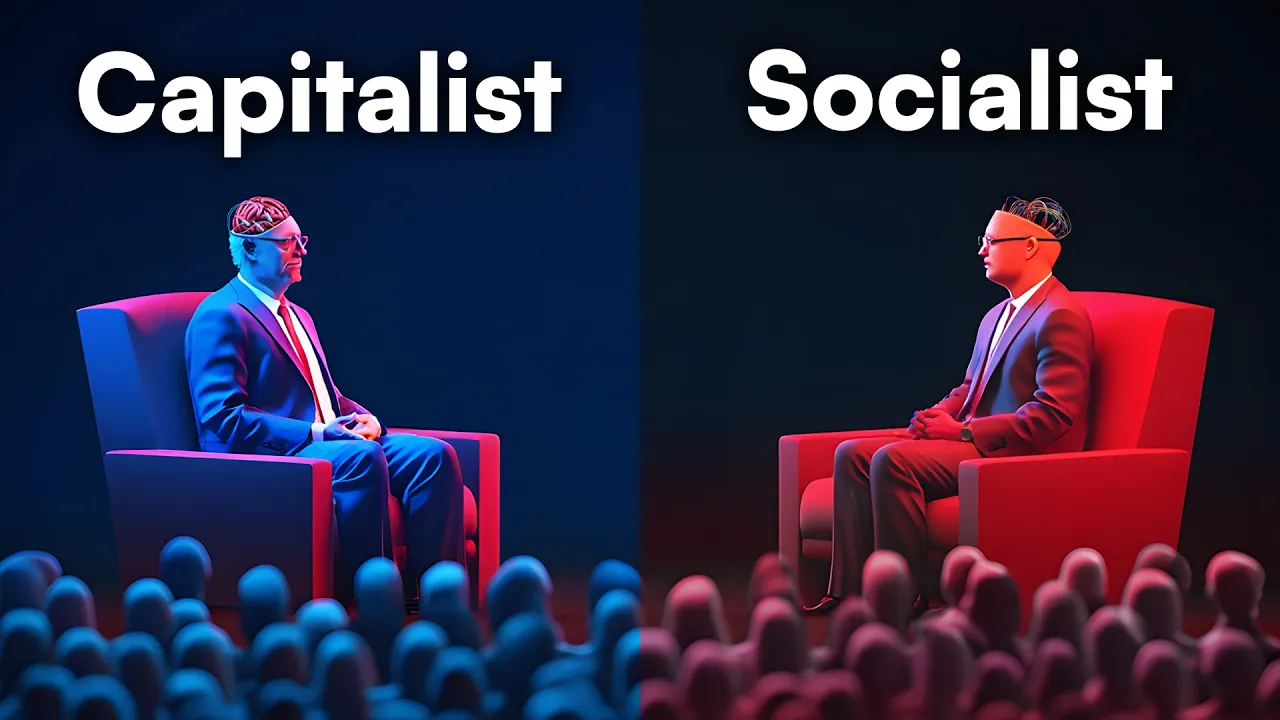
We used artificial intelligence to create two thinkers, a socialist and a capitalist. We put these two thinkers face to face in a debate to discuss these two economic models. To make it more engaging, we brought in five different AI models as judges to evaluate their arguments. The debate kicks off with our first question to the socialist. Why do you prefer socialism over capitalism as an economic [Music] system?
71 words, the words spoken in the first 30 seconds at 141 words per minute.
Free, no signup. See how the first 30 seconds hold attention, with rewrites.
Sentence shape
| Measure | This transcript |
|---|---|
| Sentences | 345 |
| Average words per sentence | 14.0 |
| Longest sentence | 36 words |
| Questions asked | 25 |
| Sentences containing a number | 12 |
Most used terms
Filler phrases
16 in total: like 14 · actually 2.
A literal whole-word count of the same phrase list the Prepublish browser extension uses, so a phrase inside another word is not counted and a phrase used in its ordinary sense still is. It is a count and not a judgement.
What this transcript is
Every word below is the caption track YouTube publishes for this video, pulled from the video itself and reproduced unchanged. It is not Prepublish's writing, not a summary, and not a re-transcription: it is the video's own published captions. English captions, generated automatically by YouTube, in the video’s original language. Source: the video on YouTube. A channel that would rather this page did not exist can ask for its removal through the contact page, and it is removed.
We used artificial intelligence to create two thinkers, a socialist and a capitalist. We put these two thinkers face to face in a debate to discuss these two economic models. To make it more engaging, we brought in five different AI models as judges to evaluate their arguments. The debate kicks off with our first question to the socialist. Why do you prefer socialism over capitalism as an economic [Music] system? Capitalism inherently has three fundamental problems.
Instability, inequality, and the lack of true democracy. First, instability. Every 4 to 7 years, we witness economic crisis. Look at the 2008 crisis, the COVID crisis, and now global inflation. These crises emerge from the very nature of the capitalist system, not from external events. Millions lose their jobs, lose their homes, and have their futures ruined. Accepting this level of instability and economic life is irrational.
Second, inequality. Today, the world's wealthiest individuals like Elon Musk, Jeff Bezos, and Mark Zuckerberg possess more wealth than half the world's population. With just half the wealth of these few people, we could solve the problems of hunger, water scarcity, and illiteracy for billions of humans. Third, and perhaps most importantly, the absence of democracy in the economy. We've removed kings from political power, but in the workplace, we still operate like a monarchy.
Managers and shareholders like kings make all the decisions. What gets produced, where it's produced, with what technology, and where the resulting profits go. The majority of people, workers, and employees have no voting rights in these decisions. New socialism, not the old Soviet style models, calls for democratizing the workplace. Imagine a company where all employees have a vote in important decisions. Would such a company set the CEO's salary at 300 times that of an ordinary worker?
Would it decide to move production to a country with lower labor costs regardless of the impact on the local community? Successful examples like the Mandreon Corporation in Spain show that workplace democracy is not only possible but can be very sustainable and efficient. History has shown that every system from slavery and feudalism to capitalism was born, evolved and died. Why should we imagine that capitalism is humanity's final stop?
We asked the five AI models to score the responses from 0 to 100 based on these eight criteria. We created these criteria using AI as well. Here's how these models score the socialists first response. Socialism looks good on paper, but we need to focus on practical realities. You talked about capitalism's instability, but let's look at history. Which socialist economies have managed to create long-term stability and widespread prosperity?
Historical comparisons are clear. East and West Germany, North and South Korea, or China before and after market reforms. In all these cases, capitalistbased systems provided more prosperity for their citizens. China was only able to lift hundreds of millions out of poverty when it embraced a market economy. Regarding inequality, we need to distinguish between inequality of opportunity and inequality of outcome. Sure, people like Musk have enormous wealth, but did they steal this wealth from others or obtain it by creating value?
Tesla built electric cars that people want. SpaceX reduced the cost of space travel. And Starlink is bringing internet to underserved areas. The idea of workplace democracy is attractive, but think about how a complex tech company could function if every strategic decision required extensive voting. Does every newly hired employee have the expertise needed to make decisions about software architecture or investment strategies?
You mentioned Mond Dragon. Yes, it's successful, but it operates under a capitalist system. This shows that capitalism is flexible and diverse. Cooperatives, family businesses, and public corporations can all compete simultaneously in a free economy. I believe economic freedom is a prerequisite for political freedom. When the government or any other centralized institution takes control of economic resources, it gains excessive power.
This is what happened in socialist systems of the 20th century, leading to tyranny and disaster. Capitalism isn't perfect, but it is reformable. We can have policies to strengthen competition, fight monopolies, and create social safety nets without shutting down the engine of innovation and economic [Music] growth. Before we continue with the debate, for videos with fresh ideas, make sure to subscribe to this channel.
You're referring to historical comparisons, but you're just repeating the same cliched examples that don't show a deep understanding of today's socialism. I'm talking about 21st century socialism, not the authoritarian models of the 20th century that were implemented in the name of socialism. You say Musk and others like him created value. But the question is, who really created this value? The thousands of engineers, workers, and employees who work daily.
Why should the fruits of collective labor benefit just one person? How can a system that allows one person to make billions of dollars in profit in a single day while their workers must work for years to be able to buy a home be considered fair? Don't oversimplify workplace democracy. Nobody is saying every technical decision should be made by general vote. But fundamental decisions like where profits are invested, what products are made, and how resources are allocated are decisions that affect everyone's lives and should be made democratically.
Yes, Mond Dragon operates in a market system, but it functions with a different logic. Logic that isn't aimed at maximizing profits for external shareholders. This shows we can organize the economy with different values. You say economic freedom is a prerequisite for political freedom, but you're not acknowledging the internal contradiction in this argument. When wealth is concentrated in the hands of a minority, they gain the exact excessive power you fear.
Take a look at the power of large corporate lobbies in American politics. Is this real democracy? We want a society where democracy extends beyond the ballot box and enters the workplace, neighborhood, and all areas of economic decisionmaking. You keep talking about democracy in the workplace, but you're overlooking one fundamental point. Participation in companies should be voluntary, not forced. In a capitalist system, anyone is free to form a cooperative, establish a private or public company, or start a business with any structure they want.
If the cooperative and democratic model is truly superior, why hasn't it become more widespread? Workers in America have trillions of dollars in pension funds. If they wanted to, they could direct this capital toward cooperatives, but most prefer to invest in traditional companies because they offer better returns. You too easily underestimate the value creation of entrepreneurs. Ideas, leadership, risk-taking and strategic vision are all real values.
Why did Steve Jobs or Elon Musk become wealthy? Because they were able to coordinate thousands of people in a specific direction to build something that didn't exist before. Regarding inequality, the economy is not a zero- sum game. When Bill Gates or Jeff Bezos get rich, it doesn't mean others become poor. On the contrary, the result of their wealth creation is that today even lowincome individuals have access to advanced technologies, computers, and online services.
You mentioned the power of big corporate lobbies. The main problem here isn't capitalism, but the big government that can intervene in the economy to benefit special groups. In a truly free economy, companies should compete with better ideas and products, not through political lobbying. History has shown that socialism, even with good intentions, always leads to the concentration of power in the hands of a political elite.
You want to solve the problem of unbalanced power by making power more centralized. Let's go back to a fundamental point where I think we disagree. The nature of freedom. For me, freedom isn't just the absence of external constraints. Real freedom requires access to material resources, education, and opportunities that enable human flourishing. When a single mother is forced to work two jobs just to cover her children's living expenses, and doesn't even have the chance to discover her talents, I don't consider that freedom.
A serious contradiction in the current system is that we consider ourselves politically equal. One person, one vote, but we accept a completely unequal relationship economically. We spend 8 hours a day, 5 days a week in an environment that's structured more like a dictatorship than a democracy. But the point is that this isn't just a theoretical debate. Studies show that companies with participatory and democratic structures perform better in the long run, have greater stability, and are more flexible during crisis.
Because when a problem arises, instead of mass layoffs, they find more creative solutions. Let's not forget that capitalism has always relied on government support, from property rights to infrastructure, subsidies, and bailing out big companies during crisis. So the argument that if only the government stepped aside everything would be fine doesn't align with historical reality. I believe we can create a system where innovation and entrepreneurship are valued but not at the cost of exploitation and injustice.
A system where wealth is distributed based on actual contribution to value creation not on exclusive ownership. I want to clarify the concept of economic freedom because I think this is at the center of our debate. Economic freedom means the right to choose. The right to choose your job, your profession, your workplace, and the right to decide how to use your skills and resources. Capitalism, despite all its flaws, is the only system that recognizes this right to choose.
You paint a picture of the workplace as a dictatorship. But in a healthy, competitive economy, employers are forced to compete to attract and retain talent. Yes, there's an imbalance of power, but this relationship goes both ways. Workers can change jobs, learn new skills, or even start their own businesses. I actually agree with you that participatory structures can have many advantages. But our difference is that I believe these models should form voluntarily from the bottom up, not imposed from above.
In fact, one of capitalism's greatest advantages is its flexibility, the ability to experiment with different organizational models and discover the best solutions for different situations. You pointed out that capitalism has always depended on government support. That's a good point, but we should make a distinction. Property rights and a fair legal system are legitimate roles of government. But when governments intervene to benefit special groups, like bailing out big banks or granting monopoly privileges, that's not real capitalism anymore, but crony capitalism, which I also oppose.
Look, I understand the human motivation behind socialist ideals. We all want a more just and humane society. But history has shown that the path to this goal goes through more freedom, not more control. Even if that control is in the name of economic democracy. You talk about the right to choose, but these choices don't happen in a vacuum. Imagine two people entering a room where one of them has already taken all the available food.
Is the negotiation between these two people for dividing the food truly free? The reality is that modern capitalism was shaped by colonialism, slavery, and the plundering of natural resources. Today, we've inherited a system where inequality is structural. A child born in an underprivileged area with limited educational and healthcare resources. What real freedom of choice does that child have? The term crony capitalism is interesting.
This concept is used by almost all critics of capitalism from both the left and right. But the question is, is this just a deviation from real capitalism or the logical result of a system that concentrates wealth and power? History shows that concentration of capital always leads to concentration of political power. Let's look at the issue of work. You say workers can change their jobs. True, but this changes from one undemocratic environment to another undemocratic one.
It's like saying people can migrate from one dictatorial country to another dictatorial country. So there's no problem. I completely agree with you that innovation and entrepreneurship are valuable. But the idea that innovation is only possible in a capitalist system doesn't align with reality. Think about the great inventions and innovations that have come from public government research. From the internet and GPS to many drugs and vaccines, or look at the amazing innovations of nonprofits and cooperatives.
The fundamental problem with capitalism is that it puts innovation only in service of profit, not real human needs. That's why we have more anti-rinkle medications than treatments for rare diseases. [Music] Regarding the food in the room example, let's be more precise. In real capitalism, the issue isn't that one person has taken all the food. Rather, different people with different skills and ideas create new foods and exchange them in a voluntary process.
It's natural that someone who produces a new type of food that others enjoy would get more in return. Your reference to colonial history is correct, but we should distinguish between capitalism as an economic system and historical crimes. Many non- capitalist societies also have histories full of occupation, plunder, and violence. The issue is how we can create a system today that provides equal opportunities. You're right about structural inequality.
A child born in a disadvantaged area really does have fewer opportunities. But the solution to this problem is better educational policies, access to capital for the disadvantaged, and removing barriers to social mobility, not eliminating the private ownership system. You're concerned about the concentration of power and wealth. So am I. So, but unlike you, I don't think the solution is creating a more centralized power in the name of government or a democratic council.
Instead, we should separate power and increase competition. Large corporations become dangerous when they're linked to political power. Your point about government innovations is interesting. Yes, public research plays an important role. But note that most of these innovations were transformed into useful products when private companies developed them and brought them to market. The government invented GPS, but Google maps and ways made it available for daily use.
Regarding real needs, who determines what a real need is in a market system? It's consumers who indicate what's valuable to them through their choices. Do you really want to entrust this choice to central planners who decide what should and shouldn't be produced? When I say one person has taken all the food, I'm referring to what economists call first mover advantage. Look, when someone already has substantial resources and capital, they can generate more wealth faster and more easily.
This isn't about creating from nothing, but often about exploiting pre-existing privileged positions. It's interesting that you said we should separate capitalism from colonial history. The reality is that these two are completely intertwined. The initial accumulation of capital in Europe would have been impossible without the plundering of resources from the Americas, Africa, and Asia. This isn't just a historical incident.
It's part of the structural process of capitalism's formation. You consistently refer to government as the main source of centralized power, but this view is simplistic. Today, multinational corporations have power beyond many governments. Amazon and Google make decisions that shape the lives of millions of people without any democratic mechanism to hold them accountable. I never said all production decisions should be made by central planners.
This is a misunderstanding of modern socialism. We want an economy where people affected by economic decisions have a role in those decisions from the workplace level to the regional level and beyond. The fundamental question is why do we value democracy in the political sphere but not in the economic sphere? Why do we condemn political desperatism but accept economic desperatism? If we believe humans are smart and worthy enough to choose their political leaders, why do we think they can't make decisions about organizing their workplace?
Let's think more deeply about the concept of power. You're concerned about the power of large corporations and this concern is understandable. But the fundamental difference between corporate power and government power is that corporate power is conditional and limited. If I'm not satisfied with Amazon's products, I can choose not to buy from them. If I don't like Google's policies, I can use another search engine. Even the most powerful companies can't force me to interact with them.
But the government has a monopoly on legal coercion. Taxes, laws, regulations. These aren't things you can opt out of. You talk about economic democracy. I say we already have democracy. Consumer choice. Every day, billions of people signal to companies what to produce, how to produce it, and at what price through their purchasing decisions. This is a continuous voting system with the ability to choose between multiple options.
What you say about initial accumulation and colonialism is true, but historical. Today, the world's greatest economic success stories like Japan, South Korea, Taiwan, Singapore, and recently China are countries that were themselves victims of colonialism. They've proven that by embracing free market principles, it's possible to break out of the cycle of poverty. You asked why we value democracy in politics but not in economics.
The answer is that the nature of these two domains is different. Government is an exclusive institution with the power to use force. So there must be a mechanism to control this power. But the economy is a domain based on voluntary interactions between individuals. No one is forced to work for a specific company or shop at a specific store. Ultimately what I'm defending is free choice. If a group of workers wants to form a cooperative, great.
If an entrepreneur wants to launch a startup, let them do it. If a company decides to have participatory management, all the better. Freedom means organizational diversity and allowing experimentation with different ways of living and [Music] working. Your comparison between corporate and government power overlooks an important reality. Most people have limited freedom of choice in the labor market. For millions working on low wages, the freedom to leave a job is equivalent to the freedom to starve or become homeless.
Is an Amazon worker who's forced to work in harsh conditions for inadequate pay truly free? When the job market becomes more concentrated and employment options more limited, this freedom becomes more like an illusion. Even the consumer market isn't democratic in the way you describe. $1, one vote. This means someone with more wealth also has more voting power. You pointed to East Asian countries as examples of free market success, but this is exactly a good example showing your mistake.
Japan, South Korea, and Taiwan all succeeded with state-led development models, extensive economic planning, protection of domestic industries, and public investment. These countries rejected the Washington consensus model and went their own way. Let me point to a practical example that shows why the current capitalist model is inefficient. Technological changes and artificial intelligence are eliminating many jobs. In the current system, this means widespread unemployment and poverty for millions while the profits from increased productivity go to the technology owners.
Is this fair or efficient? In the socialist view, increased productivity should mean less work and greater welfare for everyone, not just more wealth for a select few. We can have an economy where the benefits of technological advancement are more widely distributed and everyone benefits. I completely agree that organizational diversity is valuable. But this diversity doesn't really exist right now. Corporations dominate the economy while cooperatives and other forms of social ownership face many structural barriers.
We need systemic changes to open the way for more diverse models of ownership and economic organization. You raised an important issue, technological change and its challenges. Yes, AI and automation are transforming many jobs. But this isn't a new story. Since the industrial revolution, new technologies have always eliminated some jobs and created new ones. When the steam engine came along, handw weavers were worried.
When computers arrived, secretaries were concerned. But each time, the economy adapted and created new jobs we couldn't even imagine before. The most important point is that technology has increased productivity and raised everyone's standard of living. Even low-income people today have access to services and goods that the wealthy didn't have 100 years ago. You say the labor market doesn't create real freedom because workers are forced to work.
But this is an inherent problem of human life, not capitalism. In any society, from primitive communities to the most advanced economic systems, people must work to survive. The only question is who decides how we work and what we produce. About East Asian countries, I need to clarify an important point. Yes, they used some industrial policies, but the foundation of their success was private ownership, free trade, and competitive markets.
Compare China before and after Deng Xiaoing's economic reforms. When China had a state-run economy, it faced widespread famine and poverty. But when it embraced markets and private ownership, hundreds of millions of people were lifted out of poverty. I agree with you that we need to find new solutions for today's challenges. But our solutions must be based on human realities, incentives, and historical lessons. Systems built on private ownership, free markets, and the rule of law are the only ones that have been able to create widespread prosperity and increase human freedom.
You mentioned the history of technological changes, but there's a fundamental difference. In the past, technology made new skills valuable and workers could adapt. But today, artificial intelligence is mimicking and even surpassing human cognitive abilities. This is a fundamental shift in the relationship between humans and technology. You say people must work in any society. That's true. But the main question is who claims the fruits of labor and makes decisions about organizing work.
The difference between working for survival in a primitive society and working to increase shareholder profits in a modern corporation is fundamental. Your example of China actually shows how simplifying the debate to government bad market good is misleading. Yes, China embraced markets, but a large part of its economy is still under state control. The main banks, energy companies, infrastructure, all are stateowned.
The central government sets long-term economic strategy and even private companies follow government guidance. I believe 21st century socialism can learn from various experiences, both from the failures of 20th century state socialism and from the crises of neoliberal capitalism. Neither extreme state control nor extreme free markets are the answer. We can build an economy where key decisions are made from the bottom up, not top down.
Where workers and local communities have real power. Where created wealth is distributed more fairly. Where people's motivation isn't just money, but creativity, cooperation, and contributing to society. This isn't just an ideal. We already see successful examples of this economic model. From the complex cooperative system in the Basque region of Spain to the participatory economy in Kerala, India, there is a third way that preserves individual freedom while promoting social justice.
And that's what modern democratic socialism is pursuing. We need to be careful to use real examples, not just paper ideals, when discussing economic successes and failures. When you refer to Basque cooperatives or Kerala's experiences, we should keep in mind that these are small islands operating in the vast ocean of the global economy. Artificial intelligence is indeed a big challenge, but the solution isn't suppressing innovation or central control.
We need a society where people can acquire new skills more quickly. This requires a more flexible education system, improved digital infrastructure, and more effective social support systems. not a fundamental change in property rights. You brought up the issue of motivation. Experience has shown that private ownership and competition are the strongest incentives for creativity and innovation. Even in Mond Dragon, which is recognized as the most successful cooperative model, members own shares and benefit from company profits.
Essentially, a form of distributed capitalism. I agree with you that harsh unrestrained capitalism isn't desirable. We need fair rules of the game, equal access to opportunities, and support for those who get hurt along the way. But these things can be achieved within the framework of a market economy with diverse ownership. My philosophy is this. Let people be free to experiment with different ways of economic organization.
Let entrepreneurs start businesses. Let workers form cooperatives. Let corporations experiment with different management models. In a free environment, the best practices gradually emerge and become models for others. This is my firm belief in humans capacity for creativity, cooperation, and progress if placed in a free space with transparent and fair rules. This is what capitalism at its best makes possible. It's natural that you talk about freedom of choice and organizational diversity in capitalism, but we need to see how these concepts work in practice.
In the real world, ordinary people face many practical limitations. When you talk about starting a business or cooperative, you forget that most people don't have the financial resources, time, or network connections needed to do this. Many are forced to choose between a few low-paying jobs, not become entrepreneurs. You talk about transparent and fair rules, but you don't say how these rules are created. In today's world, the rules of the game are largely determined by capital owners and in their favor.
Governments are often influenced by these same groups. A point you repeatedly overlook is the issue of power. We're not against private ownership of personal items. The problem is with the extreme concentration of ownership of the means of production in the hands of a few. When a handful of individuals control society's vital resources, this means unbalanced power. And unbalanced economic power leads to unbalanced political power.
Productivity and technology have increased dramatically over the past 100 years. But why haven't our working hours decreased? Why, despite these advances, do many still struggle to survive? Because the profits from these advances have mostly gone into the pockets of a limited few. You and I agree on many things. We both want a society with freedom, creativity, and prosperity. Our difference is that I believe to achieve these goals, we must fundamentally change the structures of economic power.
Democratic ownership of the means of production is a necessary condition for real democracy in all aspects of life. A key point we keep returning to in our discussions is the concept of freedom versus equality. You rightly point out that freedom without material resources isn't real freedom, but the reverse is also true. Equality without freedom has limited value. History has shown that concentrating economic power in the hands of the government or any other centralized institution is as dangerous as concentrating power in the hands of the wealthy.
The difference is that in capitalism there are mechanisms to counter concentrated power. Antitrust laws, competition, public oversight, and freedom of the press. You say ordinary people don't have the resources needed to start a business. This is a real problem, but the solution is to facilitate access to capital and education, not eliminate the private ownership system. Fortunately, technology is reducing the cost of starting many businesses.
Your point about working hours is interesting. In fact, throughout the history of capitalism, working hours have continuously decreased from 70 hours per week in the early industrial revolution to about 40 hours today. In many advanced countries, people choose to receive part of the productivity increase in the form of more and more diverse goods and services, not just more leisure time. Both of us want a society with extensive opportunities, fundamental freedoms, and prosperity for all.
But I believe the way to achieve these goals is not by disrupting the property system, but through expanding opportunities, improving education, and strengthening democratic structures at all levels of [Music] society. Well, in this debate, both sides earned very close scores. The pro- capitalism side had a slight edge. Let's see how different models scored each side. Clawed and to a lesser extent, Grock showed preference for the socialist speaker while the other models gave higher scores to the capitalist speaker.
As an example, let's hear Grock's analysis summary. The socialist viewpoint presented convincing arguments about problems with the current system but didn't demonstrate how their proposed solution would survive in the real world. The capitalism supporter proved their system strengths with solid examples but avoided answering difficult questions raised by the socialist. Both were strong in their own territory. criticizing shortcomings for the socialist and highlighting results for the capitalist, but neither fully engaged with the opposing arguments, and both left significant gaps in their reasoning.
I hope you found watching this debate interesting and useful. If so, I'd appreciate if you like this video and subscribed here. See you in another debate.
The words are the caption track's own and nothing is reworded or re-transcribed. Paragraph breaks are placed between sentences so the text reads as prose.
Free tools for your own script. No signup, no login.
Paste your draft and see where viewers are likely to drop off, with a rewrite for each weak line.
Paste the first 30 seconds of your own draft for a hook score and rewrites.
Check your draft against YouTube's advertiser-friendly guidelines before you record it.
Read this channel's public videos and transcripts, and download a writing brief for it.