Getting the transcript
Reading the captions from YouTube. A video nobody has opened here before takes 10 to 30 seconds; this page fills in on its own.
Getting the transcript
Reading the captions from YouTube. A video nobody has opened here before takes 10 to 30 seconds; this page fills in on its own.
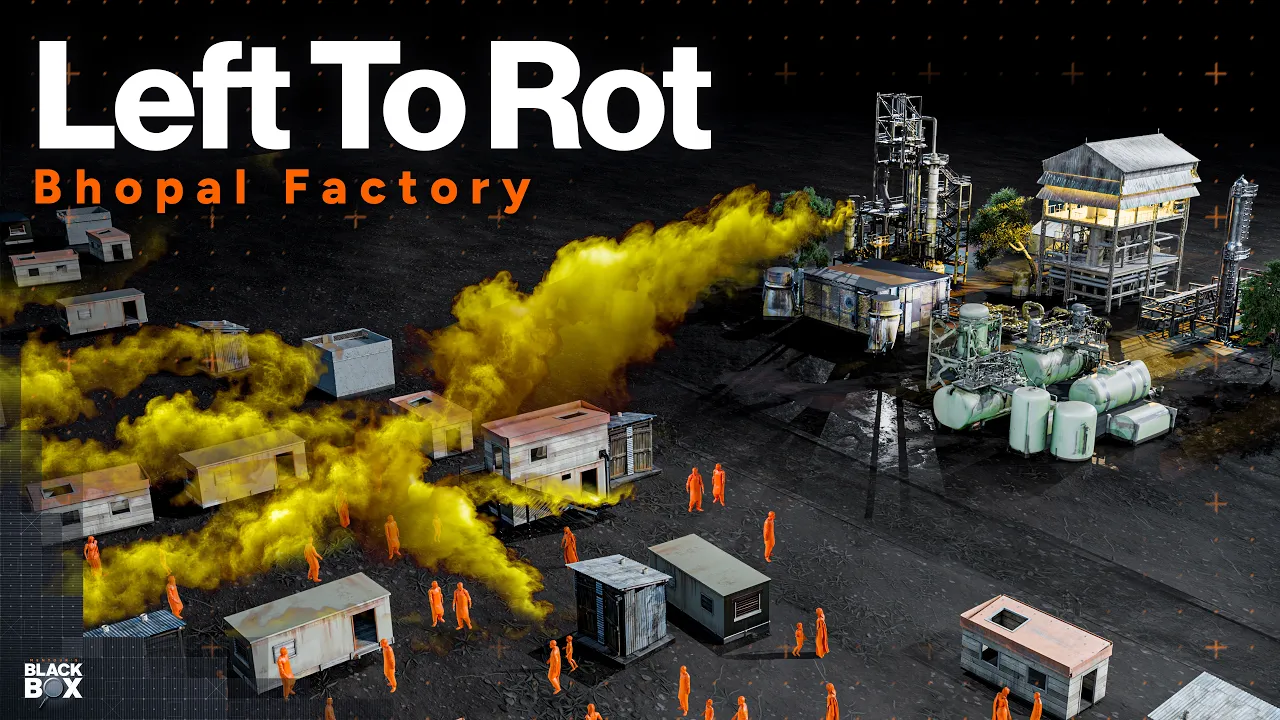
Mentour's Black Box · @MentourBlackBox
Words
6,678
Runtime
48:28
Speaking pace
138wpm
Reading time
28min
138 words per minute, below the 160 25th percentile of 349 measured videos. That distribution comes from the 349-video hook study.
Opening (first 30 seconds)
The time is almost 3:00 in the morning on December 3rd, 1984 and the location is Bal Central India. Young filmmaker Ash Chichre is asleep beside his pregnant wife Rohini when a noise from the street jolts him awake. Ashay opens the window to see what's happening and immediately a mysterious choking cloud rushes in completely filling the room. Within moments, their eyes are burning and both are struggling
69 words, the words spoken in the first 30 seconds at 138 words per minute.
Free, no signup. See how the first 30 seconds hold attention, with rewrites.
Sentence shape
| Measure | This transcript |
|---|---|
| Sentences | 405 |
| Average words per sentence | 16.5 |
| Longest sentence | 72 words |
| Questions asked | 14 |
| Sentences containing a number | 101 |
Most used terms
Filler phrases
46 in total: actually 18 · like 8 · right? 8 · basically 5 · you know 4 · kind of 2 · I mean 1.
A literal whole-word count of the same phrase list the Prepublish browser extension uses, so a phrase inside another word is not counted and a phrase used in its ordinary sense still is. It is a count and not a judgement.
What this transcript is
Every word below is the caption track YouTube publishes for this video, pulled from the video itself and reproduced unchanged. It is not Prepublish's writing, not a summary, and not a re-transcription: it is the video's own published captions. English captions, generated automatically by YouTube, in the video’s original language. Source: the video on YouTube. A channel that would rather this page did not exist can ask for its removal through the contact page, and it is removed.
No Script X-ray for this video: YouTube shows a Most replayed graph only once a video has enough views.
The time is almost 3:00 in the morning on December 3rd, 1984 and the location is Bal Central India. Young filmmaker Ash Chichre is asleep beside his pregnant wife Rohini when a noise from the street jolts him awake. Ashay opens the window to see what's happening and immediately a mysterious choking cloud rushes in completely filling the room. Within moments, their eyes are burning and both are struggling to breathe. You know, usually when you wake up to a weird smell in your house, your first instinct is to open all the windows and get outside into the fresh air.
And Aay had the same instinct. But unfortunately, there was no relief to be found outside. only chaos. Once the couple was outside, people were running in every direction, desperately looking for help, but nobody was able to tell which way was safe. As Aay and Rohini thread their way through the chaos, they notice people are dropping to the ground around them, suffocating to death. About a half a kilometer away, the terrified couple finally reaches a local college, the SV government polytenic.
And with Roini being 7 months pregnant and struggling to breathe, she can't take another step. They have no choice but to take refuge inside. The entire city of Boal was trapped beneath a massive cloud of poison gas. But what was it exactly? And how did it get there? It turns out there was one very obvious suspect. On the northern edge of the city stood a large chemical factory that manufactured pesticides. It would take hours, some accounts say days before Union Carbide India, the plant's operators, confirmed what the poisonous cloud actually was.
Methyl is cyanate, or MIC for short. one of the most reactive and acutely hazardous industrial chemicals ever manufactured. You know, it's actually quite difficult to overstate just how toxic mic is. Let's take hydrogen cyanide for instance, one of the world's most infamous and fast acting poisons. NYOSH considers an atmosphere containing just 50 parts per million of hydrogen cyanide to be immediately dangerous to life or health.
Now for mic that threshold is just three parts per million 17 times less than hydrogen cyanide. And that night in Boal, roughly 40 tons of mic escaped into the air, forming a dense groundhugging cloud that poured through the streets, alleys, and homes of Bal's most densely populated neighborhoods. Before we go any further into the horror of the accident itself, we really need to understand what this chemical plant actually was. because the reason it existed and the way it was built are central to why this catastrophe unfolded the way that it did.
Union Carbide Corporation was an absolute giant. By 1984, it was the third largest chemical company in the United States and the country's 37th largest industrial corporation with hundreds of facilities spread across 37 countries. It was one of the world's largest producers of prochemicals, plastics, industrial gases, metals, minerals, and specialty chemicals. It also owned Energizer and Ever Ready, making it the world's largest producer of dry cell batteries.
During World War II, it was involved in the Manhattan Project, which, if you're unfamiliar, is the project responsible for the development of the first atomic bomb. And after the war ended, Union Carbide operated the enormous K25 uranium enrichment facility at Oakidge, Tennessee. And later many other government nuclear facilities involved in uranium enrichment, weapons component production, and research. So to put it plainly, Union Carbide was an industrial giant with its hands in almost everything, and pesticides were only a small corner of that empire.
One of those pesticides was called seven, a product built around a chemical called carbburil and developed by Union Carbide in the late 50s. And in India, that timing was actually perfect because the country was right in the middle of its green revolution, which was an enormous effort to increase agricultural yield and help India produce more of its own food. And as you can imagine, the green revolution created a huge market for agricultural chemicals, including pesticides.
So seizing this opportunity, Union Carbide commissioned a pesticide factory in Boal through its longestablished Indian subsidiary, Union Carbide India Limited, or UCIL. The factory opened in 1969 and for almost 10 years it actually imported the finished chemical ingredients including mic and then it just mixed them into the various products. But in 1979 that process changed. In an effort to save money, the plant was upgraded to manufacture mic onsite.
And that decision is really where this whole story begins because manufacturing carbburel locally also meant manufacturing and storing methyl isocyanate in bulk. Now let's talk a little bit about what mic actually is because you need to know the chemistry to understand why storing it in bulk was a terrible idea. MIC is an organic compound molecular formula CH3 NCO and it's part of a family of chemicals called isocyanates which are known for being extremely reactive.
MIC can react with almost any chemical including itself and the extreme reactivity comes from its isocyanate group which is highly electrofilic meaning that it very happily bonds with electronrich molecules. Some common examples of electronrich molecules are water and alcohols. But also, MIC aggressively reacts with the biomolecules that make up our living cells, damaging proteins and disrupting the basic machinery that keeps those cells alive.
It wouldn't be a good pesticide if it didn't have that wonderful characteristic. At just 20° C, mic has a vapor pressure of only 6.7 psi or about half an atmosphere. So in other words, even at ordinary room temperature, mic is already evaporating aggressively, producing a substantial amount of vapor above its liquid. And as its temperature rises, that vapor pressure rises rapidly with it. So the hotter it gets, the easier the transition into a gas.
So basically in its natural state, this stuff just wants to kill everything and it requires constant active sedation to keep it from killing everything. If you're someone who spends a lot of time in backtoback meetings or conferences, give me just over a minute and this could change the way that you work. This is the Plaude Note Pro, the sponsor of today's video. It's basically a second brain for your meetings. You press record and it captures the conversation so you can focus on whatever is being said.
And if something important comes up, you press again to highlight that moment, making it easier to find later. It can pick up voices from up to 5 m away and record for up to 50 hours on a single charge. So, it's built for even the busiest working weeks. And afterwards, Plaude turns everything into a transcript, structured summary, key insights, and clear action points. But Ask Plaude takes it a step further. Say you're pulling together a launch strategy from three different prep meetings.
Instead of going back through every single recording, you can simply go into the app and ask, "What decisions have we made so far?" And Plaude will pull together all the relevant information for you. And because this is sensitive stuff, PLA meets major compliance standards, including SOC2, GDPR, and HIPPA. Always get everyone's consent before recording. It also comes with this great magnetic case that you can just put on the back of your phone, making it super slick.
You don't got to carry around multiple things in your pocket. I love that kind of stuff. Blackbox viewers get 10% off Plaid Note Pro. Just scan the QR code or use the link in description and enter code blackbox at checkout. There's also a 30-day return policy if you want to just give it a try. Thanks to Plaude for sponsoring this video. One of those primary sedation methods was actually Union Carbide's storage system which was designed to keep mic very very cold.
So, a dedicated 30ton refrigeration system circulated the mic through a heat exchanger with the goal of keeping it around 0° C. So, cooling the chemical obviously moved it further away from its boiling point. That's a good thing, right? That's what we want. But just as importantly, it lowered the vapor pressure inside the tank. Meaning that less mic was constantly trying to escape into the gas phase. So that refrigeration system was in a sense the leash on an extremely aggressive dog.
You remove the leash and you've taken away one of the main things, keeping its behavior under control. Now, one particularly nasty reaction that mic has is with liquid water. The moment water meets mic, the highly reactive isocyanate group forms an unstable intermediate substance that almost immediately breaks down into methylamine and carbon dioxide. The methylamine that has just been produced is itself extremely reactive with mic.
The methylamine and mic reaction produces a chemical called dimethylura. And dimethyl ura still contains reactive groups. So it reacts even more with mic producing yet another chemical called trimethylburiate. Each of these three reactions is strongly exothermic. That means that they produce energy usually in the form of heat. But we're not done yet. As the mic grows hotter, it starts reacting with itself. the MIC molecules start reacting with one another, joining together in a process known as self-polymerization.
And as you may have guessed, this reaction is also exothermic. So now when we zoom back out, we can see that with all of these reactions taking place at the same time, a very dangerous loop is created. The hotter the MIC becomes, the faster those reactions proceed. And the faster those reactions proceed, the more heat they generate. This is what's known as a runaway exothermic reaction, which is something that we've actually talked about before on this channel when we talked about the Bayroot port explosion, where ammonium nitrate underwent explosive thermal decomposition.
You can check out that video after this one if you want to learn more. So, a runaway reaction is basically exactly what it sounds like. It's a self-acelerating chemical feedback loop in which the reaction begins generating heat faster than the system can remove it. Generally, that's not a good thing. So, unless something comes in and interrupts that cycle, the temperature will continue to climb until all the reactants are exhausted.
So the obvious takeaway here is whatever you do, keep water away from mic. And one of the most effective ways to do that is with nitrogen. The empty space above the liquid mic in the storage tanks was kept filled with dry inert nitrogen and maintained at a slight positive pressure. So basically that means that the tank was always gently pushing outward making it much harder for humid air, moisture or any other contaminant to work their way inside.
So in effect the nitrogen formed an invisible protective layer of sorts, right? A cushion around the mic, keeping the atmosphere out and the dangerous chemical inside, isolated from the things most likely to set it off. Now, at the time of the disaster, the MIC was stored as a liquid in three massive horizontal tanks built from type 304 stainless steel and partially buried in reinforced concrete casing. Like I said, the three storage tanks were pretty enormous, each measuring about 2.4 m in diameter and 12.2 2 m long with a nominal capacity of 15,000 US gallons or roughly 56,800 L.
Imagine a full-size school bus for a close comparison. Two of the tanks, E610 and E611, were the working tanks. And there was a third tank, an identical tank, E619, but its job was completely different. E619 was meant to be kept empty. It was another safety measure and it was held in reserve specifically so that if anything ever went wrong with the other two tanks, the contents could be pumped somewhere safe. And additionally, as another built-in safety margin, the working tanks were never supposed to be filled beyond half of their capacity.
That meant that no working tank should have held more than about 28,400 L of MIC at any one time. But on the night of our story, tank E610 alone held roughly 43,000 LERs or about 42 tons of liquid mic. Tank E611 held another 22,000 L or about 21 tons. And the reserve tank, which was supposed to be empty, actually wasn't. It contained at least another 1.1 tons of offspec MIC. Altogether, that is roughly 64,000 kilograms or 141,000 pounds of one of the most hazardous substances ever produced at an industrial scale sitting inside a densely populated city.
Now, some of you may be wondering why store such enormous quantities of mic in the first place. It's a good question, right? MIC wasn't the product that the factory was selling. It was only an intermediate, you know, just an ingredient. In principle, the plant could have just produced mic in very small quantities as it was needed, you know, and fed it directly into the next stage of production. Seems pretty reasonable.
In fact, this is a pretty commonly used strategy in chemical production. It's called minimization. So, instead of trying to contain a huge hazard with several layers of protection, you just reduce the amount of hazard that exists in the first place. and you only produce what is immediately needed by production. Safety pioneer Trevor Klitz summed this up pretty well when he said, "What you don't have can't leak." And ironically, someone inside Union Carbide itself appears to have raised this exact concern before the plant was even built.
Former managing director Edward Munoz later testified that he had argued against bulk mic storage and recommended only small token quantities. But according to Munoz, that recommendation was unfortunately overruled and Bal was instead equipped with three enormous mic storage tanks. I guess you could say it's kind of a compromise because if you remember there was supposed to be this massive demand right driven by that green revolution all across India but unfortunately that market never really materialized.
Severe drought left many Indian farmers with less money to spend while cheaper locally produced pesticides and newer competitors began eating into sevens market. So the Bullpaul plant had been designed to produce more than 5,000 tons of MIC based pesticides a year, but by 1984 it was producing less than a quarter of that. So clearly the plant was losing money. And with the future increasingly uncertain, management began looking for ways to cut costs.
Over the next two years before the disaster, total staff at the plant fell from 850 down to 642. The MIC unit's operating crew was cut from 12 people down to six, and its dedicated maintenance staff went from 6 down to two. Experienced MIC operators disappeared, and their places were increasingly filled by workers transferred from other units with far less training for the job. And all this was happening at a plant that already had a pretty troubling safety record.
In December of 1981, a worker named Muhammad Ashraf Khan was doing maintenance on a pipe carrying fosgene, a highly toxic intermediate chemical used in making mic and coincidentally a chemical weapon from the First World War. when he was accidentally splashed with it. In a panic, he tore off his gas mask and inhaled a large quantity of it directly. He died three days later. And that wasn't the last incident. Not by a long shot.
In January of 1982, a Fosgene leak sent 24 workers to the hospital because, of course, none of them had been wearing the protective equipment that they should have been. Now, that specific leak in 1982 was traced back to a seal failure in the refrigeration pump. And rather than fix that seal, management's response was to shut down the entire refrigeration system completely. That system remained offline for almost 3 years, all the way up until this accident.
There goes the leash. Because if you remember, mic will begin to vaporize at a pretty low temperature. So it is critical to keep the mic cool, very cool, and in a liquid state. That's what the refrigeration system was for. And then later that same year, 1982, another MIC leak burned a chemical engineer over 30% of his body. And in October, yet another leak caused a supervisor severe chemical burns while trying to stop it. and exposed two other workers badly enough that they needed medical treatment.
That May, Union Carbide's own American engineers had actually audited the plant and found 61 separate hazards, 30 of them being defined as a major hazard. In fact, this internal audit identified the catalyst that would eventually cause the tragedy 2 years later. So, Union Carbide really had no excuse, right? because they already knew about the risk and they already knew what MIC operation was supposed to look like. Because at Boal's sister plant in West Virginia, many of the safeguards that Boal lacked were already in place.
Now, back in Boal, one person had been trying to warn the public directly in print for years was a local journalist named Rajkumar Kashwani. He had a friend at the plant. It was the same Muhammad Ashraf Khan who died from that fosene exposure that we mentioned earlier. So after his death, Kashwani spent nine months investigating and on September 26th of 1982, he published the first in a series of warnings in a local newspaper called Rapat.
The headlines he came up with were quite chilling. The first one was, "Please save this city, sir." Another was, "Bo Paul is sitting on the brink of a volcano." And then another, "If you don't understand, all will end." He returned to the story again on October 1st and October 8th. And then once more in June of 1984, just 6 months before this disaster, but despite Kashwani's warnings and investigation, neither Union Carbide India nor the state government opened an investigation.
Now let's come back to December 2nd, 1984, which was the day before disaster when workers had begun the process of clearing a blocked pipe near the mic storage unit by pumping large amounts of water through it. It's a pretty straightforward process, and when it's done correctly, it's a very effective solution to a blocked pipe. Around 9:30 p.m., work began on the blockage. And normally during a flush, excess water should drain out through bleeder valves elsewhere in the system, but those were likely at least partially clogged.
So the water began backing up through the pipe work, creeping toward the stored mic. Now, to make sure that the water didn't reach the mic, workers had actually closed an isolation valve about 300 m upstream of the tanks. But here's the fun part. Those valves had a known history of leaking. The standard fix for this was something called a slip blind, which is a solid metal disc bolted straight into the pipe, creating a physical barrier.
It's pretty simple, but the best engineering solutions are almost always the simplest. Now, installing a slip blind actually requires a maintenance supervisor to sign off on it. All right, simple enough? Not exactly because that role had been eliminated as a cost cutting measure. Now some of you might be saying even without the slit blind shouldn't the positive pressure from the nitrogen inside the tank keep the water out?
And the answer is yes it should. That is if it was actually pressurized properly. It turns out that just a few weeks before the disaster, the nitrogen pressure inside tank E610 had dropped to just 20% of normal. The pressure drop was likely a result of a defective valve. And of course, workers hadn't managed to restore it yet. So without that pressure, there was nothing left standing between the backflowing water and the mic in the tank.
And not only that, losing the nitrogen pressure in tank E610 made the reserve tank effectively useless because that nitrogen pressure was the plant's way of forcing mic through the transfer piping. And this improvised method was only implemented after the dedicated transfer pumps proved chronically unreliable because of leaks. So, I hope you've stayed with me so far, but just in case, let's do a quick recap. The factory was built around bulk mic storage, even though safer alternatives existed.
Its operations and maintenance staffing had been totally gutted to save money. Storage tanks were filled beyond the 50% maximum limit. The reserve tank wasn't empty, and even if it had been, the working tanks could no longer reliably transfer their contents into it. The refrigeration system was shut down. The nitrogen blanket and positive pressure were gone. The isolation valve was leaking. The slip blind was never installed.
And none of the warnings, internal audits, outside investigations, or the very real accidents that had injured and killed workers had been enough to force the system back into a safe state before catastrophe struck. The time is now 10:45 p.m. Now, by this point, water had been flowing through the pipe work for more than an hour, and the evening shift was beginning to hand over to the night crew. Everything still looked pretty routine, except for one thing.
One of the workers noticed that the pressure inside tank E610 had climbed from roughly 2 PSI to around 10 PSI, a five-fold increase. But that alone wasn't enough to set off alarm bells. I mean, at a normal plant, it would be, but the instruments at this plant in Boal were notoriously unreliable with gauges that often corroded or became clogged by deposits. bad readings were actually quite common. So, the pressure increase was treated exactly that.
Probably just another bad instrument. Right by 11 p.m., the night shift had arrived and 500 L of water had found its way into tank E610. And based on what we learned earlier, you can imagine what was going on inside that tank. The instant water came into contact with the mic, it began to hydraize, releasing massive amounts of heat and pressure. Now, under normal circumstances, that pressure had two possible routes out of the tank.
The first was the processed vent header or PVH, which was the normal low pressure vent system used to handle the small amounts of mic vapor produced during ordinary operation. And the second was the relief valve vent header or RVVH. This was the emergency system. E610's rupture disc and pressure relief valve were connected to this line. And if pressure inside the tank became dangerously high, they would open automatically and dump the tank's vapors into the RVVH.
Originally, the PVH and RVVH were completely separate. But at some point before the disaster, workers had actually installed a temporary jumper line connecting the two headers reportedly so that one could be used while maintenance was being carried out on the other. And this jumper line would become critically important during this night because the water that ultimately entered E610 approached the tank through pipe work connected to RVVH where the rupture disc blocked it from entering the tank.
It then crossed through the jumper into the PVH and from there it had a clear route toward the tank. Okay, so both the PVH and the RVVH were connected into the plant's gas disposal system. At the heart of which was something called the vent gas scrubber or VGS. The scrubber was this giant chemical washing tower of sorts with thousands of ceramic pieces constantly sprayed with a circulating solution of costic soda or sodium hydroxide. toxic gas entered the tower and was forced through this enormous wet surface.
So as MIC came into contact with the costic solution, it reacted chemically and was destroyed before it could reach the atmosphere. So if everything was working as it's supposed to be, whatever gas emerged out of the top of the scrubber should have little to no mic remaining. At around 11:30 p.m., workers began noticing something they could no longer blame on a malfunctioning instrument. Their eyes were starting to water.
MIC gas was in the air. A few workers had gone to go look for it, and near the mic structure, they found a dirty liquid dripping from the pipework accompanied by a faint yellowish white vapor. at approximately 11:45 p.m. That leak was actually reported to the night shift supervisor, but his decision was to deal with it after a scheduled tea break coming up at 12:15 a.m. That terrible decision bought the reaction another half hour.
And inside E610, every minute mattered because a runaway reaction doesn't progress at a constant speed, right? It accelerates exponentially. So every minute lost is more consequential than the minute before it. So over the next half hour, the temperature inside E610 continued to increase as the reaction accelerated. The tank was effectively becoming an energy producing reactor. At 12:15 a.m. the tea break began, but it didn't last very long.
And I should hope it wouldn't because a worker checked the instrumentation for E610 and the temperature gauge had reached 25° C which was the top of the scale. The pressure was also climbing rapidly toward 40 PSI about to the point at which the emergency relief system was expected to open. Clearly something was obviously wrong. So the worker went out to investigate. As he stepped onto the massive concrete slab covering the buried storage tanks, he could actually feel it moving beneath him.
From underneath came the sound of violent, chaotic boiling, like a volcano ready to pop. The concrete began to crack. Heat was radiating up from the tank so intensely that the worker had to back away and could no longer approach it safely. And back in the control room, the pressure indicator had gone beyond 55 PSI, which is the maximum the gauge could read. So whatever the actual pressure was, the instrument could no longer tell them.
And finally, the rupture disc burst and the emergency relief valve opened. The rapidly expanding gases inside E610 now had a much larger escape route, rushing into the relief valve vent header and toward the vent gas. disposal system. So, that's good news, right? The vent gas scrubber should now neutralize the mic before it ever gets a chance to escape the plant, right? Nope. Because, of course, the vent gas scrubber had been taken out of normal operation and was sitting in standby after mic production stopped in October.
So when workers tried to bring the scrubber online that night, there was no indication that the costic solution had begun circulating. The flow meter stayed at zero. And to make matters even worse, workers couldn't even say with confidence how strong the costic solution still was. Its concentration apparently had not been analyzed since October. And even if the scrubber was online, it was never designed to deal with anything remotely close to the volume of gas that was now coming out of E610.
The normal flow rate that that scrubber could handle was 86 kg hour. But during the incident, the peak flow was likely as much as 1 ton per minute. So, even a perfectly functioning scrubber might have reduced the amount released, but it would have never stopped it. Okay, no scrubber. But there's still hope, right? The scrubber isn't supposed to be the last line of defense. Anything that did make it through the scrubber should be caught by the flare tower.
Now, a flare is essentially a controlled industrial burner where vent gases are piped to the top of a tall stack, mixed with air, and ignited by a continuously maintained pilot flame, essentially neutralizing any threat. So, even if the scrubber couldn't catch everything, the flare offered one final opportunity to prevent mic from escaping. I think we're far enough into the story that you probably know what's coming, and that's that the flare tower wasn't available either.
The flare system had been under maintenance since November 25th. A section of the flare vent piping had been completely removed, leaving the tower physically disconnected from the mic disposal system. And very similar to the scrubber, even if the flare tower was operational, it was not designed to handle the volume of gas spewing out of E610. Union Carbide's own works manager Jay Mukund when asked afterward whether the flare could have disposed of the roughly 40 tons released from E610 he said the tower had been intended for comparatively small flows a few hundred L an hour and that trying to force the accident scale discharge through it would have produced a massive combustion event and in his assessment would have caused the flare tower to completely collapse. apps.
So, by this point, the situation is almost absurd. The first system meant to chemically destroy the MIC wasn't working and was too small anyway, and the second system meant to burn whatever got past the first wasn't connected and was too small anyway. There was now nothing left. Just before 1:00 a.m., untreated MIC and other dangerous products from the reaction violently erupted from the 33 m high atmospheric vent line in the VGS and expanded into the cool night air over BAL.
As the hot discharge met the cold air, it cooled rapidly and condensed into an aerosol-like heavier than air cloud that gravity soon pulled straight to the ground. Within minutes, the toxic cloud had completely swallowed the plant itself and had begun spilling over the perimeter walls and into the streets of Bal. Immediately surrounding the plant were some of Boal's poorest neighborhoods. Dense settlements of workers and their families packed tightly together in fragile Kutcha homes.
They were built from brick, timber, sheet metal, and whatever else people could afford. Tragically, these houses offered almost no protection. The doors didn't seal. Windows were just open or poorly fitted, and the walls and roofs were full of gaps. So, when the toxic cloud arrived, there was really nothing in its way. People woke up with their eyes burning as if acid had been thrown into them. Their throats closed, chest tightened, and every breath became a fight.
Some people quickly died in their sleep. Some began coughing uncontrollably, and others vomited or collapsed before they even understood what was happening. Can you imagine waking up like that? It's just a nightmare. Worried parents stumbled through dark rooms trying to find their children while families poured out into the streets looking for cleaner air only to run deeper into the toxic cloud. About 1 kilometer from Union Carbide and directly in the path of the spreading cloud stood Boal Railway Station.
Deputy station superintendent on duty that night, Gulam Dastigear was still inside his office finishing paperwork. when he heard a noise coming from the station's entrance. So, he decided to go check it out. Once he stepped outside, his eyes immediately began to burn and his throat tightened. Breathing became difficult. He immediately went looking for his superior station superintendent, Hares Derv. But Derve was already dead.
He and a porter had gone toward the northern end of platform 1, trying to wave an approaching express train through Bo Paul without stopping. And in doing so, they had walked directly into the gas. Their effort appears to have worked. The train passed through the station, and because it was a cold winter night, most of the passengers had their windows closed. So, a train full of people was spared the worst of what was happening outside.
Within an hour, 21 people at the station were dead. Around 200 were unconscious, and roughly 600 more were lying throughout the station complex, suffering from the effects of the gas. The deadly cloud eventually spread across 40 square kilometers, causing severe exposure several kilometers downwind. But fortunately, Bo Paul's two large lakes actually helped neutralize part of the cloud, preventing a potential bigger tragedy.
By the time the sun came up the next morning, the scale of what just happened was only just becoming visible. Hundreds were already dead. Bodies lay in the streets, on foot paths, inside homes, some still beneath the blankets that they had gone to sleep under only a few hours earlier. Hundreds of animals had died where they stood. Cattle lay bloated in the streets alongside dogs, birds, livestock that had been breathing the same air as everybody else.
Asha and Rohini eventually did return home 3 days later. Even their house seemed to bear witness to what had just passed through the city. Their pomegranate tree had turned completely yellow and the peeppool tree had turned black. Across Boal, the hospitals were completely overwhelmed with a tsunami of patients. At the 1200 bed Hamidia Hospital, 55,000 patients arrived with burning eyes, respiratory distress, and difficulty breathing.
Doctors and nurses had no idea what they were dealing with. Union Carbide had provided them with virtually no useful information about what the gas was or how to treat exposure, and some of the members of the hospital staff themselves were overcome by the fumes and had to be replaced. People were dying faster than the hospital could process them. The doctors didn't even know with certainty what poison they were treating.
In the days that followed, arguments raged over whether the cloud had contained MIC, fosgene, hydrogen cyanide, or some other mixture of reaction products. Union Carbide's local medical officer initially told frantic doctors that the gas was essentially nonpoisonous and that the victims should simply use wet towels over their eyes. By the most widely corroborated accounts, the official immediate death toll was 2,259.
The Madia Pradesh government later confirmed and compensated the families of 3,787 deaths tied directly to the disaster. Other commonly cited estimates put roughly 8,000 dead within the first 2 weeks and another 8,000 after the first two weeks from gas related illness. An estimated 600,000 people were exposed in total. Some estimates run even higher than that. And tragically, the death toll is still being measured decades later.
A 2006 government study found that 9% of babies born to gas exposed mothers had congenital birth anomalies compared to 1.3% in an unexposed control group. And a 2023 study found it dramatically elevated cancer risk among men who were still in the womb at the time of the disaster and stayed in the effective area significantly higher than men born before or after it or born elsewhere. Now the final death toll is really one of the hardest numbers to pin down in the Boaul story because people did not stop dying when the cloud disappeared.
The government of India ultimately recognized at least 5,479 deaths that were attributable to the disaster. While more than half a million people receive compensation for death or injury claims, but independent estimates are much much higher. Amnesty International estimates that 7,000 to 10,000 people died in the immediate aftermath with roughly 15,000 more premature deaths over the following two decades, putting the long-term toll at well over 20,000.
Asha and Rohini never fully recovered. In 2003, 19 years later, Ashade died of esphyxiation during another unrelated gas leak in his own home. His mother would later say that his lungs simply hadn't been strong enough to survive it, permanently weakened by what he breathed in that night as a young man. He was just 42 years old. More than 40 years later, survivors continue to live with chronic respiratory and other illnesses linked to their exposure.
The scale of that vulnerability became particularly stark during the recent CO 19 pandemic. Early in the outbreak, survivor groups found that gasaffected people accounted for 75% of the COVID deaths they examined in Bal. Among those was Rajkumar Kaswani, the journalist we mentioned earlier, who had spent years warning that a catastrophe like this could happen. He had survived the gas that night, only to die 37 years later during a pandemic that hit Boal's gas exposed population especially hard.
In the aftermath, three separate investigations tried to establish what happened and landed in three very different places. Union Carbide ran its own internal investigation and argued that the cause was sabotage. But even taking that at face value, it only explains how water got into the tank. It doesn't touch the fact that every other safety layer had already been stripped away months or years before. The Indian government's investigation and trade unions report both place responsibility squarely with Union Carbide, pointing at the same chain we've just walked through. 4 days after the disaster, Union Carbide's chairman, Warren Anderson, flew to Boal, saying that he wanted to understand what had happened and help coordinate the company's response.
He was arrested on arrival along with union carbide chairman Kashab Mahindra and managing director VP Gokale. Among the offenses listed against them was section 304 of the Indian Penal Code, culpable homicide not amounting to murder, a very serious nonbailable offense. And yet Anderson was held for only a few hours. That same afternoon he signed a 25,000 rupee bail bond promising to appear whenever required by the police or the courts and was released.
He was flown from Boal to New Delhi and soon left India never to return again. The disaster's impact reached well past Boal itself. In the United States, it directly led to the Emergency Planning and Community Right to Know Act of 1986, which forces hazardous chemical facilities to disclose their inventories and emergency plans to local communities, plus the EPA's risk management program, requiring documented worst case release scenarios.
In Europe, it accelerated the Seveso 2 directive, the EU's framework for controlling major chemical hazards. And back in India, it led directly to the Environment Protection Act of 1986 and the creation of the Ministry of Environment and Forests. All good steps in the right direction. Now, as for the plant itself, Union Carbide India shut the site down and basically walked away. It was never properly decommissioned. Decades of soil and groundwater testing have found persistent contamination with heavy metals and industrial pollutants.
The actual cleanup finally began on January 1st, 2025, more than 40 years later. Union Carbide was eventually bought by DAO Chemical in 2001 and both companies have consistently denied any ongoing legal liability. In 1989, the company was forced to pay 470 million in damages to the victims. However, no further compensation has been secured for the ongoing chronic health effect of continuing contamination. In fact, in 2023, India's Supreme Court rejected a petition seeking an additional $1.1 billion for the ongoing damages.
And as for Warren Anderson, he never stood trial. He died in the United States in 2014, but there were seven other employees of Union Carbide that were eventually convicted in 2010 of death by negligence, a charge carrying a maximum sentence of two years. The 1984 Boal disaster remains the worst industrial accident in human history. And it was especially tragic because every single decision that led to it was made by people who understood the risk.
There were so many opportunities to prevent the tragedy. But when greed and negligence are in charge, it's only a matter of time before something terrible happens. If you enjoyed this episode and want to support the work that goes into bringing these stories to life, consider joining us on Patreon by scanning the QR code on your screen or by going to patreon.com/join/mentorpilot. And of course, don't forget to like and subscribe.
And be sure to let us know your thoughts and any ideas you have for future videos in the comments below. We really appreciate it. And if you haven't already, be sure to check out our previous episodes. And of course, we have plenty more fascinating stories coming your way in the future, so stay tuned. Thank you again for watching. My name is Jake Ryland. It's been a pleasure being here with you and I'll see you again
The words are the caption track's own and nothing is reworded or re-transcribed. Paragraph breaks are placed between sentences so the text reads as prose.
Free tools for your own script. No signup, no login.
Paste your draft and see where viewers are likely to drop off, with a rewrite for each weak line.
Paste the first 30 seconds of your own draft for a hook score and rewrites.
Check your draft against YouTube's advertiser-friendly guidelines before you record it.
Read this channel's public videos and transcripts, and download a writing brief for it.