Getting the transcript
Reading the captions from YouTube. A video nobody has opened here before takes 10 to 30 seconds; this page fills in on its own.
Getting the transcript
Reading the captions from YouTube. A video nobody has opened here before takes 10 to 30 seconds; this page fills in on its own.
AI Engineer · @aiDotEngineer
This video has no Most replayed graph yet: YouTube shows one only once a video has enough views. These are the moments viewers replayed most in AI Engineer's most watched videos.
Most replayed moment at 18:45
4.8x that video's typical replay level
that they're they're changing they're changing things in the database not yet. You want to run them through the ontology first and make sure that works. Okay. I only got an I've got I've got another I've just a short time. I'm going to try to show you some of the things that um that you can
Said at 18:37
Most replayed moment at 16:13
3.6x that video's typical replay level
method signatures, the program layout and the call stacks. So here's some examples. I don't think you'll be able to read this one, but this is like the level of abstraction we're at. It's how we're actually going to lay this stuff out and how these systems are going to interact. Dylan Mulroy from Cloudflare talks a
Said at 16:06
Most replayed moment at 6:57
5.9x that video's typical replay level
do light mode. It's I It's not my nature, but sometimes. That's better, yeah? Okay. So we have we have a model and we're trying an old LG Sorry. We We shouldn't have seen that. No, we'll
Said at 6:50
The graph counts replays. It does not show where viewers stopped watching.
Words
3,138
Runtime
20:24
Speaking pace
154wpm
Reading time
13min
154 words per minute, below the 160 25th percentile of 349 measured videos. That distribution comes from the 349-video hook study.
Opening (first 30 seconds)
[music] Hi everyone. How's it going? Hey Patricia, how are you? >> Uh so last presentation of the day, so let's make it count. Um, all right. Let's, uh, let me start with a little bit of background on myself. And, um, my background, I'm a voice subject matter expert. I've been working in voice AI for a long time across different surfaces, devices, and um, both at Alexa, at at Roku, at my own startups, you
77 words, the words spoken in the first 30 seconds at 154 words per minute.
Free, no signup. See how the first 30 seconds hold attention, with rewrites.
Sentence shape
| Measure | This transcript |
|---|---|
| Sentences | 171 |
| Average words per sentence | 18.4 |
| Longest sentence | 101 words |
| Questions asked | 4 |
| Sentences containing a number | 21 |
Most used terms
Filler phrases
128 in total: um 40 · uh 28 · you know 27 · like 17 · actually 7 · kind of 4 · basically 3 · I mean 2.
A literal whole-word count of the same phrase list the Prepublish browser extension uses, so a phrase inside another word is not counted and a phrase used in its ordinary sense still is. It is a count and not a judgement.
What this transcript is
Every word below is the caption track YouTube publishes for this video, pulled from the video itself and reproduced unchanged. It is not Prepublish's writing, not a summary, and not a re-transcription: it is the video's own published captions. English captions, generated automatically by YouTube, in the video’s original language. Source: the video on YouTube. A channel that would rather this page did not exist can ask for its removal through the contact page, and it is removed.
[music] Hi everyone. How's it going? Hey Patricia, how are you? >> Uh so last presentation of the day, so let's make it count. Um, all right. Let's, uh, let me start with a little bit of background on myself. And, um, my background, I'm a voice subject matter expert. I've been working in voice AI for a long time across different surfaces, devices, and um, both at Alexa, at at Roku, at my own startups, you know, in the app store.
And my perspective is a little different from a lot of other voice AI practitioners. I think it's a combination of um a deep um voice user interface expertise and intu intuition mixed in with new technical approaches uh that I think can produce really magical experiences. So I think it's both sides and I think that's especially true in this new area that we're in with frontier tech where the human interface is basically being redefined.
So let me start with uh I'll just blast through the first couple of slides then get to the premise. I think everybody knows that voice has incredible potential. There's the power of voice I think across everywhere. It's the most natural interface. Humans love talking. And uh the problem is the other half is the pain of voice. So it's the power and the pain. Voice is errorprone. And I think those errors are going to continue for a while.
And I think the cost or consequence of those errors is going to grow, especially as we go fromational AI bots to embodied AI where rather than just giving answers that might be erroneous, we're going to have AI systems take physical actions or digital actions where, you know, if the robot throws your watch out with the trash, it's a lot worse than playing the wrong song. So I do think that a new approach is definitely needed and here's the TLDDR of the premise we're going to walk through today.
Um there are two ways to improve customer or user satisfaction of a voice AI assistant and that is by increasing accuracy which people know about I mean technically accuracy and the other is a different knob that we have that we are not using adequately and I'll call that a system decision which we will define which is orthogonal which is different from accuracy and I believe This approach which I have used in several different environments and seen some success I think is a promising area that we should consider developing.
Um let me walk through this with a simple smart speaker example and we'll go step by step with this approach but it is a scalable approach that I think uh can apply across different surfaces and devices. So let's get started. So suppose we all you know are making a smart speaker coincidentally called uh Alexa and Alexa is very simple. It just allows you to you know ask for music and it'll play a song and of course it will play either the song you wanted or a different song.
So it'll be right or it'll be wrong. This isn't that different from what you've seen out there. Um now let's to first talk about accuracy. Accuracy. Let's say we define it as we you know take a thousand spoken requests. We observe the input and the output. We label it and we look at this. This is the map of a thousand points and 79% of the time 790 dots here were actually the correct song. This is let's say human annotated 20% 21% wrong song.
So that's the accuracy. Now, like I said, knob one is to spend a lot of time working on improving the accuracy, you know, um, percentage point by percentage point at any layer in the stack. There's, if it's a cascaded system, you know, there's a perhaps a wakeword layer and a speech ASR layer and a NLU layer which might have intent classification, entity extraction, a lot of different layers, VAD, etc. And any of those can contribute to errors.
So we spent time we might be able to reduce that 210 to a smaller number that is I think a known area that we're tackling but I think knob 2 which is what I was talking about is what we'll go through here which is keeping the accuracy exactly the same. So 79% what could we do in conditions of uncertainty to improve user satisfaction apparent and I I think we can do a lot. So let's start first with the original system is just acting like I said user says something system plays a song it's either the right song or the wrong song immediately I think just common sense tells us that we could introduce at least one system behavior to stop or rather to reject the hypothesis and do nothing.
So uh there is now one more option to decide the system may decide and say sorry I didn't get that or sorry could you repeat that? Uh the challenge of course is how how when do we decide to stop and I mean quantitatively. Um here's one approach to kind of visualizing this because if we don't we'll just take probably some swag like some guesstimate and I'll prove that if we just took a guesstimate we would end up with a worse situation than a more rigorous approach.
So let's just assume I took those thousand data points and like I said they've been annotated and we assign a confidence score a single confidence score to the hypothesis that was generated by the system you know between zero and one and let's say it's reasonably calibrated. This is a simplification of if it's a cascaded system there are multiple layers and multiple you know confidence scores but let's just assume that for now.
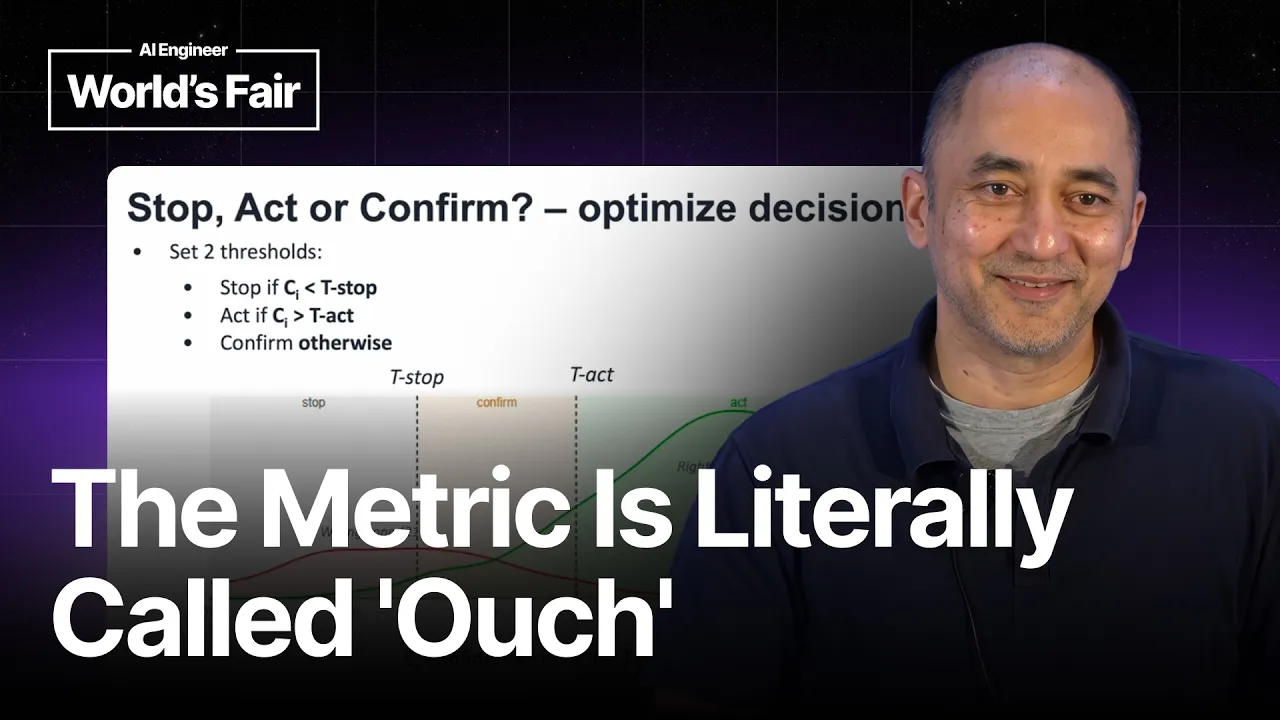
Whoops. So we're going to have 790 points 200 that are correct 210 wrong. Each one has a confidence score and we're going to plot it, you know, plot the distributions. Uh on the x-axis, I've just converted from 0ero to one to percentages. And the question is how do we choose a threshold t such that whatever that percentage is um to the left of it meaning if when the system um forms a hypothesis if the confidence score c is less than that t stop and say sorry otherwise play question is how do we choose a t so far everything I'm saying is fairly common sensical but this is where um intuition will fail us we might say something like okay I don't know let's do 65%.
It seems you know gut feeling like okay it's kind of confident that's probably when we should speak. Um now here's where we start coming out with some sophistication. Any tea we choose is producing bad outcomes. Bad in the in two fields. One is obviously on the left side anytime you stop it's bad. The user doesn't want it to stop. He wants to they want to hear their song. The other bad is if you do play a wrong song, of course that's bad as well.
So these are two two kinds of bad outcomes. But here's the important part. Now I've like elaborated on the um tree diagram on the right hand side. The bad outcomes are not equally bad. They're not the same thing from a user perspective. And obviously let's let's think about it. If the wrong song plays, you said play kiss and it starts playing kiss by Chris Brown instead of the one by Prince. That's going to be um the highest user cost.
Now I'm defining user cost from the user's perspective. First I have to like hear music and realize that is not Prince. Then I have to shout over my Alexa and um you know get it to stop and then I have to re-request. All of that is a lot of effort. that is definitely a worse outcome than the system stopping and saying sorry I didn't understand that however we should go further and try to quantify that relative badness and there many ways to do it and I think this is an area to be explored for now let's just consider this a heristic of if that outcome happens how many more seconds additional seconds will it take for the user to get back to success which is to play the song they wanted kiss by Prince and I'm I just put down some numbers here.
Let's say in the case of a bad song, it's 10 seconds if you add up all the things I got to do. And if it's a I didn't understand you, it's 4 seconds because that's how long it would take you to respe and and the extra latency. And now here's where we can start utilizing that. If we go back to our distribution curve on trying to find out where is T. Now we've basically turned this into a problem of minimizing a cost function.
It's a user cost function. It is the number of bad acts wherever that whatever the t causes times 10 because that was a unit cost we gave plus the number of stops times four because that's the the unit cost we gave. By the way, one thing I should have elaborated because I work in voice and we like language and we like puns. So this whole thing is called an outcome user cost heruristic. So that spells the word ouch and that is some expression of pain.
Yes, we are you know language nerds. So these kinds of things amuse us. Um so now let's consider that is the cost function is to minimize the ouch. And now um that let's see if uh I'm going to bring up a tool. Let's see if this works. Where I have actually gotten or with one of my coding assistants gotten uh an interactive um graph where we have actually plotted those thousand points and as we vary the threshold t you can see that the total user cost here which is that function of you know x * y + a * b actually changes.
So let's in the very beginning when we said the system was just playing the the cost across those thousand points was 2100 or divided by a,000 is 2.1 ouch points per turn. Then we said okay let's insert a stop behavior and let's like wing it and say 65%. That's when I want the threshold. If we brought this up to 65 yeah that's better. Now it's 1904 or 1.9 per turn, but it's not optimal. As it turns out, if we do actually um ask for the AI to solve the uh the problem across this curve, it turns out 43%.
So I'll drag it now to 43 is in fact the optimal optimal point of t. This minimizes the cost function. You can see it's the lowest point on this graph down here to 27. So effectively we haven't changed the accuracy at all. The system is not any smarter in that sense. But with some clever system behavior, conversational behavior is what we'd call it and some optimization and a cost function called ouch. Um we have from the user's perspective produced a more satisfactory assistant.
And this is not a trivial you know accomplishment. Okay. Now, let me go back to this. [clears throat] Let me see if I can get this. Oh, great. Okay, let's continue this. Let's continue this with by now adding one more behavior. Let's call it the confirm behavior. So, there was play obviously, then stop, confirm. Confirm is basically the system after you said something saying uh kiss play kiss by Prince or maybe play kiss by Chris Brown.
And uh you know the user can either confirm like affirm it or they can correct it. It is a different kind of behavior and again this is kind of how humans behave. Um that's obviously the inspiration. Now if we go back to our problem of optimization, we have a third obviously um option which is to confirm. And so this would translate to two thresholds um two thresholds which are separating the distribution into three spaces of stop, confirm and uh act.
And the question is now where are these T's? and we have now given up on guesstimating because we know it doesn't work. So we're going to be a lot smarter and go back to the concept of user outcome cost and then you know use it go look for some optimization in that graph. So let's uh define what are the what are all the possible bad outcomes that t1 and t2 um make for. So good you can see my cursor. So uh of course any stops are still bad.
Then in the middle are confirmations. Confirmations are bad because they slow the user down. There is a confirmation outcome called confirm yes where they just affirmed it by saying yeah or no where they had to correct it. And going back to our formula these outcomes are not equally bad. And in fact, nobody will, I think, argue here from a user's perspective. Affirming, just saying yes is obviously less painful than saying no and then having to restate whatever it is that you wanted in the first place.
So now we I've assigned values of two or six. And again, I said it was a heristic. This would be roughly the amount of time it would take for the extra for the user to get to the song they want. Saying listening and then saying yes is like two seconds. Um and then now uh we restate the cost function for this you know added behavior as this number of you know bad type one times unit cost bad type plus bad type two times unit cost etc.
And now we try to minimize this user cost function and minimize the ouch. Yes, I'm going to keep doing that pun. Um let's go back. So this is now the interactive graph but with um the cost values the unit costs here and uh you know we're just going to ask the AI to tell us here's the heat map because it's now two dimensions saying that the optimal values are 41 for the the T1 and 49 for the T2 and if we employed that then we would go to 1464.
Uh, by the way, whatever numbers I put in here, like let's say I thought wrong act was 20. It's really irritating and painful and takes way longer to actually correct it when you hear a wrong song. That would change you know all these numbers uh and the optim optimal point. So again it is about how what is the relative badness of these outcomes also of course the distribution curves naturally. Uh let's go back here. Okay.
So, um I'm gonna speed up a little bit. Uh let's go back here. Presentation mode. Okay. So, what have we shown that if we did the super naive approach, it's 2.1 act and stop 1.9 then 1.27 then 1.26. We are able to bring this with every added layer of sophistication, adding more behaviors, being smart about outcome, uh, user cost and optimizing. Um, we have made a tremendous difference without changing the accuracy at all.
Um, this was a super simplified example. In real systems, you're not going to have obviously some offline decision threshold or two. It's going to be a real time, you know, learned decision model. But the principle is the same. And I believe this is uh scalable across all voice AI surfaces. Obviously this is a smart speaker but if we go across any of these surfaces you will find the equivalence. If we um we will find the analogies with some differences but the spirit and the I think the the gain will be similar.
So just for example in the TV AI assistant space if you employ it here it's going to you're going to have the same thing when users express intents like on TV it's you know open a channel that's one of the most common obviously um requests on a TV voice assistant same thing you're going to find you'll have exactly the same approach but the difference will be maybe in the the assignments of the user outcomes because the UI and the modalities are different when you have a TV you have a multimodal interface where choices can be shown.
So instead of you know asking did you mean ABC you know uh news live by speech that you will the system would display choices and not just one it show ABC News live this that would be the confirm step and if it's visual and you can use your remote control to select something it's less pain so you would change some of these values or if in fact launching the channel would kick you out of your current state then it would go in the other direction than cost of you know a bad act would go much higher.
So it's the same concept but in this new modalities um variables can change, values can change, arguments can change but the premise still holds and you can improve from the user's perspective because we're all about you know making humans happy. Um you can make them happier and this as I said in conclusion can be applied across all surfaces. I did say at the very beginning, just to recap for us, that voice is great when it works, bad when it doesn't.
And as we get into embodied AI, where these AI assistants are taking actions, physical or even digital, like making a phone call or sending an email, it is getting more and more difficult just to rely on accuracy to improve user satisfaction. I believe there's a whole knob the second knob called smarter conversational behavior under uncertainty and um if we actually exploit that we can uh very much help these AI systems reach a acceptable user experience otherwise I think this will continue to be a bottleneck like a lot of things will get better but if the voice interface as experienced by user does not improve it is going to be a a a choke point.
And um if you just remember one word or two words from this whole um presentation, it would be to minimize the ouch of the experience. Um so thank you. I'll stick around for questions if you guys got any. Thanks a lot. [applause] >> [music]
The words are the caption track's own and nothing is reworded or re-transcribed. Paragraph breaks are placed between sentences so the text reads as prose.
Free tools for your own script. No signup, no login.
Paste your draft and see where viewers are likely to drop off, with a rewrite for each weak line.
Paste the first 30 seconds of your own draft for a hook score and rewrites.
Check your draft against YouTube's advertiser-friendly guidelines before you record it.
Read this channel's public videos and transcripts, and download a writing brief for it.