Getting the transcript
Reading the captions from YouTube. A video nobody has opened here before takes 10 to 30 seconds; this page fills in on its own.
Getting the transcript
Reading the captions from YouTube. A video nobody has opened here before takes 10 to 30 seconds; this page fills in on its own.
Ruth Livingston · @ruthlivingston7490
Words
4,772
Runtime
38:36
Speaking pace
124wpm
Reading time
20min
124 words per minute, below the 160 25th percentile of 349 measured videos. That distribution comes from the 349-video hook study.
Opening (first 30 seconds)
in this presentation we will be discussing the development of your informative speech in this class you will have an informative speech and then you will have a persuasive speech and this will also talk about delivery finding sources putting those sources in apa format to use the support within your speech first of all how do you overcome anxiety we know
62 words, the words spoken in the first 30 seconds at 124 words per minute.
Free, no signup. See how the first 30 seconds hold attention, with rewrites.
Sentence shape
| Measure | This transcript |
|---|---|
| Sentences | 1 |
| Average words per sentence | 4772.0 |
| Longest sentence | 4,772 words |
| Questions asked | 0 |
| Sentences containing a number | 1 |
Most used terms
Filler phrases
36 in total: like 11 · you know 9 · um 8 · uh 6 · actually 1 · sort of 1.
A literal whole-word count of the same phrase list the Prepublish browser extension uses, so a phrase inside another word is not counted and a phrase used in its ordinary sense still is. It is a count and not a judgement.
What this transcript is
Every word below is the caption track YouTube publishes for this video, pulled from the video itself and reproduced unchanged. It is not Prepublish's writing, not a summary, and not a re-transcription: it is the video's own published captions. English captions, generated automatically by YouTube, in the video’s original language. Source: the video on YouTube. A channel that would rather this page did not exist can ask for its removal through the contact page, and it is removed.
No Script X-ray for this video: YouTube shows a Most replayed graph only once a video has enough views.
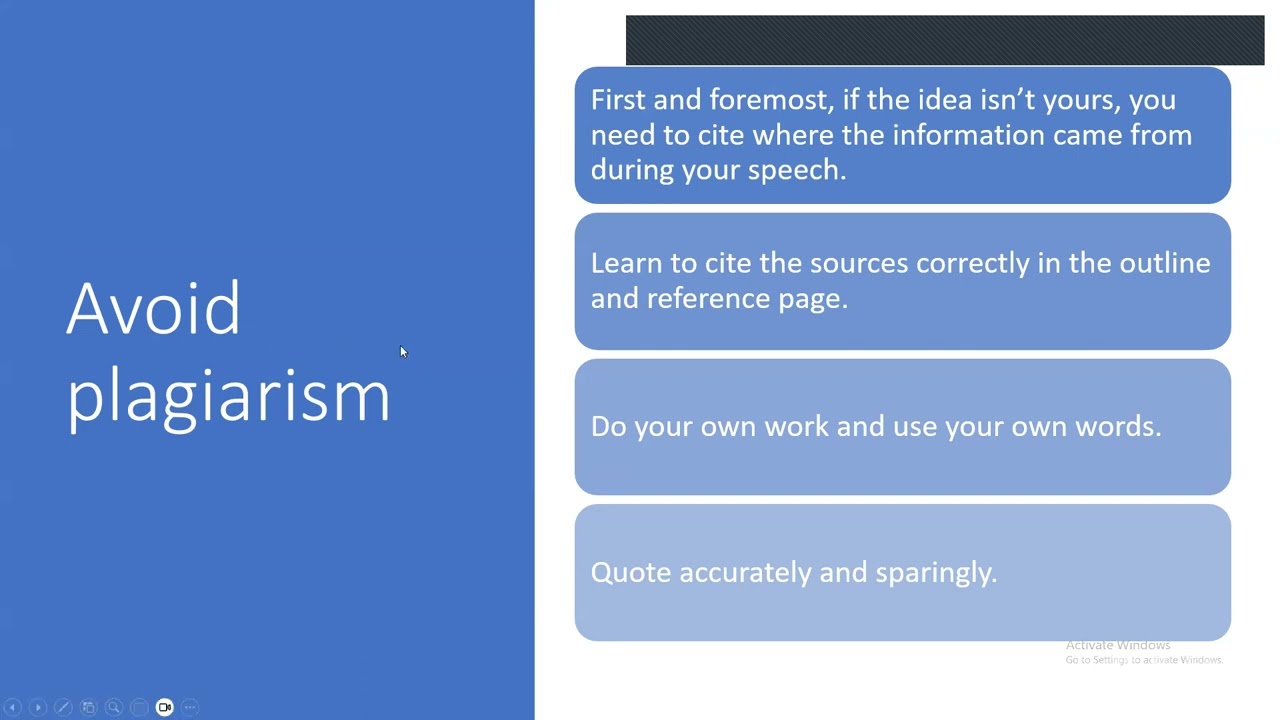
in this presentation we will be discussing the development of your informative speech in this class you will have an informative speech and then you will have a persuasive speech and this will also talk about delivery finding sources putting those sources in apa format to use the support within your speech first of all how do you overcome anxiety we know that public speaking is the number one fear in the world and the best way that I know in my many years of experience in harnessing this fear is that you just have to do it as Nike would say you just have to do it and remember you were not going to die you don't die of embarrassment it's a good idea to take deep breaths to stand poised and this helps you with your adrenaline uh the the adrenaline mush that you will get might cause you to shake and that sort of thing but use the adrenaline or organize your butterflies in order to give you more energy also practice put your speech together be well prepared practice practice and practice and I highly suggest that you practice in front of people who are going to give you some feedback and maybe some some support and you can practice dogs make great audience members cats not so much now first you need to choose a topic and I suggest that you choose something that you're very interested in and that you already know about remember that you are going to be researching this article or this topic so think of something that you would find interesting to research something you may already talk about something that you're very curious about But be sure to keep it positive and interesting the speech topic needs to have some substance and it needs to be something that people want to hear about that is positive so categories can be objects and places people who you highly admire that can be fictional can be real people can be characters Concepts such as growth mindset events that you may have participated in and it's very beneficial if you will choose a topic in which you have had an experienced if you have been to Glacier National Park my favorite National Park then that would be a great topic if you enjoyed that time there and then you can talk about a process maybe something that is a hobby or that you'll enjoy doing or that would be beneficial to us as how do we maintain our cars and then there are also categories of things that might be of interest so think of your topic don't worry about getting the absolute perfect one you you don't have very long to decide upon a topic for this fast-moving course so choose a topic that you care about if you just can't think of anything then look online put in informative speech topics and there will be hundreds of ideas that pop up I ask that you do not go with anything that might be offensive and certainly don't delve into the negativity and politics and so forth let's go with something positive something interesting something that is Meaningful to you so next you're going to need to research that topic and you need to find information that you can use within your presentation you must have three secondary sources and these would be articles books websites things that you can research and read about research that is not something that you have primarily done although you should know some of this information firsthand which would be a primary source you would be the primary source I would like you to reach out and research the topic further I have a video that you will watch that explains how to put references in apa format in your outline at the end of your outline you must have three references of secondary sources in APA format and these are different types of sources you can use periodicals newspapers and books reference tools as dictionaries and websites But be sure that the website that if you use a website that it is a credible source and that it can be put in APA format types of supporting materials that you need to be thinking about to back up your main points you will have your main point and then you will need to back that up your main points will be written with Roman numerals and then you will have support for those and I will show you an outline example and there are other resources that have outline examples and it's laid out in the template so supporting materials that could be examples and those might be examples that that could even be narratives which is stories or antidotes where you or someone else has had an experience with this topic such as visiting Glacier then you will need to use definitions if you're using unfamiliar words but be sure that those are few and far between and then you can bring in statistics it is very important if you are going to use a statistic that you follow these rules rule number one tell the source within the body of your presentation when you are speaking a statistic a number a scientific fact you need to tell where you got that according to the American Lupus Foundation 1.5 million Americans have been diagnosed with lupus and 90 of those are women now I have rounded that large number off you know it's not exactly one million five hundred thousand people so I have rounded that number off so it could be more memorable I've also told the source and the source is a reliable source the American Lupus Foundation and then I use two I stack two and it's best not to do any more than that if you just do one number after the other after the other people won't remember it it will lose its it will lose its impact and it just has no meaning after a while it's no longer interesting so you throw that statistic out there that is impressive and you tell the source where you got that you round it off and it's also good to use possibly a story so this is a big number but then bring it on Home with a story of where this actually happened to someone and testimonies is just testimony or information from experts or people who have had experience with it this is how you put references in apa format on your outline it's going to have references is going to be in apa format and as I said there is a video that explains how to do this but you have the last name comma first initial of the author the year month day the name of the article written as a sentence not all in caps The Source or name of the periodical that is written with caps because it's a proper noun so you write it like a proper noun and that would be italicized and then the full URL address if there is no author then you start with the name of the article if there is no date you put in Period D period if and then after that without an author you have the source and then the URL address as I said please watch the video and put three articles in APA format in your reference area of your outline types of supporting material I've already gone over um okay so be sure that you do not plagiarize your work will be turned in your outline will be turned in and turn it in you use quotes from articles sparingly you can use a quote But be sure that that is properly cited and if you say a quote in your speech be sure you tell us who said it Palm stopper a famous playwright and journalist once said words are sacred they deserve respect if you can get the right ones in the right order you can nudge the world a little so I told you who Tom stopper was and what his name is and because he's a journalism playwright that would be an appropriate quote for him so be sure that your work is your work and not and don't use anyone else's unless it's properly cited and paraphrase rather than just quote quote quote your speech that you turn in to mean will be an oral presentation you are going to write an outline that you are not going to write your speech out word for word because I do not want you to read it so you have a full sentence preparation outline that goes along with the template that you're provided what you bring to a lectern or when you get up to speak notes should be minimal your outline is 20 points of your presentation your presentation will be a 100 points your outline will be 20 points you're going to have quite a bit of your speech on that outline but I would suggest that you don't just write it out in blocks it needs to look like an outline and you will have some examples of those you can take notes up with you but be sure that they are minimal you can write words and phrases you can put them on cards but always set them down speak hands-free so you can use your hands to to make natural gestures these are the organizational patterns of a presentation chronological or time order and that's if you were going to discuss a process and that can be an informative speech it could be a process or stages spatial order is is directional so if I were going to talk about the mountains of the United States I might want to start from the east coast to the west and topical order is what most of you will use and that is you will have your speech divided up into to usually it doesn't have to be but it's usually three parts so we have three subtopics you will use Monroe's motivated sequence for your persuasion speech which is similar to a problem solution order but we'll talk about that when we get into persuasion most of the time these problem solution these are persuasive speeches the most important words in your presentation are your first words you will not start your speech if you want to gain full points for the beginning you will not start your speech with your name or your topic do not start your speech with your name or your topic you will start your speech using an attention grabber and when you get up to give your attention grabber you don't have to say well I'm gonna start with the story just jump in jump in with power and start your story or you can say something that we're not expecting or ask a question if you're going to ask a direct question you need to show the audience what response you want for instance if you're asking so by a show of hands how many of you love horror movies you know that you ask them to respond if it's a hypothetical or or a rhetorical question where you just want them to think about this just think about it then you would just ask the question give them a moment to think and then move on we've already talked about statistics if you want to start with a powerful statistic that is great I suggest that you might tell the statistic and then do a story or you could do a story and then tell statistic this person is not alone statistic arousing curiosity to make people go hmm what what are they talking about or a quote the quote needs to be punchy you need to know who said it and it needs to be one two two sentences no more than that so start using one of those techniques after the attention grabber you're going to link your topic to the attention grabber establish or credibility how do you do that you simply say according to or in my extensive research I have discovered or I have been a fan of UT football my entire life since I can remember or I've been playing video games for 10 years and Eminem Avid at Esports or something where you've had an experience and if you have not had an experience then you need to say I have researched this in some manner so establish your credibility that's five points of your presentation Five Points of this speech and then preview your speech or tell us what you're going to tell us the three parts of a speech the introduction you preview and tell us what you're going to tell us the body of your speech you tell us what you previewed and told us you were going to tell us and then in the conclusion you're going to signal in conclusion to transfer into that and then tell a complete summary so tell us what you've already told us in a summary like a package that we can take home this is my residual message this is what I want you to take home with you and always remember and then you end with a bang in the body of the presentation you will write your main points in complete sentences so you have if you're going to have three points for instance let's say I was going to do a speech on on Lupus and I said today I'd like to explain what lupus is and it's symptoms and treatments so Roman numeral one will be this will be explaining what Loop this is lupus is an autoimmune disease that affects mostly women and I'm going to I'm going to back that up tell a little bit more maybe what autoimmune is maybe how many people have been affected but but I'm going to to go in here and talk about what it talk about the disease itself what it is and then I'm going to say now that you know what lupus is let's look at the signs or symptoms that you might experience so lupus Accord according to the American Lupus Foundation there are four major symptoms and I'm just making this up but if you if you're going to do that then and then you would have a symptom one uh would be here and then symptom two and then you would write that out and and if I had four main I'm going to have a b c d as my symptoms and then I'm going to have an e that will transition now that you know what the signs are let's consider the treatments for lupus and then I go into according to that there is no cure for lupus but there are ways to head off the disease or to help those Vine relief and then I will go into those treatments then I'm not going to have a transition into the conclusion I'm just going to get back into the conclusion now we see these things we see that uh the these sub points here well those sub points can also be backed up you within those to have stories so if I were going to tell a symptom um I could say this particular symptom and then I might want to back it up with someone I know or if I have had experienced that a story of where where that happened um so or I might talk about what the doctors refer some something like that so you're going to get into within that A and B sub points you can use any of these things to support what you're talking about then in between the body or the the introduction in the body your transition will be your preview this morning I'm going to discuss this this this all of your points will be in that preview and the body of your speech you will have transition between each main point so your internal previews well is a phrase or sentence that gives an idea of what's coming next so that can be now that we've seen the problems caused by the lack of bad adolescent curfew laws let's examine how curfew laws can could benefit our community so that would be transitioning from one now we're going to look at this if you are doing something like a process you would want to use signposts rather than internal previews because internal previews would be too long if I said first you take the deadbolts off now that you know how to do that let's look at no you would just say the first step secondly third the final step you know and that's what you would do in dealing with transitioning your audience to a new thought without overdoing it your transition in your to your conclusion is simple remember we've got those three parts of the speech introduction to body the transition is your preview now we have body to conclusion and the transition is a signal you must have a signal going into your conclusion so your audience can move to that part of your speech with you similarly you must have a preview to move the audience into the body of the speech so that signal that transition that signal is very simple you simply say something like and conclusion let me conclude by saying to sum up let's wrap this up all of those are ways to signal that you're almost done it's also a great way to bring your audience member back to you if they happen to be taking a trip and their mind is wandered it's just natural that when you say that you will move your audience back to you into your conclusion now in the presentation I want you to think about using more powerful language give this some some thought using verbs that mean something as we talked about in non-verbal communication and verbal communication we can use words that are familiar and that have more power I gave the example of you have a different view if I said running through the park as jogging you have more of an idea that this person may be getting exercise as opposed to running away so think about ways that you can use the most powerful words possible figurative language is Martin Luther King Jr used in his speeches were so powerful and he used words like Injustice anywhere is a threat to Justice everywhere many metaphors similes personifications he was a master at that and you are going to watch a series of speeches and I want you to watch for the figurative language in those that will be coming later where I want you to identify what makes these three four speeches great one of those speeches will be a speech by Martin Luther King Jr that I Have a Dream speech but what makes them great and using powerful words is the key to a truly powerful persuasive or influenced presentation to make your speech powerful with in as an informative or but informatively you need to be able to link new information to something that's relatable so if I'm going to as I said talk about a symptom I might lead to a story of someone that has experienced that a story that might resonate with me if I'm going to talk about um you know dog breeds I might talk about things that would be more relatable to to my dog people and you know how dogs do this well this is what that means so I'm going to link something that they already know to this new information personal stories can really have an impact and make you more credible because you have had that experience with the situation in speeches online you really can't do short videos very often and that's why I don't require visual aids in these speeches because it's hard to do so if you want to use the visual item there's a way that you can show yourself with the visual aid that's great but if not I totally understand in this online environment in my face-to-face courses they must use a visual aid for their informative speeches but in this online I don't require it I don't know if other instructors might but I don't the final part of your presentation is your conclusion and there are three parts to a conclusion first of all you signal that you're almost done and that brings people back and go oh almost through in conclusion in summary let's wrap this up let me conclude by saying and then you give a summary the summary needs to be four to five sentences needs to not be assured as a preview but but a complete summary of the residual message that you want people to take home with them it is going to include all of your points but nothing new and then in as powerfully as you began the introduction and that Center at the end should be the most powerful parts of your speech that attention grabber and then leave with a bang and you can do that various ways you can end with a powerful quote your persuasion speech will all end with a call to action this is an informative speech so I don't find that as helpful usually um as in the as it is and the persuasive speech but I think the best way if you can is to go back to that attention grabber do you remember when I asked you and then go back to that or maybe if you were talking about Kobe Bryant and you gave a quote at the beginning from him you could possibly end I'll I will leave you with the words of yes and then end with that you could also do a story and sometimes what's effective is if you're telling a story at the beginning for instance I did give a speech once on Lupus and I had a child who was suffering from lupus and then the last I caught people up to where she was at the time and now thankfully she's in totally in remission but at that time she was not and it was a hard struggle for our family and that many other families have had to bear so you can finish your story if that would apply if you're going to give a video it should be a minute or less but you can end with a video for instance I have had students give speeches on Metallica well you have to end with a short video showing a little Metallica because then you just don't get the whole everything if you haven't heard and seen them so those are all ways that that you can end your presentation just be sure that you end with the bang do not end your presentation with that's all or that's all I got or that's it that takes away from it those final words should be compelling and Powerful just like the beginning this is I copied and pasted the template because I wanted to go over it quickly and this should be Roman numeral one and and when you do your attention grabber write it out unless you're giving a story so with your attention grabber if it's a story just say story about when I was diagnosed with whatever but story about other than that put it in there uh and and if it's quote say according to an article in Forbes Magazine you are bombarded with 3 000 persuasion messages every day so you're gonna you're gonna give the statistic and tell where you got it if it's quote uh put it say the quote or say you know such and such said quote and put it in quotes there then you must establish your credibility so you're going to tell of your experience with the topic or that you've researched the topic if the attention grabber is all about you and your experience with the topic then that is not necessary but if you have not given your experience in pretty good in depth in the attention grabber then you need to tell that you have had an experience or that you have researched it and then you're going to preview the speech with today I will discuss now when you write this outline you're going to get rid of my words and you're going to put in your own and I've had students who kept this in a complete sentence right first point and then they put the first point here don't do that so you're gonna you're gonna write in a complete sentence the first point that you're going to make and then you support that with Statistics or stories or examples and so forth and then more support and then you will have your transition now that I have explained and remember as I said before it may not be a b C it may be a b c d e but all of that support needs to go here and it needs to be broken up in this way do not write big clumpy paragraphs just have a number one and then just full paragraphs so get rid of get rid of my words and put in your own and then finally you're going to have your references in secondary references and an APA format now the next thing that you look at you need to look at is the importance of delivery you give a presentation to be able to give your emotional input all of those important things so so here we're going to have delivery should should be dynamic and do not read your presentation you should talk about it in a conversational manner be sure to use eye contact with your audience have vocal variety and some charisma you put meaningful silent pauses when you want to drive home a point but don't put vocalized pauses or filler words such as um and um like anywho so all of those things and of course you want to be dress appropriately and and be well groomed so today we discussed how to harness your anxiety you were going to write a prep preparation outline using the template provided you need to research and find unbiased support and put those articles in the APA format or or books you can use information out of books or newspapers you can learn hopefully you learn how to develop supporting materials using all different ways of examples and testimonial and and quotes and statistics those sorts of things antidotes and then to present needs to be professional and conversational the final thing that you're going to do is you're going to write uh an analysis of your own presentation within this week I'm going to ask you to look at an informative speech and grade it using the same grading rubric I will use to grade your speech then when you present your presentation you will need to be in front of an audience of three or more people I will need to see your audience and then turn have one of them video you in front or video via video you and it needs to the video needs to show you from at least the waste of so I can see any gestures that you might make and I can see if you're making eye contact then you will put that on a in a YouTube link you can use YouTube which is ND too well but I would prefer that you use a YouTube link not a public link that can be seen by anyone but an unlisted link so that only the people you share the link to can see your video and then you will share that with your group members you'll share that with me and you will analyze yourself and your group members speeches and that is over the next couple of weeks but um this week you will start your informative speech outline and and research and start preparing for that presentation
The words are the caption track's own and nothing is reworded or re-transcribed. Paragraph breaks are placed between sentences so the text reads as prose.
Free tools for your own script. No signup, no login.
Paste your draft and see where viewers are likely to drop off, with a rewrite for each weak line.
Paste the first 30 seconds of your own draft for a hook score and rewrites.
Check your draft against YouTube's advertiser-friendly guidelines before you record it.
Read this channel's public videos and transcripts, and download a writing brief for it.