Getting the transcript
Reading the captions from YouTube. A video nobody has opened here before takes 10 to 30 seconds; this page fills in on its own.
Getting the transcript
Reading the captions from YouTube. A video nobody has opened here before takes 10 to 30 seconds; this page fills in on its own.
AI Edge · @AIEdgeHQ
This video has no Most replayed graph yet: YouTube shows one only once a video has enough views. These are the moments viewers replayed most in AI Edge's most watched videos.
Most replayed moment at 4:10
6.2x that video's typical replay level
different sections, but I think it came out super cool. And my plan is to make it better over time. So, once I was happy with the design, I exported it into Claude code. This is how you actually take it from a design into a functional website. And I got Claude code to mock the entire architecture,
Said at 4:03
The graph counts replays. It does not show where viewers stopped watching.
Words
9,767
Runtime
45:48
Speaking pace
213wpm
Reading time
41min
213 words per minute, above the 201 75th percentile of 349 measured videos. That distribution comes from the 349-video hook study.
Opening (first 30 seconds)
If you actually want to make money with AI, this video could completely change the trajectory of your life because I just sat down with Cory for a master class on his AI concurge business model. And I've got to say, I truly believe this is one of the lowest barrier to entry AI business models while still having insane potential upside if well executed. Pretty much anyone could jump into this, even if you're time poor, and the margins are incredible. So, sit back, take some notes, and let's get into the episode. All right. Very excited for this episode. Today I'm joined by Corey and
107 words, the words spoken in the first 30 seconds at 213 words per minute.
Free, no signup. See how the first 30 seconds hold attention, with rewrites.
Sentence shape
| Measure | This transcript |
|---|---|
| Sentences | 576 |
| Average words per sentence | 17.0 |
| Longest sentence | 142 words |
| Questions asked | 68 |
| Sentences containing a number | 74 |
Most used terms
Filler phrases
445 in total: like 226 · you know 91 · right? 29 · actually 24 · um 21 · kind of 17 · uh 16 · literally 15 · I mean 4 · basically 1 · sort of 1.
A literal whole-word count of the same phrase list the Prepublish browser extension uses, so a phrase inside another word is not counted and a phrase used in its ordinary sense still is. It is a count and not a judgement.
What this transcript is
Every word below is the caption track YouTube publishes for this video, pulled from the video itself and reproduced unchanged. It is not Prepublish's writing, not a summary, and not a re-transcription: it is the video's own published captions. English captions, generated automatically by YouTube, in the video’s original language. Source: the video on YouTube. A channel that would rather this page did not exist can ask for its removal through the contact page, and it is removed.
If you actually want to make money with AI, this video could completely change the trajectory of your life because I just sat down with Cory for a master class on his AI concurge business model. And I've got to say, I truly believe this is one of the lowest barrier to entry AI business models while still having insane potential upside if well executed. Pretty much anyone could jump into this, even if you're time poor, and the margins are incredible.
So, sit back, take some notes, and let's get into the episode. All right. Very excited for this episode. Today I'm joined by Corey and he's going to talk through a very cool business model. It's an AI concurge which can make you over $1,000 an hour. And Corey, you say you can learn to do this in less than 30 days. That's that's crazy. Could you give us a breakdown of of what we're going to learn today? >> Yeah, 100%.
So, first of all, Miles, thanks for having me. Now, what I love about this AI concierge business model, so I don't know if you've ever seen the movie Catch Me If You Can, where like Leonardo DiCaprio is the star of that movie. He's like a con artist and at one point in the movie he's teaching a college class and when he finally gets caught in the end they're like how are you able to teach this college class you're not you know you're not a professor you're not trained in this methodology and he's like well I just needed to stay one chapter ahead of the students in order to teach this class and AI concierge is the same exact concept you literally just need to be one chapter ahead of your client because all we're doing as an AI concierge is we're teaching people how to use Claude co-work and build Claude skills to automate the manual tasks in their business.
That is all we're doing. It's that simple. And I call it done with you consulting because we're literally just on a Zoom call having the client share their screen and we're teaching them, you know, where to click, what to prompt, helping them build skills. Again, kind of like handholding them through the process. And if you know how to build claude skills for yourself and for your own business, then you are perfectly qualified to sell this as a service. >> Interested to know a little bit more about your background with this.
Obviously, you've been doing consulting for a while. Can you tell the viewers about your experience? >> Yeah, so I came up with this offer about 5 months ago. And again, what it kind of came about because I was like, you know, if I'm going to do consulting, my I'm willing to do this for a minimum of $1,000 per hour. Like if I'm going to trade my time for money, I want to be making at least $1,000 an hour. So I asked myself like what needs to be true for me to make at least $1,000 an hour selling AI consulting?
And you know, nobody's going to pay you $1,000 to jump on a Zoom call with you for an hour. So what I realized is I really need to package this into an offer that has very high perceived value, but also helps clients drive outcomes. So, and I can we can get into the actual system here in a second. like we'll we'll get into detail around like what are we actually offering? How do we fulfill it? How do we set it up? We're going to give the audience everything they need to know, but as far as my results, so like this is and again I the only reason I share this is because I think there's a lot of people out there who who don't have receipts for what it is that they're doing.
I mean this is a screenshot taken today of my Stripe. These are four of my AI concierge clients. I've got him paying at different intervals because when I when I first launched this offer, I pitched it at 1,200 a month and the guy said yes so fast. I was like, damn, I knew I underpriced. >> So then I pitched it at to the next guy at 1,500 said yes. Next guy 1,800 said yes. Next guy 2,000. Sorry. Yeah. Next guy 2,000 said yes.
So like I just continued raising my price and continued getting a yes. And these are recurring um monthly retainers that are coming in for my clients. So again, we can get into exactly the problem we're solving. I think that's a good place to go next. Um, but before we do, Miles, any questions on, you know, the business model itself or anything we've covered thus far? >> Well, I just wanted to say the cool thing about you is that you're actually showing a lot of people and they should check out your channel.
I'll leave it below like how they can actually do this like in a practical sense. like you know you went around door knocking you've been on cold calls like you actually you know walk the walk as well which is one of the main reasons I wanted to have you on the channel cuz I think a lot of the bigger channels a lot of it's lap whereas like you're actually legit like in the trenches doing this stuff so I think um yeah I just wanted to say that I think that's an amazing part of your content and I think um yeah this is going to be a great great walk through. >> Yeah, I appreciate that.
Yeah, I like to I like to kind of share the in the trenches look because I mean at the end of the day that's where people learn the most. So in terms of the problem that we're solving, right? So the first of all the clients that we're targeting here, these are your small to medium-sized business owners. Now I'd say my smallest client is running a business doing probably, you know, two to three million a year in revenue.
My largest client is a CEO of a $150 million fintech company. Now, that that client is a little outside the norm. Like, typically, you're not going to be working with nine figure CEOs. This guy just wanted to learn how to use AI better so that he could turn around and show his employees that he's leading from the front and knows how to use these tools. But your general AI concierge client is going to be CEO or like you know COO of a small business doing 2 to 10 million a year in revenue who wants to learn how to use AI and wants to get better at building with AI.
The the ideal client for this offer is not someone who is willing to pay an agency 20 grand to build them an automation or build them an AI agent, have them instal have it installed in their business and then if it breaks, they don't know what to do. Like they have no choice but to go back to you and pay you to fix it. No, this is the person that wants to get their hands dirty and they want you to hold their hand while you teach them how to do the thing.
So, that's really who we're targeting here. And the problem that we're solving is like this business owner is typically the guy or the girl who's they're spending their whole week in the business, right? They don't have the bandwidth to rise above the noise, build the systems that get them out of the trenches because they're so busy in those trenches on a day-to-day basis. So most of these people, they've got three or four manual tasks that are eating most of their week.
And these are things that happen every single week. They're constantly putting out fires. balls are getting dropped like the second they get swamped or the second they get behind they're not responding to new leads or they're not doing their marketing or they're, you know, they're delaying their expense reports, all the things that tend to pile up when we get busy. This is also the person who has probably tried chat GBT or maybe tried claude or maybe tried, you know, one-off AI tools here and there, but they stalled because either they didn't understand how to use it or they didn't fix the underlying process first.
They tried to automate a broken process, which is a big problem that we'll get into how to solve that here shortly. And like I said, they don't want an agency to deliver, you know, a black box of an automation. They want a partner beside them that is going to hold their hand and teach them how to do the thing. So that's really the problem that we're solving at the end of the day. And there are, you know, I get a lot of people that say like, "Oh, well, you know, isn't this competitive?
Like, isn't everybody trying to do AI consulting?" There are probably 10, 20, 30 million business owners in the US alone who are perfectly qualified for this offer. Like, and there's there's not 20 million AI consultants, right? So there's more than enough opportunity >> and even the bigger firms and this is the thing the bigger firms it's not worth it for them to do low ticket consulting and like even guys like you for example I'm sure at some point you'll pivot to mostly high ticket and it kind of frees up the market because naturally a lot of people start in low ticket consulting and then they'll move up which like naturally keeps demand like at this at this bottom level and a lot of people also you know from a retail point of view people getting into this space they don't have the follow through or the drive or determination, you know, to even sit down and focus on something for a day, let alone, you know, a week or two to actually make this work.
And >> you know, for that reason, like there's probably less competition than you think, like if you actually follow the steps, which we'll talk about today. Um, and I've seen this firsthand as well. You know, I'm doing a little bit more higher ticket stuff, but I've seen the demand. You know, I've had people DMing me and asking me for openclaw and Hermes setups and offering crazy numbers without me even mentioning a number.
They'll be like, "Have 10k, have 20k." Like, they're desperate to to to learn. And I think um the same principles apply not just to people with personal brands like us, but to people um you know on on all rungs of the business ladder like they just want uh implementation and that's essentially what someone is stepping in to offer. Uh so yeah, I'm very keen to find out how how to get this started in a practical sense because I took a different route like I went through through more so content to get here, but you know, you've taken a practical one.
So I think it's you know, awesome for the viewers to have this insight. >> Yeah, 100%. And to your point too, like I I think that there's a lot of money to be made going up market. So like obviously this offer is geared towards the like$2 to10 million CEO or executive but you could run this same offer for you know the 30 or 50 or hundred million company and those and it's going to look a little different but like those companies have are under pressure from their boards and their investors to be able to say that they are implementing AI like they need to be able to check that box.
So, by paying you, the consultant, 5K, 10K, 20K, 30K a month, they can say to their board, "Yes, we're handling this problem." Obviously, you're going to help them drive outcomes, but this works at every level is kind of the point that I'm trying to make. And I know like obviously, Miles, you're doing it at a very high level, too. So, let's talk about the actual offer itself and the deliverables because this is going to be kind of like the meat and potatoes.
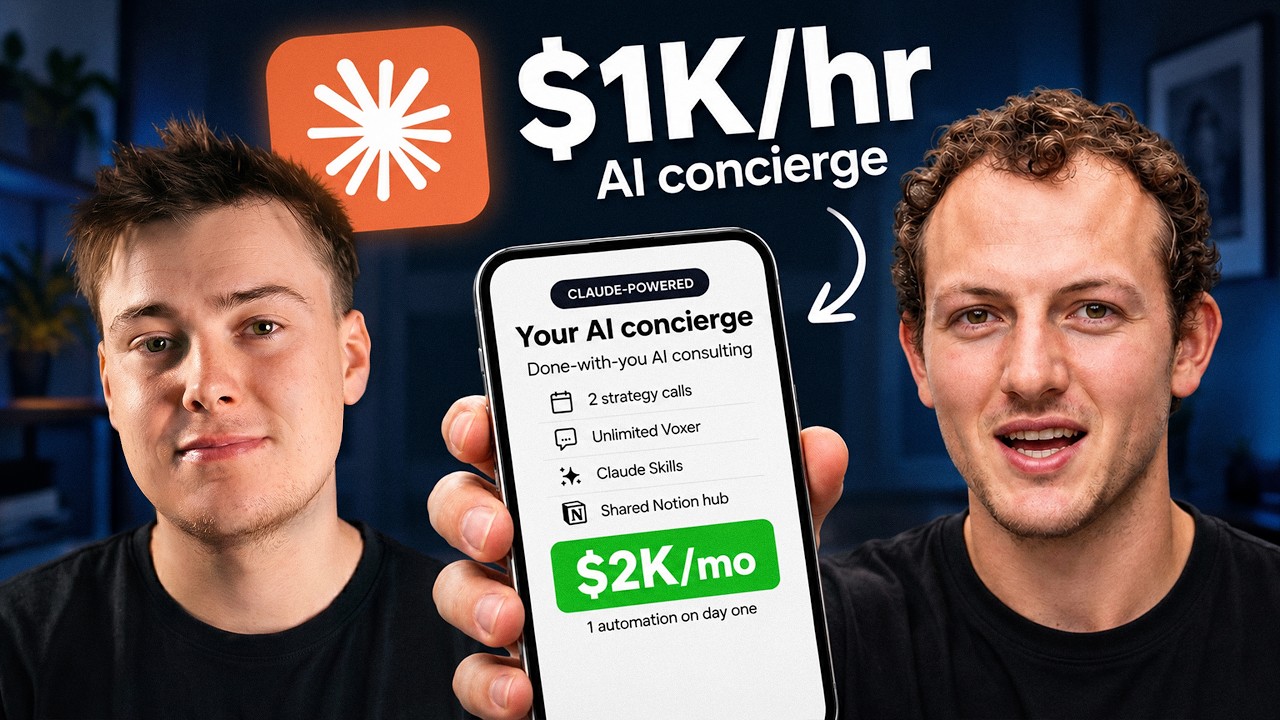
This is going to be what we're actually fulfilling. So, there's four parts of the AI concierge offer. There's the intake form that we had the client fill out before the uh engagement. There's the actual strategy calls, which is like 80% of the heavy lifting. There's what we call the walkie-talkie or the voxer access that we give clients so that they can get in touch with us. And then there's the notion hub where all of the client's information lives so they can access it between calls.
So the first part which is the intake form. This is a simple jot form that we have claude create. So I can even pull that up here and show you what that looks like. So this is uh essentially an AI concierge intake form. As soon as the client pays, we send them this form. They fill this out. What it does is it just kind of forces them to do a brain dump on everything related to their business. So it's like, you know, what's your role?
Um what are the tasks that are eating most time of your week? Where do you feel the bottleneck is? what balls get dropped when you're swamped, you know, give me some one or two repeatable processes across sales, operations, finance, marketing, and just kind of getting all their business information. So, this is like step one. So, we make them fill this out before we ever get on the initial call with them. And with that information, that information helps us tailor the engagement to what they're looking to achieve, right?
So, when they tell us um like, hey, this is the current biggest bottleneck in my business. Well, that's going to be what we attack in the beginning of our engagement to try to get them some quick wins to keep them renewing month after month after month. >> It's just like sales, you want you want to know pretty much upfront what the issues are because you can just tailor your offer towards that. And just like the catch me if you can example you gave if you know if they clearly state a certain pain point like we're struggling to get clients that's what you'll you'll focus on.
Um if you have the basic understanding of AI and how the right tools which obviously we'll go through today then you you're kind of able to then use those tools to you know if if you have a bit of agency even in a couple days or a day just not out that specific issue and someone that just doesn't have that baseline experience with AI they're just going to struggle to get um you know the the right output. So, I think yeah, definitely the understanding piece I've found is just so important when it comes to sales and consulting. >> Super important.
Yep. Just knowing exactly what you're solving for. And again, that's what the intake form kind of uncovers. Like, it just tells you what to focus on so that you can deliver wins and so that you can get renewals. Like, it's pretty much. >> And by the way, I'm sure people are going to be like, "Yeah, but already thinking, but who do I send the intake form to? I don't have clients." That's something I'm sure we'll get into later on.
Yeah, we'll we'll definitely talk about how to find clients. And honestly, the answer is it's a lot easier than most people think. It doesn't involve like cold emails or cold calls or any cold outreach of any kind. Like everybody, I guarantee you, everybody watching this, your first client is sitting in your phone contacts. I guarantee you that. But before we get into that, we'll finish off the offer and then we'll talk about uh how to actually find clients.
So the second part of the offer is the the two 45 minute strategy calls that you conduct every month. So these are uh one working session every two weeks again with the owner whoever the point person is at the client company. And all we're doing is we're running what we call our AOA framework which stands for audit optimize automate on on their bottlenecks one at a time. Right? So, like let's say they're, you know, that one of their biggest bottlenecks is their client uh their client onboarding process.
Well, we're not going to just immediately turn that process into a skill, right? Because the process itself probably is inefficient to a degree. So, we're going to run AOA. We're going to audit the process first, which is just us watching the client perform the process while we take notes. Then, we're going to O optimize, meaning we're going to cut out the fat. Right? Chances are that process is 16 steps and it only needs to be 12.
So we're going to cut out those four steps that don't make sense. And then now that we have a clean optimized process, then we're going to automate it. Then we're going to turn it into a clawed skill. Right? So that is the part that everybody gets wrong, not just in an AI concierge engagement, but when building skills in general, is everybody wants to jump straight to automate because that's the fun part. when audit and optimize is like 80% of the work.
Nobody wants to audit, nobody wants to optimize, but if you do, it makes the automate step super easy. So, we're literally just like if we wrote down, you know, their their top eight bottlenecks, we're starting from the top. Run AOA, turn it into a skill. run AOA, turn it into a skill, run AO. And the beautiful part of an AI concierge engagement, and this is another big objection that I get, is like, oh well, once you work through all their bottlenecks or like once you teach them how to do this, aren't they going to just cancel?
And the reality is no. Because by the second call, once you've showed them how this thing works, they start getting all these ideas of like, oh, we can actually, you know, we can automate this and we could work on this. And so your list like >> more bandwidth as you're as you're knocking stuff off the list, the list gets so much longer. Like I'm five months in and I've only had one client churn. >> I all my other clients are like our lists have gotten significantly longer and I will probably have my current clients for at least the next four to five months based on the current um >> dude I'm I'm the same of this.
I'm the same because problems don't go away in business, right? I hired a developer. I hired him for one job. I thought he was going to be on board for maybe, you know, a few months while we solved this problem. He's still with me like six months later. I just chucked a new project out in today. I'm like, "Oh, what if we did this? What if we built this product?" And now he's like, "Ah, I have too much to do." I'm like, "Okay, let's hire more developers." So, like, it just unlocks, especially if you get results.
So, if you actually help the business, even make an extra 10% profit. They've got a bit more wiggle room now to even scale up, pay you more money, and, you know, scale up the entire automation side of the business. So, you're actually incentivized to do a good job as well because you're creating your future work. And I think yeah, as you said, only having one client churn, that's like something that I can anecdotally like attest to as well.
Like the churn is it's probably one of the lower churn businesses if you do a good job. Obviously, it hinges on you knowing what to do. And that's what we're going through today. >> And the other thing that makes this a really sticky offer is the fact that it's forced accountability for your clients, right? Because if they were to fire me, I guarantee you they would never ever sit down again to build these processes.
They just wouldn't. So, by continuing to pay me, you know, 1,500, $1,800, $2,000 every month, the reason, one of the big reasons they continue paying me is they know that every two weeks we're going to sit down for 45 minutes and work on the business, not in the business. And simply creating that forced accountability many times is enough to prevent them from churning, right? Because again, if they were to fire me, they these things would never get automated.
They just wouldn't get done. So, it's a really good way to kind of keep force them to stay accountable and and I think they really like that. And again, on these calls, all we're doing is we're building Claude skills. That's all we're doing. >> On the very first call with any new client, all we're doing is onboarding them to Claude Co-work. We're creating their context files and we're connecting their tools on that first call.
That's all we're doing. Before we get into part three where we get really practical, uh I just wanted to ask you like how how quickly were you able to make cash flow with this business model? You said like you can get $1,000 an hour, but how how did how quickly were you able to like, you know, start getting clients? >> Yeah. So, funny enough, so when I when I kind of like came up with this offer, it just happened to be a week that I had like a ton of calls lined up.
And these were not sales calls like to sell this offer, mind you. These were just like, you know, calls where I was catching up with people or calls that I just happened to have on my schedule with people that I already knew. Like for example, one of which was my financial adviser, right? We have a quarterly check-in call. And on the call, she was asked, she was just asking me like, you know, what have you been up to?
What have you what have you been doing? And I was and I just like to talk about what I'm doing. I'm like, oh, well, yeah, you know, I'm I'm doing this AI concierge thing. This it's done with you consulting, helping business owners learn AI. This is what it looks like. She's like, "Oh, well, you know, how much does that cost?" And I was just like I was like, "Uh, you know, 1,500 a month." Like, I just threw out a number.
And she was like, "Okay, like I'm in. Can can I do that?" I was like, "Yeah." >> So, like signed her on the spot. And again, I had I had six calls like that one over the course of like the 10 days after I came up with this offer. Literally, five of those six people closed on this offer. And like I said, the first one was at 1,200 a month. That was a commercial insurance agency. Second one was 1,500 a month. I was like a DTOC brand.
Third one, 1500 a month. Fourth one, 1800 a month. Fifth one, two grand a month. And this was all in the course of uh 10 days. And so yeah, like eight I guess what that's like 8K MR within about 10 days just from now, of course, these were warm leads, right? and we'll talk about how you, the audience, the viewer, >> can leverage the warm leads that you literally have in your phone contacts. >> But it's it's a it's a compelling offer.
Like people love it. People it will it will sell if you pitch it properly for sure. And we'll talk about how to do that. >> So the yeah the the third part of the offer and honestly guys, this is this is one of the components that makes it so sexy to the potential client. This is like such a good part of this offer because the perceived value is so high, but the cost for you to fulfill is like zero. So, the third part here is unlimited access to me via Voxer.
Now, Voxer is just like a walkie-talkie app on your phone, right? Somebody can send you a voice message, they can send you a text message, and you can respond with a voice message or a text message. Now, the reason this is such a good part to include in the offer, yeah, that's Voxer. completely free. Free for you, free for the client. The reason this is such a compelling part of the offer is in the client's mind, they're like, "Oh, I have unlimited access to Corey.
Anytime I need him, I can just ask, you know, any questions I have about AI or anytime I get stuck, I can just hit them up." And they can, right? And I promise a 12 business hour response time. So, if somebody sends me a message on a Monday, I'm going to respond within 12 business hours. The reality of the situation is that so I've been like I said I've been doing this for five months. I have literally gotten a grand total of six boxer messages across all my clients. >> So like again perceived value in the mind of the client like this is super valuable.
This is great. Like I have Corey anytime I need him. They never use it. But it really helps close them on the monthly retainer when they think that they can hit you up anytime because they can. So that's a com that's a component that I like to stress in the sales call. I'm like look like anytime you get stuck, anytime you have questions, you can hit me up anytime, right? And and they never end up really doing it. So it's a very high perceived value. >> Now the last piece is the notion hub.
So this is just like a a one-pager in notion that this is a clientf facing document in notion where each client gets their own hub in notion and it just contains you know like my the link to my boxer so that they never lose my contact there. It contains my scheduling link so they can always schedule the next strategy call. And it also serves as a log to document everything that we've done together during our engagement.
And it this kind of doubles as a retention mechanism because the client and at any point in time they can log into notion and literally see every call that we've done together and everything that we've built on each call. So, for example, on call one, they're going to see like, okay, call one, we built our brand voice context file. We bu built our working preferences context file. We connected these four tools to Claude.
We built these two skills. Right? So, it's like an inventory of everything that we've done together. So, in the client's mind, they see right there on paper like, "Oh, wow. These are all the things we've done. We've made a ton of progress. This is valuable. I'm going to keep paying Corey every month." >> Do you get like lots of success stories from your students? Like I landed a client. I >> Dude, we've got Yeah. So, it's funny enough our a lot of guys in our community are landing like >> much bigger AI concierge deals than I have.
Like I'm honestly a [ __ ] I'm not charging enough. Like we had a guy Yes or no two days ago in the community. He was brand new. He's like he said he's been like trying to sell AI consulting for a while but like hadn't had success with it. He walked into a local I think it was like a garden supply store. happened to talk to the owner. He did a free assessment for her, which is what we teach as like a a lead, like a front-end offer, and he upsold her on I think it was 12 grand for three months for AI concier. >> [ __ ] no. >> And it's like more than I make from any of my clients.
I'm like, [ __ ] I need to be charging more. One of our other guys uh recently closed like a $7,500 a month fractional chief AI officer consulting engagement. So, like, yeah, we've that is something that we have quite a bit of is is testimonials and case studies, which is cool. >> Wow. >> But we've got I've got this notion template pulled up, too. >> We should we should All right. So, this is the notion template. Do you want to walk us through how this works? >> Yeah, exactly.
So, so this is what every client gets access to during the engagement. So, this is just like the templated version that I created in Notion. So, this is the client's private workspace. So, first thing it's going to have is quick links. So like link to my Voxer, link to my scheduling. Uh if if they have any questions outside of Voxer, they can shoot me an email. This is where we just kind of give the engagement overview.
So again, this is pretty much cut and paste for every client. You know, client name, start date, cadence, contact, focus area. Now, this is where this is where it gets interesting is the call log. So this is where we take every single call that we do with the client and we put a link to the recording of that call, the summary of that call, the top three takeaways, the action items, and then an inventory of the tools or the skills that we built during the call.
So this is where again the client can see on paper here are the skills that we built, here's the tools that we connected, here's the context files we created on paper so that they can see immediately this is the value that I got on this call. And now, you know, towards the end of the the video, we'll share I actually have some Claude skills that I built that automate the entire filling out of this notion log. So, like as soon as I get off a call with the client, it's run one skill in Claude, Claude fills out this whole notion template, sends an email to the client telling them it's updated, and then you're literally done until the next call with the client.
So that's how it's truly only 45 minutes every two weeks and there's like no other back-end effort required. So does that make sense so far, Miles? >> 100%. >> Awesome. So we can talk about pricing and margins and then we'll talk real quick about how you can get your first client with this offer. So again, the math is really simple. If you're charging 1,500 a month and you're doing an hour and a half a month of calls, so that's two 45 minute calls per month, you are effectively making $1,000 an hour.
Now, my tip for people listening to this, if you're new, you can charge as little as $1,000 a month just to get your foot in the door, but I would never charge less than that because this is hightouch done with you work. The second you charge less than $1,000 a month for this offer, you're going to attract the wrong type of client. the type of client who's going to be high maintenance, who's not going to be a good fit, who's going to churn, who's just generally not going to be a good fit for this offer.
Now, again, if you're charging $1,500 a month, you're making $1,000 an hour. If you're charging $2,000 a month, you're making about $1,333 per hour. And again, I've got clients paying me anywhere from $1,200 a month up to 2,000 a month per client. And my just general advice is again, if you're brand new to this, close two clients at a,000 a month each and then immediately raise your price for the next client to 1,500 a month and then from there >> and tell the old client that you've raised prices so you keep,000. >> Exactly.
Yeah. >> If they cancel and then and then you know they're trying to work with you later, you want them to know like you know just look new happy to work with you at 1,000. Just letting you know all new clients are at 1,500. Exactly. Yeah. That's that's just like good good sales practice in general. Just like let them know like, "Hey, you know, by the way, your price is staying the same. I'm not going to raise your price, but just letting you know that if you were to refer me anybody or if you were to send anybody my way for any of my new clients, they're they're currently paying 1,500 a month." So, just basically letting them know they're getting a deal, it's another incentive for them to stay.
It's also better probably to start low because I don't know if word of mouth goes around and one tells another like probably better to start low and then raise price than than it is to go the other way. >> Yeah, 100%. Like I've I've made that mistake in the past where you know maybe I get like this is on like other offers and other industries, but like maybe I I get one client at, you know, say $5,000, but then I can't get anybody else at $5,000.
So then, you know, I close a client on the same offer at $3,000 and then somehow word gets back to my $5,000 client and they're like, "Dude, what the heck?" Like, you know, you charge me five. So it just ends up shooting yourself in the foot. That's why again, I prefer to start low and work your way up. However, that said, as soon as you get a yes or, you know, once you get at least two yeses, start raising that price until you get a no. >> So if we if we talk about, you know, how to find a client, right?
So again, this is everybody's biggest hang-up is like, okay, this is great. like I understand the model, you can make money doing this, that's great, but how do I actually find clients? And my advice to people is everybody watching this, you know, regardless of who you are, you probably have at least 10, some of you 20, some of you maybe even 30 business owners in the contacts on your phone. These are people that you know from the gym, from church, uh, you know, old colleagues of yours who went out on their own, you know, parents of your kids' friends.
Make a list of all the business owners in your phone contacts and you're going to just send them a simple text message. Now, what we're not going to do is pitch them on this AI concierge offer. What we're going to do is we're going to send them a text. It says, "Hey, this is Corey. I've been going down the AI rabbit hole recently. I'd love to spend 15 minutes with you and and help you uncover one simple way where AI can either make you more money, save you time, or increase the quality of your product or service.
No strings attached, completely free. Are you open to that? So again, we're we're starting with just a free foot in the door offer where we're going to just provide a ton of value and help them see one way that AI can, like I said, pull one of those three levers. And that's what we call our mini assessment. So we do a mini assessment for, you know, a friend or a business owner that we know. And then if we can if we can deliver a good solution from that mini assessment, which is usually just like, oh, hey, you're currently doing this process manually, you could create a clawed skill that does that process automatically.
Like that is literally your deliverable from the mini assessment. All you're doing is helping them see what they could be doing, right? like that's the deliverable and once they see that they're like oh that's great you know can you help me with that or what do I go where do I go from here that's when you pitch the AI concierge right that is where you can upsell them on the service we lead with value we lead without asking for money and then once we've proven that we can add value then we ask for the sale so that's my usually my foot in the door that I recommend people do and again if you text 10 business owners you know six are going to respond Of those six, two to three are going to agree to a free mini assessment.
Of those two to three mini assessments, you're probably going to close one AI concierge client. So that's generally how the math works out. And you know, outreach is a numbers game. If you can reach out to 20 business owners, you're going to get probably two to three really hot leads. >> Let me ask you a question. >> Let's say I'm a I'm a recluse, right? I had no friends in high school. I've been staying inside. I'm too anxious to leave the house.
I just I so I haven't I I've got three people in my contacts, my mom, my brother, and my dad. >> How do I get someone? Do I do I start looking at cold outreach? Like what what would you say the next best way to get started is if for some reason someone just doesn't know anybody. >> So the next best way Yeah. So if if you don't have any warm contacts like that, then you're going to have to do cold outreach of some kind.
If you're going to do cold outreach, right, which works, absolutely works, the most effective way to do it is to walk inside local service businesses, right? Like literally go in person, face to face into a, you know, it could be a a home builder, it could be a realtor's office, it could be a property manager's office, it could be an HVAC company, it could be an electrician. But like you walk in the door, you ask to speak to the owner, and you pitch the mini assessment exactly the way that I just laid it out.
It's the same exact pitch. It's the same exact offer ladder. The only difference is we've got to show up in person because by showing up in person, we build rapport in 30 seconds, you know, so much faster than we do over the phone or by email or anywhere else. and our chances of, you know, if we knock 10, like for example, I had a guy DM me recently, he knocked 30 doors, so 30 different businesses in his town. From those 30, he landed five meetings.
From those five meetings, he closed two deals. I had another guy DM me. He knocked one door. Literally, his sample size was one. And that one door, it was a financial adviser, turned into a client. Same day, he knocked the door. The owner happened to be there. He went out for coffee with the owner that same morning. He signed that guy on the spot for a consulting deal. Like that's >> And I think the caveat the caveat here is like the these are just people that are knocking on random businesses.
But if you're a little bit smarter and you actually targeted specific company types that are more that lend themselves more towards AI. are probably less food and bev, which could still work, but more like, you know, salesbased businesses like >> plumbing, gardening, these kind of businesses that rely on inbound, outbound systems. If if you just did a bit of scraping in your local area and you just drove around to those exact businesses, then your your your rate would probably go from like 1 in 20 to like or 1 in 10 to like 5 and 10 because you've done a bit of prefiltering as well.
So, that's if you're going to do the local thing, that's probably something I would do. Yeah, I'd focus on higher ticket local service businesses, right? Not like Yeah. And and mom and pop owned, you know, not owned by private equity if you can filter that in any way. And the goal when you're walking in there is you're you're pitching an outcome, right? Don't go in pitching AI. Pitch getting more leads or getting the phone to ring or automating busy work.
Like there's there's a lot of outcomes that business owners want to achieve. And quite frankly, they don't care about AI. They care about whatever that outcome is that that they're looking for. And that's it. >> AI is a tool to help you make more money, get more clients, >> become more efficient, buy back more of your time. And I think that's where the a step of the process, the auditing that you spoke about before becomes so important to really understand what they want.
And then you just tailor your automations towards that. >> Exactly. And that's why the mini assessment is so effective. Like it's literally a mini audit where we're just uncovering like what is one bottleneck that you're struggling with where I can go and figure out where AI can fix that bottleneck and then I make one simple prescription that lends itself to them wanting to hire me to implement that prescription and all these other things that we could do to make to help them make more money, save them time, or increase the quality of their product or service.
Pretty much that simple at the end of the day. Now, I know you have a school community that teaches this, but I want to flip this question. Instead of asking what makes people succeed, what actually makes makes people fail? Like, when you see your students, you know, the ones that I don't know are complaining or a bit disgruntled, like what are these students typic? >> Dude, such a good question. And the answer is always they're not focused on outreach like in the early stages.
The people that don't make it are the ones who spend the time doing the things that don't move the needle, right? They are building the website and they're getting the business cards and they're doing research and they're, you know, learning about AI, like they're watching YouTube videos. They're doing everything except outreach. And in the early days, the only thing that matters is outreach. Like the guy that wins, the guy that gets to, you know, 10K MR in the first 60 days is the guy that has set a goal for the number of sales conversations he's willing to have on a daily or weekly basis and he's hitting that goal no matter what.
And the guy who doesn't succeed is the guy not doing that. It's literally that simple. >> What if there's someone sitting there saying, "But I just don't have the confidence that I'm good enough at AI. Like, I just want to learn a bit more about AI first and then I'm going to do do this later. So that's where I go back to, you know, what we open the video with the the catch me if you can line. Like you need to be one chapter ahead of the client, right?
Because AI is such a new industry and 99% of people are not using it effectively. If you literally know how to build a clawed skill, you are in the top 0.1% of AI users period. So if you know how to build a clawed skill, if you don't know how to build a cloud skill, go and build a skill for yourself. like automate one thing in your business for yourself or in your life for yourself. Once you've done that one thing, you don't need to learn anymore.
You need to go out. You do need to go do outreach and you need to have sales conversations. It's you you're already qualified at that point >> cuz after the audit, you could probably already go out, have the conversations, not have confidence, just fake it till you make it. Once you do the audit, then like you know, you get home, you close the door, like, "Okay, [ __ ] Now I got to work out how to do this." And then it's like, "All right, what do they need?
They need this, this, and this." you brain dump into cord brain brain dump go watch some YouTube videos if maybe there's something that I've taught that you can learn for one specific painoint maybe it's something you've taught um maybe it's on another channel maybe they're really struggling with CRM management so you got to work out okay watch some videos what's the best CRM oh notion does this linear does this or I actually think they're a better fit for linear cla do you think they're a better fit for linear based on the audit blah blah blah obviously if you went in person oh if you had a phone call the audit would be a transcript you just put into an LLM I would also recommend probably using the the the smartest model.
I still feel like at the time of recording it's Fable 5.1 in terms of this type of thinking. Astra is probably going to be your better like grunt work coder, but like for the for the I think and you as well, right? You would use Claude currently could change. Yeah. >> As as the uh as the planner. So yeah, you can kind of figure it out that I think catch me as you can is such a great analogy because I think it's kind of like cramming for a test.
It's like you know you you find out what the test is. says, "Oh [ __ ] I got the test tomorrow. Now I got to like learn all I can for this test." I think it's it's a similar thing. You can actually I actually think by getting a client, it'll force pressure for you to learn the stuff that you're just not able you keep procrastinating on your own because it's too easy to watch another YouTube video, too, easy to just, you know, mess around.
Whereas the second you have a client like, "Yeah, I'm expecting a proposal from you." It's like there's like, you know, it's like having a test tomorrow. It's like, "I got to like study for this. I got to like learn this. figure out how to deliver and like that's the only thing I need to figure out is how do I deliver this one thing and then I do it and then it's okay what's the next bottleneck either I've got to find another lead or I've got to deliver this other thing and then I'll it's like just in time learning like there's no there's no use in learning anything unless you need it so why would we learn it until we need it right it's like let's just focus on the outreach which is going to move the needle in the meantime >> a question that's common is why would I pay for consulting if I can just make a claude skill myself.
The thing is a lot of business owners, they aren't just optimizing for expertise. That's an element. They're also optimizing for time. And I've even done this in my business in the past where yes, I could build an automation for content repurposing. I could do that. But it is easier if I just go and pay someone else a couple of thousand dollars that's already done it and has built an engine for it and has the data and it's connected the APIs.
I could do that. I know how to connect APIs, but they've already done it. And it's going to save me five hours. And I value my time. I value five hours more than $2,000. You'll find a lot of business owners like this that it's it's not actually just catch me if you can. It's like it's it's time. It's like it's they might be the same level of expertise as you, but they're just willing to pay you cuz you're good enough to get the job done, but most importantly, you save the owner time and mental bandwidth cuz like, yeah, even myself, I hire developers.
Am I capable of doing a lot of that dev work? Yes. Do I want to do it or do I think it's optimal? No. So, there's also a time arbitrage, which is, I think, good for a lot of people watching this because it shows you like you don't need the craziest dev skill. You just need to be able to figure stuff out and you just need to have more time on your hands for that to solve that specific problem than than the owner of the business does. >> Couldn't agree more.
Yeah, very well said. >> Awesome. Well, um, so you talked about what makes people fail. Is flipping the question again. Is what makes people succeed. You would say the same answer, like they just did more outreach in the beginning. >> Yeah. I mean, it's really that simple. It's like they they do more outreach and they're consistent with the outreach. That's the other thing. Like especially doing any sort of outbound sales, the most successful outbound salespeople aren't necessarily the ones who do the most.
They're the ones who do they're the ones who do it every day, right? Like we were even talking about this off camera. It's like, you know, with YouTube, like we need to be putting out a video every day. It's not enough to take two weeks off and then post four videos in a row. We'd be way more successful if we just did one simple video every day for two weeks, right? It's the same concept in sales. You're the guy who makes 10 sales calls a day every day for 30 days is going to absolutely smoke the guy who makes a hundred sales calls a day once a week for two months, right?
The guy who's making just 10 a day is going to be way more successful. >> And the best part is I feel like all of this is stuff you can do on the weekend or outside of work or getting this started doesn't require you to take a big risk in life. It's really just like you can be working a 9 to5 and just do a bit of consulting on the side and you never know you might, you know, like you did in the first week, you might make 8,000 bucks.
It might take you 3 months, not a week, but and then you quit your job or or you at least, you know, start skewing the time more. Maybe you drop your work hours and you increase the hours here. So, I think um it it's a good niche because it's like something that isn't preventative um you know, if you have a job. And I think the other thing um that's really great just like why I think people should do social media or start posting even if it's on an anon account is is you just learn like what's okay worst case right worst case you make no money you you you make no money all your leads bomb you bomb it you you you you mess up you embarrass yourself the the owner of the business laughs you every time you walk past the shop that that's the worst case um is it really that bad?
No, probably not. Not not really. But even if it did happen, you gained all this experience. You're now taggy better than AI, which will make you more successful the next time you try and get a client. You showed yourself that you can actually have an idea and do something. And most people can't do anything. So, you've actually proven that you can do something. And you're just generally a your character now is better at dealing with rejection cuz you got rejected.
Now, you are stronger. You know how to deal with rejection going forward. So, a lot of like the fears people have, I think you really just have to think like literally what's the worst thing? Oh, someone says no. >> Do you really don't care what they think anyway? like you you mess up. Probably messed up a million things in in other areas of life. It's just just another mess up. Your character just gets better. And I think, you know, successful entrepreneurs, that's a mindset and a mindset that really helps me not be afraid to screw up.
I just put out content, might say the wrong thing, might act the wrong way, might mess up the video, but it's fine. You just go again. You learn from it and you just become better. And actually, the the losses create character. So, I would think of it as a win-win. Either you make money or you learn a lot, which is going to help you make money later. So either way, action creates the outcome of making money. >> Completely agree.
Yeah, 100% agree. >> Action creates clarity. I think a lot of people sit around um trying to plan and brainstorm and even I'm guilty of this at times, brainstorming and strategizing, whereas the real thing that's going to get you the results you want in life is just through taking relentless action. And if you do that, you will stumble into the business model. And there might be things that aren't specified here, like I don't know that one of these elements might not work for you.
Maybe notion doesn't quite work or maybe you know one of the one of the solutions isn't quite for you. But like just by going down the path, maybe this business model isn't for you. That's also worth mentioning. It's not for everyone. But only by going down the path and trying it do you realize what is for you. And may maybe you end up doing high ticket. Maybe you start here. This is isn't an end goal for everyone. Maybe you start here on low ticket.
It works. and and that's just an experience builder for you to go and do high ticket or for you to go and land a job. Maybe you do want to work at a corporation. Maybe this helps you get a job at Meta or Nvidia because in their marketing department or their consulting department because you've already proven that you can do it at scale and that shows agency and that shows entrepreneurialism. So like that you can only really win by taking action in life. >> Yep.
I mean, you're spot on. And I think if people just go out there and have have a couple of sales conversations and try it out and build a skill and learn how it works, and if it crashes and burns, who cares? If it succeeds, then great. You've got a really good opportunity on your hands, but it that's pretty much what it comes down to. >> Well, thank you so much for joining, Corey. I'm going to leave your uh links in the description below.
I know you have a free school community if people just want to dip dip their toes in and, you know, learn more about this. Obviously, you have um more advanced offers, too, for people that are Yeah. If for some reason you watch this video, you're really serious to commit. I know Cory has uh has that available for you guys. Um I'll I'll leave the links below so you guys can check out his stuff. But yeah, I think honestly should YouTube channel should be getting more views.
I'll help you a little bit with that just for fun because I think >> Yeah, thank you. >> I think I think you should be. I think your content's amazing and I think yeah, guys, go and sub to him as well. We'll probably collab the video and just click click down below and you know sub there and and and learn more about this stuff. >> Thanks so much for having me, Miles. Yeah, hopefully we can do it again in the future and you know if anybody has any questions they can always hit me out on hit me up on, you know, DMs on X, on Instagram, on LinkedIn, wherever, you know, feel free to reach out and I'm happy to help people.
So, thanks again for having me. >> Amazing. Awesome. Thanks guys for watching. See you in the next one.
The words are the caption track's own and nothing is reworded or re-transcribed. Paragraph breaks are placed between sentences so the text reads as prose.
Free tools for your own script. No signup, no login.
Paste your draft and see where viewers are likely to drop off, with a rewrite for each weak line.
Paste the first 30 seconds of your own draft for a hook score and rewrites.
Check your draft against YouTube's advertiser-friendly guidelines before you record it.
Read this channel's public videos and transcripts, and download a writing brief for it.