Getting the transcript
Reading the captions from YouTube. A video nobody has opened here before takes 10 to 30 seconds; this page fills in on its own.
Getting the transcript
Reading the captions from YouTube. A video nobody has opened here before takes 10 to 30 seconds; this page fills in on its own.
Clive Thompson · @clivethompson-jc9my
Words
4,159
Runtime
23:41
Speaking pace
176wpm
Reading time
17min
176 words per minute, between the 160 25th percentile and the 181 median of 349 measured videos. That distribution comes from the 349-video hook study.
Opening (first 30 seconds)
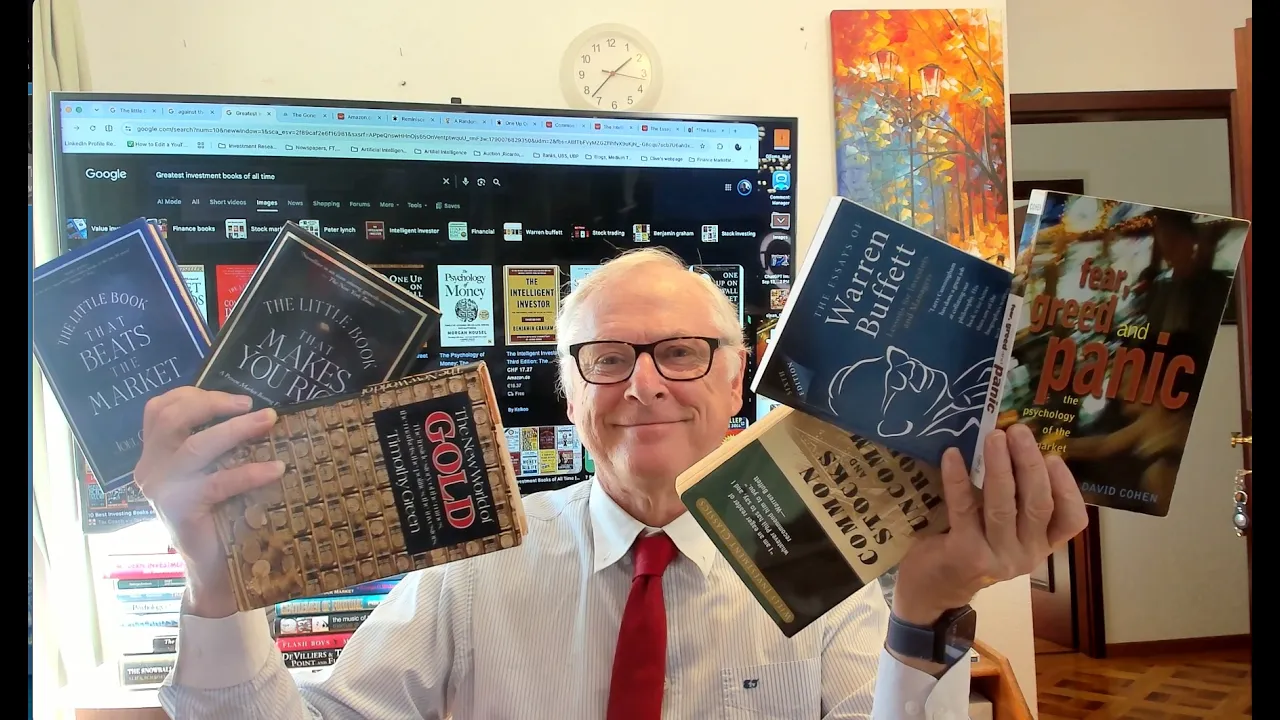
Hello dear friends. My name is Clive Thompson and today I'm going to be talking about great investment books. Many of which I've read. Well, in fact, all the books behind me you see I've read and there's a few which I haven't read. Uh for example, I'm hoping to read this book uh called History of Interest Rates. A big thick tome. Haven't really started that one yet. And I'm halfway through this book um called Empire of Deception by Dean Job. the incredible story of a
88 words, the words spoken in the first 30 seconds at 176 words per minute.
Free, no signup. See how the first 30 seconds hold attention, with rewrites.
Sentence shape
| Measure | This transcript |
|---|---|
| Sentences | 245 |
| Average words per sentence | 17.0 |
| Longest sentence | 99 words |
| Questions asked | 7 |
| Sentences containing a number |
What this transcript is
Every word below is the caption track YouTube publishes for this video, pulled from the video itself and reproduced unchanged. It is not Prepublish's writing, not a summary, and not a re-transcription: it is the video's own published captions. English captions, generated automatically by YouTube, in the video’s original language. Source: the video on YouTube. A channel that would rather this page did not exist can ask for its removal through the contact page, and it is removed.
No Script X-ray for this video: YouTube shows a Most replayed graph only once a video has enough views.
Hello dear friends. My name is Clive Thompson and today I'm going to be talking about great investment books. Many of which I've read. Well, in fact, all the books behind me you see I've read and there's a few which I haven't read. Uh for example, I'm hoping to read this book uh called History of Interest Rates. A big thick tome. Haven't really started that one yet. And I'm halfway through this book um called Empire of Deception by Dean Job. the incredible story of a master swindler who seduced a city and captivated a nation.
It's about a guy called Leo Caretses who back in the roaring 20s swindled a lot of people who should have known better uh by creating a company called the Bayion Bayono Bayano company uh which was basically pretending to own a lot of timberland and oil wells in Panama. I thoroughly recommend reading some books about the great frauds because in this world we are still full of frauds and you need to know what you're looking out for.
The signs are always the same, something which is too good to be true. For example, the books I'm going to be talking about are the ones which provide the greatest insight for you rather than the ones which are the best sellers. Of course, all the books I'll be talking about are books that I have read. And if you don't have a huge amount of time to read, I'll be telling you about a book at the end of this video which brings together the collective wisdom of 150 investment authors.
On the screen behind me, you can see many of the world's best-selling books on investments. Uh, and I've read a large number of these. And what I'm trying to do today is to save you some time by telling you the ones that you should read and maybe to some extent the ones you shouldn't read. But there's some great books out there and if you read the right ones that I tell you um and don't have to read them all but if you read the ones I tell you uh you'll be well ahead of the market.
Um I just looking there's one which I've read Rich Dad Poor Dad by Robert Tiasaki. Um I don't recommend it. I I personally didn't like the book. I felt it was mostly about property, not stocks. And I felt it was very US- ccentric, which wasn't really my cup of tea because I'm not really interested in US property. Um, you know, not to say he's not a great investor and he knows what he's doing. Absolutely. Uh, it's just not my cup of tea, so I won't be recommending that one to you.
Let's start with the greatest investment book of all time called the intelligent investor by Benjamin Graham. Benjamin Graham was the one the man who taught Warren Buffett. So he's the father of in of of investing if you like. This is a very thick tome as you can see it's well thumbmed. I must have read it two or three times. There's no way I can tell you everything which is in it. So when I paraphrase don't think that I'm summarizing an entire book in in two or three sentences.
But let's just say the biggest themes in this are buying undervalued companies. Uh he looks at price to book low price to book. if you want to buy at low price to price earnings ratio. Um he's looking for something called the margin of safety and intrinsic value in the stocks he buys. If you don't have time to read the whole book, I recommend you read chapter 8 which is called the investor and market fluctuations. And basically in this chapter he talks about how the investor's greatest enemy is his own emotions.
The next book I'd like to recommend to you is called Common Stocks and Uncommon Profits by Philip A. Fischer. In a way, it's complimentary to the intelligent investor by Ben Graham because that book is more about buying companies at low price to book, low price to earnings. And this book is about finding companies which have got exceptional growth opportunities. And it tells you how to identify the best management. They also talk in this book about the moat.
A moat is where a company has a product or a service which would be very difficult for other companies to compete with. As an example, you might have a pharmaceutical company which has got a cure for a particular illness and it would be quite hard for another company to break into the same area. One of the things he says in this book is if you find a truly remarkable company bought at a reasonable price, it might be worth keeping forever.
And this is something that I found that the longer you keep stocks, the more profit you're going to make. In other words, more activity tends to dampen your profits a bit. So, keeping stocks forever tends to work best. A very important chapter in this book is called is chapter six called when to sell and when not to sell. Dear viewers, I make these videos for the benefit of everybody so they can learn about investing.
I talk about gold, silver, equities, property, and stories from the past, including stories from my career and stories from the world of investing going back in time. If you like videos which are educational in this sense, please click the subscribe button. The next book I'd like to talk about is called The Essays of Warren Buffett by Lawrence A. Cunningham. Basically, he's taken the annual shareholder letters written by Warren Buffett and reorganized them into a coherent set of lessons about investing.
There are more lessons in this book than you can possibly imagine. But just to take one interesting concept from the book, he talks about the difference between price and value. Price is what you pay for something. Value is what you ultimately get back. And if value, what you get back is significantly more than what you paid, you've got a bargain. Elsewhere in the book, uh I recommend reading the chapter called Mr. Market, which is taking a leaf out of Ben Graham's book, The Intelligent Investor, where they imagine an imaginary person called Mr.
Market. And Mr. Market is more than willing to buy your stocks when there's panic in the marketplace. People are distressed. They're distressed selling. They're selling at very low prices and they are selling below what the stocks are worth. In other words, the price is below the value. And the opposite is true from sometimes Mr. Market is very excited. He's very enthusiastic. He's very bullish. And he's willing to buy stocks from you at more than what they're really worth.
In other words, he'll buy the price he'll pay is higher than the value. Uh so that's a great chapter to read if you want to read just one chapter of this book. The next book I was a little bit uncertain whether I should show it to you. Um it's called Security Analysis by Benjamin Graham and David L. Dodd and it is a thick thick tome and there's a lot in it and the reason I was a bit reluctant um this book was written in 1940 although it's been updated many many times but you will find that some of the sections seem to be a little bit dated having said that it is a very serious professional textbook for analyzing shares bonds distress securities and most of what's in here is valid today as And one of the comments in this book is that an investment should protect the capital and offer an adequate return.
And if it doesn't, you're just speculating. If you want to read just one chapter from this book, it's going to be chapter four, which is called the distinctions between investment and speculation. The next book to look at is the most important thing illuminated by Howard Marx. Now this is a book which focuses on market cycles and contrarian opportunities. He likes value investing. He likes momentum and he talks about the market psychology and how you can avoid overpaying for stocks.
Um so it's all about risk risk cycles let's say contrarian thinking um and understanding the way the market is behaving and actually taking advantage of that. So what he's saying is if you want to be a smart investor, you want to be better than the rest, you have to think differently from the crowd and you have to be right. He basically says that in order to perform well, you need a trace of wisdom, a little bit better than the average.
And here's a line from his book and it goes like this. No rule always works. And how true is that? We buy books all the time with, you know, how to make money in stocks and it's all about one rule. Basically, it's buy low, sell high, dressed up in a complicated formula. But actually, whichever rule they've got in that book, it works some of the times, but no rule works all of the time. And that's very valid. If you want to choose one chapter to read from this book, it's chapter two, which is called the most important thing is understanding market efficiency and its limitations.
And basically he discusses the theory known as the efficient market theory and says that he you know the markets are efficient but they're not always right and you can take advantage of that. The next book I'd like to recommend to you is One Up on Wall Street by Peter Lynch. Now Peter Lynch was one of the world's greatest investors. He ran something called the Mellan Fund uh for 13 odd years with an average compound rate of return of 29.2% 2% and he could retire at the age of 46.
Um, this book has got some great stuff in it. He basically says that private investors can discover great companies before the professionals find them. And he tells you exactly how to do it. Flicking through the book, I see I've written a lot of notes in the margins when I when I read it. I'll just read a few of my notes. Um, thanks to the information highway, the average investor can now do as well as the professional and in some cases better.
Similar to the picks and shovels strategy in the gold rush, it is possible for non-technology companies to benefit from new technologies. So that would be very relevant to artificial intelligence. You can buy the AI companies themselves or you can buy the companies which are going to benefit from AI. Here's another article thing I've written in the in the margin. Liking a product or service isn't necessarily a reason to buy it stock, but it's a good reason to take a closer look.
Uh here's one. Diversify and you will have both winners and losers. But the maximum you can lose on a bad pick is 100%. There's no limit to what you can make on a winner. Here's another one. Stock market news has gone from hard to find in the 1970s to impossible to get away from now. It's easy to think you see something that no one else sees. But of course, everybody else sees what you see. Um, history shows that both bull and bare markets are dominated by a small group of market leaders.
In other words, when the market's going down, it's the leaders which are going down. When the market's going up, is the leaders going up? So, bear that in mind. If the market goes down, the stocks you don't want to be in are the market leaders. As of today, investors tend to be pessimistic and optimistic at precisely the wrong times. Stocks aren't like wives. Oh, this is a funny one. Stocks aren't like wives. You can get rid of them if they stop performing.
Anyway, uh that's uh Peter Lynch for you. Uh those quotes were my own, not uh Peter Lynch's, but they were quotes I wrote as I read the chapters of his book. The next book to mention is called A Random Walk Down Wall Street by Burton G. Malcielle. I'm not sure what to say about this book because in a way it implies that all the books with um investment methodologies don't work as well as a diversified portfolio of stocks picked randomly.
In other words, the monkeys and the dartboard principle. The monkeys throw darts at the dart board and you just buy those stocks. Now that's not exactly what he says. It's kind of the impression I got. But he does stress diversification index investing and he has a lot of skepticism towards market beating systems. So in a way he's the opposite of all the other books I'm talking about which say that you can beat the market.
So why am I showing it to you? Well, if you don't have a lot of time to read books and study the market, he's actually right. you should just buy a basket of stocks or some index funds, e exchange traded funds as they're now known, and sit on them forever and you'll be fine. And he basically says if you have a collection of index funds and hold them over time, you are likely to beat the professional portfolio managers.
And in that respect, the evidence is that he has been right and that's what you should have done. So basically he's arguing that markets are mostly efficient and right whereas the previous book said they can be efficient but they're not necessarily right about the price. Another reason why this book may not suit some people. There's an awful lot in it about taxation and it's very US- ccentric. So uh if you're not living in the USA it's maybe not for you but if you're living in the USA it's a great book.
My favorite chapters from this book are chapters two and three. Chapter two is called the madness of crowds in which he talks about some past speculations such as the tulip bubble, the South Sea bubble, and chapter 3 is a good one, too. Chapter 3 is speculative bubbles from the ' 60s into the '90s. So, there's a lot of history in this book, uh, basically to prove the point that there's too much speculation in the market.
You should have just bought an index fund and not try and second guessess what's going to be good or bad. The next book I'd like to talk about is called Reminiscences of a Stock Operator by Edwin Lefv. Now, this is more of a story book than uh a book about investing, but it follows the story of Jesse Livermore, who was an investor back in the 1900s and 1920s. Uh Jesse Livermore went from fortune to bankruptcy to fortune to bankruptcy several times, and I believe he died a po a porpa.
This book was written in 1923 before Jesse Livermore died. Although this book doesn't give you any specific stock strategies to buy individual stocks, it does give you a sense of uh crowd psychology, speculation and leverage and selfdeception. It's hard to read an individual chapter out of context. You should really read this book from start to finish. But if you had to pick one chapter out of it, I would take chapter five, which is basically the downfall of Jesse Livermore at the end of the day, uh, due to constant buying and selling.
So I suppose the underlying messages buy and hold would have worked a lot better for him. Another book I particularly like is The New World of Gold by Timothy Green. Now, this is an outofdate book. It's 1982 and it was written at a time when gold had soared from $35 to $850 and then crashed afterwards. Where I think it's interesting is for the historical context of what the world was thinking about gold at the time. It doesn't really reflect today's modern world where a lot of things have changed.
I think it's a great read and there's still a lot of very valid stuff in it today. I'll just read a line or two from the book to give you a sense of the historical context. Major Middle East wholesalers thought nothing of ordering up to 750 kilos of gold a week from Swiss banks. All this came to an abrupt halt, of course, with the soaring gold price in the autumn of 1979. Jewelry manufacturers and hoarders stopped buying long before the Swiss banks found themselves buying back melted ornaments, literally by the ton, as the price pressed on to $850 an ounce in January 1980.
Their refineries were kept scarcely able to cope with the disording. In all, the Swiss repurchased nearly 150 tons of gold mainly from the Middle East during 1980 as local prices in places such as Cairo and Tran fell far below the international level. The next book to show you is the gone fishing portfolio by Alexander Green. In this book, he tells you that you can have an effective yet simple approach to investing that embraces the uncertainty of financial markets and reveals how you can generate exceptional results both during good times and bad times.
But basically, he's saying don't believe the hype that you need a professional investment manager. You can do it yourself and you can do it yourself very easily and then go to sleep. The book contains a nice asset allocation strategy starting off with 30% US equities, 30% international equities. Then it talks about property, it talks about gold mining shares, talks about inflation linked bonds and short-term bonds and what's known as high yield bonds.
And it gives you percentages for each. And he says, don't keep looking for the perfect moment to invest. As an illustration, he says, look, if if all the lights had to turn green before you left home, you'd never leave home. Sometimes you just got to invest and accept the defaults of the particular company or the economy or the market at the time. My favorite chapter in this book is chapter well it says chapter 13 but it might be chapter 15 in a later version um which is called the in other words it's the last chapter of the book it's called your most precious resource and in that chapter it talks about your time and building a portfolio to get the maximum time and I'm just uh looking here I see I've underlined some some thoughts here for example I've underlined without any kind of sell strategy emotions come into play and emotions are almost always wrong.
I'll just go quickly through a couple of other books without reading anything from them. Uh, another Peter Lynch book which is called Beating the Street. Really great book. Fear, Greed, and Panic by by what's his name? David Cohen. Another set of books which are really easy to read are called the Little Book series. little book that beats the market, little book that makes you rich, the little book of value investing, and there's quite a few more.
Those books are all really easy to read and actually really useful. Another book which shaped my thinking about risk and investing was a book more about gambling and probability than anything else called Against the Gods by Bernstein. In this book, he traces the history of probability and the history of gambling right back to ancient times from the ancient Romans rolling the dice through to gambling in the Renaissance period and then modern-day gambling and probability.
And even if our ancestors didn't understand probability very well, those who organized the games still had the odds on their side. This book opened my eyes to a number of things which I had not previously understood. It's an easy read. It doesn't specifically talk about stocks, but if you are an investor in stocks, you'll need to read it. The next book completely changed the way I invest after I'd read it. This book is called What Works on Wall Street.
The book was first published 30 years ago, but it's been updated countless times since then, so you can find a modern version of this book. This one I'm holding up is a book I read many decades ago. In the book, it stresses many strategies for investing money. Strategies like buying stocks with high momentum, buying stocks with low price to sales ratio, buying stocks with low price to earnings ratio. All of these techniques are thought to be good investment techniques.
But do they all work? And which ones work best? And do having two techniques in combination, do they work well? This book has got countless tables of how various investment strategies would have worked out over the decades. Which ones would have worked and which ones would have not worked. For example, um I see a table here which tells me how $10,000 would have become between 1954 and 1996 with a variety of strategies.
So, for example, price to sales ratio less than one, high relative strength, all stocks would have produced about $13 million from a $10,000 investment. Whereas, had I bought uh at the bottom of the table high yield large stocks, that $10,000 would have turned into $1,732,000, much less than the $30 million, should we say, uh from the first strategy. So each of these uh strategies which man has uh developed as an investment idea are followed and in my in my notes which I wrote about wrote after reading the book um I've just got a I'll read a few extracts from it.
My conclusions from reading this book many times are one there are some strategies that consistently do better than the S&P 500. There are some strategies that consistently do worse than the S&P 500. There are also strategies which have less risk or volatility than the S&P 500. And then I go through the best and worst strategies in my notes here. Of course, there's no guarantee that these strategies which did work in the past will work in the future.
But you've got a good indication that of the kinds of things which have worked well and the kinds of things which worked less well. The next book, which I'd say is required reading, is called the Bitcoin Standard. I won't go into the details, but just trust me, it's going to be worth reading. And it talks about the debasement of the world's money and why things like Bitcoin could be interesting. I promised you one book to read if you don't have time to read all the others.
And it's this book. It's called The Harman Book of Investing Rules, edited by Philip Jen and Steven Eckett. And basically, it contains 150 summaries of great investors. you might notice is that some investors just aren't mentioned. I didn't see Warren Buffett mentioned anywhere in the book, but there are lots of famous investors mentioned. For example, here's a page about Ray Dallio and it for each investor, they discuss that investor's investment strategy and what makes them a winner in their own strategy and what how they how it works for them.
So, I'm not going to say there's 150 investment strategies in here, but there's certainly a lot of different strategies, including some common themes and some unusual themes, including investing in futures and investing in options from certain investors. As far as I can tell, this book is made up of articles or contributions by the authors themselves, um, which maybe explains the absence of a few, like Warren Buffett's not in there, but I'll give you a few names which are in there.
Out of the 150, William Bernstein, John C. Bogle, Lawrence Cunningham, Mark Faber, the Goldman, Jeremy Grantham, Bill Gross, Burton Malkeiel, Robert Prector, Charles Schwab, Gary Schilling, Jeremy Seagull, Jim Slater, Paul Templeton, and Ed Yardini, just to name a very small number of people who are in the book with their articles about how to invest money. My name is Clive Thompson. If you'd like more videos from me about investing generally in equities, in gold, in silver, in property, or anything else, please click the subscribe button.
Thanks very much for watching, and also I'd like to say thank you to everybody for the lovely comments on the recent videos. Much appreciated. Goodbye everybody and look forward to seeing you
The words are the caption track's own and nothing is reworded or re-transcribed. Paragraph breaks are placed between sentences so the text reads as prose.
Free tools for your own script. No signup, no login.
Paste your draft and see where viewers are likely to drop off, with a rewrite for each weak line.
Paste the first 30 seconds of your own draft for a hook score and rewrites.
Check your draft against YouTube's advertiser-friendly guidelines before you record it.
Read this channel's public videos and transcripts, and download a writing brief for it.
| 28 |
Most used terms
Filler phrases
85 in total: uh 28 · um 18 · like 16 · basically 13 · actually 4 · you know 3 · kind of 2 · literally 1.
A literal whole-word count of the same phrase list the Prepublish browser extension uses, so a phrase inside another word is not counted and a phrase used in its ordinary sense still is. It is a count and not a judgement.