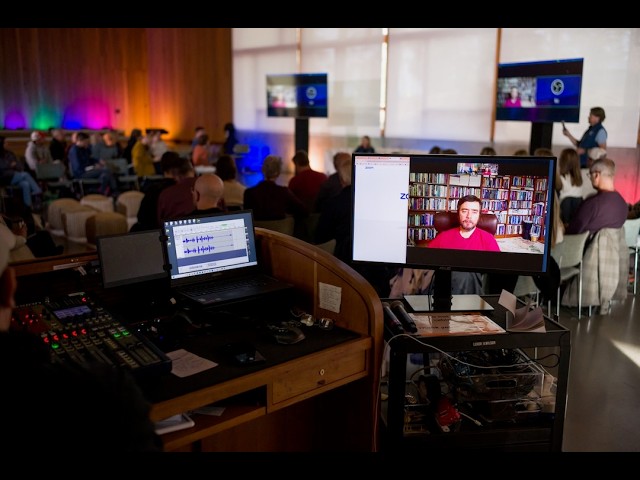
Recognizing Intelligence in Unconventional Beings | Michael Levin | Artificiality Summit 2025 transcript
Stay Human, from the Artificiality Institute · @Artificiality
Words
12,141
Runtime
59:49
Speaking pace
203wpm
Reading time
51min
203 words per minute, above the 201 75th percentile of 349 measured videos. That distribution comes from the 349-video hook study.
Opening (first 30 seconds)
Good morning everyone. We hope that you found your way around town. You at least these groups found your way back which is lovely. So, oh thank you Dakota for the lights. So this morning we have the great pleasure of having Michael Leven join us again. Now, yesterday, one of the things that I stressed was the word synthetic and why we like to use the word the phrase synthetic intelligence. And I actually credit Michael for at least my real interest in that phrase. And last year, if you were here, you heard Michael talk about diverse intelligences. And when
102 words, the words spoken in the first 30 seconds at 203 words per minute.
Sentence shape
| Measure | This transcript |
|---|---|
| Sentences | 710 |
| Average words per sentence | 17.1 |
| Longest sentence | 120 words |
| Questions asked | 59 |
| Sentences containing a number | 17 |
Most used terms
- uh222
- um79
- patterns52
- cells39
- okay36
- space36
- different32
- physical28
- kinds24
- world24
- actually23
- beings22
Filler phrases
509 in total: uh 222 · um 79 · like 63 · you know 41 · kind of 40 · actually 23 · basically 15 · sort of 11 · right? 8 · I mean 7.
A literal whole-word count of the same phrase list the Prepublish browser extension uses, so a phrase inside another word is not counted and a phrase used in its ordinary sense still is. It is a count and not a judgement.
What this transcript is
Every word below is the caption track YouTube publishes for this video, pulled from the video itself and reproduced unchanged. It is not Prepublish's writing, not a summary, and not a re-transcription: it is the video's own published captions. English captions, generated automatically by YouTube, in the video’s original language. Source: the video on YouTube. A channel that would rather this page did not exist can ask for its removal through the contact page, and it is removed.
Transcript
Good morning everyone. We hope that you found your way around town. You at least these groups found your way back which is lovely. So, oh thank you Dakota for the lights. So this morning we have the great pleasure of having Michael Leven join us again. Now, yesterday, one of the things that I stressed was the word synthetic and why we like to use the word the phrase synthetic intelligence. And I actually credit Michael for at least my real interest in that phrase.
And last year, if you were here, you heard Michael talk about diverse intelligences. And when you get your head around the idea, which takes a little work, you understand the sort of the scope and scale of intelligence that exists. And I think once you understand the scope and scale of what might exist, it helps you think about all the kinds of possible intelligences that we don't even know about yet. So the concept of only making artificial versions of what exists seems kind of limited.
And so I I thank Michael for inspiring for me what I think of is the pursuit of possibles, the pursuit of possible intelligences, things that are beyond the, you know, constraints of our own understanding of our own three-dimensional experience of the world because these intelligences live in basically unlimited dimensions. And so Michael really opened my eyes and my mind kind of sometimes I feel like he opens my mind a little too wide open. uh you know uh but thank you for that and I also want to credit and thank Michael for his incredible generosity.
This is not an easy journey um that primarily my wife takes me on on these sort of intellectual journeys and so it is um really wonderful how much time and care that Michael has taken with us in helping us think through these things. So I'm going to just step out of the way and let Michael give you his presentation today rather than try and stub my toe making any introductions. So, thank you very much, Michael, for joining us again.
Go ahead, Michael. >> Fantastic. Thank you so much. Um, okay. What I'm going to talk about today is a topic that I call mind blindness. And, uh, we're going to discuss the prospects for being able to recognize and communicate with a very wide variety of unconventional beings. If you want to follow up on any of this, uh, this is my official lab website. So, the data, the the software, the published papers, every everything is here.
And this is my personal blog around what I think some of these things mean. So uh what I would uh ask us to do first is to consider uh this this phenomenon of the butterfly um developing from a caterpillar. So you start off with a softbodied creature which crawls around in a kind of two-dimensional world. It eats leaves and it has a brain suitable for that purpose. Now what it has to do is turn into this this very different creature which is which is has hard elements completely different controller needed.
It lives in a three-dimensional world. It flies around, drinks nectar and so on. And it has a very different brain. In order to get from here to here, what this system does is basically uh dissolve most of its brain. Most of the cells are killed off. The connections are broken and uh eventually a new brain is rebuilt that's suitable for this for this life. Now, the I'm going to use this as a as an example to talk about the plasticity of our perspectives because this the the subject matter here that we're dealing with has enormous plasticity.
And in particular, what happens is that if you train this caterpillar, okay, if you train it on a behavioral assay, you can then find out that the moth or butterfly that results from it still remembers the original information. In other words, memories uh persist through this kind of drastic refactoring of the brain. And you can think about how that might be. But more importantly is the fact that memories can't persist as they are.
The actual memories of a caterpillar. In other words, for example, uh crawl over to eat leaves when you're hit with a particular light stimulus are of no use whatsoever to the butterfly because first of all, it doesn't move like that. Second, it doesn't care about leaves. It wants nectar. So it's not about the fidelity of the memories. It's about the salience of the memories being remapped onto a completely different body.
So now in this model system now that we've we've discussed that I want to invite you to take uh three different perspectives. The first perspective is that of the caterpillar. So as a caterpillar you are involved in a process that uh is going to drastically remake you. In fact you're facing a singularity. There's an impending singularity where you as you know it are not going to exist any longer. However, in some important sense, you will continue in a new world, in a higher dimensional space with new capabilities.
Uh things you cared about before, you will no longer care about, but you will have new new and interesting things to do. So, so that that would be the perspective of the of the uh of the caterpillar. Now, take on the perspective of the butterfly. uh you've come into the world, you have things that you're interested in and things that you can do, but you you're also kind of saddled with some mysterious memories, these behavioral traits, uh such as the well, the things that the that the caterpillar was trained on, but of course, you don't know anything about that.
You just know that you've inherited some sort of weird propensities to to do certain things when you see specific stimuli, and you don't know where those come from. Um they're certainly not from this life that you remember. they come from somewhere else, right? And and somehow they become integrated into your behavioral repertoire. So that's that's a different and also interesting perspective. Now, the most bizarre one of all, I propose to take the perspective of the memory itself.
And we're going to talk about how it is that memories and other patterns in excitable media can even have perspectives. We'll we'll we'll get to that. But but the but the idea basically is this. If you're a memory pattern within this uh within this system within the within the caterpillar, what you know is that you can't persist as you are. If you hope to persist through this change, you yourself are going to have to change.
You're going to have to be modified in a way that is going to be salient to this uh novel substrate so that you are not wiped and forgotten. That means um you you're facing the paradox of change. If you don't change, you will not persist. if you do change, are you really the same? Are you really you anyway? And and all of these interesting things are brought up by this by this kind of uh system. And the reason the reason that that uh I I'm going through all this is that I think we're going to have to radically widen the number of systems from whose perspective you are going to have to learn to think. right now uh we don't do that very well and we're going to have to get much better at it because what we're going to talk about is not about language models or standard AIs.
The first thing that we're going to confront is this this kind of thing because we now know that as humans we stand at the center of this continuum. We were single cells both during evolution and during embryionic development. Each of us made their way from a single cell to what we are now some sort of modern adult human. But of course uh there's another uh continuum of modifications here both biological and technological where we already have the humans walking around with the sensory augmentation and various implants and that's that's only going to that's only going to grow.
And so the idea is that uh this distinction that people like to make between proper proper beings, proper humans in fact and and then so-called machines uh is really not going to serve us well at all uh in the next uh coming decades because uh what we don't want is to be sitting there trying to figure out whether your neighbor has 51 or 49% of their brain replaced with various engineered artifacts to see if they are a real human and deserving of your of your respect and compassion and and and whatever. whatever else.
And most of these issues and you can see this discussed in this paper. Most of the issues brought up recently by AI um uh such as uh you know do do these kinds of systems truly understand I mean we understand things. What does that really mean? You know uh all these kinds of questions are fundamentally unsolved questions about ourselves, right? They're being brought up by technology and AI, but they're really not novel. this issue of of being replaced, you know, and and future generations doing things that past generations don't don't understand and all all all these kinds of things have been with us for for a really long time.
So, what I'm interested in is trying to uh expand our very limited idea of how to recognize other beings and how to relate to them. And I want to give you a very simple example. uh in the pre-scientific age we had static electricity and we had lightning and magnets and visible light and we used to think those were all very different things. We had different names for them. We thought they were categories that are discreet.
They are different and and so on and uh then the the theory of a modern theory of electromagnetism did two things for us. First of all, it told us that all of those kinds of things are really manifestation of the same underlying continuum. So it discovered a very deep symmetry in the world showing us that our former categories don't really cut up the world in a in a uh in a deep in a deep way and we're going to this this issue is going to come up again and again.
And the second thing it did is remind us that because of our own evolutionary history, we are only sensitive to a tiny portion of the spectrum. We were completely unaware that all this other stuff exists and we were not able to operate in that spectrum. And I would propose that we have the exact same issue with respect to other minds. we um have a tremendous amount of mind blindness around beings that operate at different scales uh in different spaces and so on.
We're just not good at recognizing them because of our own evolutionary history. So uh my my framework and the goal of a large part of my lab is around being able to develop tools to recognize, create and ethically relate to truly diverse intelligence. And that means not just uh primates and birds and maybe an octopus or a whale, but also really weird creatures such as colonial organisms and swarms, engineered synthetic new life forms, AIs, whether software or robotic, maybe someday exobiological agents such as aliens, and then even some very strange things which I'll touch on towards the end of the talk, such as patterns in physical media.
And uh what what what we'll end on is this idea of patterns in a platonic space. Um, some of some of this can be seen in uh in in this uh paper where I very carefully go over all the kind of philosophical issues that are that have to be settled here. But what I'm fundamentally interested in is uh frameworks that are not just philosophy but make really practical content with the the world. That is they move experimental work forward and most of our lab um takes these advances into regenerative medicine and birth defects and cancer and and things like that.
But but as well uh eth development of of of novel ethical systems which I think is going to be critical and the one thing to to understand about uh this kind of spectrum uh of of whether you call it intelligence or cognition or whatever the the important thing about the spectrum is that it's what we're really talking about are is choosing appropriate relationship tools. So if if the system is simple and and mechanical then you're the only way you're going to relate to it is by modifying its hardware. you're not going to convince it of anything or make it feel guilty or or anything like that.
But if you have a system like your thermostat that is a is homeostatic, then you have something new you can do. You can use the tools of control theory and cybernetics to reset its goals. It's a it's a it's a primitive goal seeking system. And then you keep going and eventually you encounter systems that um have all kinds of learning capacity and you can interact with them via the tools of behavior science and training and rewards and punishments.
And then eventually you reach systems with which you can use the tools of psychoanalysis and friendship and love and and and reasoning and and and all of that. So so the key thing to understand is that when you're looking at some system, you can't simply have feelings about where you think it is on the spectrum. You know, when you see cells or simple simple machines or whatever, you say, well, I don't think this thing is cognitive.
You can't you can't really say that. You have to do experiments. Um all of these things is to be deci are to be decided empirically and not not via ancient philosophical categories. And any kind of a claim like this is really a protocol claim. It means that you take your set of tools, you try to have that interaction with the system and then all of us can see how well that worked out for you and maybe you guessed too high or maybe you guessed too low.
But it's really important to develop these tools so that we can get a good estimate when we're dealing with systems that we do not understand very well. And uh I think I think what's going to happen here is similar to what's happened in mathematics when people discovered new and different kinds of numbers. So originally we had the counting numbers and everybody understood what that was. One sheep, two sheep and so on.
Then somebody came up with zero and that was kind of wild and then eventually negative numbers and then you know ratios and then irrational numbers. And what happens as you expand your your concept is that uh you have to you have to widen the initial definition which was too narrow. So these ancient categories can be too narrow to give you what you want. And then you have to break some assumptions. You have to be able to recognize these other things.
You have to be able to do something useful with them. And uh and I'm going to uh basically go up this uh go up this um this this scale to show you how we're going to expand this notion of other cognitive beings that you might want to interact with. And and the thing is that process is disturbing. Uh that you know this poor guy got drowned. They drowned him off a ship for talking about um irrational numbers and things like that because anytime you break ancient categories it shifts around a lot of things that we've gotten used to and uh it makes things more complicated.
But I think more beautiful in a very necessary sense. And the thing we're going to have to get beyond is this ancient picture. This is this was called Adam names the animals in the Garden of Eden. And uh you see what's going on here? Uh there's are discrete natural kinds. There's a there's a finite set of specific individual creatures. Um Adam's giving them uh names and then and then we'll know everything that exists and we'll have a we'll know how to relate to to all of these things.
So, we're going to have to what what we're going to have to break here is this is this notion that uh that we can easily tell where all the creatures are and uh and and that there's a a specific set that we know ahead of time what everybody is. The thing we're going to keep from this is actually a very deep and interesting part of the story, which is that originally Adam had to name the animals. God couldn't do it. The angels couldn't do it.
It had to be Adam to name them. And and that's because well for two reasons. One is that uh he was the one that was going to have to live with them. And that's true. We are going to have to do the same. And also uh in these ancient traditions, naming something means you've discovered its deep inner nature. Yeah. When you give something a name, you've discovered its profound inner nature. And uh we are going to have to do that.
We're going to have to discover the nature of some some very novel beings that no one has seen before. So we're going to have to we're going have to really get uh get get beyond this kind of picture. So let's start let's start in a place where everybody understands. So, uh, it it's really easy to detect mind in brainy animals. Um, like this this this little guy is going to set up a little accident scene here. He knows he knows exactly what he's doing.
He he has a pretty good theory of mind. Uh, he's even going to look to see if uh if if mom and dad are are are watching to make sure that, you know, make sure that somebody's somebody's catching this this the terrible accident scene. And and this is, of course, this is very obvious because it works on the same spatial temporal scale as we do. It's in the same problem space. these beings have similar goals, you know, as as we do.
Okay, we we can detect this pretty easily. So, now let's get beyond this. Let's talk about biological intelligence outside the brain. And we're going to have to make some leaps here. And we're going to have to we're going to have to break some things. And this is what we do mostly in our lab is we study cells as collective intelligence operating in morphus. The first thing to realize is that we are all collective intelligences.
Why? Uh because we are made of an agential material. This is what we're made of. Not just not just bee colonies and antills and things like that. Our collective intelligences. All of us are made of parts. And by the way, our parts are very smart. So this is a single cell. There's no brain. There's no nervous system. Well, this is this is a free-living organism. But uh but you get the idea. Uh it it has it has extreme competency in its tiny little cognitive light going here with its local very very small agendas.
Uh but this is the kind of thing we're made of. And in fact, even this creature, if you think to yourself, um, what is this thing made of that allows it to do that? Well, it's made of molecular networks. And as it turns out, these molecular networks are themselves capable of at least six different kinds of learning, including Pavlovian conditioning. Just the molecular networks inside, not the cell, there are no neurons, but but but just small molecular networks already are capable of learning.
Not only that, we recently found out that uh learning and causal emergence are tightly related. As the molecular networks learn, their causal emergence goes up. So that means they become more integrated. They become more more of more than the part than the sum of their parts. Okay. So so individuality and individuation and learning are are are tightly coupled and we're using we're taking advantage of this in the lab for um applications like drug conditioning and other things that are very important in biio medicine.
So, as we think about the future and the kinds of beings that we're going to share our world with, we have to remember that we as humans are just obsessed with three-dimensional space. We because of because of our our own senses, you know, we see creatures uh doing smart things by moving around in threedimensional space and we say, "Okay, that's that's intelligence and we're okay at recognizing that. Not not great, but but we're okay." But biology has been solving problems in all kinds of weird spaces that are very hard for us to imagine.
So the space of all possible gene expression, that's like a 20,000dimensional space. The space of physiological states, the space of anatomical outcomes. Long before muscles and nerves and brains and all of that developed, living things were doing that same perception, decision-m, memory, action loop that that we associate with behavior in threedimensional space. Biology was doing that in all these other kinds of spaces.
And so this means you have to be very careful when you say that your AI is not real because it is disembodied because it isn't rolling around in the physical world and touching things in the uh in the 3D environment and you say okay well it doesn't have a body so therefore it doesn't bind its symbols and it can't know what it's talking about. Yeah, there's there's a there's a whole lot of different intelligences in biology that that that do that same tight interaction with their environment but not because they're moving in 3D space.
So we have to we have to break our um you know kind of kind of attachment to 3D space as the only space in which you can have a body. There are many other spaces in which you can have a body. And I just want to point out normally I would give a whole hour um talk about this. I just want to point out two two two quick things about this collective intelligence of cells. Becoming what what you are whether you're a human or um or or this this axelottle um becoming what you are is a navigation task in anatomical space.
It is not a set of uh hardwired mechanical chemistry rules that just sort of roll forward. That is not at all what happens in development and in general is uh is incredibly plastic and it's a goal seeking process. If you amputate this limb anywhere along the the length, the cell the the the cells know that they've been deviated from the right position in anatomical space. They'll work really hard to get there and then they stop.
That's the most amazing part of this is that when they reach their goal, they will stop. That's how you know it's a goal-seeking system. Uh, and of course, no individual cell knows what a finger is or how many fingers you're supposed to have, but the collective does and it very reliably pursues this goal. And the same thing is is true during during development. Now, what's important about this the fact that uh the reason I'm going through this is that these cells, it's the collective intelligence that pursues this this giant goal.
And I want to point out why why this is important. Here's here's an experiment that was done in the 50s. Somebody took tails and grafted them to the side of this kind of amphibian to the flank. And what happens is that over time that tail become begins to remodel into a limb. Now that is an amazing thing. This is not about damage and it's not about injury response. Take the perspective of the cells up here at the tip of the tail.
They are tail tip cells sitting in their normal position at the end of the tail. There is no damage. There is no injury. And yet they turn into fingers. Why are they doing this? Because this is a system when with top down control because the collective, not the individual cells, but the group knows perfectly well that what you need in the middle here is a is a limb, not a tail. And then those commands filter down and actually uh make all of the cell biological and molecular biological changes needed to turn this structure into into fingers.
So from the perspective of the of the tail, right, if you were if you were a cell sitting here, you would have no understanding of what's going on, but there would be major changes coming and it's very clear that they're integrated, that they're some something is happening. These are not random changes, but you don't know why and you don't know where it's going because you don't have the as a as a single cell, you don't have the cognitive ly to see into that anatomical space to know what's going on.
Okay? But the but the collective does. And the reason it's important is that all of us are these kinds of systems. So so ju just imagine this this this is a remarkable uh fact that that hardly anybody talks about. When you wake up in the morning, you might have u financial goals, social goals, uh what whatever these are extremely abstract goals in very abstract problem spaces. For you to act on any of them, you have to get up out of that.
In order to do that, uh, potassium and calcium and other ions have to move across your muscle cell membranes for you to actually execute those goals. Th this this is this is remarkable everyday magic that that these abstract mental states are actually making the chemistry do do different things uh at the uh at the at the location of of of your aectors. And your whole body is basically a system for transducing very high level abstract uh thoughts and and goal states down into the molecular events that have to uh have to take place for you to actually walk.
So so what you have here is and and and so this is something this is something that we study in our lab all the time is how does that transduction work and how do we communicate with the different parts of the uh of this of the system. Okay. And so so the way the system actually works has to do with bioelect electricity. Not a huge shock because of course we already know that's how our brain electrophysiology works and and and that's where it evolved.
But we develop tools to read and as I'll show you momentarily write the electrical pattern memories that this collective is forming. So this is an early frog embryo and you can see each one of these things is an individual cell and then they're going to divide and so on. But all of these colors are electrical conversations that the cells are having with each other so that the collective can figure out which side is left, which side is right, how many eyes are there going to be all all that kind of stuff.
And we have lots of we've developed lots of computational tools to try to understand what's going on here and how these electrical pattern memories work. And I want to show you um an instance of communication uh and in particular uh uh how how these kinds of collectives talk to each other. So this is the these are two frames from this video which I'm going to play momentarily and the color again uh these the color indicates voltage.
Okay. So so what we're reading is again these bioelectrical states the color indicates voltage and what you'll see is that this cell has a very different voltage than this whole um collective here except after it makes this tiny little contact. Boom. Then it changes. So so watch what happens. So here it's minding its own business moving along. It has a different electrical state than this. Bang. That's it. That's all it takes is that tiny little touch and now it changes. it becomes just like this this other collective uh group of cells and it goes over and joins them and starts to boom.
That's it right there. It's been it's been hacked and it found whatever whatever message you just got. It found really convincing and it went over and uh and and began to work with them. Now, the reason we we like to study stuff like this is because we want to communicate to these collectives, too. For example, here's one, and I could show you dozens of examples, but here's one. U we've learned how to prompt the cells to make an eye.
So, what you're looking at is the side of a tadpole here. This is the brain up here. Here's the mouth. Here's the gut. The other eye is back here on the other side away from you. And here's the normal eye. What we did was inject uh some ion channels to give the these cells here a very simple voltage-based message that says build an eye. We we have no idea how to build an eye. We have no idea how to control all the tens of thousands of molecular events that need to take place to specify an eye.
Much like you don't know what you have to do to get ions to move across your muscle membranes to make you walk, right? Your body is takes care of that being the transduction machinery. Same thing here. Once we give the stimulus, if we do it correctly, not only will the cells obey and build an eye and we don't have to sweat the details of of how it happens, but also if we don't inject enough cells, so the blue ones are the ones we injected, they will automatically talk to all the others and get them to participate.
Okay? So So all this brown stuff out here, we never touched it. we we only injected these blue cells. They got they they instructed the others to help to help out and make this thing. So the material is is is is incredible. Not only does it understand very highlevel messages like like an eye, right? Not just gene expression, not just the proteins and things like that, but it actually understands organ identity, but it also knows how to uh uh distribute that message to to other cells so that so that they will help.
Of course, they resist actually, but that's that's a whole other story. But this is this is why we would like to learn to communicate. And so what you're seeing here is the practical implications of of of having these crazy ideas about talking to collective intelligence is you have to find the cognitive glue. In this case, it's the bioelectric dynamics that we've been tracking. And then you have to learn the language and then you have to be able to send the messages in that send and receive messages in that language to communicate with them.
And that's how you know you're on the right track when you're able to have uh applications in regenerative medicine or or other fields that um that actually work. And so just as a as a kind of peak at what I think future medicine is, you know, today all uh all biio medicine is basically here. It's all these bottom up techniques focused on the hardware and really understanding not only the software of life but actually the intelligence of the agential material of which we are all made and you can see the details here are is going to allow some amazing uh novel uh approaches and I think future medicine is going to look a lot more like a kind of sematic psychiatry than it is like chemistry.
Right now everyone thinks it's going to look like chemistry. I actually think it's going to be all about um communication and and and and uh other other ways to understand the stressors and the memories and the priors and everything else of the material of which we're made. So, if that wasn't weird enough for you, uh that taking taking this this notion of um of behavioral intelligence from 3D space into anatomical space and developing tools to communicate with that anatomical intelligence about the things it cares about, which is about different kinds of anatomy.
Um, I want to take one step further and I want to talk about uh active patterns as the target of our communications. Up until now, what we've been talking about are actual physical things. Okay, they're weird because they're not brains, but they're cells and in fact electrically active cells. So, you can kind of get get an idea of how we're going to talk to them, but now we're going to take one step further and we're going to go beyond this and we're going to talk about um patterns as opposed to uh physical objects.
So, so what I mean by patterns are things like this. First of all, these are this is a simulation. So this is an amazing uh system called Lennia by Bert Chan where uh you can find these it's basically like if you've heard of the game of life uh the cellular automaton it's a souped up version of that. You can think of it that way but it has these amazing patterns in it. And the patterns I mean to our visual system which is very key to understand to to detect agents.
You can see that these are not just individual pixels turning on and off. you've got some you've got some uh stable um well patterns for lack of a better word that are that are doing various things in that space. Of course, our tissues are doing exactly the same thing. So uh so we have uh different kinds of uh uh the this is this is again bioelectric imaging and there are there are patterns that that propagate not only through individual embryos which you can see here but actually through groups of embryos.
So look this one that I poked this one in the middle and it uh that pattern that wave propagated outwards. Okay. Through uh through these um through the so so this so so when they do this when they do this injury uh that that information propagates as a wave across the whole across the whole collective. So what I'm going to claim momentarily is that we need to take patterns in excitable media seriously as targets of uh communication. that is we they are not merely uh uh uh dissipative readouts of what the what the actual hardware is doing.
They are actually uh the agents at some degree of cognitive capacity. We're not sure yet where they land on that spectrum that we have to take seriously. And now at this point you might be saying but but that's but that's crazy. Surely surely uh only physical beings can can be agents. Patterns and media are are just that. They're just patterns. They're not agents. So, I want to tell a very quick um science fiction story uh which is based on a on a story which unfortunately I don't remember which one it was that that I read many many years ago.
Imagine um that out of the core of the earth come some creatures that live down there. They live they live in the center of the earth. They're incredibly dense. They use gammaray gamma rays for vision, you know, and and so so they they live in the core. They come out of the surface. What what what do they see? Well, everything that you see around you, all this supposedly solid stuff is like a thin plasma to them. They don't even notice it.
It's it's basically what what they're going to see is that their planet is surrounded by this like thin gas that that has certain patterns in it. And if one of them is a scientist, he might track these patterns, these eddies in this in this thin plasma. And he might say to the others, you know, um, I've been kind of watching this gas and there are like these patterns that kind of hold themselves together for a while.
And they say, well, how long? Well, on the order of a hundred years, I suppose. And they also these patterns look like they're doing things. They almost seem like agents, you know, they they they move around. They kind of look like they're they're pursuing goals. And of course, the others laugh at them and they say, "Well, no, no, we we are actual agents. We we are real physical beings. Patterns in a gas can't be can't be agents." And so so now I remind us all that we are all temporary metabolic and other kinds of patterns.
Uh the the distinction between uh who's a physical agent and who and who's a pattern of data that flows through that agent is really very relative. It is it is not absolute. And so uh actually this idea um the the the first real paper I saw about this was was quite a while ago by by Randy Beer. He has this awesome awesome uh paper on the cognitive domain of a glider in a game of life. gliders of course being patterns in that medium.
They're not real. They're the the the actual physics of that world. All it has is individual pixels. Doesn't have any gliders in it. Um and then this is something you might want to check out that Chris Fields and I wrote um on trying to uh dissolve the distinction between thoughts and thinkers between systems that process information and the data patterns that flow through them. There's a there's a deep complimentarity here that we have to think about.
And in the body there are many many patterns of metabolic and biomechanical and biioelectrical that are moving around that we really need to uh take uh take very seriously. So okay so so the next step uh I want to take is this. I want to talk about um some very novel embodiment for patterns of anatomy and behavior. And we're going to go beyond evolution for this one for reasons that um that I'm going to show you. Um these are these are zenobots.
You may have seen them before. What happens is when we take epithelial cells from early frog embryos and we set them aside, they don't die. They don't crawl away from each other. They don't form two-dimensional um cell culture layers. What they form are these little tiny compact beings. In fact, you can watch you can watch it happen. Each one of these circles is a single cell. It's this little group of cells. I love the fact that it looks like a little horse.
They don't all look that way. There's a wide range, but it sort of moves around as a collective. It can it has these interesting motions. it it tends to these are calcium um signaling flashes when it explores nearby nearby other cells. And so they all put together uh in into this kind of creature that has its own motion. It has uh psyia which are these little hairs that that are that it waves to move through the medium.
They can go in circles. They can go back and forth like this. We can make them into weird shapes like donuts. They can have collective behaviors. They have all kinds of amazing behaviors. So, I'm only going to show you two. One is called kinematic replication. So, if you give these zenobots loose um epithelial cells, what they'll do is they'll go in circles uh and and uh basically push these cells into little little balls and then they polish the little balls.
And guess what they become? They become the next generation of xenobots. And what do they do? They do exactly the same thing and they make the next generation and the next generation. We call this kinematic replication. uh remember that these these all we did here was to release these cells from the uh instructive constraints of the other body cells. We didn't change the DNA. We didn't put in any scaffolds. There are no synthetic biology circuits.
All we did was was liberate the cells from their normal environment and ask what would you do if you didn't have to do what the other cells are normally forcing you to do, which is to be a boring two-dimensional outer layer keeping the bacteria out of the body. Okay. Um and then the other thing we find out that they that they do which is which is quite wild is they have hundreds of uh differential gene expressions that they express differently.
Okay, so genes that are expressed differently than they would if they had stayed in the body. And some of those genes here's a cluster related to perception of sound. And so we thought is it could it could they possibly hear? And so so we put a speaker underneath the dish and sure enough in this video you can see we found out that when you start playing the the sound their behavior changes. they they unlike unlike actual frog embryos which don't do this the the zenobots actually perceive these vibrations and change their behaviors accordingly.
Okay. So uh and then and then uh you might say well this is uh these are these are amphibian cells and amphibians are known to be pretty plastic in their embryionic cells and so maybe maybe this is some sort of frog specific uh thing and and and some people did say that when when all when when our first cenabot war came out is they said oh this is this is an artifact of a frog behavior. So, so then I asked, well, what's the furthest we can get from embionic frogs?
And those would that would be adult humans. And so I would ask you, what do you think your cells would do if we liberated them from this virtual governor that your body is to them that that controls your cell behavior? Th this thing here, which looks like we got this from the bottom of a lake somewhere, uh, like a primitive organism. This is actually, if you were to genetically sequence this, this you would you would see 100% homo sapiens.
These were taken from the these cells were taken from adult human tracheal epithelial uh tissues. So not embryionic. Adult patients go get tracheal biopsy samples. They sell the cells to a company and we buy them. And this is what this is what they self assemble into. This thing right here. We call it an anthrobot. It also has psyia. It runs around uh doing various things. What does it know how to do? Well, one thing it knows how to do is to heal neural wounds.
So if we take a bunch of human neurons here, we make a big scratch down the middle. So you take a scalpel, make a big scratch down the middle, and then you let some some of these zenobots in this case uh tag green, you let them into the into the arena, they will assemble this thing we call a superbot cluster. They will assemble and then they start knitting together the two sides of the wound, right? If you lift them up, this is what you see under where they were sitting.
So it's amazing these these these beings which have never existed before. The first and this is this is the first thing we found. This is not experiment number 800, you know, of a thousand things we did. This is the first thing we tried. We said, "What is this novel being capable of?" Well, it looks like it's capable of healing. And who knows what else it's capable of, but but but it looks like it's the beginning of a of a bioobotics platform made of your own cells.
So, if you were using this in the body to heal, you wouldn't need immunosuppression because these are your these are your own cells. And again, not genetically modified, no weird drugs or nanomaterials or scaffolds or anything like that. This is a this is plasticity of your own cells to do new things when uh when given the opportunity. They have these these anthrobots have 9,000 differentially expressed genes from what they were doing when they were sitting in your airway.
I mean, who would have known that your your tracheal epithelium which sits there quietly uh in your in your airway for decades dealing with, you know, mucus and and air particles and whatever. Who would have known that that it has the ability to make a self-contained multile creature that also has the ability to heal? They, by the way, are younger than the cells they come from. So, they actually deage during this process, which is the beginnings of of of our anti-aging uh program.
Um, they have discrete behaviors. So, here's here's why I'm here's why I'm telling you all this because because there's there's something very interesting going on here that's going to help us understand novel beings. We know that for example the frog genome learned to do developmental stages of a frog and eventually of tadpoles. We know when it happened. It happened during the eons of of um of frog evolution and and selection.
And we also know when the computational cost for this was paid. It was paid by this this this genome bashing against the environment and getting it selected. But when did we pay the computational cost for being zenobots or anthrobots? There's never been any zen zenobots. There's never been any anthrobots. There's never been selection to be a good zenobot or anthrobot. Those anthrobots don't look like any stage of human development.
That is not what um what what they do. There's never been selection for kinematic self-replication. All of these things are completely new. You can't pin them on selection. And you and and and you can ask the question when were the computational costs for this paid? When did the cells learn how to do all this? This is a this is a profound mystery. Where do the goals of novel beings come from? Okay. So, so this is this is what we're going to talk about now uh for a bit is where do novel novel goals come from.
The reason it's important is that if we are going to relate to new beings whether ones that we have made ourselves or whether ones that we have recognized in our environment which I think is actually chalk full of uh of of all kinds of uh cognitive beings that we just poorly set up to recognize where do their goals come from if it's not the kind of selection thing that we're used to thinking about. So, and so I want to introduce this this notion of a of a mathematical latent space.
So, in biology, we love to pin things on genetics and environment. Basically, if you want to know why a creature has certain patterns, it's because of a history of of an environment which led you to to be selected that way, plus some uh some laws of physics. Okay? There's aspects of physics that that determine how things are going to go. But we know we know from mathematics that that is not the only place where patterns come from.
For example, here is something called a plot of a very simple mathematical object uh that is defined by this little equation complex number zq + 7. This is what the pattern exists that's hiding in this little simple little uh little description. Where did this particular thing come from? It wasn't physics. There is nothing in the physical world that determines this. There's nothing in the physical world that you can change that will make this be different.
And it isn't history. Nobody selected these things to be like this. It comes from wherever the laws of mathematics come from. It is a property of a mathematical object. It's not physical. And we can make movies and and uh you know videos and and sort of look at all this stuff. It doesn't hurt that that they all look very organic. It's kind of cool. Um but the fact is that that all the specificity that you see here, all these different patterns come from neither properties of physics nor from any kind of selection.
That's going to become important in in a minute. And and also it's important that at least some mathematicians, I'm not sure if it's most at this point or not, but some some mathematicians have a kind of a platonist view of it where they're not inventing new things. They're systematically discovering the properties of pre-existing mathematical objects. Right? So nobody created nobody in no no human created or invented that plot that I just showed you. it was discovered uh and and more specifically that that there is a uh an ordered structured space of these things that we can study.
It's not just a random grabag of patterns. We can actually navigate this space. So uh I'm going to propose that uh you know this this question that I think Hawking asked you what what breathes fire into the equations. I'm going to flip this and I'm going to say, "No, what actually is happening is that the properties of mathematical objects are breathing fire into physical embodiment that we make." And and I'm not the first person to say this.
So, here's a here's a nice quote from Heisenberg and and from Whitehead. Lots of lots of people have this had this idea that basically physics is the behavior of systems that are constrained by specific patterns that exist outside the physical world. Okay. So I mean even even you know uh Pythagoras already knew knew this and and and said said as much. Uh biology on the other hand is something slightly different. Biology is the beha is the study of behavior of systems that are elevated by these patterns.
Not just constrained by them although also constrained by them but in fact biology exploits the heck out of these patterns. And um I'm g I'm going to give you a a simple example. Uh this these cicas. So these cicas they sleep and they hibernate and then they come out at 13 years and 17 years. And if you're a biologist and you want to understand why you will eventually catch on to the fact that oh it's because they want to not be timed by their predators.
In other words, if it was 12 years why then every 2 year, every 3 year, every four year, every six year predator would come out and get me. Uh 13 and 17 are kind of kind of cool for that. And then uh and then you say okay but why those two? And you say well because they're prime. But why are 13 and 17 prime and not something else? Uh, and now you're in the math department. Now you've left the biology department. It's not the physics department.
You're in the math department because the reason this biology is doing this is but because of the distribution of primes that um that that that is a property of this of this mathematical object. And so when I say where patterns come from and when I make the claim, which I'm going to make in a second, that these patterns are functionally determinative of what happens both in biology and physics, I'm not saying that there's some kind of temporal causality the way we normally understand the C A causes B.
What I'm saying is if if this was different, if the distribution of primes were different, the cicas would be doing something different. But it doesn't work in reverse. Okay? There's nothing you can do in the physical world to change this. And biology exploits these these kind of patterns that you don't need to evolve. You get them for free. I don't have time to go into it, but but there's a there's a ton of examples that that I could give you.
And so this is the interesting thing that if you if both in physics and biology, if you ask why long enough, you eventually always end up uh with with mathematics. It's it's it's really interesting both for you know for properties of particles and physics. And eventually the answer is well it's because the amplitude has this or that symmetry or or something like that. It's it's always going to be like that. And so uh and so now we have two ways of thinking about it.
Okay, where do the goals of novel beings come from? If they're not going to be uh if it's not going to be selection in history because there haven't been any such beings and we're talking about, you know, AI, synthetic biology, whatever. If they've never existed, where do their goals come from? And and where do these amazing features come from? The fact that anthrobots can heal, the fact that zenobots do kinematic self-replication, the fact that simple uh gene regulatory networks can do Pavlovian conditioning.
Where does that stuff come from? Well, there are two options. Option one is what I think most scientists opt for. And they say, look, uh physical physical facts are the only facts that exist. The physical world is the only thing that exists. And therefore for these other patterns that are determined in these weird ways, what we're going to say is ah it's it's emergent. Well, what does that mean? Well, these are just facts that hold.
That's all. We just have to we just have to bite the bullet and say that that's just how it is. The these are just facts that hold. And the problem with that is well, the benefit of it is that you get to have a sparse ontology. You get to just stay in the physical world. You don't need sort of these exotic platonic spaces. The downside is that I think it's a really mysterious pessimistic view. It just means that well from time to time we'll come upon these um surprises.
That's what emergence really means is that you got surprised. You didn't see it coming. And uh and then we'll write them down in our big book of of of emergent outcomes and and that'll be that. Uh I I I don't like it. uh I think I I propose uh a different metaphysical stance which is more optimistic and and it's basically what the mathematicians are doing is to say no it's not a random grabag of uh of of patterns that we find it is a structured ordered space and what we can do is investigate that space.
How do you investigate that space? Well, you make vehicles for exploring it like zenobots, like anthrobots, like chimeas, like like all these different things are ways to explore and and I call it a platonic space just to kind of link to the work in mathematics that has been done on this, but I I'm not trying to sort of stick close to what Plato said about this and I I differ from it in many ways, but but this notion that there is a space of patterns that are that that is not physical because these patterns are not determined or defined by anything that happens in the physical world then and so okay.
So, so up until now, everything that I've said up until now, I think is actually uh pretty um pretty mundane and uh and and makes sense. But, um I'm going to now now here comes the the the weirder parts, which is we can ask the question, what else inhabits this uh what else inhabits this space? So, so we know there are some properties of numbers and and and shapes and things like that, but what else? Could it be that there are other patterns here that are not these kind of low agency things that mathematics studies?
So maybe math is just the behavioral science of one layer of that space, things that are kind of well behaved in formal models. But um maybe maybe there are there are high agency forms here that we would recognize as kinds of minds, right? Behavioral propensities. And so at this point you should be saying, okay, but but that sounds like a dualist interactionist model. There are non-physical patterns that are somehow interacting through the through the brain and and you know and affecting the physical world.
Uh I would say I would say to that is yeah we're going to have to uh revive this right because because physicalism was really already dead even even at the time of Pythagoras and Newton we already knew that physical objects were kind of haunted by the laws of mathematics even long before there was any quantum mechanics or any of that. Um and I would suggest that that the mind body connection is basically the same problem as the mathematics physics connection.
Okay. And um uh this is uh and I'm almost done here. I'm just going to wrap up with a couple of ideas which is which is this uh that that that model makes the suggestion that the that that the brain and the physical bodies in general are thin clients. They're interfaces through which these patterns manifest in the physical world. And and one thing and you can read here um Karina Kaufman and I reviewed cases of uh human clinical cases where there's tremendous reduction of brain volume and yet normal behavior.
Okay, that that's the kind of thing that really isn't um predicted by standard neuros neuroscientific theories, but this this idea that everything we make, embryos, robots, biobots, AIs, whatever are basically interfaces to these these patterns. And the reason this is important is that pretty much every combination of evolved material, engineered material and software is going to be an interface for some kinds of patterns that ingress from this space.
And everything we know about on Earth, all of the living beings are a tiny corner here. They are the tiny corner of the possible beings in the space with hybrids and cyborgs and and all this other very alien stuff. And when we make novel interfaces, we are going to make we're going to be fishing in a pool of of different types of minds that we have never encountered before. And and we need to uh ramp up and understand their goals and uh and and how to how to ethically relate to them in a kind of um syniosis.
And so the final thing I want to say is this uh if if you were with me this this far, this this is typically where where people uh you know leave the uh leave the train is is is this. We can say okay by you know biology fine what what you've just said is that biology and all the complexity of biology makes these amazing interfaces which uh are good uh in which which which are good to um allow the ingressions of these complex behavioral propensities.
So you get patterns that are not well well defined by the laws of chemistry and all that fine but surely at least we have simple machines. We have simple things, algorithms that behave. They only do the thing you force them to do. They are they are not real beings like us. They are not creative. They just follow the algorithm. And I I don't have time to to get into this. I have to wrap up. But uh I I'm just here to tell you that that this this these do not require biology.
They do not require significant complexity. They make themselves known if you know how to look. They make themselves known in even the simplest tiniest uh most minimal models uh fully deterministic. In this in this system we study uh sorting algorithms things like bubble sort and if you know how to look you already find intrinsic motivations that are nowhere in the algorithm. Okay this this stuff is everywhere and we have to you know how long's it been 60 years 80 years that people have been studying these algorithms.
Nobody had noticed this because we're not primed to look for it. And so uh I'm just going to say say this that nothing neither neither biochemical machines like us nor digital uh algorithmic machines that we make are what our formal models say they are. Okay. I I don't I don't think there are any machines anywhere in the in the sense that that we try to uh that we try to formalize them as and minds are not fully defined by our models of them. uh neither for their limitations nor for their um for their competencies pretty much because these models in computer science and physics biology are models of the front end.
They're models of the front-end interface. They are not good models of the the the entire system. And so um I'm just going to I'm going to stop here and just summarize as follows. Uh I think intelligence is to be found in very diverse embodiment. I think a lot of distinctions that we make now are basically artifacts of lack of imagination and knowledge from from prior ages. These things are going to dissolve. We need much better formalisms.
The tools are coming online to allow us to to do that. And uh not only not only the e ethics and and a mature um humanity going forward depends on this but also very practical things around biio medicine, bioengineering and so on. And there's there are there are lots of things that um that that that we can talk about here. And so the future uh the the real Garden of Eden view is going to be I think a lot more like this.
And um uh we're in for some I think for some very interesting times, but it's going to require us to level up uh in terms of being able to relate to beings that are very uh unlike ourselves. And so I'll stop here and just thank the postocs and the students who did the work that I showed you today. Um lots of our amazing collaborators and our funders who have supported us over the years. And uh I have to do disclosures.
These are three companies that have licensed some of our intellectual property and uh and support our work. So, thank you. I'll stop here. [applause] Michael, thank you so much. I I I again mind blown. Have you got a minute or two to hang on for a question or so? >> Yes, I do. Y >> wonderful. Okay. Um, so, uh, first of all, I do want to say that now whenever I've had six months to get used to some of these ideas and, um, and it's become part of our family lexicon.
So much so that when Dave says something weird, I say that's one of those ingressing minds. >> Yeah. Great. Thank [laughter] you very much for that. >> So, the the first the question I have is is the the mind blindness. I can I can kind of wrap my head around that. And I found it very humbling to think of myself as as this intelligence that's just something I can understand and see and I can understand all of you guys and see you guys.
The part that I'm that I've struggled a little bit more with is how do I think about embodiment now? What what's a body? What is embodiment? >> Yeah. Yeah. That that's a that's a that's a great that's a great question. Well, um, the obvious thing I can say is that bodies are something that bodies are not just to be found in the threedimensional world. So when people argue about what is it, you know, like like the um like the 4E folks or the uh you know the embodied cognition field, what they're talking about is that you have to have the ability to navigate a problem space to to um as as an agent, you have to have some way of of interacting with a with a space of of others of of inanimate objects of higher agency objects and so on.
But that can take place in many other spaces and biology teaches us that. So, so the first obvious thing is that uh these bodies are not just to be found in the obvious three-dimensional space. But the more bizarre consequence of this as as I was showing you today is that there are other things like patterns. I mean we are also patterns but so are the solatons and phonons and hurricanes and various other things are different degrees of of persistence persistent patterns which are also good interfaces for the patterns from this platonic space and uh this the the the kinds of things that allow those are very diverse.
I mean algorithms and patterns and of and physical bodies all of them all of them are are fodder for for embodiment. Yeah. Yeah. Good point. Uh so, so the key the key thing to uh to the key move to make here is that I don't think it is a goal of ours to um define uh binary definitions. So we are not here trying to say this is definitely cognitive intelligent whatever and this is definitely not and our goal is to figure out what the definition is that's going to allow us to keep a nice sharp boundary.
Uh I I think our actual goal is to uh say that this is this is a spectrum and what we really want to know is what kind and how much. So if you tell me that hey look I found a pattern in my whatever uh our task is not to say is it or isn't it whatever you know which whichever term our goal is to say okay great what what is it capable of so this goes back to the I don't know third or fourth slide that I show where I talk about interaction protocols so you might say and and people people write to me all the time and they say oh oh you know the whole solar system the whole universe is like one giant mind you clearly like maybe maybe but you can't just say that any more than you can say it isn't.
You have to do experiments. And when somebody says to me, "Well, then you might as well say the weather is is agential." I I I don't know. Have you tried training a a windtor, you know, a wind system? I have no idea. These are experimental um empirical things. You can't just decide that. So, so the when when we understand that these things are not to be settled as as philosophical or linguistic problems, these are scientific questions, then it becomes very clear.
We don't argue about it. We go do the experiments and we open up the we start with the behaviorist handbook and you okay fine. Can it can it be habituated? Can it sensitize? Can it do uh associative conditioning? Can it do counterfactuals? Does it have future predictions and anticipation? Can it do long-term planning? Does it have language? Does it have like all of you know mental time travel? All these things. You do experiments and you find out and then you're going to find out nah this is just a very simple dissipative pattern doesn't do anything. when you going to find out, oh my god, this thing stores four different kinds of memories and we can, you know, communicate with it this way and that way.
So, so that's that's the key. I think we have to let go of this binary um issue of of it being a philosophical problem and simply saying it is now an empirically uh tractable question of what kind and how much in any given case um okay language uh the only thing I can say about that is uh I I I don't know uh we are just beginning to ask the question of how you would recognize language in in very unfamiliar systems. And so stay tuned for that.
Hopefully next year we'll have we'll have some data on that. I don't know. As far as consciousness, um, look, it's a very thorny problem. Uh, I'm not going to be able to give you any kind of a breakthrough solution to that ancient ancient problem. But I will I will say what what I what I can say from from the data that we have now. I I think a couple things. I think uh for the exact same reasons and there are typically five reasons that people use to attribute consciousness to each other.
So you and I don't feel each other's consciousness but we give each other the benefit of the doubt and there are typically about four or five reasons we we use to do that for those exact same reasons. You should be very open to the existence of consciousness, specific consciousness in other parts of your body, other components of your body. Um that means and and it's you can't just say well I don't feel my liver being conscious, right?
Of course you don't, but you don't feel me being conscious either. The liver or whatever other structures for the exact same reasons that that that brains seem to harness it will have um will have first person experiences and so on. So we have to take that actually quite seriously. Now and the other thing I'll say is and this is total total um conjecture. I don't have any way of proving this. I think that what we mean by the word consciousness is the view of the platonic patterns outward.
In other words, we are not physical bodies that happen to be sort of parasitized by these patterns that sometimes show up. We are the patterns. Okay? We are the Platonic patterns, the different kinds of minds that exist in that space. And occasionally we get embodied and then we have two ways of looking at the world. We can look outwards, which is this is the first person experience of the pattern as it looks out into the physical world.
And then we have the third person perspective when when our interfaces are looking at each other. And that's conventional science and everyday, you know, everyday interaction with each other. But that's that's what I think we mean by consciousness is the experience of being a an an active platonic pattern looking out into the physical world. >> All right. Thank you very much, Michael, for being with us again. >> Thank you so much.
Thank you for the great [applause] question. Thank you all. [music]
The words are the caption track's own and nothing is reworded or re-transcribed. Paragraph breaks are placed between sentences so the text reads as prose.
Use this transcript
Three free tools that work on the material around a video like this one. No signup, no login.
Hook Analyzer
Paste the first 30 seconds of your own draft for a hook score and rewrites.
Policy Pre-Flight
Check your draft against YouTube's advertiser-friendly guidelines before you record it.
Channel Skill Generator
Read this channel's public videos and transcripts, and download a writing brief for it.