Getting the transcript
Reading the captions from YouTube. A video nobody has opened here before takes 10 to 30 seconds; this page fills in on its own.
Getting the transcript
Reading the captions from YouTube. A video nobody has opened here before takes 10 to 30 seconds; this page fills in on its own.
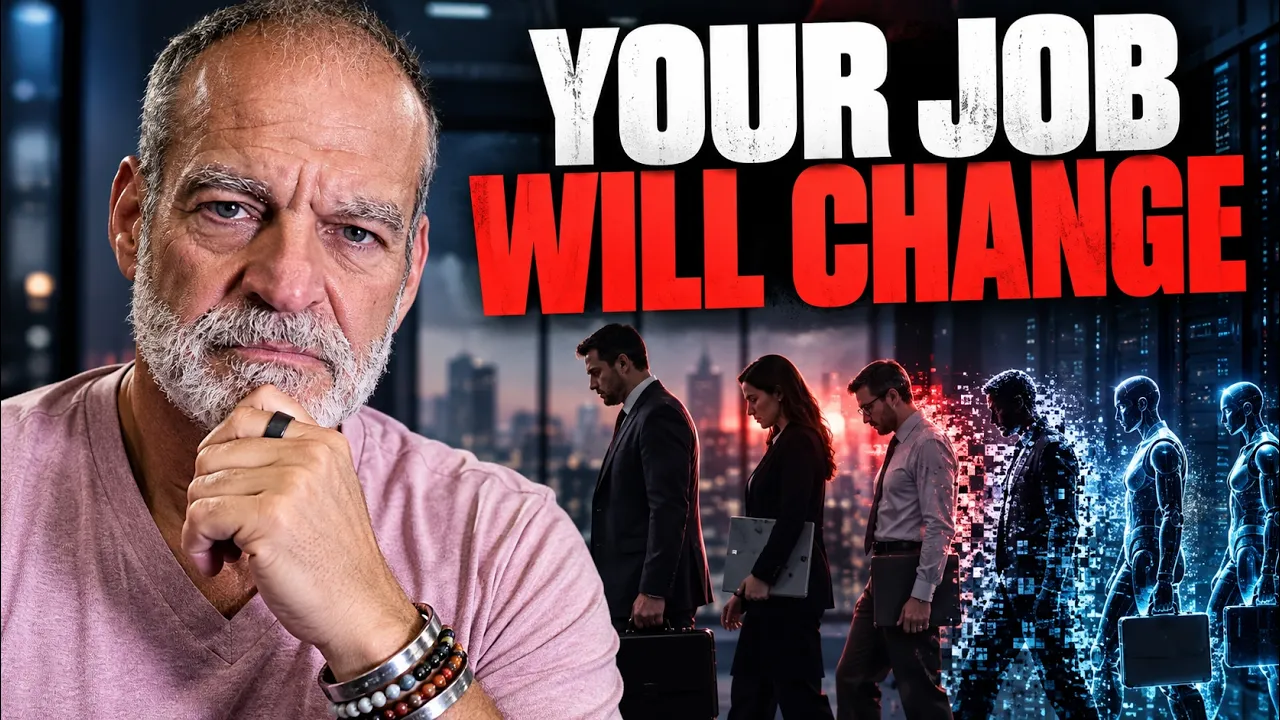
Pete Sacco · @PeteSacco
Words
1,502
Runtime
9:23
Speaking pace
160wpm
Reading time
6min
160 words per minute, between the 160 25th percentile and the 181 median of 349 measured videos. That distribution comes from the 349-video hook study.
Opening (first 30 seconds)
Half of all American jobs get rewritten in the next 24 to 36 months. That's not a prediction from a podcast. [music] That's Boston Consulting Group's microeconomic model published this past April. 50 to 55% of US jobs fundamentally reshaped. And I want to be straight with you about that number because most people won't be. BCG also says only 10 to 15% of jobs get eliminated and that's over a 5-year window. Reshaped is not erased but reshaped is
80 words, the words spoken in the first 30 seconds at 160 words per minute.
Free, no signup. See how the first 30 seconds hold attention, with rewrites.
Sentence shape
| Measure | This transcript |
|---|---|
| Sentences | 139 |
| Average words per sentence | 10.8 |
| Longest sentence | 30 words |
| Questions asked | 9 |
| Sentences containing a number | 17 |
Most used terms
Filler phrases
8 in total: actually 8.
A literal whole-word count of the same phrase list the Prepublish browser extension uses, so a phrase inside another word is not counted and a phrase used in its ordinary sense still is. It is a count and not a judgement.
What this transcript is
Every word below is the caption track YouTube publishes for this video, pulled from the video itself and reproduced unchanged. It is not Prepublish's writing, not a summary, and not a re-transcription: it is the video's own published captions. English captions, generated automatically by YouTube, in the video’s original language. Source: the video on YouTube. A channel that would rather this page did not exist can ask for its removal through the contact page, and it is removed.
No Script X-ray for this video: YouTube shows a Most replayed graph only once a video has enough views.
Half of all American jobs get rewritten in the next 24 to 36 months. That's not a prediction from a podcast. [music] That's Boston Consulting Group's microeconomic model published this past April. 50 to 55% of US jobs fundamentally reshaped. And I want to be straight with you about that number because most people won't be. BCG also says only 10 to 15% of jobs get eliminated and that's over a 5-year window. Reshaped is not erased but reshaped is not nothing either.
Reshaped means the thing you were hired to do isn't the thing you're going to be paid to do. I've spent 30 years building data centers, the physical buildings where these AI agents actually live. Power, cooling, racks of servers, the megawatts. I'm in the room where this capacity gets allocated 18 months before you ever even see a product announcement. So, I'm going to tell you something the headlines are getting wrong in both directions.
They're overstating how fast this arrives and they're badly understating what it does to you when it does. There's a gap between what you're reading about AI agents and what's actually happening and it's not just an organizational gap, it's a physical one. I want to show you both. For 2 years, we've repeated the same comforting line, AI won't take your job, a person using AI will take your job. That line is expiring not because AI got smarter, because the architecture has changed.
An assistant needs a pilot. You ask it to write the email, it writes the email. You read it, you send it. Every loop runs through a human. An agent gets a goal, find 50 prospects, research their last quarter, write each one personally, send. If they reply, book it on my calendar. Nobody's piloting that. Somebody is managing the outcome and that's a genuinely different job, not a harder version of your old job, a different one.
That's the technology. When we get to the hats, I'll tell you why I don't think this is an AI story at all. Microsoft surveyed 20,000 workers across 10 countries this past spring. 65% said they're afraid of falling behind if they don't adapt to AI right now. 19% are in what Microsoft calls the frontier, where individual capability and organizational readiness are already both high. Read those two numbers next to each other.
The people are ready, the buildings they work in are not. If this is useful, then please subscribe. We break down AI, infrastructure, and business every week from somebody who's actually pouring the concrete. That's the gap everybody's writing about. Here's the one almost nobody is. Every one of those autonomous agents is a physical event. It's electricity moving through a chip in a building on a grid cooled by water or refrigerant connected by fiber somebody had to put in a trench.
An agent that runs all night doesn't run in the cloud. It runs in a room. I can drive you to one. And here's what I see from inside that room. The software is ready to scale, but the grid is not. So, when someone tells you every knowledge worker gets a fleet of 50 autonomous agents by Christmas, ask them where the power for that is coming from. Which is why I think the timeline is slower than the panic. And also why I think the outcome is more certain than the skeptics believe.
Because that constraint is exactly what tells you this is real. Nobody spends a decade fighting a utility over a substation for a fad. So, you've got more time than the headlines say. The question is, what do you do with it? Everybody reaches for the tractor. The tractor didn't eliminate the farmer, it eliminated the farmers pulling the plow. True, but that's where the analogy usually stops, and the useful half is actually what comes next.
The farmer who thrived after mechanizations weren't the ones who drove the tractors the best. Driving got commoditized in about a decade. The ones who thrived were the ones who knew what was worth planting. Which crop, which market, which land, which year to hold. Execution got cheap, judgement got expensive. That's the whole story. It happened in 1930, and guess what? It's happening right now. Here's the frame I've been building for years, and I think it's the one that survives the next decade.
Two technologies are arriving at the same time, and we're only paying attention to one of them. The first is artificial intelligence. That's optimization technology. It answers how we do this faster, cheaper, better. It's extraordinary at that, and it's going to keep getting better at it, and you won't beat it. So, don't try. The second technology is human consciousness. That's discernment technology. It answers the question optimization cannot touch.
Should we be doing this at all? Optimization without discernment doesn't save you. It just gets you to the wrong place faster. So, when people ask me what the highest paid skill of the next 5 years is, everyone expects me to say prompt engineering or AI delegation or agent orchestration. Those are real. Learn them, but be honest about what they are. They're bridge skills. They're valuable precisely as long as the gap exists, and that gap is closing.
Prompt engineering had about a 30-month career. The thing that doesn't get automated is the thing that decides what the automation is for, and that has an uncomfortable implication, which I'll get to in the last hat. Okay, so let's put on the hats. The AI hat. Most companies are going to use agents to shrink. That's the failure mode. If agents can surface 10,000 qualified leads, you don't cut your sales team, you point them at 10,000 leads.
The companies that use this to reduce payroll are going to get eaten by the companies that use it to multiply output. Same tool, opposite outcomes. The tool isn't deciding which one you get. The infrastructure hat. There's a loud argument right now that this is a bubble, and I want to be careful here because there are two different claims hiding in that word. Are some balance sheets fragile? Absolutely. Some of these companies are financing 10-year assets with 2-year money, and that ends how it always ends.
But the asset itself is not fictional. Fiber in 2001 was overbuilt and mispriced, and every single strand of it got used. Concrete, copper, and megawatts don't evaporate when the equity does. The mystic hat. What happens to a human being when execution becomes nearly free? We're moving from an economy of labor to an economy of discernment. Your value stops being how well you execute and becomes knowing what's actually worth executing.
And that's not a career question. That's an interior one. Discernment isn't a technique you download. It comes from presence, from attention, from actually knowing what you want your life to be for, which means the real question of this decade isn't will AI free us? It will. It's freed for what? Most people have never had to answer that. We're about to find out who has. The human hat. And this is the honest one. This isn't an AI crisis.
It's a leadership crisis. You can't hand somebody a tractor when they've only ever driven a horse. Change nothing about the field, the schedule, or the training, and then blame them for the harvest. And here's the part I don't think anyone wants to say out loud. This technology doesn't change the distribution of human agency. It actually amplifies it. There's always been a small group that builds, a smaller group that burns, and most of us somewhere in the middle.
AI hands all three of them the same exact leverage. I'm still optimistic, and not naively. The builders have always outnumbered the burners. That's not a hope, that's the historical record. But amplification is not a lottery. It goes to the people who decide what they were building before they got the tools. The lie was that AI wouldn't replace you. The truth is, it will replace the machine inside of you. The part that was already running on autopilot.
The part that never needed your humanity in the first place. I don't think that's a loss. I think that's an invitation, but only if you pick up the other half. So, two questions in the comments, and I want both. One, what's the task you'd hand to an autonomous agent tomorrow without even blinking? And second, and this is the one I actually care about. What would you do with the hours it gives you back? That second answer is your discernment technology.
If it's hard to answer, that's worth knowing now, while you still have time to work on it. I read every one of these, and if you want me to go deeper, there's more of this on this channel. I'm Pete Sacco, and I'll see you next time.
The words are the caption track's own and nothing is reworded or re-transcribed. Paragraph breaks are placed between sentences so the text reads as prose.
Free tools for your own script. No signup, no login.
Paste your draft and see where viewers are likely to drop off, with a rewrite for each weak line.
Paste the first 30 seconds of your own draft for a hook score and rewrites.
Check your draft against YouTube's advertiser-friendly guidelines before you record it.
Read this channel's public videos and transcripts, and download a writing brief for it.