Getting the transcript
Reading the captions from YouTube. A video nobody has opened here before takes 10 to 30 seconds; this page fills in on its own.
Getting the transcript
Reading the captions from YouTube. A video nobody has opened here before takes 10 to 30 seconds; this page fills in on its own.
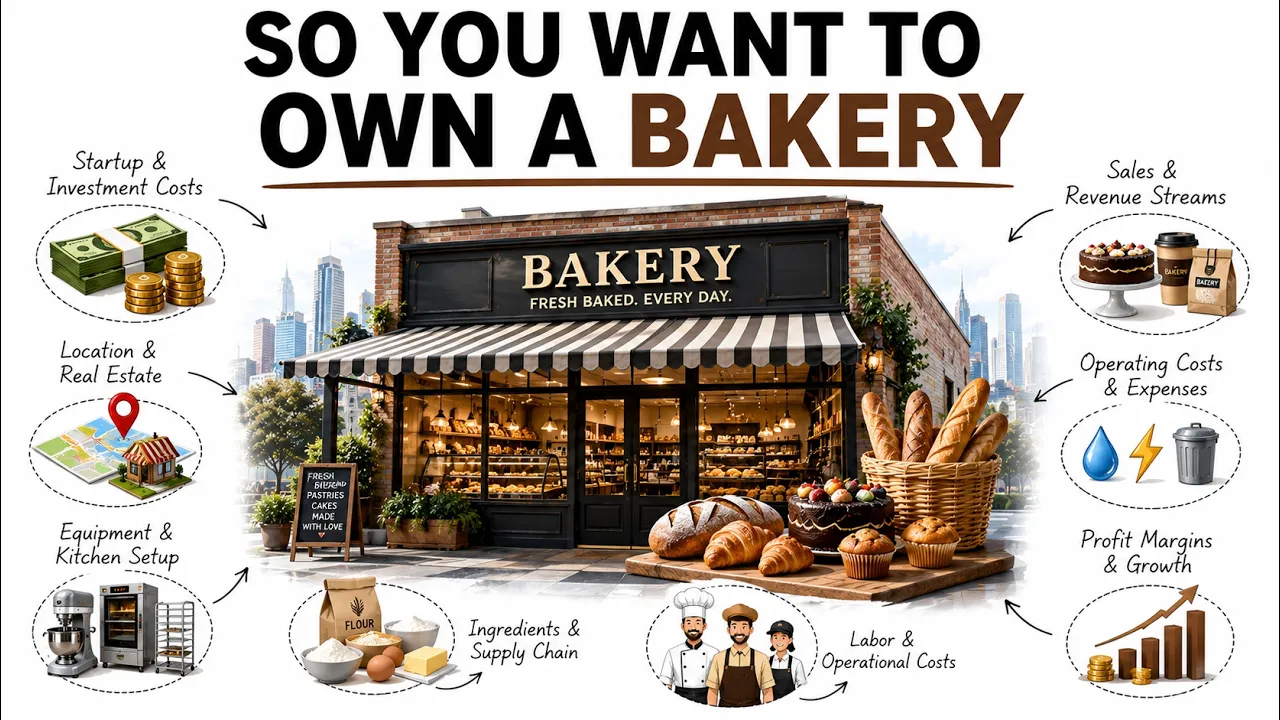
Mr. Finance · @misterfinanceyt
This video has no Most replayed graph yet: YouTube shows one only once a video has enough views. These are the moments viewers replayed most in Mr. Finance's most watched videos.
Most replayed moment at 11:12
4.0x that video's typical replay level
the ambient conditions you've engineered. And the evidence is in how they behave. They will spend 45 minutes choosing a coffee at home, drive 15 minutes to your store, pay $5.50 for a drink they could have made for 60, and
Said at 11:06
The graph counts replays. It does not show where viewers stopped watching.
Words
4,464
Runtime
23:43
Speaking pace
188wpm
Reading time
19min
188 words per minute, between the 181 median and the 201 75th percentile of 349 measured videos. That distribution comes from the 349-video hook study.
Opening (first 30 seconds)
Okay, so you want to own a bakery. You find a space, you buy a few ovens, you bake some bread, people walk in, hand you money, and you go home happy. That is the dream, and from the outside it looks believable. You walk past a bakery on a Tuesday morning, and the line is out the door. The display cases are stacked full of croissants and sourdough and little cakes with icing on top. The place smells incredible. The register is ringing every 30 seconds. This, you think, is a business that
94 words, the words spoken in the first 30 seconds at 188 words per minute.
Free, no signup. See how the first 30 seconds hold attention, with rewrites.
What this transcript is
Every word below is the caption track YouTube publishes for this video, pulled from the video itself and reproduced unchanged. It is not Prepublish's writing, not a summary, and not a re-transcription: it is the video's own published captions. English captions, generated automatically by YouTube, in the video’s original language. Source: the video on YouTube. A channel that would rather this page did not exist can ask for its removal through the contact page, and it is removed.
Okay, so you want to own a bakery. You find a space, you buy a few ovens, you bake some bread, people walk in, hand you money, and you go home happy. That is the dream, and from the outside it looks believable. You walk past a bakery on a Tuesday morning, and the line is out the door. The display cases are stacked full of croissants and sourdough and little cakes with icing on top. The place smells incredible. The register is ringing every 30 seconds.
This, you think, is a business that is clearly working. Here is the thing nobody tells you before you sign the lease. A bakery can have a line out the door every morning, sell hundreds of items a day, take in thousands of dollars before noon, and still leave the owner with almost nothing at the end of the month, sometimes less than nothing. And the reason for that is not bad luck. It is not the economy. It is the specific structural way that bakery economics actually work underneath all that steam and flour and golden pastry.
So, let us start from the very beginning, because this only makes sense if you follow the money from the moment it enters the register. When a customer buys a $4.50 croissant, that money does not belong to you in any meaningful sense yet. What you have received is gross revenue, and gross revenue is not the same thing as profit. Gross revenue is just the number on the top line. Everything that follows is subtraction.
The entire game of running a bakery is figuring out how much of that 450 you actually get keep after every single cost has taken its piece. And when you start counting those costs, the number that remains at the end is almost always much smaller than you expected. Think about one bakery, a real kind of bakery, the type you would find in any mid-sized American or British city. A place doing around $1,500 in daily sales.
That sounds like good money. Over a 30-day month, that is $45,000 coming in through the door. Most people hear that number and think the owner must be doing well. But, let us follow where that $45,000 actually goes. The first thing that comes out is the cost of making the food itself, the flour, the butter, the eggs, the yeast, the sugar, the chocolate, the cream. All the raw ingredients that go into every single item in that display case.
For a typical bakery, this lands somewhere between 25% of total revenue. On our $45,000, that is roughly $13,000 a month just to buy the raw materials before a single item is baked. Now, here is where most people get the math wrong. They assume that if ingredients cost about 30%, then 70% is profit. That is not how this works at all because are just the first subtraction and they are not even the largest one. The largest cost in a bakery is labor.
Every single item in that display case required a human being to make it. Usually multiple human beings. You have bakers who come in at 3:00 or 4:00 in the morning to start mixing dough before the shop opens. You have staff who shape the bread, who laminate the pastry dough, who glaze the croissants. You have people behind the counter taking orders, making coffee, wrapping things in paper bags. You have someone cleaning up at the end of the day.
All of that labor in a well-run bakery will typically consume another 30 to 35% of your revenue. On our $45,000 month, that is another $14,000 going out the door in bill. So, after just ingredients and labor, roughly 64% of the revenue is already gone. You are left with about $16,000 to cover everything else. And there is a great deal of everything else. Rent comes next. And this is where location starts doing something very specific to bakery economics.
A bakery needs to be somewhere people will walk past it. A bakery on a quiet street in a cheap part of town may have affordable rent, but it will not have the foot traffic to generate enough daily sales to survive. A bakery in a good location, somewhere busy, somewhere visible, somewhere that gets the morning commuter traffic it needs, will pay significantly more for that privilege. Rent on a decent bakery space in a city like New York or London or Chicago, can run anywhere from $4,000 to $9,000 a month, depending on size and location.
On our $45,000 baseline, even a modest rent of $4,500 is already taking another 10% of your revenue. Then come the utilities. A commercial bakery is essentially a small manufacturing plant. The ovens are industrial. They run for 8 to 12 hours a day. Commercial deck ovens draw enormous amounts of electrical power. You also have refrigeration running around the clock to keep your dough cold and your dairy products safe.
You have ventilation systems required by health codes. You have hot water for washing equipment. Monthly utility costs in a commercial bakery can easily run between $1,200 and $2,500. On our model, call it 2,400 a month. Then there are the costs that most people never think about until they are already inside the business. Credit card processing fees. Every time a customer taps their card or uses their phone to pay, a percentage of that transaction go to the card network and the payment processor.
It is typically somewhere between 2 and 3% of the transaction value, plus a small flat fee per swipe. On thousands of small transactions, this adds up to a meaningful number. For a bakery doing 45,000 a month, where most customers pay by card, you might lose another $2,000 a month to processing fees alone. Add in packaging. Grease-proof bags, paper boxes for cakes, tissue paper, labels, stickers. None of it is expensive per piece, but when you are packaging hundreds of items every day, it accumulates.
Another few hundred to over a thousand dollars a month, depending on what you sell and how you present it. Add in equipment maintenance. Your commercial oven is not a domestic appliance you replace when it breaks. It is a piece of capital equipment worth $20,000 that needs to be maintained, serviced, and eventually replaced. Bakers build a maintenance reserve into their costs. If a $30,000 oven lasts 8 years, that is $300 a month just in depreciation, before you pay for any actual repairs.
After all of this, the $45,000 in monthly revenue that looked so promising at the start has been reduced to somewhere around 3,000 to 4,000 dollars in actual operating profit. That is a net margin of roughly 8 to 9%. On a good month with good management and tight cost control. And that is before anything goes wrong. This is the number that gets bakery owners, not the cost of flour, not the price of butter. The sheer volume of costs stacked on top of each other, each one individually manageable, but collectively consuming almost everything the register takes in.
Now let us go even deeper because there is one cost that behaves completely differently from everything else we have talked about. And it is one of the strangest parts of bakery economics. Bread goes stale, pastries go soft, cakes dry out. Every item in a bakery display case has a very short window during which it can be sold at full price. Once that window closes, the item either gets discounted, given to staff, donated, or thrown away.
And every single one of those outcomes represents money that was spent on ingredients and labor and electricity that will never come back. Think about what this means in practice. A bakery bakes in batches. You cannot bake one croissant. You bake 20 or 40 or 80 at a time because that is how commercial ovens work. You are making a bet every single morning that the number of croissants you bake is going to be close to the number of croissants you sell.
If you bake 80 and sell 60, 20 croissants go in the bin. Not just the ingredient cost, the labor cost, the energy cost, the packaging cost. All of it gone. If a batch of 200 brioche buns cost $1.80 each to produce in fully loaded costs, and you throw away 40 of them at the end of the day, that is $72 in direct losses from one batch on one day. Across a week, this kind of waste can quietly destroy margins that were already thin to begin with.
The cruel irony is that if you try to solve the waste problem by baking less, you run the risk of selling out too early and turning customers away. And in a business built entirely on daily repeat visits, turning customers away is not just one lost sale. It is a pattern of disappointment that eventually sends them somewhere else permanently. If you are finding this useful, please take a second to subscribe to the channel and like the video.
It genuinely helps this kind of content reach more people, and there is a lot more of this to come. This brings us to something that most people never expect when they think about bakery economics. Selling more does not always mean making more money. In fact, under certain conditions, selling more can actually hurt you. Every bakery has a physical capacity. The oven has a fixed surface area. There are only so many trays that fit inside at one time.
The proofer, which is the cabinet where dough rises before baking, only holds so much. The counter staff can only process so many customers per hour before the line backs up and people leave. When customer demand exceeds what the bakery can comfortably handle, things start to go wrong. Dough that has to wait because the oven is already full will over proof, which means it rises too much and then collapses. You get loaves that look wrong and cannot be sold.
That is direct waste. Staff who are pushed beyond their normal shift length trigger overtime pay, which in the United States and United Kingdom is legally required at 1 and 1/2 times the normal hourly rate. So, the marginal cost of the extra units you are selling rises sharply, and the profit margin on those extra sales can actually be worse than the profit margin on your normal volume. You can be busier than ever and less profitable than you were when it was quieter.
This is not a theoretical problem. It is something that catches bakery owners off guard constantly, especially in the early months after a positive write-up or a social media post goes viral and suddenly demand doubles overnight. Now, let us talk about timing because the rhythm of a bakery's day is completely unlike almost any other business. The vast majority of a bakery's daily revenue comes in a very narrow window.
Roughly 65 to 80% of daily sales happen between 7:00 in the morning and 10:00 in the morning. That 3-hour stretch is when the commuters are moving, when people want their morning coffee and pastry, when the bread is fresh, and the display case is at its most impressive. For those 3 hours, a good bakery is running at full speed. Then 10:00 arrives. Traffic drops, sometimes dramatically. The afternoon is quiet, the evening is quieter still.
But here is the problem. Rent does not pause between 10:00 and 5:00. The ovens, refrigeration, and utilities keep drawing power. Staff who are scheduled until closing time still need to be paid whether they are serving 100 customers an hour or five. All of the fixed costs of the business continue accumulating throughout the entire operating day, while revenue concentrates in a tiny fraction of it. This is why smart bakeries do not simply wait for the next morning rush.
They introduce afternoon products, lunch items, sandwiches, quiches, salads, savory pastries that give afternoon customers a reason to come in. They use the quiet hours in the kitchen to batch produce items for the next day or for wholesale orders. They extend their revenue window precisely because their cost window never closes. And this is the moment to talk about coffee because coffee changes the economics of a bakery more than almost anything else.
A customer walks in for a loaf of sourdough at $9. That is one transaction. Now add a flat white. In a city like London or New York, that is another 450 to 550. The total transaction is now $14 instead of nine. But here is the important part. The cost of making that coffee is almost nothing compared to the cost of baking the bread. Coffee beans, milk, a paper cup. The raw input cost of a specialty latte might be 55 cents.
The retail price is 550. That is a gross margin of 90% on the coffee alone. Compare that to the sourdough loaf, which has a gross margin of around 85% but took hours of labor to produce. The coffee is faster to make, requires almost no kitchen footprint, and generates an extraordinary return per transaction. This is why you will notice that almost every serious bakery in America and Britain now operates a coffee program alongside their baking.
It is not a sideline. It is a core part of the economics. Adding that $5 beverage to a pastry sale can increase the value of a transaction by over 100% while adding almost no additional cost to the business. The product mix matters enormously in a bakery, which is something the display case never reveals to the customer, but the owner thinks about constantly. Not every product in the case earns the same return. Some items are there because customers expect them.
A baguette, a plain croissant, a basic white loaf. These items may have fine ingredient costs, but they require skilled labor, they have high waste rates if unsold, and they tend to be low priced because customers have strong price expectations for them. Other items are there because they generate excellent returns. A specialty cake, a signature pastry that nobody else in the area makes, a seasonal item that commands a premium price.
The bakery is not simply selling food. It is managing a portfolio of products with wildly different economic profiles, and the decisions about what gets prime display space, what gets promoted, and what gets quietly retired have real consequences for the bottom line. There is also a concept called a loss leader, and it creates a specific trap worth understanding. A loss leader is a product priced very low on purpose.
A $2.50 baguette, a $1.50 plain roll. The idea is that this cheap item brings customers through the door, and once inside they buy higher margin things. A coffee, a cake, a specialty pastry. If that is what actually happens, the strategy works. The low margin item pays for itself through the sales it drags along with it, but when a significant portion of customers buy only the cheap item and leave, you are running a busy operation that generates almost no profit.
High volume, low return, maximum labor. Tracking whether your best-selling low margin product actually drives additional purchases or simply generates foot traffic that walks straight back out is one of the most valuable things a bakery owner can do. Now let us talk about custom cakes because they operate under a completely different set of economic rules. A custom celebration cake is not really a bakery product in the conventional sense.
It is a skilled craft commission. When a customer orders a three-tier birthday cake with hand-piped decorations and a custom design, they are not primarily paying for butter and eggs. They are paying for the decorator's skill, for the hours of labor involved, for the design consultation, for the structural engineering that keeps a three-tier cake from collapsing, and for the emotional significance of a product that is being created specifically for one moment in one person's life.
Many bakery owners, especially those who are new to the business, price custom cakes using a simple formula. They calculate the ingredient cost and multiply it by three. If the ingredients cost $22, the cake sells for $66. This sounds logical. It is also wrong, and it routinely produces losses. A three-tier custom cake with hand-piped flowers and a custom inscription might use $22 in ingredients, but it also requires 5 and 1/2 hours of a skilled decorator's time at a real wage of around $30 per hour.
That is $165 in labor alone. Add kitchen overhead, the energy used, the specialist supplies, and the correct price for that cake, if the business wants to actually retain a profit, is somewhere north of $300. The ingredient * 3 formula would have priced it at $66. The difference between those two numbers is the difference between building a viable custom cake business and slowly hemorrhaging money on every order. Value-based pricing means charging what the skill, time, and emotional significance of the product is actually worth.
And customers buying a custom wedding cake or a milestone birthday cake are generally willing to pay for it because they understand they are buying something irreplaceable. The bakeries that understand this price accordingly. The ones that do not are doing the most demanding work in the shop for the worst returns. There is also a category of hidden costs that only becomes visible once you are already running the business, and these costs tend to surprise people who thought they had planned their finances carefully.
Third-party delivery platforms. If a bakery offers delivery through services like DoorDash or Uber Eats or Deliveroo in the United Kingdom, those platforms charge commission rates between 15 and 30% of every order value. On a $20 order, the platform might take five or six dollars before a single ingredient cost or labor cost is considered. Many bakeries that rush to offer delivery without adjusting their online prices discover they are effectively paying customers to order from them rather than generating any profit at all.
Payment processing on small transactions is also more expensive than most people realize. When someone pays by card for a $4.50 croissant, the processing fee is typically around 10 cents plus 2.8% of the transaction. That works out to about 23 cents on a $4.50 purchase. That is over 5% of the transaction value going to the card network. Across thousands of small transactions per day, this cost becomes significant and is completely invisible to the customer.
So, after working through all of this, what does the realistic financial picture of a bakery actually look like? Let us use what accountants call the break-even point. This is the daily sales level the bakery needs to reach before it starts making any profit at all. Every dollar of sales before this point is simply paying fixed costs. Every dollar after this point is where the actual earnings begin. For our model bakery with $45,000 in monthly revenue and roughly $14,000 in fixed monthly overhead including rent, core payroll, insurance, and utilities, operating with a contribution margin of around 42%, the monthly break-even threshold works out to just over $33,000.
That is about $1,100 in daily sales the bakery needs before a single dollar of profit is generated. On a typical operating day, the bakery needs to clear roughly the first 74% of its sales volume just to cover what it owes. Only the last quarter of the day's sales is generating actual margin. This is why small bakeries are so fragile. A bad week of weather, a street closure that blocks foot traffic for 3 days, a piece of equipment that breaks down and needs emergency repair.
Any of these events can push daily sales below the break-even threshold and turn a marginally profitable week into a loss. The fixed costs never stop even when the register slows down. And now we arrive at the part of bakery economics that is almost never discussed publicly because it is uncomfortable. It involves the owner. There is a zone that many small bakery owners fall into and never escape. The business is busy enough to consume their entire life but not profitable enough to justify what they are sacrificing.
The owner wakes up at 4:00 in the morning to start baking. They serve behind the counter during the rush. They handle supplier calls in the afternoon, bookkeeping in the evening, social media whenever there is a spare minute. They clean the kitchen when staff go home. 70, sometimes 80 hours a week. And at the end of the year, the business shows a profit on paper. Maybe $40,000, maybe $60,000. But here is the question that matters.
What would it cost to replace that owner with paid staff doing the same jobs? A head baker, a manager, a bookkeeper, a social media coordinator. When you add up the market wages for all the roles the owner is filling personally, the number is often higher than the profit the business generates, which means the business is not actually profitable. It is simply paying the owner below market rate for their labor and calling the difference profit.
This is the owner-operator trap, and it is the single most important concept in understanding whether a bakery is genuinely a good business or simply a very demanding job with unusually high costs of entry. The way out is not necessarily size. It is systems. Standardized recipes any trained baker can execute, documented processes for every part of the operation. A team that does not need the owner present for things to run.
When a bakery reaches this point, the economics shift. The owner's time moves away from production and toward decisions that actually grow the business. Pricing strategy, new products, wholesale relationships, additional locations. Some bakeries make this transition by centralizing production in a cheaper industrial facility that bakes at scale and feeds multiple small retail kiosks in high-traffic locations. The production unit pays 12 to 18 dollars per square foot in an industrial zone rather than 80 or more in a city center.
The kiosks carry almost no equipment overhead. It trades romance for much cleaner economics. Others go into wholesale, supplying restaurants, hotels, corporate canteens, and grocery stores with daily orders. Wholesale accounts pay less per unit, typically 40 to 60% below retail price, but they offer something retail never can, predictable volume. When you know you are baking 500 loaves for a hotel contract every morning, you can plan your staffing, and energy use precisely.
Wholesale trades margin for certainty, and for many bakeries, certainty is worth more. And beneath all of this economic machinery, there is one asset that almost no bakery balance sheet ever puts a number on, but which is arguably the most valuable thing the business owns. It's regular customers. A customer who buys a coffee and a pastry three times a week, 50 weeks a year, for three years, has spent over $4,000 in that bakery.
That is the economic value of one regular. A bakery with 200 regulars at that frequency has close to a million dollars in lifetime customer value walking through its doors. The marketing cost to retain those people is essentially nothing compared to the cost of finding new ones. This is why consistency matters more than novelty in a bakery. The sourdough needs to taste the same every week. The croissant needs the same layers, the same color, the same weight every time.
Because the economics depend not on how impressive the opening week was, but on how many people made it a habit. Before you go, if you are looking to sharpen your understanding of how businesses actually work from the inside, there is a detailed business guide linked in the description below and pinned in the first comment. It covers the fundamentals that most people learn the hard way. The bakeries that build genuine brands know this intuitively.
A bakery with a strong identity, one known for a specific thing, a particular bread style, a commitment to local ingredients, can charge more than a generic bakery on the same street. Not because the ingredients are different, but because the customer is buying something that feels distinct. A 30 to 50% price premium over a commodity competitor is achievable for a well-differentiated bakery. That premium does not just add to revenue.
It changes the entire profitability structure of the business. So, what does it actually take for a bakery to be profitable? Not surviving, not breaking even, but genuinely generating a return worth the investment and the labor? It takes prime cost control, which means keeping the combined total of ingredients and labor below 65% of total revenue. It takes a high beverage attachment rate, meaning the majority of food transactions also include a drink.
It takes waste management, which means producing as close to what you will actually sell each day as possible through demand tracking and smart batch sizing. It takes real estate efficiency, which means understanding exactly how much revenue every square foot of your space needs to generate. It takes pricing discipline on custom work, which means never undervaluing labor. And it takes repeat customers because the unit economics of a bakery simply do not work if you are spending heavily to constantly acquire new ones.
None of these things is complicated in isolation. All of them together, managed simultaneously, consistently, day after day, that is the actual job of running a bakery. It is much harder than it looks from the customer side of the display case. The next time you walk into a bakery and see that line out the door and that beautiful display case full of pastries and that register ringing every 30 seconds, try a different question.
Not just what does this croissant cost? Ask how much of that price is still in the owner's pocket after the flour, the butter, the wages, the rent, the utilities, the card fees, the packaging, the waste, the equipment, and everything else have taken their share. The answer, more often than not, will surprise you. And it will tell you something true, not just about bakeries, but about every business that looks profitable from the outside and reveals its real economics only to the people on the inside.
If you found value in this video, please like it and subscribe to the channel if you have not already. It means a great deal, and it helps this work reach people who will genuinely find it useful.
The words are the caption track's own and nothing is reworded or re-transcribed. Paragraph breaks are placed between sentences so the text reads as prose.
Free tools for your own script. No signup, no login.
Paste your draft and see where viewers are likely to drop off, with a rewrite for each weak line.
Paste the first 30 seconds of your own draft for a hook score and rewrites.
Check your draft against YouTube's advertiser-friendly guidelines before you record it.
Read this channel's public videos and transcripts, and download a writing brief for it.
Sentence shape
| Measure | This transcript |
|---|---|
| Sentences | 284 |
| Average words per sentence | 15.7 |
| Longest sentence | 48 words |
| Questions asked | 5 |
| Sentences containing a number | 69 |
Most used terms
Filler phrases
26 in total: actually 15 · like 7 · kind of 3 · you know 1.
A literal whole-word count of the same phrase list the Prepublish browser extension uses, so a phrase inside another word is not counted and a phrase used in its ordinary sense still is. It is a count and not a judgement.